Dax Index: Will Hawkish Fed Stances Impact the DAX Market’s Thursday Mood?

Dax Index: Will Hawkish Fed Stances Impact the DAX Market’s Thursday Mood?

DAX Wednesday Overview

On Wednesday, the DAX gained 0.75%. Partially reversing a 0.40% fall from Tuesday, the DAX ended the day at 15,782.

People’s Bank of China Shows Signs of Confidence

On Wednesday, the People’s Bank of China (PBoC) demonstrated confidence, leaving loan prime rates unchanged. Economists expected the PBoC to stand pat following more upbeat economic indicators from China last Friday.

Trading Derivatives carries a high level of risk to your capital and you should only trade with money you can afford to lose. Trading Derivatives may not be suitable for all investors, so please ensure that you fully understand the risks involved, and seek independent advice if necessary. A Product Disclosure Statement (PDS) can be obtained either from this website or on request from our offices and should be considered before entering into a transaction with us. Raw Spread accounts offer spreads from 0.0 pips with a commission charge of USD $3.50 per 100k traded. Standard account offer spreads from 1 pips with no additional commission charges. Spreads on CFD indices start at 0.4 points. The information on this site is not directed at residents in any country or jurisdiction where such distribution or use would be contrary to local law or regulation.

German Producer Prices Offer Pre-Fed Comfort

The European equity markets turned from panic mode to calm and reflection. German producer prices drove early buyer appetite on Wednesday. German producer prices increased by 0.3% in August versus a 1.1% slide in July. Economists forecast a 0.2% rise.

An upward trend in producer prices reflects an improving demand environment, allowing producers to increase contract prices.

A pullback in Government bond yields offered relief to riskier assets ahead of the Fed interest rate decision.

The Wednesday Market Movers

The risk-on sentiment provided support to several sectors. Auto stocks were among the front-runners.

Porsche rallied 2.78%, with BMW and Mercedes Benz Group seeing gains of 2.64% and 2.05%, respectively. Volkswagen rose by 1.90%, while Continental ended the day up by 0.09%.

A bounce back in German car registrations likely contributed to the session gains. German car registrations surged by 12.4% in August, reversing a 13.2% slump from July.

Bank stocks were also on the move. Commerzbank and Deutsche Bank saw gains of 1.59% and 0.97%, respectively. Commerzbank CFO projected net interest of €8 billion this year on higher interest rates, signaling a positive earnings outlook.

US Federal Reserve to Send the DAX South

Investors will respond to the overnight Fed interest rate decision, economic projections, and press conference. Fed Chair Powell addressed the markets, indicating that the future rate path hinges on the economic indicators. However, the FOMC economic projections were hawkish, with 10 out of 19 FOMC members seeing rates holding above 5% throughout 2024.

US equities tumbled in response to a hawkish Fed-fueled jump in Treasury yields. The Dow fell by 0.22%, with the S&P 500 and NASDAQ Composite Index ending the day down 0.94% and 1.53%, respectively.

The futures markets point to a bearish Thursday session, with the DAX down 154 points.

Later today, US jobless claims need consideration. Tight labor market conditions would support the more hawkish Fed interest rate path. However, Philly Fed Manufacturing Index numbers will also move the dial. Investors will look for reasons for the Fed to deviate from the new interest rate path.

Beyond the numbers, investors should consider ECB Executive Board member speeches. Executive Board member Isabel Schnabel and ECB President Christine Lagarde are on the calendar to speak today. Hawkish central bank chatter could spook the markets as investors digest the latest from the Fed.

Short-Term Forecast

Downside risks linger for the DAX, with the Fed in a more hawkish mood and the ECB concerned with inflation. However, improving macroeconomic conditions across the euro area would cushion the downside.

DAX Technical Indicators

Daily Chart

The DAX remained below the 50-day EMA while holding above the 200-day EMA, sending bearish near-term but bullish longer-term price signals.

A break above the trend line would support a DAX move to the 50-day EMA. Dovish ECB member commentary and a spike in US jobless claims would give the bulls a run at 16,000.

However, failure to break above the trend line would leave the 15,663 support level in play. Better-than-expected US economic indicators and a hawkish ECB President would support a break below the 15,663 support level.

The 14-Daily RSI reading of 49.38 indicates a DAX break below the 15,663 support level to sub-15,500 before entering oversold territory.

DAX Daily Chart sends bearish near-term price signals.
DAX 210923 Daily Chart

4-Hourly Chart

The DAX sits above the 50-day EMA while below the 200-day EMA, sending bullish near-term but bearish longer-term price signals. A DAX break above the trend line would support a DAX move to the 200-day EMA.

However, a break below the 50-day EMA would give the bears a run at the 15,663 support level.

A break below the 15,663 support level would support a DAX return to 15,500 and target 15,459 support level.

The 51.86 RSI reading supports a DAX break above the trend line before entering overbought territory.

4-Hourly Chart sends mixed price signals.
DAX 210923 4-Hourly Chart
EUR/USD Forecast: A Delicate Balance Between ECB Sentiments and US Job Claims

EUR/USD Forecast: A Delicate Balance Between ECB Sentiments and US Job Claims

Wednesday Overview

On Wednesday, the EUR/USD fell by 0.18%. Following a 0.12% loss on Tuesday, the EUR/USD ended the day at $1.06605. The EUR/USD rose to a high of $1.07368 before falling to a low of $1.06500.

French Business Confidence and ECB President Lagarde in Focus

The French economy will be in focus this morning. French business confidence will draw investor interest. The markets must assess the impact of ECB monetary policy moves on business sentiment.

Trading Derivatives carries a high level of risk to your capital and you should only trade with money you can afford to lose. Trading Derivatives may not be suitable for all investors, so please ensure that you fully understand the risks involved, and seek independent advice if necessary. A Product Disclosure Statement (PDS) can be obtained either from this website or on request from our offices and should be considered before entering into a transaction with us. Raw Spread accounts offer spreads from 0.0 pips with a commission charge of USD $3.50 per 100k traded. Standard account offer spreads from 1 pips with no additional commission charges. Spreads on CFD indices start at 0.4 points. The information on this site is not directed at residents in any country or jurisdiction where such distribution or use would be contrary to local law or regulation.

Economists forecast the Business Confidence Index to climb from 96 to 97. A more marked increase in confidence would ease concerns over business investment and hiring. Plans to increase hiring would support the French economy.

French private consumption accounts for over 50% of GDP. Improving labor market conditions would fuel wage growth and consumer spending. However, a more upbeat labor market outlook would also support demand-driven inflation.

Late in the session, ECB President Lagarde and ECB Executive Board member Isabel Schnabel are on the calendar to speak. Lagarde will have more influence on the EUR/USD. A deviation from the Thursday press conference script would direct the EUR/USD.

US Labor Market Takes Center Stage

US initial jobless claims and the Philly Fed Manufacturing Index will be in focus on Thursday. A spike in US jobless claims would raise question marks about the FOMC projections for unemployment.

Weaker labor market conditions would weigh on spending and impact the US economy. US private consumption accounts for over 65% of GDP.

While initial jobless claims are vital, the Philly Fed Manufacturing Index also needs consideration. The markets will respond to economic indicators that could adjust the Fed interest rate path.

Economists forecast initial jobless claims to rise from 220k to 225k and the Philly Fed to slide from 12.0 to -0.07.

Short-Term Forecast:

Monetary policy and economic divergence continue to tilt in favor of the dollar. Steady labor market conditions and a grim euro area economic outlook support further EUR/USD downside. However, the dollar remains at risk of a stumble on a spike in jobless claims.

EUR/USD Price Action

Daily Chart

The EUR/USD remained below the 50-day and 200-day EMAs, affirming bearish price signals. A EUR/USD break below the $1.06342 support level would support a EUR/USD move toward sub-$1.06.

Better-than-expected US economic indicators would support the Fed rate path projection and the EUR/USD trajectory.

However, a EUR/USD return to $1.07 would give the bears a look at the $1.07635 resistance level. The EUR/USD needs hawkish ECB speeches and a spike in jobless claims to support a return to $1.07.

The 14-period Daily RSI at 34.06 supports a EUR/USD break below the $1.06342 support level before entering oversold territory.

EUR/USD Daily Chart sends bearish price signals.
EURUSD 210923 Daily Chart

4-Hour Chart

The EUR/USD sits below the 50-day and 200-day EMAs, reaffirming the bearish price signals. A EUR/USD break above the 50-day EMA would support a EUR/USD move toward the $1.07635 resistance level.

However, a break below the $1.06342 support level would give the bears a run at sub-$1.06.

The 14-period 4-Hourly RSI at 39.47 indicates a EUR/USD break below the $1.06342 support level and a return to sub-$1.06 before entering oversold territory.

4-Hourly Chart affirms bearish price signals.
EURUSD 210923 4 Hourly Chart
Silver Prices Forecast: XAG/USD’s Upside Limited by Fed Tightening, US Dollar Strength

Silver Prices Forecast: XAG/USD’s Upside Limited by Fed Tightening, US Dollar Strength

Dynamics of Silver in a Strong Dollar Environment

Silver’s (XAG/USD) performance on Thursday appeared somewhat reserved as the U.S. dollar and bond yields pressed onward. This restraint comes on the heels of the Federal Reserve’s recent indication of an upcoming rate hike this year and a shift in their easing strategy, expected to last until 2024.

Trading Derivatives carries a high level of risk to your capital and you should only trade with money you can afford to lose. Trading Derivatives may not be suitable for all investors, so please ensure that you fully understand the risks involved, and seek independent advice if necessary. A Product Disclosure Statement (PDS) can be obtained either from this website or on request from our offices and should be considered before entering into a transaction with us. Raw Spread accounts offer spreads from 0.0 pips with a commission charge of USD $3.50 per 100k traded. Standard account offer spreads from 1 pips with no additional commission charges. Spreads on CFD indices start at 0.4 points. The information on this site is not directed at residents in any country or jurisdiction where such distribution or use would be contrary to local law or regulation.

Recent Highs Overshadowed by Monetary Policy

The precious metal’s peak just the previous day, the highest since September 6th, found itself eclipsed by the U.S. Fed’s newly recalibrated economic outlook. This outlook hints at prolonged higher rates, sending ripples of uncertainty through the market. However, the silver market still remains attractive to some speculators, providing a safety net against a sharp decline.

Decoding the Fed’s Hawkish Undertones

Wednesday was a whirlwind in the bond market. Treasury yields leaped after the Federal Reserve hinted at an additional rate increase before 2023 concludes. This decision brought two notable yields to levels unseen in over a decade. Fed Chair Jerome Powell, in a post-meeting press briefing, hinted at a cautious approach to future hikes while acknowledging the challenges posed by persistent inflation.

Despite some market speculation of a nearing end to rate hikes, the Fed’s latest stance suggests a prolonged period of elevated rates to combat inflation. Notably, the central bank’s campaign against inflation started in March 2022 and has been mostly consistent, given the continued moderate inflationary pressures evident in recent reports.

Implications on Silver’s Appeal

Historically, silver’s allure is fortified during inflationary times. Yet, as interest rates ascend, this charm diminishes, predominantly due to the competitive pull of Treasury yields. In other words, as rates rise, demand for silver tends to weaken since the asset doesn’t pay interest to hold it. The immediate future suggests a possible restrained upward momentum for silver.

Short-term Projections for Silver

The current market environment implies a limited upward movement for silver prices in the near term. Potential for a surge might arise from a combined global and U.S. sentiment favoring declining interest rates and a weakening dollar. Nonetheless, silver remains on the radar of central banks, their continuous demand serving as a foundational support for its pricing.

Technical Analysis

4-Hour Silver (XAG/USD)Based on the 4-hour data provided for Silver (XAG/USD), the current price of 23.24 sits slightly below the 200-4H moving average of 23.33 but above the 50-4H moving average of 23.06, suggesting a neutral trend and impending moving average breakout. The 14-4H RSI reading of 52.60, while above the neutral level of 50, indicates mildly strengthened momentum but doesn’t signify an overbought condition.

The commodity’s price remains comfortably nestled between the main support area of 22.70 to 22.28 and the main resistance range of 25.00 to 25.27. Given these metrics, the current market sentiment for Silver leans slightly bullish, yet it’s essential to monitor closely for any breakout or breakdown signals.

Generally speaking, look for upside momentum to develop on a sustained move over 23.33 and downside momentum to increase on a sustained move under 23.06

Gold Prices Forecast: Fed’s Hawkish Stance Dims XAU/USD’s Luster

Gold Prices Forecast: Fed’s Hawkish Stance Dims XAU/USD’s Luster

Fed’s Tightening, Dollar’s Rise Fuels XAU/USD Retreat

Gold (XAU/USD) prices faced a setback on Thursday as the U.S. dollar and bond yields surged. This surge was triggered by the Federal Reserve’s indication of an additional rate hike within the year and a decreased likelihood of policy easing till 2024. Spot gold (XAU/USD) slightly declined to $1,928.70 per ounce, while U.S. December Comex gold futures were down by nearly 1% at $1,948.40.

Wednesday’s Peak and the Aftermath

Just a day before, gold reached its peak since September 1st. However, the U.S. Fed’s revised economic outlook, emphasizing sustained higher rates, overshadowed this achievement. With this updated interest rate scenario, the market is exhibiting some nervousness. Yet, gold is attracting buyers, preventing a drastic plunge in its price.

Trading Derivatives carries a high level of risk to your capital and you should only trade with money you can afford to lose. Trading Derivatives may not be suitable for all investors, so please ensure that you fully understand the risks involved, and seek independent advice if necessary. A Product Disclosure Statement (PDS) can be obtained either from this website or on request from our offices and should be considered before entering into a transaction with us. Raw Spread accounts offer spreads from 0.0 pips with a commission charge of USD $3.50 per 100k traded. Standard account offer spreads from 1 pips with no additional commission charges. Spreads on CFD indices start at 0.4 points. The information on this site is not directed at residents in any country or jurisdiction where such distribution or use would be contrary to local law or regulation.

Implications of U.S. Fed’s Hawkish Stance

The U.S. dollar index experienced a 0.4% boost, marking its highest since March 9. Concurrently, two-year Treasury yields escalated to a 17-year pinnacle. The Fed maintained its interest rates but delineated a more rigorous approach to tackle the inflation predicted to linger until 2026. This focus on higher interest rates tends to deter investors from non-interest-generating assets like gold.

Short-term Forecast: A Capped Upside for Gold

While gold traditionally serves as an inflation hedge, its charm fades when interest rates climb. This phenomenon is due to the increased allure of competing Treasury yields. Current indications suggest that gold’s upward trajectory may remain limited.

A more pronounced positive momentum for gold prices might only materialize if there’s a market consensus about declining global and U.S. interest rates, coupled with a weaker dollar. Moreover, central banks’ consistent demand for gold, as part of their diversification strategy, offers some support to its price.

Technical Analysis

4-Hour Gold (XAU/USD)Gold (XAU/USD) trading above both the 200-4H and 50-4H moving averages, showcases a bullish short-term trend. These moving averages, specifically at 1919.35 and 1922.13 respectively, serve as immediate support levels.

If the commodity were to break below these points, it could signal a potential shift in market sentiment and trigger accelerated selling pressure. Conversely, remaining above these averages maintains a positive outlook.

Additionally, the RSI at 50.00 suggests a neutral market.

The proximity of the current price to these moving averages highlights the significance of their role as potential pivot points in the market. As always, it’s crucial for traders to monitor these levels closely, alongside other indicators and market news, to make informed decisions.

Fed’s Powell Urges Flexibility on Rate Projections: Forecasts Not Set in Stone

Fed’s Powell Urges Flexibility on Rate Projections: Forecasts Not Set in Stone

Powell’s Take on Rate Plans

Federal Reserve Chair Jerome Powell delivered a word of caution following today’s recent Federal Open Market Committee (FOMC) meeting. Addressing the
Fed’s updated rate forecasts, Powell emphasized that the presented outlook isn’t necessarily indicative of a concrete plan. The new projections simply suggest that the economy might outperform earlier expectations.

Powell, who oversaw a decision to maintain steady rates but hinted at a possible increase by year-end, stressed the need for flexibility. He stated, “We are prepared to raise rates further if appropriate.”

Fed’s Monetary Stance

Central bank’s current approach has garnered widespread attention. Ahead of its meeting, there were strong expectations for significant rate cuts in the coming year. These expectations have since been tempered by projections indicating that 10 of 19 officials foresee the policy rate lingering above 5% through the next year. Market responses were swift.

The two-year Treasury note surged to its highest since July 2006, stocks closed lower, and the dollar made a comeback against major currencies. With the recent turn of events, traders seem less optimistic about rate reductions in the future.

Economic Forecasts and External Views

There’s a notable change in the Fed’s economic growth projections. Previously forecasting growth as slow as 0.4% for the year, the central bank now anticipates a 2.1% growth for 2023. The predictions also suggest stable unemployment rates, hinting at confidence in managing inflation without major job cuts. However, there are concerns. With rising borrowing costs, companies and households could face stringent credit conditions.

Olu Sonola of Fitch Ratings interpreted the Fed’s revised figures as evidence of increased confidence in a soft economic landing, despite persistently high rates. In contrast, Omair Sharif of Inflation Insights labeled the Fed’s projections as “oddly optimistic” regarding the labor market and “pessimistically skewed” on core inflation.

Experts Weigh In

Various experts had their say post the Fed announcement. Garrett Melson of Natixis Investment Managers Solutions, Boston, saw a strong signal towards a soft landing, given the upward revisions in growth and the reduced unemployment projections.

Gina Bolvin from Bolvin Wealth Management Group, Boston, believed the Fed has returned to a neutral stance and is optimistic about the potential for a soft landing.

Contrarily, Tom Martin from Globalt Investments, Atlanta, found the announcement more hawkish than expected and foresaw elevated interest costs persisting for a longer duration.

Short-Term OutlookA Cautious Stance

Drawing from the current updates and expert opinions, it’s clear that the Federal Reserve is advocating a cautious and flexible approach, re-evaluating its stance as and when new data emerges.

While the current sentiment might lean towards a bullish outlook, traders and investors should remain vigilant, as policy decisions will remain heavily tethered to evolving economic conditions.

Gold and Silver After the Fed: XAU/USD, XAG/USD at Risk to Higher Treasury Yields

Gold and Silver After the Fed: XAU/USD, XAG/USD at Risk to Higher Treasury Yields

XAU/USD Analysis

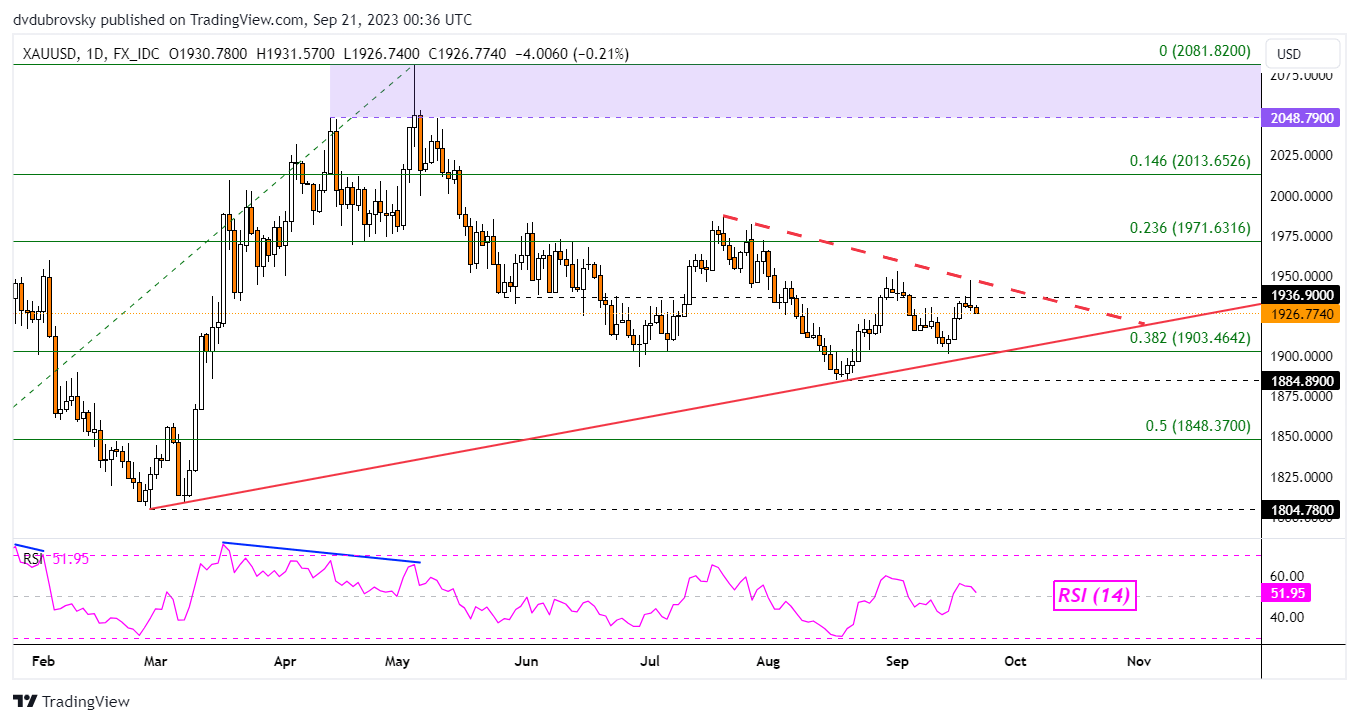
Gold and silver prices have turned lower in the aftermath of the Federal Reserve monetary policy announcement. There, Chair Jerome Powell basically alluded to a ‘higher for longer’ approach, causing financial markets to price in a higher terminal Federal Funds rate and pushing back expectations of rate cuts further down the time horizon.

In response, Treasury yields and the US Dollar rose, working together to pressure precious metals, like gold and silver, lower. On the daily chart below, XAU/USD rejected a recently formed, near-term falling trendline from July. That has opened the door to revisiting rising support from April, which is closely aligned with the 38.2% Fibonacci retracement level of 1903.46.

Clearing under the latter would open the door to a stronger bearish technical bias. Otherwise, pushing above near-term falling resistance exposes the 23.6% level of 1971.63.

image1.png

XAG/USD Analysis

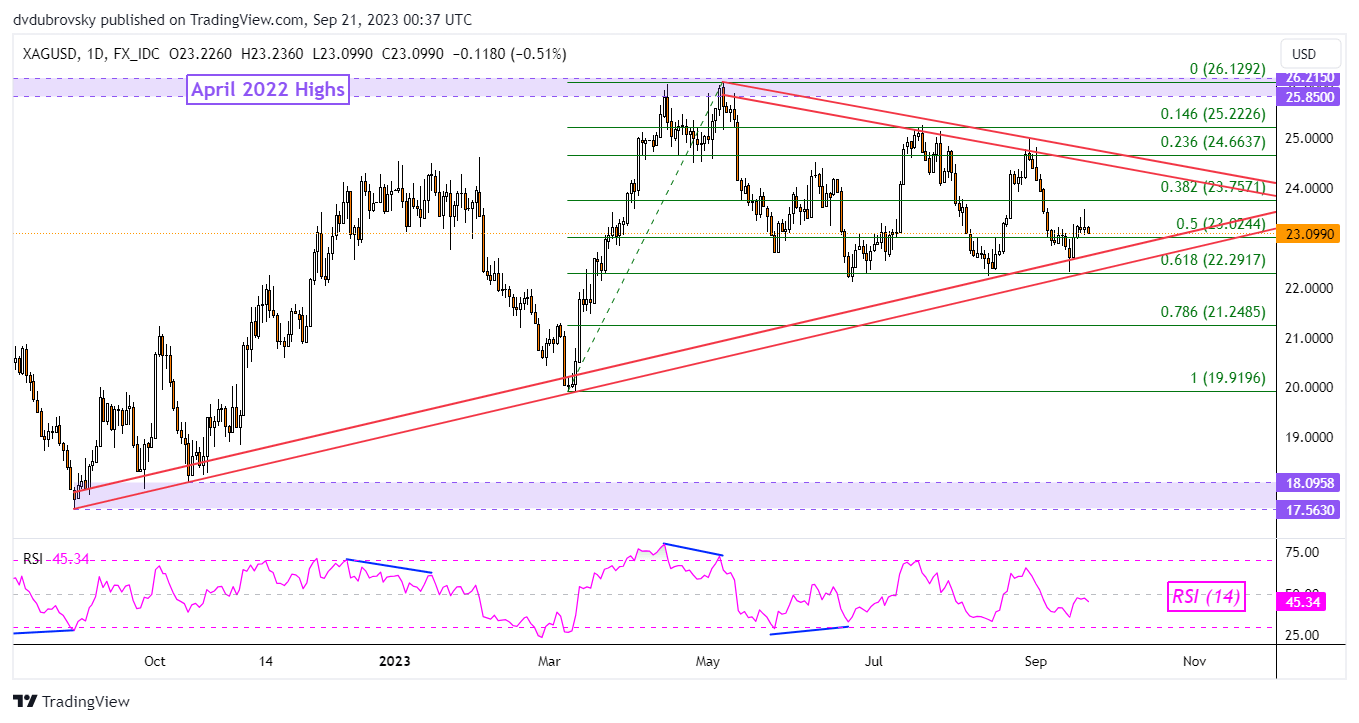
Meanwhile, silver faces a similar predicament in the wake of the Fed. Higher borrowing costs for longer and a stronger Greenback will likely pressure XAG/USD.

On the daily chart, silver can be seen turning back lower towards the rising range of support from August. Broadly speaking, XAG/USD has been consolidating between this rising support and a range of falling resistance from May.

As such, the broader technical outlook remains neutral. But, the fundamental consequences of the Fed on silver could open the door to an extended move lower. As such, keep a close eye on rising support. Breaking lower exposes the 78.6% Fibonacci retracement level of 21.24.

image2.png

AUD Price Forecast: FOMC Weighing on Aussie Dollar

AUD Price Forecast: FOMC Weighing on Aussie Dollar

AUSTRALIAN DOLLAR FUNDAMENTAL BACKDROP

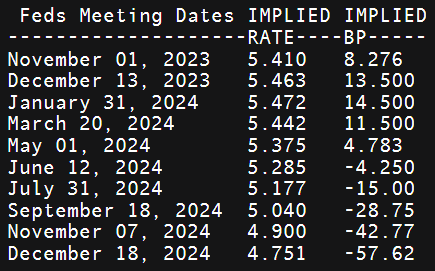
The Australian dollar took a turn lower after yesterday’s FOMC announcement and Westpac lending index data. The Fed kept their rates on hold but delivered a hawkish message that suggested sustained elevated interest rates for a longer period with fewer rate cuts in 2024 – now priced in at 56bps vs 100bps recently (see table below).

IMPLIED FED FUNDS FUTURES

image1.png

Earlier this morning, the RBA bulletin was released with the key takeaway being the close scrutiny of wage developments due to its impact on inflation.

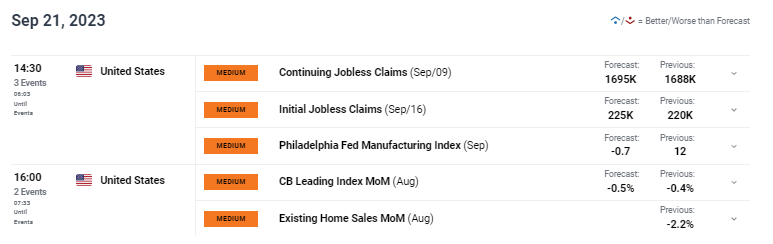
Later today, the pair will be largely driven by US factors including initial jobless claims data (see economic calendar below). Recent figures have reiterated the robust labor market in the US and this week look to exhibit little change. A strong initial jobless claims figure could supplement US dollar upside and weigh on the AUD.

AUD/USD ECONOMIC CALENDAR (GMT +02:00)

image2.png

TECHNICAL ANALYSIS

AUD/USD DAILY CHART

image3.png

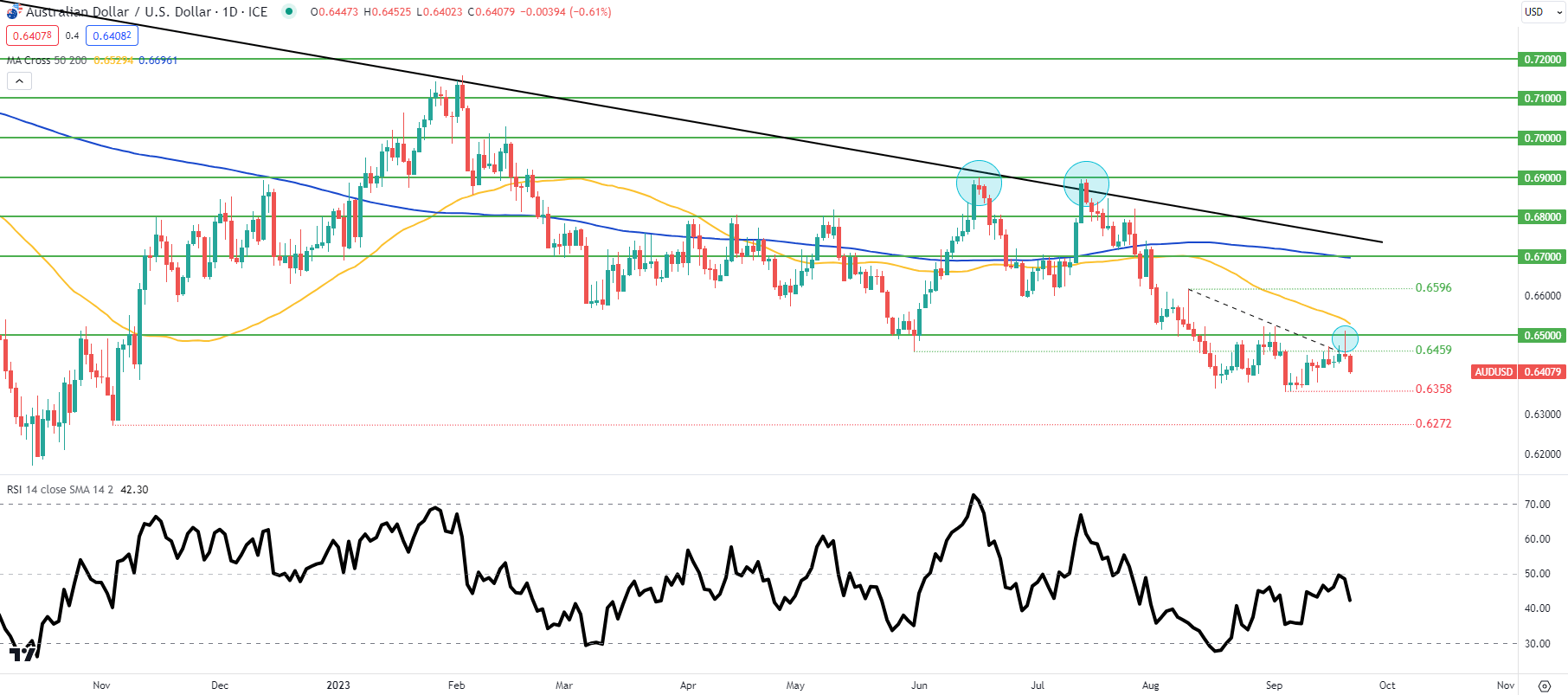
Daily AUD/USD price action above shows Aussie bulls respectful of the medium-term trendline resistance (dashed black line) after levels breached the 0.6500 psychological handle yesterday. The candle subsequently closed with a long upper wick (blue), suggestive of impending downside to come. Subsequent support zones could be under threat if markets buy into the Fed’s ‘higher for longer’ stance.

Japanese Yen Remains at Risk After the Fed, Retail Traders Unwind USD/JPY Bullish Bets

Japanese Yen Remains at Risk After the Fed, Retail Traders Unwind USD/JPY Bullish Bets

The Japanese Yen weakened against the US Dollar in the aftermath of the Federal Reserve interest rate decision, where Chair Jerome Powell alluded to a ‘higher for longer’ monetary policy approach. In response, retail traders have become less bullish about USD/JPY. This can be seen by taking a look at IG Client Sentiment (IGCS), which typically functions as a contrarian indicator.

USD/JPY Sentiment Outlook – Bullish

The IGCS gauge shows that about 38% of retail traders are net-long USD/JPY. Since most of them are biased to the downside, this hints that prices may continue higher down the road. This is as upside exposure decreased by -5% and -17% compared to yesterday and last week, respectively. With that in mind, the combination of overall positioning and recent changes offers a stronger bullish bias.

Japanese Yen Daily Chart

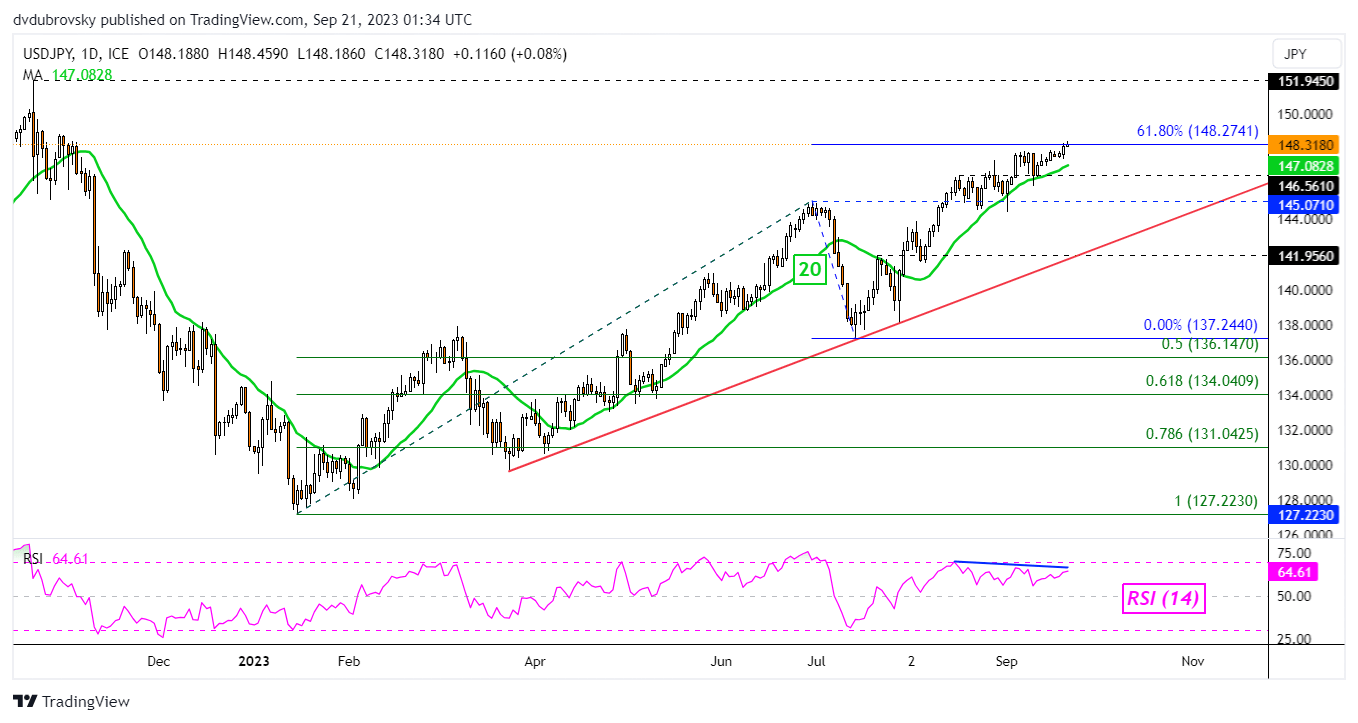
Looking at the daily chart, USD/JPY is flirting with attempting a break above the 61.8% Fibonacci extension level at 148.27. That said, negative RSI divergence is present. This shows that upside momentum is fading, which can at times precede a turn lower. That would place the focus on the 20-day Moving Average, which is immediate support.

That said, the broader bullish bias is being maintained by rising support from March. As such, it would take an extended move lower to overturn the bullish bias. Clearing higher exposes last year’s high of 151.94.

Japanese Yen Daily Chart


US Dollar Gets a Boost from Optimistic Fed; EUR/USD, GBP/USD, AUD/USD

US Dollar Gets a Boost from Optimistic Fed; EUR/USD, GBP/USD, AUD/USD

The US dollar received a boost overnight after the US Federal Reserve signaled one more rate hike before the end of the year and fewer rate cuts than previously indicated. The Fed kept the fed funds rate unchanged at 5.25%-5.5%, in line with expectations while lifting the economic assessment to ‘solid’ from ‘moderate’ and leaving the door open for one more rate hike as ‘inflation remains elevated’.

The Summary of Economic Projections showed 50 basis points fewer rate cuts in 2024 than the projections released in June. The Committee now sees just two rate cuts in 2024 which would put the funds rate around 5.1%. With the US economy outperforming some of its peers, the path of least resistance for the greenback remains sideways to up.

EUR/USD Weekly Chart

image1.png

EUR/USD: No confirmation of a low

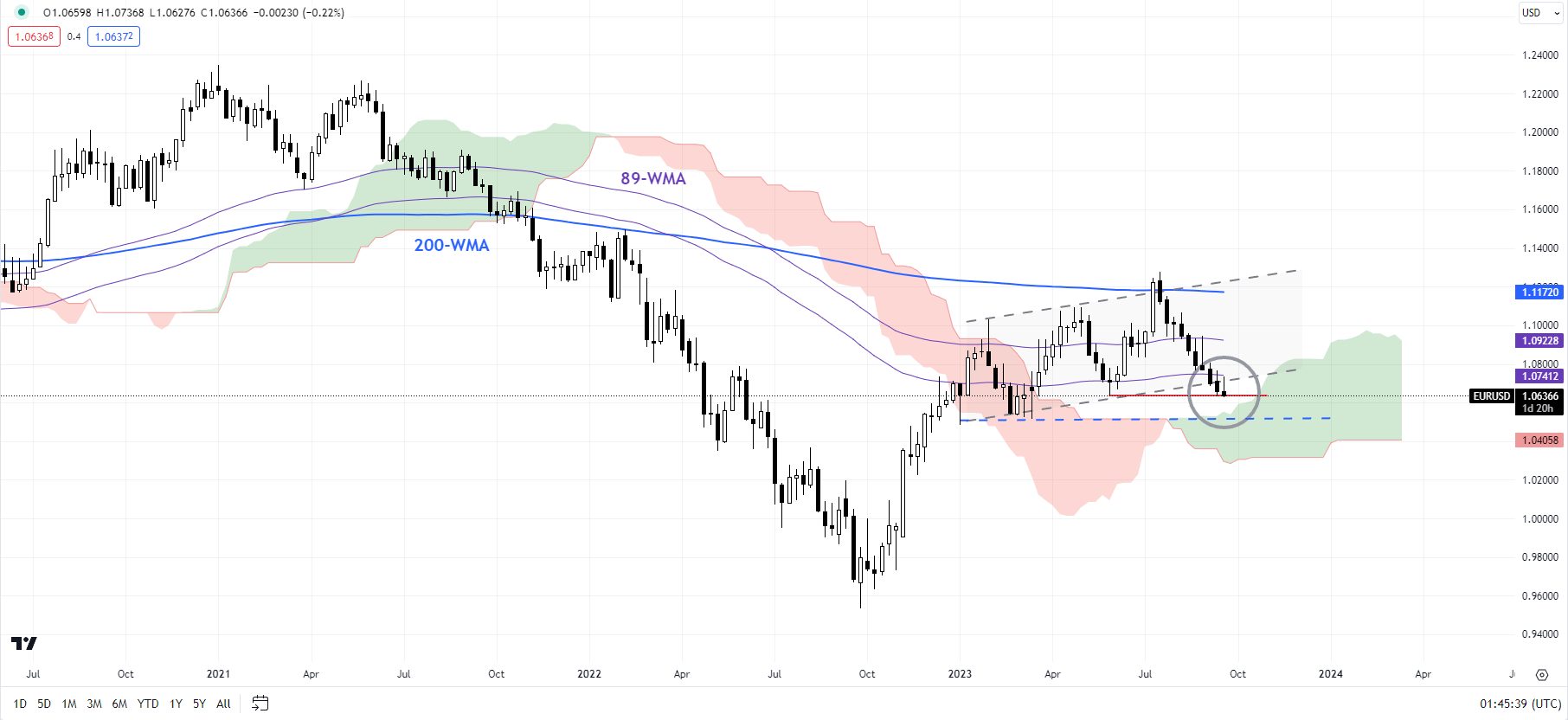
EUR/USD is testing fairly strong support at the May low of 1.0630. Oversold conditions suggest it could be tough to break below at least in the first attempt. But unless EUR/USD is able to recover some of the lost ground, including a rise above the early-August high of 1.1065, the broader sideways to weak bias is unlikely to change. Below 1.0630, the next support comes in at the January low of 1.0480.

GBP/USD Daily Chart

image2.png

GBPUSD: Downward bias unchanged

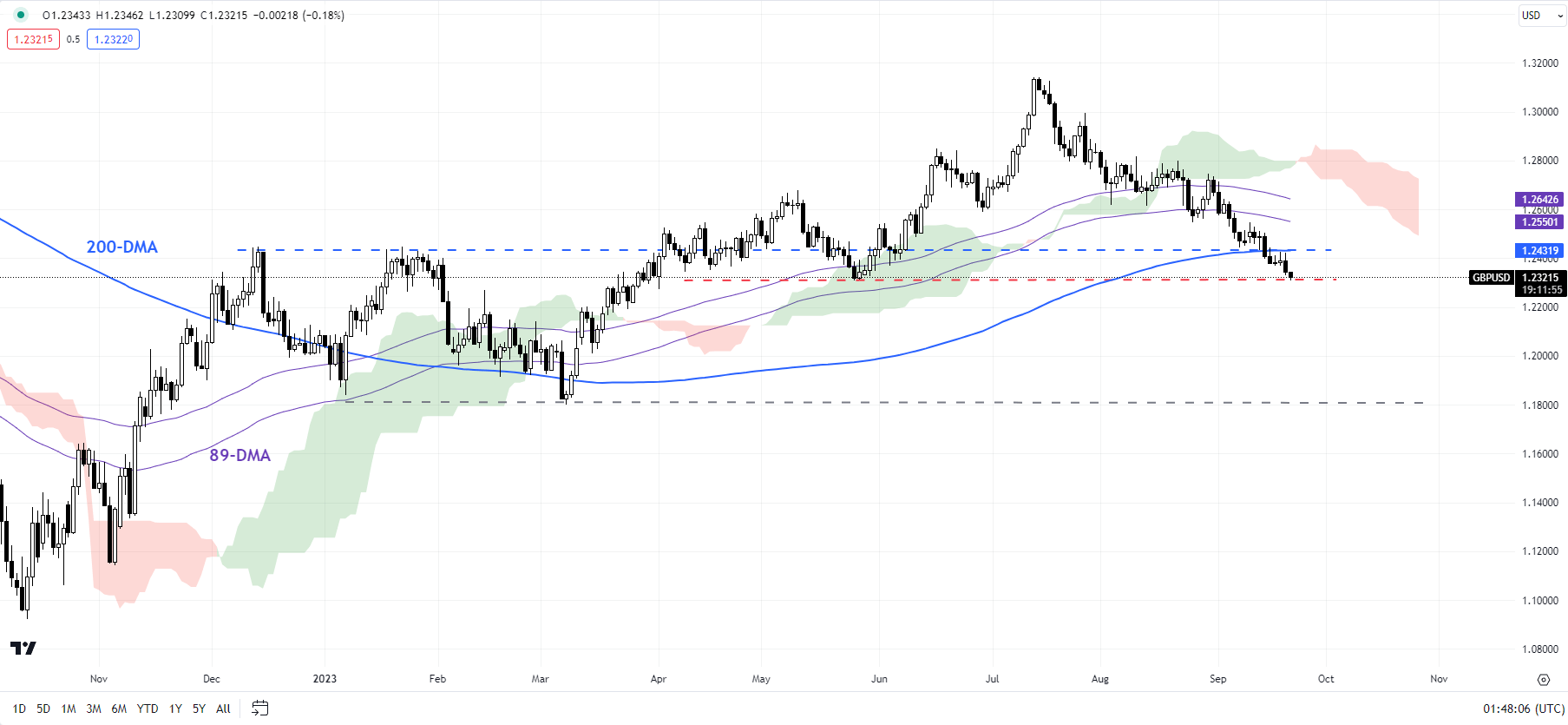
The sequence of lower-highs-lower-lows since July keeps GBP/USD’s short-term bias bearish. For the first time since the end of 2022, cable has fallen below the Ichimoku cloud support on the daily charts – a reflection that the bullish bias has changed. For more discussion, see “Pound’s Resilience Masks Broader Fatigue: GBP/USD, EUR/GBP, GBP/JPY Setups,” published August 23.

However, cable looks oversold as it tests quite strong converged support at the end-May low of 1.2300, near the 200-day moving average. This support is strong, and a break below is by no means imminent. However, A decisive break below the May low of 1.2300 would disrupt the higher-low-higher-high sequence since late 2022. The next significant support is at the March low of 1.1800.

AUD/USD 240-minute Chart

image3.png

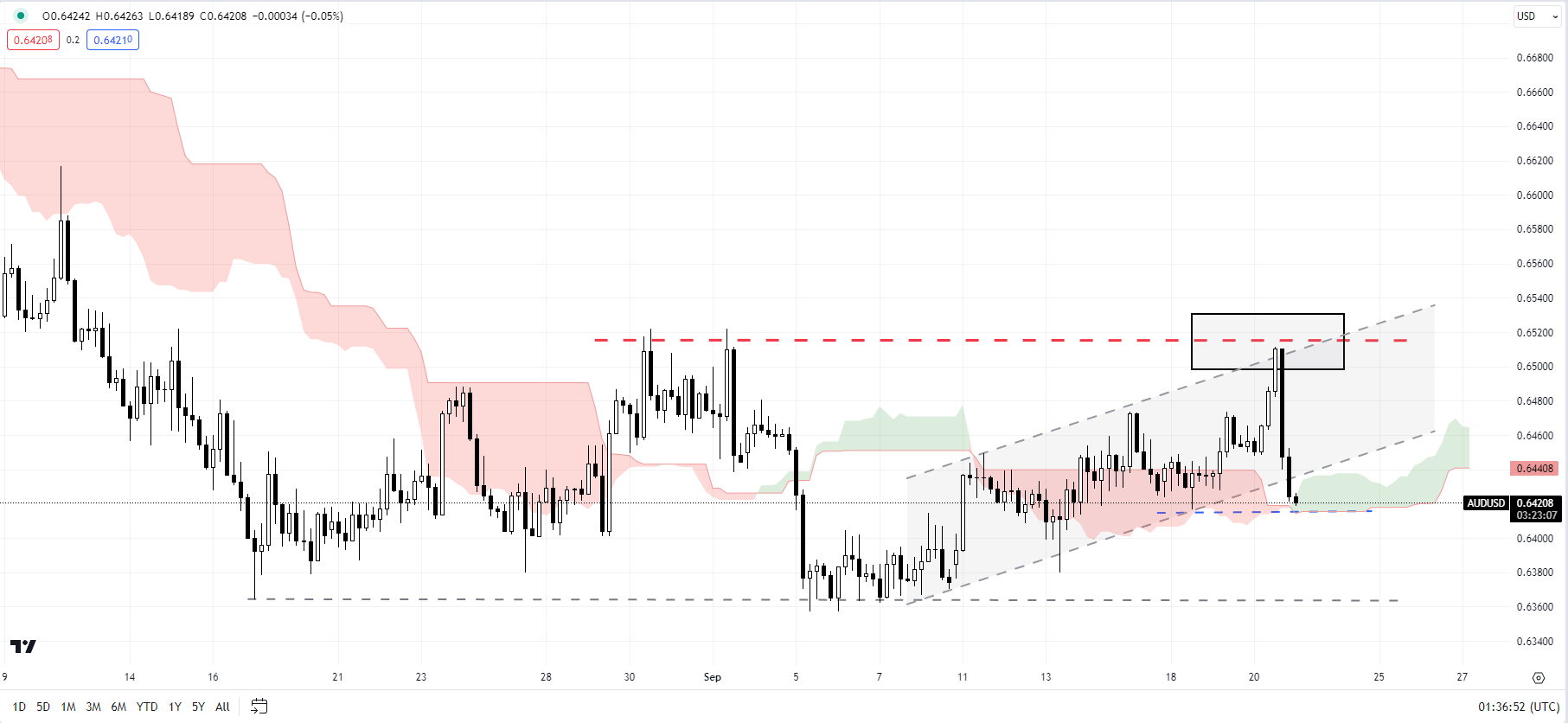
AUD/USD: Backs off from key resistance

AUD/USD has retreated from fairly strong converged resistance at the August high of 0.6525, coinciding with the upper edge of a rising channel since early September. The focus now shifts to the vital cushion at Monday’s low of 0.6415, near the lower edge of the Ichimoku cloud on the 240-minute charts. AUD/USD needs to hold above the support if the recovery from the start of the month has to extend, failing which the immediate bias would shift to range from bullish. Any break below the August-September lows of around 0.6350 could expose downside risks toward the November 2022 low of 0.6270.

UK Inflation Softens to 6.7% Creating Uncertainty About a BoE Rate Hike

UK Inflation Softens to 6.7% Creating Uncertainty About a BoE Rate Hike

UK Inflation Report

The UK inflation report for August was in the spotlight this morning. A pickup in UK inflationary pressure would force the Bank of England (BoE) to keep rates higher at the expense of the UK economy.

However, the UK annual inflation rate softened from 6.8% to 6.7% in August. Economists forecast an inflation rate of 7.0%. Consumer prices increased by 0.3% in August versus a 0.4% decline in July. Economists forecast a 0.7% jump in consumer prices.

There was more interest than usual in the numbers. With the UK heading for a recession, softer inflation rates could ease pressure on the BoE to push rates higher and tip the UK economy into a deeper recession.

GBP to USD Reaction to the UK Inflation Report

Before the UK inflation report, the GBP to USD pair rose to a pre-stat high of $1.23970 before falling to a low of $1.23821.

However, in response to the UK inflation report, the GBP to USD pair tumbled from $1.23856 to a low of $1.23332.

This morning, the GBP to USD was down 0.32% to $1.23514.

GBP to USD sinks on softer UK inflation.
The US Federal Reserve will be in the spotlight later today. With the markets betting on the Fed to hit the pause button, the focus will be on the FOMC economic projections and press conference.Upbeat revisions to GDP, inflation, and unemployment would fuel bets on a November rate hike. Considering the latest UK inflation numbers, a hawkish Fed pause would weigh more heavily on the GBP to USD pair.