DAX Set for Another Testy Session with the US Jobs Report in Focus

DAX Set for Another Testy Session with the US Jobs Report in Focus

It was a bearish Thursday for the DAX, which fell by 0.72%. Following a 1.36% fall on Wednesday, the DAX ended the day at 15,893. Significantly, the DAX ended the day at sub-16,000 for the first time since July 11.

Economic indicators from the euro area continued to weigh on investor sentiment. After the disappointing manufacturing PMI numbers, service sector PMIs added to the bearish mood. Trade data from Germany was also bearish despite a widening trade surplus.

Trading Derivatives carries a high level of risk to your capital and you should only trade with money you can afford to lose. Trading Derivatives may not be suitable for all investors, so please ensure that you fully understand the risks involved, and seek independent advice if necessary. A Product Disclosure Statement (PDS) can be obtained either from this website or on request from our offices and should be considered before entering into a transaction with us. Raw Spread accounts offer spreads from 0.0 pips with a commission charge of USD $3.50 per 100k traded. Standard account offer spreads from 1 pips with no additional commission charges. Spreads on CFD indices start at 0.4 points. The information on this site is not directed at residents in any country or jurisdiction where such distribution or use would be contrary to local law or regulation.

Later in the European session, US service sector activity slowed, raising more red flags.

The NASDAQ Composite Index slipped by 0.10%, with the Dow and the S&P 500 seeing losses of 0.19% and 0.25%, respectively. After the US closing bell, Amazon.com (AMZN) and Apple (AAPL) beat earnings forecasts.

Daily Chart sends bullish price signals.
DAX 040823 Daily Chart

Economic Indicators Sent Bearish Signals

It was a busy day on the European economic calendar, with German trade data and euro area services PMIs in focus. The numbers disappointed, with services PMIs taking a dip in July.

Going into the European session, trade data from Germany disappointed. While the trade surplus widened from 14.4 billion to €18.7 billion, a slide in imports and a modest rise in exports reflected the weak demand environment.

Service sector PMI numbers from the euro area added to the bearish sentiment. The German Services PMI fell from 54.1 to 52.3 in July, with the Eurozone Services PMI down from 52.0 to 50.9.

The numbers from the US also weighed, with the all-important ISM Non-Manufacturing PMI falling from 53.9 to 52.7 in July versus a forecasted 53.0. The sub-components drew interest. A fall in employment and an upswing in the price sub-components sent bearish signals. Significantly, the ISM Non-Manufacturing Prices sub-Index rose from 54.1 to 56.8.

The Market Movers

It was another mixed session for the auto sector. Both BMW and Continental AG saw losses of 2.17%. Porsche and Volkswagen fell by 0.76% and 0.18%, respectively, while Mercedes-Benz Group bucked the trend, rising by 0.15%.

However, it was a bullish session for the banks. Commerzbank and Deutsche Bank ended the day up 2.86% and 2.09%, respectively.

The Day Ahead for the DAX

This morning, German factory orders will set the tone. After dire manufacturing sector PMI numbers, a slide in factory orders would raise the bets on a euro area economic recession. Economists forecast factory orders to fall by 1.5% in June.

Eurozone retail sales figures will also draw interest in the early part of the European session. However, the US Jobs Report will have the final say. Economists are betting on a soft landing and the Federal Reserve ending its monetary policy tightening cycle. The Jobs Report will test the theory.

A pickup in wage growth and a steady unemployment rate of 3.6% could put the Fed hawks back in the driving seat.

DAX Technical Indicators

Looking at the EMAs and the 4-hourly chart, the EMAs sent bearish signals. The DAX sat below the 50-day (16,140) and 200-day (15,963) EMAs, sending bearish near and longer-term price signals.

Significantly, the 50-day EMA narrowed to the 200-day EMA, sending bearish price signals and supporting a DAX return to sub-15,750 to bring the 15,600 – 15,525 support band into play.

However, a DAX move through the 200-day EMA (15,963) and the lower level of the 16,000 – 16,080 resistance band would give the bulls a run at the 50-day EMA (16,140).

The 14-4H RSI sits at 31.46, signaling bearish sentiment, with selling pressure overweighing buying pressure. Significantly, the RSI aligns with the EMAs, supporting a return to sub-15,750 to bring the 15,600 – 15,525 support band into play.


DAX Four Hourly Chart sends bearish price signals.
USD to CAD Price Forecast: Steady Ahead of US, Canada Job Reports

USD to CAD Price Forecast: Steady Ahead of US, Canada Job Reports

Overview

As the world’s financial markets hold their breath, the USD to CAD pair trades almost flat. Investors and traders worldwide are eagerly awaiting the US Non-Farm Payrolls report, Canada’s Employment Change, and Unemployment Rate reports. A rollercoaster week for Treasury yields, which have touched their highest level since November 2022, has driven the USD/CAD pair’s bullish performance.

Treasury Yields Stir USD/CAD Fluctuations

Treasury yields have had a significant impact on the Forex pair’s fluctuations. The 10-year Treasury jumped 11 basis points to 4.185% while the yield on the 2-year Treasury climbed marginally higher at 4.881%. The shifts in Treasury yields come in response to traders digesting new economic data and contemplating Fitch’s recent U.S. downgrade.

Trading Derivatives carries a high level of risk to your capital and you should only trade with money you can afford to lose. Trading Derivatives may not be suitable for all investors, so please ensure that you fully understand the risks involved, and seek independent advice if necessary. A Product Disclosure Statement (PDS) can be obtained either from this website or on request from our offices and should be considered before entering into a transaction with us. Raw Spread accounts offer spreads from 0.0 pips with a commission charge of USD $3.50 per 100k traded. Standard account offer spreads from 1 pips with no additional commission charges. Spreads on CFD indices start at 0.4 points. The information on this site is not directed at residents in any country or jurisdiction where such distribution or use would be contrary to local law or regulation.

Fitch Downgrade Shakes USD/CAD Market

The downgrade, which saw the U.S. long-term foreign currency issuer default rating drop from AAA to AA+, was caused by “fiscal deterioration,” shaky governance standards, and mounting general debt. This news from Fitch Ratings shocked the markets earlier in the week and has since been a critical player in influencing investor sentiment.

Jobs Report Eyed Amidst Slowdown

Concurrently, traders are keenly observing the recent key economic data which portrays the labor market and economic health. The hope is that a slowdown in hourly earnings growth might convince the Federal Reserve that past interest rate hikes have achieved their goal. With economists predicting the addition of 200,000 nonfarm payrolls in July and a steady unemployment rate of 3.6%, all eyes are firmly fixed on the forthcoming jobs report.

BOC Hike Bolsters Loonie Forecasts

In contrast, the Bank of Canada (BOC) has adopted an aggressive approach towards inflation by raising its benchmark interest rate to a 22-year high of 5% last month. They also hinted at further possible tightening. Analysts have subsequently revised their forecasts upwards for the Canadian dollar, while the loonie is expected to strengthen about 2% to 1.31 per U.S. dollar in the next six months.

Anticipated Fed Shift Will Boost Canadian Dollar

Bets are now placed on the Federal Reserve concluding its interest rate hikes, followed by rate cuts expected in early 2024, with the USD forecasted to soften broadly over the next 12 months. This anticipated shift, along with a globally improving risk backdrop, is seen as favorable for Canada, given its status as a significant commodities exporter.

Forex Market Awaits BOC’s Next Move

In conclusion, while the Bank of Canada may mirror the Fed’s interest rates adjustments in 2024, the Canadian dollar’s support is expected to come from a generally softer USD and investor diversification away from USD-denominated assets. Amid this drama, the Forex market waits for the next move.

Technical Analysis

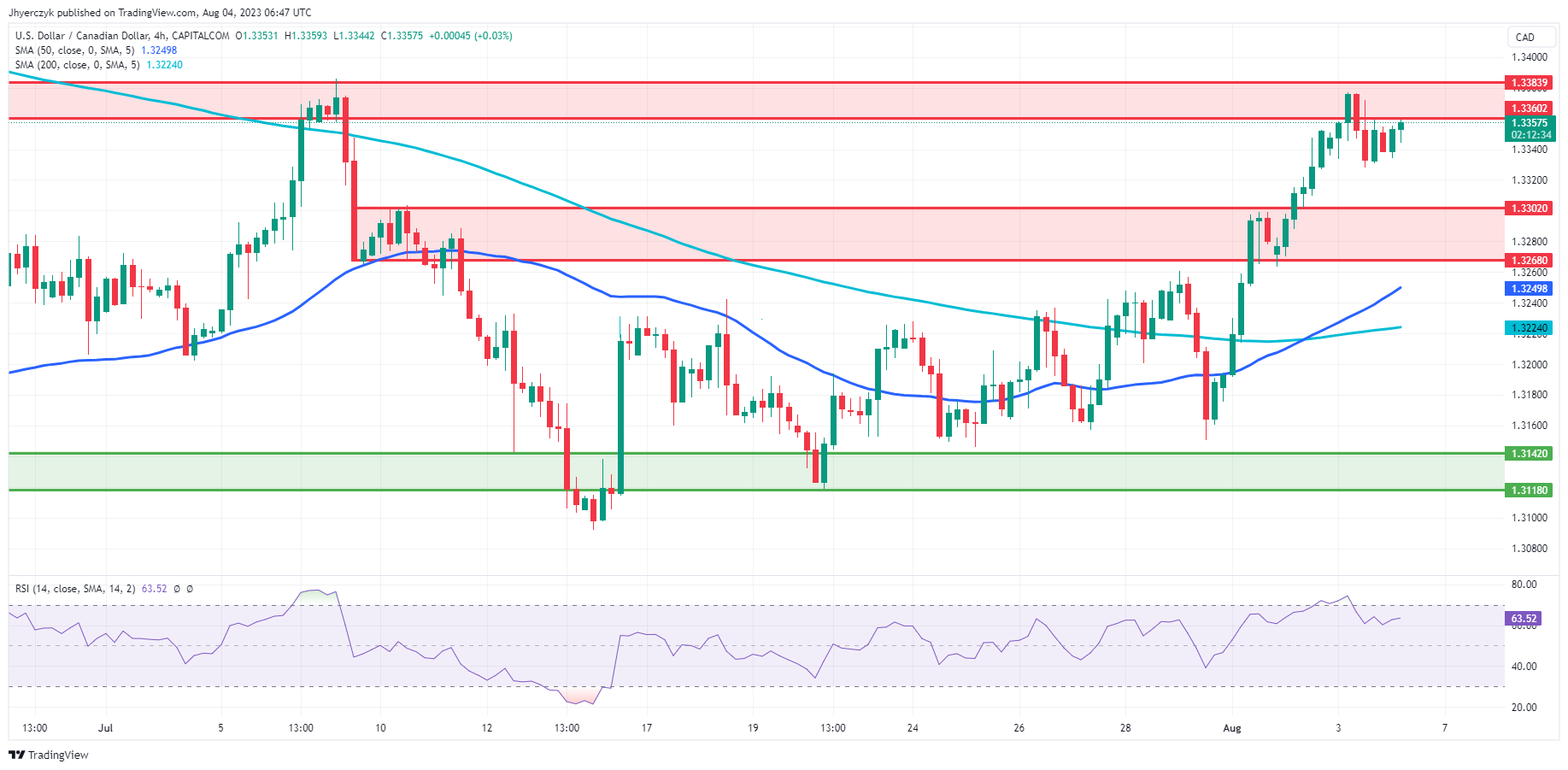
4-Hour USD to CADThe USD/CAD is currently displaying bullish sentiment, trading slightly above its previous 4-hour close and surpassing the 200-4H and 50-4H moving averages. The 14-4H Relative Strength Index suggests strong buying momentum, further bolstering this bullish trend.

The pair is testing the main resistance zone. If broken, this could confirm the bullish bias. This analysis, however, should be continuously updated with new market information and developments because the USD to CAD is nearly overbought and ripe for a correction.

Gold Price Forecast: XAU Fate Hangs on Impending US Jobs Data Release

Gold Price Forecast: XAU Fate Hangs on Impending US Jobs Data Release

Overview

The imminent release of the US Non-Farm Payrolls report at 12:30 GMT is holding gold prices at bay. A bullish report could put pressure on gold, with potential hikes in treasury yields and confidence in labor market growth. A bearish report, conversely, could stimulate gold prices as the economic health falls under question. Investors are eagerly anticipating these figures to decide their next moves in the gold market.

Gold Teeters Amid Non-Farm Payroll Anticipation

Gold (XAU) finds itself in a precarious situation as the world waits for the release of the US Non-Farm Payrolls report. With investors bracing for the results, gold prices have stagnated, teetering on the edge of their worst week in six months. The buoyancy of this week’s robust economic data, which pushed Treasury yields to nine-month highs, has pressured the gold market.

Trading Derivatives carries a high level of risk to your capital and you should only trade with money you can afford to lose. Trading Derivatives may not be suitable for all investors, so please ensure that you fully understand the risks involved, and seek independent advice if necessary. A Product Disclosure Statement (PDS) can be obtained either from this website or on request from our offices and should be considered before entering into a transaction with us. Raw Spread accounts offer spreads from 0.0 pips with a commission charge of USD $3.50 per 100k traded. Standard account offer spreads from 1 pips with no additional commission charges. Spreads on CFD indices start at 0.4 points. The information on this site is not directed at residents in any country or jurisdiction where such distribution or use would be contrary to local law or regulation.

Yields on the 10-year and 2-year Treasury notes experienced significant changes this week, largely propelled by fresh economic data and the fallout from Fitch’s US downgrade. The US long-term foreign currency issuer default rating suffered a blow, dropping from AAA to AA+, a decision taken in light of concerns over “fiscal deterioration,” questionable governance standards, and escalating general debt.

Market sentiment, pivoting on these developments, will now heavily hinge on the Non-Farm Payrolls data for July. This report could illuminate the state of the labor market and economy and dictate the Federal Reserve’s next move.

Bullish Payrolls Report May Depress Gold

A bullish Non-Farm Payrolls report could result in a dip in gold prices. Increased confidence in the economy’s health could lead to more considerable interest rate hikes by the Federal Reserve, further pushing Treasury yields up, and pushing gold, often considered a safe-haven asset, down.

Bearish Payrolls Report Could Boost Gold

In contrast, a bearish Non-Farm Payrolls report may stimulate gold prices. If the report shows signs of a weakening labor market or economic downturn, gold might witness increased demand as investors seek safer investment avenues amidst the uncertainty.

Short-Term Outlook:  Data Dependent

As the world of finance holds its breath, all eyes are firmly fixed on the forthcoming jobs data. The outcome will not only shape the future of gold prices but also influence the Federal Reserve’s strategy in its ongoing battle against inflation.

Technical Analysis

4-Hour Gold (XAU)Gold’s (XAU) current 4-hour price is below both the 200-4H and 50-4H moving averages, indicating a bearish sentiment in the short to medium term. With a 14-4H RSI of 37.4, momentum is weakening, but not yet oversold. The price is nearing the main support area (1902.75 to 1914.00), suggesting a potential further drop before a potential reversal. As such, the market for Gold appears bearish in the short to medium term, although this may change with market dynamics or new labor market data.

Silver Price Forecast: XAG Tone Determined by Non-Farm Payrolls Numbers

Silver Price Forecast: XAG Tone Determined by Non-Farm Payrolls Numbers

Overview

Silver (XAG) currently finds itself in a precarious situation as the world anticipates the US Non-Farm Payrolls report. With the results looming, silver prices have remained relatively stagnant, teetering on the edge of their worst week in six months. This week’s robust economic data, which pushed Treasury yields to nine-month highs, has added pressure to the silver market.

Traders Brace for US Non-Farm Payrolls

The imminent release of the US Non-Farm Payrolls report at 12:30 GMT is creating tension in the silver market. Should the report turn out to be bullish, it may put downward pressure on silver prices, due to potential hikes in treasury yields and a boost in labor market confidence. Conversely, a bearish report might stimulate an increase in silver prices as concerns over the economic health arise. Investors are waiting with bated breath for these figures, eager to plan their next moves in the silver market.

Trading Derivatives carries a high level of risk to your capital and you should only trade with money you can afford to lose. Trading Derivatives may not be suitable for all investors, so please ensure that you fully understand the risks involved, and seek independent advice if necessary. A Product Disclosure Statement (PDS) can be obtained either from this website or on request from our offices and should be considered before entering into a transaction with us. Raw Spread accounts offer spreads from 0.0 pips with a commission charge of USD $3.50 per 100k traded. Standard account offer spreads from 1 pips with no additional commission charges. Spreads on CFD indices start at 0.4 points. The information on this site is not directed at residents in any country or jurisdiction where such distribution or use would be contrary to local law or regulation.

Yields, Silver Impacted by Fitch Downgrade

Significant changes in yields on the 10-year and 2-year Treasury notes have been noted this week, largely driven by new economic data and the consequences of Fitch’s US downgrade. The US long-term foreign currency issuer default rating was downgraded from AAA to AA+. This decision was motivated by concerns over “fiscal deterioration,” questionable governance standards, and rising general debt.

NFP Report to Influence Fed Rate Decision

Market sentiment, now pivoting on these events, is highly contingent on the forthcoming Non-Farm Payrolls data for July. This report could shed light on the state of the labor market and the broader economy, influencing the Federal Reserve’s subsequent actions.

Bullish NFP Data to Weigh on Silver

In the event of a bullish Non-Farm Payrolls report, silver prices could take a hit. With a renewed confidence in the health of the economy, the Federal Reserve may implement more aggressive interest rate hikes. This, in turn, could further push up Treasury yields and push down silver, which is often viewed as a safe-haven asset.

Bearish NFP Report Could Bolsterr Prices

On the other hand, a bearish Non-Farm Payrolls report could stimulate an uptick in silver prices. If the report indicates a faltering labor market or signs of an economic downturn, silver may see a surge in demand. Investors would likely view it as a safer investment route amidst the prevailing uncertainty.

Short-Term Outlook:  Data Dependent

As the financial world waits in suspense, all eyes are trained on the imminent jobs data. The results will not only determine the trajectory of silver prices but also influence the Federal Reserve’s approach in its ongoing fight against inflation.

Technical Analysis

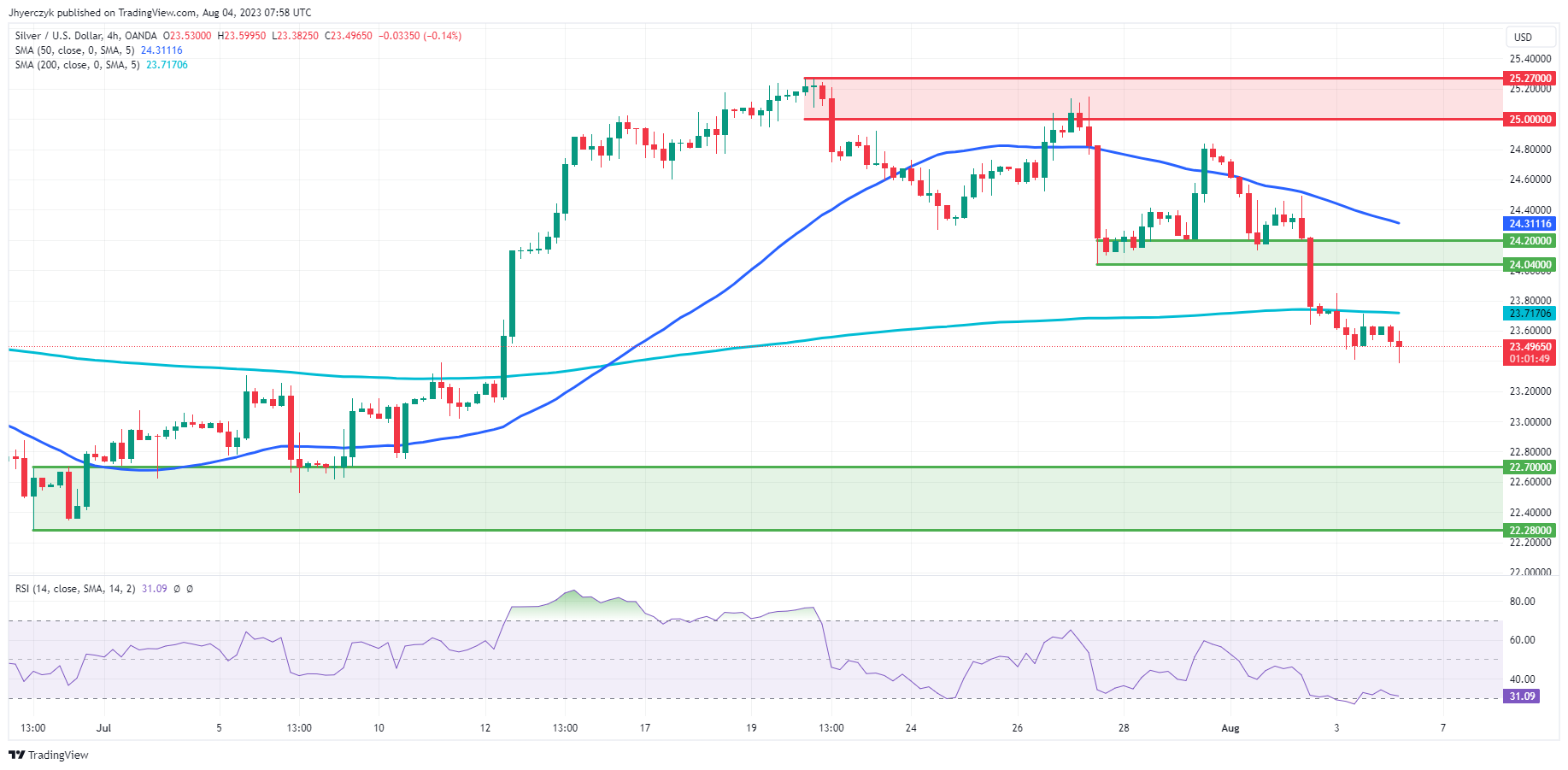
4-Hour Silver (XAG)The Silver (XAG) market’s short-term sentiment appears bearish, with the current 4-hour price at 23.47, slightly below the 200-4H (23.71) and 50-4H (23.72) moving averages. The 14-4H RSI at 30.76 suggests an oversold market, possibly indicating an upcoming price rebound. The 4-hour price is above the main support area (22.28 – 22.70), yet below the main resistance area (25.00 – 25.27), further signaling bearish sentiment. However, the oversold RSI might imply potential for an upward price correction.

Oil Price Forecast: Saudi Arabia, Russia Production Cuts Fuel Price Rise

Oil Price Forecast: Saudi Arabia, Russia Production Cuts Fuel Price Rise

Overview

As we approach the weekend, oil prices are on the rise for a second consecutive day, marking a six-week streak of gains. This surge is primarily fueled by announcements from Saudi Arabia and Russia, the world’s second and third-largest crude producers, committing to continued output cuts through the coming month.

Saudi, Russia Pledge Extended Oil Cuts

Saudi Arabia has voluntarily pledged to extend its oil production cut of 1 million barrels per day (bpd) until the end of September, while Russia has also promised to reduce its oil exports by 300,000 bpd in the same period. This move by these two oil giants, announced ahead of a critical OPEC+ meeting, has ignited concerns about supply shortage, thereby pushing oil prices higher.

Trading Derivatives carries a high level of risk to your capital and you should only trade with money you can afford to lose. Trading Derivatives may not be suitable for all investors, so please ensure that you fully understand the risks involved, and seek independent advice if necessary. A Product Disclosure Statement (PDS) can be obtained either from this website or on request from our offices and should be considered before entering into a transaction with us. Raw Spread accounts offer spreads from 0.0 pips with a commission charge of USD $3.50 per 100k traded. Standard account offer spreads from 1 pips with no additional commission charges. Spreads on CFD indices start at 0.4 points. The information on this site is not directed at residents in any country or jurisdiction where such distribution or use would be contrary to local law or regulation.

Economic Factors Threaten to Curb Oil Demand

Despite this, there are economic factors that might curb the demand for oil, thereby applying downward pressure on prices. Fresh U.S. data points to a tightening labor market and a slowing service sector, implying a potential economic slowdown. Similarly, the strengthening dollar could suppress oil prices as market participants speculate whether a heated labor market will impel the Federal Reserve to tighten its monetary policy.

Europe’s Economic Slump May Lower Oil Demand

In Europe, economic activity seems to be slowing, with the downturn in Eurozone business activity in July being more severe than initially projected. Moreover, the Bank of England’s decision to increase its interest rate to a 15-year peak could dampen economic growth by increasing borrowing costs, which might consequently decrease oil demand.

Short-term Forecast

However, despite these potential headwinds, an improved demand outlook and a constrained supply could continue to support the oil markets. A key piece of data to watch out for will be Friday’s U.S. non-farm payroll figures, which will likely guide market sentiment. In the short-term, we could expect a bullish outlook for oil prices, given the ongoing production cuts from major oil-producing countries. Yet, it’s crucial to note that any changes in economic conditions or monetary policy could shift this forecast.

Technical Analysis

4-Hour Crude OilCurrent sentiment for Crude Oil points towards robust, bullish momentum. The slight rise in the 4-hour price confirms this momentum. The current price sits above both the 200-4H and 50-4H moving averages, indicating strong bullish market sentiment in both the short and long term. The 14-4H RSI reads at 59.95, reinforcing the stronger momentum.

The current 4-hour price is within the main resistance area, a critical factor to consider for potential pullbacks. All in all, the market is decidedly bullish, warranting careful watch for any signs of resistance level breakouts or a potentially bearish closing price reversal top.

Italian service sector growth continues to slide in July

Italian service sector growth continues to slide in July

Italy’s service sector experienced a rise in business activity during July, but growth softened to a half-year low as sales broadly stagnated. Price pressures remained prevalent, whilst for the first time since April 2021 there was a drop in employment. Confidence in the future was again positive but concerns over higher interest rates and the elevated cost of living ensured that optimism was muted when compared to its historical trend. The headline index from the report, the HCOB Italy Services PMI® Business Activity Index registered 51.5 in July. That compared to 52.2 in June, and marked a seventh successive

French services economy deteriorates at faster pace in July amid worsening demand and persistent inflationary pressures

French services economy deteriorates at faster pace in July amid worsening demand and persistent inflationary pressures

The French service sector started the third quarter with a contraction in activity, according to the latest HCOB PMI® survey conducted by S&P Global, indicating a further weakening of the economy after June’s first decline in services output for five months. Overall, the contraction in business activity was the fastest for almost two-and-a-half years. The deterioration in activity during July was accompanied by a slowdown in jobs growth, as well as a further reduction in the level of incoming new work. However, business confidence improved after a marked slump in June. Meanwhile, the slowdown of inflation

German service sector shows a substantial loss of momentum at start of third quarter, while price pressures remain stubbornly high

German service sector shows a substantial loss of momentum at start of third quarter, while price pressures remain stubbornly high

The German service sector saw a further loss of momentum at the start of the third quarter as business activity growth slowed notably for a second straight month, the latest HCOB PMI® survey compiled by S&P Global showed. The slowdown stemmed from a drop in demand, with inflows of new business falling for the first time in six months. Business expectations meanwhile deteriorated, which in turn contributed to a marked slowdown in job creation. On the price front, there was a pause in the recent easing trend in service sector inflationary pressures. Driven by growing wage demands, firms’ input cost rose at a sharp rate

UK: Weakest service sector performance for six months

UK: Weakest service sector performance for six months

UK service providers experienced another period of subdued business conditions during July, with activity levels and new work expanding at much slower rates than in the previous month. Pressure on operating capacity subsequently showed signs of easing as backlogs of work declined at the fastest pace for nearly two-and-a-half years. Strong rises in input costs persisted during July, largely driven by higher wages. Moreover, the overall rate of input price inflation edged up since June and remained historically elevated. Prices charged inflation nonetheless eased to its lowest since March, with some firms citing