Bitcoin’s Continued Slide Down

Bitcoin’s Continued Slide Down

Crypto Market Cap Dips, Bitcoin Struggles Amidst Market Uncertainty

The crypto market cap fell 1.6% in 24 hours to $1.166 trillion. Risk assets in traditional markets came under pressure as the accumulated overheating in equities (especially in techs) accompanied a trigger – Fitch’s cut of the US rating.

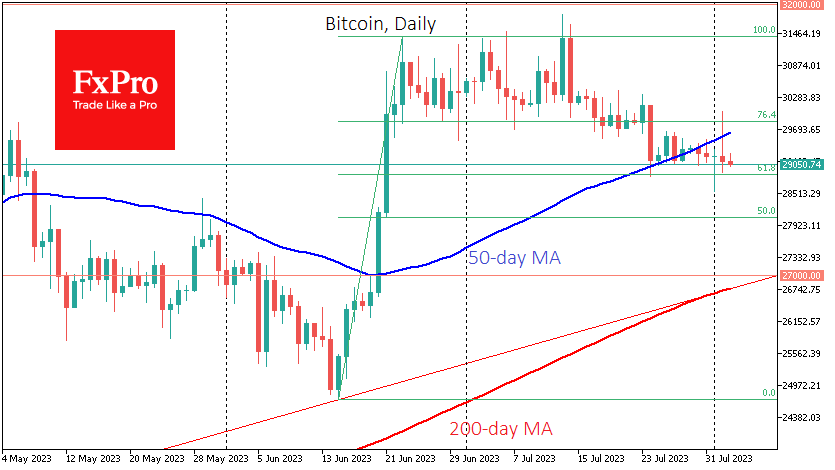
Bitcoin daily chartThe initial flight of speculators into Bitcoin proved to be short-lived. Bitcoin closed Wednesday down 0.5%, losing over 3.1% from its peak at the start of the day, and failed to get back above the 50-day average. This is another bearish signal in addition to the sequence of downward daily candles. So far, Bitcoin has managed to avoid accelerating the sell-off, but it looks like it’s only a matter of time before it does.

Trading Derivatives carries a high level of risk to your capital and you should only trade with money you can afford to lose. Trading Derivatives may not be suitable for all investors, so please ensure that you fully understand the risks involved, and seek independent advice if necessary. A Product Disclosure Statement (PDS) can be obtained either from this website or on request from our offices and should be considered before entering into a transaction with us. Raw Spread accounts offer spreads from 0.0 pips with a commission charge of USD $3.50 per 100k traded. Standard account offer spreads from 1 pips with no additional commission charges. Spreads on CFD indices start at 0.4 points. The information on this site is not directed at residents in any country or jurisdiction where such distribution or use would be contrary to local law or regulation.

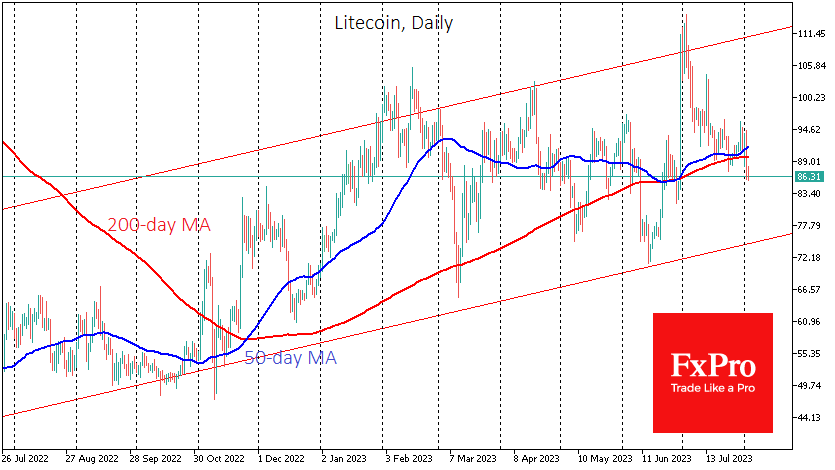
Litecoin daily chartOn Wednesday, the Litecoin (LTC) network saw its third halving. The reward per block was reduced to 6.25 LTC. So far, 87.5% of the total LTC supply has been mined. The altcoin reacted with a decline and hit new month lows at around $86. This drop sent the coin below the 50 and 200-day averages, raising the question of a long-term trend change and opening the way down to $77-80.

Crypto News

Trading activity in the Bitcoin spot market has weakened to its lowest since November 2020, Santiment noted. Major players have so far refrained from entering exchanges, and this trend may continue in August.

MicroStrategy founder Michael Saylor said the company had bought an additional 467 BTC worth $14.4 million in July. As of 31 July, MicroStrategy owns 152,800 BTC worth approximately $4.53 billion at $29,672.

BlackRock’s filing to launch a bitcoin ETF is part of an “adoption cycle” that will allow the first cryptocurrency to hit record highs, Galaxy Digital CEO Mike Novogratz said. The head of BlackRock believed in Bitcoin, he said, and that’s the most important thing that has happened in the crypto market this year.

The chances of the US Securities and Exchange Commission (SEC) approving a bitcoin-ETF application have risen to 65 per cent, Bloomberg analyst James Seyffarth said. Two weeks earlier, he estimated this probability at 50%; a few months ago – at 1%.

Germany’s Trade Surplus Widens to €18.7 billion on Imports Slide

Germany’s Trade Surplus Widens to €18.7 billion on Imports Slide

It is a busy Thursday on the European economic calendar, with service PMIs for Italy and Spain and finalized PMIs for France, Germany, and the Eurozone in focus.

However, German trade data drew interest going into the European session. With the German economy facing a weak global demand environment, today’s numbers would give the markets a better sense of how the economy is performing.

In June, the German trade surplus widened from €14.4 billion to €18.7 billion. Economists forecast a trade surplus of €15.0 billion.

  • Exports increased by 0.1% in June to €131.3 billion.
  • Imports slid by 3.4% in June to €112.6 billion.

Trade with EU countries

  • German exports to EU countries increased by 1.3%, while imports from EU countries fell by 3.1%.
  • The value of goods exported to euro area countries increased by 1.8%, while imports slid by 4.1%.

Trade with non-EU countries

  • Exports of goods to third countries declined by 1.1%, with imports down 3.7%.
  • Exports to the US fell by 0.2%, while exports to China slumped by 5.9%.
  • In contrast, imports from China surged by 5.3%, while imports from the US declined by 1.2%.

While the trade surplus widened, the modest rise in total exports and slide in total imports painted a grim demand picture.

EUR/USD Reaction to German Trade Figures

Before the German trade data, the EUR/USD rose to a pre-stat high of $1.09494 before falling to a low of $1.09193.

However, in response to the trade data, the EUR/USD fell to a post-stat low of $1.09346 before rising to a high of $1.09434.

This morning, the EUR/USD was up 0.02% to $1.09416.

EUR/USD shows muted response to German trade data.

Next Up

After bearish manufacturing sector PMIs from Tuesday, the European private sector will be in focus for a second time this week. Service sector PMIs from Spain and Italy and finalized numbers for France, Germany, and the Eurozone will move the dial.

Weaker service sector activity across Italy and Spain and a downward revision to the Eurozone services PMI would fuel recessionary jitters. According to the flash survey, the Eurozone services PMI fell from 52.0 to 51.1 in July.

ECB Executive Board Member Fabio Panetta is on the calendar to speak today. However, investors should monitor the news wires for chatter with the media.

The US Session

US initial jobless claims and the all-important ISM Non-Manufacturing PMI will be in focus. Economists forecast the ISM Non-Manufacturing PMI to fall from 53.9 to 53.0. However, investors must consider the sub-components. These include employment, new business, and prices.

Other stats include finalized Markit survey-based service PMI, nonfarm productivity, unit labor costs, and factory orders. However, these stats should play second fiddle to the initial jobless claims and ISM survey-based numbers.

Bad Trader App Launches Alternative Trader Network

Bad Trader App Launches Alternative Trader Network

CHICAGO–(BUSINESS WIRE)–IG US Holdings, Inc., the parent company of tastylive and tastytrade, announces today the launch of the Bad Trader app, a community focused on financial markets that embraces speculation. By building a community around experimentation and the inevitable blunders that come with it, Bad Trader aims to help people better understand how to take calculated risks and when it may be appropriate to take them.

Now available for iOS and Android, Bad Trader offers daily hosted livestreams where young, but knowledgeable traders drive interactive conversations around markets, trading, sports, politics, and other things that probably matter. Bad Trader users can hop into chat to roast their friends for their impulsive decisions, as well as complete daily tasks, earn badges, and accumulate in-game points. Bad Trader users can also connect to their tastytrade account through a simplified, intuitive, and tasteful neon interface, with the plan to include connections to additional brokers in future releases.

Created to give users a fun, educational, and experiential introduction to risk, community engagement for young investors and traders is at the core of Bad Trader’s mission. According to survey data collected in November and December 2022, 41% of Gen Z and 38% of Millennials surveyed report owning individual stocks. Social media is the top source of financial information for Millennial and Gen Z investors, with 42% of Millennials and nearly half of Gen Z (48%) learning about investing and financial topics from YouTube and apps such as Instagram, TikTok, twitter and Reddit.1 These trends have inspired Bad Trader’s novel approach on what a finance app should feel like: a community-driven platform centered around watching entertaining, knowledgeable traders and learning from each other’s mistakes.

“I got into trading because the internet is dead and the planet’s on fire. Trading is exciting, it’s challenging, it’s a great way to stay informed on current events without slipping into existential dread… it also teaches great lessons and it’s much more fun with friends,” said Julia Spina, the 28-year-old CEO of Bad Trader and author of The Unlucky Investor’s Guide to Options Trading, an Amazon best seller in multiple categories.

“I hate giving quotes like this, write whatever you want,” said Tom Sosnoff, founder and CEO of tastylive and the visionary behind Bad Trader. “Also, go download Bad Trader.”

Click here to access videos and photography of the Bad Trader app.

About Julia Spina

Julia Spina is the CEO of Bad Trader and author of The Unlucky Investor’s Guide to Options Trading. Julia holds BS degrees in Engineering Physics and Applied Mathematics from the University of Illinois in Urbana-Champaign, as well as a MS in Physics with a research focus in quantum optics and information. Julia transitioned into finance in 2020 and worked as a quantitative researcher and content creator alongside Tom Sosnoff at the financial network tastylive. Published in 2022, The Unlucky Investor’s Guide is an Amazon best seller in multiple categories, and Julia has spent the last year promoting her book at talks across the country on tastylive’s “Bad Trader” tour. Now, with several years of experience in investor education and a deep passion for memes, Julia is focused on building up the Bad Trader community.

About Bad Trader

Bad Trader is owned by IG US Holdings, Inc., parent company of tastytrade, an online retail brokerage firm, tastylive, a financial content and education platform, tasty Software Solutions, LLC, and a subsidiary of IG Group Holdings PLC (LON:IGG), a global fintech company that provides award-winning products, platforms and access to ~19,000 financial markets to investors around the world.

AUD to USD Forecast: Bears Eye Sub-$0.66 on Risk Aversion

AUD to USD Forecast: Bears Eye Sub-$0.66 on Risk Aversion

On Tuesday, the AUD/USD tumbled by 1.43% to end the day at $0.66130. A surprise RBA decision to leave the cash rate unchanged at 4.10% sent the Aussie to sub-$0.6650.

This morning, AIG Manufacturing Index numbers for July will be in focus. The numbers are unlikely to impress when considering the disappointing numbers from China and Europe. Economists forecast the Index to fall from -19.8 to -22.0.

Trading Derivatives carries a high level of risk to your capital and you should only trade with money you can afford to lose. Trading Derivatives may not be suitable for all investors, so please ensure that you fully understand the risks involved, and seek independent advice if necessary. A Product Disclosure Statement (PDS) can be obtained either from this website or on request from our offices and should be considered before entering into a transaction with us. Raw Spread accounts offer spreads from 0.0 pips with a commission charge of USD $3.50 per 100k traded. Standard account offer spreads from 1 pips with no additional commission charges. Spreads on CFD indices start at 0.4 points. The information on this site is not directed at residents in any country or jurisdiction where such distribution or use would be contrary to local law or regulation.

The services sector has the most marked contribution to Australian GDP, circa 65%, while the manufacturing sector accounts for circa 25%. On this basis, the Index would have to see a more marked decline than forecasts to move the dial.

The US Session

It is a busy US session, with ADP nonfarm employment numbers for July in focus. While the latest US CPI Report eased bets on a September Fed rate hike, tighter labor market conditions would support a further pickup in wage growth and drive demand-fueled inflation. Economists forecast a 188k increase. In June, the ADP reported a 497 surge.

Labor market conditions remain a consideration for the Fed and monetary policy. Tighter labor market conditions would lead to higher wage growth levels and a demand-driven inflation pickup. Notably, the US labor market forms part of the Fed’s dual mandate, with the longer-run normal rate of unemployment estimated to be 4.1%. The US unemployment rate fell from 3.7% to 3.6% in June.

AUD/USD Price Action

Daily Chart

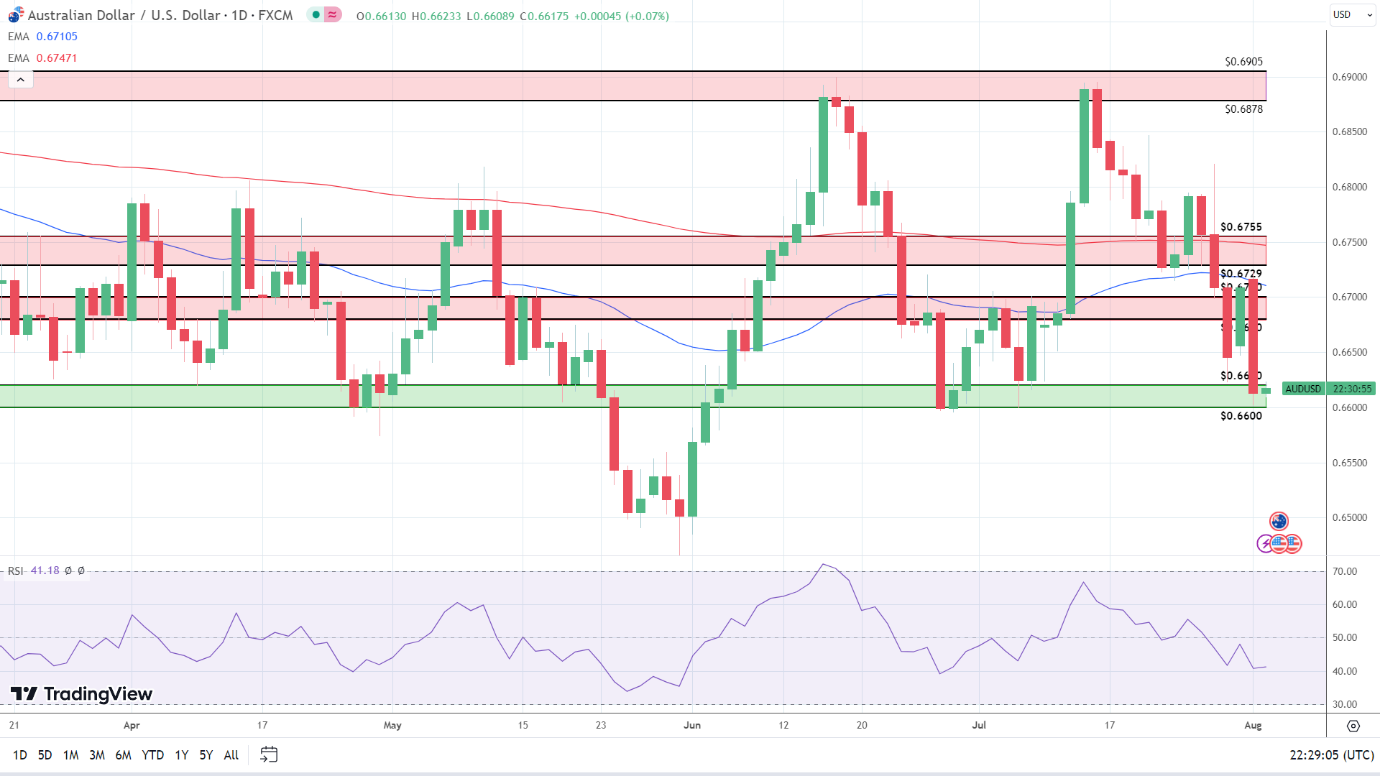
The Daily Chart showed the AUD/USD tumble through the $0.6700 – $0.6680 resistance band and the 50-day EMA ($0.67105) in response to the RBA interest rate decision. Support at the lower level of the $0.6620 – $0.6600 support band cushioned the downside on Tuesday.

After the Tuesday sell-off, the AUD to USD sat below the 50-day ($0.67105) and 200-day ($0.67471) EMAs, sending bearish near and longer-term price signals. The 50-day EMA fell back from the 200-day EMA, affirming the bearish trend.

Looking at the 14-Daily RSI, the 41.18 reading signals bearish sentiment and supports a fall through the 0.6620 – 0.6600 support band. However, an AUD/USD move through the $0.6680 – $0.6700 resistance band and the 50-day EMA ($0.67105) would give the bulls a run at the $0.6729 – $0.6755 resistance band. Failure to move through the 50-day EMA would leave sub-$0.66 in play.

AUD to USD Daily Chart sends bearish price signals.
AUDUSD 020823 Daily Chart

4-Hourly Chart

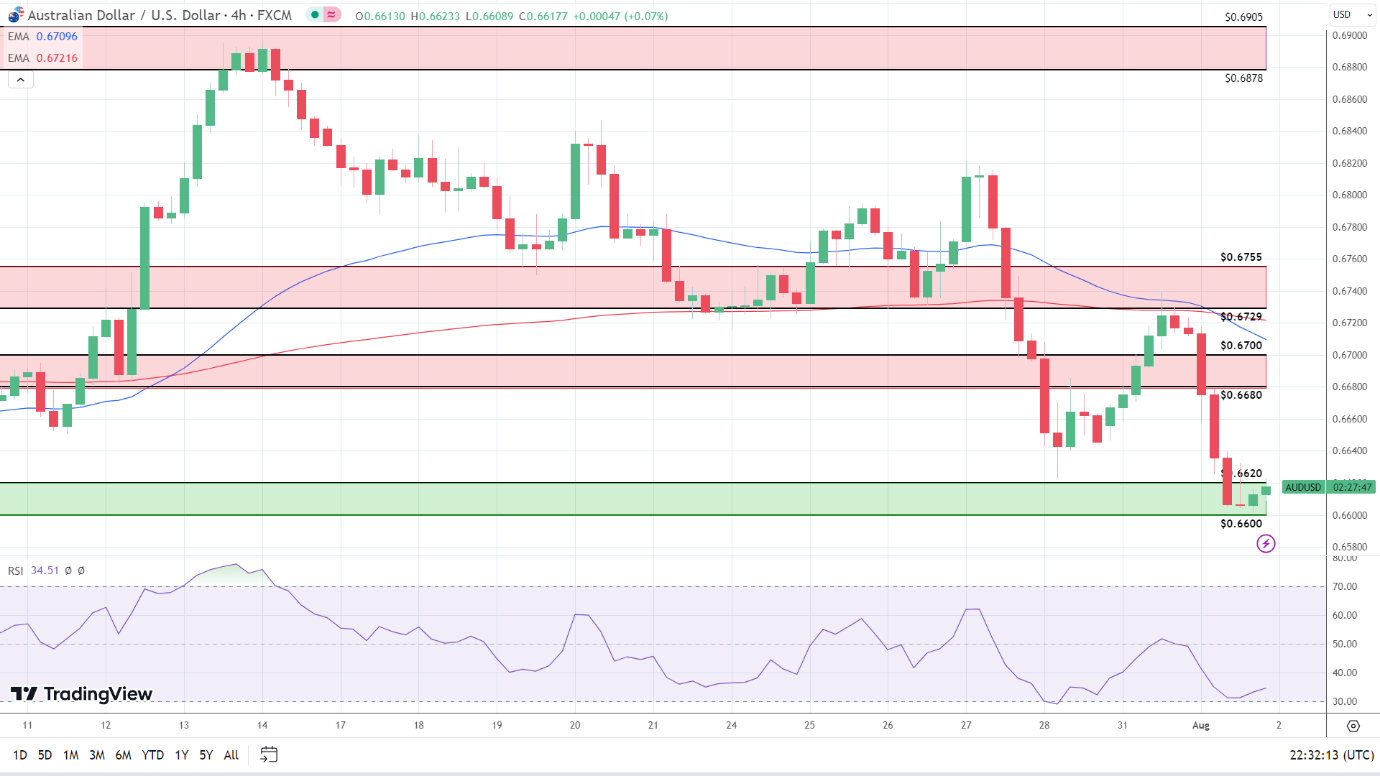
Looking at the 4-Hourly Chart, the AUD/USD sits within the $0.6620 – $0.6600 support band. The AUD/USD also remains below the 50-day ($0.67096) and 200-day ($0.67216) EMAs, sending bearish near and longer-term price signals.

Significantly, the 50-day EMA pulled back from the 200-day EMA after the Tuesday bearish cross, supporting a fall through the $0.6620 – $0.6600 support band. However, an AUD/USD move through the $0.6680 – $0.6700 resistance band would bring the 50-day EMA ($0.67096) into play.

Looking at the RSI indicator, the 14-4H RSI reading of 34.51 indicates bearish momentum, with selling pressure outweighing buying pressure. The RSI signals a fall through the $0.6620 – $0.6600 support band to sub-$0.66.

4-Hourly Chart sends bearish price signals.
AUDUSD 020823 4-Hourly Chart
The US stripped of AAA rating; Bitcoin now less volatile than stocks and gold

The US stripped of AAA rating; Bitcoin now less volatile than stocks and gold

The ASX 200 is set to open lower on Wednesday following a mixed session on Wall Street. At 8am AEST this morning, the ASX 200 index futures was pointing down by -0.55%.

Overnight, the S&P 500 fell by 0.26%, tech heavy Nasdaq by -0.43%, but blue chips Dow Jones finished 0.20% higher.

US investors assessed earnings results from big pharma against data showing manufacturing activity in the US slowed more than expected in July.

Pfizer fell -1.25% after saying it would launch a cost-cutting program if demand for its COVID-19 products remains muted this quarter.

Uber fell almost -6% despite reporting its first-ever quarterly operating profit. Total revenue grew 14% to $US9.2 billion during the quarter, but has missed analysts’ forecasts.

Keeping the Dow afloat meanwhile was construction and mining equipment maker Caterpillar, which rose 9% after reporting a rise in Q2 profits.

Elsewhere, the US has been stripped of its top tier AAA rating by Fitch Ratings.

Fitch downgraded long term US Treasuries from AAA – a rating it has enjoyed since 1994 – to AA+, while keeping the Outlook rating as ‘Stable’.

Fitch noted:

“The rating downgrade of the United States reflects the expected fiscal deterioration over the next three years, a high and growing general government debt burden, and the erosion of governance relative to ‘AA’ and ‘AAA’ rated peers over the last two decades that has manifested in repeated debt limit standoffs and last-minute resolutions.”

Downside risk in H2, but Australia may hold up – analyst

AI enthusiasm, cash on the sidelines, and resilient economic growth are supporting stocks in the near-term as the economy continues to slow down, slowly.

Despite that, Russell Investments sees risk skewed to the downside.

“A recession in the United States seems probable over the next 12-18 months,” said Andrew Pease, Russell Investment’s global head of investment strategy.

Pease added that identifying the investment winners and losers from AI is not clear-cut.

“The gains may end up more evenly shared between the users and creators of AI,” he said.

He also said the Australian economy is continuing to slow, but the probability of a recession remains lower than for countries in the northern hemisphere.

“Immigration levels are high, which will support economic activity,” he said.

“However, the increase in interest rates and the expiration of many fixed-rate mortgages over the last three months will further slow household spending.”


In other markets …

Gold fell -1% to US$1,943.66/oz ahead of US manufacturing and labour market data.

“Looking ahead to the second half of 2023, an economic contraction could bring additional upside for gold, further reinforcing its safe-haven asset status,” said a report from the World Gold Council.

Crude prices fell by around -0.5%, with WTI now trading at US$81.37 a barrel.

Iron Ore 62% fe dipped almost -4% to $US108.32/ a tonne.

Bitcoin meanwhile was modestly lower by -0.1% in the last 24 hours to US$29,194.

According to data from crypto research firm K33, BTC is now less volatile than traditional assets and indices like the Nasdaq, S&P 500, and even gold.

“But my short-term thesis is that the market’s volatility pressure is about to climax and that an eruption is near,” said Vetle Lunde, senior analyst at K33.

“The tricky job is to build an informed view of when the pressure gets too strong.”


5 ASX small caps to watch today

BCAL Diagnostics (ASX:BDX)
BCAL has announced breakthrough results and a major step towards commercialisation of its breast cancer diagnostic test. A clinical study it sponsored with Precion Inc. in North Carolina achieved an impressive sensitivity of 90% and a specificity of 85.5%. These results were consistent with the findings of earlier studies conducted in Australia using a different mass spectrometry platform. The company now expects first sales in the second half of 2024.

Midas Minerals (ASX:MM1)
Midas has received a further 147 assay results from its Yellowknife Lithium Project in Northwest Territories, Canada. Significant assay results from this batch include: 4.65%, 4.12%, 3.02%, 2.97%, 1.80% and 1.63% Li2O.

Westgold Resources (ASX:WGX)
Westgold has provided its production, cost and capital guidance for FY24. Production guidance is 245-265koz at an All-In Sustaining Cost (AISC) of $1,800 – $2,000/oz. Meanwhile, Westgold has delivered on its guidance in FY23, hitting the top end of production guidance and mid-point of costs.

Podium Minerals (ASX:POD)
Podium said that Sam Rodda has tendered his resignation as CEO effective immediately. With this resignation, the company will not have a full-time Managing Director for a period of time. Leadership of the company will be provided by Chairman Rod Baxter, who will assume executive responsibilities for an interim period as an Executive Director.

EDU Holdings (ASX:EDU)
EDU has cancelled its plan to acquire Nurse Training Australia (NTA). Completion of the acquisition was subject to NTA gaining reaccreditation of its Diploma of Nursing program by the Australian Nursing and Midwifery Accreditation Council (ANMAC). But after 12 months, the assessment is still ongoing without a timeframe.


China’s central bank favors downward interest rates for individual housing loans

China’s central bank favors downward interest rates for individual housing loans

BEIJING, Aug. 1 (Xinhua) — The People’s Bank of China made clear its stance of favoring downward interest rates and down payment ratio for individual housing loans at a work meeting held Tuesday.

The stance is part of the efforts to implement city-specific and differentiated housing credit policies and to better meet residents’ rigid and improved housing demand, according to the meeting jointly held by the central bank and the State Administration of Foreign Exchange on the work for the second half of the year.

The central bank said it would also continue to guide commercial banks to adjust the interest rates for existing personal housing loans in a timely manner according to laws.

To support the steady and sound development of the real estate market, the regulators acknowledged the necessity to keep real estate financing stable and orderly and increase financial support for housing leasing, the renovation of urban villages and the construction of affordable housing.

The meeting emphasized the need to coordinate efforts to defuse local debt risks through financial support and to enrich the tools and means for preventing and defusing systemic risks.

The meeting also proposed to strengthen and improve foreign exchange policies to maintain the sound operation of the foreign exchange market.

Other work mentioned at the meeting includes prudently promoting research and development of the digital yuan, simplifying procedures for foreign investors to invest in the Chinese market and diversifying the types of investable assets.

Unemployment fell by 10,968 people in July to its lowest in 15 years, chaining five consecutive months of declines

Unemployment fell by 10,968 people in July to its lowest in 15 years, chaining five consecutive months of declines

The number of unemployed people registered in the offices of the State Public Employment Service (SEPE), at the end of the month of July, has decreased by 10,968 (-0.41%) with respect to the previous month, chaining five months of consecutive decreases. The total number of unemployed remains below 2.7 million, specifically it stands at 2,677,874 unemployed and stops. It is the lowest figure for any month since 2008. In year-on-year terms, registered unemployment fell by 205,938 people (-7.14%). This percentage decrease reflects a very sharp drop given the stable conditions in which our labor market operates,

Russia will return to Black Sea grain deal when its interests are upheld – Kremlin

Russia will return to Black Sea grain deal when its interests are upheld – Kremlin

This content was produced in Russia, where the law restricts coverage of Russian military operations in Ukraine.

MOSCOW, Aug 2 (Reuters) –

The Kremlin on Wednesday restated its position on the Black Sea grain deal, saying it was ready to return to it “immediately” once the part that concerns Russia was implemented.

Kremlin spokesman Dmitry Peskov was commenting a day after the U.S. envoy to the United Nations said there were “indications” that Russia might be interested in returning to discussions about the deal, which had allowed Ukraine to export grain by sea.

Peskov also told reporters that President Vladimir Putin was holding a call on Wednesday morning with Turkey’s President Tayyip Erdogan, whose country brokered the deal along with the United Nations in July last year.

Moscow exited the deal last month, complaining that the international community had failed to ensure that Russia could also freely export its grain and fertiliser as part of that accord.

Asked about the issue, Peskov said: “Russia – and President Putin has said this 100 times already – is ready to immediately return to the deal itself… just the deal must be implemented in the part that concerns the Russian Federation. So far this has not been done, as you know.”

“The West imposed sanctions against Russia without taking into account the needs of the world community for food, the U.N. General Secretariat is well aware of this,” he added.

Russia’s grain and fertiliser exports are not subject to Western sanctions but Moscow has said restrictions on payments, logistics and insurance have been a barrier to shipments.

The deal aimed to alleviate a global food crisis, and grain prices have risen since Moscow let it expire on July 17. Ukraine and Russia are both leading grain exporters.

Nearly 33 million tonnes of Ukrainian grain was exported while the Black Sea deal was in operation. (Reporting by Reuters Writing by Gareth Jones; Editing by Mark Trevelyan)

AUD/USD Technical Analysis – The bears are looking to sell the rally

AUD/USD Technical Analysis – The bears are looking to sell the rally

The Fed raised rates by 25 bps as expected and kept everything unchanged. Fed Chair Powell didn’t hint to anything and just reaffirmed their data dependency keeping all the options on the table. The data since the FOMC meeting has been support the soft-landing narrative as the labour market data remained strong and the inflation data missed expectations.

The RBA, on the other hand, kept its cash rate unchanged with a slight tweak to a line in the policy statement that suggests that they are leaning more on the dovish side. The data makes their job harder as the Australian Jobs report surprised again to the upside but the Inflation report missed expectations. Nonetheless, they will see more data now before the next meeting and can make a better informed choice.

AUDUSD Technical Analysis – Daily Timeframe

AUDUSD Daily

On the daily chart, we can see that AUDUSD has eventually reached the 0.6563 support where we can now expect the buyers stepping in with a tight risk below the level. In fact, the recent selloff got a bit overstretched as depicted by the price distance from the blue 8 moving average. In such instances, we can generally see pullbacks or some consolidation before the next move.

AUDUSD Technical Analysis – 4 hour Timeframe

AUDUSD 4 hour

On the 4 hour chart, we can see that the first target for the buyers should be the resistance at 0.6630 where we can find the previous swing low level, the 38.2% Fibonacci retracement level and the daily blue 8 moving average for confluence. This is also the resistance zone where the sellers are likely to pile in with a defined risk above the level and target a break below the 0.6563 support.

AUDUSD Technical Analysis – 1 hour Timeframe

AUDUSD 1 hour

On the 1 hour chart, we can see that we have a divergence with the MACD which is generally a sign of weakening momentum often followed by pullbacks or reversals. This setup increases the chances of getting the pullback into the resistance zone, but if it fails and the price falls with conviction below the support, the sellers are likely to pile in and increase the bearish momentum.

Upcoming Events

Today the only notable event will be the US ADP report, which is generally a less reliable report than the NFP, but it can still be market moving. Tomorrow, the market will be focused on the US Jobless Claims and the ISM Services PMI data. On Friday, we will finally see the latest NFP report. Strong data should support the USD, while weak figures are likely to weigh on the greenback in the short-term.

New Zealand employment up 1% in Q2, wage inflation unchanged at 4.3% yoy

New Zealand employment up 1% in Q2, wage inflation unchanged at 4.3% yoy

New Zealand reported a better-than-expected employment growth of 1.0% in the second quarter of 2023, surpassing market expectations of a 0.6% rise. On the other hand, unemployment rate slightly increased from 3.4% to 3.6%, marginally above the anticipated 3.5%.

The data released showed that employment rate rose from 69.6% to 69.8%, and the participation rate increased from 72.0% to 72.4%. These are the highest rates recorded since the series began in 1986.

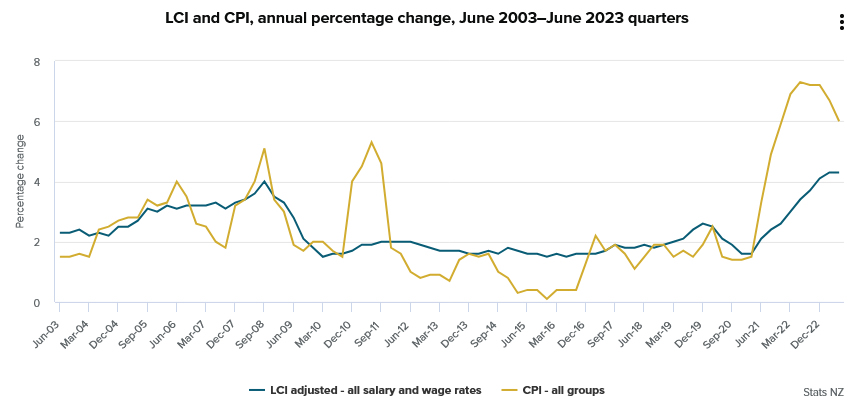
In terms of wage growth, all sector wage inflation climbed by 1.1% on a quarterly basis, resulting in an annual increase of 4.3%. “Annual wage costs continued to increase at historically high rates this quarter, equal to the 4.3 percent annual increase last quarter,” said Bryan Downes, business prices delivery manager.

Downes noted that the most significant contribution to the Labour Cost Index for the June 2023 quarter came from retail trade and accommodation industry. This sector witnessed 1.5% increase in wages on a quarterly basis, following 0.7% rise in the previous quarter. The wage growth in this industry was primarily driven by rise in minimum wage, thereby pushing up overall wage growth during the quarter.