Gold Price Forecast: XAU Safe-Haven Buying Tied to Fitch’s US Credit Downgrade

Gold Price Forecast: XAU Safe-Haven Buying Tied to Fitch’s US Credit Downgrade

Fitch Downgrade Spurs Gold Surge

The catalyst behind this surge was Fitch’s unexpected decision to downgrade the United States’ highly coveted triple-A credit rating to AA+. The move by Fitch cited concerns over the country’s fiscal deterioration and rising government debt burden in the next three years. As confidence in the economy waned, investors flocked to the safety of gold, driving its demand higher.

Trading Derivatives carries a high level of risk to your capital and you should only trade with money you can afford to lose. Trading Derivatives may not be suitable for all investors, so please ensure that you fully understand the risks involved, and seek independent advice if necessary. A Product Disclosure Statement (PDS) can be obtained either from this website or on request from our offices and should be considered before entering into a transaction with us. Raw Spread accounts offer spreads from 0.0 pips with a commission charge of USD $3.50 per 100k traded. Standard account offer spreads from 1 pips with no additional commission charges. Spreads on CFD indices start at 0.4 points. The information on this site is not directed at residents in any country or jurisdiction where such distribution or use would be contrary to local law or regulation.

In the past, a credit rating downgrade had sent markets into a frenzy. However, this time, the initial reaction seemed calmer. Nonetheless, experts are keeping a close eye on the unfolding situation, recognizing the potential impact on the markets going forward.

Gold, denominated in U.S. dollars, has long been favored as a safe-haven investment during times of economic uncertainty and stress.

Traders Eyeing Non-Farm Payrolls Data

As the greenback strengthened following solid data on U.S. manufacturing and construction in June, gold experienced a 1% drop and hit a three-week low. Despite this temporary setback, all eyes are now fixated on the non-farm payrolls report set to release on Friday, which will be a crucial indicator of the U.S. economy’s health. Expectations are that job numbers will rise by 200,000 in July, following a solid increase of 209,000 in June.

Global Central Bankers Aim to Manage Inflation

U.S. central bankers, while expressing hope in managing inflation without harming job opportunities, have acknowledged that higher interest rates will be necessary for some time. The rise in interest rates poses a challenge for gold investors, as it increases the cost of holding the precious metal, which bears no yield and requires money for storage and insurance.

WGC Predicts Drop in India’s Gold Demand

In addition to the U.S. economic situation, the World Gold Council (WGC) brings focus to India’s gold market. The WGC predicts that India’s gold demand for 2023 may experience a 10% decline from the previous year, reaching the lowest levels in three years. The country’s retail purchases are being dampened by record-high gold prices. The reduced gold imports may have broader implications, as it could narrow India’s trade deficit and provide support for the Indian rupee.

Short-Term Outlook:  Bearish, but Fitch Downgrade is New Bullish Wildcard

As investors navigate uncertain economic waters, the gold market remains a key focal point. With global events and economic indicators at play, traders must stay vigilant for potential bullish or bearish outcomes in the precious metal market.

Technical Analysis

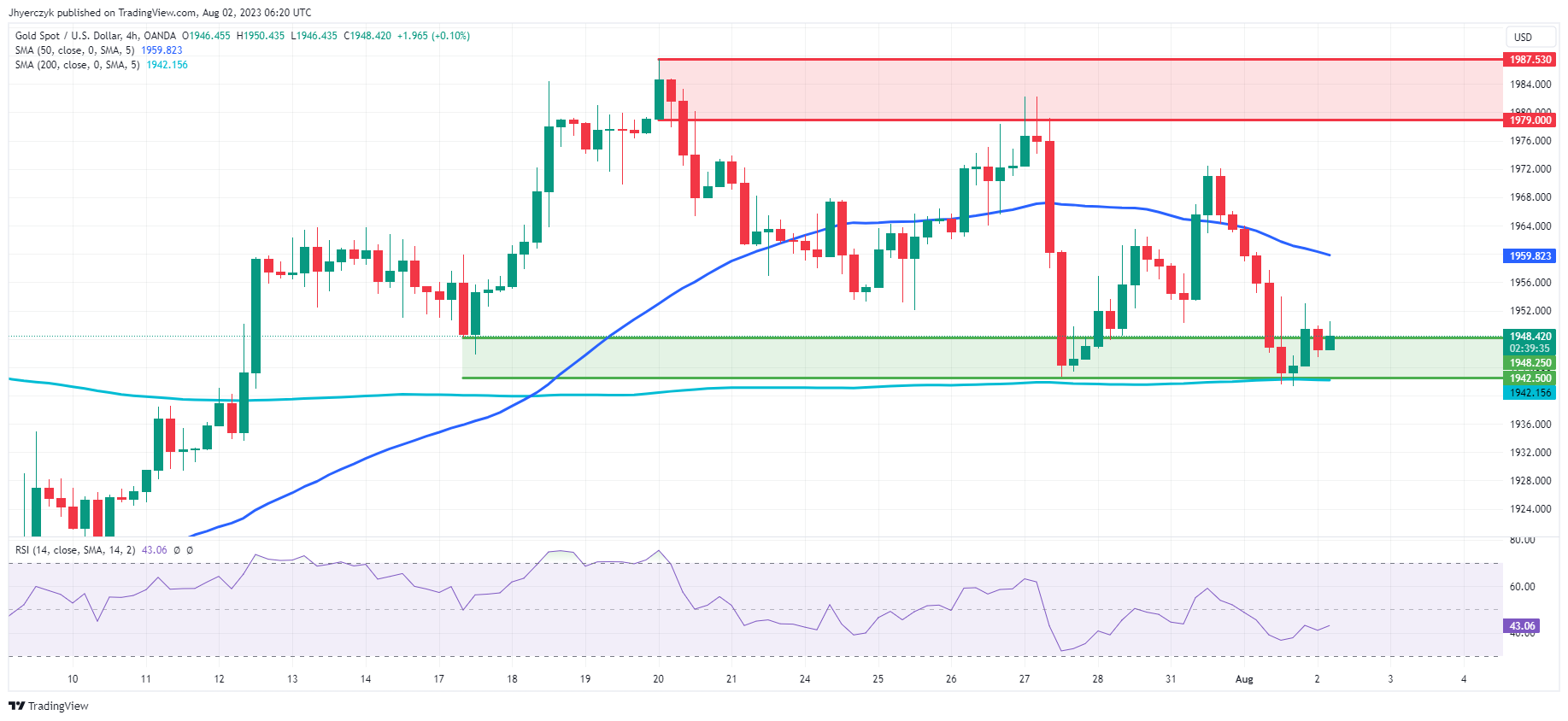
4-Hour Gold (XAU)Gold (XAU) is showing a mixed market sentiment on the 4-hour chart. The current price stands at 1948.60, higher than the previous close of 1946.55, suggesting a short-term bullish sentiment.

However, the price is below the 50-4H moving average (1959.82), indicating some bearish pressure. The 200-4H moving average (1942.15) serves as strong support. The 14-4H RSI reading of 43.06 suggests weaker momentum.

The main support area lies between 1942.50 and 1948.25, while the main resistance area extends from 1979.00 to 1987.53. Traders should closely monitor these levels for potential trading opportunities.

Asian Markets Skittish Following Fitch’s US Rating Downgrade; Commodity Currencies Bear the Brunt

Asian Markets Skittish Following Fitch’s US Rating Downgrade; Commodity Currencies Bear the Brunt

Market sentiment in Asia today leans heavily toward risk aversion, following the unexpected move by Fitch Ratings to downgrade US sovereign rating. Consequently, commodity currencies are grappling with strong sell-offs. New Zealand Dollar is leading the downward spiral, despite strong wage growth reflected Q2’s employment data. Australian Dollar, still reeling from the aftereffects of yesterday’s RBA decision, is also on a downward trajectory, breaking through key short-term support levels against both Dollar and Euro. Canadian Dollar is faring slightly better, although it’s also notably weak.

Amid this atmosphere of risk aversion, Yen is attempting a recovery, albeit with limited momentum so far. Dollar remains robust but is battling to break free from its current range against Euro. Market attention now turns to today’s ADP employment report, with traders likely holding off on significant bets until Friday’s non-farm payroll figures. Meanwhile, Euro leads the pack among European majors, but they’re actually just range bound against each other.

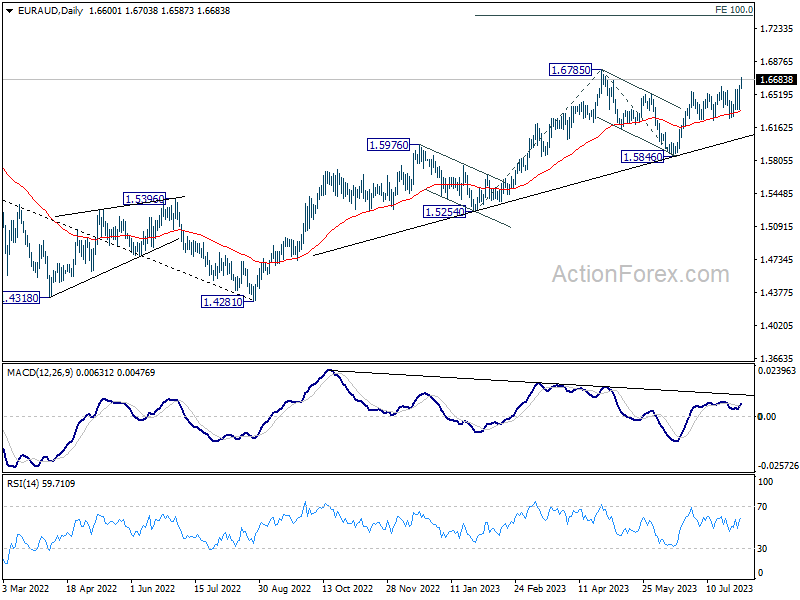
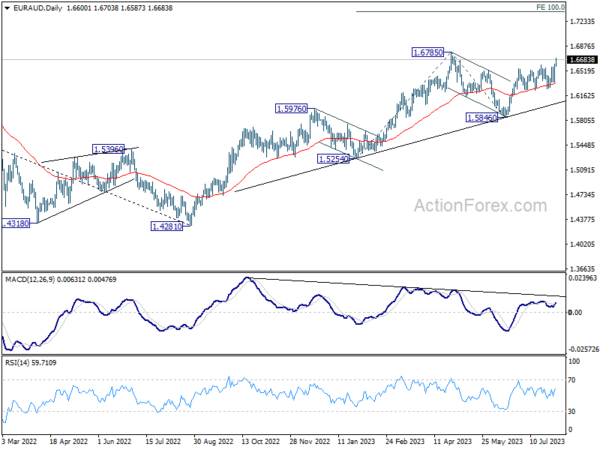
Technically, EUR/AUD finally looks ready to resume medium term up trend with today’s strong rally. Immediate focus for the next few days is 1.6785 high. Decisive break there will set the stage for 100% projection of 1.5254 to 1.6785 from 1.5846 at 1.7377. Judging from current sluggishness in EUR/USD, extended rally in EUR/AUD would more likely be accompanied by deeper fall in AUD/USD, probably through 0.6457 support if EUR/AUD breaks 0.6785 decisively.
At the time of writing, Nikkei is down -2.31%. Hong Kong HSI is down -2.17%. China Shanghai is down -0.99%. Singapore Strait Times is down -1.32%. Japan 10-year JGB yield is up 0.034 at 0.628. Overnight, DOW rose 0.20%. S&P 500 dropped -0.27%. NASDAQ dropped -0.43%. 10-year yield rose 0.092 to 4.051.

Fitch cuts US sovereign rating on steady deterioration in standards of governance

Asian stock markets took a significant plunge following Fitch Ratings’ surprise decision to downgrade US sovereign rating from AAA to AA+. This move mirrors S&P Global Ratings’ decision made over a decade ago, causing considerable unrest among investors.

Fitch’s statement highlighted, “In Fitch’s view, there has been a steady deterioration in standards of governance over the last 20 years, including on fiscal and debt matters, notwithstanding the June bipartisan agreement to suspend the debt limit until January 2025.”

US Treasury Secretary Janet Yellen fiercely contested the downgrade, calling it “arbitrary and based on outdated data.” The White House has also voiced opposition to Fitch’s assessment, with press secretary Karine Jean-Pierre declaring, “It defies reality to downgrade the United States at a moment when President Biden has delivered the strongest recovery of any major economy in the world.”

Fed Goolsbee: Every meeting is live around transition point

Chicago Fed President Austan Goolsbee has refrained from pre-committing to Fed’s actions in September, insisting that every meeting is crucial when navigating the transition point. “When you’re around the transition point, every meeting is a live meeting and you’re trying to figure out trends, not just reflect one month’s data,” Goolsbee said yesterday.

Goolsbee is “guardedly optimistic” about Fed’s ability to stick to what he terms the “golden path,” bringing down prices without inducing a recession. He emphasized the importance of watching how core goods and housing inflation evolve in the coming months to remain on this path.

“Those are the two components that over the next three to six months, let’s call it, if we are to succeed to stay on the golden path, we’ve got to see progress on those two parts of inflation,” he said. He added that progress on services inflation isn’t currently necessary.

He also shared his perspective on the link between wages and inflation, suggesting that wages are more of a lagging indicator rather than a predictor of inflation. According to Goolsbee, if Fed officials focus too much on wages when shaping their policy, they could risk overshooting interest rates.

Fed Bostic warns of overtightening risks, advocates for cautious approach

Yesterday, Atlanta Fed President Raphael Bostic expressed guarded optimism and highlighted the “significant progress” in controlling inflation. He observed, “Inflation is well off its highs that we saw in the last year. And recent numbers have come in promising in ways that suggest that we might be seeing continued declines.”

Bostic pointed to the ongoing economic evolution as in line with an “orderly slowdown,” which he views as “quite promising”. As such, he advocated to be cautious, patient and resolute” in policy-making.

He also voiced concerns about the risk of overtightening monetary policy. “I think we are in a phase now where there is some risk of us overtightening. And so we’ve just got to have that in mind,” he said. By exercising appropriate caution, Bostic believes that the damage to employment can be minimized.

Looking forward, Bostic said, “My baseline outlook doesn’t contemplate any cuts until the second half of next year at the earliest.” He insists on being “resolute to make sure that we don’t move our policy posture in a different direction until we’re absolutely, absolutely certain that inflation is going to get to our target.”

BoJ Uchida: Monetary easing to continue to nurture firms’ changing pricing strategies

BoJ Deputy Governor Shinichi Uchida highlighted in a speech today an emerging trend in firms’ pricing strategies, noting that “firms are developing more forward-looking strategies for setting prices.” According to Uchida, these changes “might be the chance to finally change Japan’s economy.” Hence, he emphasized BoJ will “patiently continue with monetary easing to carefully nurture these signs.”

Uchida was explicit in outlining the Bank’s monetary policy stances. Firstly, he ruled out near-term adjustments to short-term interest rate, currently at -0.10%, stating “there is still a long way to go before such decisions are made.”

Secondly, BoJ will “maintain the current framework” until sustainable and stable achievement of 2% inflation target “come in sight”.

Thirdly, Uchida affirmed the ongoing yield curve control under the present policy framework, aiming to balance its benefits and drawbacks, especially in relation to financial intermediation and the market.

Despite the high economic and price outlook uncertainty, Uchida stated the recent yield curve control modification, allowing the 10-year JGB yield to rise to up to 1%, is aimed at sustaining the ultra-loose policy. “Needless to say, we do not have an exit from monetary easing in mind,” he emphasized.

New Zealand employment up 1% in Q2, wage inflation unchanged at 4.3% yoy

New Zealand reported a better-than-expected employment growth of 1.0% in the second quarter of 2023, surpassing market expectations of a 0.6% rise. On the other hand, unemployment rate slightly increased from 3.4% to 3.6%, marginally above the anticipated 3.5%.

The data released showed that employment rate rose from 69.6% to 69.8%, and the participation rate increased from 72.0% to 72.4%. These are the highest rates recorded since the series began in 1986.

In terms of wage growth, all sector wage inflation climbed by 1.1% on a quarterly basis, resulting in an annual increase of 4.3%. “Annual wage costs continued to increase at historically high rates this quarter, equal to the 4.3 percent annual increase last quarter,” said Bryan Downes, business prices delivery manager.

Downes noted that the most significant contribution to the Labour Cost Index for the June 2023 quarter came from retail trade and accommodation industry. This sector witnessed 1.5% increase in wages on a quarterly basis, following 0.7% rise in the previous quarter. The wage growth in this industry was primarily driven by rise in minimum wage, thereby pushing up overall wage growth during the quarter.

Looking ahead

Swiss SECO consumer climate and PMI manufacturing are the main features in European session. US will release ADP private employment later in the day.

AUD/USD Daily Report

Daily Pivots: (S1) 0.6569; (P) 0.6647; (R1) 0.6692; More…

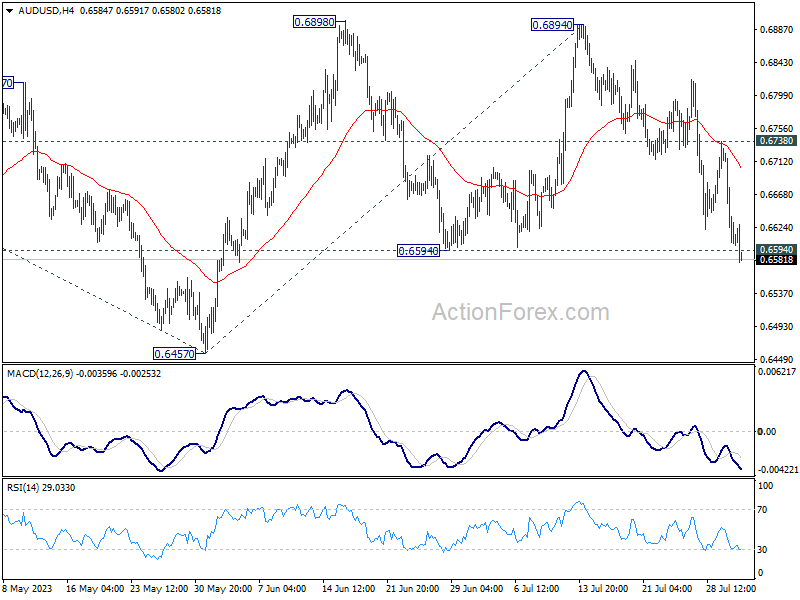
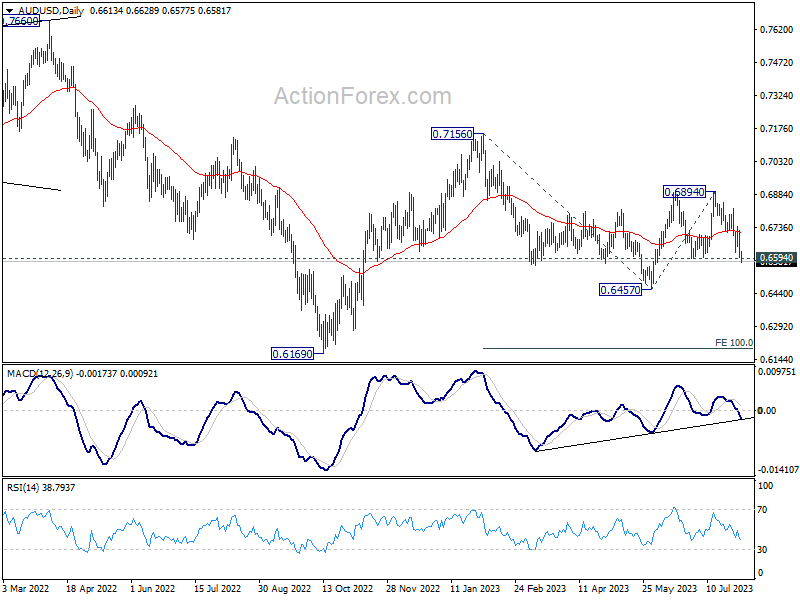
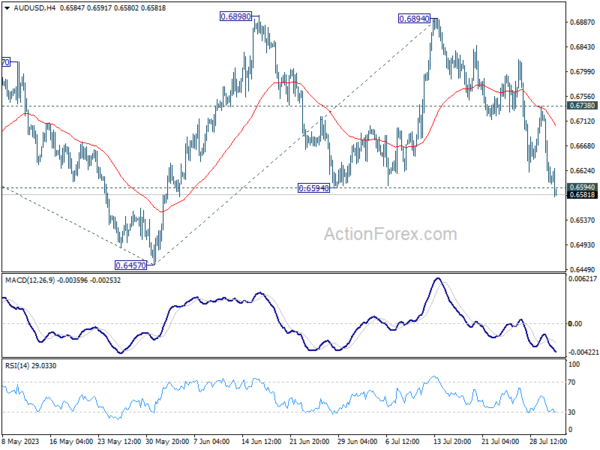
AUD/USD’s break of 0.6594 support argues that rebound from 0.6457 has completed at 0.6894 already. Intraday bias is back on the downside for 0.6457. Break there will resume the fall from 0.7156 to 100% projection of 0.7156 to 0.6457 from 0.6894 at 0.6195. For now, risk will stay mildly on the downside as long as 0.6738 resistance holds, in case of recovery.
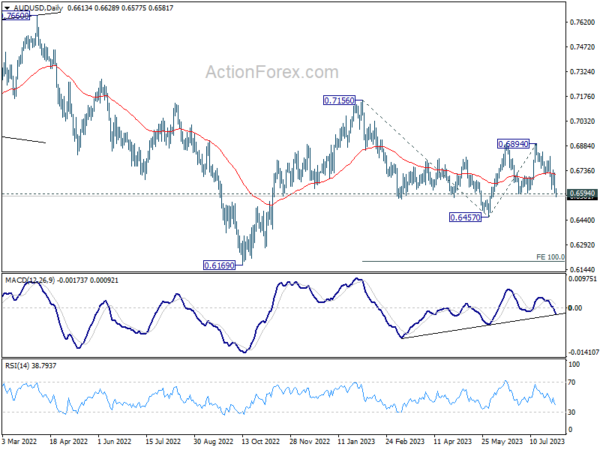
In the bigger picture, outlook is mixed for now as AUD/USD failed to sustain above both 55 D EMA (now at 0.6713) and 55 W EMA (now at 0.6784). On the upside, break of 0.65898 resistance will solidify the case that down trend from 0.8006 (2021 high) has already completed, and target 0.7156 resistance for confirmation. However, break of 0.6457 will likely resume the down trend through 0.6169 (2022 low).

EUR/USD holds recovery near 1.1000 ahead of US ADP jobs data

EUR/USD holds recovery near 1.1000 ahead of US ADP jobs data

EUR/USD is holding recovery gains near 1.1000 in the early European session on Wednesday. The pair is finding support from a broadly weaker US Dollar, as investors stay cautious amid the US debt rating downgrade and ahead of the key US ADP jobs data.

The EUR/USD dropped modestly on Tuesday, and the bias is to the downside; however, the pair has been able to remain above an uptrend line and above the strong support area of 1.0950/60. A break below this support level could trigger an acceleration to the downside towards 1.0910, where the 55 and 100-day Simple Moving Averages await. On the upside, the Euro needs to rise above 1.1070 (20-day SMA) to improve the outlook.

On the 4-hour chart, the pair is rebounding from a trendline, and technical indicators are starting to show the Dollar’s strength is fading. The Momentum is moving north, approaching the middle line, and the Relative Strength Index (RSI) is bouncing from near 70. However, price remains under the 20-SMA. A recovery above 1.1000 would indicate that the Euro could recover further, with the focus turning to 1.1050.

The EUR/USD dropped towards last week’s lows, but it remained above and rebounded, trimming losses during the American session. The pair held above the important support area of 1.0950. The dollar stays resilient, but momentum appears to be fading. Incoming US data and market sentiment are likely to be key drivers.

The Final Eurozone PMI showed little change, with the headline remaining at 42.7, and Germany’s at 38.8. The German Unemployment rate fell in July to 5.6%. The interest rate market suggests that the odds of another rate hike from the European Central Bank (ECB) are below 40%.

The US Dollar lost strength versus the Euro following mixed US data. The JOLTS Job Openings report came in below expectations at 9.58 million. The ISM Manufacturing PMI in July rose to 46.4, below the market’s expectation of 46.8. The Price Paid index fell from 41.8 to 42.6, and the Employment Index declined from 48.1 to 44.4. Despite the numbers, US yields moved modestly higher.

The Greenback remains strong, but the momentum versus the Euro is waning. On Wednesday, the focus will be on more US employment data with the ADP report, with the focus set on Friday’s Nonfarm Payrolls.

A second wave of inflation could dash US rate cut hopes

A second wave of inflation could dash US rate cut hopes

The US could experience a second wave of inflation, perhaps starting as soon as the next Consumer Price Index (CPI) data to be reported, according to StoneX market strategist Vincent Deluard. Inflation could pick up to a 3.5% annual rate in July due to base effects and a rally in the oil price, now over $80 per barrel from under $70 earlier this year. Such a second wave would echo history. Moreover, identifiable economic shocks could take inflation higher. Traders expecting the Fed not to raise rates this year, and to enact progressive interest cuts next year, could well be disappointed in inflation rises.

Euro area unemployment at 6.4%

Euro area unemployment at 6.4%

In June 2023, the euro area seasonally-adjusted unemployment rate was 6.4%, stable compared with May 2023 and down from 6.7% in June 2022. The EU unemployment rate was 5.9% in June 2023, also stable compared with May 2023 and down from 6.1% in June 2022. These figures are published by Eurostat, the statistical office of the European Union. Eurostat estimates that 12.802 million persons in the EU, of whom 10.814 million in the euro area, were unemployed in June 2023. Compared with May 2023, unemployment decreased by 2 thousand in the EU and by 62 thousand in the euro area. Compared with June 2022, unemployment

German labour market shows very first cracks

German labour market shows very first cracks

German unemployment increased by 62,000 in July, raising the number of unemployed to 2.617 million. The seasonally-adjusted unemployment rate, however, dropped to 5.6%, from 5.7% in June. For those who want to find some sign of weakening in the labour market, today’s report brought some reassurance: the July increase was the second largest July increase of the last 10 years. Compared with last year, unemployment was up by almost 150,000.

FIrst cracks in the labour market

The strong labour market has been an important driver of the economy’s resilience over the last few years. A combination of fiscal stimulus, furlough schemes and demographic change seems to have made the German labour market almost invincible. Now, however, it is showing some cracks. For the current wage negotiations, these first signs of cooling will be too small to have a significant impact. We still expect wage growth of around 5% this year and 4% in 2024. Not included in these numbers are one-off payments that have become more popular in wage bargaining since the government announced it would exempt one-off payments of up to 3000 euros from taxes and social contributions to help alleviate the impact of rising inflation.

The stagnating economy has dampened recruitment plans, both in the manufacturing and services sectors. The longer economic growth remains sluggish and uncertainty persists, the higher the likelihood that unions and employees will increasingly opt again for job security rather than high wage growth. As a result, the current wave of surging wages should be temporary and will represent more of a ‘catch-up’ after years of falling purchasing power, rather than a textbook-style wage-price spiral.

German labour market shows very first cracks

EURCHF current upleg could have legs

EURCHF current upleg could have legs

Technical Analysis – EURCHF current upleg could have legs

EURCHF is trading sideways today, a tad above the new 2023 low of 0.9521 recorded on July 27. This was the lowest print of the pair since September 29, 2022 as the bears finally staged their much-anticipated breakout from the 10-month-old rectangle.However, the good news for the bears appears to stop here as the momentum indicators are gradually turning in favour of the bulls. More specifically, the Average Directional Movement Index (ADX) traded to the highest level since December 2021, but it is now moving aggressively lower. This could be seen as a sign that the recent bearish trend has run its course. Similarly, the stochastic oscillator is preparing to rise above its oversold territory. If this move actually takes place, it could be a strong signal for the start of a bullish move.

Should the bulls feel inspired by the momentum indicators, they would like to reclaim the key 0.9650-0.9665 range that is defined by the January 15, 2015 low and the 23.6% Fibonacci retracement of the June 9, 2022 – September 26, 2022 downtrend respectively. Even higher, the 0.9706 area, populated by the November 14, 2022 low and the 50-day simple moving average (SMA), should prove stronger to overcome. If successful, the bulls could start thinking about pushing EURCHF back inside the recent rectangle.

On the flip side, the bears look determined to push EURCHF even lower. The first obstacle appears to be the August 23, 2022 low at 0.9552 and the recent 2023 low at 0.9521. Breaking these levels would mean that the door would be wide open for a more sizeable move towards the 0.9403 area, and the chance to record a new all-time low. To sum up, the bears remain in control of the market but there is increasing bullish pressure which could quickly gain traction if the bulls stage a rally above the 0.9665 area.

Rise in production fails to prevent further deterioration of CA operating conditions in July

Rise in production fails to prevent further deterioration of CA operating conditions in July

Canada’s manufacturing sector remained in contraction territory during July, but only just as a marginal rise in output and a weaker fall in new orders were registered. Job cuts were, however, more prominent, whilst there were accelerations in both input and output price inflation. Firms retained some confidence for the future, with sentiment picking up to a four-month high. The seasonally adjusted S&P Global Canada Manufacturing Purchasing Managers’ Index® (PMI®) posted below the 50.0 no-change mark for a third month running in July. However, rising to 49.6, from 48.8 in June, the headline index pointed to the

Australia’s central bank leaves rates unchanged at 4.1%

Australia’s central bank leaves rates unchanged at 4.1%

The Reserve Bank of Australia held interest rates at 4.1% for a second month on Tuesday as the central bank buys time to assess the impact of previous hikes, while warning of further hikes in the future.

This decision to hold rates steady comes as inflation in Australia slowed to 6% in the second quarter from 7% in the first quarter, but was still well above the RBA’s stated target of 2% to 3%.

Economists were divided on whether the Australian central bank would raise interest rates at this meeting, with a slim majority expecting a 25-basis point hike.

“The higher interest rates are working to establish a more sustainable balance between supply and demand in the economy and will continue to do so,” Governor Philip Lowe said in a statement.

“In light of this and the uncertainty surrounding the economic outlook, the Board again decided to hold interest rates steady this month. This will provide further time to assess the impact of the increase in interest rates to date and the economic outlook,” he added.

The Australian dollar extended earlier losses against the dollar after the announcement. It was trading down almost 0.7% at at about 0.67 to the dollar in afternoon trading in Asia.

The Australian central bank has hiked interest rates by a cumulative 400 basis points since May last year to its highest in 11 years. The country has been grappling with surging inflation as economic activity picked up after the height of the Covid-19 pandemic.

“While the RBA retains a tightening bias, we expect the hurdle to another rate is high,” Commonwealth Bank of Australia economists said in a note. “It would take an upside surprise to the economic data from here, namely on prices and/or wages, for the RBA to shift its assessment of the outlook.”

Forward guidance

In his August policy statement, the RBA governor pointed to several “significant uncertainties.”

Among them is the lag time that policy takes root in the real economy, and how firms’ pricing decisions and wages will respond to the slowing economy at a time when the labor market remains tight.

Lowe pointed to consumption growth that has substantially slowed due to cost of living pressures and higher interest rates.

“The central forecast is for CPI inflation to continue to decline, to be around 3.25% by the end of 2024 and to be back within the 2-3 per cent target range in late 2025,” Lowe said.

“Some further tightening of monetary policy may be required to ensure that inflation returns to target in a reasonable timeframe, but that will depend upon the data and the evolving assessment of risks,” he added.

Tuesday’s RBA policy meeting is Philip Lowe’s penultimate meeting as governor. Michele Bullock is set to succeed him when he finishes a seven-year term in office on Sept. 17.