Underlying inflation has slipped below 6%, but is the slide enough to stop the RBA pushing up rates further?

Underlying inflation has slipped below 6%, but is the slide enough to stop the RBA pushing up rates further?

Australia’s inflation rate has fallen for the second consecutive quarter.

After reaching a 30-year high of 7.8% at the end of 2022, annual inflation as measured by the Bureau of Statistics’ quarterly Consumer Price Index slid to 7% in the March quarter of 2023, and fell further to 6% in the June quarter.

The quarterly results are consistent with the newer monthly measure of annual inflation which has also been falling since hitting a high of 8.4% in December.

The monthly measure slid to 5.4% in June.

Helping bring inflation down were state government electricity rebates and cuts in the prices some households paid for medicines.

The prices of new dwellings grew more slowly as demand eased and problems with the supply of materials improved.

Conversely, there were sharp increases in the prices of insurance and some other financial services.

The bureau’s measure of rents (which covers rents paid in distinction to more widely quoted measures of rents advertised) grew by 6.7% in the year to June, up from 4.9% in the year to March, and the most since 2009.

Underlying inflation down

To get a better idea of what would be happening were it not for some of these unusual and outsized moves, the bureau calculates what it calls a trimmed mean measure of “underlying” inflation.

This excludes the 15% of prices that climbed the most in the quarter and the 15% of prices that climbed the least or fell.

This measure, closely watched by the Reserve Bank, is also falling and is now 5.9%.

The fall in Australia’s inflation is in line with falls in other Western nations including the United States, Canada and the United Kingdom. They have been brought about by an easing of supply bottlenecks and slowing economic activity in response to increases in interest rates.

An exception is China, which has almost no inflation.

Much of the slide in Australia’s inflation rate reflects weaker economic growth.

The economy grew only 0.2% in the March quarter. The Reserve Bank believes it grew by only that much again in the June quarter.

Consumer climate recovers losses from previous month

Consumer climate recovers losses from previous month

Consumer climate recovers losses from previous month

Following the slight decline in the previous month, consumer sentiment stabilized again in July. Income expectations increased slightly, while economic expectations and the propensity to buy remained virtually unchanged from June. GfK is forecasting -24.4 points in consumer sentiment for August, up 0.8 points from July of this year (revised -25.2 points). These are the findings of the GfK Consumer Sentiment Study for July 2023.

With this slight increase, the consumer climate fully compensates for the losses it suffered in the previous month, although the propensity to buy and the propensity to save remain virtually unchanged compared with the previous month. “Currently, only income expectations are contributing to the improvement in consumer sentiment. The main reason for the decrease in pessimism is the hope of declining inflation rates,” explains GfK consumer expert Rolf Bürkl. “This has somewhat improved the chances of consumer sentiment resuming its recovery course. However, the level will still remain low in the coming months, and private consumption will therefore not be able to make a positive contribution to overall economic development.”

Income expectations at highest level since February 2022

Private households are currently more optimistic about their income expectations, probably because prices are rising less sharply. The indicator gained 5.5 points, climbing to a total of -5.1 points. This is the best value since the outbreak of the war in Ukraine. The measurement in February 2022 was 3.9 points.

This actually represents an increase of 40.6 points compared to the same period of the previous year. Nevertheless, the income indicator will remain affected in the coming months by the inflation-related loss of household purchasing power.

Propensity to buy continues its stable development at a low level

Unlike income expectations, the propensity to buy can hardly increase. The indicator has gained a marginal 0.3 points, climbing to -14.3 points. It is thus almost at the same level as in the previous year (July 2022: -14.5 points).

The stagnation of consumer buying at a low level is attributable to the continuing high level of uncertainty among consumers. High food and energy prices, the ongoing war in Ukraine, and concerns about rising costs due to real estate renovation measures as a result of the heating law are currently causing consumers to be more cautious with their planned purchases.

Economic optimism remains unchanged

The weakening of economic sentiment seen in the previous two months has been halted – at least for now. The indicator remained virtually unchanged in July compared with the previous month. Economic expectations continue to remain at 3.7 points. This represents an increase of almost 22 points compared to the previous year.

Stable employment continues to be a key pillar of the German economy. However, the monetary policy of the European Central Bank (ECB) is causing uncertainty among consumers. On the one hand, it is certainly necessary to bring inflation back to an acceptable level through a more restrictive monetary policy. On the other hand, there is a risk that an overly restrictive monetary policy will lead the already struggling economy further into recession. The coming months will show to what extent the ECB’s chosen path has produced the desired result.

The boomers boosting inflation as the RBA lifts rates to fight it

The boomers boosting inflation as the RBA lifts rates to fight it

In the fight to bring down inflation the Reserve Bank has smashed the more than one in three Australians with home loans by dramatically raising interest rates on repayments.

But a further third of our society have paid off their housing.

They tend to be older and they’re enjoying higher asset prices and bigger returns from their savings.

Data shows they’re spending at a rate far exceeding inflation — working against the goal of lowering the temperature of the economy.

This has a growing number of experts questioning whether interest rates should be used as almost the sole tool to tackle the inflation crisis.

Aquaculture expert Greg Jenkins has benefited from interest rates climbing at the steepest rate in the history of our economy.

On the verandah of his home on the outskirts of Perth, he’s looking forward to imminent retirement and some big trips.

Greg Jenkins 2

Greg Jenkins is recovering from surgery, considering retirement and reading up on road trips.(ABC News: Phil Hemingway)

“My wife and I, never been better,” he says.

“We don’t pay a mortgage, the stock market’s earned a 9 per cent increase in the year.

“The interest rates actually make it better for us because we’re earning more money on deposits.”

And that rising wealth has sent a clear signal: spend.

“We’ve probably spent more money in the last two years than we have in the last 20.”

But Greg isn’t happy about it.

“We’re not paying the price,” he says.

“I can guarantee that decades ago, when people got together and decided that interest rates were going to be the lever to control inflation, none of those people had mortgages.

“It doesn’t impact them, it doesn’t impact us. It’s not right.”

Asia Day Ahead: Lukewarm Reaction to Fed Meeting

Asia Day Ahead: Lukewarm Reaction to Fed Meeting

In a widely expected move, the Federal Reserve (Fed) hiked its policy interest rate by 25 basis-point (bp) to the 5.25%-5.5% range and left the door open for another hike in September. But given that Fed Chair Jerome Powell also guided for rate decisions to be on a “meeting-by-meeting” basis, additional tightening moves still lack commitment at current point in time. In light of the Fed’s data-dependent stance, along with the broader trend of moderating US inflation, Fed rate expectations remained firm for an extended pause through the rest of the year.

Perhaps something to keep on the back of mind is that the Fed Chair still does not see inflation returning to the Fed’s 2% inflation goal until 2025, which may suggest that he foresees a more arduous process in pushing pricing pressures down moving forward. The abating of base effects and some firming in commodities prices lately could present some potential challenges.

Wall Street managed to pare earlier losses to close flat for the day, with after-market moves edging higher on Meta’s results. A beat on all fronts (top and bottom line, active users base, average revenue per user), along with a better-than-expected guidance for the third quarter, were more than sufficient to put a 6.8% gain in its share price in after-hours trading.

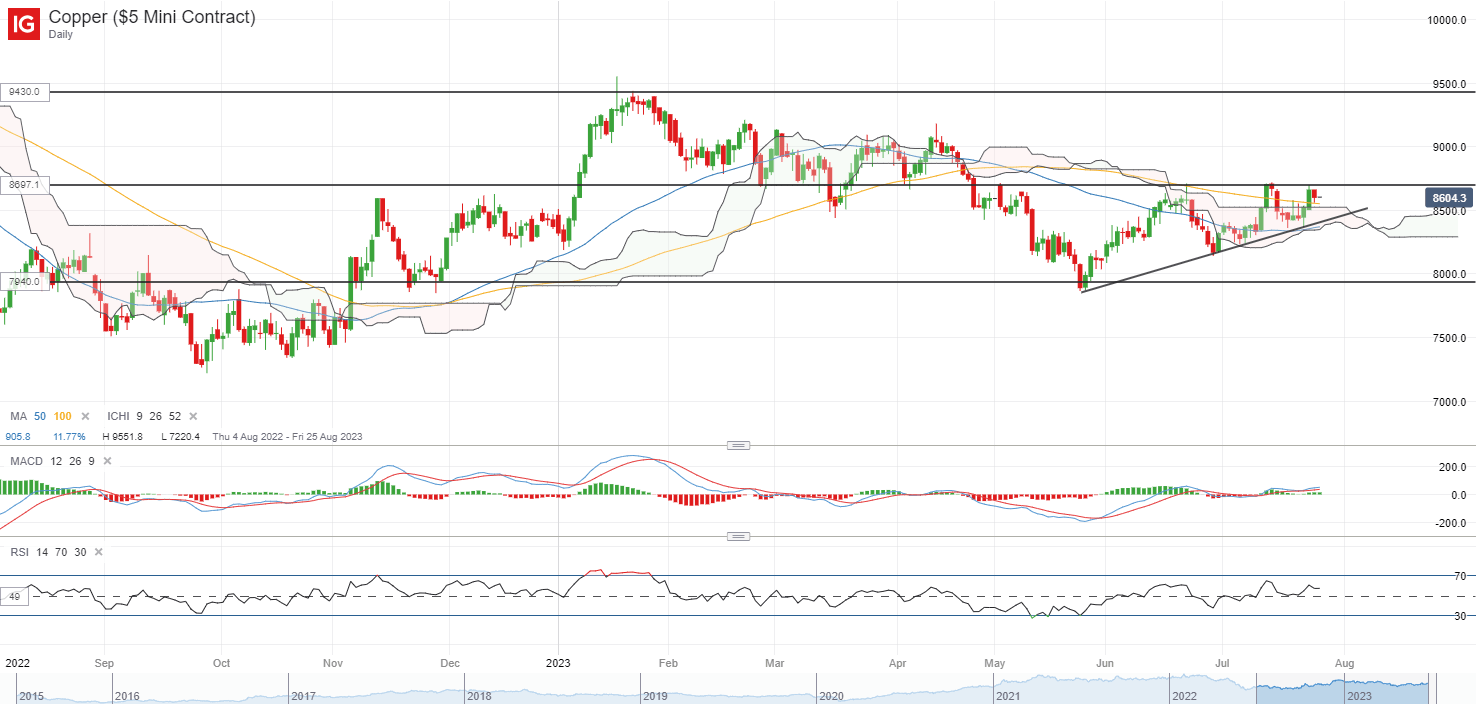
The US dollar were 0.3% lower, alongside a downtick in US Treasury yields. One to watch in the commodities space on a more subdued US dollar may be copper prices. Prices have been trading within an ascending triangle pattern over the past two months, with recent retest of the upper trendline resistance at the US$8,700/tonne level once more. Near-term upward momentum is supported by an increasing moving average convergence/divergence (MACD) and relative strength index (RSI) above 50, with any successful break above the level potentially paving the way to retest the US$9,000/tonne level next.

image1.png

Source: IG charts

Asia Open

Asian stocks look set for a slightly positive open, with Nikkei +0.11%, ASX +0.54% and KOSPI +0.57% at the time of writing. The Nasdaq Golden Dragon China Index were up 2.8% overnight, following a more lacklustre session in the earlier session, with cautious optimism still at play for further follow-through in China’s economic stimulus. Closer to home, the focus is on UOB’s 2Q 2023 result release this morning.

The bank continues to benefit from the net interest income tailwind, with a 31% year-on-year jump in the segment uplifting overall profits by 27%, in line with forecasts. Net interest margin continues to moderate for the second straight quarter (2.12% from previous 2.14%), but some may find comfort in the softer pace of decline, which could suggest some stabilising above the 2% level for the months ahead. Loan growth and net fee income remains more subdued with single-digit decline from a year ago, but thus far, management’s guidance may have provided a positive spin on outlook, pointing to some economic resilience in the region. Dividends were raised to S$0.85/share from last year’s S$0.60/share, potentially leaving a forward dividend yield of 5.5%.

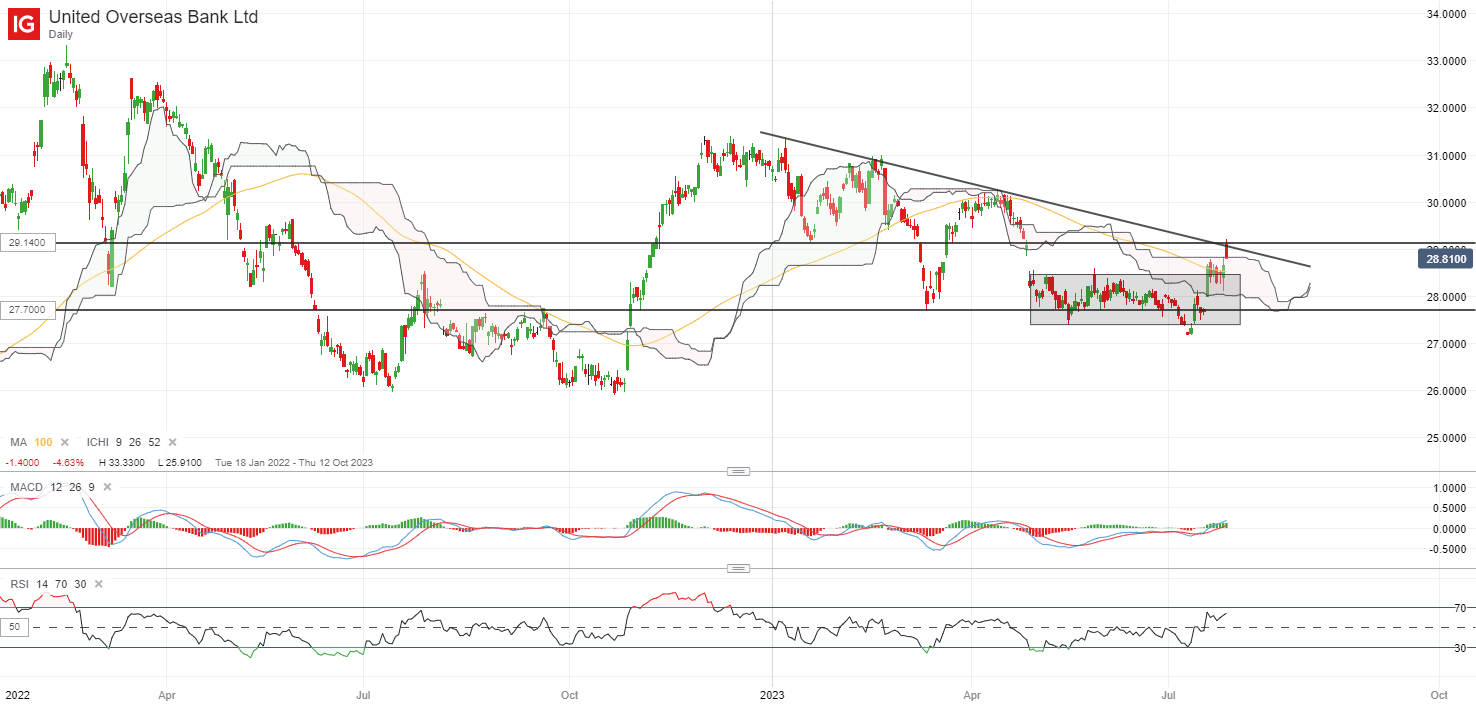
For UOB’s share price, a gap higher this morning has led to a retest of key resistance confluence at the S$29.14 level. While buyers remain in control, with its MACD heading above zero and RSI sustaining above the key 50 level, a break above the S$29.14 resistance may be warranted to support further upmove to the psychological S$30.00 level. On the downside, the previous consolidation range at the S$28.45 level may serve as near-term support.

image2.png

Source: IG charts

On the watchlist: EUR/USD resting at support ahead of European Central Bank (ECB) meeting

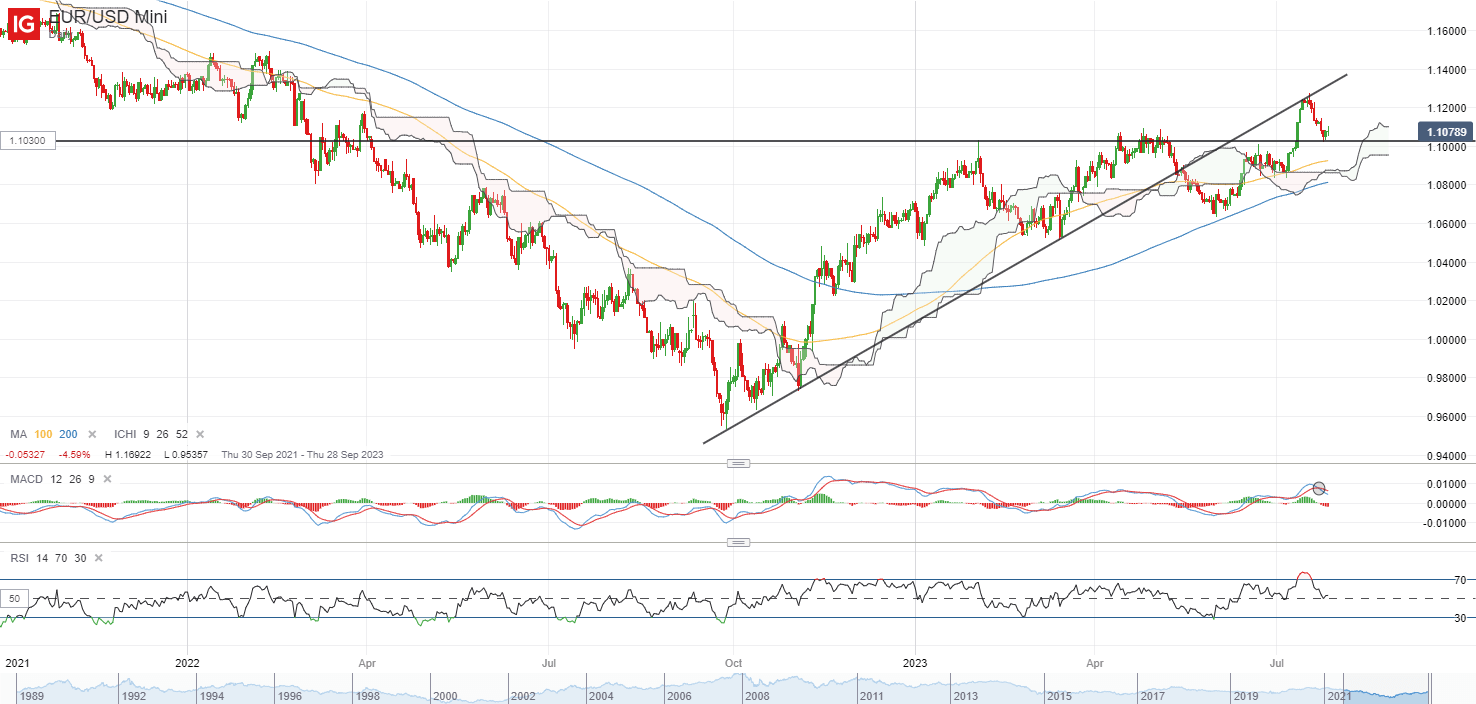
Thus far, the EUR/USD has been trading on an upward trend, with a series of higher highs and higher lows displayed since October last year. Following a lacklustre showing in the US dollar overnight post-FOMC, the EUR/USD is finding an attempt to stabilise at a near-term support around the 1.103 level, with all eyes on the ECB interest rate decision later today.

While rate expectations were firmly priced for an extended pause from the Fed moving forward, the ECB is expected to keep hiking over the next two meetings. Any validation on that front or more aggressive tone from the ECB could be supportive of the pair in the near term. With a bearish crossover on MACD and declining RSI pointing to some moderation in near-term momentum, the 1.103 level will have to see some defending ahead. Failing to do so may pave the way towards the 1.083 level as the next line of support.

image3.png

Source: IG charts

US Dollar Slips After Fed Rate Hike: What Has Changed for EUR/USD, GBP/USD, USD/JPY?

US Dollar Slips After Fed Rate Hike: What Has Changed for EUR/USD, GBP/USD, USD/JPY?

The US dollar slipped but held well within the recent range after the US Federal Reserve hiked interest rates by the widely expected quarter percentage point and on balance kept its options open for further tightening.

Powell’s remarks at the press conference came across as neutral, stopping short of committing either way. Meanwhile, the post-meeting statement was largely unchanged from the previous meeting, still containing the phrase “additional policy firming”, highlighting the slight hawkish tilt. On balance, the key takeaway appears to be the data-dependent/patient approach going into the next meeting.

For the US dollar, the balanced tone provides little cues. However, while risk sentiment remains resilient amid an encouraging start to the earnings season and hopes of additional stimulus from China, USD could stay on the back foot. In this regard, the USD hasn’t been able to recoup the losses triggered by the recent US jobs and inflation data. As long as the market believes US rates are near a peak, the appetite for the safe-haven USD could stay diminished.Meanwhile, key focus is now on the European Central Bank policy meeting (later Thursday) and the Bank of Japan meeting (Friday).


EUR/USD 240-minute Chart

image1.png

Chart Created by Manish Jaradi Using TradingView

EUR/USD: Holds above crucial support

EUR/USD on Wednesday held above stiff support around an uptrend line from early June, near the 200-period moving average on the 4-hour chart. Still, it would be too soon to conclude that the immediate bearish pressure has alleviated – the pair would need to clear the initial hurdle at Monday’s high of 1.1150. Until then, the bias appears to be of consolidation within a broadly constructive outlook. As highlighted in the previous update, only a fall below the mid-July lows of 1.0825 for the broader upward pressure to ease.

GBP/USD 240-minute Chart

image2.png

Chart Created by Manish Jaradi Using TradingView


GBPUSD: Bullish pressure is still intact

GBP/USD has managed to rebound from a fairly strong cushion on converged support around 1.2800, including an uptrend line from the end of June, and the mid-June high of 1.2850. A hold above the support was crucial to keep the short-term upward pressure intact. GBP/USD now needs to overcome the initial cap at Thursday’s high of 1.2965 to eliminate any imminent downside risks.

Any fall below Monday’s low of 1.2800 would confirm that the bullish pressure had faded in the near term, potentially opening the way toward the end-June low of 1.2600. Zooming out, the broader bias remains up, with a potential to rise toward 1.4200 in the coming months (see theprevious updatefor more details).

USD/JPY 240-minute Chart

image3.png

Chart Created by Manish Jaradi Using TradingView

USD/JPY: Growing odds of a false bullish candle

While EUR/USD and GBP/USD remained within the recent ranges, the reaction in USD/JPY was relatively convincing. Wednesday’s fall below immediate support at Monday’s low of 140.75 has raised the odds of a false move higher last week. For more on this, see “US Dollar Scenarios Ahead of Fed Rate Decision: EUR/USD, GBP/USD, USD/JPY Price Setups,” published July 26.

USD/JPY is now testing the vital converged support area at 139.50-140.00. Any break below could confirm that the sharp rebound on Friday above the 200-period moving average on the 240-minute chart was a false one. On the upside, a rise above Friday’s high of 142.00 remains a vital hurdle to clear.

Gold Prices Embrace Golden Cross as XAU/USD Looks to Beyond the Fed Next

Gold Prices Embrace Golden Cross as XAU/USD Looks to Beyond the Fed Next

Gold prices were left slightly higher in the aftermath of Wednesday’s rate hike from the Federal Reserve. The most meaningful development from the central bank was not the widely anticipated tightening, but rather commentary from Chair Jerome Powell that most officials do not envision a recession in the horizon, underscoring expectations of a soft landing.

With that in mind, it is widely anticipated that the Fed will do nothing in September. Anything beyond that will be dictated by incoming economic data. For now, let us examine how the technical landscape is shaping up in gold.

The most interesting development from the XAU/USD daily chart is that a bullish Golden Cross is taking shape between the 20-day and 50-day Moving Averages (MA). This is offering an increasingly upside technical bias and reverses the bearish Death Cross seen in May.

The Golden Cross has formed in the aftermath of prices breaking above a near-term falling trendline from May. Since then, gold seems to have found resistance around the 23.6% Fibonacci retracement level at 1971. Clearing higher exposes the minor 14.6% point at 2013 before May highs kick in. These make for a range of resistance between 2048 and 2081.

Otherwise, a turn lower and drop through the moving averages places the focus on immediate support, which is the 1936 inflection point. Beyond that sits the 38.2% level at 1903. Clearing the latter opens the door to a stronger bearish conviction.

image1.png


US Equity Indices Post FOMC: Nasdaq, S&P 500, Dow Price Setups

US Equity Indices Post FOMC: Nasdaq, S&P 500, Dow Price Setups

US equity indices were largely flat, hovering around year-to-date highs after the US Federal Reserve hiked interest rates by the widely expected quarter percentage point.

While the post-meeting statement kept the bias for “additional policy firming”, at the press conference, Fed Chair Powell seemed to have leaned toward the dovish side. “I would say it’s certainly possible that we will raise funds again at the September meeting if the data warranted,” said Powell. “And I would also say it’s possible that we would choose to hold steady and we’re going to be making careful assessments, as I said, meeting by meeting.” The data-dependent/ patient approach going into the next meeting has boosted the market’s perception that US interest rates are peaking, supporting risk appetite at the margin.

With the earnings season off to a good start, global growth being resilient, and additional China stimulus remaining a possibility, markets have reasons to cheer. Having said that, extreme optimism, overbought conditions, overcrowded positioning, and seasonality headwinds are potential risks. Dow Jones Industrial Average Weekly Chart

image1.png

Dow Jones Industrial Average: Scope for further gains

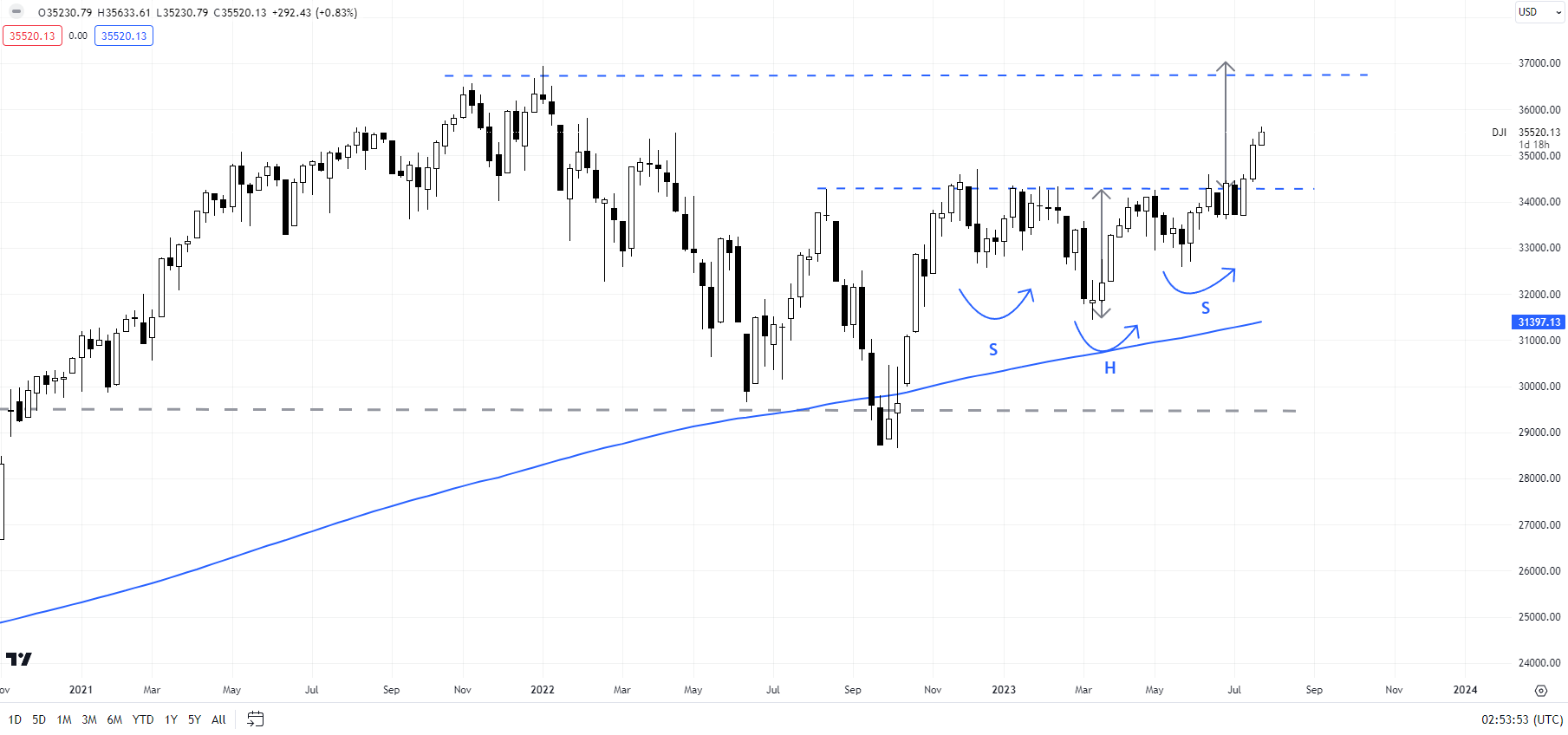
The Dow Jones Industrial Average’s recent break above a horizontal trendline from August at about 34280 has triggered a reverse head & shoulders pattern, first highlighted in “Dow, S&P 500, Nasdaq Technical Outlook: No Sign of a Reversal,” published July 9. The left shoulder is at the December low, the head is at the March low, and the right shoulder is at the May low. The bullish break has opened the way toward the 2022 high of around 37000.

NASDAQ 100 Monthly Chart

image2.png

Nasdaq 100: Overbought, but no sign of reversal

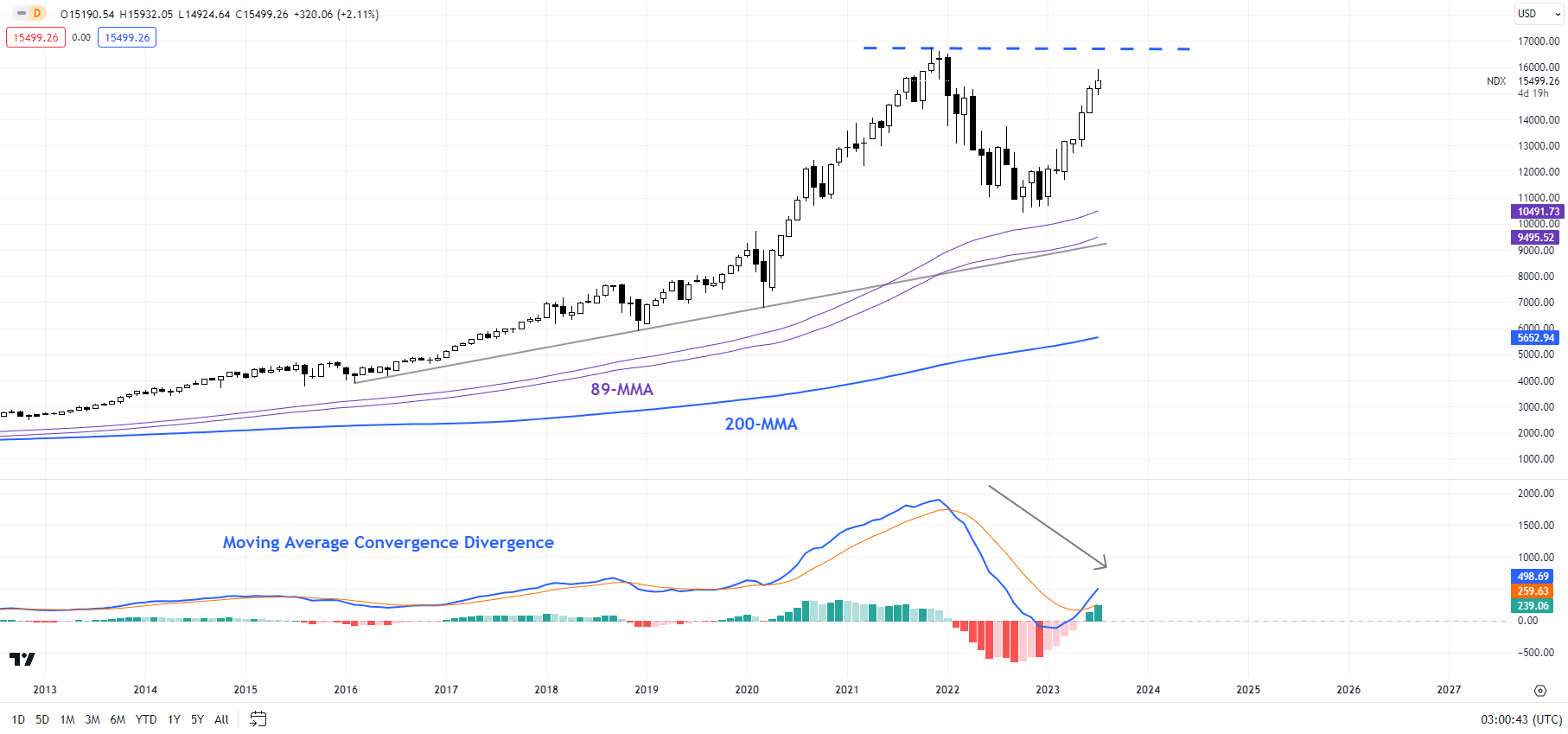
The Nasdaq 100 index is looking quite overbought, while diversity continues to remain low. For more on diversity, see “S&P 500, Nasdaq 100 Forecast: Overly Optimistic Sentiment Poses a Minor Setback Risk,” published July 23. Furthermore, the momentum on higher timeframe charts has failed to reflect the strength on shorter timeframe charts. For instance, on the monthly chart, the index is close to its 2021 peak, but the Moving Average Convergence Divergence indicator has hardly picked up.

To be sure, this doesn’t necessarily mean the index is bearish, not at least until there is a price confirmation. It probably means, from a risk: reward perspective, it may be prudent to turn cautious. Immediate support is at the mid-June high of 15285, around the 30-day moving average. Subsequent support is at the end-June low of 14690 – a break below this support would be needed for the immediate bullish pressure to ease.

S&P 500 Weekly Chart

image3.png

S&P 500: Uptrend intact as it nears a key hurdle

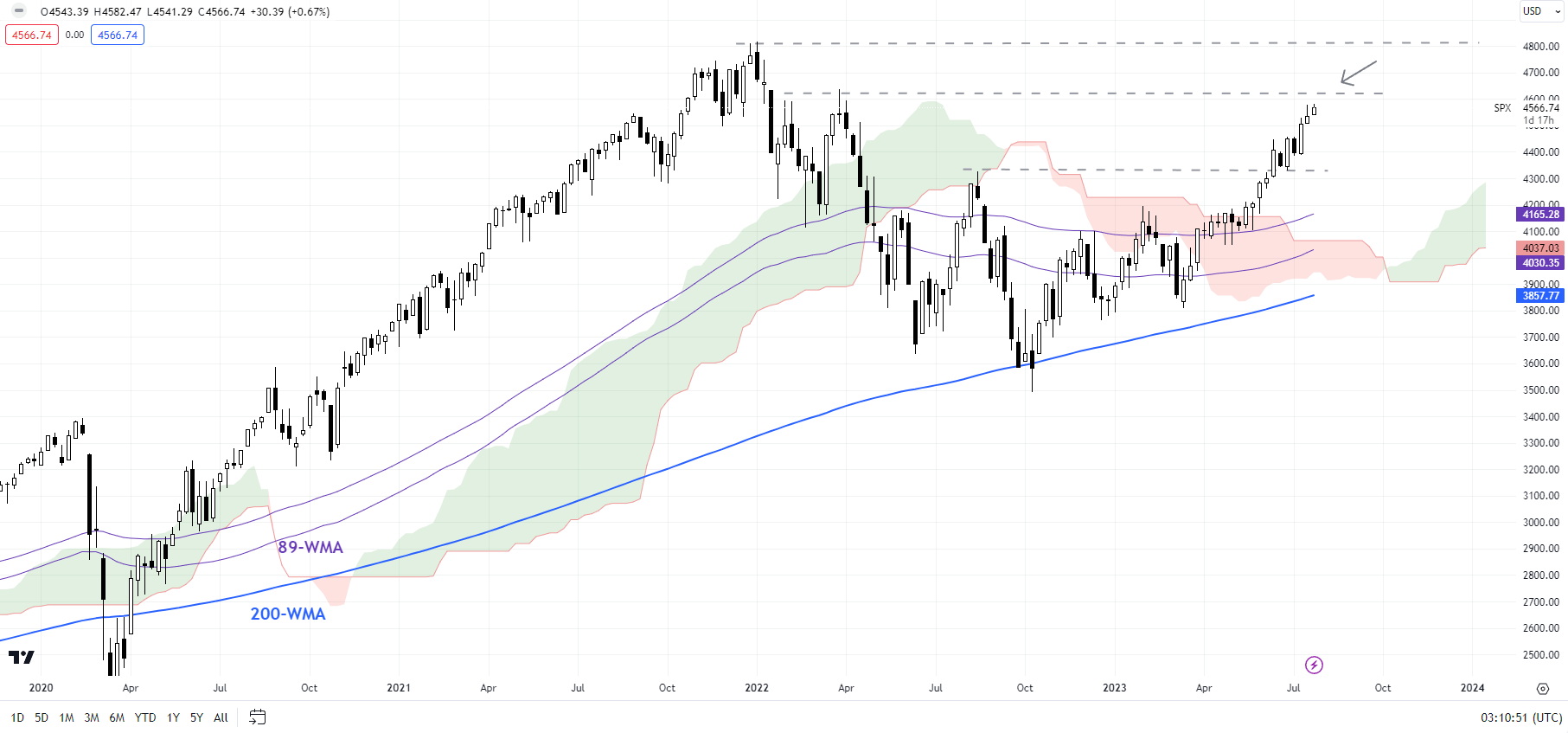
From a trend perspective, like the Nasdaq 100 index, there is no sign of a reversal of the uptrend on the S&P 500 index charts. Having said that, tentative signs of fatigue are emerging as the S&P 500 index nears the April 2022 high of 4637, slightly below the 2022 record high of 4819.

Still, unless the index breaks below immediate support at the mid-June high of 4450, the path of least resistance remains sideways to up in the near term – a point confirmed by still-solid momentum on the weekly charts. Only a break below 4450 would indicate that the bullish pressure had temporarily faded. For the broader bullish outlook to reverse, the index would need to fall below the 89-day moving average (now at about 4250).

Australian CPI data due today, preview – RBA will be comforted, no rate hike next week

Australian CPI data due today, preview – RBA will be comforted, no rate hike next week

ANZ’s preview of the data due today and the implications for the Reserve Bank of Australia policy meeting on August 1:

  • We expect both headline (+6.2% YoY) and trimmed mean inflation (+5.9% YoY) to have moderated in Q2.
  • The RBA will likely take comfort that inflation appears to be falling in line with, or a touch faster than, its May forecasts. The RBA forecast Q2 headline inflation of 6.3% YoY and trimmed mean of 6.0%, each 0.1ppt above our forecast.
  • While the August meeting is live, an inflation outcome around our forecast would support our expectation that, on balance, an extended pause from the RBA is now most likely (including no move in August).

Earlier previews take an opposite view of the RBA meeting next week:

76% of corporate leaders say Japan’s economy is ‘expanding’

76% of corporate leaders say Japan’s economy is ‘expanding’

Business confidence has dramatically improved after COVID-19 was downgraded to the equivalent of seasonal flu.

An Asahi Shimbun survey of business sentiment among 100 major companies nationwide found that 76 viewed the domestic economy as “expanding” or “gradually expanding.”

The finding represents an increase of 30 companies from the previous survey last November.

Many corporate leaders are optimistic that economic activity and personal consumption are on the rise now that the novel coronavirus has lost its “scare” factor.

However, concerns remain about labor shortages and a slowdown in overseas economies that could impact Japan.

The Asahi Shimbun conducted the survey from July 3 to 14.

Seventy-five companies responded that the domestic economy is “gradually expanding.” One company said it is “expanding.”

Twenty-two companies viewed the economy as “at a standstill.” The figure was half that of the previous survey late last year.

When asked to choose up to two reasons for their assessment, most companies, 71, cited “personal consumption.”

Asked about the prospects for personal consumption over the next three months, 74 companies expected a “gradual recovery,” up from 44 in the previous survey.

“The mindset of consumers toward spending has improved,” said Taro Fujie, president of Ajinomoto Co. “We are at the beginning of a cycle where wage increases are linked to appropriate price hikes.”

Chiharu Fujioka, managing officer of Mitsui Fudosan Co., noted that hotel occupancy rates exceeded 80 percent, and that “the average daily rate is higher than in 2019 before the pandemic.”

In addition to the easing of pandemic-related restrictions on social activities, the influx of foreign visitors following the lifting of entry curbs is a positive factor.

Tatsuya Yoshimoto, president of J. Front Retailing Co., said that along with an increase in domestic travelers and foreign tourists, “customer numbers and sales at department stores and shopping centers have grown.”

“Business activity at large-scale stores near stations, which had been slow to recover, has also significantly improved,” he said.

Forty-three companies cited “capital investment” as a reason for their assessment.

Fifty-one companies answered that they will increase their domestic capital investment in the current fiscal year compared to the previous fiscal year.

Ichiro Ozeki, president of Secom Co., said his company has received many inquiries about access control systems.

“Investments in facilities aimed at improving work efficiency and saving labor are increasing amid growing labor shortages caused by the recovery from the pandemic,” he said.

On the other hand, senior officials of companies who view the domestic economy as “at a standstill” voiced concern about labor shortages and the slowdown of overseas economies.

“While demand for construction is strong, there are delays in projects due to a lack of manpower,” said Nobuaki Nara, president of Tokyo Steel Manufacturing Co.

Turning to the global economy, 51 companies took a cautious view, saying it is “at a standstill.”

Takahiro Mori, vice president of Nippon Steel Corp., said, “There are also downside risks, such as the tightening of monetary policy by central banks in the United States and Europe and the downturn in the Chinese economy.”