WTI Price Analysis: Bulls remain on the defensive below 50-DMA/descending trend-line confluence

WTI Price Analysis: Bulls remain on the defensive below 50-DMA/descending trend-line confluence

Western Texas Intermediate (WTI) Crude Oil prices come under renewed selling pressure on Wednesday and reverse a major part of the previous day’s positive move. The intraday downfall picks up pace during the early part of the European session and drags the commodity to a fresh daily low, around the $70.25 region in the last hour.

Worries that a global economic slowdown will dent fuel demand overshadow expectations for tighter supply due to output cuts announced by top exporters – Saudi Arabia and Russia – and act as a headwind for Crude Oil prices. Apart from this, a modest US Dollar (USD) strength is seen as another factor weighing on the black liquid. Traders now look to a meeting of oil industry executives with energy ministers from OPEC and its allies. Apart from this, the FOMC meeting minutes should provide some meaningful impetus and contribute to producing short-term trading opportunities.

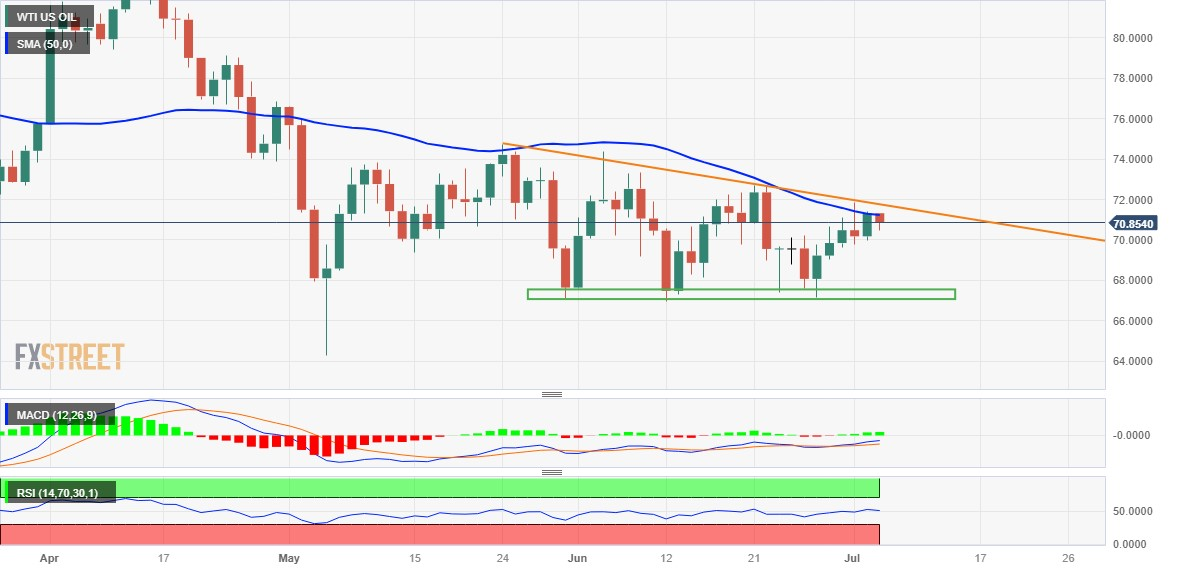
From a technical perspective, the recent recovery from strong horizontal support near the $67.00 mark fails to find acceptance above the 50-day Simple Moving Average (SMA) and fails near a downward-sloping trend-line extending from late May. The price action, meanwhile, constitutes the formation of a descending triangle on the daily chart and favours bearish traders. That said, oscillators on the daily chart are yet to confirm a negative outlook. This makes it prudent to wait for a sustained break below the $67.00 support before positioning for any further losses.

In the meantime, any subsequent downfall is more likely to find some support near the $70.00 psychological mark ahead of the $69.60 area. The next relevant support is pegged near the $69.00 mark, below which Oil prices could drop to the $68.25-$68.20 region en route to the $67.60 zone and the $67.00 strong horizontal support. A convincing break below the latter will confirm a bearish breakdown through the triangle support and make the black liquid vulnerable to sliding further.

On the flip side, the 50-day SMA, currently around the $71.20-$71.30 area, might continue to act as an immediate barrier ahead of the $72.00 mark, or the descending trend-line. A sustained strength beyond will negate the bearish outlook and shift the bias in favour of bullish traders. WTI Crude Oil price might then surpass an intermediate hurdle near the mid-$72.00 mark and aim to reclaim the $73.00 mark. The momentum could get extended further beyond the $74.00 round figure, towards testing the June monthly swing high, around the $74.35 region.

WTI daily chart
fxsoriginal

Gold Price Forecast: XAU/USD flat-lines below $1,930 level, FOMC minutes awaited

Gold Price Forecast: XAU/USD flat-lines below $1,930 level, FOMC minutes awaited

Gold price attracts some dip-buying near the $1,920 area and climbs to the top end of its intraday trading range during the early part of the European session. The XAU/USD, however, remains below the weekly high touched on Tuesday and currently trades around the $1,927-$1,928 region, up less than 0.15% for the day.

The disappointing Chinese macro data, along with the worsening US-China relations, temper investors’ appetite for riskier assets and turn out to be a key factor that benefits the safe-haven Gold price. In fact, the Caixin/S&P Global Services PMI fell from 57.1 in May to 53.9 last month – the lowest reading since January. This comes after China introduced export curbs on two metals – widely used in semiconductors, electric vehicles and high-tech industries – to the United States (US). This marks a potential escalation in a trade conflict between the world’s largest economies and might cause more disruption to global trade, which, in turn, could further undermine already weak economic conditions.

The upside for the Gold price, however, is likely to remain capped in the wake of a more hawkish stance adopted by major central banks, including the Federal Reserve (Fed). In fact, the US central bank had signalled in June that borrowing costs may still need to rise as much as 50 bps by the end of this year. Moreover, the markets have been pricing in a greater chance of a 25 bps lift-off at the next FOMC monetary policy meeting on July 25-26. This, in turn, remains supportive of elevated US Treasury bond yields, which acts as a tailwind for the US Dollar (USD) and contributes to keeping a lid on any meaningful upside for the non-yielding yellow metal, warranting some caution for bullish traders.

The USD, meanwhile, lacks bullish conviction amid the uncertainty over the Fed’s future rate-hike path. It is worth recalling that the softer US PCE Price Index released on Friday, along with Monday’s weaker US ISM PMI, raised questions over how much headroom the Fed has to continue with its monetary policy tightening cycle. Hence, the market focus will remain glued to the release of the June FOMC meeting minutes, due later during the US session. Investors will closely scrutinize minutes for cues about the Fed’s near-term policy outlook, which, in turn, should play a key role in influencing the USD price dynamics and help determine the near-term trajectory for the XAU/USD.

Pound Sterling recovers as UK PM Sunak shows confidence about price stability

Pound Sterling recovers as UK PM Sunak shows confidence about price stability

The Pound Sterling (GBP) has picked strength as the market mood is turning cheerful. The GBP/USD pair has recovered sharply as the Bank of England (BoE) is taking some strong steps to strengthen financial conditions. United Kingdom’s inflation looks set to pick pace again as labor shortages are expected to elevate.

After a marginal increase in United Kingdom’s Manufacturing PMI, investors are shifting their focus to the Services PMI. UK’s service sector is in an expansion stage, unlike factory activity which has been posting contraction, straight for the past 11 months.

Meanwhile, UK PM Rishi Sunk is confident that price stability will be achieved.

Daily Digest Market Movers: Pound Sterling jumps swiftly to 1.2720

  • United Kingdom Prime Minister Rishi Sunak has promised to fully utilize monetary and fiscal policy to tame persistent inflation.
  • UK Sunak cited that inflationary pressures are showing a higher persistence than expected but that doesn’t state that the policy measures used are the wrong ones.
  • The Britain government has announced that it is committed to spending 11.6 billion pounds on international climate finance.
  • Firms are ramping up investments in Germany to compensate for custom delays and tedious bureaucracy inspired by an exit of Britain from the European Union.
  • Financial Times reported that the Bank of England is planning to discuss with international banks to set up subsidiaries.
  • Higher inflationary pressures in the UK economy are backed by shortages of labor and 45-year high food price inflation.
  • Labor shortages are expected to elevate further as almost one in three female workers are expected to consider early retirement because of health issues.
  • UK Finance Minister Jeremy Hunt gave his backing to the country’s financial regulator Financial Conduct Authority (FCA) to ensure banks are passing on better savings rates to consumers, as reported by Reuters.
  • Investors are focusing on the June Services PMI data, which is seen steady at 53.7.
  • The monthly survey by Citi Bank and polling firm YouGov showed that consumer inflation expectations for one year have increased to 5.0% in June from 4.7% in May.
  • Financial markets are anticipating that the BoE will eventually raise interest rates to 6.25% from the current state of 5%.
  • The risk profile has turned cautious ahead of the United States markets opening after a holiday.
  • The US Dollar Index (DXY) has dropped sharply as investors are confident that the Federal Reserve (Fed) will raise interest rates only once this year despite Fed chair Jerome Powell considering two small interest rate hikes appropriate.
  • Later this week, investors will focus on Federal Open Market Committee (FOMC) Minutes, ISM Services PMI, and Employment data.

Technical Analysis: Pound Sterling continues winning streak

Pound Sterling has continued its three-day winning spell by surpassing Tuesday’s close around 1.2710 as the US Dollar Index is under pressure ahead of FOMC Minutes. The Cable has continued to maintain sustainability above the 20-period daily Exponential Moving Average (DEMA) at 1.2667, which indicates that the short-term trend is bullish.

Momentum oscillators are looking to shift into the bullish trajectory, which would infuse strength in the Pound Sterling bulls.

Buyers could add positions if Cable manages to jump firmly above 1.2740. The upside bias could fade if it corrects below the psychological support of 1.2500.

EUR/GBP falls back as UK Services PMI matches expectations

EUR/GBP falls back as UK Services PMI matches expectations

The EUR/GBP pair has retreated as the United Kingdom S&P Services PMI has matched expectations. The economic data has landed at 53.7 as expected by the market participants.

The Pound Sterling is expected to remain in a positive trajectory as inflationary pressures in the UK economy are expected to elevate further.  A poll from Reuters indicates that almost one in three female workers is expected to consider early retirement because of health issues. The economy is already facing issues of labor shortages due to Brexit and early retirements and now further increase in early withdrawal from work would propel red-hot inflation.

Considering the stubbornness in UK inflation, the Bank of England (BoE) is far from pausing the policy-tightening spell. UK Consumer Price Index (CPI) has turned sticky above 8.5% despite lower gasoline prices.

Meanwhile, UK firms are planning to shift investments to Germany to compensate for customs delays inspired by the Brexit event.

The Euro is expected to face pressure as preliminary Eurozone inflation has softened to 5.5% in June vs. the former release of 6.1%. Thanks to the drop in prices of oil but core inflation has marginally decelerated to 6.8% against the prior figure of 6.9%. This might allow the European Central Bank (ECB) to go slow on the policy-tightening spell. However, ECB policymaker Joachim Nagel has cited that the central bank has not reached the end of policy-tightening yet.

Higher interest rates by ECB President Christine Lagarde have pushed the Eurozone economy under threat. Citi has cut the real Gross Domestic Product (GDP) forecast in the Euro area to 0.3% and German’s GDP forecast to 0.2%.

UK Service sector growth loses momentum in June

UK Service sector growth loses momentum in June

June data indicated a sustained upturn in UK service sector output, but the rate of expansion eased to its weakest for three months amid a much softer rise in new orders. In contrast, staffing levels expanded at the fastest pace since last September as improving candidate availability helped to boost recruitment. Service providers recorded another sharp increase in their average cost burdens. Rising salary payments offset falling energy and transportation bills. However, the latest overall rise in business expenses was the weakest for just over two years. Prices charged by service companies meanwhile increased

Fed or ECB Policy Error Is Now a Big Risk, Allianz’s Subran Says

Fed or ECB Policy Error Is Now a Big Risk, Allianz’s Subran Says

The prospect that US or euro-zone policymakers might overdo tightening is now one of the most prominent threats to the global economy, according to Allianz Chief Economist Ludovic Subran.

Speaking to Bloomberg Television, he said his outlook for a so-called “soft landing” hinges on policymakers not going overboard in their drive to tame consumer prices.

“It depends vividly on central banks’ determination to kill inflation,” he said. “One of the main risks to the economy is the risk of policy mistakes from central banks, and this toxic policy mix risk between fiscal and monetary tightening at the same time.”

Policymakers from advanced economies are still showing a concerted bias toward more interest-rate hikes, with both the US Federal Reserve and the European Central Bank poised to deliver increases later this month. In Australia, officials kept borrowing costs unchanged on Tuesday, but held out the possibility of more action if needed.

For Subran, a danger of error might materialize if central banks keep policy too tight for too long. He referenced a discussion among officials at the ECB’s annual retreat last week.

“What would happen if the ECB were to hold rates high on top of adding a couple more hikes for the full of ‘24 to see the full transmission?” he asked. “This for me would qualify for a policy mistake because that would mean we would start seeing the real economy effect of this embedded tightening, so that would be already too late for the central bank to pivot.”

Memories of policy mistakes by the ECB this century still linger. Twice, in 2008 and 2011, officials began policy tightening cycles that were soon aborted.

Questioned on lingering risks to the financial system, Subran said that “they haven’t disappeared.”

“I stand by my call to be very cautious with the liquidity situation” for at least a year, he said. “I still see a lot of leverage and a lot of concern about credit risk, and to be fair a lot of financial institutions also that need to continue to do the right testing. Remember, financial accidents could also come from exogenous shocks, think about climate risks.”

FOMC Minutes: The Path Ahead

FOMC Minutes: The Path Ahead

Investors are going to be looking for some clarifications out of the minutes from the last FOMC meeting. The market and the Fed are at odds about the future of rate hikes. More importantly for how the dollar behaves, there is considerable disagreement about what happens at the September meeting. What FOMC members said at the last meeting could clarify that situation, and either push the dollar up, or bring it down.

The issue regarding the supposed “skip” as opposed to a pause seems to be largely settled. There was some initial doubt about it, since Fed Chair Jerome Powell made a point of not calling the lack of action at the meeting as a “skip”. We’ll recall that the main issue around that particular debate was whether or not there was an implication that there would be a rate hike now in the June meeting.

What the market says

Now, over 80% of traders are expecting a rate hike at the next meeting. This comes after Powell gave testimony before Congress, and made comments at the ECB Forum at Sintra saying that two more rate hikes were likely this year. That matches the so-called “dot plot” matrix which is the summary of forecasts by FOMC members. They, too, see two rate hikes this year.

The market, however, disagrees. Only 37% of traders expect two rate hikes this year. The consensus seems to be that the July meeting will have a rate hike, and then the Fed will be done. But, the market has been wrong about the Fed so far; previously the market expected the Fed to quit at or before 5.0%, and the rates are now higher than that. The question is whether the FOMC minutes provide enough force to convince enough traders to switch to believing there will be a second rate hike.

The timing is crucial

The main reason for the disconnect is the differing outlook for the economy. The Fed expects a “soft” landing (that is, a mild recession) that will allow them to keep rates high to bring down inflation. The market forestalls a “hard” landing (that is, a financial crisis) that will force the Fed to cut rates.

The thing is, it’s been over a year now that markets have been forecasting a recession, and time is running out. There are only four more rate decisions for the rest of the year. Since the market is widely agreeing that there will be a rate hike in July and a hold in September, that leaves only the December meeting for there to be a financial crunch severe enough to shake up the Fed.

The potential reaction

So far, US data is not in a good place, but hasn’t outright presented a scenario that would force a rate cut. Therefore, if the FOMC members appear to be confident enough in the outlook, it might be enough for the market to reassess its bets, giving the dollar a boost.

On the other hand, if FOMC members showed that they were concerned about economic indicators and might be open to reassessing the situation, that could grow the majority expecting only one rate hike, and weaken the dollar.

NZD/USD Price Analysis: Kiwi bulls eye 0.6220 resistance confluence, focus on China PMI, FOMC Minutes

NZD/USD Price Analysis: Kiwi bulls eye 0.6220 resistance confluence, focus on China PMI, FOMC Minutes

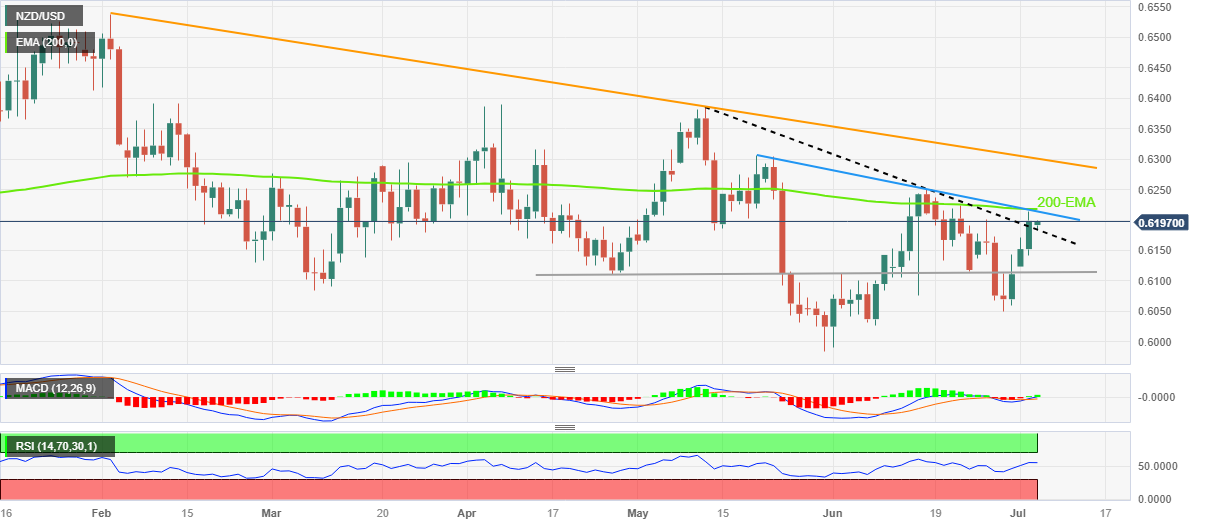
NZD/USD justifies the previous day’s upside break of a two-month-old resistance line while printing a four-day winning streak near the 0.6200 round figure. In doing so, the Kiwi pair remains mildly bid near the highest levels in a fortnight amid early Wednesday morning in Auckland.

Not only the trend line breakout but the latest bullish MACD signals and the upbeat RSI (14), not overbought, also keeps the Kiwi pair buyers hopeful.

However, a convergence of the 200-Exponential Moving Average (EMA) and a six-week-long falling trend line, close to 0.6220 at the latest, tests the NZD/USD buyers. Also acting as a short-term upside filter is the previous monthly high of 0.6250.

Above all, a downward-sloping resistance line from early February, around the 0.6300 threshold by the press time, becomes crucial for the NZD/USD bulls to cross for conviction.

On the contrary, a downside break of the previous resistance line stretched from early May, surrounding 0.6180, can recall the intraday sellers of the pair.

Following that, 10-week-old horizontal support and the yearly bottom marked in May, near 0.6110 and 0.5990 in that order, will be the key to watch for the NZD/USD bears.

NZD/USD: Daily chart

Italian service sector growth continues to slow in June

Italian service sector growth continues to slow in June

Italy’s service sector continued to expand during June. However, amid reports that client uncertainty and increased interest rates were weighing on sales, activity rose at the slowest rate in four months. Confidence in the future remained positive, and firms took on extra staff though also at a slower rate compared to May. Disinflationary pressures were apparent as signalled by concurrent falls in input and output price inflation. The headline index from the report, the HCOB Italy Services PMI Business Activity Index recorded 52.2 in June. Although indicating another period of above trend growth, the index was down

GlobalDairyTrade auction results: Slip sliding away

GlobalDairyTrade auction results: Slip sliding away

Dairy auction prices fell sharply overnight continuing the downward trend that started in March 2022. While prices fell across all product categories, there were some marked differences. Key whole milk powder (WMP) prices were just a shade weaker, falling by just 0.4%. However, milk fat prices were sharply lower, with prices for butter and butter milk powder dropping by 10.3% and 11.4%, respectively. Meanwhile prices for cheddar cheese and skim milk powder dropped 3.1% and 6.0%. Although a significant drop, the result was still better than expected. We had expected WMP to fall by about 4%, with the futures market