USD/JPY analysis: Yen strengthens on hot inflation figures

USD/JPY analysis: Yen strengthens on hot inflation figures

Consumer prices in Japan continued to rise in April according to the latest report, which saw core CPI y/y (a key measure of prices) rise to a 42-year high. Food prices jumped 9% from the same period last year, up from 8.2% in March and services inflation rose 1.7% which suggests labour costs are seeping through to the broader economy.

Retail firms tend to soften prices in the new financial year, so to see it rise in April should be a concern for the BOJ who still see current prices rises as transitory (a word the Fed was forced to abandon as inflation was showing no signs of abating).

However, the chart above shows that producer prices continue to decline at a rapid pace and that likely explains why the BOJ remain confident that the current pace of rising inflation will not be sustained. The fact that key trade partners such as China and measures of inflation across the world are also slowing is another reason to suspect that the BOJ may be right, eventually. Furthermore, trade data for April continued to decline which is itself could be seen as a form of deflation as demand for products domestically and internationally dwindles.

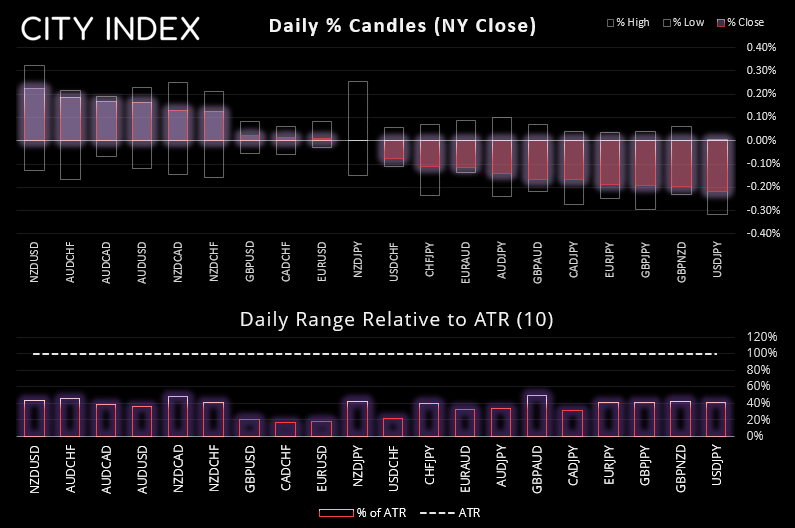
The yen pairs strengthen across the board, but volatility remains low

20230519moversCI

Regardless, the yen strengthened across the board as traders placed bets that the BOJ could be forced to tighten sooner than later. And perhaps it will, but I doubt it will be enough to turn the tide on recent risk-on gains and hawkish Fed commentary. So, if anything, today’s inflation figure could be seen as the catalyst to help trigger a needed retracement ahead of the weekend, which could leave the potential for trend traders to extend this week’s move in later sessions or perhaps next week if the US debt ceiling is presumably raised.

Besides, we can see on the volatility table above that daily ranges remain well within their ATR’s (average true ranges), so at this stage the moves are assumes to be corrective.

USD/JPY daily chart:

20230519usdjpyCI

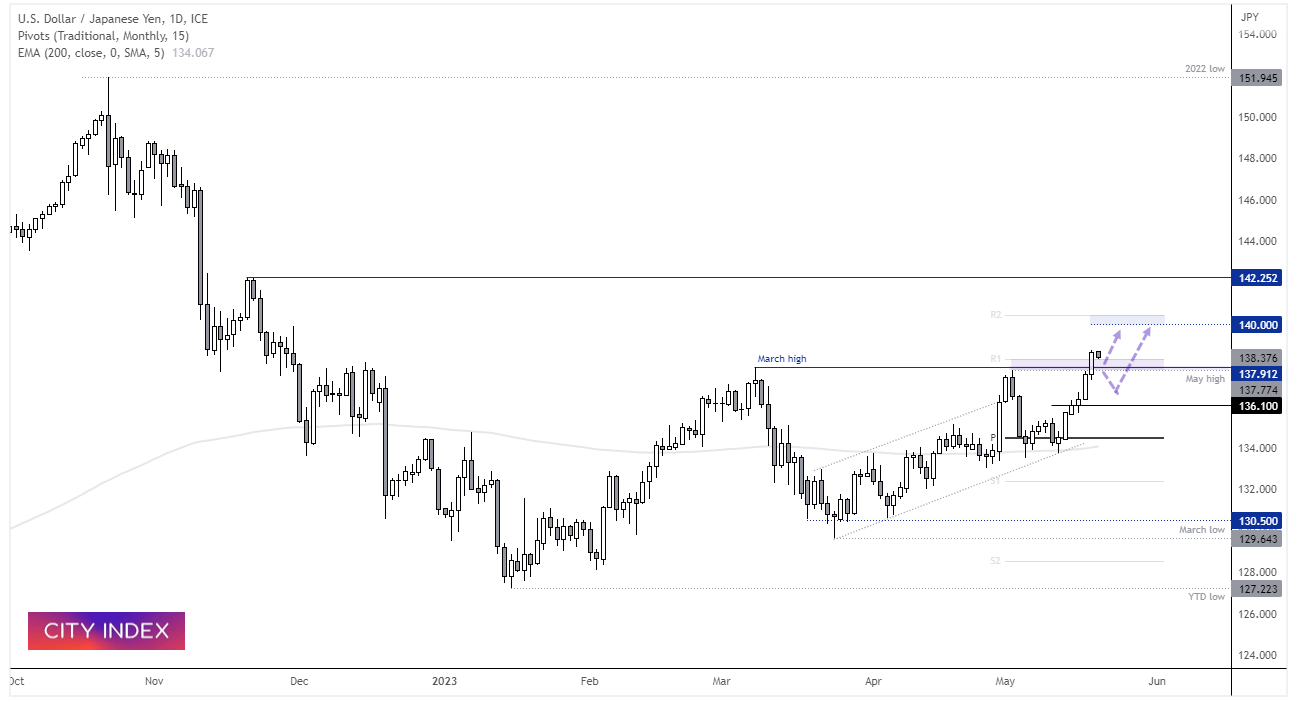
USD/JPY rallied for a sixth consecutive session to 9-month high, making light of the previous YTD high in March. Prices are now retracing from yesterday’s highs but holding around the monthly R1 pivot, although the march high at 137.91 and May high at 137.78 nearby to provide potential support. A risk to the downside could be if debt-ceiling talks get a setback and weigh on appetite for risk.

USD/JPY 1-hour chart:

20230519usdjpyH1ci

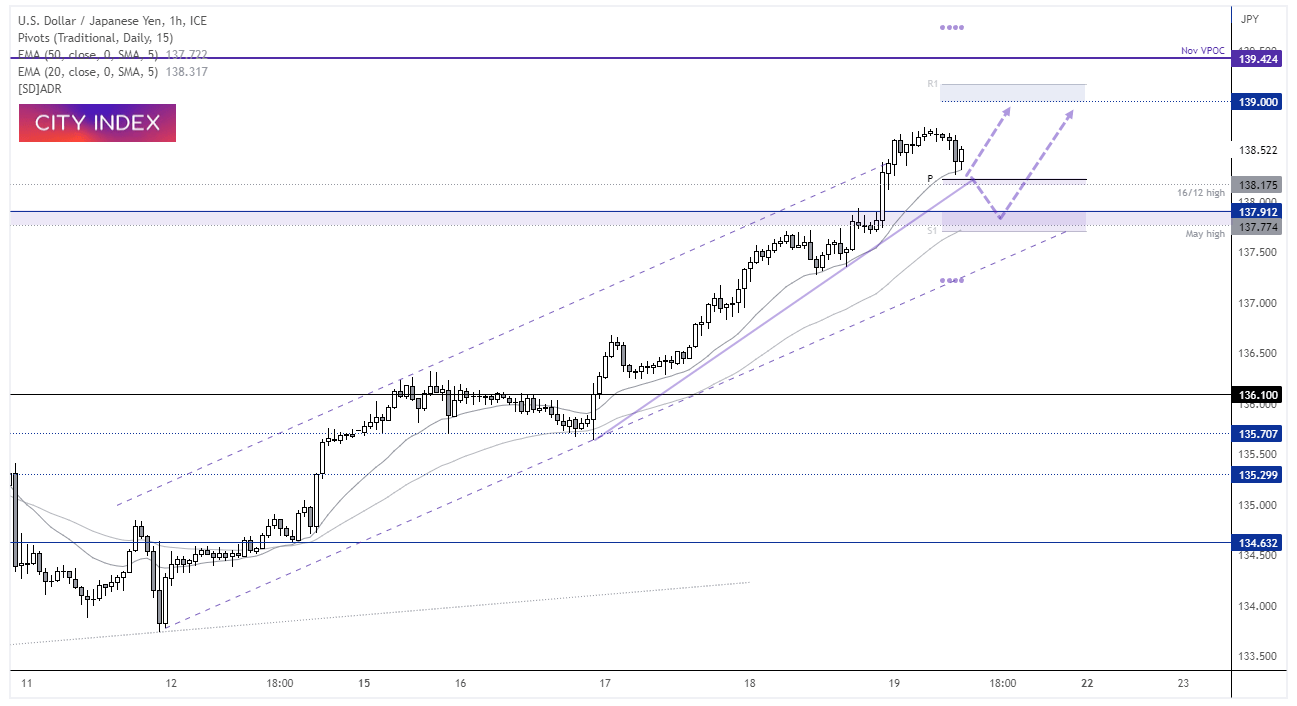
Yesterday’s retracement was shortly lived, before reverting higher after finding support at the 20-bar EMA. Prices are making attempt to break higher from the daily pivot point, and head for the 139 handle, just beneath the daily R1 pivot. Take note that the upper ADR (average daily range) band is just below 140.

However, we may find that prices could recycle lower, in which case bulls could seek evidence of a base around the May high (137.91) or May high before momentum potentially reverts higher.

China, US commerce and trade chiefs to meet next week

China, US commerce and trade chiefs to meet next week

WASHINGTON: China’s commerce minister will visit the United States next week for meetings with the commerce secretary and Washington’s top trade official, the spokesperson for China’s embassy in Washington said on Thursday (May 18), as the US seeks engagement with Beijing to salve damaged ties.

Liu Pengyu made the announcement at a Chinese embassy online briefing with journalists, adding that Beijing was open to communication at all levels with United States, but only on the basis of mutual respect.

The Chinese embassy later said in an emailed statement that both sides were still discussing details of the plans.

A source familiar with planning for the meetings said that Chinese Commerce Minister Wang Wentao was expected to meet with Commerce Secretary Gina Raimondo in Washington next week before traveling to Detroit for a meeting of Asia Pacific Economic Cooperation (APEC) trade ministers.

Wang would then meet with US Trade Representative Katherine Tai on the sidelines of that gathering, scheduled for May 25 to 26.

Spokespersons for Tai’s and Raimondo’s offices did not respond to requests for comment.

Washington has expressed eagerness for high-level meetings with China in an effort to keep increasingly tense relations from veering toward conflict.

President Joe Biden’s national security adviser Jake Sullivan met China’s top diplomat Wang Yi last week in Vienna, and both sides recognized the need to move beyond an alleged spy balloon incident that dented relations between the superpowers, a senior US official has said.

Biden has been seeking to hold a phone call with Chinese President Xi Jinping but neither side has offered updates on the prospects for such a call, or on the possibility of rescheduling a visit to Beijing by US Secretary of State Antony Blinken.

Blinken postponed a planned February trip after the US shot down a Chinese balloon that flew over sensitive military sites.

“It is imperative for the US side to adopt a correct perception of China and we hope the US side will return to a rational and pragmatic China policy for the two countries to better develop themselves and prosper together,” Liu told reporters.

Liu said China and the US should put into practice what has been agreed between Xi and Biden at their last meeting in November and properly handle sensitive issues such as Taiwan, the democratically self-governed island claimed by China.

The US and Taiwan on Thursday agreed on an initial trade pact, a move likely to anger China, which sees official engagement by the island with other countries as a violation of its sovereignty.

“China is open to communication at all levels and cooperation across the fields with the United States, but only on the basis of mutual respect, equality and mutual benefit,” Liu said before that trade deal was announced.

He added that the US should work with China to “create favorable conditions for the future interactions between the two presidents”.

Some Biden administration critics, including Republican lawmakers, have questioned US overtures to Beijing to hold high-level meetings, arguing that past decades of engagement have failed to change China’s calculus on a slate of trade, security and human rights issues.

Blinken, Raimondo, and US Treasury Secretary Janet Yellen have all expressed interest in visiting China.

China state banks reportedly seen swapping Yuan for US dollars in onshore forwards market

China state banks reportedly seen swapping Yuan for US dollars in onshore forwards market

The thinking here is to swap the yuan for dollars in the forwards market to manage the fall in the domestic currency itself. This is done via mopping up dollar liquidity from the swap market, thus reducing readiness of dollar sales against the yuan. This is part of the typical playbook by China to defend the currency but so far, the sources say that there are no signs of intervention in spot trades yet. “State banks have started heavily trading buy/sell one-year tenor since Thursday”, according to one of the sources.

EUR/USD closes in on 1.0800 as US Dollar corrects ahead of Powell

EUR/USD closes in on 1.0800 as US Dollar corrects ahead of Powell

EUR/USD is trading close to 1.0800, sustaining its bounce in the European session. The US Dollar is correcting across the board amid a better market mood. ECB President Lagarde’s remarks aid the EUR/USD recovery. All eyes remain on Fed ‘Powell’s speech.

From a technical perspective, the overnight breakdown and acceptance below the 100-day Simple Moving Average (SMA) for the first time since November 2022 could be seen as a fresh trigger for bearish traders. The said support breakpoint, around the 1.0800 round-figure mark, coincided with the 50% Fibonacci retracement level of the March-May rally and should now act as a pivotal point. Meanwhile, oscillators on the daily chart are still far from being in the oversold zone and add credence to the negative outlook.

That said, any further decline is more likely to find some support near the 61.8% Fibo. level, around the 1.0730-1.0725 region. Some follow-through selling will reaffirm the bearish bias and drag the EUR/USD pair below the 1.0700 mark, towards the next relevant support near the 1.0675-1.0670 horizontal zone. Spot prices could slide further towards the 1.0635 region before eventually dropping to test the 1.0600 round figure.

On the flip side, the 1.0800 confluence now seems to act as an immediate strong barrier, above which a bout of a short-covering has the potential to lift the EUR/USD pair towards the 38.2% Fibo. level, around the 1.0865-1.0870 region. Some follow-through buying, leading to a subsequent strength beyond the 1.0900 mark, suggests that the recent pullback from over a one-year high has run its course and shift the bias in favour of bullish traders.

The shared currency fails to gain any respite from bets for more rate hikes by the European Central Bank (ECB). It is worth recalling that ECB President Christine Lagarde has already made it clear that efforts to curb stubbornly high inflation aren’t over and said that there are factors that can induce significant upside risk to the inflation outlook. This, however, fails to impress bulls or lend any support to the EUR/USD pair. Investors now look to the ECB Bulletin for some impetus, though the focus will remain glued to Fed Chair Jerome Powell’s appearance later this Friday.

Market players will closely scrutinize Powell’s remarks for fresh clues about the US central bank’s next policy move. This, along with the US bond yields, the US debt-limit negotiations and the broader risk sentiment, will influence the USD price dynamics and provide some impetus to the EUR/USD pair on the last day of the week. Nevertheless, spot prices remain on track to register heavy losses for the second straight week and the aforementioned fundamental backdrop supports prospects for additional losses. Hence, any attempted recovery might still be seen as a selling opportunity.

US Dollar Price Forecast: DXY Builds on Gains as Yields, Data Improve

US Dollar Price Forecast: DXY Builds on Gains as Yields, Data Improve

Initial Jobless Claims Print Better Ease After Last Week’s Larger Print

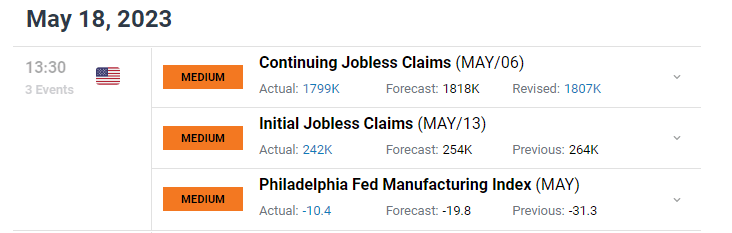
Last week’s initial jobless claims raised many eyebrows after coming in at 264k, suggesting that tighter financial conditions is beginning to take its toll on the labor market, lowering the chances of another rate hike form the Fed. However, this week the print came in at 242k, below consensus of 254k. At the same time the less followed Philadelphia manufacturing index came in at -10.4 vs forecast of -19.8. The health of the manufacturing sector appeared to take a sharp turn lower after the NY Empire State Manufacturing Index unexpectedly sank to 031.8 in May from 10.8 in April.

image1.png

Customize and filter live economic data via our DailyFX economic calendar

US Yields Aid the Dollar’s Bullish Momentum

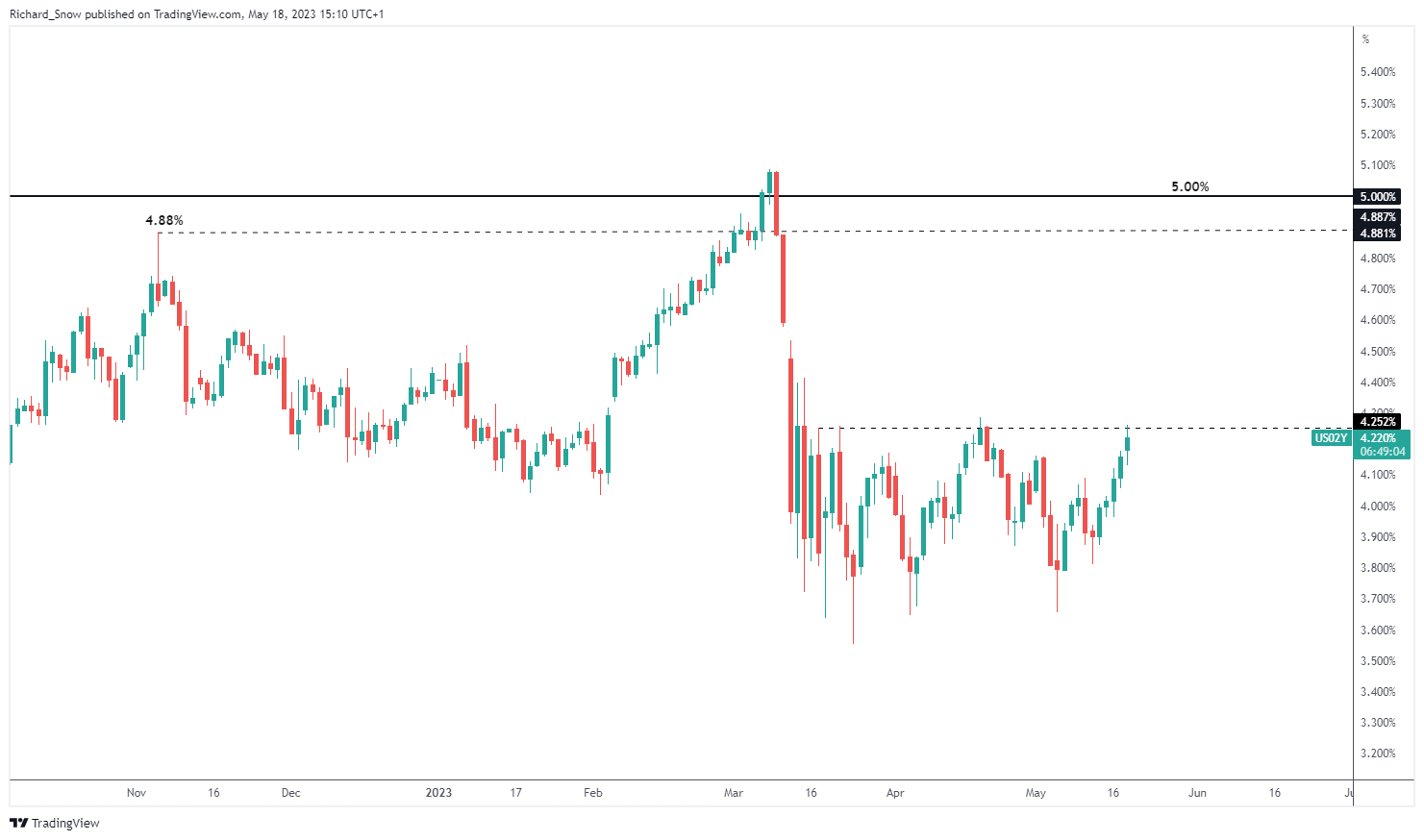
Both the 10-year and more interest rate sensitive 2year treasury yields continued to rise early in the US session, helping lift the dollar (DXY).

US 2-Year Treasury Yield Daily Chart

image2.png

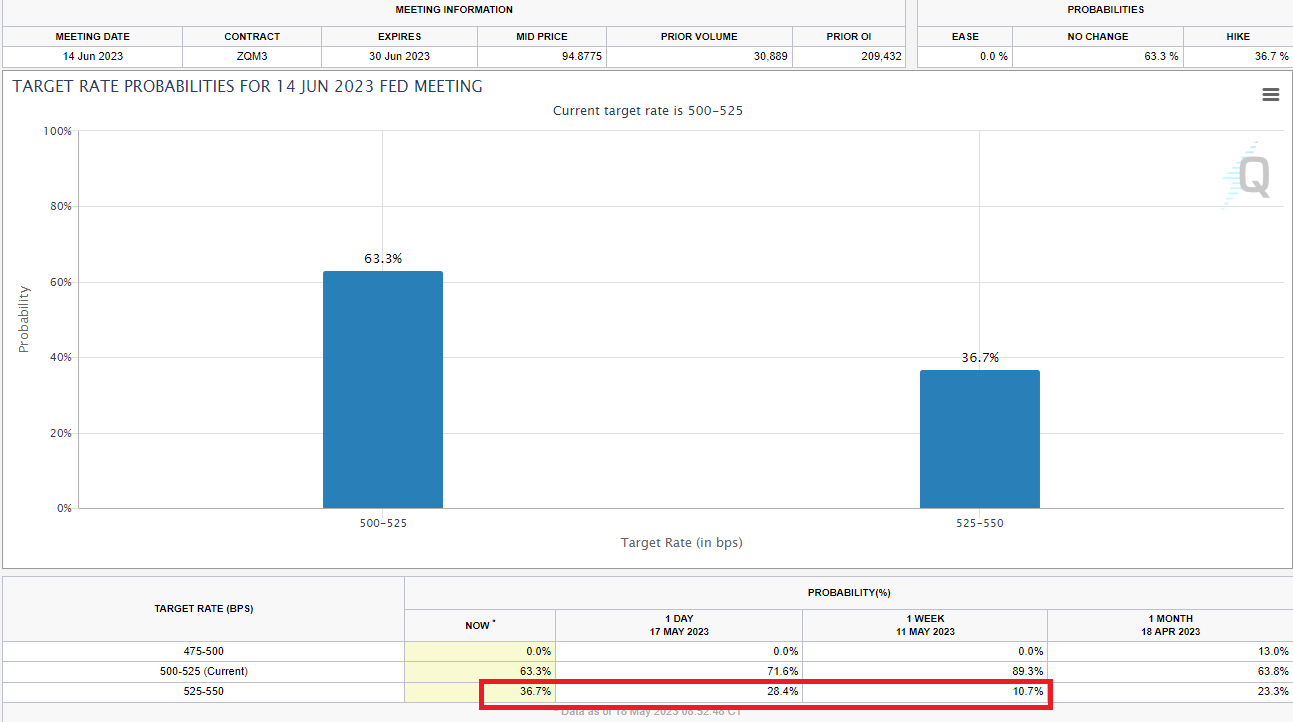
As fundamental data ebbs and flows, we’re likely to see mixed reaction in the market however, the recent dollar trend has been one-sided. Initially the dollar appeared to be driven by the uncertainty around a potential US default resulting from the failure to agree to raise the debt ceiling. Now, it would appear that the dollar is pricing in a greater probability of another 25-basis point hike as the FedWatch tool reveals below. Markets now anticipate a 36% chance we could get another hike in June, up from just a 10% chance one week ago.

CME FedWatch Tool

image3.png

DXY Technical Analysis

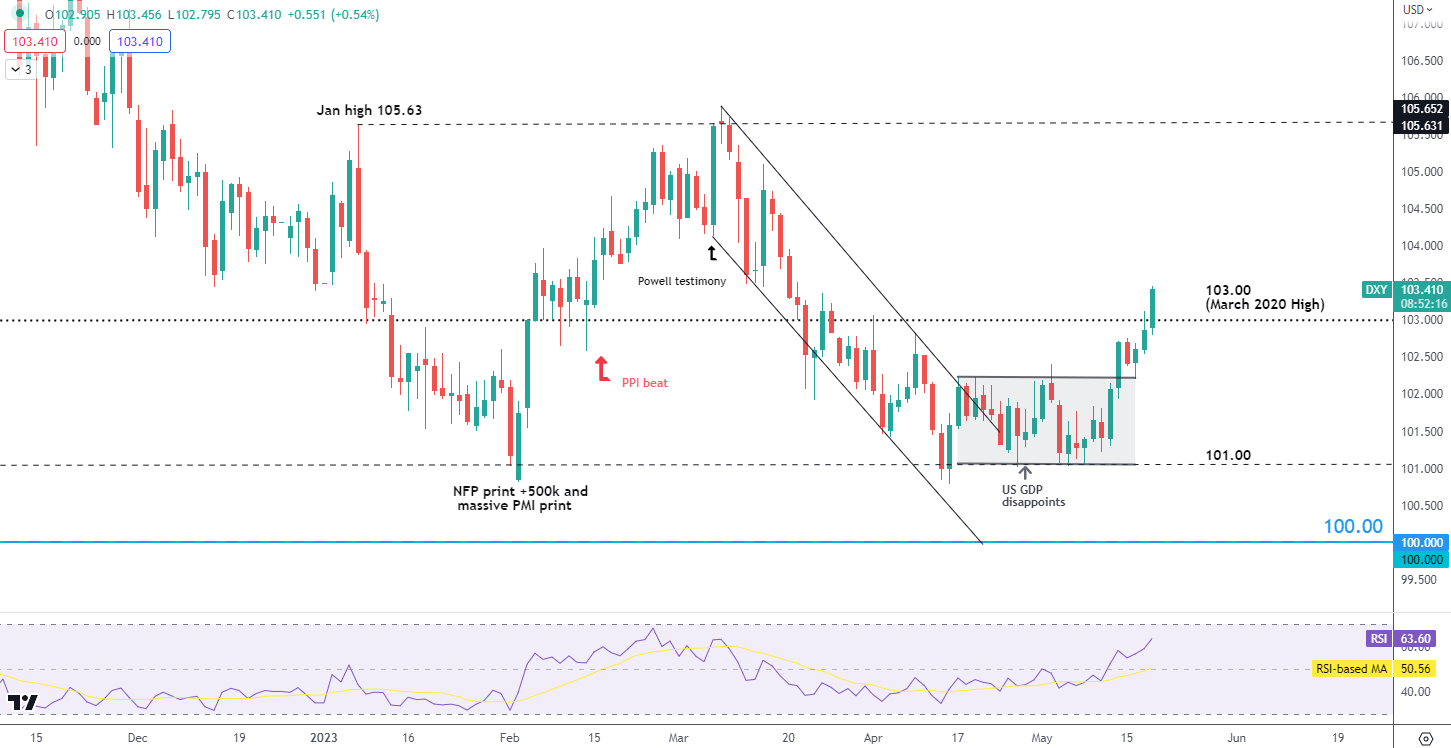
The US dollar basket has risen since the latter stages of last week and hasn’t looked back. After breaking out of the horizontal channel, the index made and attempt at trading above 103.00 – a level that has come into play numerous times in 2023. Today’s continued bullish momentum has sent DXY well above 103, showing few signs of pulling back.

In the event DXY closes above 103, that would bring into focus the January and March highs which appear some distance away at 105.65 and 105.88, respectively. If DXY closes above 103 then naturally it will become relevant as the nearest level of support followed by the upper-bound of the horizontal channel, around 102.25 and then 101.00 flat. The sheer momentum of the current move could soon see the market overheat – the RSI can be used as a gauge for this.

US Dollar Basket (DXY) Daily Chart

image4.png

Gold Prices Crushed by Resurgent Yields & Strong Dollar, Bullish Outlook in Peril

Gold Prices Crushed by Resurgent Yields & Strong Dollar, Bullish Outlook in Peril

Gold prices suffered a major setback on Thursday, falling for a third consecutive session and reaching their lowest level since the beginning of April. In early afternoon trading in New York, XAU/USD was down 1.4% to $1,960, dragged down by U.S. dollar strength and rapidly rising bond yields following encouraging macro data and news that the U.S. Congress is making progress in negotiations to raise the debt ceiling.

Focusing on today’s catalysts, unemployment claims corresponding to the previous week and the Philadelphia Fed’s manufacturing production for May were much less negative than anticipated, reinforcing the view that business activity remains remarkably resilient despite numerous headwinds, such as tightening lending standards, sticky inflation and non-stop recession talk in financial media.

With the economy holding up better than expected, the market is gradually pricing out the aggressive easing that had been discounted for the second half of 2023 in the immediate aftermath of the U.S. banking sector turmoil that erupted in March. Although with some qualms, it seems traders are starting to position for a “higher for longer” interest rate regime again, a key risk for precious metals.

Optimism over the prospect of an agreement to raise the U.S. borrowing cap and avoid a federal default also appeared to hurt safe-haven assets, including gold. For context, sentiment took a turn for the better after House Speaker Kevin McCarthy said that the lower chamber of Congress could vote on a deal as soon as next week, a sign that discussions are moving in the right direction.

Although fundamentals remain somewhat constructive for gold, the situation could change. For example, if the U.S. economy manages to stabilize and dodges a recession, rates could remain elevated for longer than initially contemplated. This scenario would undercut non-yielding assets, boosting the U.S. dollar in the process. For this reason, traders should keep a close eye on incoming data in the weeks and months ahead.

GOLD PRICES TECHNICAL ANALYSIS

After breaking below cluster support at $1,975, gold prices accelerated their retreat, falling to their weakest point in more than a month on Thursday.

While the recent decline seems to be a corrective move within a medium-term uptrend, the outlook could turn negative if bears manage to keep the pressure on the market.

In the event of a larger pullback, initial support appears near $1,920, the lower limit of a rising channel in play since September of last year. Bulls do not want to see prices breach this floor, otherwise sellers could make a try on $1,895, the 38.2% Fib retracement of the September 2022/May 2023 rally.

On the flip side, if bulls regain control of the price action and spark a rebound, technical resistance lies at $1,975, followed by the psychological $2,000 mark.

GOLD PRICES TECHNICAL CHART

A picture containing screenshot, text, line, diagram  Description automatically generated


US Dollar Eyeing Best 2-Week Performance Since September, Eyes on Resistance

US Dollar Eyeing Best 2-Week Performance Since September, Eyes on Resistance

US Dollar Back in the Spotlight as Treasury Yields Rise

The US Dollar roared higher on Thursday, extending a recent winning streak. Over the past 2 weeks, the DXY Dollar Index is up about 2.2%. That is the best 10-day performance since September 2022. Let us take a closer look at the past 24 hours and what to expect into the end of the week.

Unsurprisingly, the 2-year Treasury yield has rallied over 8.5% over the past 2 weeks, marking the best performance over such a period since September 2022 as well. Rising near-term bond yields can be seen as a sign of rising confidence in the US economy.

During Thursday’s Wall Street session, reports crossed the wires that Congressmen on Capitol Hill are creating plans to vote in the short term on a bipartisan deal to raise the debt ceiling, opening the door to averting a default.

Meanwhile, timely data on the labor market showed signs of improvement. Initial jobless claims unexpectedly fell to 242k last week. Economists were eyeing a 251k increase. Still, both numbers are below the previous +264k print.

As a result, financial markets continued pricing out near-term rate cuts from the Federal Reserve amidst a still-tight labor market and sticky underlying inflation. Since last Wednesday, almost 2 rate cuts were taken off the outlook in one-years’ time.

This is likely why the US Dollar rallied. Heading into the remaining 24 hours, all eyes turn to a speech from Chair Jerome Powell and former Chair Bernanke during a policy panel. If the former continues cooling near-term Fed rate cut bets, USD could add momentum to its impressive rally.

US Dollar Technical Analysis

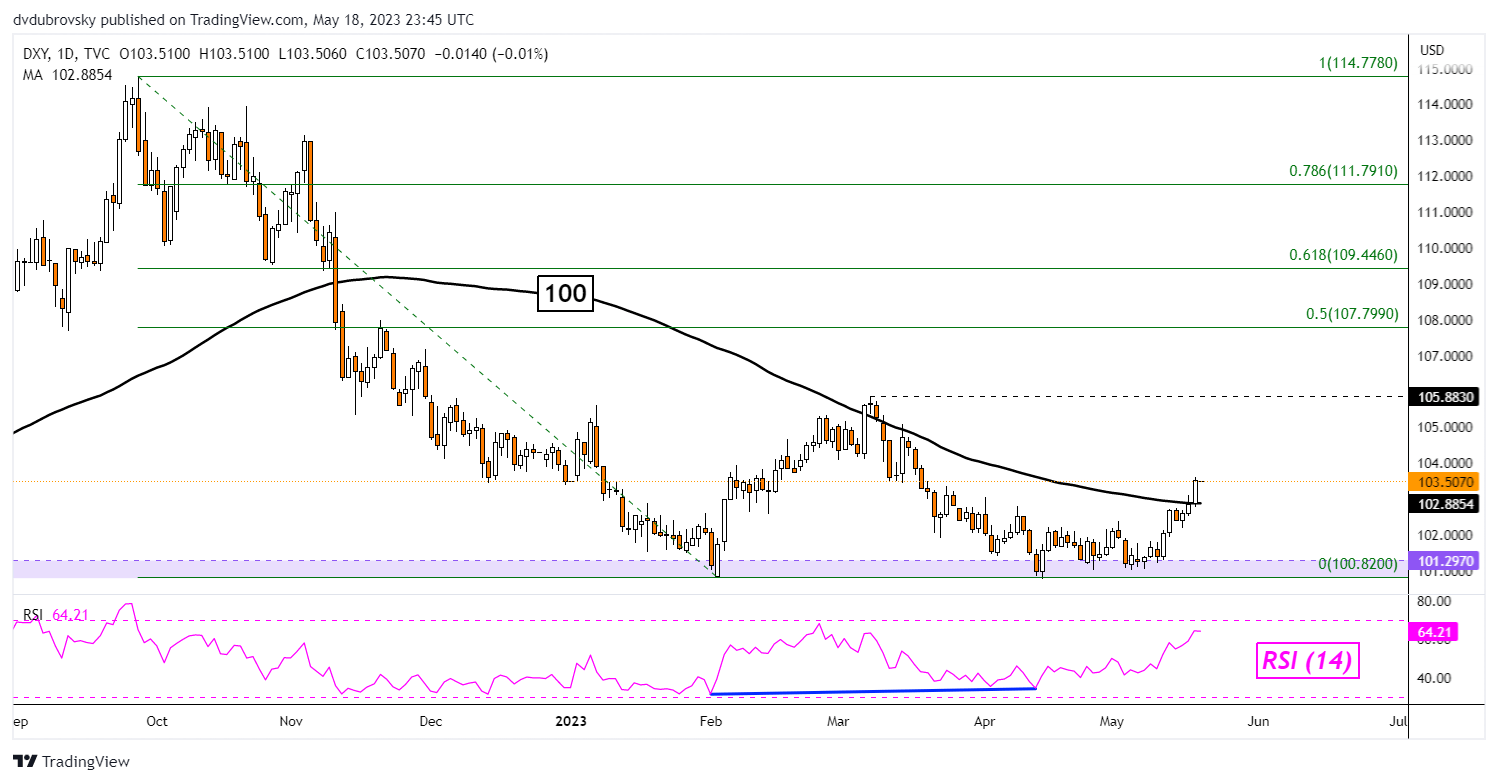
On the daily chart, DXY has broken above the 100-day Simple Moving Average (SMA). That has exposed the March high of 105.88. Given upside confirmation, this could open the door to extending higher in the near term. Key support is the 100.82 – 101.79 range below.

DXY Daily Chart

DXY Daily Chart


US Stocks: S&P 500 Tags New Yearly High on Debt Ceiling Optimism

US Stocks: S&P 500 Tags New Yearly High on Debt Ceiling Optimism

US Stocks Edge Higher Despite Stronger Dollar, Higher Yields

Sentiment has taken a large stride forward this week as news emerged about a possible deal at the end of this week or sometime next week regarding the raising of the US debt ceiling. Markets no longer appear to be pricing in the possibility of a US default, which would have unthinkable ramifications not just for the US but for the wider market as a whole.

As concern around the debt ceiling wanes, markets are left to contemplate the rising probability of another 25-basis point hike form the Fed early next month as inflation shows little sign of improvement. According to the CME FedWatch tool, markets price in more than a 30% chance of a rate hike, up from 28.4% yesterday and 15.5% last week.

image1.png

US yields, mainly the 2-year and 10-year treasuries continue to rise, elevating the dollar in the process. However, this has not appeared to weigh on the index but could serve to cap S&P 500 upside as the index briefly tagged a new yearly high.

Additionally, Fed speakers this week expressed an openness to another hike should the data deem it necessary. Later today (16:00 UK time) Fed Chairman Jerome Powell is due to speak at a Fed hosted conference titled ‘Perspectives of Monetary Policy’.

S&P 500 Technical Levels to Consider

The index’s recent bullish momentum had catapulted it to a new high for 2023, trading above 4200 and the February high of 4008.50. The latest move is significant given the previous inability to break into territory above 4200 for more than a day. Should the index head into the weekend clear of 4200, further upside resistance comes in at 4311.75, the 61.8% Fibonacci retracement of the major 2021 – 2022 selloff. Immediate support comes rests at 4208.50 followed by 4180 and lastly, 4110.

S&P 500 E-Mini Futures (ES1!) Daily Chart

image2.png


Debt Ceiling Blues, Part 79. What Happens if the US Defaults?

Debt Ceiling Blues, Part 79. What Happens if the US Defaults?

There’s a particular long-running piece of political theater with which the United States rather ghoulishly entertains itself and, increasingly, the wider world. A farce in seventy-eight acts (so far), since 1960. It’s called “Raising the Federal Debt Ceiling”.

Technically there is a limit on how much money the US government is allowed to borrow. This idea was baked only vaguely (if at all) into the Constitution but, as time went on, it became codified in various public debt acts and their numerous amendments. Of course, while there is a borrowing limit, Congress has always in the past simply raised it, often just in time, before the government runs out of money without the legal means to borrow any more.

Even the most partisan political show-ponies realize that debt default, the alternative to ceiling-raising, would swiftly turn farce into tragedy.

You may have spotted by now that the ceiling is in effect an executive fiction, one that the world is by and large happy to believe in.

For the US Dollar has long been the world’s reserve currency and by far the most-used unit in international commerce. It overcame all rivals to reach that dizzy height, displacing Sterling at the top of global trade back in the 1930s. It has since seen off all possible comers since, from the one-time contender Japanese Yen to bold upstarts like the Euro and Chinese Yuan. All sorts of global markets, contracts and derivative products are benchmarked against the Dollar, usually far more than all other comparable products put together.

image1.png

The Dollar Has No Plausible Rival

There’s simply nothing that can match the depth and liquidity of US markets, to the point where it’s quite legitimate to talk about a “Dollarized” world financial system. The deepest pools of capital for everything from stocks and bonds to oil and gold are all in the Dollar.

US debt is also supposed to be the world’s pre-eminent ‘risk free’ investment. Why so? Well, because the United States federal government never defaults on its debt.

So, make no mistake, on some level, the US debt ceiling affects us all.

And now the seventy-ninth act is upon us. For the US hit its debt ceiling this week. The thing currently stands at $31.4 trillion dollars and that’s where we are. So, the federal government now finds itself legally unable to borrow more money until Congress decides to suspend or raise the ceiling.

And what has happened seventy-eight times before (three of them in the last six months) is that the ceiling has simply been raised. But now Republicans control the House of Representatives and they want spending cuts which the Democrats in the Senate and, of course, the White House, say they won’t permit.

This gridlock has raised serious concerns that this time farce could morph into tragedy, potentially leading to the first intentional debt default in the history of the Republic.

Sadly, there’s still room for political brinkmanship because the US Treasury can manage the situation at least temporarily. In the past this has included steps like suspending investments it’s meant to make into retirement and health benefits for federal employees, only to top them up once the ceiling has been raised. Treasury Secretary Janet Yellen has announced a package of such measures. She thinks that could keep the government above water until around June.

Now, despite the current impasse, it’s overwhelmingly likely on all past evidence that the two main parties will eventually come together and raise the ceiling.

The Dollar Has No Plausible Rival

Data Source: Bank of International Settlements

So, What Happens If Congress Can’t Agree?

But what if they don’t? What would happen if the unthinkable occurs and the US does in fact default on its debts?

The practical, domestic consequences would be bad enough, with federal salaries unpaid, along with military ones, medical care payments and a host of other outlays usually deemed essential, not least those interest repayments on the national debt.

The United States credit rating would be downgraded, with the government obliged to pay higher interest rates to get its bonds sold. Of course, Washington would remain “investment grade” but the global bond market would have seen its anchor slip for the first time. And that would be a hugely uncomfortable experience.

But the horrors of debt default would soon break free of their homeland and ripple out into the wider world. Other reserve currencies such as the Euro and Yen would see a huge influx of funds at the expense of a tanking Dollar. And don’t forget, many currencies operate within a “Dollar peg” system which explicitly links them to the US currency. They would all experience significant dislocation should the US default.

US import prices would likely also rise extremely sharply, reigniting inflation just when it looked to be cooling down.

The timing would be appalling too. Clearly there’d never be a good time for Washington to fail in its obligations. But a world only just recovering from Covid and still chafing under the burdens of inflation and Russia’s invasion of Ukraine really wouldn’t need another huge problem. A US debt default would probably nail on a deep global recession.

Even so, it’s important not to get too dramatic. A debt default arising from political gridlock would be nasty, but that very fact would probably see the impasse broken. Eventually that ceiling would be raised again, and the federal debt train would trundle on. Dollar appetite took years to build. It’s not going to vanish overnight.

But default is a financial nuclear option that would leave the Greenback forever diminished. Some will feel that even a humbled USD has no plausible rival, and they’d have a point.

But in the end, it’s extremely doubtful that Congress will consider a real world test of that point.

Isn’t it?