The SNB is tightening its monetary policy further and is raising the SNB policy rate by 0.5 percentage points to 1.5%. In doing so, it is countering the renewed increase in inflationary pressure. It cannot be ruled out that additional rises in the SNB policy rate will be necessary to ensure price stability over the medium term. To provide appropriate monetary conditions, the SNB also remains willing to be active in the foreign exchange market as necessary. For some quarters now, the focus has been on selling foreign currency. The SNB policy rate change applies from tomorrow, 24 March 2023. Banks’ sight deposits
Xi and Putin just wrapped up talks in Moscow: What does it mean for the war in Ukraine and China’s global standing?
It’s a friendship testing the limits. Chinese leader Xi Jinping left Russia on Wednesday after three days of talks with Russian President Vladimir Putin, in which Putin endorsed China’s “peace plan” for Ukraine and the two leaders stressed the need to “respect legitimate security concerns of all countries” to end the war—a talking point Russia has used to blame NATO and legitimize its war of aggression. What did this visit do for Putin’s international standing? What role might China play in the war? How should Washington view this partnership? Below, our experts cut through the pageantry and diplomat-speak.
China has doubled down on relations with Russia
Xi’s meetings with Putin and the joint statements released on Tuesday should dispel any remaining doubts that Xi has doubled down on relations with Russia over the past year even as Putin has unleashed his punishing war on Ukraine. Xi, intent upon preventing Russian failure in Ukraine, is supporting Putin’s continued ability to prosecute the war in numerous ways short of sanctions violation while deepening the countries’ military and economic ties.
At the same time, Xi is calling for peace and parroting Kremlin narratives about US and NATO culpability for “fanning the flames,” underscoring his belief that China can capitalize on this moment to bolster China’s claims to responsible global leadership. To that end, Beijing’s so-called “peace plan” is a gambit to remain faithful to Russian interests in maintaining control over illegally occupied territory in Ukraine while claiming neutrality and building China’s burgeoning reputation as a peacemaker following its brokering of an initial rapprochement between Saudi Arabia and Iran earlier this month. These efforts dovetail nicely with Xi’s Global Security Initiative, a vague framework for global cooperation and security designed to offer a Chinese alternative to the US-led global order and rooted in principles repeated in yesterday’s joint statement such as opposition to “blocs” like NATO. Xi seems to view Russian partnership as essential not only to China’s bid to revise the global order but to girding for an expected protracted strategic competition with the United States as US-China ties grow ever more fraught. In particular, Russia is viewed as critical to mitigating the People’s Republic of China’s vulnerability to US actions in the event of a war over Taiwan and devising an alternative to the US-centric global financial system.
As the limits to the “no limits” partnership grow harder to discern, the United States and its allies must reconcile themselves to dealing with an authoritarian entente that will complicate mutual security interests in Europe and Asia, distort global narratives, and undermine the liberal underpinnings of multilateral institutions in the years ahead.
—David O. Shullman is senior director of the Global China Hub at the Atlantic Council and former US deputy national intelligence officer for East Asia on the National Intelligence Council.
Putin won’t even take the first step to legitimize China’s sham ‘peace plan’
Putin’s faltering war on Ukraine was the backdrop of Xi’s long state visit to Moscow this week, but it suited both parties not to single out the conflict. While the international community and media were paying particular attention to this issue, the visit was scripted to cover a broad array of bilateral and international issues of which Ukraine was simply one. The reason for this is simple. Moscow’s failures on the battlefield and its international isolation are problems that neither Putin nor Xi wants to highlight. They are, however, also problems that both leaders need to manage—even as their interests are overlapping but not identical.
Putin is in a difficult spot and would like more support from China—political, economic and even military. Xi would like to strengthen Putin’s hand, but does not want to risk Western sanctions, nor international criticism by explicitly endorsing Russian aggression. These considerations provided the drama before Xi ever boarded a plane for Moscow. The news reported that Washington believed China was considering sending arms to Russia and that doing so would lead to major sanctions. China denied these reports. But there is growing evidence that at least some Chinese weapons—rifles—and components for drones have been sent to Russia. Beijing may well be probing for what it can do without provoking a strong US response. In any case, this issue did not factor in the public discussion of the visit by either China or Russia.
The big Ukraine development at the summit was Putin’s general endorsement of China’s twelve point approach to peace in Ukraine. Putin thought the Chinese document was “consistent” with Moscow’s policy and could serve as a “basis” for negotiations when Kyiv and the West were ready to talk. This was hardly a ringing endorsement. That is no surprise because the Chinese plan contains elements—such as respect for territorial integrity—that Moscow has already violated and has no intention of respecting. China’s peace proposal is meant to help Moscow while enabling Xi to posture as a neutral party. But despite his failures on the battlefield, Putin still holds maximalist aims that makes him reluctant to take the one step that might give the Chinese peace initiative something to build on—announcing his readiness for an immediate ceasefire in place. It was precisely this possibility that prompted warnings from Washington and others about the dangers of the Chinese proposal. But Putin’s ongoing intransigence rendered this concern irrelevant—at least for now.
Plans are apparently underway now for a Xi phone call to Ukrainian President Volodymyr Zelenskyy. This is part of Beijing’s charade that it is neutral and a logical mediator in a crisis that it refuses to call a war. If it comes off, little will come of it because Ukraine will insist, as National Security Chief Oleksiy Danilov said this week, that the plan’s reference to territorial integrity means the war must end with either the withdrawal or capitulation of Russian troops.
Perhaps the big winner this week of grand diplomacy was not Xi or Putin, but Japanese Prime Minister Fumio Kishida. While Xi was giving a big hug to recently indicted war criminal Putin, Kishida visited Kyiv and Bucha to pay homage to the victims of those war crimes.
—John Herbst is senior director of the Atlantic Council’s Eurasia Center and former US ambassador to Ukraine.
Putin and Xi are building an alternative world order—with Russia as the vassal state
The Xi-Putin summit is a continuation of the ongoing process through which both China and Russia are decoupling from the West, politically and economically, and replacing those ties with a deeper bilateral relationship. The main aim of that partnership is to reduce their vulnerabilities to, and ultimately roll back, US global power. For both, this has been and continues to be a conscious choice. Putin chose to sacrifice his ties to the West when he invaded Ukraine. Xi has convinced himself that the United States is implacably opposed to his country’s rise, and he is therefore seeking to ensure China’s “national rejuvenation” by forging an foreign policy focused on confronting Washington, with a partnership with Russia as a key feature.
In light of that, both sides got what they wanted out of the summit. Putin continues to benefit diplomatically and economically from closer ties to China as he pursues his Ukraine war. Xi got to play the grand international statesman, carrying a purported “peace plan” in his pocket, all the while deepening ties to Russia and making the country more dependent on China.
There are risks for both as well. By taking this course, Putin is turning Russia into, in effect, a vassal state of China. Over time, as the power imbalance in the relationship continues to widen in China’s favor, Moscow will find itself less and less able to chart an independent foreign policy or deviate from alignment with Beijing’s interests. That, of course, suits Xi just fine, since he gets greater leverage over Moscow. For Xi, the love-fest with the man who started the worst European war in eighty years will further consolidate the view among the United States and its democratic allies that China is a threat, tightening a coalition against Xi, and thus bringing about the very scenario he fears he must counter. In the process, Xi is turning against key sources of trade, investment, and technology (the United States and European Union) in favor of a relationship with Russia that cannot replace what is potentially being lost. That doesn’t bode well for China’s already struggling economy.
I’d be very, very, very cautious about the talk of negotiations to end the Ukraine war that was a feature of the summit. Putin’s comments expressing interest in peace talks strikes me as a throwaway statement, something any leader at war would say. As for Xi, if he sincerely reaches out to Zelenskyy and tries to mediate a settlement, I wish him all the best. More likely, Xi’s supposed interest in diplomacy is a cynical public-relations stunt to make it appear that China is a responsible world power while deepening ties to Russia. The two autocrats are using China’s “peace plan” to create an alternative narrative that blames the United States for causing and perpetuating the war. In my view, the outcome of the summit makes peace in Ukraine less likely. With such strong backing from Xi, Putin is unlikely to feel much pressure to make concessions to the West.
Xi’s approach to Russia is representative of his changing foreign policy overall. First, Xi has fully embraced anti-Americanism and that has become the primary driver of its foreign policy. Secondly, writing off the United States and its partners as inherently hostile, Xi is reorienting China’s foreign policy to focus on the developing world, where which Beijing believes is more fertile ground for building support for Chinese interests. There China can create unequal relationships which it dominates politically and economically, as with Russia. In Beijing’s planning, those relationships will form the basis of an alternative world order centered on China and controlled by Beijing. Russia is key to that vision.

EUR/USD seen moving lower to 1.02 in six-month horizon – Danske Bank
The Fed raised its policy rate by 25 basis points (bps) to the range of 4.75-5%. EUR/USD jumped to 1.09 – the highest level since the beginning of February. However, economists at Danske Bank still expect the pair to move downward over the coming months.
A cautious 25 bps hike
“Fed hiked by 25 bps in line with our expectations but sent a dovish signal by emphasizing that Fed is ready to pause if credit conditions tighten markedly.”
“We stick to our call for a final 25 bps hike in May. We expect the Fed to maintain the policy rate at 5.00-5.25% through 2023.”
“We still see EUR/USD moving lower to 1.02 in 6M horizon. Relative rates have favoured EUR after the more hawkish ECB last week, but a prolonged rally in EUR/USD could support a renewed uptick in commodity prices and inflation expectations, and thus hinder a return to 2% inflation.”
EUR/USD Price Analysis: Refreshes seven-week top near 1.0930, pokes the last defense of bears
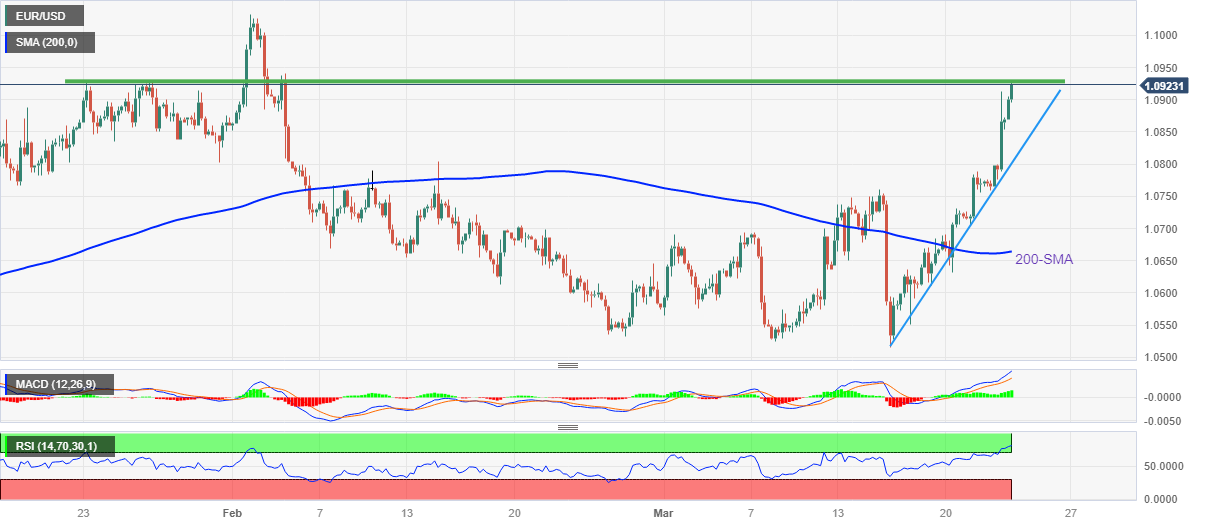
EUR/USD bulls occupy the driver’s seat for the sixth consecutive day as they prod 1.0930 mark to renew a seven-week high during early Thursday.
In doing so, the Euro pair extends the Federal Reserve (Fed) inspired gains during the one-week-old upward trajectory, as marked by an ascending trend line from March 15, amid bullish MACD signals.
However, a two-month-old horizontal resistance area surrounding 1.0930-35 joins the overbought RSI (14) line to challenge the EUR/USD buyers.
Hence, it becomes necessary for the pair to provide a successful break of 1.0930 to keep the bulls in dominating position otherwise the bears could cheer good profits on a U-turn.
It should be noted that a downward-sloping resistance line from May 2022, around 1.0950 by the press time, also acts as a short-term upside filter for the EUR/USD pair.
That said, a sustained break of 1.0950 could quickly propel the EUR/USD price toward the monthly high of 1.1033. However, the 1.1000 psychological magnet may act as an intermediate halt during the run-up.
On the flip side, a one-week-old ascending support line, close to 1.0800, puts a floor under the EUR/USD price.
However, the pair sellers should remain cautious unless the quote remains beyond the 200-SMA support of 1.0665.
EUR/USD: Four-hour chart
Gold Patiently Awaits the Fed’s Next Move – How Will XAU/USD Respond?
FOMC Economics of projections and Fed rate decision to guide gold’s next move
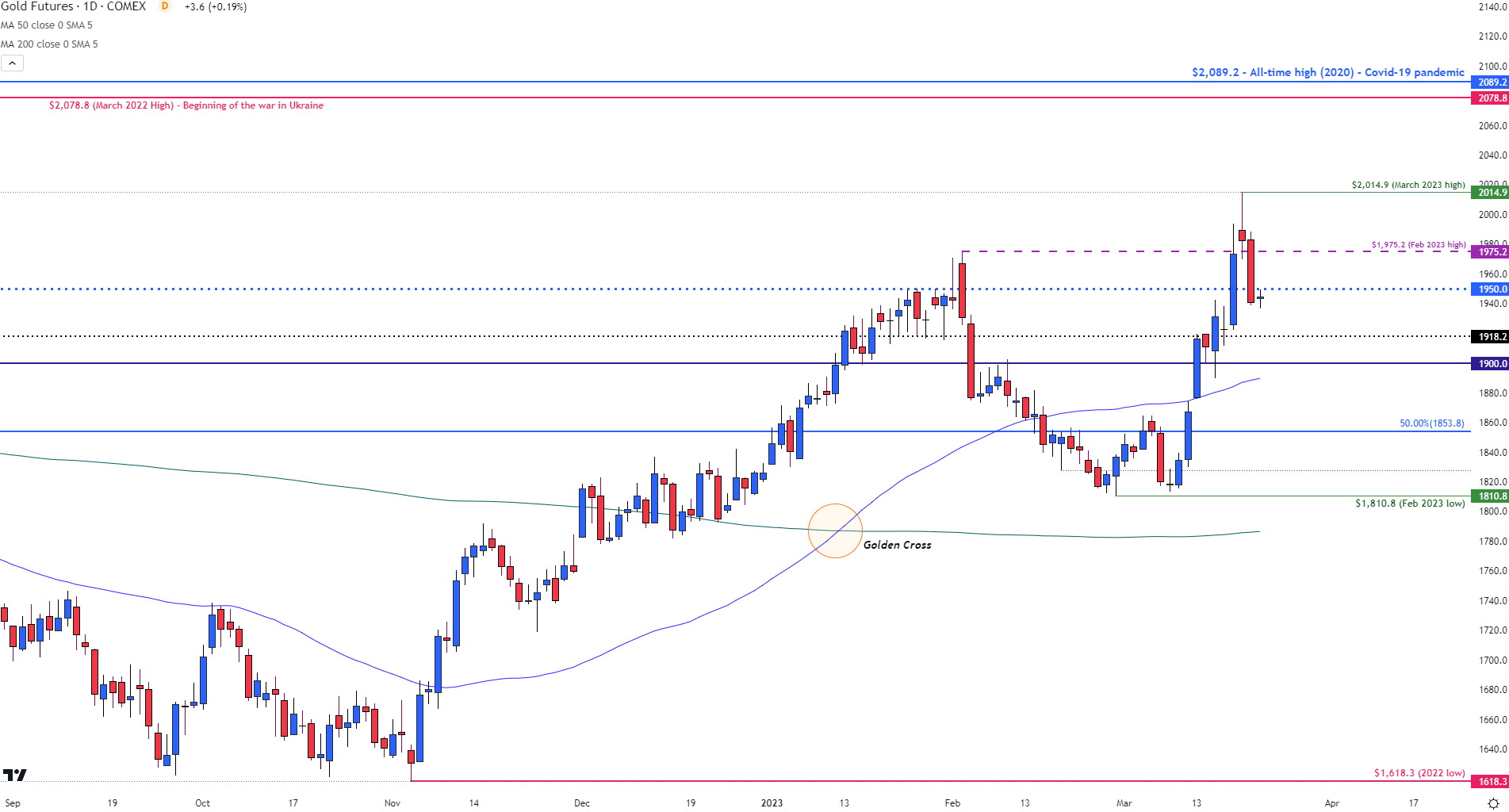
Gold prices have steadied after yesterday’s decline, pushing XAU/USD into a tight range around $1,946. With fears around the banking crisis beginning to ease, market participants appear to be regaining confidence. This has been illustrated by a steep drop in the VIX index, which measures the volatility of the S&P 500 and has gained a reputation as ‘fear gauge’.
At the onset of a potential banking crisis, the VIX started to increase at a rapid pace which was exacerbated when Credit Suisse appeared to be in financial distress. However, after rising by approximately 37%, the VIX fell sharply, shedding around 18% of those gains.
Because gold holds a reputation as a hedge against inflation and is sensitive to growth prospects, its safe-haven appeal assisted in driving prices higher. However, it was the expectations surrounding the Federal Reserve’s next move that enabled a break of $2,000.
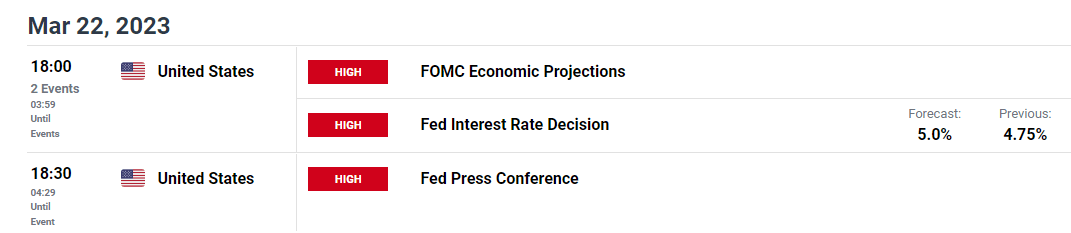
With the FOMC economic projections and the Fed’s rate hike on today’s economic docket, markets are now pricing in a 25 basis-point rate hike, half of what was anticipated a two weeks ago.
Gold (XAU/USD) Technical Analysis
After soaring to a new high of $2,014.9 last week, gold prices started to fall, erasing a small portion of recent gains. With recession fears subtly subsiding, XAU has found temporary support around $1,946. As key technical levels continue to provide support and resistance for price action, there are two scenarios that can play out.
Gold Price Chart (Daily)
If Fed Chairman Powell hikes rates by 50 basis-points (above expectation) and he suggests that the path for interest rates remain unchanged, then it is possible for gold to experience a sharper pullback towards $1,900.
On the other hand, if the Fed pauses or sticks to a 25 bps (0.25%) hike and hints at a pivot, gold could resume its bullish move, opening the door for $2,000.
US Dollar Wavers Ahead of Fed Decision. What Should Forex Traders Expect?
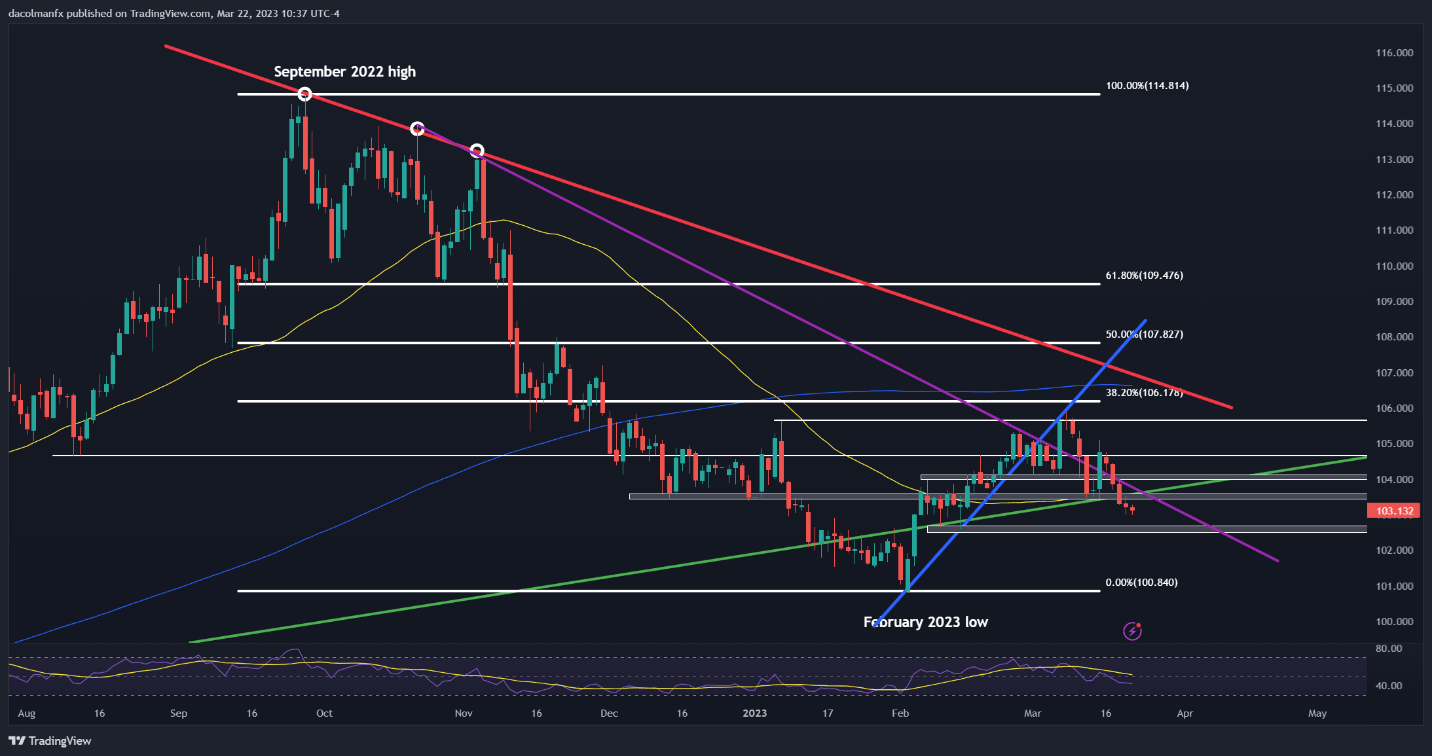
The U.S. dollar, as measured by the DXY index, lacks directional conviction on Wednesday morning, moving between small gains and losses around the 103.15 level, as traders avoid taking large positions ahead of a high-impact event: the March FOMC announcement.
At the conclusion of a two-day meeting, the Fed will release its monetary policy decision this afternoon. Expectations have been in flux, but a majority of traders believe that the central bank will raise interest rates by a quarter of a percentage point to 4.75%-5.00%. Meanwhile, a small segment of the market anticipates a “pause” in the tightening cycle in the wake of the collapse of two U.S. lending institutions.
Prior to the recent banking sector turmoil, investors were convinced that the Fed would plow ahead with its hiking cycle forcefully in its efforts to strangle high inflation, but the backdrop has changed, leaving room for potential surprises at today’s event.
WHAT HAS CHANGED?
Although tighter policy may be necessary to ensure inflation convergence towards the 2.0% target, the financial system is in a fragile position, with the two bank runs earlier this month exposing the banking sector’s vulnerabilities to rapidly rising borrowing costs.
While sentiment has improved somewhat following coordinated actions by government authorities to shore up struggling lenders, underlying headwinds have not dissipated entirely. This means that systemic risks could emerge at any time if stress in the system continues to build.
To preserve financial stability and avoid rocking the boat at a time of heightened uncertainty, the Fed could err on the side of caution, halting its hiking cycle temporarily to assess the situation and take stock of how tightening is rippling through the real economy. Another possible option would be to hike rates by 25 basis points while offering dovish guidance.
The two scenarios described above are likely to be bearish for the US dollar in the near term, suggesting that more losses could be around the corner for the greenback.
In terms of technical analysis, the DXY index’s trading bias has turned negative following recent losses, with prices now eyeing key support in the 102.60 region. A break below this floor could accelerate the US dollar’s decline, setting the stage for a retest of the 2023 lows. Conversely, if the bulls regain the upper hand, resistance lies between 103.50 and 103.65, followed by 104.10. Above that, the next upside target lies at 104.65.
US DOLLAR TECHNICAL CHART
Fed Hikes Rates to Zap Inflation, Offers Less Hawkish Guidance, US Dollar Sinks
FOMC MARKET REACTION:
Immediately after the FOMC announcement crossed the wires, the U.S. dollar took a turn to the downside, with the DXY index falling more than 0.8%, undermined by the sharp pullback in Treasury yields, especially those at the front end of the curve. This move was prompted by the Fed’s softer guidance, which was less hawkish than previous iterations in the face of the recent banking sector upheaval. All this suggests that the central bank’s hiking cycle is close to its end, a bearish outcome for the U.S. dollar.
The Federal Reserve concluded today one of its most anticipated meetings in recent memory and voted by unanimous decision to raise interest rates by a quarter of a percentage point to 4.75%-5.00%, largely in line with consensus estimates. This adjustment brings borrowing costs to their most restrictive level since 2007, a sign that the central bank will not relent in its efforts to restore price stability.
Ahead of today’s announcement, Wall Street’s expectations were in flux amid banking sector turmoil in the aftermath of the collapse of two lending institutions and the bailout of Credit Suisse earlier this month. Although market stress has begun to ease after government authorities swiftly unveiled coordinated measures to shore up the financial system, sentiment was still fragile.
In the policy statement, the FOMC noted that the labor market continues to be robust, and that inflation remains elevated. Regarding recent developments related to regional banks, the Fed stated that the banking system is sound and resilient, but underscored that the situation could result in tighter credit conditions for households and businesses, creating downside risks for economic activity, hiring and inflation.
In terms of forward guidance, language indicating that “ongoing increases in the target range will be appropriate” was removed and replaced by “additional policy firming may be appropriate”. While this points to further tightening, it is less hawkish than previous messages, a sign that the hiking cycle is coming to an end. This is likely to be bearish for the U.S. dollar over the medium term.
SUMMARY OF ECONOMIC PROJECTIONS
There were meaningful changes in the March Summary of Economic Projections (SEP) compared to the material presented in December of 2022. For 2023, the GDP forecast was downgraded to 0.4% from 0.5% previously, while the unemployment rate was marked down to 4.5% from 4.6%, a vote of confidence in the labor market despite growing economic headwinds. Meanwhile, core PCE inflation for 2023 and 2024 was revised higher by one-tenth of a percent to 3.6% and 2.6%, respectively. Key details are highlighted in the below.
Source: Federal Reserve
FED DOT PLOT
The Fed’s so-called dot plot, which shows the trajectory for interest rates, signaled the same hiking path for 2023 as the one contemplated three months ago, with the median projection steady at 5.1%, implying about 25 basis points of additional tightening through year’s end. For 2024, rates are seen at 4.3% versus 4.1% in December, indicating a little less easing with respect to the terminal rate on the horizon.
Learn to Take Losses Like a Professional
Nobody likes to be a loser, but taking losses well is required in order to be a winner. Just ask some of the most prolific hedge fund managers of all time. George Soros once said (I’m paraphrasing), it isn’t about being right, it’s about how much you make when you are right versus how much you lose when you are wrong.
Soros’ extremely successful disciple, Stanley Druckenmiller, once said in an interview that he estimates he is right about 60% of the time. This means he is wrong 40% of the time. Paul Tudor Jones, another billionaire macro legend, once said he is wrong about as often as he is right, but he also echoed Soros by saying that what matters the most is how much he makes on his winners when right versus how big the losses are when wrong.
That means that some of the most successful hedge fund managers in the world are wrong, a lot. And they don’t care because it is part of the game and not what really matters most. What they care about is managing the risk on their ideas and seeking asymmetry between their winning and losing ideas.
Accepting losing is of course easier said than done given it is human nature to dislike losing, so for many taking losses frequently can be a jagged pill to swallow. But you should embrace it, actually, because it is just part of the game and what will keep you in the game in the long run. Furthermore, the faster an idea hits its stop the faster you can move onto the next potential winner.
Not all losses are created equally. What should raise red flags is when you are constantly taking losses, or taking outsized losses relative to your wins. A loss could be a function of market conditions not conducive to your trading style/strategy, or it could be something deeper that implies you are not consistently following your trading rules.
When suffering a losing period (drawdown) take a close look at what you are doing. Examine your trade log, go through your journal, see if you are following your trading plan or deviating. If deviating, then you need to figure out what you need to do to get back on track. This is when losing isn’t acceptable, because it is self-inflicted.
However, if you are following your plan it could be a function of a market not conducive to your strategy, and while you should be flexible to adapting to market conditions, a solid time-proven strategy over multiple cycles should still come out ahead. The key here is to be consistent and seeing the strategy through the ups and downs.
Summary:
- The very best in the business understand that taking losses is part of the game and don’t focus on being right all the time
- What matters most is managing the risk on winning ideas versus losing ideas and coming out ahead with asymmetrical win/loss ratios
- Not all losses are created equally, though; you need to understand when losing is a function of market conditions and when it is a function of deviating away from your trading plan
Gold Prices Turn to US Initial Jobless Claims to Gauge SVB Economic Shock
Gold prices gained about 1.6% on Wednesday in the aftermath of the Federal Reserve rate decision and Chair Jerome Powell’s press conference. The takeaway from the Fed was that Mr Powell stressed that at this time, policymakers did not see the case for rate cuts this year. The latter is something that markets have been aggressively pricing in since SVB’s collapse.
Still, markets focused on the less hawkish shift in the Fed policy statement. Policymakers downgraded the messaging about rate hikes being as “ongoing increases” to “anticipating” some extra firming as appropriate. The 2-year Treasury yield and US Dollar turned lower on the Fed. Gold typically functions as the anti-fiat instrument. As such, XAU/USD welcomed the decline in the greenback and bond yields.
Understand that markets remain firmly on the anticipated rate cut path for this year while Fed projections do not. If the latter ends up being the story, gold would be at risk of giving up its progress since earlier this month. With that in mind, what is gold facing over the remaining 24 hours?
All eyes turn to US initial jobless claims due at 12:30 GMT. Economists anticipate unemployment filings to clock in at +197k last week compared to +192k prior. Jobless claims are one of the few timely pieces of data we have on the labor market. It will offer a slight glimpse into how the economy is faring in the first full week after Silicon Valley Bank collapsed. An unexpectedly strong surge could confirm market expectations of rate cuts. That may benefit gold.
XAU/USD Daily Chart
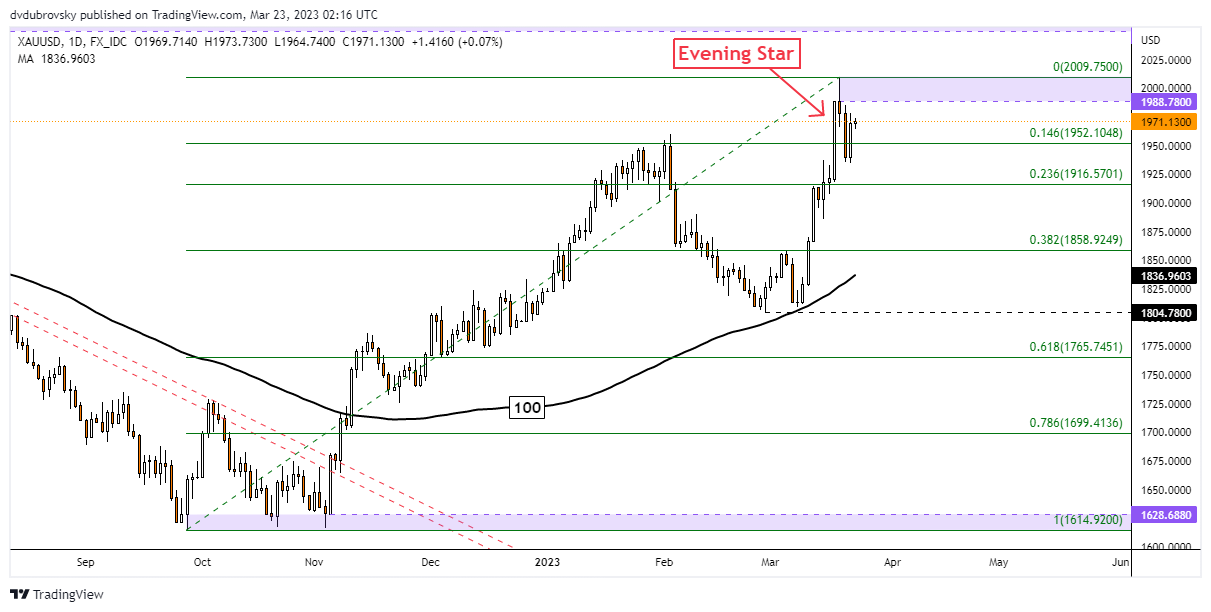
On the daily chart, gold can be seen turning back higher to the critical 1998 – 2009 resistance zone. This is undermining the emergence of a bearish Evening Star candlestick pattern. A confirmatory close above this resistance range would open the door to an increasingly bullish outlook. Otherwise, extending lower places the focus on the 23.6% Fibonacci retracement level at 1916.
Impacts of industrial guidance funds on the performance of Chinese manufacturing enterprises
Industrial guidance funds are Chinese public-private investment funds aiming to optimise industrial structure. There are debates over the fairness of these funds for competition and more broadly on their effectiveness. This column analyses the effects of industrial guidance funds on various measures of firm performance. It finds that firms which receive investment from a fund significantly increase their fixed assets and employment. However, the effects on other measures, including sales and labour productivity, are less clear.
Industrial guidance funds (IGFs) are China’s public-private investment funds collected from government agencies, financial institutions, corporations, private equity funds, public pensions, and other financing entities aiming to “optimize industrial structure.” IGFs have attracted attention as a policy instrument for directing a wide range of capital from the whole society into venture capital and early-stage technology-based small and medium-sized enterprises. According to Zero2IPO Research (2023), a total of 2,107 funds were established or in progress as of the end of 2022, and their target and actual amount of investment summed up to RMB 12.84 trillion and 6.51 trillion, respectively. Figure 1 shows the number and the investment amount of new funds by year. Considering that annual fiscal subsidy related to industrial policy is in the order of 100 billion yuan, the role IGFs play is very important in China’s industrial policy today.
Figure 1 Number and investment amount of new industrial guidance funds

Source: Zero2IPO Research (2023).
The US government heavily criticises IGFs as a bad industrial policy that distorts the market and undermines the fairness of competition. For example, its report titled “How China’s Economic Aggression Threatens the Technologies and Intellectual Property of the United States and the World” takes as an illustration one of the IGFs, China Integrated Circuit Industry Fund, and argues that the Chinese government uses those funds as an instrument to rapidly acquire foreign assets and technologies (White House Office of Trade and Manufacturing 2018).
Whether the funds constitute a bad policy is a complex issue. They might be an innovation-promoting ‘industrial policy of the 21st century’, and more market-oriented than traditional infant industry protection. Naughton (2021, p.110) argues that “the benefit of IGFs in the eyes of government policy-makers—and to a certain extent in reality—is that they create clearly specified responsibilities and incentives, and therefore permit professionalization and market-responsive behavior.”
Besides the above issue of market orientation and fairness, there are arguments that actual performance of IGFs is less than expected. Luong et al. (2021) point out that despite being intended to support early-stage companies, many funds end up investing in mature firms. According to the data of 2018 they cite, 6.41% of the IGF investments were in seed stage companies, 18.69% were in start-ups, 42.30% were in corporate expansion, and 31.21% were in mature stage companies. Furthermore, according to the authors, “overcapacity, diversion, incompetent management, and excessive government intervention are widespread, and so far, the funds have raised and deployed much less capital than intended” (p. 24). Gong et al. (2019) also admit that government involvement in operation and management affects fund performance. They refer to data that the average return on exit of government-led industrial investment funds as of March 2018 was less than one third of that of private equity funds and explain that government involvement causes the funds’ low returns, resulting in reduced attractiveness and financing capacity.
Gong et al.’s data casts doubt not only on the financing capacity of IGFs but also on their effect on the performance of firms receiving the investments. The low return might be thought of as a cost to promote innovation, but the cost might be too high if their investment has only limited effect on investee’s performance.
We examined the effect of IGF investment on firm performance by using the data from Orbis from Bureau van Dijk and PEdata from Zero2IPO, China. We listed IGFs from Pedata and searched Orbis for manufacturing firms they invested in. We then found from PEdata when these firms received investment and employed a difference-in-differences-matching approach to estimate the average treatment effect of the investment, selecting the control group through a combination of propensity score and exact matching.
We estimated the effects on sales, fixed assets, employment, labour productivity, R&D/sales ratio, profit/sales ratio, return on equity, and debt/equity ratio after one and two years of investment. Figure 2 shows the result.
Figure 2 One- and two-year effects of industrial guidance fund investment

Notes: Circles and vertical lines denote average treatment effect on the treated (ATT) estimates and 95% confidence intervals, respectively. They are changes in the deviation from the average percentage growth rate (sales, fixed assets, employment, and labour productivity) or the average percentage ratio (R&D/sales, profit/sales, return on equity (ROE), and debt/equity).
The effects on fixed assets and employment are significant. Firms that received investment from the fund increased their fixed assets by approximately 50 percentage points and their employment by 20 percentage points above average levels. However, the effects on sales and R&D intensity are not significant and productivity might have decreased. The effects on profit, return on equity (ROE), and debt ratios are also ambiguous.
Our estimate is limited by the fact that although we made a list of more than 3,000 IGFs, we could find less than 300 investees with minimum required data, and the number was reduced to at most 126 after matching the controls. The sample might not be large enough, and for this reason we could only estimate the effects after one and two years. However, our result that the effects are only apparent on fixed assets and employment is consistent with the data that return on investment was low. It seems that at least to this point, actual performance of IGFs is less than expected not only in terms of financing capacity but also in their effect, and that focused attention needs to be maintained on this issue.