
Retreat in US Yields Supports Gold, But for How Long? XAU/USD, XAU/EUR Price Setups

Retreat in US Yields Supports Gold, But for How Long? XAU/USD, XAU/EUR Price Setups

Gold rose on Tuesday, tracking the decline in US Treasury yields after a deal in Washington to raise the government’s debt ceiling, potentially averting a catastrophic government default. But is the short-term downtrend in the yellow metal over?

Yields on near-end US Treasury bills fell sharply even as the deal needs to secure blessings from Congress before June 5, when the Treasury Department could run out of funds to pay its debts. A vote on this is expected to occur in the House on Wednesday which gives the Senate time to consider it before June 5.

XAU/USD 240-minute Chart
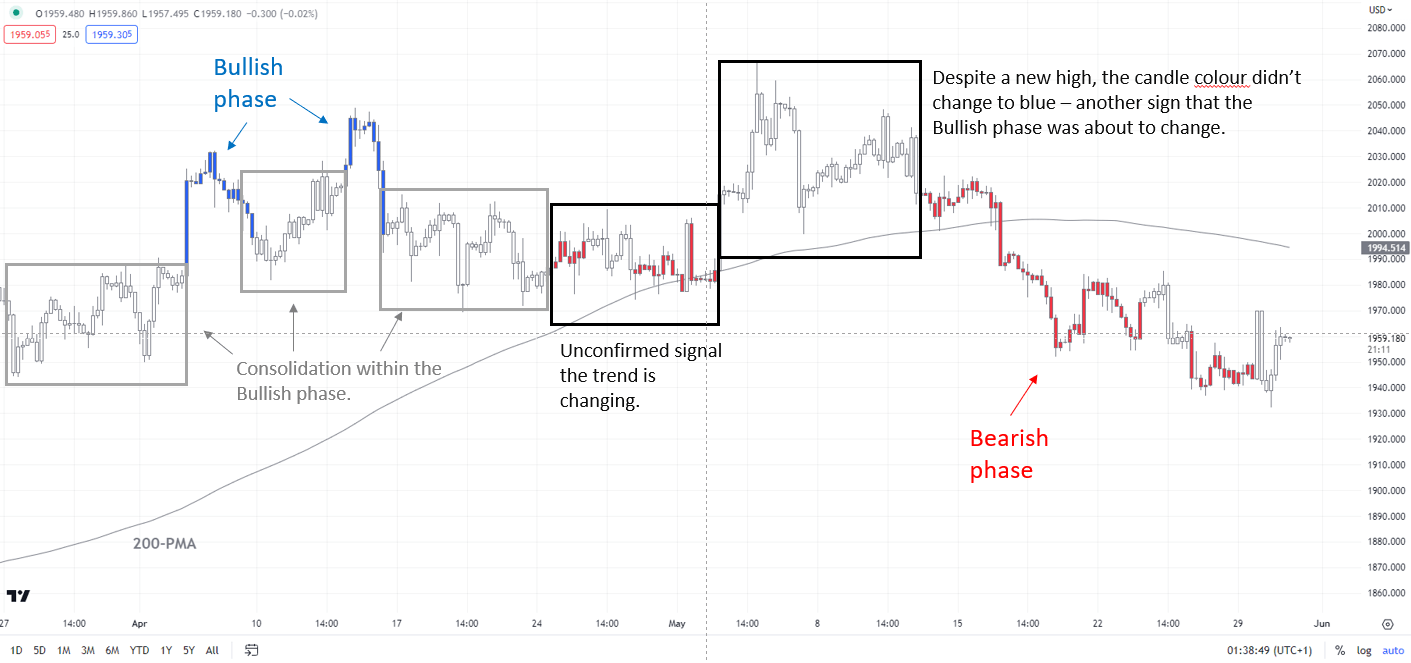
image1.png

However, the upside in gold could be capped by growing odds of another rate hike by the US Federal Reserve at its next meeting. Markets are pricing in a 60% chance of a 25 bps Fed rate hike at the June meeting up from 25% about a week ago, according to the CME FedWatch tool.

XAU/USD Daily Chart
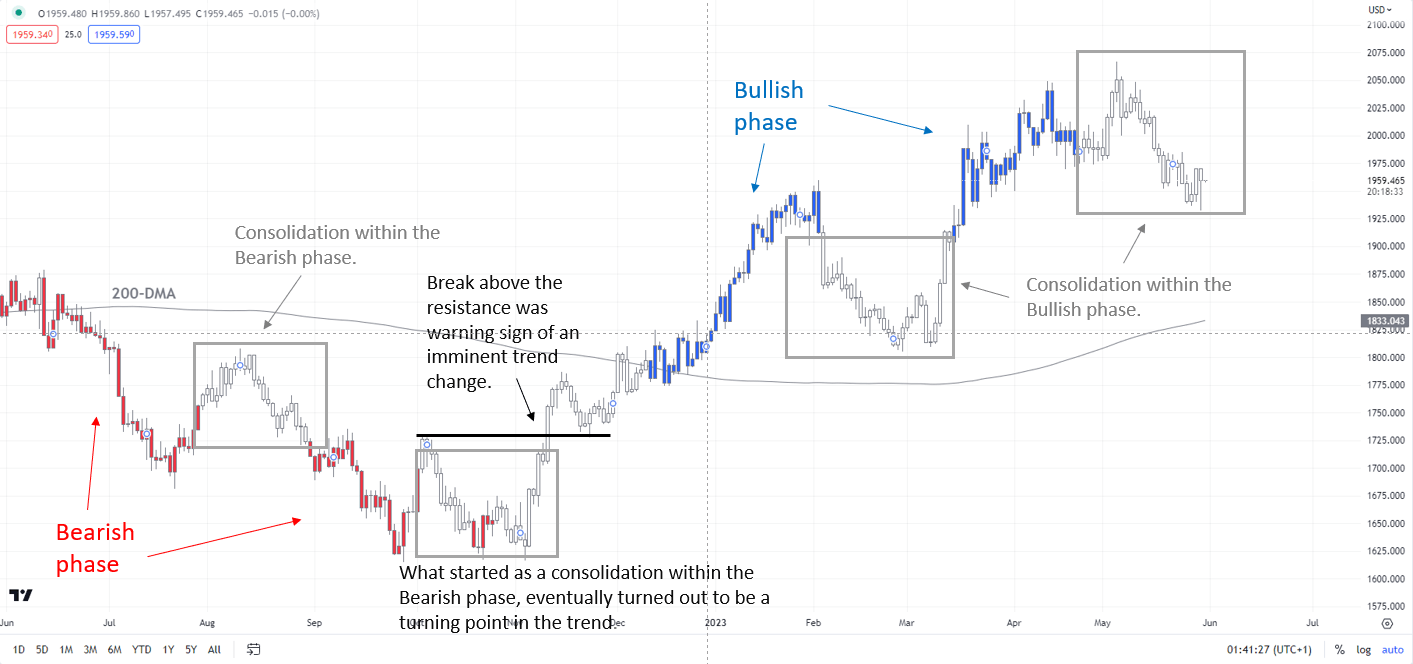
image2.png

XAU/USD: Short-term trend remains down

On technical charts, XAU/USD remains within a well-defined downtrend channel since early May on the 240-minute charts, a point reinforced by colour-coded candlestick charts, based on trending / momentum indicators. For the immediate downward pressure to fade, the yellow metal needs to break above the 1985-2000 area (including the 200-period moving average and the late-March high on the 240-minute charts).

XAU/USD Daily Chart
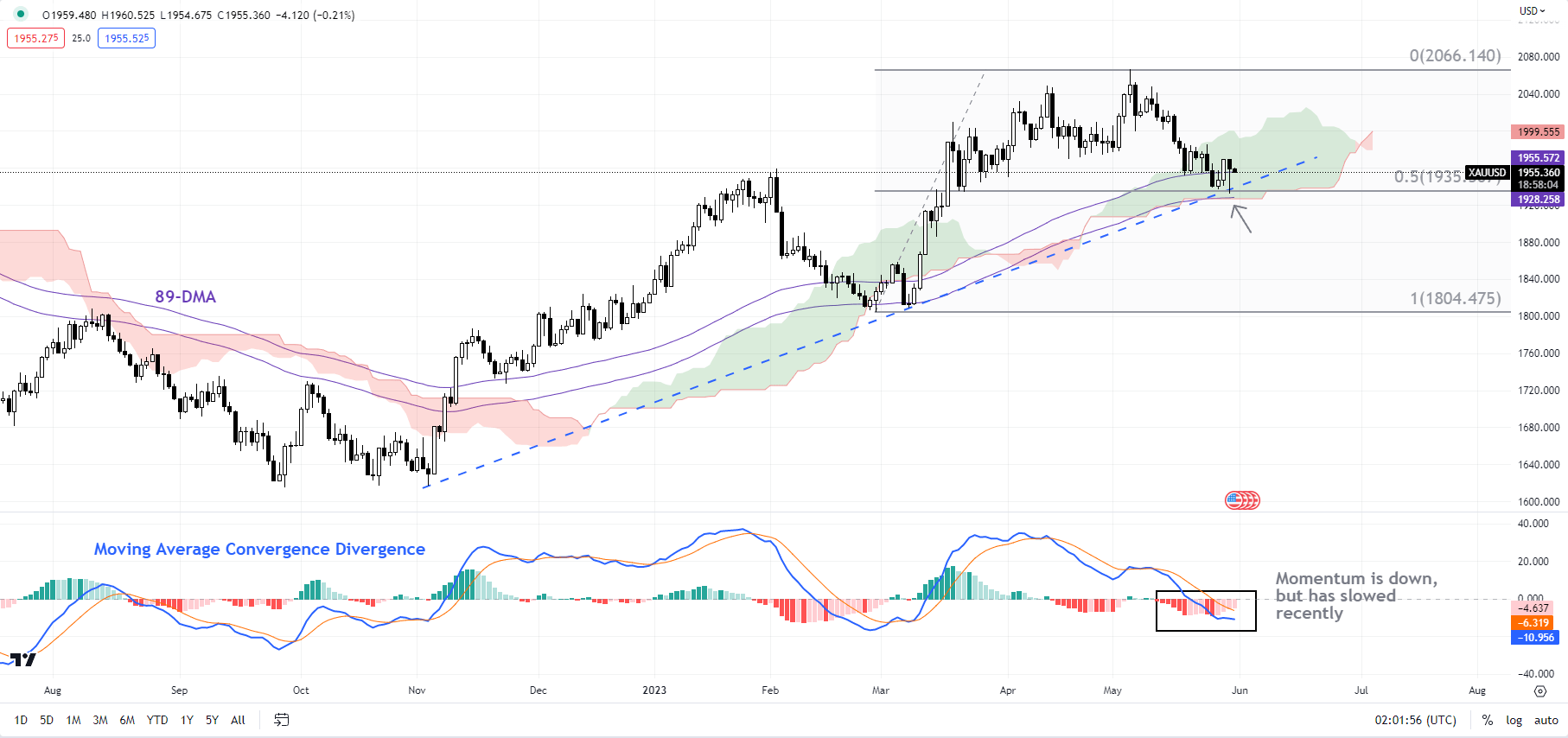
image3.png

On the daily charts, as the colour-coded candlestick charts show, the trend has moved to a consolidation phase within the overall bullish structure. If history is any guide, consolidations can extend from a few days to a few weeks. So far, gold is holding above quite a strong cushion around 1930, including an uptrend line from the end of 2022, the 89-day moving average, and the lower edge of the Ichimoku cloud on the daily charts. This support is crucial, and any break below could open the door toward the 200-day moving average (now at about 1835).

XAU/USD 240-minute Chart
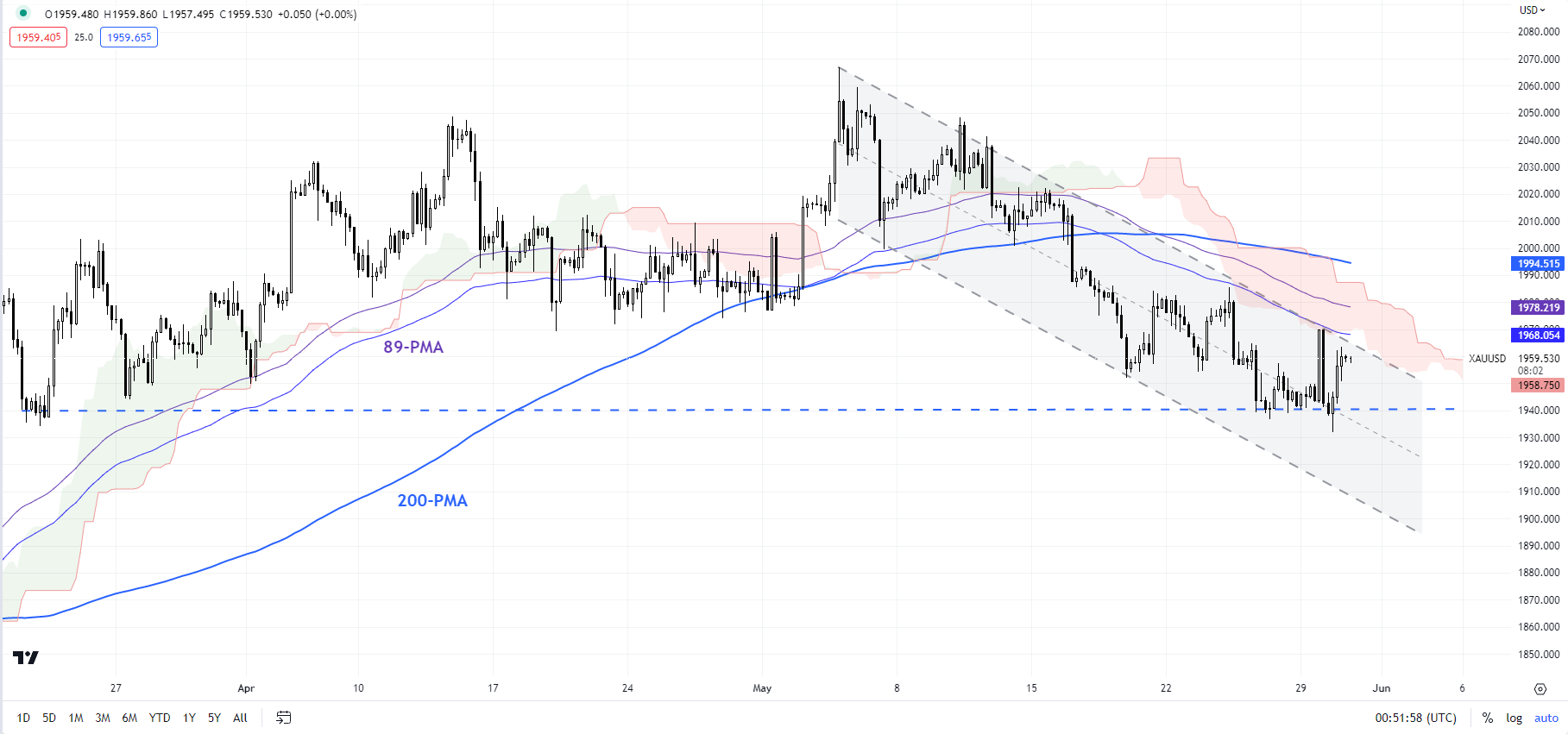
image4.png

Beyond the daily charts, in recent months, the momentum on higher timeframe charts has been a concern – see previous updateson March 28,April 16,April 24,May 10, May 17, and the most recent “Is the Downward Correction in Gold Over?”, published May 22.

XAU/EUR Monthly Chart
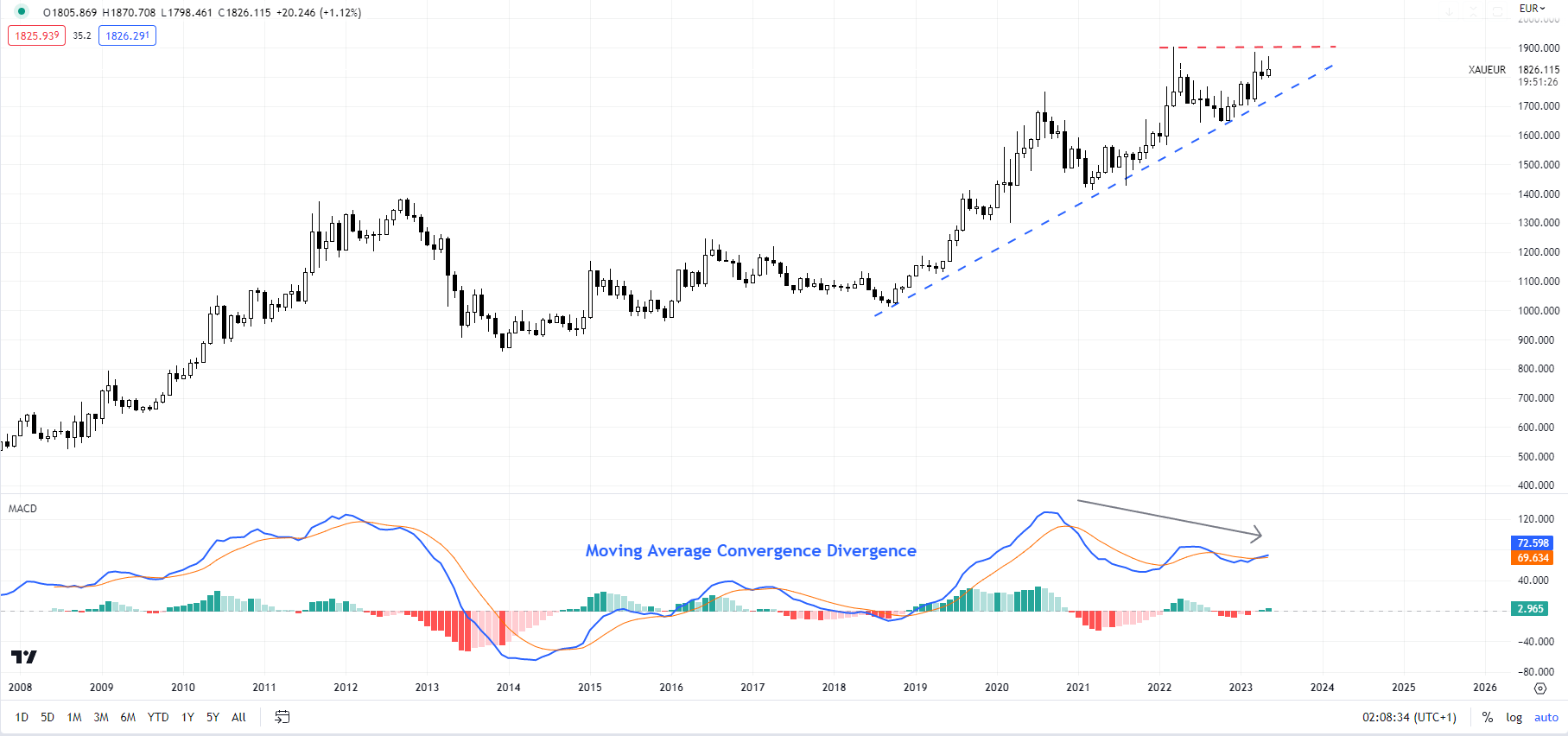
image5.png

XAU/EUR: Slowing momentum on higher timeframe charts

Like in the case of XAU/USD, the momentum on higher timeframe charts has slowed even as XAU/EUR has made new highs in recent months. Most recently, gold has failed to cross above the March highs of 1865-1885 against the euro. Any break below an uptrend line from early 2021 (at about 1725) would indicate that the upward pressure had faded in XAU/EUR.

Note: In the above colour-coded charts, Blue candles represent a Bullish phase. Red candles represent a Bearish phase. Grey candles serve as Consolidation phases (within a Bullish or a Bearish phase), but sometimes they tend to form at the end of a trend. Note: Candle colors are not predictive – they merely state what the current trend is. Indeed, the candle color can change in the next bar. False patterns can occur around the 200-period moving average, or around a support/resistance and/or in sideways/choppy market. The author does not guarantee the accuracy of the information. Past performance is not indicative of future performance. Users of the information do so at their own risk.

Japanese Yen Gains on Intervention Warning as US Dollar Steadies

Japanese Yen Gains on Intervention Warning as US Dollar Steadies

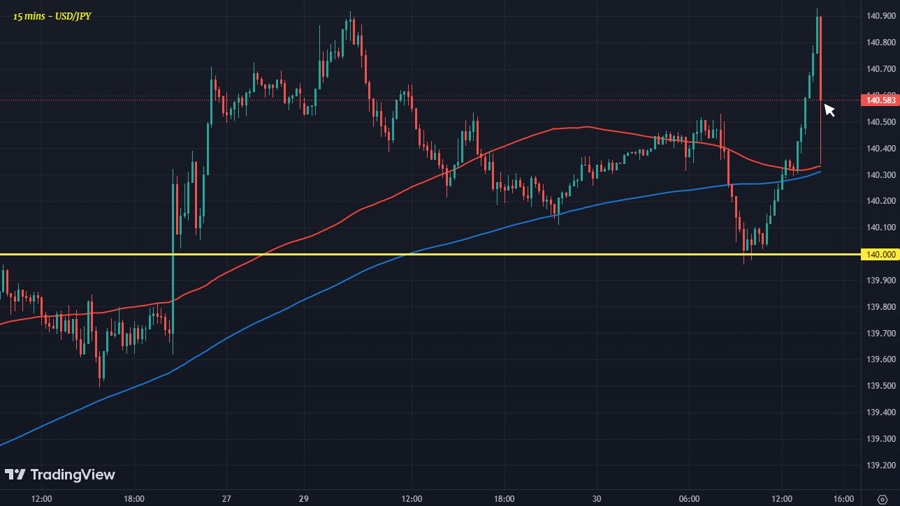
The Japanese Yen rallied toward the end of the Asian session on Wednesday as markets recalibrate the prospect of Japanese authorities intervening in USD/JPY.

Masato Kanda, Japan’s Vice Finance Minister for international affairs, intimated late Tuesday that authorities may act to curd the sinking Yen. He said, “We will closely watch currency market moves and respond appropriately as needed.”

On the topic of intervention, he further ventured, “If necessary, we won’t rule out every option available,”

The Bank of Japan directly intervened several times last year as USD/JPY climbed. Initial buying of Yen near 137 did little to stem the flow, but the bank persisted and continued selling IUSD/JPY toward the peak near 152.

With USD/JPY above 141, the jawboning would seem inevitable in hindsight. There remains potential for more verbal entreaties toward market participants.

The BoJ’s extremely loose monetary policy remains in place for now and today’s industrial production for Japan is not seen as helpful for a tilt away from the stance. Month-on-month output for April decreased -0.4% against forecasts of a 1.4% gain and 1.1% prior.

Going into Wednesday the focus for the next few sessions seems to be on the debt deal being passed. Expectations are that it will get over the line after several comments from Washington lawmakers overnight.

Aside from USD/JPY, the US Dollar is stronger across the board with the high beta AUD and NZD bearing the brunt of Chinese PMI figures missing estimates.

Chinese manufacturing PMI for May printed at 48.8 against the 49.5 anticipated and the non-manufacturing came in at 54.5, against the 55.2 forecast. This combined to give a composite PMI read of 52.9 against 54.4 previously.

APAC equities are all in the red with the perspective of slowing growth in the region becoming apparent. South Korea’s KOSDAQ is the only bright spot in today’s trade.

Treasury yields are steady going into the European session after sliding overnight. The 2-year note saw the largest declines, trading toward 4.4% today after nudging 4.64% late last week.

The slide in yields boosted gold with the front-month COMEX futures contract now trading back near US$ 1,980, after bouncing off support at US$ 1,936 yesterday.

Crude oil remains under pressure after yesterday’s collapse. The WTI futures contract is under US$ 69.50 bbl while the Brent contract is below US$ 73.50 bbl.

The full economic calendar can be viewed here.

USD/JPY LEVLES TO WATCH

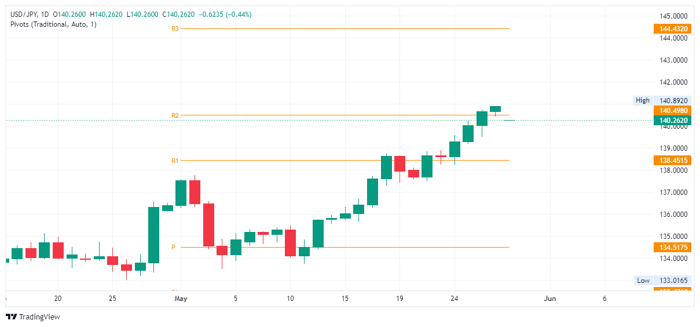
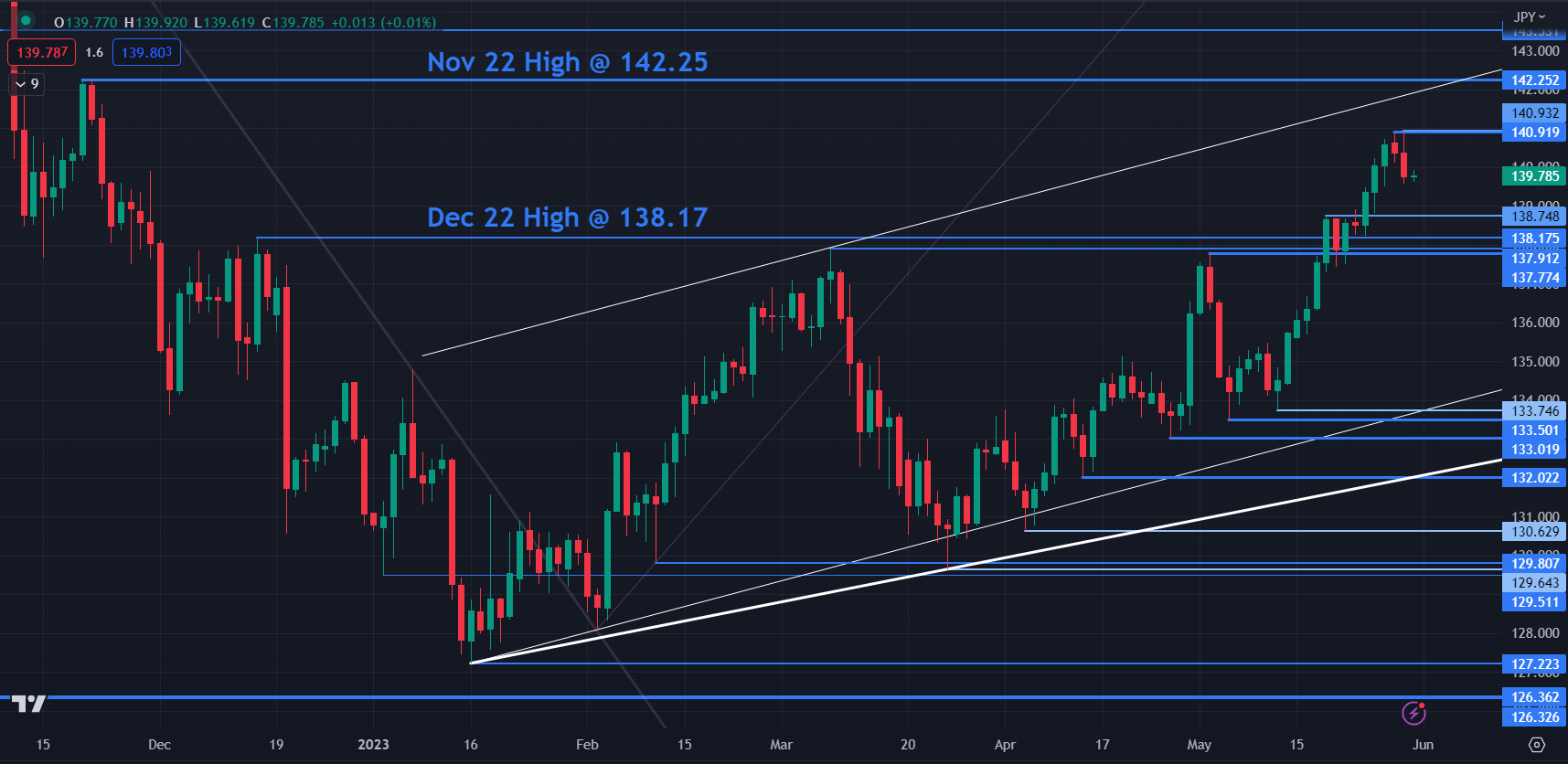
USD/JPY made a six-month high yesterday at 140.93 and that level may offer resistance ahead of November 2022 peak at 142.25. and a breakpoint near 143.50.

On the downside, support may lie at the breakpoints of 138.75, 138.18, 137.91 and 137.77.

image1.png


Gold Price Forecast: 100-Day MA Provides Support as Gold Eyes Recovery

Gold Price Forecast: 100-Day MA Provides Support as Gold Eyes Recovery

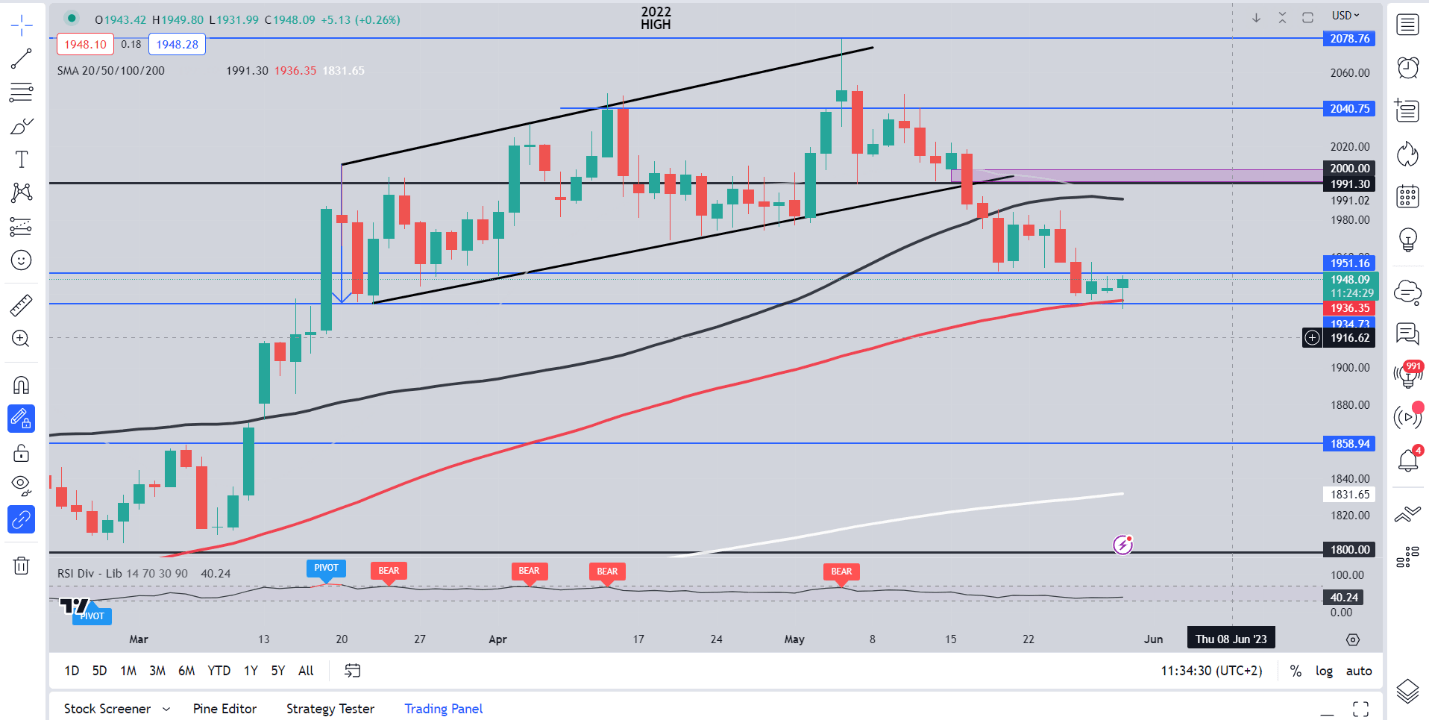
Gold prices retreated in Asian trade as the Dollar Index (DXY) printed fresh highs this morning. XAU/USD has since found support at the 100-day MA around the $1936/oz handle at the start of the European session.

DOLLAR INDEX AND DEBT CEILING DEAL

Given yesterday’s Bank holiday in the US and UK, market participants will do doubt be keeping a close eye on the reaction to the US debt ceiling agreement (in principle). Of course, this deal still needs to be ratified by both White House and Republican Congressional leaders before the bill makes its way to US President Bidens desk. US Treasury Secretary Yellen on Friday provided a new date for a potential default providing policymakers with a little more wiggle room as the date was shifted from June 1 to June 5.

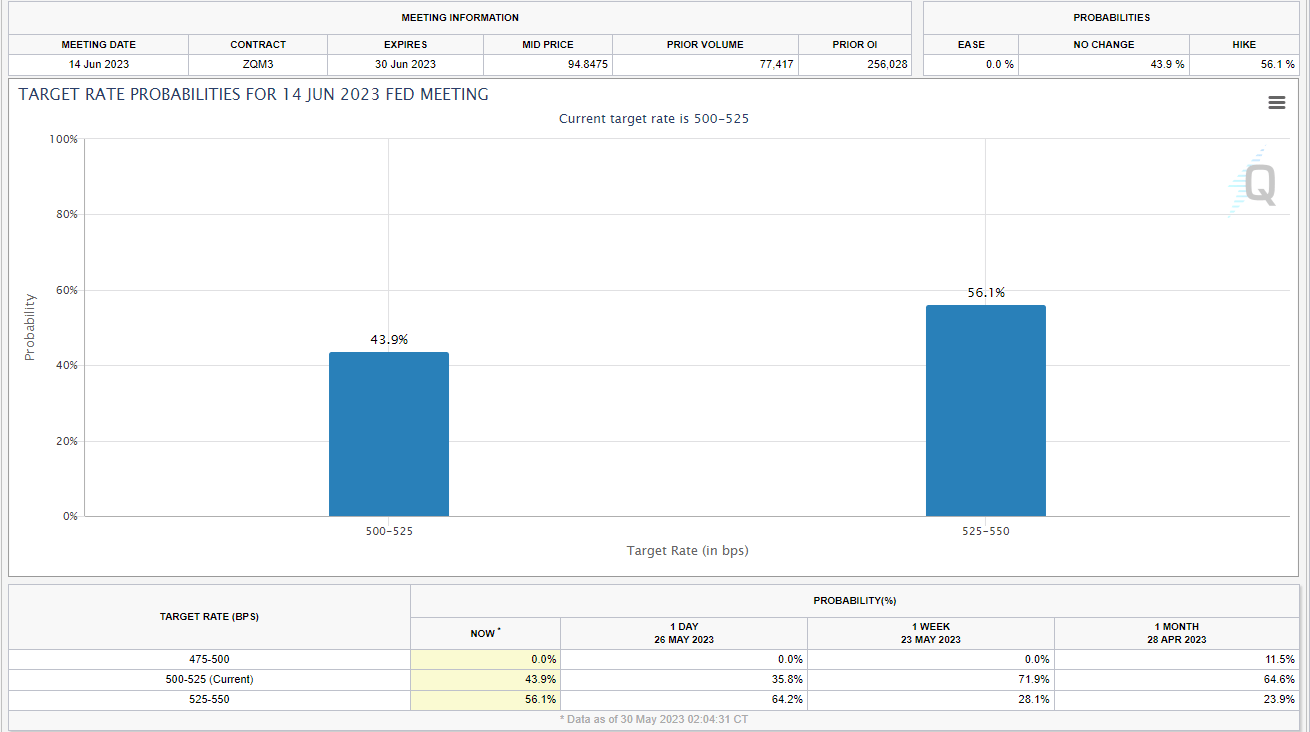
A lot could potentially go wrong in the interim, however more importantly will be the reaction from markets today, which could provide a gauge of what to expect ahead of US jobs data on Friday. The US dollar has also received renewed support of late as Fed Fund rate hike probabilities for the Feds June meeting has increased. Markets are now pricing in around a 56% chance of a 25bps hike in June, up from 28% a week ago. US NFP and jobs data lie ahead this week and could result in an increase in rate hike probabilities should the labor market continue its resilient trend.

image1.png

There is not a lot on the docket today with overall sentiment expected to continue driving market movements. The highlight on the economic calendar comes in the form of CB Consumer Confidence data out of the US.

image2.png

GOLD TECHNICAL OUTLOOK AND FINAL THOUGHTS

Form a technical perspective, Gold price action had been hinting at further downside for a while as improving sentiment and a strong dollar formed the perfect mix. Yesterday’s daily candle however closed as an inverted hammer hinting at a potential shift and bounce to the upside today.

Following a dip in the Asian session the European session has seen the Dollar Index (DXY) retreat slightly with XAUUSD bouncing off the 100-day MA to trade at $1945/oz at the time of writing. A continuation of the bounce this morning will have the $1950 level to contend with before eyeing resistance around $1957 and $1970 respectively. The 50-day MA currently rests around the $1991 handle should bulls take control and the rally gather steam.

Alternatively, a break back below the 100-day MA around the $1936 mark could see price revisit the $1925 handle before ticking lower toward the psychological $1900 mark. Gold is interesting given a debt ceiling deal could see safe haven demand dissipate, weighing on the precious metal. A weaker dollar on the other hand could support further upside as bulls and bears are likely to continue jostling for position.

Support Levels:

  • 1936 (100-day MA)
  • 1925
  • 1900

Resistance Levels:

  • 1958
  • 1970
  • 1991 (50-day MA)

Gold (XAU/USD) Daily Chart – May 30, 2023

image3.png


US Dollar (DXY): Facing Uncertainty as Debt Ceiling Agreement Lingers

US Dollar (DXY): Facing Uncertainty as Debt Ceiling Agreement Lingers

Overview

The US dollar, a key global currency, is experiencing a slight decline against major counterparts on Tuesday, despite remaining near a two-month high. The decline comes after a deal was reached on the US debt ceiling, which has boosted risk sentiment. However, the agreement may face challenges in Congress, adding an element of uncertainty to the situation.

The dollar index, which measures the US currency against six major peers, has slipped by 0.125% to 104.17, moving slightly away from the recent high of 104.42 reached on Friday. Nevertheless, the index is expected to register a 2.5% gain for the month, reflecting the overall strength of the US dollar.

Trading Derivatives carries a high level of risk to your capital and you should only trade with money you can afford to lose. Trading Derivatives may not be suitable for all investors, so please ensure that you fully understand the risks involved, and seek independent advice if necessary. A Product Disclosure Statement (PDS) can be obtained either from this website or on request from our offices and should be considered before entering into a transaction with us. Raw Spread accounts offer spreads from 0.0 pips with a commission charge of USD $3.50 per 100k traded. Standard account offer spreads from 1 pips with no additional commission charges. Spreads on CFD indices start at 0.4 points. The information on this site is not directed at residents in any country or jurisdiction where such distribution or use would be contrary to local law or regulation.

Currency Update: Euro, Pound, Yen Rise

In other currency news, the Euro is up 0.09% to $1.0715, while the British Pound is trading at $1.2365, indicating a 0.11% increase for the day. Meanwhile, the Japanese Yen has rebounded by 0.28% to 140.06 per dollar, recovering from a six-month low recorded the previous day.

The Yen’s performance going forward may be influenced by optimism regarding the US avoiding default. If the Dollar/Yen exchange rate sees a significant increase, it could trigger actions by Japanese authorities. This could potentially lead to a strengthening of the Yen in the coming weeks. Factors such as higher US Treasury yields and limited expectations of tightening by the Bank of Japan may contribute to an increase in the USD/JPY exchange rate.

Debt Ceiling Agreement Faces Opposition

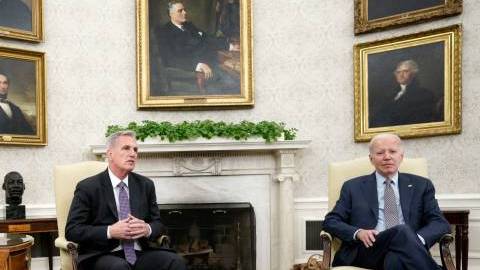
Despite the recent debt ceiling agreement, conservative Republican lawmakers have voiced their opposition to the proposed deal. This is adding to the challenges faced by President Joe Biden and House leader Kevin McCarthy. The package needs approval from the Republican-controlled House of Representatives and the Democratic-controlled Senate before the debt limit is reached, which is anticipated to occur by next Monday.

The situation resembles a game of chicken between the two political parties, with neither side willing to back down. However, a middle ground compromise may be reached by raising the debt ceiling and implementing spending reductions in the fiscal year 2024 budget.

The proposed bill, spanning 99 pages, aims to suspend the debt limit until January 1, 2025, effectively postponing the politically sensitive issue until after the presidential election in November 2024. It also includes a cap on certain government expenditures over the next two years. Failure to raise the debt ceiling by June 5 could result in a government default, as warned by US Treasury Secretary Janet Yellen.

Default Uncertainty Lingers, Rate Hike Expectations Support Dollar

The uncertainty surrounding a potential US government default is expected to persist until Congress successfully passes the agreement into law. However, outside of any volatility generated by the debt ceiling issues, expectations for Fed rate hikes are likely to support the US dollar in the near term. Markets are currently pricing in a 60% chance of a 25 basis-point hike in June, compared to a 26% chance just a week earlier.

Furthermore, the debt ceiling deal has had an impact on longer-dated US Treasuries, causing yields to fall as bond prices rise. Benchmark 10-year yields dropped 6 basis points to 3.7596%, while 30-year yields fell 5.5 basis points to 3.9207%.

Resilient Dollar Faces Uncertainty, Rate Hike Support

In conclusion, the US dollar index is showing resilience despite a small decline against major currencies. While the debt ceiling agreement has increased risk sentiment, its passage through Congress remains uncertain.

In the near term, the US dollar is likely to be supported by expectations for Federal Reserve rate hikes. However, the potential for a US government default adds an element of unpredictability to the currency markets.

Technical Analysis

Daily USD/JPYThe main trend is up. The index is currently trading within striking distance of 104.406 (R1).  Taking out this level with conviction will indicate the buying is getting stronger. This could trigger an acceleration to the upside with 104.720 (R2) the first target, followed by 105.490 (R3).

A sustained move under 103.631 (S1) will signal the return of sellers. If this creates enough downside momentum then we could see a retest of 102.405 (S2).  That’s the longer-term support.

S1 – 103.631 R1 – 104.406
S2 – 102.405 R2 – 104.720
S3 – 101.797 R3 – 105.490


China warns EU against sanctions bid

China warns EU against sanctions bid

Country will respond strongly to action on entities without solid proof: Envoy

China’s top diplomat to the European Union said that Beijing will respond strongly to any EU sanctions on Chinese entities for alleged circumvention of EU sanctions on Russia without providing any solid evidence.

Fu Cong, head of the Chinese Mission to the EU, made this remark during an interview with the New Statesman on May 24, which was published on Sunday, at a time when the EU is weighing its 11th round of sanctions on Russia which will focus on tackling the issue of “third” countries circumventing existing sanctions.

News reports suggest that the names of eight Chinese companies are in an EU draft document for alleged circumvention of sanctions.

Fu said that China has not provided any military equipment to Russia, and China has exercised extreme caution when it comes to dual-use items.

“At the same time, China maintains normal economic relations and cooperation with Russia. So these normal economic cooperation and activities should not be interfered with, and they should not be the reason for any coercive measures from any side, either from the US or the European side.”

China is against unilateral sanctions without the basis of international law or the authorization of the United Nations Security Council resolutions, said Fu, a career diplomat who assumed the current job in December.

“In particular, we are firmly against the extraterritorial jurisdiction of all these measures.”

The EU has long opposed extraterritorial sanctions, arguing such sanctions are against international laws and violating nations’ sovereignty and independence. The EU formulated the Blocking Statute law in 1996 to forbid EU operators from complying with extraterritorial sanctions. It also protested against and resisted US sanctions on EU companies after then-US president Donald Trump’s administration withdrew from the Iran nuclear deal in 2018 to reimpose sanctions.

Fu said he is very sad that the EU is copying what the US has been doing in the past years, adding that it is in violation of the EU’s own position against extraterritorial application of national sanctions.

He voiced China’s deep concerns about such change in the EU.

“Let me be very clear: If the European side imposes sanctions on Chinese companies without providing us with any solid evidence to show that these companies are engaged in activities that may circumvent or have circumvented EU sanctions on Russia, then we certainly will retaliate.”

He emphasized that China wants to resolve the issue in an amicable way and that the EU should show evidence if it has any, adding the EU should not apply any new law to business deals that were conducted before the law was made.

Basic principle

“That is the basic principle of the rule of law, right? So that’s why we say that we need to talk about this. But unfortunately, we have approached the EU side, and we have not been given any clear explanation,” Fu said.

“One thing they did tell us was that they did not have solid evidence that those companies had re-exported the items they had imported from the EU companies to Russia.”

If the EU goes ahead with the sanctions on Chinese companies despite China’s efforts to resolve the issue in an amicable way, there will be strong responses from China, Fu said.

“Frankly speaking, again, it will not be good for either side, and we do not want to see this happen.”

The EU has been discussing the 11th sanction package since early May. So far, Hungary and Greece have voiced their opposition to the package, citing Ukraine’s listing of some of their private companies as “international war sponsors”. A unanimous agreement is required from the 27 members before it can go ahead with the sanction package.

The annual change in the flash estimate of the CPI stands at 3.2% in May

The annual change in the flash estimate of the CPI stands at 3.2% in May

The annual change in the flash estimate of the CPI stands at 3.2% in May, nine tenths less than the one registered in April The annual rate of the flash indicator of underlying inflation decreases five tenths, to 6.1% The annual rate of the flash indicator of the HCPI is 2.9% Annual rate evolution The estimated annual inflation of the CPI in May 2023 is 3.2%, according to the flash indicator prepared by the NSI. This indicator provides a preview of the CPI which, if confirmed, would mean a decrease of nine tenths in its annual rate, since in April this variation was 4.1%. This development is mainly due to the

USD/JPY dips on emergency meeting by Japanese authorities

USD/JPY dips on emergency meeting by Japanese authorities

The pair just fell down from 140.85 to 140.35 before keeping around 140.50 levels now after the announcement here. It looks to be some position squaring just in case Japanese officials sound some warning about the currency falling rapidly. Japan’s top currency diplomat Kanda is to speak to the press thereafter as well. So, that sort of hints at what the meeting might be about.

FX Daily: Markets steady ahead of final push on the debt deal

FX Daily: Markets steady ahead of final push on the debt deal

After a long weekend in many parts of the world, FX markets are returning to mull progress on a US debt ceiling deal. This now has to pass the committee stage in the House and will probably go to a House vote tomorrow. Progress on the deal will allow investors to focus on sticky US inflation – likely seeing the dollar hold onto recent gains

USD: Progress on debt deal allows markets to focus on another Fed hike

After long weekends in many parts of the world, FX markets are returning to some progress on the US debt ceiling. President Joe Biden and House Speaker Kevin McCarthy have reached a two-year deal. That deal will be assessed by the House Rules Committee today and, if approved, will likely go to a vote in the House tomorrow. Both Democrat and Republican leaders feel they have the votes to get the deal through Congress – although at times like these, there may be a few holdout politicians who like their day in the sun.

Progress on the debt deal has seen some declines in yields for US Treasury Bills maturing in June, although it has had little impact on FX markets. We said last week that FX markets had already been trading in a de-stressed fashion on the assumption a deal would go through. Assuming there are no hiccups in the deal’s passage, FX markets can return to the most pressing issue of sticky inflation and what central bankers plan to do about it.

Last Friday’s US data set made the firm case for one additional 25bp Fed hike – now fully priced by the time of the 26 July meeting. Money markets price a 63% chance of that hike coming earlier at the 14 June meeting – a meeting which will likely see the Fed have to raise its inflation forecasts. The default view, therefore, seems to be that the dollar can hold its recent gains at least into that June meeting. That is unless US price and activity data start to fall away sharply.

On that front, this week sees US JOLTS job opening data (Wed), ADP (Thurs.), and the May NFP (Friday). Barring any major downside miss in these releases, it looks like the market will support another 25bp hike from the Fed, continued inversion in the US yield curve, and a strong/stronger dollar.

DXY looks comfortable above 104.00 and could extend recent gains to 104.65 or even 105.30 this week.

Chris Turner

EUR: Can China come to the euro’s rescue?

EUR/USD has quietly slipped below support at 1.0700/1.0720 and may be gently making its way to the March lows at 1.0515/0530. As we mentioned last week, we think EUR/USD is relatively cheap given the massive reversal in energy prices over the last year and that, in time, the 1.05/1.07 area will come to be seen as a summer base. Helping that proposition would be some kind of recovery in China. The release of the China Beige Book has shown some recovery in the China manufacturing sector in May. Official May Chinese PMI figures are released later this week. A bounceback here, helping to reverse the recent run-up in USD/CNH, could provide the euro with some support.

For today, the eurozone focus will be on the release of industrial and consumer confidence figures for May. Consensus expects some further deterioration here and if so this should keep EUR/USD on the soft side. We will also hear from a raft of ECB speakers today. Expect more hawkish rhetoric especially in advance of the May eurozone CPI data on Thursday. Consensus expects core eurozone CPI to edge lower to 5.5% year-on-year in May. Another upside surprise here – feeding the sticky inflation narrative – warns that investors could return to pricing a 4.00% ECB deposit rate.

Chris Turner

GBP: Hard to fight the aggressive BoE pricing

Money markets now price 100bp of Bank of England tightening by November. This would put the Bank Rate at 5.50%. Our team’s view is that such an amount of tightening is highly unlikely and that the usually reticent Bank of England may try and verbally push back against it. However, UK data is doing the most of the talking and it will probably be the jobs/wages data (13 June) or the May CPI data (21 June) which will be the key determinant on whether the market reins in aggressive tightening expectations.

Until then, EUR/GBP can probably press support at 0.8650, below which 0.8600/8610 is the next target. GBP/USD can better resist the stronger dollar. Support around the 1.2275/2300 area may hold temporarily.

Chris Turner

CEE: US dollar remains the region’s nightmare

The second print of first quarter GDP in the Czech Republic will be published today. Besides the GDP breakdown, we will also see the wage bill, which has been mentioned several times by the Czech National Bank as a potential reason for a rate hike in June. Tomorrow, inflation for May and the details of first quarter GDP in Poland will be published. We expect headline inflation to fall from 14.7% to 13.0% YoY, below market expectations, mainly due to fuel and energy prices. On Thursday, we will see PMI numbers across the region, where we expect a slight deterioration in sentiment across the board. Later, we will see state budget data in the Czech Republic, which posted its worst-ever result in April, raising questions about additional government bond issuance. The European Parliament is also scheduled to hold a session on Thursday, which is expected to cover the Hungarian EU presidency and is also likely to touch on the topic of EU money and the rule of law.

The FX market, as usual in recent weeks, will be dominated by the global story and the US dollar. So, even this week, CEE FX will not be in a bed of roses. We still see the Polish zloty as the most vulnerable, which despite some weakening in the past week remains near record highs. The market has built up a significant long position in PLN over the past two months. Plus, we may hear more election noise. Moreover, the significant fall in inflation should push the interest rate differential lower. Thus, we see EUR/PLN around 4.540.

The Czech koruna remains the most sensitive currency in the region against the US dollar, which should be the main driver this week. On the other hand, the reversal in the rate differential has been indicating a reversal in EUR/CZK for a few days now. Thus, at least a stable EUR/USD could allow the koruna to move toward 23.600. The Hungarian forint can expect a headline attack from the European Parliament this week, and given the current strong levels, we could easily see weaker levels again closer to 375 EUR/HUF. However, we believe the market will use any spike to build long positions in HUF again.

Frantisek Taborsky

Republicans speak out against U.S. debt-ceiling deal, in sign of rocky road ahead

Republicans speak out against U.S. debt-ceiling deal, in sign of rocky road ahead

A handful of hard-right Republican lawmakers said on Monday they would oppose a deal to raise the United States’ $31.4 trillion debt ceiling, in a sign that the bipartisan agreement could face a rocky path through Congress before the U.S. runs out of money next week.

Although expected, the opposition illustrates the hurdles that Democratic President Joe Biden and top congressional Republican Kevin McCarthy will have to overcome to see the Republican-controlled House of Representatives and Democratic-controlled Senate pass the package.

Florida Governor Ron DeSantis, a candidate for the Republican 2024 presidential nomination, said the deal does not do enough to change the fiscal trajectory. “After this deal, our country will still be careening toward bankruptcy,” he said on Fox News.

Still, backers predicted it would clear Congress before the United States runs out of money to pay its bills, which the Treasury Department says will happen on June 5.

“This thing will absolutely pass. There’s no question about that,” said Republican Representative Dusty Johnson, who said he had talked to dozens of fellow lawmakers.

Biden said he had been working the phones, as well. “It feels good. We’ll see when the vote starts,” he told reporters.

The 99-page bill would suspend the debt limit through Jan. 1, 2025, allowing lawmakers to set aside the politically risky issue until after the November 2024 presidential election. It would also cap some government spending over the next two years.

A crucial first test will come on Tuesday, when the House Rules Committee takes up the bill, in a necessary first step before a vote in the full House. Though the panel is normally closely aligned with House leadership, McCarthy was forced to include some skeptical conservatives as a price for winning the speaker’s gavel.

One of those conservatives, Representative Chip Roy, said on Tuesday he did not support the bill.

“It’s not a good deal. Some $4 trillion in debt for – at best – a two-year spending freeze and no serious substantive policy reforms,” Roy wrote on Twitter.

Another panel member, Ralph Norman, has already come out against the agreement.

McCarthy told reporters on Monday he was not worried about the package’s prospects in the committee.

In the Senate, Republican Mike Lee also came out against the bill, which could point to a difficult vote there, where any member has the power to delay action for days. Democrats control the Senate by 51-49.

McCarthy has predicted it will draw the support of most of his fellow Republicans, who control the House 222-213. House Democratic Leader Hakeem Jeffries said he expects support from his side of the aisle — though many on his party’s left may vote “no” as well.

Representative Raul Grijalva, a progressive Democrat, wrote on Twitter that the bill’s changes to environmental rules were “disturbing and profoundly disappointing.”

Grijalva was referring to an element of the bill that would speed up the permitting process for some energy projects. The bill would also claw back unused COVID-19 funds, and stiffen work requirements for food aid programs for poor Americans.

It would shift some funding away from the tax-collecting Internal Revenue Service, though White House officials say that should not undercut enforcement in the near term.

Initial reaction has been positive from financial markets, which would be thrown into chaos if the United States was unable to make payments on its securities, which form the bedrock of the global financial system.

But some investors are wary that the spending cuts secured by McCarthy could weigh on U.S. growth. Investors are also bracing for potential volatility in the U.S. bond market.

Republicans have argued that steep spending cuts are necessary to curb the growth of the national debt, which at $31.4 trillion is roughly equal to the annual output of the economy.

Interest payments on that debt are projected to eat up a growing share of the budget in the decades to come as an aging population pushes up health and retirement costs, according to government forecasts.

The deal would not do anything to rein in those fast-growing programs. Most of the savings would come by capping spending on domestic programs like housing, border control, scientific research and other forms of “discretionary” spending. Military spending would be allowed to increase over the next two years.