GBP/USD Price Forecast: Pound Faces Uphill Battle Despite Debt Ceiling Optimism

GBP/USD Price Forecast: Pound Faces Uphill Battle Despite Debt Ceiling Optimism

GBPUSD FUNDAMENTAL BACKDROP

The British pound currently reflects the external environment as the US debt ceiling theme holds sway. Although there has been some progress by way of a deal, uncertainty has crept back in to global markets as several Republicans have stated that they would resist the deal within the Republican dominated House. That being said, the majority seem to be in favor of a successful passing of a deal through but markets remain cautious for now.

Interest rate probabilities for the Bank of England (BoE) reflect roughly 100bps in cumulative hikes by year end whereas the Federal Reserve has been ‘hawkishly’ repriced to of recent giving the USD added support. From a UK perspective, the below seems slightly optimistic from money markets leaving the pound exposed to further weakness against the greenback.

BANK OF ENGLAND INTEREST RATE PROBABILITIES

image1.png

Source: Refinitiv

The economic calendar is very much US centric and will be focused on the CB consumer confidence. If forecasts are accurate, this could be the first reading since July 2022 below 100 (a benchmark based on levels of optimism in 1985). The week ahead should add more clarity to the US economic outlook with Non-Farm Payroll (NFP) data being the focal point.

ECONOMIC CALENDAR

image2.png

TECHNICAL ANALYSIS

GBP/USD 4-HOUR CHART
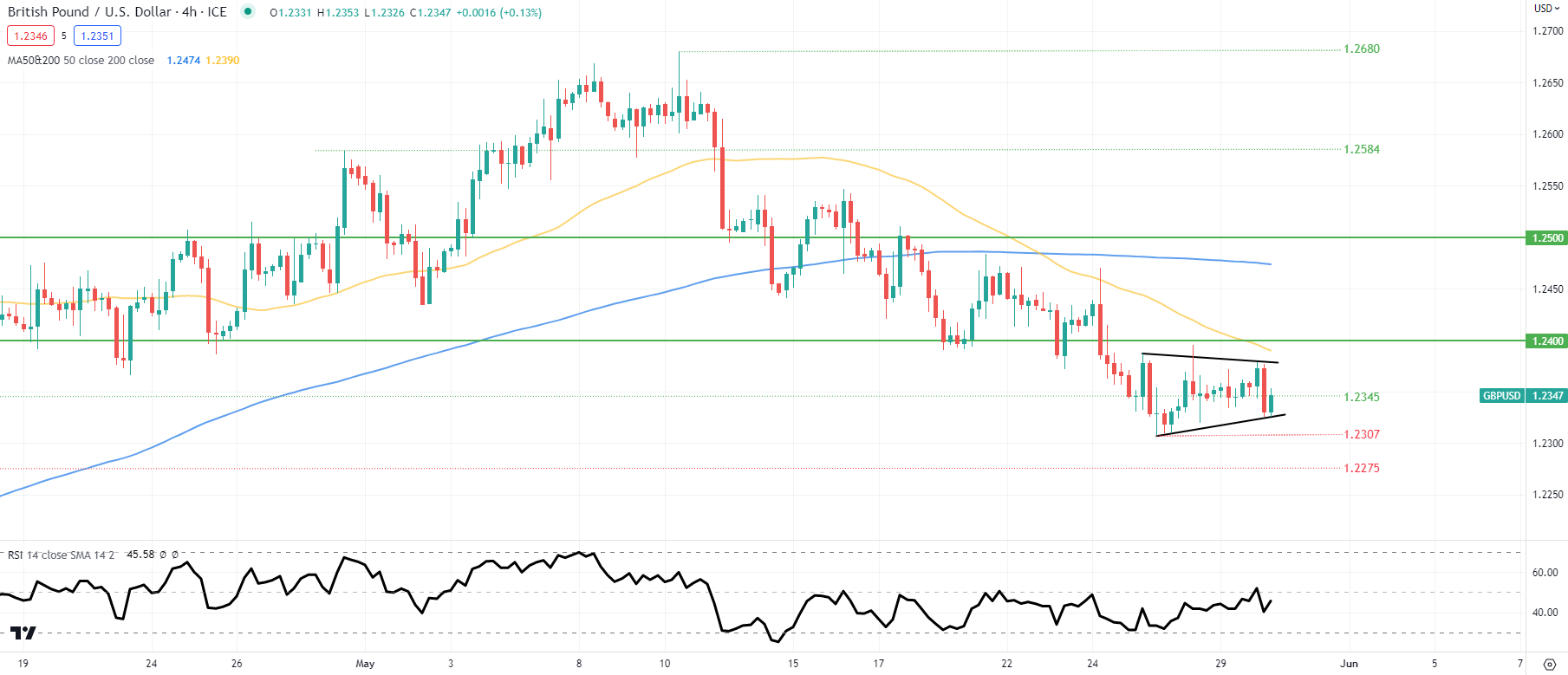
image3.png

Chart prepared by Warren Venketas, IG

The 4-hour cable chart shows a clearer view of the short-term picture facing GBP/USD traders. There is a definitive consolidation of recent forming a pennant chart pattern. More specifically, a bearish pennant due to the preceding downside trend. With prices trading below both moving averages as well as the Relative Strength Index (RSI) under the midpoint, momentum favors more downside to come. A break below pennant support could spark a move lower while a close above pennant resistance will likely invalidate the pattern.

Key resistance levels:

  • 1.2400
  • 50-day MA (yellow)
  • Pennant resistance
  • 1.2345

Key support levels:

  • Pennant support
  • 1.2307
  • 1.2275

BEARISH IG CLIENT SENTIMENT

IG Client Sentiment Data (IGCS) shows retail traders are currently net LONG on GBP/USD with 57% of traders holding long positions (as of this writing). At DailyFX we typically take a contrarian view to crowd sentiment resulting in a short-term downside disposition.

As China and the U.S. redefine geopolitics, Europe faces a win-win situation

As China and the U.S. redefine geopolitics, Europe faces a win-win situation

As the United States look at disengaging from China, Europe could soon find itself in a sweet spot.

U.S. President Joe Biden has, for most of his term so far, adopted a harsh tone on China, calling the world’s second-largest economy the most serious competitor to America. Diplomatic dialogue between the two hit a rockier patch earlier this year when Washington accused Beijing of using a spy balloon to obtain intelligence from U.S. military sites.

“The U.S.′ hawkish policy stance towards China means that China needs to improve relations with Europe to mitigate the impact of export controls. Therefore, China has an incentive to work hard on improving EU relations,” Anna Rosenberg, head of geopolitics at Amundi Institute, told CNBC via email.

Officials in Europe have adopted a slightly different approach from the Biden administration, preferring to take a softer stance with Beijing, recognizing its importance to the European economy. Data from Europe’s statistics office shows that China was the third largest buyer of European goods during 2021.

“The EU is in a very different situation than the U.S., which is clearly pursuing policy-led disengagement with China,” Jacob Kirkegaard, a nonresident senior fellow at the Peterson Institute for International Economics, said via email.

“Viewed from China, the EU is the most important high-income market that it still has largely unfettered access to. This in turn makes it far less likely that China will actively try to limit trade with the EU,” he said, adding China “has quite a lot to lose from a trade war with the EU.”

European Commission President Ursula von der Leyen has, in recent months, pushed for a policy of de-risking from Beijing — reducing dependency on the country in critical sectors such as raw materials and semiconductors. However, European officials aren’t anywhere near supporting a total breakup in economic and diplomatic ties.

“The political need to de-risk the EU-China relationship is completely different from US-China relations. In a world characterized by U.S.-China rivalry, the EU is the most important economic partner for both — this gives the EU significant political benefits versus both Beijing and Washington,” Kirkegaard also said.

The EU’s single market, where goods and services move freely across borders, is home to 23 million companies and over 450 million consumers, according to data from the European Council.

“We don’t want to feed the U.S.-China rivalry,” an EU official, who did not want to be named due to the sensitive nature of situation, told CNBC. “We prefer to calm things down … without being naïve,” the same official said.

The American rhetoric toward China eased slightly following a meeting of G7 leaders over the weekend, with Biden warming to the concept of de-risking, rather than completely detaching the two largest economies in the world.

Beijing wouldn’t have relished the idea of G7 leaders coming together to criticize China’s policies. In the wake of the gathering, China imposed a ban on its companies buying from American chipmaker Micron.

Alicia García-Herrero, a senior fellow at European thinktank Bruegel, said Europe might not find itself in an easy position amid these U.S.-China tensions.

“I actually very much doubt that will happen,” she said regarding the prospect of Washington and Beijing both looking to Europe for its economic ties.

“China is taking a lot of retaliation action against Europe in many ways and the sense that Europe is increasingly dependent on China — this kind of strategic dependence for green energy is becoming increasingly clear,” she said, noting Beijing is aware of the leverage it holds as Europe looks to develop a more sustainable economy. China is the largest supplier of several critical raw materials in the world, according to a study published by the European Commission, which are used in products like electric vehicles.

Japan finance minister says markets should set FX rates after yen weakens

Japan finance minister says markets should set FX rates after yen weakens

TOKYO :Japanese Finance Minister Shunichi Suzuki said on Friday after the yen fell to a six-month low against the dollar that currency rates should be set by markets based on economic fundamentals.

“Currency rates should be determined by markets based on fundamentals,” Suzuki told a news conference after a regular cabinet meeting.

“We will continue to watch market moves closely.”

The Japanese currency earlier weakened beyond 140 yen to the dollar, its lowest since late November.

Suzuki’s remarks were softer than warnings Japanese authorities typically issue when they see yen moves as excessive, suggesting Tokyo is for now taking a cautious approach to the latest slide in the currency.

The yen’s overnight depreciation was far milder than last year’s fall to nearly 152 yen against the dollar, a 32-year low. That prompted currency authorities to step in and warn they would take decisive action to halt the decline.

While a weak yen gives Japan’s exporters a boost, it hurts households and retailers by pushing up the cost of already high raw material imports.

Suzuki declined to comment further on Friday, saying any “careless comment” may cause confusion in the currency market.

When will energy bills fall by and how much? Ofgem price cap to drop £426 below the energy price guarantee – but average home will still pay £2,074

When will energy bills fall by and how much? Ofgem price cap to drop £426 below the energy price guarantee – but average home will still pay £2,074

Households will save £426 a year on their energy bills from this summer, regulator Ofgem says, offering hope to millions struggling with £2,500-a-year tariffs.

However, experts have warned the typical energy bill will likely remain at around £2,000 for the rest of this year, with no further Government energy bill rebates on offer.

The Ofgem price cap will fall in July to £2,074 a year for an average household, the energy regulator said today.

Crucially, this is below the current £2,500 energy price guarantee and so households will finally see their bills fall. We explain what it means for you and your bills.

The energy price cap currently sets energy bill prices for more than 80 per cent of British homes, controlling the maximum level of standard variable rate tariffs.

This has happened as the bulk of households either started off on variable rate deals or rolled off fixed deals onto them, as they were unable to find new better offers due to the energy price spike and collapse in switching.

The energy price cap will be cut from 1 July to £2,074, watchdog Ofgem revealed today. This is a big drop from its current level of £3,280 set from 1 April to the end of June.

But in practice household energy bills are actually capped at £2,500 a year for typical use.

That is due to the Government’s Energy Price Guarantee, which sees the state pick up some of the tab for consumer gas and electricity bills to protect households as the price cap spiked to more than £4,000.

Our calculator lets you work out how much your home will pay for energy when the price cap changes.

Natalie Mathie, energy expert at Uswitch, said: ‘The average household can expect monthly direct debits to be set at £173, although typical seasonal usage may only see you spend £110 a month over the summer.

‘While this is good news, the majority of homes are on standard variable tariffs and now subject to the volatility of price cap changes every three months.’

Since last autumn, the main current Government help for households has been the Energy Price Guarantee, which caps energy bills at £2,500 a year for average use.

Because of this, the Ofgem price cap has been meaningless for most households, unless they use large amounts of energy.

But that is all changing from July, when the energy price cap finally falls below the guarantee level.

The energy price guarantee was due to rise from £2,500 to £3,000 at the start of April but this was pushed back to the start of July in the Spring Budget. That is still due to happen, but the price cap will be below this meaning the rise will have no impact on consumers.

The government’s £3,000 Energy Price Guarantee will last until April 2024, so if prices spike back up consumers should be protected.

The Government has no plans to extend it past that point, meaning households will have to pay full energy bills from next April onwards.

Last year households also got a £400 energy bill rebate, which ended in March 2023 and is not being repeated.

This was applied as a set of six discounts per month of £67 to bills for customers with a standard meter and as vouchers for homes with pre-payment meters.

When will cheap fixed rate deals return?

Historically, the cheapest energy deals have been fixed-rate tariffs, with variable-rate deals normally reserved for households that had reached the end of their cheap tariff and not switched to a new one.

But energy firms all pulled these low-cost fixed deals when energy prices started rising in October 2021, leaving consumers with no choice but variable rates.

Without cheap fixed-rate energy deals, customers are at the mercy of bills dictated by the Ofgem price cap.

But households could still make major savings if energy firms bring back cheaper fixed-rate deals.

Experts believe the falling price of energy could spur providers to relaunch cheaper deals at around the £2,000 mark.

However, this would still only be around the level of the Ofgem price cap for the rest of this year, meaning households might be no better off taking a fixed rate.

Some may like the certainty that this brings but consumers will need to be careful they do not lock in to a fixed deal that later turns out to be uncompetitive, if the price cap declines by more than forecast.

Uswitch’s Mathie said: ‘This is a watershed moment for energy suppliers who can now look to start offering fixed deals again, given the market conditions – and would help to encourage genuine competition in the retail energy market.

‘We see no reason why energy suppliers cannot offer competitive fixed deals around the £2,000 level.’

AUD/USD bounce off six-month low towards 0.6550 on US Dollar’s retreat, ignores Aussie data

AUD/USD bounce off six-month low towards 0.6550 on US Dollar’s retreat, ignores Aussie data

AUD/USD prints the first daily gain in four as it rebounds from the yearly low to 0.6515 heading into Friday’s European session. In doing so, the Aussie pair pays little heed to the downbeat Australian data while cheering the US Dollar’s pullback.

Australia’s Retail Sales growth dropped to 0.0% in April versus 0.2% market forecasts and 0.4% prior.

It should be noted that the US Dollar Index (DXY) retreats from a 2.5-month high to 104.17 by the press time as US policymakers’ inability to clinch a deal on the US debt ceiling extension contrasts with the chatters suggesting a $70.0 billion gap left to be filled by the negotiators to get the much-awaited deal. Recently, US House Speaker Kevin McCarthy announced no agreement on the debt deal, as well as the continuation of talks by saying, “It’s hard. But we’re working and we’re going to continue to work until we get this done.”

An impressive tone of the Federal Reserve (Fed) officials, despite upbeat US data, prods the US Dollar bulls ahead of another round of key statistics.

On a different page, China’s FX intervention and slightly positive mood in the Asia-Pacific region, despite doubts about the Reserve Bank of Australia’s (RBA) hawkish moves, also underpin the AUD/USD pair’s corrective bounce.

That said, the second estimation of the US Annualized Gross Domestic Product (GDP) for Q1 2023 was revised up to 1.3% versus 1.0% first forecasts. Further, the Chicago Fed National Activity Index for April improved to 0.07 from -0.37 prior and -0.02 market estimations. On the same line, Kansad Fed Manufacturing Activity improved to -2 for May compared to -21 previous readings and analysts’ estimations of -11. It’s worth noting that the US Pending Home Sales for April improved on YoY but eased on MoM whereas Core Personal Consumption Expenditures also rose to 5.0% during the preliminary readings versus 4.9% prior.

Following the data, Richmond Fed President Thomas Barkin said, “Fed is in a test and learn situation to determine how slowing demand lowers inflation.” On the different front, Boston Federal Reserve President Susan Collins said on Thursday that the Fed “may be at or near” the time to pause interest rate increases, as reported by Reuters.

Against this backdrop, the US stock futures print mild losses while the Asia-Pacific equities edge higher. Further, the US Treasury bond yields retreat from the multi-day top.

Looking ahead, market sentiment dwindles and allows traders to brace for the key data including the US Durable Goods Orders for April and the Core Personal Consumption Expenditure (PCE) Price Index for the said month, known as the Fed’s preferred inflation gauge.

Technical analysis

A downward-sloping support line from December 2022, close to 0.6495 at the latest, puts a floor under the AUD/USD prices amid an oversold RSI (14). The pair’s recovery, however, remains elusive unless crossing March’s low of around 0.6565.

GBP to USD Forecasts: Sub-$1.23 in View on US Inflation and Fed Bets

GBP to USD Forecasts: Sub-$1.23 in View on US Inflation and Fed Bets

It is a busy Friday session for the GBP/USD. UK retail sales figures for April will be in focus. Following the pickup in core inflation, we expect increased sensitivity to the retail sales figures. A larger-than-expected increase in retail sales would fuel inflationary pressure and give the Bank of England more reason to take a more hawkish policy outlook.

While the retail sales figures will influence, market sentiment toward the US debt ceiling crisis will remain the key driver.

Trading Derivatives carries a high level of risk to your capital and you should only trade with money you can afford to lose. Trading Derivatives may not be suitable for all investors, so please ensure that you fully understand the risks involved, and seek independent advice if necessary. A Product Disclosure Statement (PDS) can be obtained either from this website or on request from our offices and should be considered before entering into a transaction with us. Raw Spread accounts offer spreads from 0.0 pips with a commission charge of USD $3.50 per 100k traded. Standard account offer spreads from 1 pips with no additional commission charges. Spreads on CFD indices start at 0.4 points. The information on this site is not directed at residents in any country or jurisdiction where such distribution or use would be contrary to local law or regulation.

Investors should also consider central bank chatter today and the reaction to the inflation and retail sales numbers. However, with no Monetary Policy Committee members on the calendar to speak today, commentary with the media would move the dial.

GBP to USD Price Action

This morning, the GBP/USD was up 0.06% to $1.23282. A mixed start to the day saw the GBP/USD fall to an early low of $1.23109 before rising to a high of $1.23365.

GBP to USD finds early support.

Technical Indicators

Resistance & Support Levels

R1 – $ 1.2369 S1 – $ 1.2291
R2 – $ 1.2418 S2 – $ 1.2260
R3 – $ 1.2497 S3 – $ 1.2181

The Pound needs to move through the $1.2339 pivot to target the First Major Resistance Level (R1) at $1.2369 and the Thursday high of $1.2387. A return to $1.2350 would signal an extended breakout session. However, the Pound would need economic indicators and US debt ceiling-related news to support a breakout session.

In the event of an extended rally, the GBP/USD would likely test the Second Major Resistance Level (R2) at $1.2418. The Third Major Resistance Level sits at $1.2497.

Failure to move through the pivot would leave the First Major Support Level (S1) at $1.2291 in play. However, barring another risk-off-fueled sell-off, the GBP/USD should avoid sub-$1.2250. The Second Major Support Level (S2) at $1.2260 should limit the downside. The Third Major Support Level (S3) sits at $1.2181.

GBP to USD support levels in play below the pivot.
GBPUSD 260523 Hourly ChartLooking at the EMAs and the 4-hourly chart, the EMAs send bearish signals. The GBP/USD sits below the 50-day EMA, currently at $1.24204. The 50-day EMA pulled back from the 200-day EMA, with the 100-day EMA narrowing to the 200-day EMA, delivering bearish signals.

A move through R1 ($1.2369) would give the bulls a run at R2 ($1.2418) and the 50-day EMA ($1.24204). However, failure to move through the 50-day EMA ($1.24204) would leave S1 ($1.2291) in view. A move through the 50-day EMA would send a bullish signal.

EMAs are bearish.
GBPUSD 260523 4-Hourly Chart

The US Session

Looking ahead to the US session, it is a busy day on the US economic calendar. Core durable goods orders, Core PCE Price Index, personal spending/income, and Michigan consumer sentiment numbers will be in focus.

We expect the Core PCE Price Index numbers to have the most impact. Sticky inflation would fuel bets of a 25-basis point Fed interest rate hike in June and ease expectations of an H2 interest rate cut.

Economists forecast the Core PCE Price Index to increase by 4.6% year-over-year in April versus 4.6% in March.

According to the CME FedWatch Tool, the probability of a 25-basis point Fed interest rate hike in June jumped from 36.4% to 52.2% on Thursday. Better-than-expected labor market and GDP numbers supported the shift in sentiment ahead of today’s inflation numbers.

US: Congress close to deal before breaking for holiday, reports say

US: Congress close to deal before breaking for holiday, reports say

US President Joe Biden says progress has been made in talks with top Republican Kevin McCarthy over the US debt ceiling – even as Congress breaks up for a holiday weekend.

The pair aim to reach a deal on raising the government borrowing limit for two years so it can keep paying its bills.

Investors’ fears of the US defaulting on its debts have grown – despite assurances that talks are progressing.

Mr Biden spoke of “several productive conversations” with Mr McCarthy.

During a White House event on Thursday, the president said his staff remained in conversation with the team of Mr McCarthy, the House speaker – and that the two sides were “making progress”.

He added: “I made clear time and again defaulting on our nation debt is not an option.” He said Americans deserved certainty over issues such as social security payments.

The debt ceiling is a spending limit set by Congress which determines how much money the government can borrow – an issue on which Democrats and Republicans disagree.

With no deal yet struck, the Treasury has warned that the US will not have enough money to pay all of its bills as soon as 1 June.

Analysts say there could be severe economic consequences if the US fails to honour its obligations.

GBP/USD holds gains toward 1.2350 after mixed UK Retail Sales data

GBP/USD holds gains toward 1.2350 after mixed UK Retail Sales data

GBP/USD is holding its recovery gains toward 1.2350 after the UK Retail Sales data came in mixed for April. Cable is advancing as the US Dollar is losing ground amid a correction alongside the US Treasury yields. Focus now shifts toward the US PCE inflation data.

GBP/USD has gained traction early Friday and climbed above 1.2350. Despite the recent rebound, the pair’s technical outlook is yet to signal a reversal. Ahead of the weekend, investors will pay close attention to the Personal Consumption Expenditures (PCE) Price Index data from the US.

Although risk flows returned to markets on Thursday, the US Dollar (USD) preserved its strength with robust US data feeding into the hawkish Federal Reserve (Fed) narrative. The US economy’s annualized growth for the first quarter got revised higher to 1.3% from 1.1% and the Initial Jobless Claims for the week ending May 20 came in at 229,000, much lower than the market expectation of 245,000.

Reflecting the shift in market positioning, the CME Group FedWatch Tool’s probability of a 25 basis points Fed rate hike in June climbed above 40% from nearly 20%.

In the second half of the day, the US Bureau of Economic Analysis will release the PCE Price Index figures for April. Earlier in the week, Federal Reserve Governor Christopher Waller noted that April PCE inflation data will be critical when deciding on the next policy step.

On a monthly basis, core PCE Price Index is forecast to rise 0.3%. A stronger-than-forecast monthly increase, at or above 0.5%, should provide a boost to the US Dollar and cause GBP/USD to turn south ahead of the weekend. On the flip side, a soft print below 0.3% could cause investors to refrain from betting on one more Fed rate hike, at least in the near term, and trigger a downward correction in the US Dollar Index.

Crude Oil Price Retreats on OPEC+ Perspective and a Firm US Dollar. Where to for WTI?

Crude Oil Price Retreats on OPEC+ Perspective and a Firm US Dollar. Where to for WTI?

The crude oil price collapsed overnight with expectations that OPEC+ will stick to its production target and a US Dollar that is shooting for the moon.

Comments from Russian Deputy Prime Minister Novak suggest that the Organization of Petroleum Exporting Countries (OPEC) will not be adjusting its production target at the June 4th gathering.

In an interview with the Russian newspaper Izvestiya, he said that he does not expect any changes to output targets at the forthcoming conclave in Vienna.

His remarks are in stark contrast to comments made by Saudi Arabia Minister of Energy Abdulaziz bin Salman on Wednesday when he warned speculators to ‘watch out’. It seems that the threat had its short-term desired impact with crude jumping higher before tumbling into today’s Asian trading session.

Oil had also been supported by a potential supply squeeze due to wildfires spreading across the Alberta, British Columbia and Saskatchewan provinces in Canada. The situation there has calmed down to some degree although it remains a cause for concern.

The US Dollar has been on the rampage this week and it was somewhat odd that crude had managed to rally in the face of it. Currency markets are contemplating the implications of a US debt ceiling deal being done and the ever-rising Treasury yields.

Treasury yields have lifted all along the curve but most pressing is the 1-year note being only a handful of basis points away from a 23-year high near 5.30%.

Looking ahead, crude might struggle until the outlook for global growth finds firmer footing. Some good economic data out of the US overnight is heading in the right direction but China continues to struggle to gain growth traction since pandemic restrictions were removed.

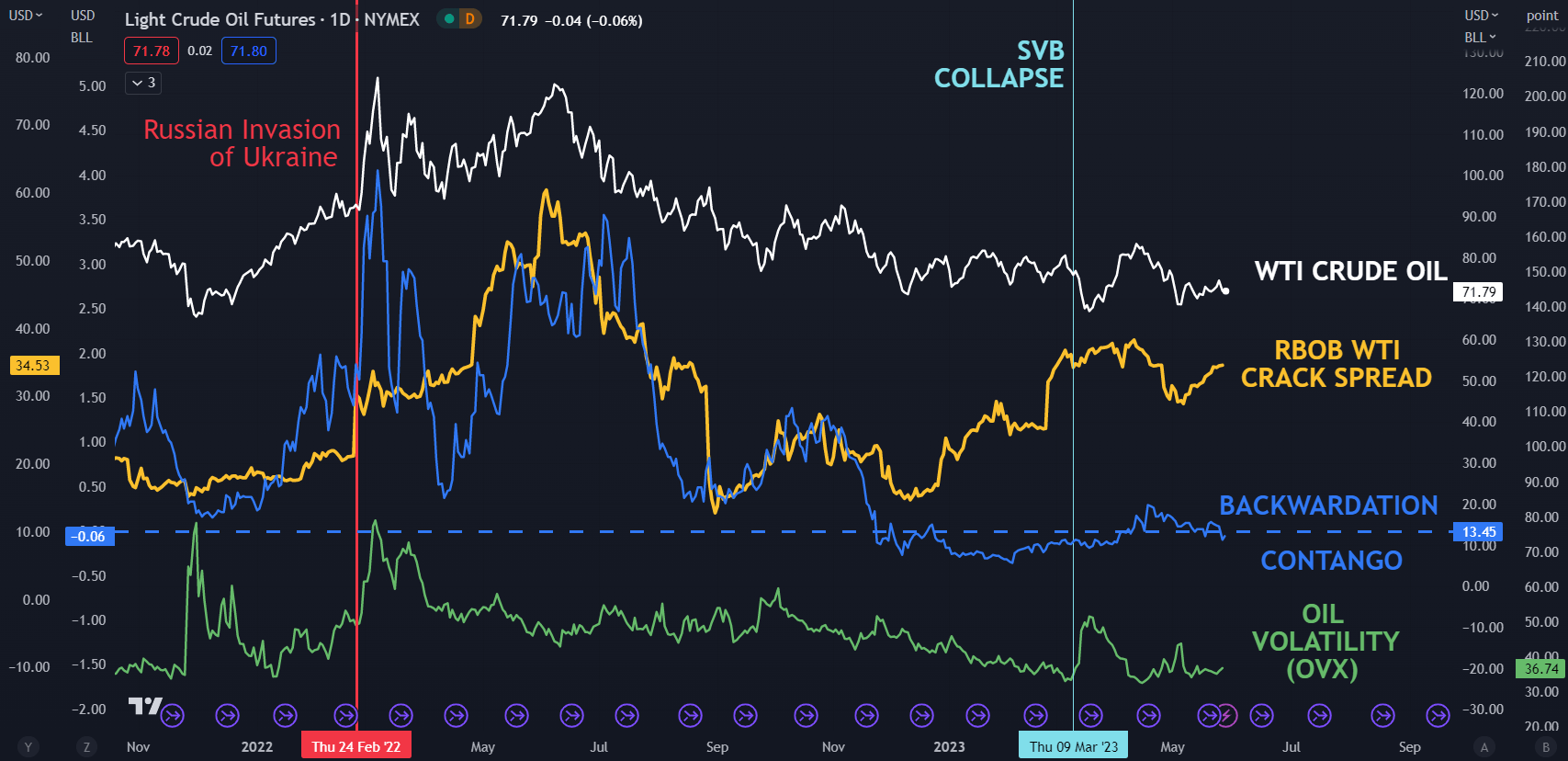
Potentially lending some support to black gold is the RBOB crack spread that has ticked up again this week. The RBOB crack spread is the gauge of gasoline prices relative to crude oil prices and reflects the profit margin of refiners.

RBOB stands for reformulated blendstock for oxygenate blending. It is a tradable grade of gasoline. If profitability increases for refiners, it may lead to more demand for the crude product.

The price action in crude has seen volatility remain relatively low as measured by the OVX index potentially revealing that the market is comfortable with current pricing.

At the same time, the difference in price between the front two WTI futures contracts is relatively benign and could hint toward a degree of balance in the market for now.

WTI CRUDE OIL, CRACK SPREAD, BACKWARDATION/CONTANGO, VOLATILITY (OVX)

image1.png