The Federal Reserve Bank: A Forex Trader’s Guide

The Federal Reserve Bank: A Forex Trader’s Guide

What is the Federal Reserve?

The Federal Reserve is the central bank of the United States. It was founded to create a stable, flexible monetary and financial system for the nation. Its general duties are to set monetary policy and oversee effective economic operation, ultimately serving the public interest.

To meet these top-level directives, the Fed performs five general functions:

  1. Promote maximum employment, stable pricing and moderate interest rates long term
  2. Reduce risk where possible to create a stable financial system
  3. Develop safety within financial institutions
  4. Champion safety within payment and settlement systems
  5. Advocate consumer protection through a supervisory stance.

To execute day-to-day operations, the nation is divided up into 12 Federal Reserve Districts, each of which is served by a separately incorporated Reserve Bank. These districts and member banks operate independently while being supervised by the Federal Reserve Board of Governors.

Who owns the Fed?

The Fed is both a private and public institution. The Board of Governors is a government agency, while the banks themselves are structured like private corporations – member banks hold stock and earn dividends.

Who is the Federal Reserve chairman?

As of August 2019, the chairman of the Federal Reserve is Jerome Powell, who has served in this office since February 5, 2018. He is the 16th person to have held the position and will serve a four-year term. Before his appointment, Mr Powell served as a member of the Board of Governors from May 25, 2012. He also currently serves as Chairman of the Federal Open Market Committee, which looks after monetary policy.

Which banks make up the Fed?

The 12 Federal Reserve Districts, each with their own Reserve Bank, are:

  • Boston
  • New York
  • Philadelphia
  • Cleveland
  • Richmond
  • Atlanta
  • Chicago
  • St. Louis
  • Minneapolis
  • Kansas
  • Dallas
  • San Francisco

How is the Fed held accountable to its functions?

The Fed is accountable to the public, as well as to the US Congress. The Chair and Federal Reserve officials testify in front of Congress, while the system of setting monetary policy is designed to be clear and transparent. In the interests of accountability, the Federal Open Market Committee (FOMC) will publish statements following all annual meetings. All financial statements are audited independently once a year to ensure financial accountability as well.

Key Economic Mandates of the Federal Reserve System

US monetary policy is the core mandate of the Federal Reserve bank. The statutory objectives of this monetary policy are outlined by the Congress and are:

  • Maximum employment: The monetary policy set out by theFOMC should ensure unemployment remains low, working to boost the economy where needed so that businesses thrive, make a profit and hire more staff to grow
  • Price stability: The Fed defines price stability as an inflation rate of 2% in the long term
  • Moderate long-term interest rates: This works alongside price stability – when an economy is stable, long-term interest rates remain at a moderate level

The Fed aims to achieve its monetary policy through its influence over interest rates and the general financial climate. This can lead to volatility of the US Dollar, ahead of Fed announcements and changes to policies.

Federal Open Market Committee

Monetary policy is set by the Federal Open Market Committee (FOMC), which oversees the open market operations of the Federal Reserve System. They set a target for the federal funds rate at FOMC meetings; this is the interest rate that they want banks to offer to each other for overnight loans. While the FOMC doesn’t control the rate, it can influence it in three main ways:

  • Open market operations. This means the buying and selling of government bonds on the open market – selling bonds decreases monetary supply with the aim of increasing interest rates. Buying bonds puts money back into the economy, with the aim of decreasing interest rates
  • Discount rate. This is the rate that banks pay to borrow money from the Fed. When this rate is lower, then it is also more likely the federal funds rate will be lower too
  • Reserve requirements. Banks need to hold a certain percentage of customers’ deposits to cover withdrawals – this is the reserve requirement. When these are raised, banks can’t loan as much money and must ask for higher interest rates. When lowered, banks can loan more money and ask for lower interest rates.

How Does the Federal Funds Rate Affect the US Dollar?

The Fed’s interest rate, also known as the Fed funds rate, is set by the Board of Governors of the Federal Reserve System. The current interest rate and the expectations of future interest rate changes can both affect the value of the US Dollar. If traders anticipate a change in interest rates based on announcements from the Board of Governors, this can cause the Dollar to appreciate or depreciate in value against other currencies.

This table sets out the way in which market expectations and rate changes can affect the value of the dollar:

Market expectations Actual Results Resulting FX Impact
Rate Hike Rate Hold Depreciation of currency
Rate Cut Rate Hold Appreciation of currency
Rate Hold Rate Hike Appreciation of currency
Rate Hold Rate Cut Depreciation of currency

Find out more about the impact of interest rates on the foreign exchange market.

As you can see in the chart below, the Dollar strengthened against the Yen in the leadup to the Fed’s interest rate announcement in December 2016 because it was widely expected that the fed funds rate would increase. The pair peaked at around 118.371 on the day of the announcement, December 14, 2016.

USD/JPY chart before and after Fed hikes in 2016
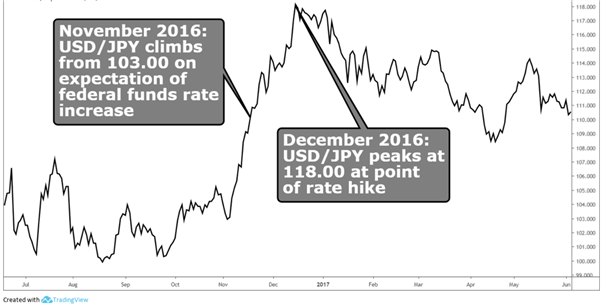
Chart to show the impact of Fed hikes on USD/JPY

Major Forex Trading Sessions from Around the World

Major Forex Trading Sessions from Around the World

There are three major forex trading sessions which comprise the 24-hour market: the London session, the US session and the Asian session. Each major geographic market center can exhibit vastly unique traits and tendencies that can allow traders to effectively execute strategies at any time.

Although the forex market is the most liquid of all asset classes, there are periods whereby volatility is constant, and others subdued. Understanding these different forex session times can improve the reliability of a forex trading strategy.

In this article, we will explore each of these forex market sessions including their key characteristics – forex time zones and how they affect trading.

forex trading hours

What are the main forex trading sessions?

Customarily, the forex market is divided into three market sessions:

The forex market is seen as highly functional/dynamic during these trading sessions as major banks, institutions and retail traders are operational. Noting the specific times of each trading session will assist forex traders in developing their trading strategies around this data.

SESSION MAJOR MARKET TIME (GMT)
US NEW YORK 13:00 – 22:00
ASIAN TOKYO 00:00 – 09:00
EUROPEAN LONDON 08:00 – 17:00

forex session times

Asian trading session

Tokyo is the first forex session to open, and many large participants use the trade momentum In Asia to develop their strategies and utilise as a gauge for future market dynamics. Approximately 6% of the world’s FX transactions are enacted in the Asian trading session.

European trading session

London is the largest and most important forex trading session in the world, with roughly a 34% market share of the daily forex volume. Most of the world’s largest banks keep their dealing desks in London because of the market share. The large number of participants in the London forex market and the high value of the transactions makes the London session more volatile than the other two forex sessions.

The onslaught of liquidity coming in from London can greatly increase the ‘average hourly move’ of major currency pairs such as EUR/USD. The chart below illustrates this statistic based on the time of day – notice the increase that takes place as the European trading session begins at 03:00 ET (08:00 GMT).

forex trading session movement

US trading session

The second largest trading market, New York handles approximately 16% of the world’s forex transactions. Many of the transactions in New York occurs during the US/Europe overlap, with transactions slowing as liquidity dries up and European traders exit the forex market.

Notice the green dot on the previous chart around 08:00 ET (13:00 GMT) when US comes online and when the market has the Europe/US overlap, the average movement increases even further until London falls offline (denoted by the red dot) near 12:00 ET (17:00 GMT).

When is the best time to trade?

DailyFX data has shown over the last 10 years, European currency pairs have shown greater success when traded during the 19:00 -11:00 GMT period. As mentioned previously, the liquidity during this time is relatively low as the US session has little/no affect. This lower liquidity allows for range bound trading strategies with greater use of indicators such as RSI.

Day traders who like ranges, meaning buying at support and selling at resistance should consider trading the European currencies during the late US session into the Asian session (19:00-07:00GMT).

Day traders who like breakouts and trends should consider trading when Europe comes online to when the Europe moves offline (08:00-17:00GMT). Secondarily, trading Asian currencies (AUD or NZD) during the Asian session may provide some breakouts too as that is the active business day for those home currencies.

If you try to trade breakouts of European currencies during the Asian session, you will likely find it frustrating as those markets tend not to move as much since that is ‘off hours’ for those currencies.

For more insights on forex trading sessions, read “When is the best time of day to trade forex?”

Supporting pages and guides to enhance your forex trading experience

  • If you are just starting out on your trading journey it is essential to understand the basics of forex trading in our free New to Forex trading guide.
  • We also offer a range of trading guides to supplement your forex knowledge and strategy development.
  • Our research team analyzed over 30 million live trades to uncover the traits of successful traders. Incorporate these traits to give yourself an edge in the markets.
  • Traders often look to retail client sentiment when trading popular FX markets. DailyFX provides such data, based on IG client sentiment.
GBP/USD Price Forecast: Cable Bounces from Oversold Territory as UK Retail Sales Recover

GBP/USD Price Forecast: Cable Bounces from Oversold Territory as UK Retail Sales Recover

The UK recorded a hot inflation print this week with hawkish repricing of the Bank of England’s (BoE) peak rate probabilities unable to arrest Cables slide as persistent US dollar strength continued. GBPUSD has enjoyed a decent bounce in the Asian session from lows around the 1.2300 mark, currently trading at 1.2340. Much like the rest of the week the question remains whether cable can hold onto its gains as the day progresses.

UK RETAIL SALES

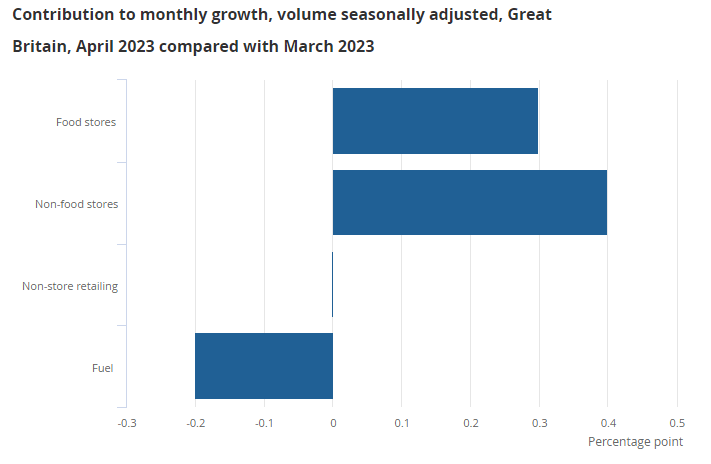
The UK released retail sales data this morning for the month of April which validated the ONS claims that poor retail sales in March was down to heavy rains. The figure for April came in at 0.5% rebounding from a fall of 1.2% in March with signs that UK retailers may look ahead with a bit more confidence. Sales volumes rose by 0.8% in the three months to April 2023, the highest rate August 2021 which came in at 1.3%.

image1.png

Source: ONS, Retail sales, Great Britain: April 2023

*NOTE: The graph above shows the contributions to the 0.5% month-on-month rise in overall retail sales volumes (quantity bought) in April 2023.

US FACTORS AND EVENT RISK

The US dollar meanwhile which has largely been the driving force behind cables move continues to hold firm which should continue as long as a deal on the US debt ceiling remains unresolved. There has been some positive rhetoric but none that would suggest a deal is imminent with next week going to be key as the June 1 deadline approaches.

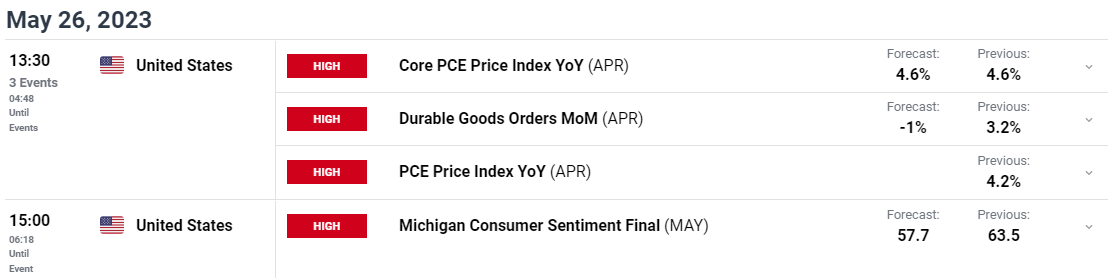
The day ahead will see focus shift to the all-important Core PCE data out of the US, which remains the Federal Reserves preferred gauge of inflation. This comes on the back of largely positive data out of the US yesterday with GDP Growth QoQ estimates beating forecast while initial and continuous jobless claims beat estimates as well. Another positive notch for the US on the labor front heading toward the June meeting.

Today’s PCE data could lend the US dollar further support should the print come in hotter than expected with the Core PCE Index forecast to come in at 4.6%. A beat of the forecast could back up recent hawkish rhetoric from Fed policymakers regarding potential hikes in June and beyond.

image2.png

For all market-moving economic releases and events, see the DailyFX Calendar

TECHNICAL OUTLOOK AND FINAL THOUGHTS

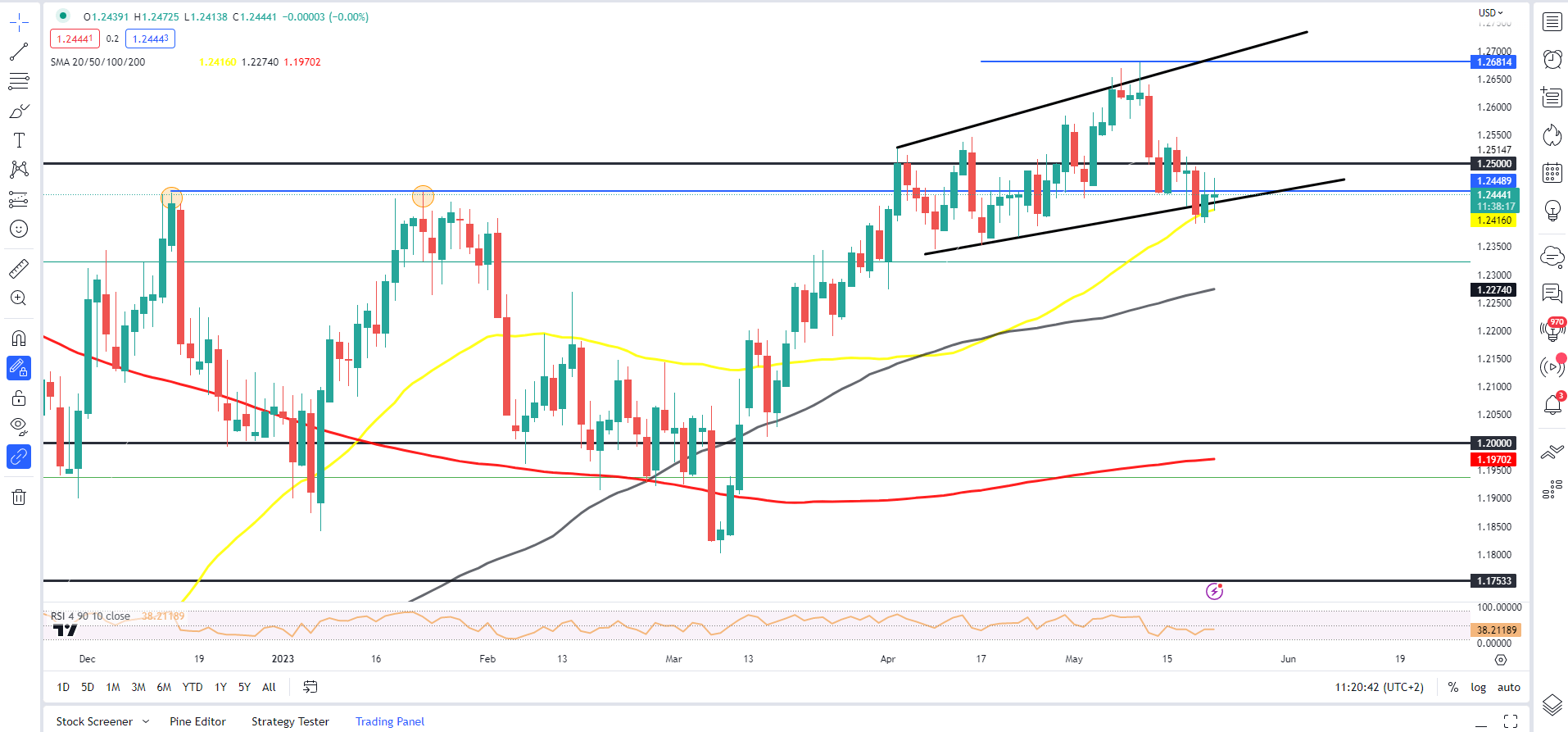
On the daily timeframe GBPUSD has continued to tick lower toward the key 100-day MA resting around the 1.2280 handle. This morning’s bounce came as the pair entered oversold territory (14-Day RSI) hitting a high of around 1.2354.

Looking at the intraday potential for GBPUSD and the biggest worry remains the US factors mentioned above which could continue to cap any upside recovery. I do think we may find significant support and a potential bottom around the 100-day MA, but this would rest on the outcome of the PCE data. The range between 1.2360 and 1.2280 (100-day MA) could remain pivotal for intraday moves.

There is a possibility that we could see a continued recovery for the majority of the European session toward yesterday’s high around 1.2388 before a selloff heeding into the US session and data releases.

Key Intraday Levels to Keep an Eye Out For

Resistance levels:

  • 1.2388
  • 1.2448
  • 1.2500

Key support levels:

  • 1.2310
  • 1.2280 (100-day MA)
  • 1.2220

GBP/USD Daily Chart – May 26, 2023

image3.png

Source: TradingView

Basis Risk Post-LIBOR Transition Will Not Affect FFELP ABS Ratings

Basis Risk Post-LIBOR Transition Will Not Affect FFELP ABS Ratings

Fitch Ratings-New York-24 May 2023: Significant change to basis risk is not anticipated for Federal Family Education Loan Program (FFELP) ABS following rate transition away from LIBOR under the Adjustable Interest Rate Act (LIBOR Act), according to Fitch Ratings. All FFELP ABS and Special Allowance Payments (SAP) will transition to SOFR-based rates on the first business day after June 30, 2023. Basis risk arises when the SAP rate index differs from the rate index for the FFELP ABS bonds, including differences in reset dates and reset frequency. We will apply similar basis risk stresses as those currently applied to LIBOR rates under our U.S. Federal Family Education Loan Program Student Loan ABS Rating Criteria, with no changes to ratings as a result of basis differentials under SOFR.

Fitch will continue to model various interest rate levels and applies basis spread stresses that align with historical movements of the relevant indices. The stresses test a transaction’s vulnerability to both short-term and long-term rate movements at all rating categories.

SAP paid by the U.S. Department of Education on the underlying assets effectively turns fixed-rate student loans into variable rate assets. FFELP ABS transactions are more sensitive to interest rate basis risk than other consumer ABS sectors, given the low absolute level of credit enhancement for these transactions that limits the ability of FFELP ABS to absorb any form of loss.

The LIBOR Act and the related final rule for implementation from the Federal Reserve Board requires the following replacement rates be applied for contracts transitioning away from LIBOR:

–SAP indexed FFELP loans: 30day Average SOFR (30dy SOFR) + spread adjustment of 0.11448%;
–For FFELP ABS when more than 50% of the portfolio consists of FFELP loans (all Fitch-rated FFELP ABS meet this threshold): (i) one-month LIBOR will be replaced with 30-day SOFR plus the tenor spread adjustment (0.11448%, the same as SAP replacement rate); and (ii) three-month LIBOR will be replaced with 90-day Average SOFR (90dy SOFR) plus the tenor spread adjustment (0.26161%). This is different from other consumer loan transactions that will utilize the CME Term SOFR and was a new addition to the final rule;
–Derivatives SOFR will be compounded in arrears for the applicable tenor, plus a stated spread adjustment based on the applicable tenor.

The 30-day SOFR and 90-day SOFR rates are relatively new rates published by The New York Federal Reserve Bank starting in 2020. SOFR observations are not available in periods of prolonged economic stress, such as the Great Recession, complicating the derivation of forward-looking stresses at all rating levels. SOFR basis spread did decrease last year as interest rates increased, which could be indicative of a decrease in basis spreads going forward; however, due to the short historical performance of the SOFR indices, historical basis spreads during periods of economic stress will continue to be factored into Fitch’s basis spread assumptions post-LIBOR transition.

Therefore, Fitch’s basis risk stresses will remain unchanged, and rating actions will not result from the transition to SOFR. Ratings downgrades in the sector remain predominately due to maturity risk, the risk that senior classes will not pay in full prior to legal final maturity dates.

The limited number of FFELP ABS with derivatives will face a meaningful operational challenge with the transition under the LIBOR Act as the date for determining the derivative payment amounts is likely to change to two days before payment in line with the Fed final rule. Such a change may interfere with the calculations for the transaction waterfall and lead to a disruption of payments on the bonds if the change in date for the swap is not successfully incorporated into the structure.

Related research:

U.S. Student Loan ABS Defaults Reach Highs in 1Q23

Contacts:

Nicole Edwards
Director, US Structured Finance
+1 212 908-9114
Fitch Ratings, Inc.
Hearst Tower
300 W. 57th Street
New York, NY 10019

Sarah Repucci
Senior Director, Fitch Wire
Credit Policy – Research
+1 212 908-0726

AUDUSD pauses decline but bears still in control

AUDUSD pauses decline but bears still in control

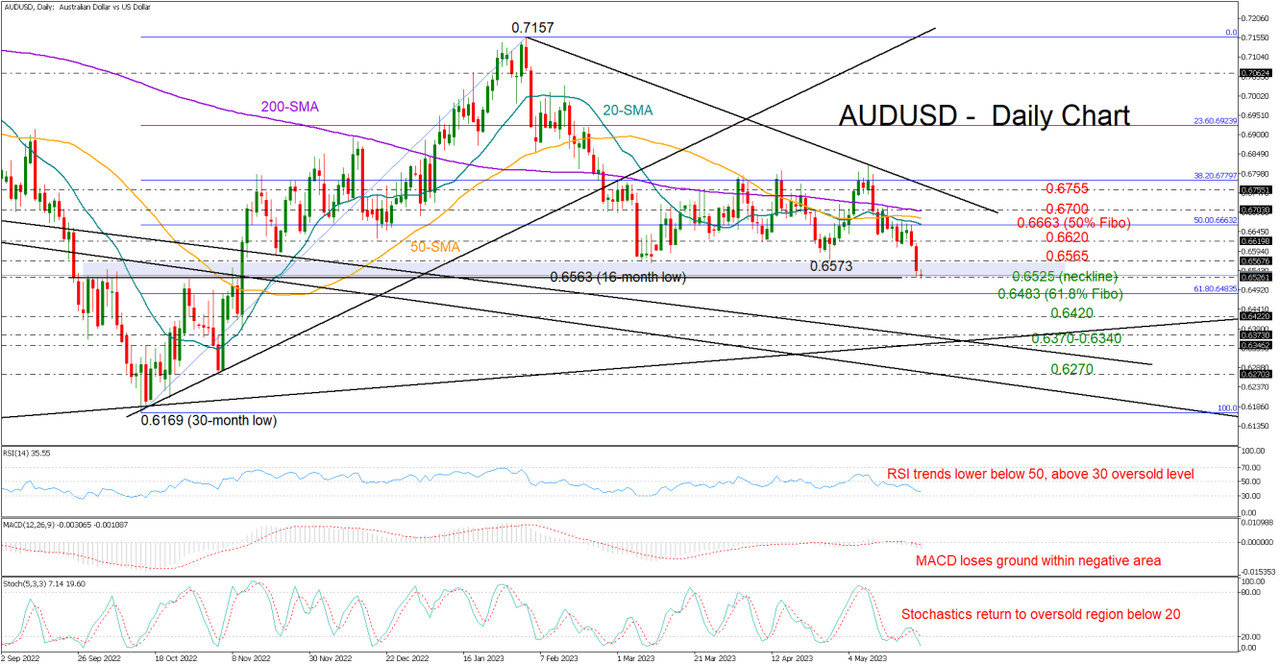
AUDUSD  plummeted to a six-month low on Wednesday to find support around the key 0.6525 area, which is the broken neckline of the inverse head and shoulders pattern registered last Autumn.

From a technical perspective, the bearish wave has more room to run as the falling RSI has yet to reach its 30 oversold level, while the Stochastic oscillator has flipped backwards to re-enter the oversold region below 20. The MACD keeps decelerating within the negative zone, sending bearish vibes as well.

Trend signals are also discouraging, with the price having declined below its simple moving averages (SMAs) to violate the 0.6565 floor of the short-term range.

Should sellers claim the 0.6525 base, the pair may initially test the 61.8% Fibonacci retracement of the previous upleg at 0.6483 before falling aggressively towards the 0.6420 region taken from Autumn 2022 and May 2020. Even lower, the 0.6370-0.6340 territory could be of greater importance as the tentative support trendline from 2020 lows intersects the descending line from August 2021 within this zone. If the downfall continues, the next destination could be the 0.6270 bar.

On the upside, the bulls might need to overcome the 0.6565-0.6620 zone in order to challenge the 20-day SMA and the 50% Fibonacci of 0.6663. A decisive close above the 200-day SMA at 0.6700 could provide direct access to the tentative resistance trendline currently seen around 0.6755.

All in all, AUDUSD may experience more selling in the coming sessions, but for that to happen, the 0.6525 floor should collapse. 


Fitch puts United States’ AAA rating on negative watch, citing debt ceiling fight

Fitch puts United States’ AAA rating on negative watch, citing debt ceiling fight

Fitch put the United States’ AAA long-term foreign-currency issuer default rating on negative watch Wednesday evening, pointing to brinksmanship over the debt ceiling.

“The Rating Watch Negative reflects increased political partisanship that is hindering reaching a solution to raise or suspend the debt limit despite the fast-approaching x-date,” the rating agency said.

Futures linked to the Dow Jones Industrial Average briefly slipped about 100 points after Fitch, one of the big three ratings agencies, issued its note.

The so-called X-date, which is when the U.S. could default on its debt, could arrive as early as June 1, according to Treasury Secretary Janet Yellen.

Fitch noted that it still expects Washington officials to arrive at a resolution before the deadline.

“However, we believe risks have risen that the debt limit will not be raised or suspended before the x-date and consequently that the government could begin to miss payments on some of its obligations,” the rating agency said.

The announcement arrives after debt ceiling negotiations between teams representing President Joe Biden and House Speaker Kevin McCarthy have fallen short of an agreement.

On Wednesday, McCarthy said that discussions over raising the debt limit were progressing toward a deal, but both parties continue to clash over spending. McCarthy did offer hope that a deal would be reached before the deadline. But House members were informed their weeklong recess would begin on Thursday, although they were put on notice they could be called back for a vote.

Canada Beats US, UK and China in Number of Gen Z Investors: FINRA

Canada Beats US, UK and China in Number of Gen Z Investors: FINRA

Canada has the highest percentage of Gen Z investors according to a new study by the Financial Industry Regulatory Authority (FINRA), a US private brokerage industry regulator. The watchdog said nearly three-quarters or 74% of Gen-Zers based in Canada and covered by the study had at least one form of investment.

The new study was conducted by FINRA Education, the regulator’s education arm, in partnership with the CFA Institute, a global association of investment professionals. The research findings are based on a November/December 2022 online survey of 2,872 Gen Zers from the US, Canada, the UK and China.

The Gen Z investors surveyed were aged 18 – 25 at the time of the study. In addition, the research examined millennials aged 26 – 41 and Gen X investors aged 42 – 57 across all regions.

Comparing its results from these jurisdictions, FINRA noted that the United States trails behind Canada with 56% of surveyed Gen Z investors in the former country saying they owned at least one form of investment. The United Kingdom and China come after with 49% and 57%, respectively.

Meanwhile, the study found that ‘a surprisingly large percentage’ or 56% of Zoomers in the United States own at least some investments with cryptocurrency as their top choice. In detail, the research noted that young investors in the country primarily invest in cryptocurrency (55%) and individual stocks (41%).

“[Gen Z investors in the United States] are less likely than their older counterparts to use mutual funds and are more likely, along with millennials, to invest in crypto and non-fungible tokens compared with Gen Xers,” FINRA noted.

Furthermore, the FINRA-CFA Institute project found that social media (48%), internet searches (47%) and parents/family (45%) are just about as equally important as primary sources of learning about investment and finances for US Gen Zers. However, when it comes to online resources YouTube dominates (60%) which is followed by internet searches, Instagram, TikTok, Twitter, Reddit and Facebook.

In addition, FINRA said Gen Z investors in the United States are risk-takers with almost half (46%) “willing to take substantial or above-average financial risks.” Half of US respondents said they have previously made an investment as a result of the fear of missing out (FOMO).

Looking at barriers to investing among young people in the United States, the study found that the lack of savings (65%), lack of sufficient income, or living paycheck-to-paycheck (64%) are the biggest discouraging factors for Zoomers who did not own any form of investment. Additionally, more than half of the young investors (56%) cited a lack of knowledge about investing as a major reason they do not have any investments.

Young Investors across the World

Meanwhile, the British financial regulator released a study on young investors on Wednesday, noting that only 20% of youths are capable of disregarding investment hype despite the fact that the number is significantly higher (33%) when it comes to dating hype. At the start of the year, Cyprus’ financial watchdog published a report on retail investor behaviour, noting that only 31% of retail investors rely on so-called ‘finfluencers’.

In a related development, Finance Magnates recently reported that regulators across the world are increasingly cracking down on ‘finfluencers’. However, questions remain about what regulatory approach should be taken towards them.

Presentation of the ECB Annual Report 2022 to the Committee on Economic and Monetary Affairs of the European Parliament

Presentation of the ECB Annual Report 2022 to the Committee on Economic and Monetary Affairs of the European Parliament

I am pleased to be back before the ECON Committee to present the ECB’s Annual Report for 2022[1], which we have published today together with our written feedback on the resolution on our activities you adopted earlier this year.[2]

These documents, as well as today’s hearing, are fundamental for the ECB’s accountability relationship with this Parliament. We greatly value this dialogue with you as it allows us to reach out to the public, which is especially important in times of high inflation.

In my remarks today, I will first focus on the outlook for the economy and the appropriate monetary policy response. I will then discuss the importance of a resilient financial system in supporting the real economy.

The outlook for the economy and the appropriate monetary policy response

The euro area economy grew modestly in early 2023. Activity is being supported by lower energy prices, easing supply bottlenecks and fiscal policy support to firms and households. But domestic demand, especially consumption, remains weak.

Headline inflation declined from its October peak and stood at 7.0% in April. Core inflation remains elevated, partly because of input cost pressures. Upside risks to inflation stem from, among other things, higher than expected wage and profit margin growth, and a potential lasting rise of longer-term inflation expectations above our target. Downside risks relate to possible renewed financial market tensions and weaker demand, due for example to a more marked slowing of bank lending or a stronger transmission of monetary policy.

As the inflation outlook continues to be too high for too long, we decided at our May meeting to raise our key policy rates again, by 25 basis points. We also announced that the Governing Council expects to discontinue reinvestments under the asset purchase programme (APP) as of July this year. While our key interest rates are the primary tool for setting our monetary policy stance, the reduction of the APP portfolio also helps to normalise monetary policy.[3]

While the speed and scope of our policy tightening since last July has already been unprecedented, our future decisions will ensure that the policy rates will be brought to levels sufficiently restrictive to achieve a timely return of inflation to our 2% medium-term target and will be kept at those levels for as long as necessary. We will continue to follow a data-dependent approach to determine the appropriate level and duration of restriction, taking into account the highly uncertain environment. To this end, our policy decisions will be based on the assessment of the inflation outlook in the light of incoming economic and financial data, the dynamics of underlying inflation, and the strength of our monetary policy transmission.

One important factor for the future inflation outlook is the behaviour of fiscal policy. As the energy crisis fades, governments should roll back the related support measures promptly and in a concerted manner to avoid driving up medium-term inflationary pressures, which would call for a stronger monetary policy response. Fiscal policies should be oriented towards making our economy more productive and gradually bringing down high public debt. Policies to enhance the euro area’s supply capacity, especially in the energy sector, can also help reduce price pressures in the medium term.

The importance of a resilient financial system

Despite the very strong tightening cycle, financial stability in the euro area has proved robust so far. But we of course continue to monitor the situation, taking into account a wide range of indicators.

Vulnerabilities in euro area financial markets were shown up by recent stress in the banking sector in other regions, which led to market reactions here too, although such spillovers were mitigated by solid euro area bank fundamentals. These tensions were short-lived, however, owing to prompt interventions by the authorities in the United States and Switzerland.

Tighter credit conditions are testing the resilience of euro area firms, households and sovereigns, while the possibility of sudden changes in property prices, especially in commercial real estate, remains a concern. We are also closely monitoring non-banks, which – given their interconnections with banks − can amplify shocks within the financial system. This highlights the need to strengthen the regulation of non-banks, in part by taking a more comprehensive macroprudential approach that would ensure their resilience while avoiding the risk of creating blind spots within the financial system.[4]

Our banking sector is strong today, largely thanks to the reforms and prudential policies implemented over the past years. However, the recent events should remind us to consistently attune our regulatory framework to the times – doing so, among other ways, by monitoring and reacting to new developments such as crypto-assets, digitalisation and the impact of social media.[5]

For our part, we have been working at international level with the Basel Committee on Banking Supervision (BCBS)[6] and the Financial Stability Board[7] to assess what can be learned from the recent events. We have also helped to define the BCBS standard for the prudential treatment of banks’ crypto-asset exposures.[8]

Your role as co-legislators will be crucial in keeping our framework robust.

First, your role is vital in fully implementing the final elements of Basel III faithfully and without delay, as this best guarantees the safety of our banking system. We are very concerned about the numerous deviations from the Basel standards introduced in the EU banking package and think they should be avoided.

Second, we need to swiftly implement in EU law the aforementioned BCBS standard for the prudential treatment of crypto-asset exposures. We need to be ambitious and make rapid progress, in particular on the envisaged exposure limit to reduce contagion between crypto and banks.

Third, it is imperative that we complete the banking union – the European Commission’s proposal on crisis management and deposit insurance is an important step towards this goal.

Conclusion

Let me now conclude.

We are going through a period of high uncertainty marked by a sequence of economic and geopolitical shocks and trade fragmentation. The best way to protect stability in the EU is to ensure closer European integration and a solid regulatory framework.

In the coming twelve months before this parliamentary term ends, we can make tangible progress on some key dossiers.

First, on fiscal policies, we very much welcome the Commission’s legislative proposals for the reform of the EU’s economic governance. A well-functioning governance framework is essential from an economic, monetary and financial stability perspective.

Second, on financial sector policies, we need to make progress on the Basel III reforms, crypto-asset standards, and the crisis management package – along the lines just outlined.

Third, on banking union, the lack of a European deposit insurance scheme is a source of vulnerability; completing the banking union is essential to pave the way for a stronger and more prosperous Europe.

Japan raises view on economy for 1st time since July 2022

Japan raises view on economy for 1st time since July 2022

Japan’s government raised its overall view of the economy for the first time in ten months in May, after recent data showed the country emerged from recession in the first quarter amid a post-COVID consumption rebound.

The Cabinet Office also upgraded its assessment of consumer spending, exports and factory output, suggesting economic and social activities gathered pace.

“The economy is recovering moderately,” the Cabinet Office said in its monthly report published on Thursday (May 24), upgrading its view for the first time since July 2022.

Previously, it said the economy was picking up moderately though there was some weakness.

Consumer spending is “picking up”, it added in the report.

Earlier this month, the government reclassified COVID-19 as an infectious disease level on par with the seasonal flu, which helped people to go out for leisure.

“The economy has entered a self-sustainable recovery phase,” said an official at the Cabinet Office. “Overall, the positive movements are spreading in the economy.”

With shipments of auto and auto parts growing as supply disruptions in semiconductors ease, the Cabinet Office raised its view on exports for the first time since December 2020.

Exports are showing “solid movement”, it said, better than its previous view of a “weak tone” in shipments.

The Cabinet Office also made an upward revision on factory output for the first time since August 2022, saying it was showing “signs of picking up”.

It removed a reference to “supply constraints” from risks but kept its caution over the downside risks to the economy amid global monetary tightening, price increase and market fluctuations.

The government expects the Bank of Japan to achieve its 2 per cent inflation target in a sustainable and stable manner backed by wage increases.