Pound Sterling stays under pressure against US Dollar as traders pare back Fed dovish bets

Pound Sterling stays under pressure against US Dollar as traders pare back Fed dovish bets

The Pound Sterling (GBP) remains under pressure near 1.2600 against the US Dollar (USD) in Monday’s London session. The GBP/USD pair struggles to gain ground as the US Dollar clings to gains near a more-than-a-year high, with the US Dollar Index (DXY) wobbling around 107.00.

The Greenback trades firmly as investors expect the Federal Reserve (Fed) to follow a more gradual rate-cut approach given the recent slight rebound in inflation and the growth outlook on strong expectations that President-elected Donald Trump will be able to implement his economic agenda smoothly.

In the December meeting, there is a 62% chance that the Fed will cut interest rates by 25 basis points (bps) to 4.25%-4.50%, according to the CME FedWatch tool. This is significantly down from the almost 77% seen a month ago.

Trump’s victory is also making analysts reassess the Fed’s interest-rate outlook for next year. “The Fed’s Monetary Policy Committee (MPC) will be acutely aware that Donald Trump’s policies could be significantly inflationary, primarily due to the impact of tariffs being passed on to consumers while lower taxes heat up the economy,” analysts at Quilter Investors said.

“Investors will no doubt be combing through their comments carefully for any perceived guidance on how that might impact the path of interest rates going forward,” they added.

Meanwhile, Fed officials have refused to comment on the likely impact of Trump’s policies on the monetary policy action and the economic outlook. On Thursday, Fed Chair Jerome Powell said that “it is too early to reach judgments on the effect of Trump policies.”

On the economic data front, investors await the preliminary S&P Global Purchasing Managers’ Index (PMI) data for November, which will be published on Friday.

Technical Analysis: Pound Sterling hovers near 1.2600
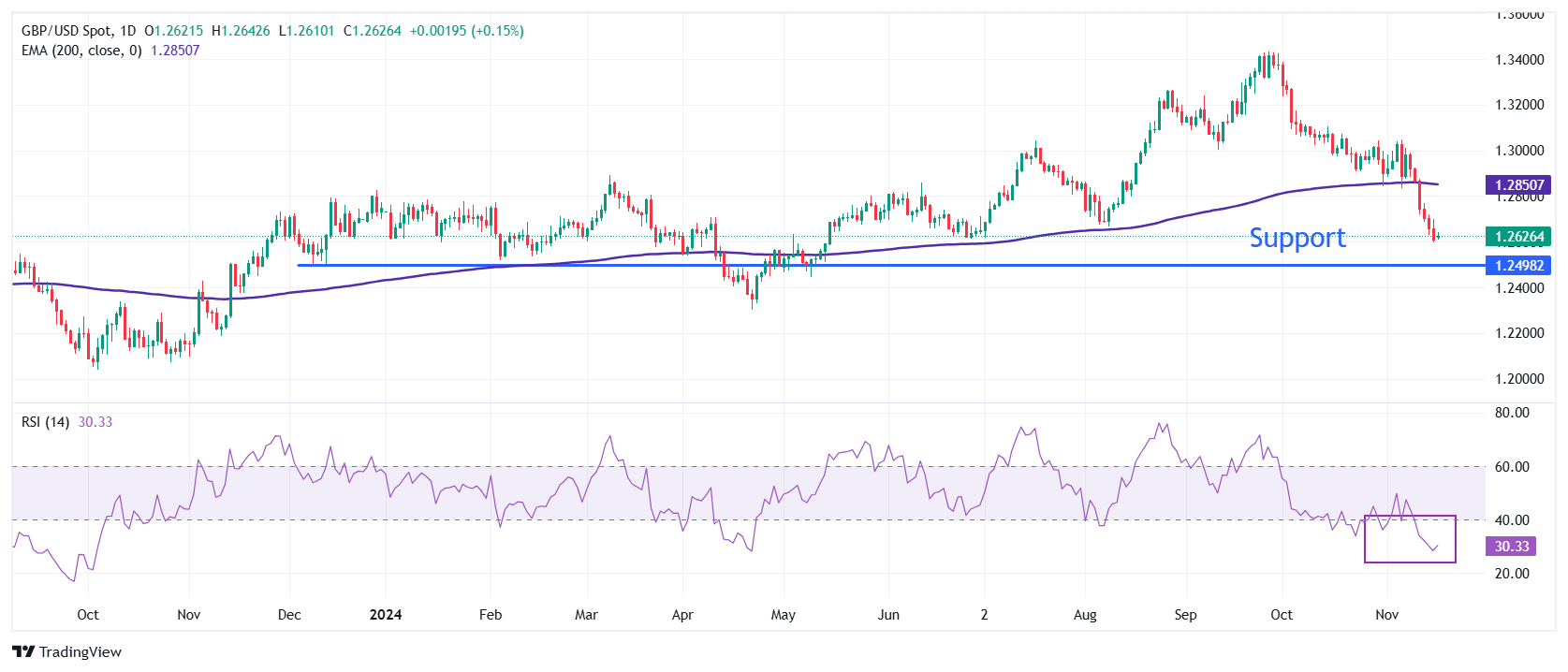
The Pound Sterling aims for a firm footing near 1.2600 against the US Dollar in London trading hours on Monday. The GBP/USD pair remains broadly under pressure as it remains well below the 200-day Exponential Moving Average (EMA) at 1.2850.

The 14-day Relative Strength Index (RSI) slides sharply to 30.00, suggesting a strong bearish momentum.

Looking down, the psychological support of 1.2500 will be a major cushion for Pound Sterling bulls. On the upside, the Cable will face resistance near the 200-day EMA.


EUR/USD grinds higher above 1.0550 amid a cautious start to the week

EUR/USD grinds higher above 1.0550 amid a cautious start to the week

EUR/USD grinds higher above 1.0550 in Monday’s European session. The pair shrugs off the re-emergence of the Russia-Ukraine geopolitical risks as the US Dollar stalls its uptrend. Divergent ECB-Fed policy outlooks could cap the upside ahead of central banks’ talks.

EUR/USD seems to have stabilized following the previous week’s decline but the technical outlook remains bearish. The pair trades within the descending regression channel and the Relative Strength Index (RSI) indicator stays below 50.

On the downside, 1.0500 (mid-point of the descending channel) aligns as first support before 1.0440 (lower limit of the descending channel). Looking north, first resistance could be spotted at 1.0570 (upper limit of the descending channel) ahead of 1.0600 (round level) and 1.0650 (50-period Simple Moving Average).

EUR/USD managed to find a foothold on Friday but still lost nearly 1.7% in the previous week. The pair stays in a consolidation phase to begin the new week and trades at around 1.0550.

Hawkish comments from Federal Reserve (Fed) officials caused investors to reassess the probability of one more 25 basis points rate cut in December last week, providing a boost to the US Dollar (USD) and weighing heavily on EUR/USD.

Monday’s economic calendar will not offer any high-impact data releases that could impact EUR/USD’s action. Hence, market participants will pay close attention to comments from central bank officials.

In the early American session, Chicago Fed President Austan Goolsbee will be delivering a speech. Speaking on the policy outlook on Friday, “I don’t like tying our hands,” Goolsbee said and added that they still have more data to come before deciding on the December policy decision. Later in the day, European Central Bank (ECB) President Christine Lagarde will deliver a speech titled “The Economic and Human Issues of a Changing Era” at an event organized by The Collège des Bernardins in Paris, France.

Meanwhile, investors will also keep an eye on geopolitical headlines. Over the weekend, CNN News reported that US President Joe Biden has authorized Ukraine to use powerful long-range American weapons to strike inside Russia. Reporting on the matter, “the change comes largely in response to Russia’s deployment of North Korean ground troops to supplement its own forces, a development that has caused alarm in Washington and Kyiv,” Reuters said.

US stock index futures trade marginally higher in the European morning but investors could seek refuge in case geopolitical tensions escalate further. A bearish opening in US stocks could help the USD regather its strength in the second half of the day.

AUD: Labor market only slightly weaker

AUD: Labor market only slightly weaker

Australia’s labor market cooled slightly last month, with only around 16,000 new jobs created in October, less than analysts had expected, according to the Bloomberg consensus. At the same time, the unemployment rate remained unchanged at 4.1%, but only because the participation rate fell slightly from 67.2 to 67.1%, Commerzbank’s FX analyst Volkmar Baur notes.

AUD to weaken in the coming months

“Despite the slowdown though, the level at which the labor market is operating remains very robust. The number of new jobs created has fallen below the pre-pandemic average of around 22,000 – but one should not read too much into a single figure. The three-month average is still above 40,000 new jobs.”

“And unemployment, at 4.1%, remains well below pre-pandemic levels, with the participation rate continuing to be very high. The unemployment rate for young people aged 15-19, who tend to be more sensitive to the business cycle, has even fallen to its lowest level in a year.”

“The Reserve Bank of Australia should feel vindicated in its hawkish stance earlier in the month when it left the cash rate unchanged at 4.35%. The market continues to take a similar view, pricing in the first rate cut only in the middle of next year. In my view, the risk is therefore more towards an earlier economic slowdown and a faster rate cut. The AUD should therefore tend to weaken in the coming months.”

EUR/USD: Trend is your friend

EUR/USD: Trend is your friend

The Euro (EUR) extended its move lower amid broad USD strength while political uncertainties in Germany is not helping. EUR was last seen at 1.0521 levels, OCBC’s FX analysts Frances Cheung and Christopher Wong note.

Risks remain skewed to the downside

“Elsewhere EU-UST yield differentials continued to widen, validating EUR’s ‘fair value’ relative to yield differentials. Daily momentum is bearish while RSI fell. Risks remain skewed to the downside. Next support at 1.0450/1.05 levels. Resistance at 1.06, 1.0740 (76.4% fibo fibo retracement of 2024 low to high), 1.0780 (21 DMA).”

“On German politics, the minority government faces economic and diplomatic challenges. PM Scholz is seeking confidence vote earlier on 16 Dec instead of 15 Jan – but is expected to lose. Snap elections likely planned for 23 Feb.”

“Overall, EUR should continue to bear the brunt of the US election outcome. Trump presidency will result in shifts in US foreign, trade policies. The potential 20% tariff (if implemented) can hurt Europe where growth is already slowing, and that US is EU’s top export destination.”

Pound Sterling falls further against USD on Trump’s clean sweep

Pound Sterling falls further against USD on Trump’s clean sweep

The Pound Sterling (GBP) refreshes over a four-month low below the round level of 1.2700 against the US Dollar (USD) in Thursday’s London session. The GBP/USD pair extends its downside for the fifth consecutive trading day as the US Dollar (USD) continues to gain on optimism over the United States (US) economic outlook, fuelled by headlines that President-elected Donald Trump and the Republican Party will control both the US Senate and the House of Representatives, according to the Associated Press.

This “clean sweep” will allow Donald Trump to execute his protectionist and expansionary policies without interruption. Trump vowed to raise import tariffs by 10% universally and lower taxes on corporations and workers in his election campaign.

Market participants believe that lower taxes and higher import tariffs will result in a high-inflation environment, a scenario that would limit the Federal Reserve’s (Fed) potential to cut interest rates aggressively. Markets currently highly anticipate a 25 basis points (bps) interest rate cut that will push borrowing rates lower to 4.25%-4.50% in December, according to the CME FedWatch tool. Market expectations for the Fed to cut interest rates again next month strengthened after the October Consumer Price Index (CPI) data released on Wednesday showed that inflationary pressures rose in line with estimates.

In Thursday’s US economic calendar, investors will focus on Fed Chair Jerome Powell’s speech, Initial Jobless Claims data for the week ending November 8, and the Producer Price Index (PPI) data for October for fresh guidance on interest rates.

Silver price today: Silver falls

Silver price today: Silver falls


Silver prices (XAG/USD) fell on Thursday, according to FXStreet data. Silver trades at $29.82 per troy ounce, down 1.58% from the $30.30 it cost on Wednesday.

Silver prices have increased by 25.32% since the beginning of the year.

Unit measure Silver Price Today in USD
Troy Ounce 29.82
1 Gram 0.96

The Gold/Silver ratio, which shows the number of ounces of Silver needed to equal the value of one ounce of Gold, stood at 85.61 on Thursday, up from 84.95 on Wednesday.

NZD/USD: Likelihood of NZD dropping to 0.5850 has increased

NZD/USD: Likelihood of NZD dropping to 0.5850 has increased

Further New Zealand Dollar (NZD) weakness appears likely; any decline may not reach the major support at 0.5850. In the longer run, likelihood of NZD dropping to 0.5850 has increased, UOB Group’s FX analysts Quek Ser Leang and Lee Sue Ann note.

NZD weakness appears likely

24-HOUR VIEW: “Yesterday, when NZD was at 0.5925, we held the view that NZD ‘is likely to trade with a downward bias towards 0.5900.’ We were also of the view that ‘a sustained break below 0.5900 is unlikely.’ The anticipated weakness exceeded our expectations, as NZD dropped to a low of 0.5876, closing at 0.5882 (-0.76%). Further weakness appears likely today, but oversold conditions suggest any decline may not reach the major support at 0.5850 (there is another support at 0.5865). On the upside, a breach of 0.5920 (minor resistance is at 0.5905) would mean that NZD is not weakening further.”

1-3 WEEKS VIEW: “We revised our view from neutral to negative yesterday (13 Nov, spot at 0.5925), indicating that ‘Despite the slight increase in momentum, the risk for NZD appears to have shifted to the downside.’ However, we noted that ‘it is too early to tell if the major support at 0.5850 is within reach.’ NZD subsequently dropped to 0.5876. The increase in momentum indicates that the likelihood of NZD dropping to 0.5850 has also increased. To maintain the buildup in momentum, NZD must remain below the ‘strong resistance’ at 0.5955 (level was at 0.5975 yesterday).”

GBP/JPY remains tepid around 197.50, awaits BoE Bailey speech

GBP/JPY remains tepid around 197.50, awaits BoE Bailey speech

GBP/JPY edges lower after posting gains in the previous session, hovering around 197.50 during European trading hours on Thursday. Traders await a speech from Bank of England (BoE) Governor Andrew Bailey at the annual financial and professional services dinner later in the day.

However, the downside of the Pound Sterling (GBP) could be restrained due to rising concerns among BoE officials about persistent price pressures. On Wednesday, BoE Monetary Policy Committee external member Catherine Mann participated in a panel at the BNP Paribas Global Market Conference, where she noted that monetary policy is affecting inflation more quickly than economic theory suggests. This allows the central bank to hold off on significant interest rate cuts for now.

The Japanese Yen (JPY) continues to face pressure as political uncertainty in Japan raises concerns about the Bank of Japan’s (BoJ) rate-hike plans. Additionally, worries over the potential impact of US President-elect Donald Trump’s proposed trade tariffs on the Japanese economy are further undermining the JPY.

On Thursday, BoJ Deputy Governor Shinichi Uchida highlighted the need for financial institutions and authorities to be prepared for sudden deposit outflows due to digitalization and technological advances.

BoJ’s Uchida also noted the growing presence of non-bank financial institutions, which now account for nearly half of global financial intermediation. As the relationship between non-bank financial institutions and the banking sector strengthens, any deterioration in the non-bank sector could ripple through the entire financial system via market channels.

EUR/USD refreshes annual lows as Trump trade momentum advances

EUR/USD refreshes annual lows as Trump trade momentum advances

EUR/USD posts a fresh annual low near 1.0530 in European trading hours and extends its losing streak for the fifth trading day on Thursday. The major currency pair has faced an intense sell-off as the US Dollar (USD) continues to enjoy upside momentum, being one of the major beneficiaries of President-elected Donald Trump’s win in the United States (US) presidential election. The US Dollar Index (DXY), which gauges the Greenback’s value against six major currencies, climbs to near 106.80, the highest level seen since November 1, 2023.

It will be easy for Trump to implement the agenda of lower taxes on businesses and workers, as well as high import tariffs, as Republicans have ensured control of the Senate and the House of Representatives, according to the Associated Press.

An increase in import tariffs would increase the demand for domestically produced goods and services, which would boost inflationary pressures that limit the potential of the Federal Reserve (Fed) to cut interest rates faster and deeper.

The Greenback rose sharply on Wednesday after the release of the US Consumer Price Index (CPI) data for October. The inflation report showed that price pressures grew expectedly on a monthly as well as annual basis, boosting expectations of interest rate cuts in the December meeting. According to the CME FedWatch tool, the probability of the Fed cutting interest rates by 25 basis points (bps) to 4.25%-4.50% next month increased to 83% from 59% a day before.

In Thursday’s session, investors will pay close attention to Fed Chair Jerome Powell’s commentary in a panel discussion hosted by the Federal Reserve Bank of Dallas at 20:00 GMT. Market participants would like to know his stance on December’s monetary policy decision and the impact of Trump’s policies in the medium and longer term.

On the economic front, investors will focus on the US Initial Jobless Claims for the week ending November 8 and the Producer Price Index (PPI) data for October, which will be published at 13:30 GMT.

Technical Analysis: EUR/USD sees more downside as all short-to-long-term EMAs turn downwards

EUR/USD slides to its lowest since November 1, 2023, near 1.0530. The major currency pair weakened after breaking below the April 16 low of 1.0600. The outlook of the shared currency pair has become bearish as all short to long-term Exponential Moving Averages (EMAs) are declining.

The 14-day Relative Strength Index (RSI) drops to nearly 30.00, adding to evidence of more weakness in the near term.

Looking down, the pair is expected to find a cushion near the psychological support of 1.0500. On the flip side, the round-level resistance of 1.0700 will be the key barrier for the Euro bulls.

Mexican Peso resumes downside after Republicans take Congress

Mexican Peso resumes downside after Republicans take Congress

The Mexican Peso (MXN) resumes the slide in its key pairs on Thursday after briefly pausing on Wednesday following the release of US inflation data. Republicans winning a majority in the US Congress is weighing on the Peso as it gives the party a “clean sweep” of the Presidency, the US Senate, and the House of Representatives. This will augment its power to push through policies, many of which the market is assessing as directly negative to the Peso (or positive for the US Dollar (USD)).

A more immediate bearish factor for the Peso comes in the form of market expectations that the Bank of Mexico (Banxico) will cut its main interest rate by 25 basis points (bps) (0.25%) to 10.25% at its meeting on Thursday. In a Reuters survey, 19 out of 20 economists said they expected Banxico to cut by 0.25% at the meeting, according to Christian Borjon Valencia,.

Mexican Peso faces headwinds from US protectionism

The Mexican Peso continues to face broader headwinds from the prospect of increased US protectionism under the leadership of President-elect Donald Trump. The imposition of tariffs on Mexican imports and the threat to deport millions of illegal workers who regularly send remittances home are both likely to reduce demand for the Peso.

The Peso steadied on Wednesday amid US Dollar weakness after the US Consumer Price Index (CPI) in October aligned with economists’ expectations. This solidified expectations that the US Federal Reserve (Fed) will cut interest rates by a quarter of a percent (25 bps) at its meeting in December. This, in turn, restrained the strength of the US Dollar since lower interest rates reduce foreign capital inflows – and gave the Peso some breathing space.

Comments from Mexican Finance Minister Marcelo Ebrard further supported the MXN after he said on Wednesday that the level of Foreign Direct Investment (FDI) in Mexico likely hit a new record high of $35.732 billion in 2024, according to El Financiero. Ebrard also hit back at suggestions from Canada’s Prime Minister of Ontario, Doug Ford, that the US and Canada should sign their own private free trade deal, saying that it was better for the Canadian economy to include Mexico, thereby maintaining the current USMCA tripartite agreement.

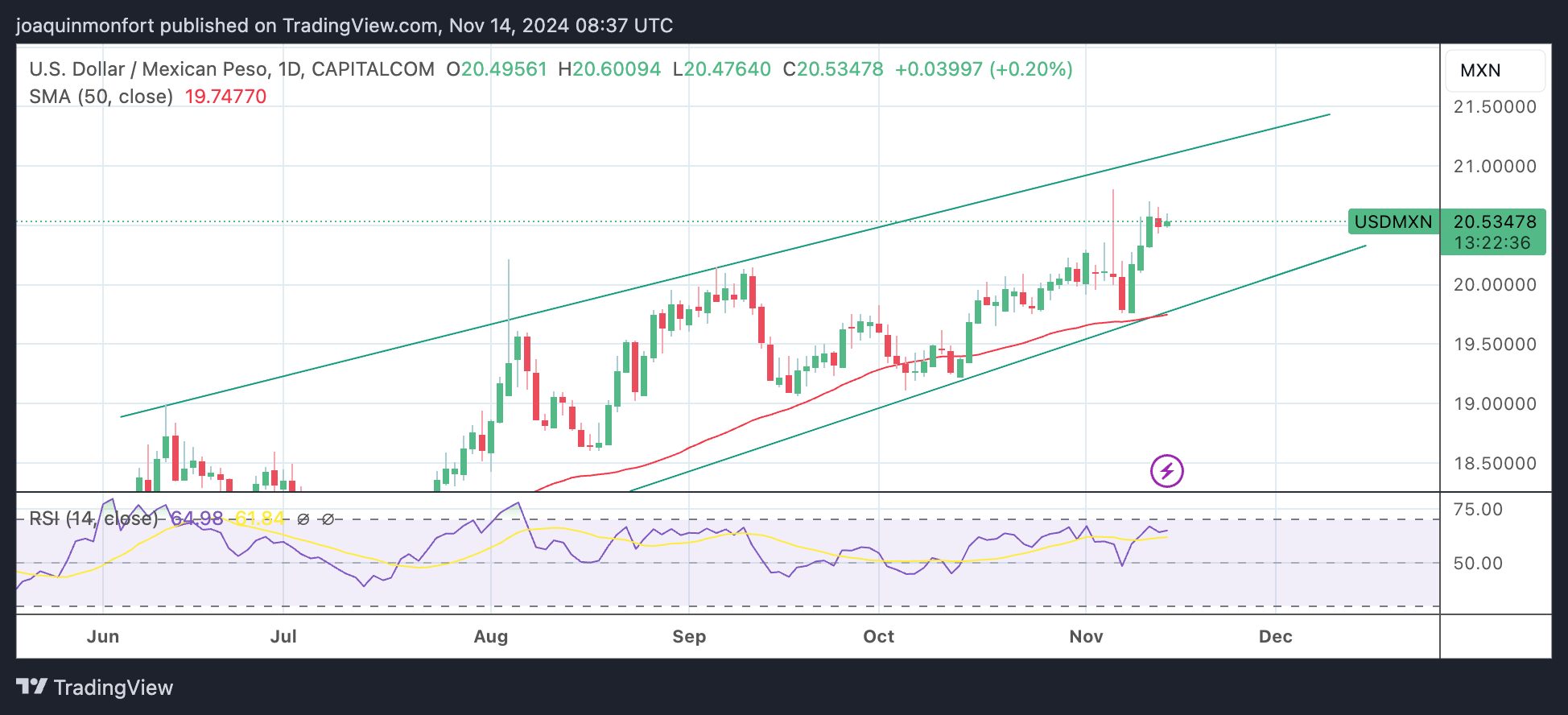
Technical Analysis: USD/MXN closes in on November high

USD/MXN resumes its rally within a rising channel after a brief pause. The short-term trend is bullish, and given the technical analysis saying that “the trend is your friend,” the odds favor a continuation higher.

USD/MXN Daily Chart

USD/MXN is also in an uptrend on a medium and long-term basis, adding weight to the move higher. A break above 20.80 (November 6 high) would confirm a higher high and an extension of the bullish trend. The next upside target lies at 21.00 (round number, upper boundary of channel), where buyers could start to meet resistance.