Mexican Peso recovers against USD on eve of “coin toss” US presidential election

Mexican Peso recovers against USD on eve of “coin toss” US presidential election

The Mexican Peso (MXN) trades mixed in its key pairs on Monday. The Peso is rising against the US Dollar (USD) as the “Trump trade” – which has proven positive for the Greenback – fades due to increased doubts about the outcome of the US presidential election.

The USD is further under pressure as concerns mount that post-election market volatility might encourage the Federal Reserve (Fed) to slash interest rates by another 50 basis points (bps) (0.50%) at its November meeting on Thursday to act as a “tranquilizer”.

Against the Euro (EUR), however, MXN is edging lower, as the shared currency gains mild support from recent solid Eurozone Unemployment and IFO survey data. Versus the Pound Sterling (GBP), the Peso seesaws between tepid gains and losses as Sterling attempts to reboot after the dust settles after the Autumn government’s budget sell-off.

USD/MXN is trading at 20.11, EUR/MXN at 21.92, and GBP/MXN at 26.07 at the time of publication.

Mexican Peso rises against USD as election remains a “coin toss”

The Mexican Peso trades higher against the US Dollar as the US presidential election proves too close to call, and traders unwind bets from a few days ago when the odds favored former President Donald Trump winning the race.

According to election guru Nate Silver, the election outcome is going to be “a pure coin toss-up,” and his website FiveThirtyEight gives Trump a 53% probability of winning, Vice President Kamala Harris a 46% chance, and a 1% probability of no outright winner.

Four US presidential election scenarios for the Peso

The number of Mexican Pesos that can be bought with one US Dollar could fluctuate between a low of 18.30 and a high of 22.26 depending on the outcome of the US presidential election, according to Mexican financial daily El Financiero.

The financial news site posits four possible US presidential election scenarios for the USD/MXN pair (graphic below).

In the case of Harris winning the presidency and the Democrats securing a majority in Congress, the Peso is likely to strengthen to between 18.30 and 19.00 against the USD.

In the worst-case scenario of a Trump victory and a Republican majority in Congress, the Peso is likely to fall to between 21.14 and 22.26 to the US Dollar.

If Kamala Harris wins the presidency without a Democrat majority in Congress, USD/MXN is likely to fluctuate between 19.40 and 18.80.

A win for Trump without a Republican majority in Congress, however, could see the pair in a range between 21.14 and 19.70.

Mexican data upbeat

The Mexican Peso is underpinned by relatively positive recent macroeconomic data.

Mexican Business Confidence improved to 52.3 in October, and the S&P Global Mexican Manufacturing PMI rose to 48.4 in October from 47.3 in the previous month, albeit remaining in contraction territory below 50. The survey showed orders remained low due to fierce competition from China, although it highlighted lower cost pressures, which might feed through into lower inflation.

The Mexican Unemployment rate stood at a relatively low 2.9% in September, unchanged from the corresponding period in the previous year.

As measured by the Gross Domestic Product (GDP) growth rate, the third-quarter economic growth for Mexico came out at 1.0% quarter-on-quarter, accelerating from 0.2% in Q2, and annualized GDP growth rose by 1.5%.

Banxico expected to cut by 0.25%

Expectations are generally still high for the Banco de Mexico (Banxico) to cut interest rates by 25 bps (0.25%) to 10.25% at their meeting on November 14. This is likely to put pressure on the Mexican Peso as lower interest rates attract less foreign capital inflows.

According to Kimberley Sperrfechter, Emerging Markets Economist at Capital Economics, Mexico’s surprise GDP growth in Q3 does not “preclude another rate cut in November” by Banxico.

A rate cut will depend on the path of inflation, and core inflation is likely to remain low, according to Klaus Baader, Global Chief Economist, Societe Generale.

“In Mexico, the sluggish core disinflation continues amid a weakening economy, and despite significant Peso depreciation,” says Baader in a recent note.

A further driver of the Peso is remittances from Mexican migrants working abroad, sending money home. These fell by 4.6% in September to $5.36 billion compared to $5.62 billion recorded in the same month last year, according to Banxico.

Technical Analysis: USD/MXN gaps down at open after peaking on Friday

USD/MXN gaps down (orange shaded rectangle on the chart below) to trade in the 20.11s at the open on Monday, after peaking at 20.29 on Friday.

The pair appears to have completed a bullish Measured Move, or “abc” pattern (see chart), which began at the October 14 swing low.

USD/MXN 4-hour Chart
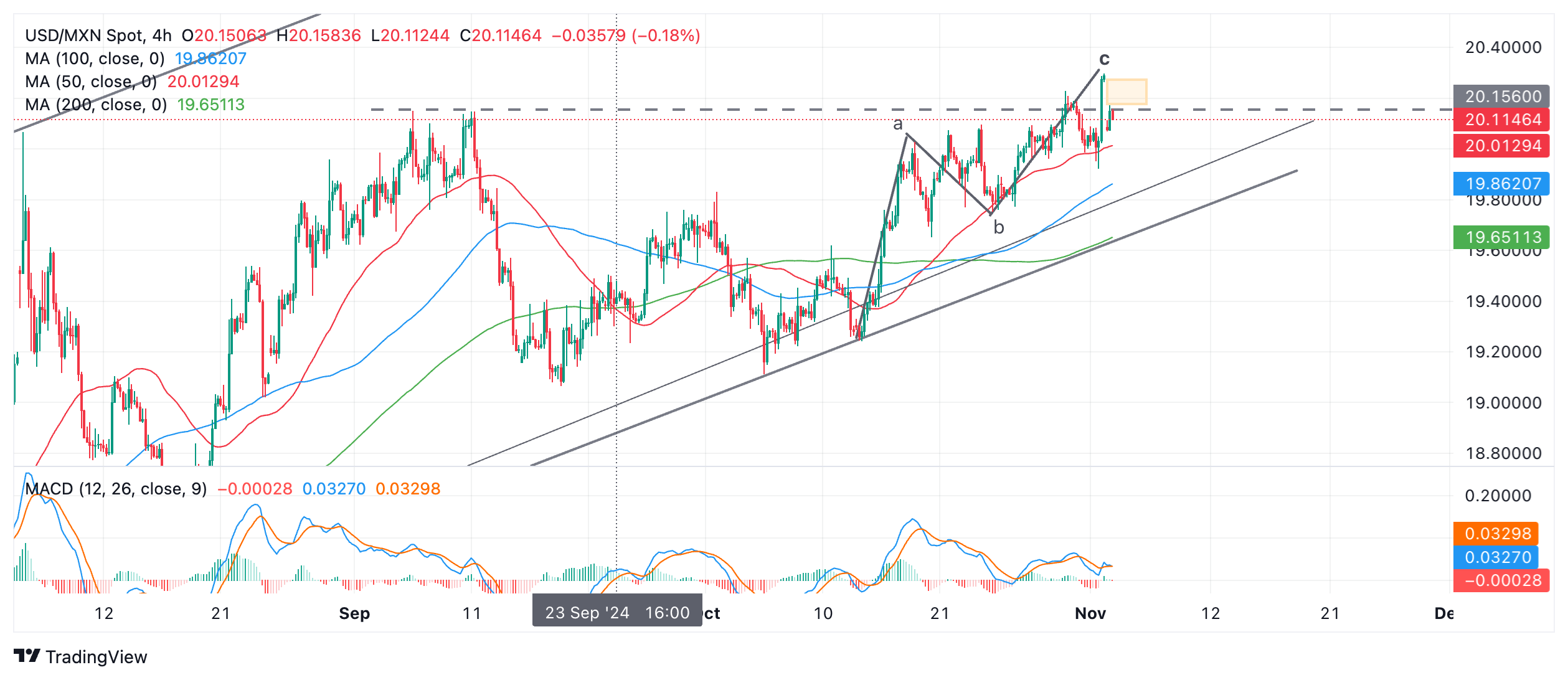
Despite the gap down, USD/MXN is still probably in an uptrend on a short, medium and long-term basis. Further, it is trading in a bullish rising channel. Given the technical dictum “the trend is your friend,” the odds favor a continuation higher.

In addition, according to technical analysis theory, gaps do not tend to remain open for long, suggesting the gap that opened on Monday could soon be filled by rising prices.

That said, momentum, as measured by the Moving Average Convergence Divergence (MACD), remains low by recent standards and indicates a lack of bullish enthusiasm underpinned Friday’s rally to new highs.

NZD/USD: Likely to trade in a 0.5940/0.6040 range for now

NZD/USD: Likely to trade in a 0.5940/0.6040 range for now

The New Zealand Dollar (NZD) could trade in a choppy manner between 0.5965 and 0.6015. In the longer run, weakness in NZD from early last month has ended; it is likely to trade in a 0.5940/0.6040 range for now, UOB Group’s FX analysts Quek Ser Leang and Lee Sue Ann note.

Weakness in NZD from early last month ends

24-HOUR VIEW: “Last Friday, we expected NZD to trade in a range between 0.5950 and 0.5990. NZD then traded in a 0.5960/0.5999 range. It closed at 0.5962 but rose above 0.6000 in early Sydney trade today. The volatile price action has resulted in a mixed outlook. Today, NZD could continue to trade in a choppy manner, probably between 0.5965 and 0.6015.”

1-3 WEEKS VIEW: “We turned negative in NZD early last month. As we tracked the decline, in our most recent narrative from last Wednesday (30 Oct, spot at 0.5970), we indicated that ‘There is still no clear increase in downward momentum and the chance of a sustained break below 0.5950 is not high.’ While NZD subsequently dropped below 0.5950, it rebounded quickly from 0.5940. In early Sydney trade today, it rose to 0.6010. Although our ‘strong resistance’ at 0.6010 has not been clearly breached, downward momentum appears to have faded. In other words, the weakness in NZD has ended. NZD has likely entered a range trading phase and is expected to trade between 0.5940 and 0.6040 for now.”

USD/CAD bounces back as Canadian Dollar weakens, US elections take center stage

USD/CAD bounces back as Canadian Dollar weakens, US elections take center stage

The USD/CAD pair recovers half of its intraday losses after discovering significant buying interest around the key support of 1.3900. The Loonie asset bounces back despite the US Dollar (USD) remaining vulnerable against its major peers, suggesting sheer weakness in the Canadian Dollar (CAD).

The CAD remains on the backfoot as the Bank of Canada (BoC) is expected to cut interest rates further in the last monetary policy meeting of the year in December. BoC Governor Tiff Macklem opened doors for another 50 basis points (bps) interest rate reduction in December.

“We’ve demonstrated we’re prepared to do a 50-basis-points cut if we think that’s appropriate. And if we think it’s appropriate to do it again, we’ll do it again,” Macklem told to Senate Committee on Wednesday. Macklem emphasized the need to lower interest rates unless he sees surprises from economic developments. The BoC also reduced its interest rates by 50 bps to 3.75% in its policy meeting in October.

For more interest rate guidance, investors will pay close attention to BoC’s Summary of Deliberations and the minutes of the policy meeting of October, which will be published on Tuesday.

Meanwhile, the US Dollar faces intense selling pressure as recent United States (US) national polls have shown that there would be fierce competition between Democratic candidate Kamala Harris and former President Donald Trump for presidential elections on Tuesday. The US Dollar Index (DXY), which gauges Greenback’s value against six major currencies, tumbles to near 103.70.

This week, investors will also focus on the Federal Reserve (Fed) policy meeting, which is scheduled on Thursday. The Fed is expected to reduce interest rates by 25 bps to 4.50%-4.75%.

USD: Trump trades being unwound after latest polls

USD: Trump trades being unwound after latest polls

US election week is starting with a weak dollar across the board. Markets are still digesting the very soft payrolls numbers on Friday, which were highly affected by extreme weather events. Meanwhile, the latest polls suggest that the Democrats have regained some momentum in some swing states may have prompted some unwinding of Trump trades. Incidentally, a recent poll suggests that Kamala Harris is leading in Iowa, previously considered a red-leaning state, ING’s FX analyst Francesco Pesole notes.

US elections and upcoming Fed meeting to shape the market

“Despite some unwinding of Trump trades, asset markets are still broadly pricing in a Trump win. As things stand now, we expect the dollar to sell off if Harris wins, while the impact of a Trump win may depend more on the Congress composition. A Republican clean sweep can send the dollar higher, but probably by less than how much a Harris win could hit USD. The USD might not rally at all if Trump wins but Democrats secure the house.”

“Another big event this week is the Federal Reserve’s rate announcement on Wednesday. By then, the election results may have not been called yet, meaning the FOMC market impact could prove rather short-lived. The Fed should cut by 25bp regardless of the US election result. Had it not been for the proximity of the vote, we would have argued a Fed cut would have been net-negative for the dollar, but the implications for FX of this Fed decision will only be assessed once the election volatility has dimmed down.”

“Expect volatility in USD crosses today and tomorrow as FX liquidity may tighten and large hedging positions may be re-assessed on the back of latest sentiment on the vote. Today’s momentum seems to be pointing to a weaker dollar, but things can turn rapidly in intraday trading. We retain a bias for a stronger USD today and tomorrow from this morning levels.”

GBP/USD: To decline GBP must break and remain below 1.2845

GBP/USD: To decline GBP must break and remain below 1.2845

The Pound Sterling (GBP) is likely to trade in a range, probably between 1.2890 and 1.2980. In the longer run, GBP must break and remain below 1.2845 before a sustained decline can be expected, UOB Group’s FX analysts Quek Ser Leang and Lee Sue Ann note.

Rangebound between 1.2890 and 1.2980 for the time being

24-HOUR VIEW: “After GBP dropped sharply last Thursday, we highlighted on Friday that ‘The sharp drop appears to be overdone, and GBP is unlikely to weaken further.’ We held the view that GBP ‘is more likely to trade in a range, probably between 1.2860 and 1.2950.’ GBP did not weaken further, but instead of trading in a range, it rose to 1.2980, then pulled back to close at 1.2921. It opened higher today. The price action provides no fresh clues, and we continue to expect GBP to trade in a range, probably between 1.2890 and 1.2980.”

1-3 WEEKS VIEW: “Last Thursday, GBP plummeted to a low of 1.2845. In our update from last Friday (01 Nov, spot at 1.2900), we indicated that ‘While there has been a buildup in momentum, GBP must break and remain below 1.2845 before further sustained decline can be expected.’ We added, ‘The likelihood of GBP breaking clearly below 1.2845 will remain intact, provided that 1.2985 is not breached.’ In NY trade, GBP rose to 1.2980, then pulled back. Downward momentum has slowed, and the chance of GBP breaking below 1.2845 has diminished. However, only a clear break above 1.2985 would indicate that the downside risk has faded.”

USD/CHF dips toward 0.8650 as the US Dollar weakens amid lower Treasury yields

USD/CHF dips toward 0.8650 as the US Dollar weakens amid lower Treasury yields

USD/CHF retraces its recent gains from the previous session, trading around 0.8650 during the European session on Monday. The US Dollar faces downward pressure as subdued Treasury yields follow Friday’s weaker-than-expected US Nonfarm Payrolls report.

The US Dollar Index (DXY), which measures the value of the US Dollar against its six major peers, trading around 103.80 with 2-year and 10-year yields on US Treasury bonds standing at 4.17% and 4.31%, respectively, at the time of writing.

On the data front, the US Bureau of Labor Statistics (BLS) indicated that October’s Nonfarm Payrolls increased by only 12,000, following a revised September gain of 223,000 (down from 254,000), which fell well short of market expectations of 113,000. Meanwhile, the Unemployment Rate remained steady at 4.1% in October, matching the consensus forecast.

Traders are closely watching the upcoming US presidential election on Tuesday, as the final New York Times/Siena College poll showed Democratic candidate Kamala Harris and Republican nominee Donald Trump are locked in a close contest across seven battleground states on Sunday. The focus will shift to the US Federal Reserve (Fed) policy decision, with expectations of a modest 25 basis point rate cut later this week.

The yield on the 10-year Swiss government bond dropped toward 0.38%, its lowest level since early October, as expectations grew for more substantial rate cuts by the Swiss National Bank (SNB). This shift follows a continued slowdown in Switzerland’s inflation, with the Consumer Price Index (CPI) falling 0.6% year-over-year in October, below the 0.8% forecast and marking the slowest rate of increase since July 2021.

Swiss inflation has not risen since April, and October’s figure came in well below the SNB’s fourth-quarter inflation forecast of 1%. This raises the likelihood that the SNB may consider a larger rate cut in December to keep inflation within its target range of 0-2%, signaling concerns over potential economic softening.

EUR/USD holds recovery gains near 1.0900 after EU Sentix data

EUR/USD holds recovery gains near 1.0900 after EU Sentix data

EUR/USD is consolidating the latest upswing to near 1.0900 in the European session on Monday. The pair holds the recovery on sustained US Dollar weakness, led by the US presidential election uncertainty. Encouraging EU Sentix data fails to provide any boost to the Euro.

The Relative Strength Index (RSI) indicator on the 4-hour chart stays above 60 and EUR/USD holds comfortably above the 200-day Simple Moving Average (SMA), currently located at 1.0870, despite having closed the previous week below this level.

EUR/USD was last seen trading near 1.0900. Once the pair rises above this level and starts using it as support, 1.0950 (100-day SMA) could be seen as next resistance before 1.1000 (round level, static level, 50-day SMA). On the downside, a daily close below 1.0870 could discourage buyers and open the door for an extended slide toward 1.0800 (round level, static level).

EUR/USD opened with a bullish gap and advanced to the 1.0900 area to start the new week, with the US Dollar (USD) coming under heavy selling pressure heading into the presidential election.

Changes in betting odds for the winner of the presidential election over the weekend triggered a USD selloff. PredictIt has placed a 51% possibility of a Kamala Harris winning on Tuesday, marking the vice president’s first lead over Donald Trump on the site since October 9. Meanwhile, the disappointing labor market data could also be putting additional weight on the USD’s shoulders, even though the immediate market reaction was mixed on Friday.

The US Bureau of Labor Statistics (BLS) reported that Nonfarm Payrolls (NFP) in the US rose by only 12,000 in October, down from the 223,000 increase (revised from 254,000) recorded in September and much worse than the market expectation of 113,000. In its press releases, the BLS noted that it was likely that payroll employment estimates in some industries were affected by the hurricanes.

Factory Orders for September will be the only data featured in the US economic docket on Monday, which is unlikely to trigger a market reaction.

Investors will keep a close eye on changes in betting odds and latest poll results. At this point, it could be risky to take a directional position in EUR/USD.

Silver price today: Silver falls

Silver price today: Silver falls

Silver prices (XAG/USD) fell on Thursday, according to FXStreet data. Silver trades at $33.59 per troy ounce, down 0.55% from the $33.77 it cost on Wednesday.

Silver prices have increased by 41.14% since the beginning of the year.

Unit measure Silver Price Today in USD
Troy Ounce 33.59
1 Gram 1.08


The Gold/Silver ratio, which shows the number of ounces of Silver needed to equal the value of one ounce of Gold, stood at 82.70 on Thursday, up from 82.54 on Wednesday.

EUR/USD grips gains on robust Eurozone GDP growth, await US data

EUR/USD grips gains on robust Eurozone GDP growth, await US data

EUR/USD holds up near 1.0850 in Thursday’s European session following Wednesday’s sharp recovery. The major currency pair strengthened as traders have pared back bets of a large interest-rate cut from the European Central Bank (ECB) in the December monetary policy meeting after a faster-than-expected Eurozone Gross Domestic Product (GDP) growth and hotter-than-forecasted German inflation.

Eurostat reported on Wednesday that the Eurozone expanded at a faster pace of 0.9% in the third quarter of the year compared with the same period a year earlier. A major contribution to higher growth in the Eurozone came from its largest nation, Germany, which managed to dodge a technical recession. The German economy surprisingly rose by 0.2% compared with the previous quarter, beating expectations of a 0.1% contraction. Meanwhile, the growth rate in Spain was higher than expected, as forecasted in France, and slower than anticipated in Italy.

The German flash Harmonized Index of Consumer Prices (HICP) for October accelerated at a faster pace of 2.4% on year, higher than estimates of 2.1% and the prior release of 1.8%, suggesting that the battle against inflation is yet not over.

“The just-released flash estimate of German inflation in October could make some members of the ECB regret the latest rate cut and the European Central Bank’s new openness to more aggressive cuts,” said analysts at ING.

For more cues on the current status of inflation, investors will focus on the Eurozone flash HICP data for October, which will be published at 10:00 GMT.

Meanwhile, ECB President Christine Lagarde has shown confidence about taming price pressures in an interview with the French newspaper Le Monde published on Thursday. “The objective is in sight, but I am not going to tell you that inflation is under control,” Lagarde said. She reaffirmed her commitment to interest rate reduction, but refrained from committing to a specific rate cut path.

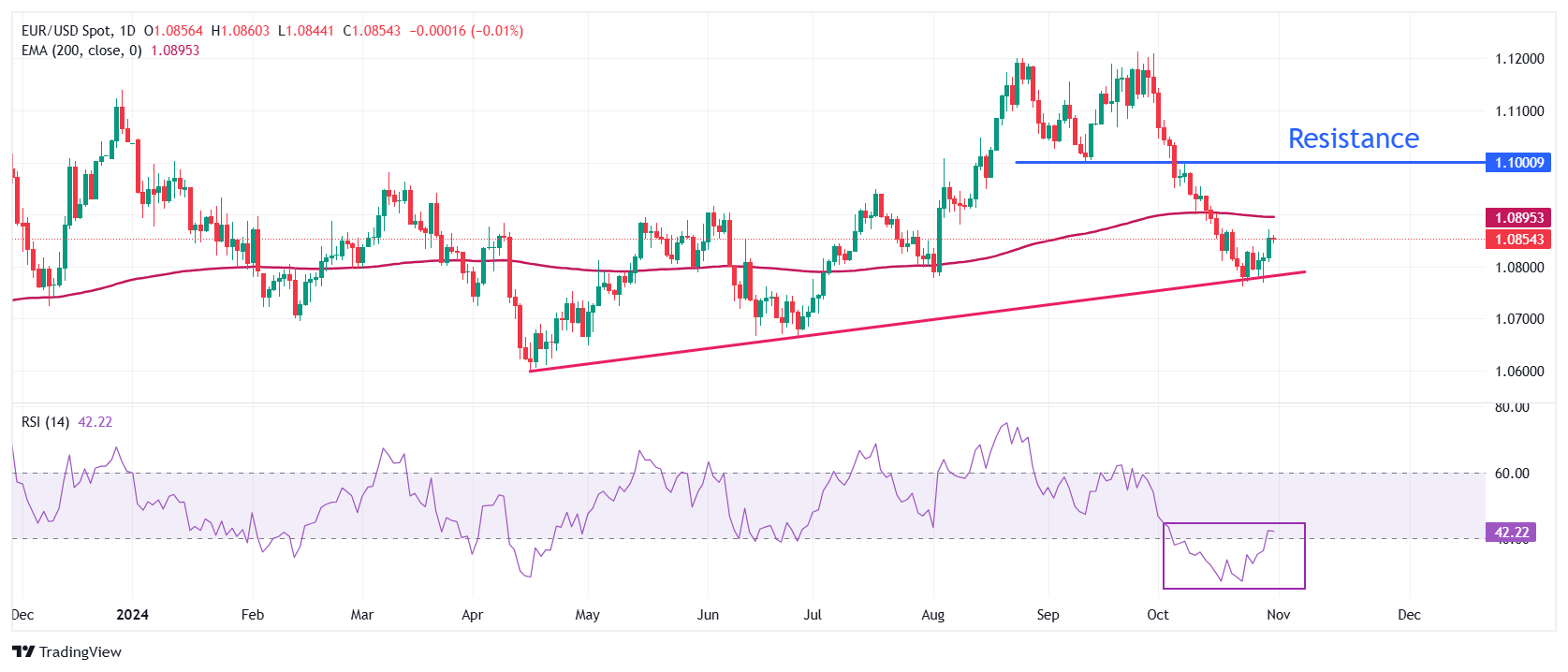
Technical Analysis: EUR/USD aims to extend upside above 1.0850

EUR/USD trades close to a fresh more than a week high around 1.0850 in European trading hours. The major currency pair holds onto its recent recovery after breaking above the round-level resistance of 1.0800. However, its broader outlook is still bearish as it trades below the 200-day Exponential Moving Average (EMA) at around 1.0900.

The 14-day Relative Strength Index (RSI) climbs to near 42.00 after staying in the 20.00-40.00 range for almost a month, suggesting that the bearish momentum has terminated.

Looking up, the shared currency pair could rise to near the 200-day EMA around 1.0900 and the September 11 low around 1.1000. On the downside, the upward-sloping trendline near 1.0750, which is plotted from the April 16  low at around 1.0600, will be the key support area for the Euro bulls.

Silver Price Forecast: XAG/USD tests nine-day EMA near $33.50

Silver Price Forecast: XAG/USD tests nine-day EMA near $33.50

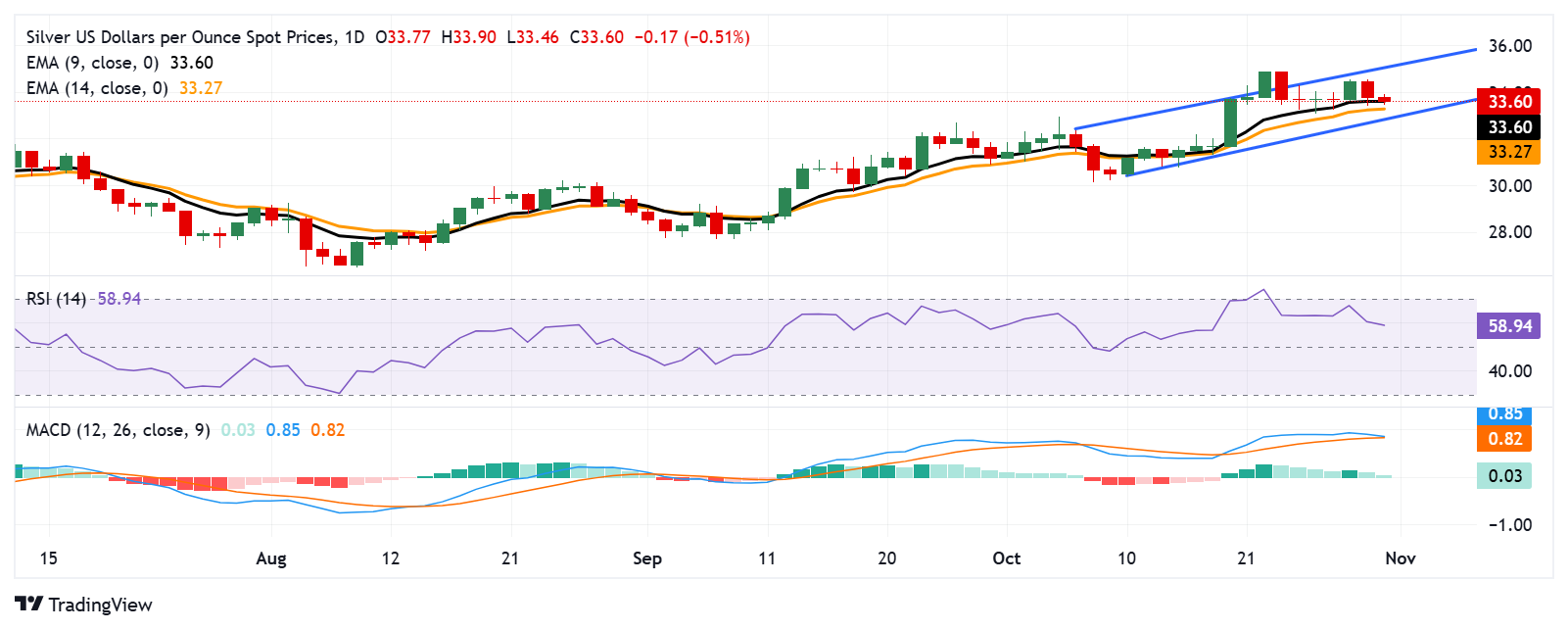
Silver price (XAG/USD) continues to decline, trading at around $33.60 during the European session on Thursday. Analysis of the daily chart indicates a bullish bias, as Silver price consolidates within an ascending channel.

Furthermore, the 14-day Relative Strength Index (RSI) remains above the 50 mark, supporting the prevailing bullish outlook. However, a decline below 50 could signal a shift toward bearish sentiment.

However, the Moving Average Convergence Divergence (MACD) line is positioned above the signal line, indicating a potential bearish signal. A bearish crossover could suggest a shift in momentum from bullish to bearish, signaling a possible sell opportunity. Nonetheless, since both lines remain above the centerline (zero line), this suggests that the overall trend remains bullish.

On the upside, the Silver price may target the psychological level of $35.00, followed by the upper boundary of the ascending channel at $35.10. A breakout above this level could propel the price of the grey metal toward the psychological level of $36.00.

Regarding support, Silver price is testing the nine-day Exponential Moving Average (EMA) at $33.60, with the 14-day EMA at $33.27 serving as the next support level. A drop below this latter level could increase selling pressure, potentially pushing XAG/USD down to the lower boundary of the ascending channel around the psychological level of $33.00.

XAG/USD: Daily Chart