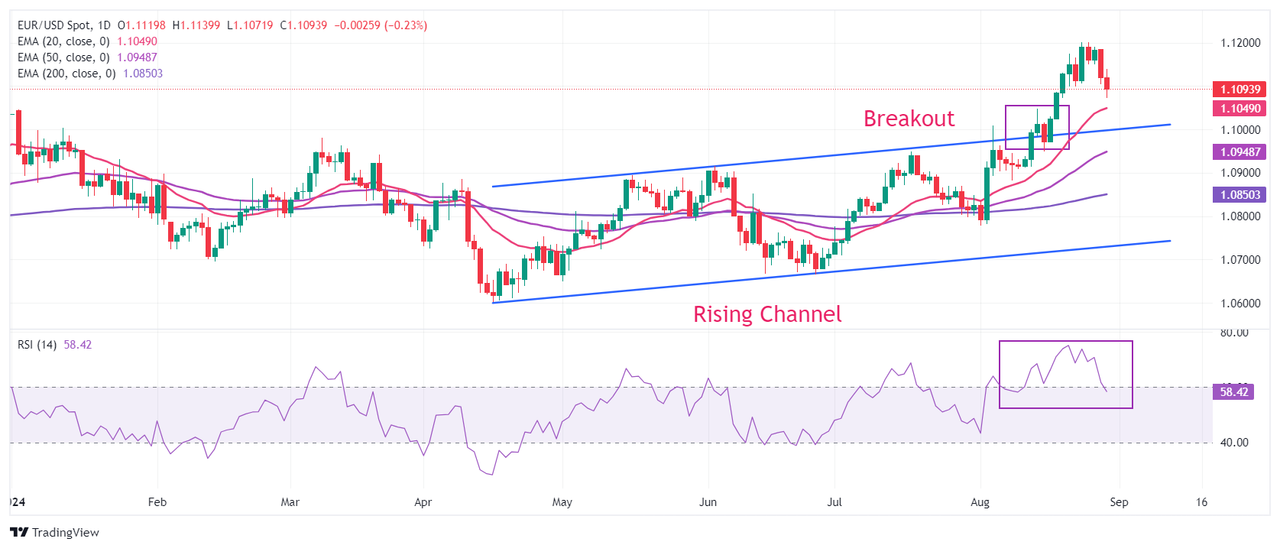
EUR/USD gains on German economic expansion, hot inflation

EUR/USD gains on German economic expansion, hot inflation

EUR/USD gains sharply to near 1.0850 in Wednesday’s European session as the flash Gross Domestic Product (GDP) data has shown that the economy surprisingly grew in the third quarter after contracting in the April-June period. The data showed that the German economy expanded by 0.2%, while economists expected a 0.1% decline as seen in the second quarter of the year.

Year-on-year German GDP contracted at a slower pace of 0.3% after a flat growth in the second quarter. Meanwhile, the October preliminary Harmonized Index of Consumer Prices (HICP) data from Germany and six of its states has come in hotter-than-expected.

Surprisingly positive Q3 German GDP  and hot inflation data have dampened expectations of the European Central Bank’s (ECB) larger-than-usual interest rate cut of 50 basis points (bps) in December. According to market expectations, the probability of the ECB reducing interest rates by 50 bps eases to 22% from 45% after the German data release.

Recent commentaries from policymakers have indicated that they are worried about inflation remaining persistently lower due to weakening economic growth. Market participants are worried about the outlook of the Eurozone economy. In Wednesday’s session, investors await the flash Eurozone Q3 GDP and the HICP data for Germany.

Meanwhile, uncertainty ahead of the US presidential election persists. While national polls have indicated tight competition between former US President Donald Trump and current Vice President Kamala Harris, traders seem to be pricing in a Trump victory, which would have deep repercussions also for the Eurozone.

Trump has promised a universal 10% tariff on all imports, except those from China, which would face even bigger tariffs. The threat of tariffs could impact the Eurozone’s powerful export sector significantly. Investment banking firm Goldman Sachs projects a 1% drop in the Eurozone’s GDP if a universal 10% tariff is imposed.

Silver price today: Silver falls

Silver price today: Silver falls


Silver prices (XAG/USD) fell on Wednesday, according to FXStreet data. Silver trades at $34.20 per troy ounce, down 0.75% from the $34.46 it cost on Tuesday.

Silver prices have increased by 43.72% since the beginning of the year.

Unit measure Silver Price Today in USD
Troy Ounce 34.20
1 Gram 1.10

The Gold/Silver ratio, which shows the number of ounces of Silver needed to equal the value of one ounce of Gold, stood at 81.33 on Wednesday, up from 80.53 on Tuesday.

USD: A blip in the strong US jobs story

USD: A blip in the strong US jobs story

The latest US macro news has dampened the dollar rally. Consumer confidence rose more than expected from 99.5 to 108.7 yesterday, the strongest monthly gain since March 2021. Interestingly, for the first time since July 2023, the survey shows some improved optimism about future job availability, ING’s FX analyst Francesco Pesole notes.

US GDP report to prevent USD narrative turn negative

“The indications from the JOLTS job openings instead pointed to some cool-off in the jobs market. There was a revision in the August figure down to 7.8m, and the September print was 7.4m – well below the consensus of 8.0m. The JOLTS report also includes the quits rate, which has decreased sharply to 1.9% from the 3% early-2022 peak, when a high number of workers were leaving their jobs for higher-paid roles elsewhere.”

“The falling quits rate can indicate that there is indeed a greater scarcity of jobs but also that workers are more worried about the outlook and value job security. This is a net-negative indicator for the jobs market, but payrolls data needs to follow through with a soft read on Friday to convince markets to price back in Fed easing. The Fed funds futures curve is embedding 45bp of cuts over November and December.”

“Today, the US will release the advanced third-quarter GDP report, which includes the quarterly core PCE figures. These are expected at 2.1% QoQ, a decline from 2.8% in the second quarter. The ADP payrolls for October are also released today and are expected to have declined from 143k to 111k. Those have limited predictive power for actual payrolls, but can still move the market. We suspect a strong growth print can prevent the macro story from turning dollar-negative before payrolls on Friday, and allow Trump hedges and rising implied volatility to feed into a stronger dollar.”

AUD/USD: Next level to monitor is 0.6520

AUD/USD: Next level to monitor is 0.6520

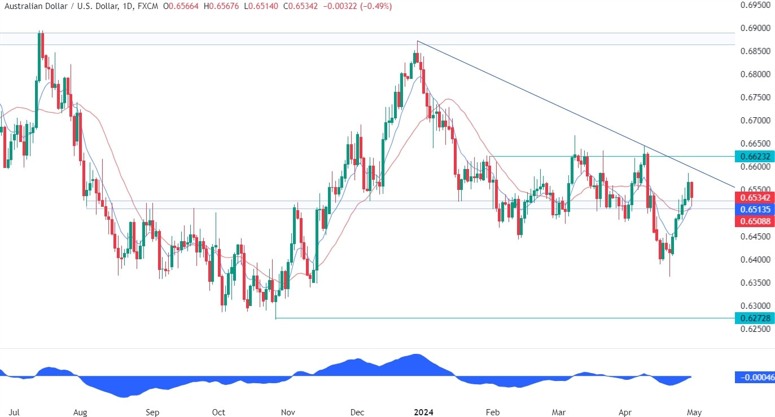
Oversold conditions and slowing momentum suggest Australian Dollar (AUD) is likely to trade in a range of 0.6545/0.6585. In the longer run, the potential for further sustained decline may be limited; the next level to monitor is 0.6520, UOB Group’s FX analysts Quek Ser Leang and Lee Sue Ann note.

AUD can test the 0.6585 resistance

24-HOUR VIEW: “After AUD fell sharply on Monday, we highlighted yesterday (Tuesday) that ‘While oversold, the decline could extend to 0.6560 before stabilisation can be expected.’ Our view of AUD declining was not wrong, even though it fell more than expected to 0.6545. Conditions remain oversold, this, combined with tentative signs of slowing momentum, suggests that instead of continuing to weaken, AUD is more likely to trade in a 0.6545/0.6585 range.”

1-3 WEEKS VIEW: “Yesterday (29 Oct, spot at 0.6585) we indicated that ‘there is potential for AUD to continue to decline to 0.6560, possibly 0.6520.’ We did not quite expect AUD to reach 0.6560 as quickly, as it dropped to a low of 0.6545 during NY trading. Although the weakness has not stabilised, given that the current decline is entering its second month, the potential for further sustained weakness may be limited. The next level to monitor is 0.6520. On the upside, a breach of 0.6620 (‘strong resistance’ was at 0.6640 yesterday) would mean that the weakness has stabilised.”

USD/CAD remains above 1.3900 near three-month highs, eyes on US GDP

USD/CAD remains above 1.3900 near three-month highs, eyes on US GDP

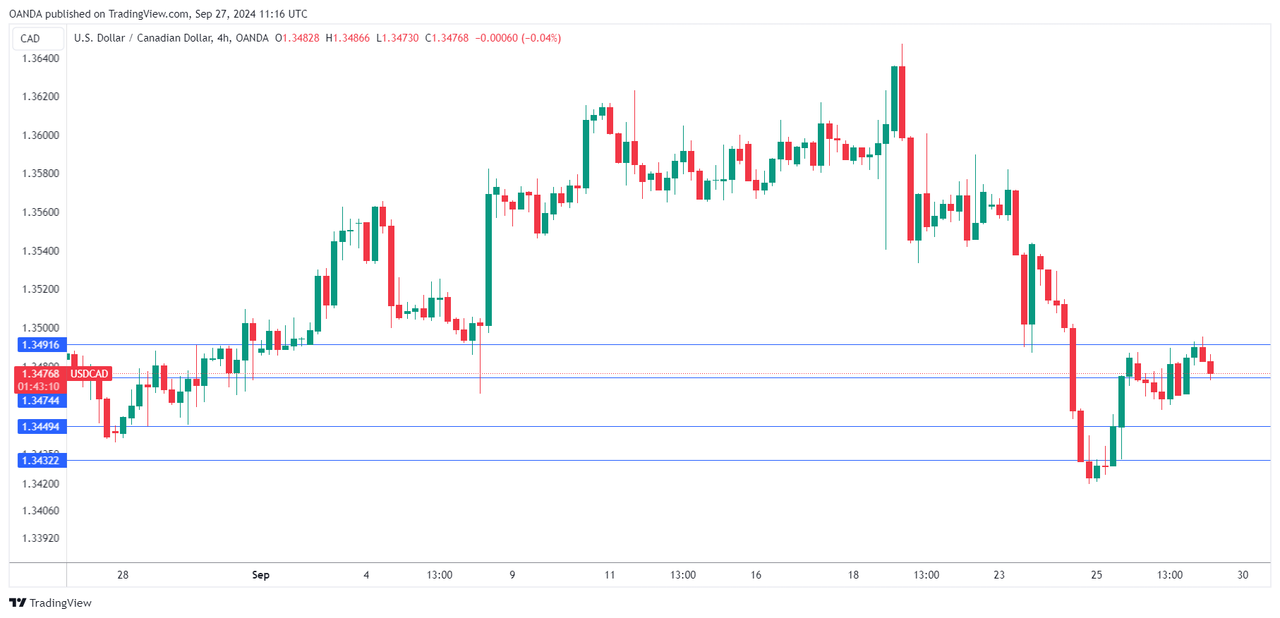
The USD/CAD pair pulls back from its three-month high of 1.3929, recorded in the previous session, trading around 1.3910 during Wednesday’s European session. The Canadian Dollar (CAD), tied to commodities, benefits from stronger Oil prices, as Canada remains the largest crude supplier to the United States (US).

West Texas Intermediate (WTI) Oil price rebounds after two days of losses, trading around $67.70 at the time of writing. Crude Oil prices are bolstered by an unexpected decline in US crude inventories. API US weekly crude Oil stockpiles fell by 0.573 million barrels in the week ending October 25, contrary to expectations of a 2.3 million-barrel increase. Investors now await the EIA crude Oil stockpiles report, due Wednesday.

On Monday, Bank of Canada Governor Tiff Macklem provided more insight into last week’s substantial interest rate cut, describing it as justified following years of sharp rate increases aimed at curbing inflation. Macklem is expected to appear before the House of Commons Finance Committee on Wednesday to discuss the bank’s monetary policy.

The decline of the USD/CAD pair could also be attributed to a weaker US Dollar (USD), driven by lower Treasury yields. The US Dollar Index (DXY), which measures the value of the US Dollar against six other major currencies, trades around 104.10 with 2-year and 10-year yields on US Treasury bonds standing at 4.07% and 4.22%, respectively, at the time of writing.

Traders will likely watch the upcoming release of preliminary US Q3 Gross Domestic Product (GDP) figures and October’s ADP Employment Change, as these could offer important insights into the timing and pace of the Federal Reserve’s (Fed) expected rate cuts. Additionally, US PCE inflation and Nonfarm Payrolls (NFP) will be closely monitored on Thursday and Friday, respectively.

EUR/USD clings to gains near 1.0850 after German data

EUR/USD clings to gains near 1.0850 after German data

EUR/USD clings to daily gains near 1.0850 in the European session on Wednesday. The data from Germany showed that the Gross Domestic Product (GDP) grew by 0.2% on a quarterly basis in Q3, coming in better than the market expectation of -0.1% and supporting the Euro.

EUR/USD broke out of the descending regression channel and the Relative Strength Index (RSI) indicator on the 4-hour chart rose to 60, reflecting a bullish shift in the short-term technical bias.

On the upside, the 200-day Simple Moving Average aligns as strong resistance at 1.0870 ahead of 1.0900 (round level) and 1.0940 (100-day SMA). Looking south, first support could be spotted at 1.0810-1.0800 (20-period SMA, 50-period SMA, round level) before 1.0750 (static level) and 1.0700 (round level, static level).

EUR/USD gains traction and rises toward 1.0850 in the European trading hours on Wednesday. Although the technical outlook highlights a buildup of bullish momentum, the Euro still faces a two-way risk on high-impact macroeconomic data releases.

Regional Consumer Price Index (CPI) figures and third-quarter Gross Domestic Product (GDP) data from Germany will be watched closely by market participants. Investors expect Germany’s GDP to contract at an annualized rate of 0.3% in the third quarter. A worse-than-expected GDP print, combined with soft regional inflation figures from Germany, could weigh on the Euro with the immediate reaction.

Later in the day, the ADP Employment Change for October will be featured in the US economic docket. Analysts see the employment in private sector rising by 115,000 following the 143,000 increase recorded in September.

Additionally, the US Bureau of Economic Analysis will publish its first estimate of the third-quarter GDP data, which is forecast to show an expansion at an annual rate of 3%.

In case the ADP and the GDP data both disappoint, the US Dollar (USD) is likely to come under renewed selling pressure and open the door for a leg higher in EUR/USD. On the flip side, the USD could regather its strength if these data arrive near or above market consensus. If the figures come in mixed, investors could refrain from taking large positions. In this scenario, the risk perception following the Wall Street’s opening bell could be the driving factor for the USD’s performance.

EUR/USD keeps range above 1.0800 ahead of key German/ EU data

EUR/USD keeps range above 1.0800 ahead of key German/ EU data

EUR/USD is keeping its range play intact above 1.0800 in the European session on Wednesday. The Euro remains vulnerable ahead of key growth data from Germany and the Eurozone, which could ramp up ECB interest-rate cut expectations.

EUR/USD broke out of the descending regression channel and the Relative Strength Index (RSI) indicator on the 4-hour chart rose to 60, reflecting a bullish shift in the short-term technical bias.

On the upside, the 200-day Simple Moving Average aligns as strong resistance at 1.0870 ahead of 1.0900 (round level) and 1.0940 (100-day SMA). Looking south, first support could be spotted at 1.0810-1.0800 (20-period SMA, 50-period SMA, round level) before 1.0750 (static level) and 1.0700 (round level, static level).

EUR/USD gains traction and rises toward 1.0850 in the European trading hours on Wednesday. Although the technical outlook highlights a buildup of bullish momentum, the Euro still faces a two-way risk on high-impact macroeconomic data releases.

Regional Consumer Price Index (CPI) figures and third-quarter Gross Domestic Product (GDP) data from Germany will be watched closely by market participants. Investors expect Germany’s GDP to contract at an annualized rate of 0.3% in the third quarter. A worse-than-expected GDP print, combined with soft regional inflation figures from Germany, could weigh on the Euro with the immediate reaction.

Later in the day, the ADP Employment Change for October will be featured in the US economic docket. Analysts see the employment in private sector rising by 115,000 following the 143,000 increase recorded in September.

Additionally, the US Bureau of Economic Analysis will publish its first estimate of the third-quarter GDP data, which is forecast to show an expansion at an annual rate of 3%.

In case the ADP and the GDP data both disappoint, the US Dollar (USD) is likely to come under renewed selling pressure and open the door for a leg higher in EUR/USD. On the flip side, the USD could regather its strength if these data arrive near or above market consensus. If the figures come in mixed, investors could refrain from taking large positions. In this scenario, the risk perception following the Wall Street’s opening bell could be the driving factor for the USD’s performance.

Silver price today: Silver rises

Silver price today: Silver rises

Silver prices (XAG/USD) rose on Tuesday, according to FXStreet data. Silver trades at $34.18 per troy ounce, up 1.48% from the $33.68 it cost on Monday.

Silver prices have increased by 43.64% since the beginning of the year.

Unit measure Silver Price Today in USD
Troy Ounce 34.18
1 Gram 1.10

The Gold/Silver ratio, which shows the number of ounces of Silver needed to equal the value of one ounce of Gold, stood at 80.59 on Tuesday, down from 81.42 on Monday.

Mexican Peso edges higher as market turns risk-on

Mexican Peso edges higher as market turns risk-on

The Mexican Peso (MXN) edges higher on Tuesday, rising by about a quarter of a percent across its most-heavily traded pairs. Positive risk appetite during the US sessions on Monday, which led to further gains for the S&P 500 stock index, may have been a factor supporting the Peso since this tends to benefit emerging market currencies.

A revival of carry trade inflows might be a further factor providing support for the Mexican Peso. This involves traders borrowing in a currency with low interest rates such as the Japanese Yen (JPY) and purchasing a currency with high interest rates such as the Mexican Peso. The difference between the interest earned on the Peso investment and that paid on the Yen loan represents the profit discounting fluctuations in the exchange rate.

The outlook for the Japanese Yen (JPY) is not looking bright after the weekend elections saw the ruling Liberal Democratic Party (LDP) coalition lose its grip on power. Opposition parties are generally against raising interest rates in Japan, which is weighing on the Yen and making the carry trade more attractive. Overnight, Yuichiro Tamaki, leader of the Japan Democratic Party for the People (DPP), said he was opposed to further rate hikes by the Bank of Japan (BoJ).

Mexican Peso impacted by political risk

The Mexican Peso may also be finding support after the news that the Mexican Supreme Court Judge, Juan Luis González Alcántara Carrancá, a staunch opponent of the controversial judicial reforms the Sheinbaum administration is trying to implement, attempted a new tactic to block their implementation. The reforms enable the election of judges rather than their appointment, but Carrancá, argued on Monday, that the creation of the “Evaluation Committees” used to short-list candidates for elections in the first step, was unconstitutional in itself, according to El Financiero.

For context, the Peso depreciated over 10% in value after the June election in which Sheinbaum and her Morena party coalition gained a super majority in the Mexican Congress. Many western investors fretted over the consequences of the result since it would enable the new government to make radical reforms to the constitution, which critics viewed as market unfriendly.

On the data front, the Peso sees a busy week ahead, especially with Mexican preliminary Gross Domestic Product (GDP) data for Q3 and the Fiscal Balance out on Wednesday,  and the Jobless Rate on Friday.

Recently, the International Monetary Fund (IMF) downgraded its forecasts for growth for the Mexican economy to 1.5% in 2024. GDP grew a robust 2.1% YoY in Q2, but corroboration of the IMF’s gloomy assessment from weak Q3 GDP data might weigh on the Peso.

Technical Analysis: USD/MXN unfolding leg higher

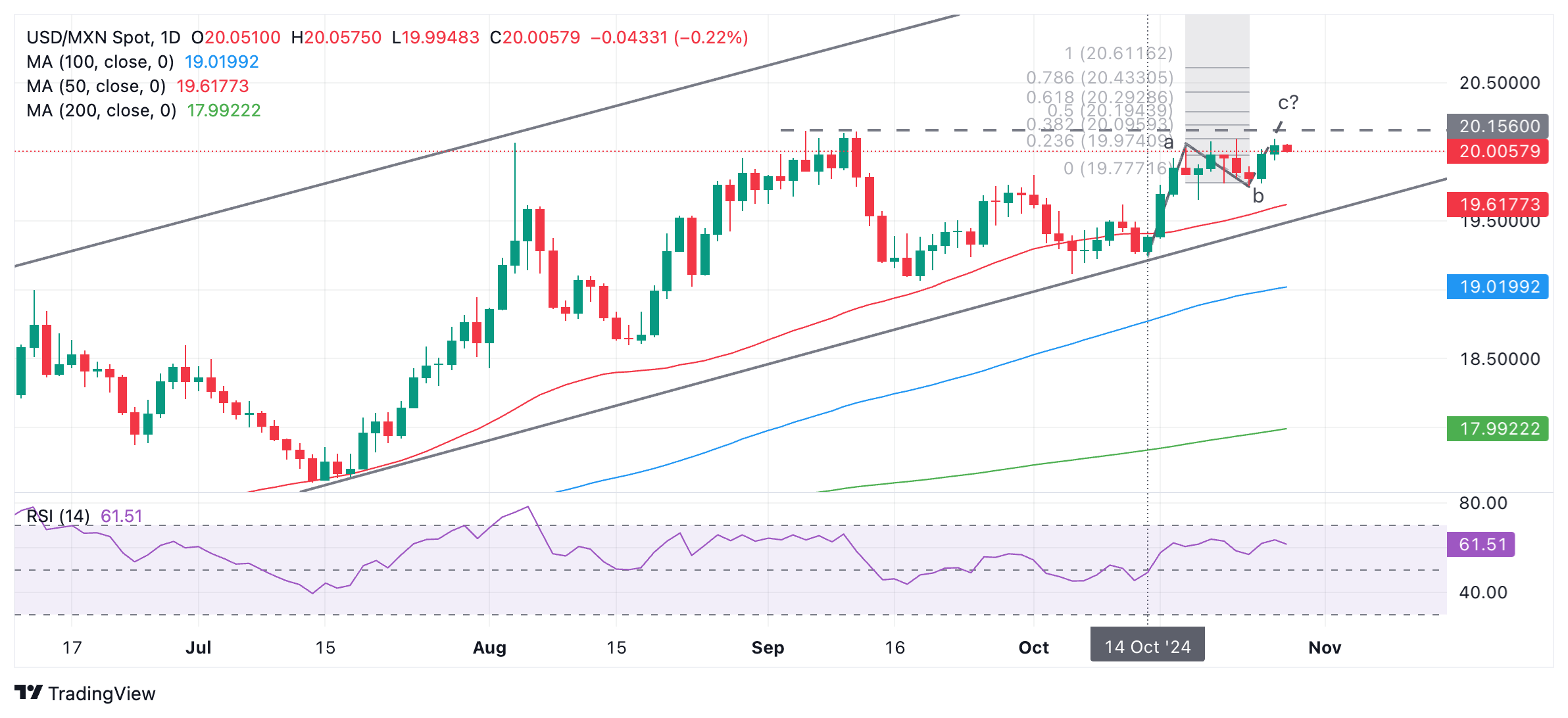
USD/MXN broadly continues unfolding a leg higher after a mild pullback. The up leg is probably the “c wave” of a bullish “abc” pattern, which began at the October 14 swing low. It will probably reach the Fibonacci 61.8% of the length of wave “a”, giving an upside target of 20.29. Such a move would gain confirmation from a break above the high of wave “b” at 20.09.

USD/MXN Daily Chart

USD/MXN is probably in an uptrend on a short, medium and long-term basis and is trading in a rising channel. Given the technical dictum “the trend is your friend,” the odds favor a continuation higher.

In addition, the original break above 19.83 (October 1 high) has already confirmed a probable move up, with a target in the vicinity of the September 10 high at 20.13.

Pound Sterling consolidates with UK budget on the horizon

Pound Sterling consolidates with UK budget on the horizon

The Pound Sterling (GBP) exhibits a subdued performance against its major peers on Tuesday. The British currency trades cautiously ahead of the United Kingdom (UK) Autumn Forecast Statement, which will be unveiled on Wednesday. This will be the first budget announcement by a Labor government in over 15 years.

UK Chancellor of the Exchequer Rachel Reeves is expected to raise taxes and increase public spending as suggested by Prime Minister Keir Starmer in his speech at Birmingham on Monday, reported by BBC News. The government would take “tough decisions,” opting to raise taxes in order to “prevent austerity and rebuild public services,” Starmer said.

Meanwhile, Rachel Reeves discussed the need to spend heavily on the National Health Service (NHS) in order to improve medical facilities, Reuters reported. “I am putting an end to the neglect and underinvestment (the NHS) has seen for over a decade now”, Reeves said.

Market participants will keenly focus on the overall spending plans as these will influence the Bank of England’s (BoE) interest rate path. According to a Reuters poll, the BoE is all set to cut interest rates by 25 basis points (bps) to 4.75% in its monetary policy meeting on November 7. This will be the BoE’s second interest rate cut this year. The central bank left its key borrowing rates unchanged at 5% in its last policy meeting in September.

Daily digest market movers: Pound Sterling traces US Dollar’s sideways performance

  • The Pound Sterling trades in a tight range below the psychological resistance of 1.3000 against the US Dollar (USD) in Tuesday’s London session. The GBP/USD pair consolidates as investors await a slew of United States (US) economic data, which will provide cues about the direction of the Federal Reserve’s (Fed) monetary policy by the year-end.
  • This week, investors will mainly focus on the first estimate of the Q3 Gross Domestic Product (GDP), the Personal Consumption Expenditure Price Index (PCE), the Nonfarm Payrolls (NFP), and the ISM Manufacturing Purchasing Managers’ Index (PMI) data to understand the current status of economic growth and inflation.
  • Meanwhile, recent commentaries from an array of Fed officials have shown that they are more worried about downside risks to economic growth, with firm confidence that inflation remains on track toward the bank’s target of 2%.
  • If the data to be published later this week show signs of robust economic expansion and upbeat labor demand, bets that the Fed will cut interest rates sharply will diminish. On the contrary, Fed rate cut bets would strengthen if the data points to slower growth and a weak job market.
  • According to the CME FedWatch tool, 30-day Federal Fund Futures pricing data shows that the central bank is expected to cut interest rates by 25 basis points (bps) in both policy meetings in November and December.
  • In Tuesday’s New York session, investors will pay close attention to the US JOLTS Job Openings data for September, which will be published at 14:00 GMT. Economists expect US employers to have posted 7.99 million job vacancies, marginally lower than the 8.04 million in August.

Technical Analysis: Pound Sterling trades below 1.3000

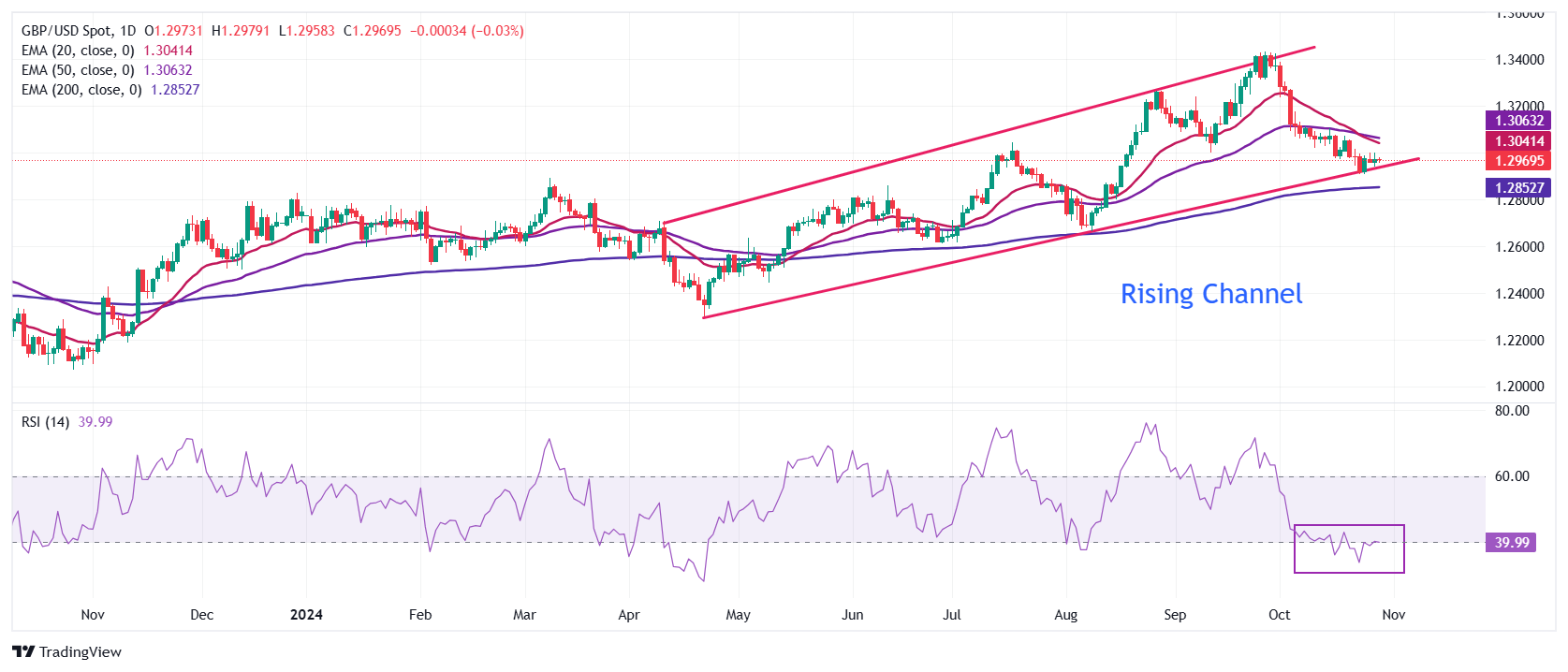
The Pound Sterling trades inside Monday’s trading range against the US Dollar (USD) in European trading hours on Monday. The GBP/USD pair remains at make or a break near the lower boundary of a Rising Channel chart formation around 1.2900 on the daily time frame.

The near-term trend of the Cable remains uncertain as it stays below the 50-day Exponential Moving Average (EMA), which trades around 1.3070.

The 14-day Relative Strength Index (RSI) rebounds to nearly 40.00. A fresh bearish momentum would trigger if it fails to climb above it.

Looking down, the 200-day EMA near 1.2845 will be a major support zone for Pound Sterling bulls. On the upside, the Cable will face resistance near the 20-day EMA around 1.3060.