EUR/USD sits at yearly lows near 1.0550 ahead of EU GDP, US PPI data

EUR/USD sits at yearly lows near 1.0550 ahead of EU GDP, US PPI data

EUR/USD is trading near 1.0550 in the European session on Thursday, sitting at the lowest level in a year. The Trump trades-driven relentless US Dollar buying and German political instability weigh on the pair. Traders await EU GDP data and US PPI report ahead of Fed Chair Powell’s speech.

The selling bias around the EUR/USD pair remains unabated for the fifth consecutive day in the wake of the continuation of the so-called Trump trade, which has been a key factor behind the post-election US Dollar (USD) rally. In fact, the USD Index (DXY), which tracks the Greenback against a basket of currencies, has advanced to its highest level since November 2023 amid hopes that US President-elect Donald Trump’s policies will boost economic growth.

Meanwhile, Trump’s plans to hike tariffs on imports could accelerate inflation and force the Federal Reserve (Fed) to pause its easing cycle. Moreover, the US Consumer Price Index (CPI) released on Wednesday pointed to a slower progress toward bringing inflation down and could result in fewer rate cuts next year. This remains supportive of elevated US Treasury bond yields and continues to push the USD higher across the board.

The US Bureau of Labor Statistics reported that the headline CPI rose 0.2% in October and by 2.6% over the last twelve months. Additional details of the report revealed that the core gauge – which excludes the more volatile food and energy categories—increased by 0.3% last month and by 3.3% as compared to the same time period last year. The data reaffirmed bets that the Fed would deliver a third rate cut in December against the backdrop of a softening labor market.

Commenting on the report, St. Louis Fed President Alberto Musalem noted that the risk of inflation moving higher has risen and that sticky inflation makes it difficult for the central bank to continue to ease rates. Moreover, Dallas Fed President Lorie Logan struck a similar tone and said that the central bank should proceed cautiously, adding that if we cut too far, past neutral, inflation could reaccelerate and the FOMC could need to reverse direction.

Separately, Kansas Fed President Jeffrey Schmid made a rare appearance and said it remains to be seen how much more the US central bank will cut rates, and where they may settle. Hence, investors will closely scrutinize Fed Chair Jerome Powell’s comments on Thursday for cues about the rate-cut path. This, in turn, will play a key role in influencing the near-term USD price dynamics and provide some meaningful impetus to the EUR/USD pair.

In the meantime, the shared currency might continue to feel pressure from the political uncertainty in Germany, following the collapse of the governing coalition in the Eurozone’s largest economy. Adding to this, the highly probable tariffs on Europe’s exports to the US, under the second Trump presidency, could significantly impact the region’s economy. This further seems to weigh on the Euro and drags the EUR/USD pair to a fresh year-to-date (YTD) low.

Heading into the key event risk, the US economic docket – featuring the release of the usual Weekly Initial Jobless Claims and the Producer Price Index (PPI) – could drive the USD demand and produce short-term opportunities around the EUR/USD pair. Nevertheless, the aforementioned fundamental backdrop seems tilted firmly in favor of the USD bulls and suggests that the path of least resistance for spot prices remains to the downside.

Dogecoin extends gains as traders assess Elon Musk’s role in upcoming Trump administration

Dogecoin extends gains as traders assess Elon Musk’s role in upcoming Trump administration

Dogecoin (DOGE) extends its gains on Monday and trades around $0.28 after rallying over 83% in the previous week, buoyed by the victory of crypto-friendly candidate Donald Trump in the US presidential election and its promotion by Trump supporter Elon Musk.

Elon Musk’s continued support for Dogecoin has reignited interest in the dog-themed meme coin. DOGE’s open interest reached a new all-time high of $2.26 billion on Monday, signaling a surge of new capital, while its daily trading volume also hit a yearly high of $13.96 billion.

Elon Musk’s support for DOGE

Elon Musk’s involvement has reignited interest in Dogecoin, particularly following his co-founding of the “Department of Government Efficiency” (DOGE), a concept aimed at streamlining US government operations and reducing waste.

Last week, Donald Trump’s victory in the US presidential election sparked renewed attention on Musk’s proposed initiative. During a campaign rally in New York on October 27, Musk claimed the formation of the “Department of Government Efficiency” could save the United States $2 trillion in tax spending. Elon Musk’s continued support for Trump’s campaign and Trump’s victory has increased the likelihood of forming such a department.

The initiative’s initials, DOGE, align with the Dogecoin ticker, fueling discussions and speculation on social media about the token’s future and enhancing bullish sentiment for the meme coin.

Dogecoin bulls eye for October 2021 highs 

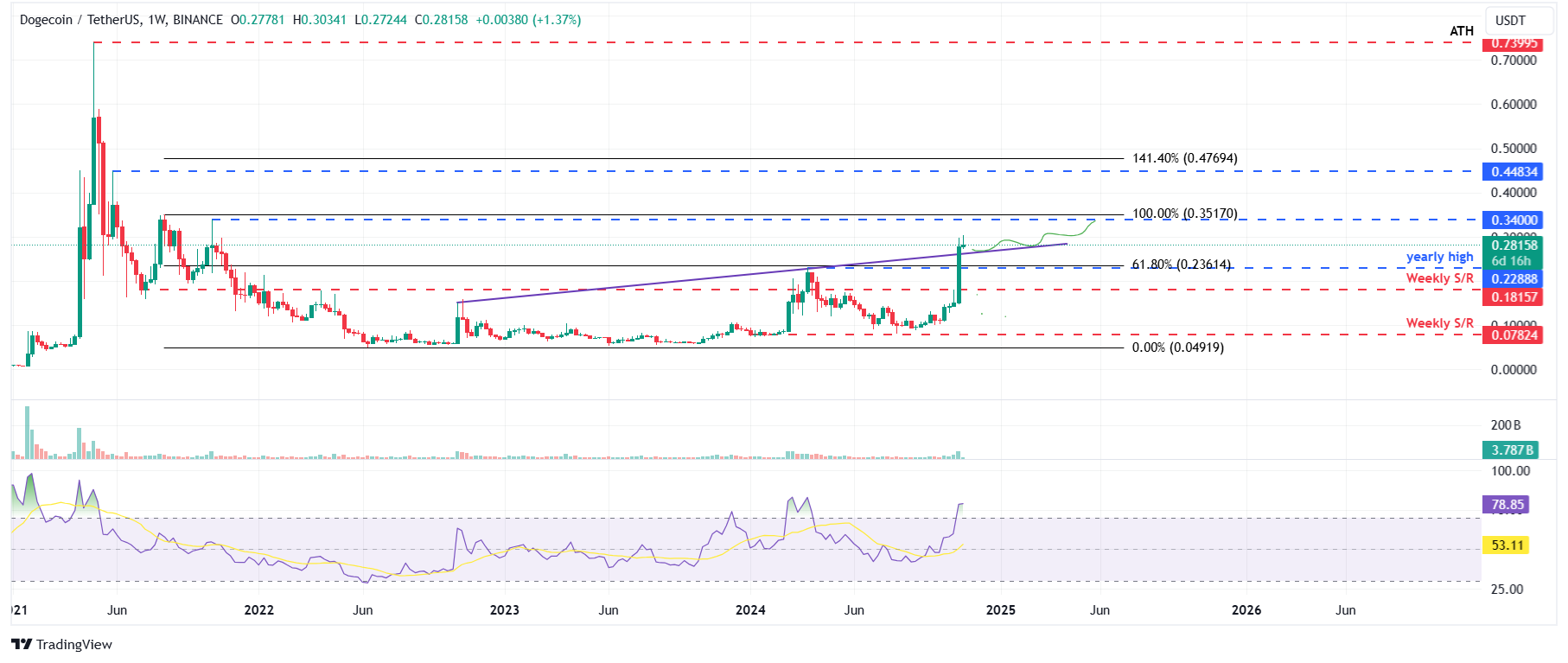
Dogecoin’s weekly chart has broken and closed above the ascending trendline, which had previously acted as resistance. The breakout from this trendline, which was drawn by connecting multiple highs since October 2022, favors bulls. As of Monday DOGE trades slightly higher around $0.278.

If DOGE’s upward momentum continues or the ascending trendline holds as support, it could extend the rally by another 21% to retest its October 2021 high of $0.34.

The Relative Strength Index (RSI) on the weekly chart is currently at 78, above the overbought threshold of 70, signaling caution as the likelihood of a pullback increases. However, the RSI may also dip slightly but maintain its bullish momentum by staying above the overbought level and continuing its ongoing rally. An exit from overbought territory would give a sell signal.

DOGE/USDT weekly chart

DOGE/USDT

Dogecoin’s on-chain data further supports the bullish thesis. Coinglass’s data shows that the futures’ Open Interest (OI) in Dogecoin at exchanges is increasing. Increasing OI represents new or additional money entering the market and new buying, which suggests a bullish trend.

The graph below shows that DOGE’s OI roughly doubled from $1.16 billion on November 5 to a new all-time high of $2.26 billion on Monday.

Dogecoin Open Interest chart. Source: Coinglass

Another aspect bolstering the platform’s bullish outlook is a recent surge in traders’ interest and liquidity in Doge’s ecosystem. Token terminal data shows that DOGE’s daily trading volume rose from $1.49 billion on November 3 to $13.96 billion on Thursday, the highest daily trading volume this year.

Dogecoin daily trading volume chart. Source: Token Terminal


USD/INR drifts higher as Donald Trump win pressures Asian FX Market

USD/INR drifts higher as Donald Trump win pressures Asian FX Market

The Indian Rupee (INR) edges lower to an all-time low on Monday. The local currency remains vulnerable amid the sustained outflows from local stocks and expectations of a stronger Greenback and higher US bond yields after Donald Trump won the US election.

On the other hand, the decline in crude oil prices might help limit the INR’s losses as India is the world’s third-largest oil consumer. Additionally, the routine intervention by the Reserve Bank of India (RBI) to sell USD might prevent the INR from significant depreciation in the near term. Traders will keep an eye on India’s October Consumer Price Index (CPI), which is due on Tuesday. On the US docket, the CPI inflation report will be released on Wednesday.

Technical Analysis: USD/INR’s constructive outlook remains in place, eyes on overbought RSI

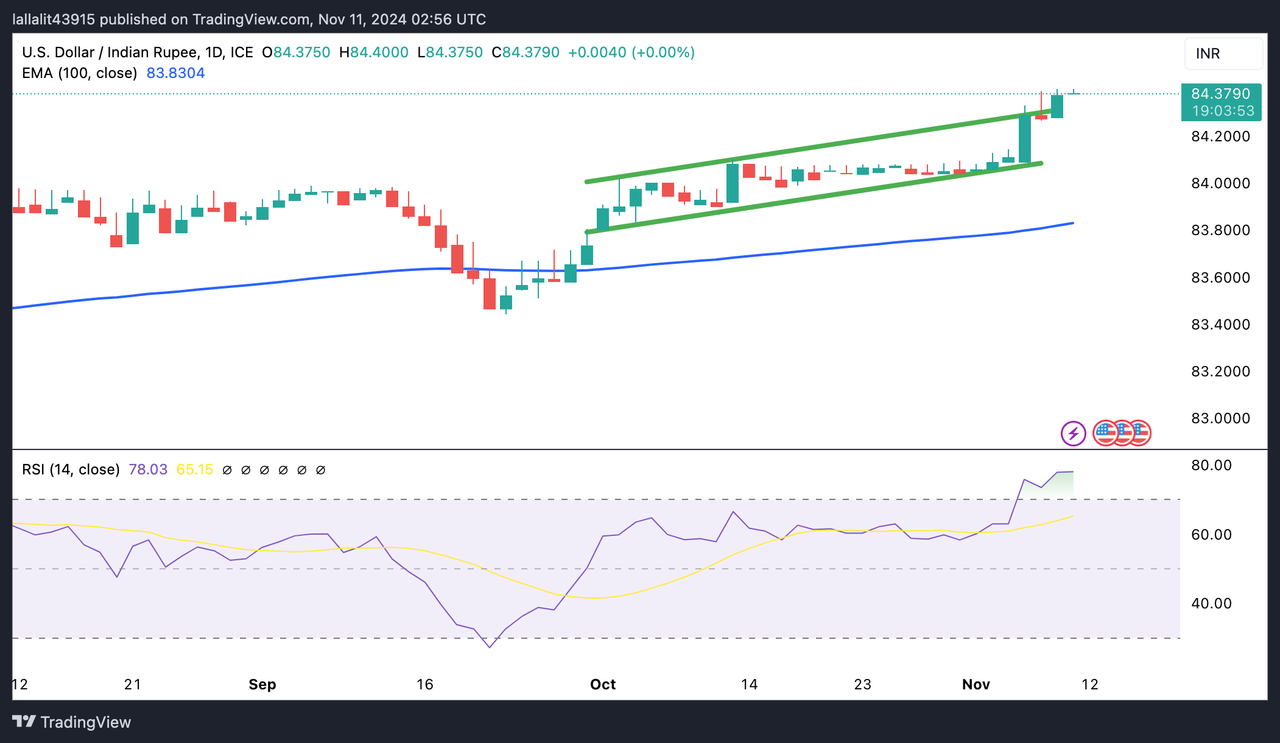
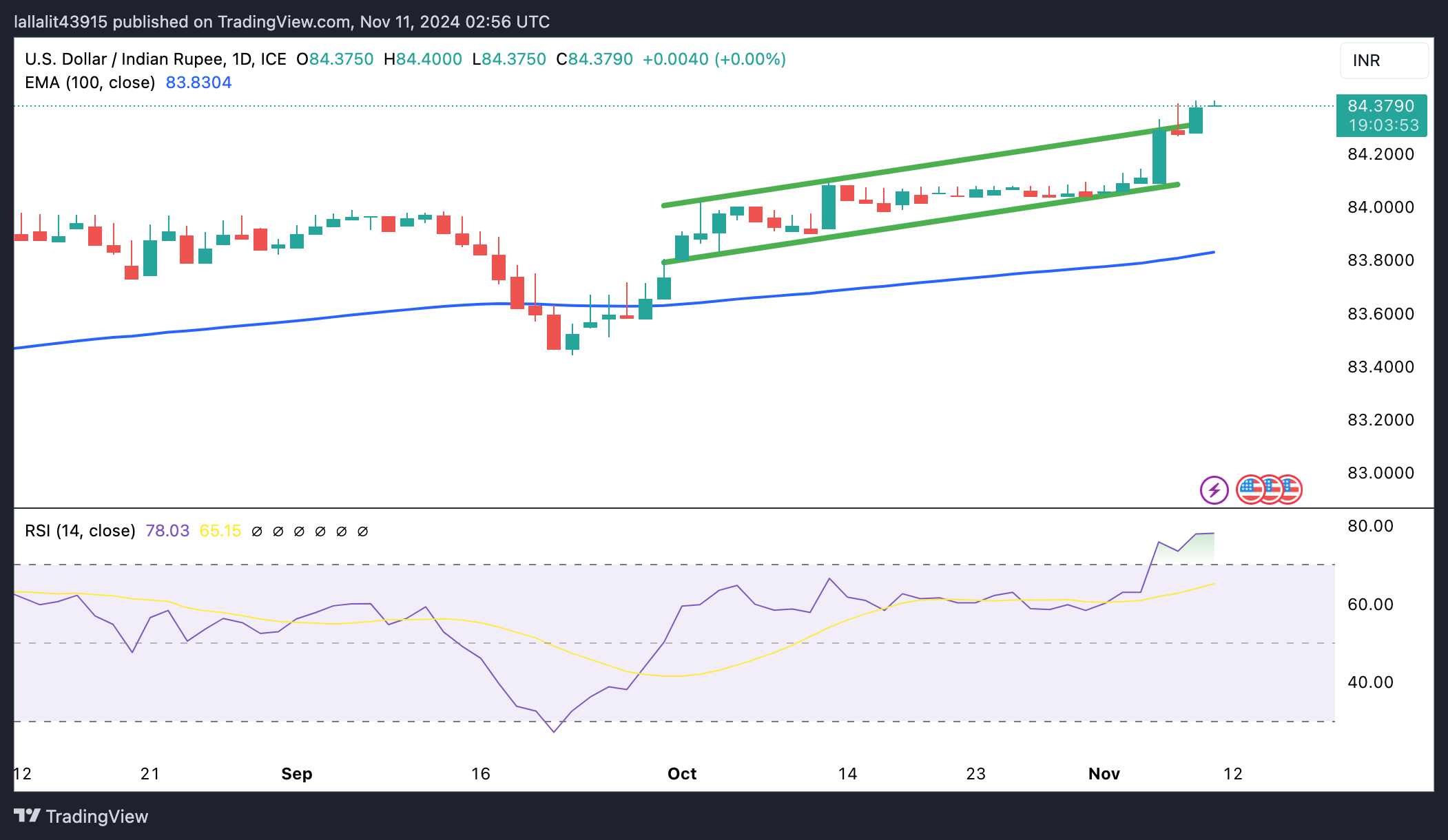
The Indian Rupee trades on a  soft note on the day. The bullish outlook of the USD/INR pair remains in play, with the pair holding above the key 100-day Exponential Moving Average (EMA) on the daily timeframe. However, additional consolidation should not be ruled out before positioning for any short-term USD/INR appreciation as the 14-day Relative Strength Index (RSI) is over the midline near 77.75, indicating an overbought condition.

A sustained buying momentum could take USD/INR to the next upside barrier at 84.50. Further north, the next hurdle emerges at the 85.00 psychological level.

On the downside, a move below the lower limit of the trend channel and the high of October 11 in the 84.05-84.10 zone could pave the way for a selloff to 83.83, the 100-day EMA. The additional downside level to watch is 83.46, the low of September 24.


USD/CHF gathers strength above 0.8750 amid the rally in US Dollar

USD/CHF gathers strength above 0.8750 amid the rally in US Dollar

The USD/CHF pair extends its upside to around 0.8770, the highest since August 1 during the early European trading hours on Monday. The upward movement of the pair is bolstered by the strength of the US Dollar (USD) as traders await the US inflation data and Federal Reserve (Fed) speakers this week.

Analysts expect that Trump’s policies would put upward pressure on US inflation and bond yields while slowing the Fed’s path to ease policy. This, in turn, lifts the Greenback against the Swiss Franc (CHF). “Given this, we still expect that the Fed will cut another 25bp at the December meeting, but thereafter will only cut once per quarter, in contrast to our previous forecast for a 25bp cut every meeting,” said JPMorgan economist Michael Feroli.

Traders will take more cues from the US Consumer Price Index (CPI), which is due on Wednesday. The headline CPI is expected to show an increase of 2.6% YoY in October, while the core CPI is estimated to show a rise of 3.3% YoY during the same period. In case of the hotter-than-expected outcome, this could further reduce the possibility of a December rate reduction, supporting the USD.

The Swiss National Bank (SNB) Vice Chairman Antoine Martin said on Monday that the central bank is not locked into more interest rate cuts in December, adding that everything will depend on conditions when we assess the situation in December. The markets anticipate the SNB to cut at least 25 basis points (bps) from the current 1% level at its next meeting on December 12.

Japanese Yen hangs near daily low, around mid-153.00s against USD

Japanese Yen hangs near daily low, around mid-153.00s against USD

The Japanese Yen (JPY) attracts some sellers on the first day of a new week after the Bank of Japan (BoJ) Summary of Opinions from the October meeting showed that policymakers were divided on rate hike timing. This, along with the political uncertainty in Japan, raises doubts over the BoJ’s ability to tighten its monetary policy further, which keeps the JPY depressed against its American counterpart heading into the European session. Apart from this, fears that US President-elect Donald Trump might again hit Japan with protectionist trade measures further dent demand for the JPY.

That said, the recent verbal intervention by Japanese authorities, along with the cautious market mood, could help limit further losses for the safe-haven JPY. Investors might also opt to move to the sidelines ahead of this week’s important macro releases – the US consumer inflation figures and the prelim Q3 GDP report from Japan. This, along with Federal Reserve (Fed) Chair Jerome Powell’s speech, will provide a fresh impetus to the USD/JPY pair. In the meantime, expectations that Trump’s policies would boost inflation and restrict the Fed’s ability to ease policy act as a tailwind for the US Dollar (USD).

Technical Outlook: USD/JPY could aim to surpass the 154.00 mark and test multi-month top

fxsoriginal

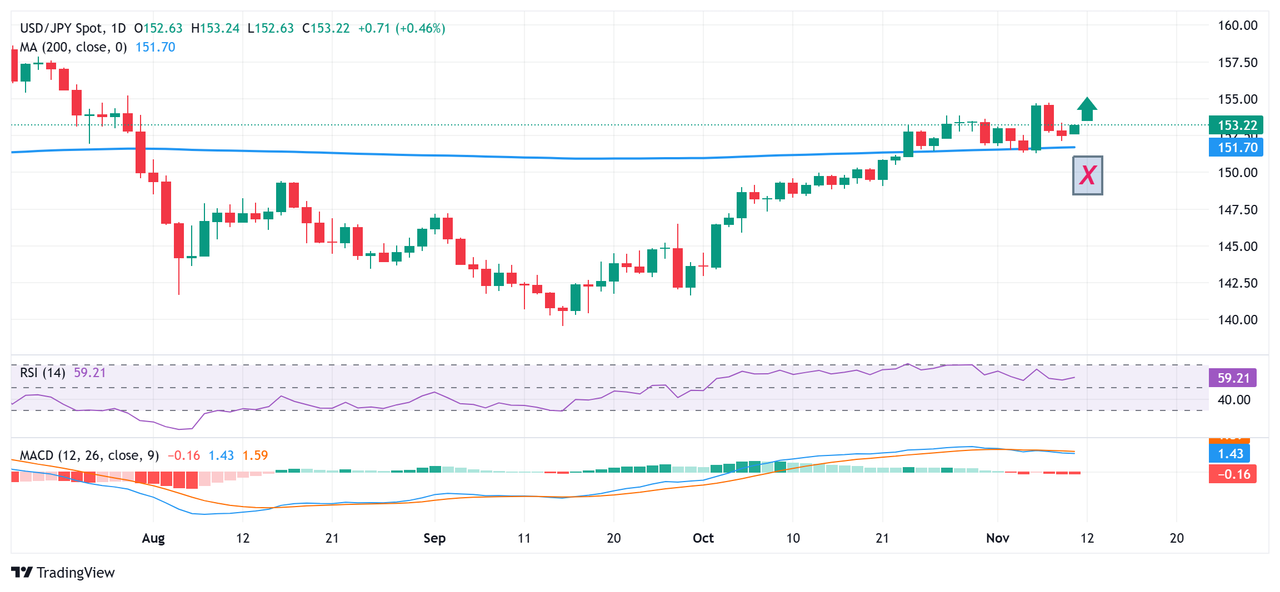
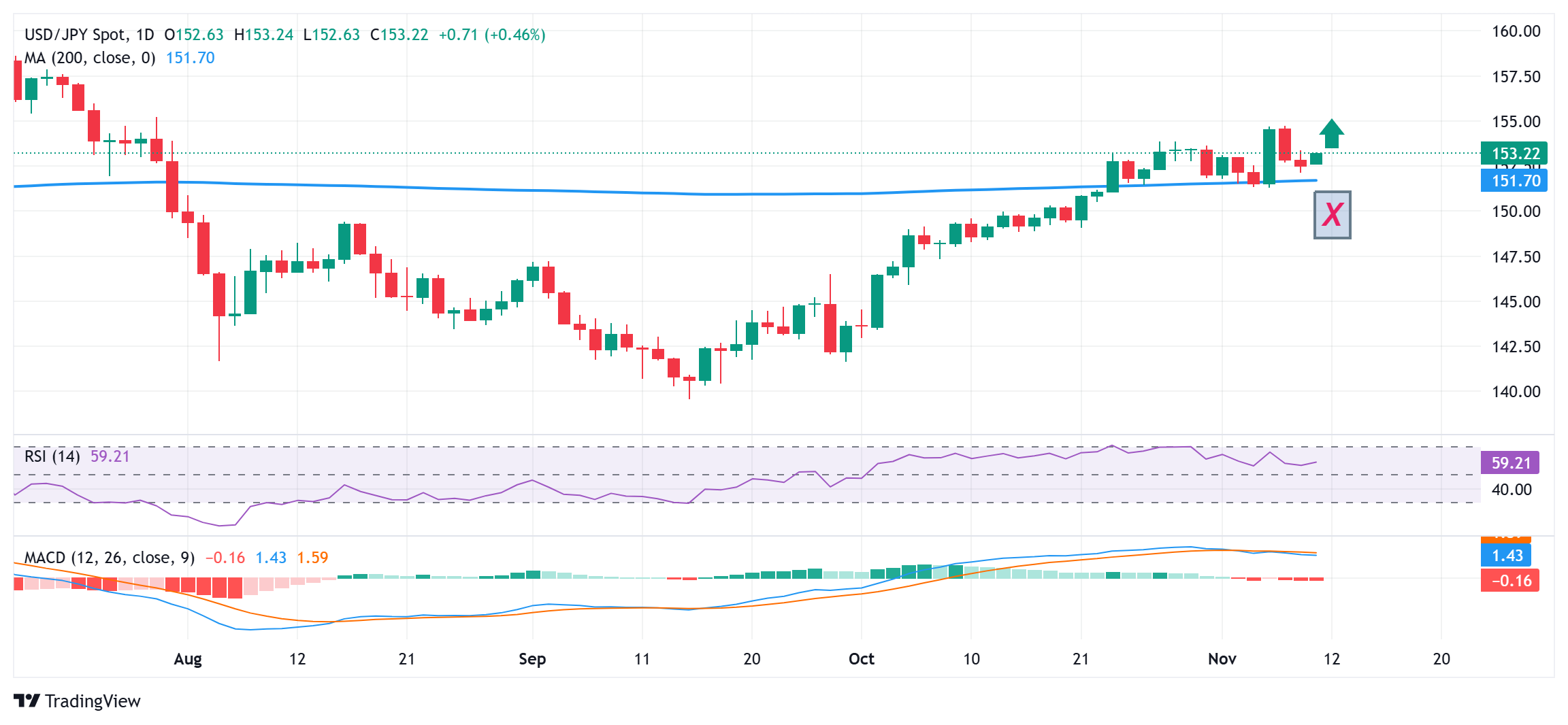
The USD/JPY pair, so far, has managed to hold above the very important 200-day Simple Moving Average (SMA) resistance breakpoint, which should act as a key pivotal point. This, along with positive oscillators on the daily chart, suggests that the path of least resistance for spot prices is to the upside. Any further move-up, however, is likely to confront some resistance ahead of the mid-153.00s. A sustained strength beyond could be seen as a fresh trigger for bulls and pave the way for a move towards reclaiming the 154.00 mark en route to the 154.70 area, or the multi-month top touched last week.

On the flip side, the Asian session low, around the 152.60 area, now seems to protect the immediate downside. Some follow-through selling could drag the USD/JPY pair below the 152.00 round figure, towards the 151.70 region (200-day SMA). A convincing break below the latter will suggest that the recent strong move up from the September low has run out of steam and shift the near-term bias in favor of bearish traders.

AUD/JPY moves above 101.00 due to BoJ uncertainty regarding interest rate hikes

AUD/JPY moves above 101.00 due to BoJ uncertainty regarding interest rate hikes

AUD/JPY retraces its recent losses from the previous session, trading around 101.20 during early European hours on Monday. The upside of the AUD/JPY cross is attributed to lower Japanese Yen (JPY) following the release of the Bank of Japan’s (BoJ) Summary of Opinions. The BoJ’s October report highlighted divisions among policymakers regarding the timing of future interest rate hikes.

Some members of the Bank of Japan expressed concerns about global economic uncertainties and rising market volatility, particularly around the Yen’s depreciation. Still, the central bank has suggested it might increase its benchmark policy rate to 1% by the latter half of the 2025 fiscal year.

In Japan, Prime Minister Shigeru Ishiba’s Cabinet resigned en masse before the Diet (parliament) during an extraordinary Cabinet meeting on Monday morning. With the ruling coalition of the Liberal Democratic Party (LDP) and Komeito now holding less than a majority in the House of Representatives, Monday’s vote is expected to lead to a runoff between Ishiba and Yoshihiko Noda, the leader of the major opposition party, the Constitutional Democratic Party.

The Australian Dollar (AUD) edged higher despite a generally cautious outlook due to concerns over Donald Trump’s proposed tariff increases on Chinese goods, which could impact Australian markets as China is one of its largest trading partners.

Further weighing on the Australian Dollar were China’s latest stimulus measures, which fell short of investor expectations and dampened demand prospects for Australia’s top trading partner. On Friday, China announced a 10 trillion Yuan debt package aimed at easing local government financing pressures and supporting sluggish economic growth; however, the package stopped short of including direct economic stimulus initiatives.

EUR/USD comes under pressure ahead of Fed speakers, US inflation

EUR/USD comes under pressure ahead of Fed speakers, US inflation

EUR/USD trades cautiously near more than four-month low around 1.0700 in Monday’s European session. The major currency pair remains on tenterhooks as the election of Republican Donald Trump as US President has strengthened the US Dollar’s (USD) outlook in the long run. The US Dollar Index (DXY), which gauges Greenback’s value against six major currencies, edges higher to near 105.00.

Trump vowed to raise import tariffs and lower taxes in his election campaign, which would add to United States (US) inflationary pressures and boost debt levels. According to a November 6-7 Reuters poll, 62% of respondents – including 94% of Democrats and 34% of Republicans – said that Trump’s policies likely “will push the US national debt higher.”

Trump’s tax cut proposals could add $7.5 trillion to the nation’s debt over the next decade, according to the nonpartisan Committee for a Responsible Federal Budget.

This week, investors will pay close attention to speeches from a slew of Federal Reserve (Fed) officials to get fresh cues about the likely monetary policy action in December. According to the CME FedWatch tool, there is a 65% chance that the central bank will cut interest rates again by 25 basis points (bps) to 4.25%-4.50% in December. This would be the second quarter-to-a-percent interest rate cut by the Fed in a row, as it also reduced its key borrowing rates last week.

On the economic front, investors will focus on the US Consumer Price Index (CPI) data for October, which will be published on Thursday. The impact of the inflation data is expected to be nominal on the interest rate outlook as Fed officials are confident about the disinflation trend towards the bank’s target of 2%. However, a significant deviation from the consensus could impact the same.

Technical Analysis: EUR/USD remains lower near 1.0700

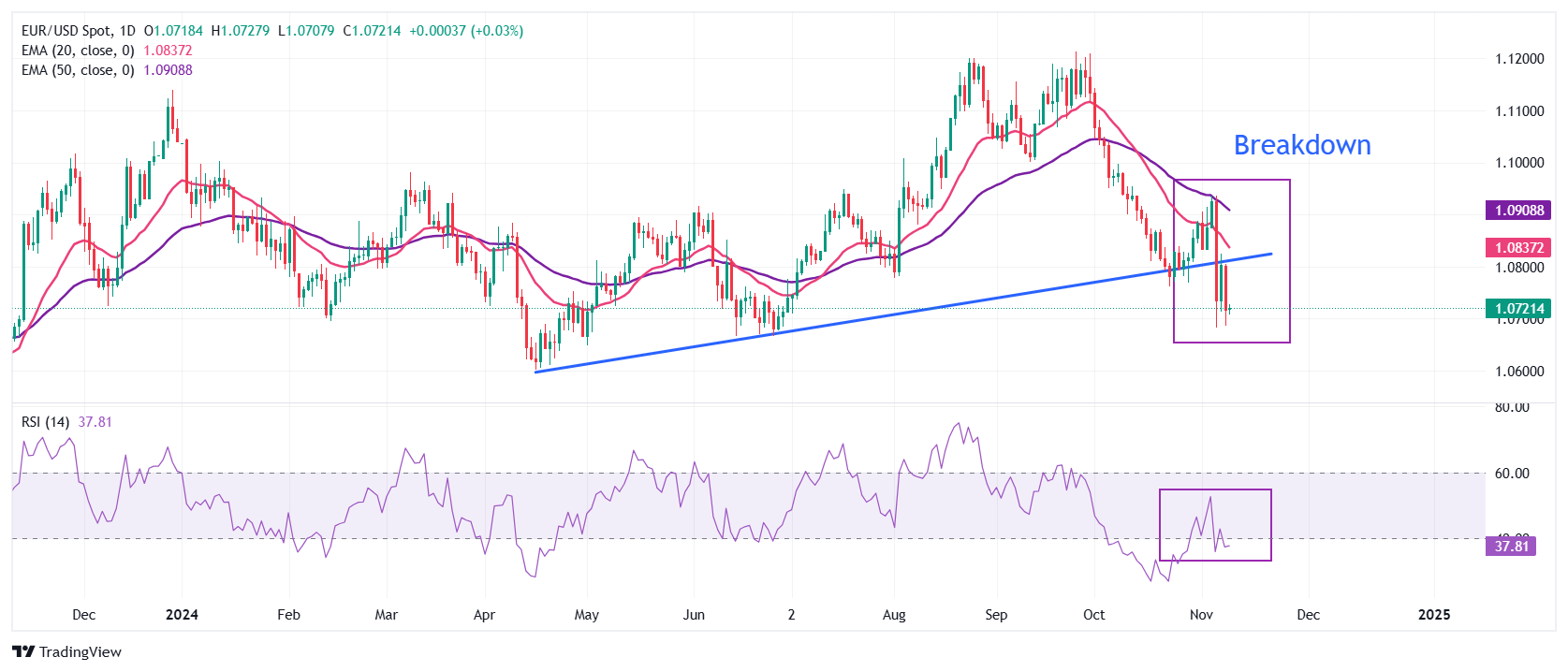
EUR/USD trades in a tight range near the more than four-month low around 1.0700. The near-term trend of the major currency pair remains bearish as the 20-day and 50-day Exponential Moving Averages (EMAs) near 1.0840 and 1.0910, respectively, continue to decline.

The 14-day Relative Strength Index (RSI) wobbles near 40.00. A bearish momentum would resume if the RSI (14) slides below that level.

The upward-sloping trendline around 1.0800, plotted from the April 16 low at around 1.0600, will act as a key resistance zone for Euro (EUR) bulls. Looking down, the shared currency pair could decline to the year-to-date (YTD) low of 1.0600.

GBP/JPY maintains position above 198.00 after LDP Ishiba re-elects as Japan Prime Minister

GBP/JPY maintains position above 198.00 after LDP Ishiba re-elects as Japan Prime Minister

GBP/JPY breaks its two days of losses, trading around 197.90 during the European session on Monday. The Japanese Yen (JPY) faces challenges due to uncertainty surrounding the Bank of Japan’s (BoJ) interest rate hikes in the future. The BoJ Summary of Opinions for the October meeting highlighted divisions among policymakers regarding the timing of future interest rate hikes.

Some members of the Bank of Japan expressed concerns about global economic uncertainties and rising market volatility, particularly around the Yen’s depreciation. Still, the central bank has suggested it might increase its benchmark policy rate to 1% by the latter half of the 2025 fiscal year.

Liberal Democratic Party’s (LDP) Shigeru Ishiba has been re-elected as Japan’s Prime Minister, receiving 221 out of 465 votes in the lower house of parliament. This follows last month’s election, in which Ishiba’s LDP, along with its coalition partner Komeito, lost their parliamentary majority.

The Bank of England (BoE) lowered interest rates by 25 basis points on Thursday. BoE Governor Andrew Bailey noted that, if the economy develops as anticipated, interest rates will continue to decrease gradually. However, Bailey stressed that monetary policy will remain tight until the risks of persistent inflationary pressures are reduced.

The Office for Budget Responsibility recently revised its inflation forecast for 2025, raising it to an average of 2.6%, up from the 1.5% estimate in March. This adjustment is closely aligned with the BoE’s August projections, which forecast inflation at 2.4% in one year, 1.7% in two years, and 1.5% in three years.

Gold price languishes near daily low amid Trump optimism-inspired USD buying

Gold price languishes near daily low amid Trump optimism-inspired USD buying

Gold price (XAU/USD) adds to last week’s heavy losses and remains under some selling pressure for the second straight day on Monday amid the underlying bullish sentiment surrounding the US Dollar (USD). The optimism over Donald Trump’s anticipated expansionary policies keeps the USD close to a four-month top touched last week, which, in turn, is seen as a key factor undermining the commodity.

Meanwhile, US President-elect Donald Trump’s pledged 10% tariff on all US imports is expected to trigger a resurgence in inflation and restrict the Federal Reserve’s (Fed) ability to ease aggressively. This, in turn, remains supportive of elevated US Treasury bond yields and contributes to driving flows away from the non-yielding yellow metal. That said, the cautious market mood could limit losses for the safe-haven XAU/USD.

Traders might also opt to move to the sidelines ahead of the release of the latest US consumer inflation figures and speeches by influential FOMC members, including Fed Chair Jerome Powell later this week. This, in turn, might help limit any further losses and warrants some caution before positioning for an extension of the recent sharp retracement slide from the vicinity of the $2,800 mark, or the all-time high touched on October 31.

Technical Outlook: Gold price remains close to multi-week low and 50-day SMA pivotal support

fxsoriginal

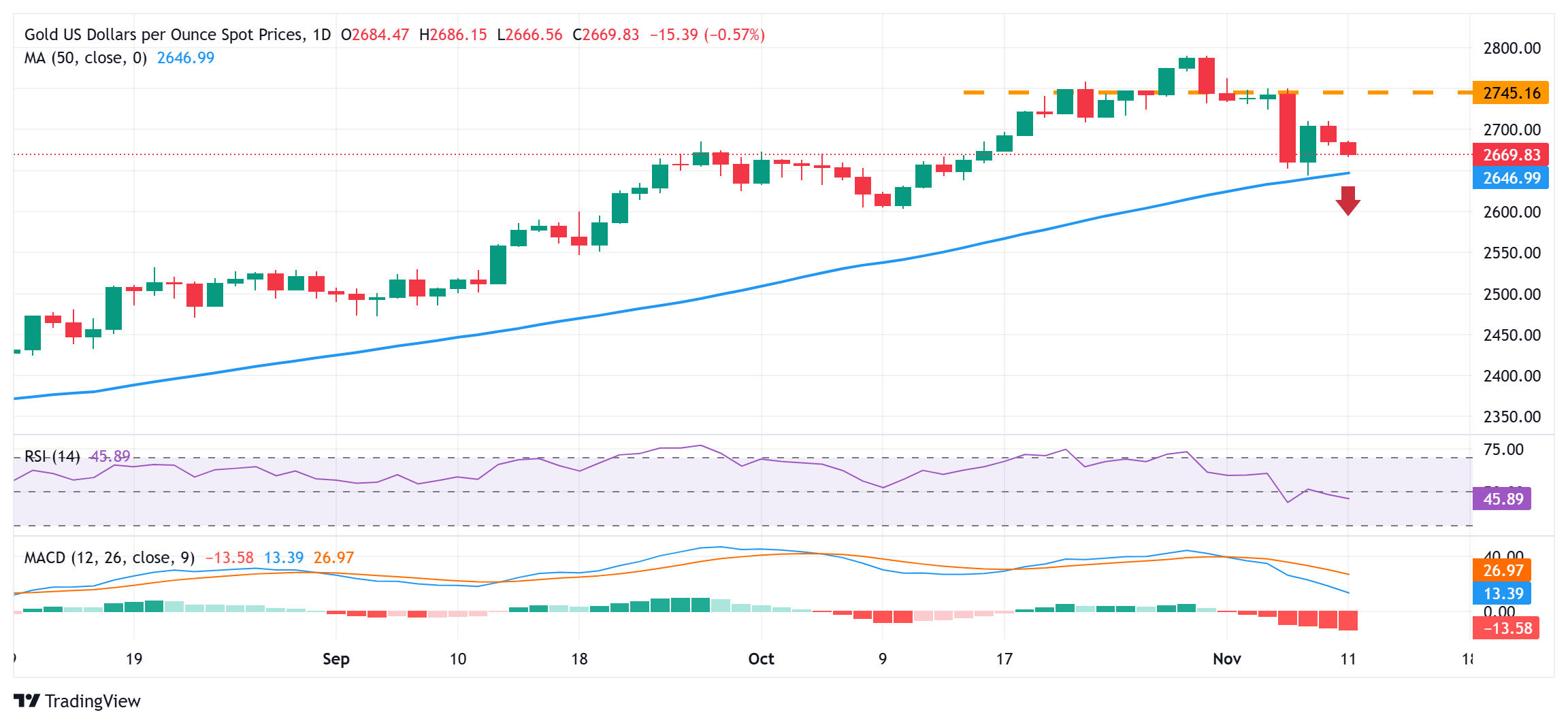
From a technical perspective, any further decline is likely to find some support near the $2,660 zone ahead of the 50-day Simple Moving Average (SMA), currently pegged near the $2,647-2,746 region. Some follow-through selling below last week’s swing low, around the $2,643 area, will be seen as a fresh trigger for bearish traders. Given that oscillators on the daily chart have been losing positive traction, the Gold price might then accelerate the fall toward the October monthly swing low, around the $2,605-2,602 region.

On the flip side, momentum back above the $2,700 mark now seems to confront stiff resistance near the $2,718 region ahead of the $2,740-2,745 supply zone. A sustained strength beyond the latter will suggest that the corrective pullback has run its course and lift the Gold price beyond the $2,750 static resistance, towards the $2,758-2,790 zone, or the record high touched on October 31.

EUR/USD stays defensive around 1.0700 amid light trading

EUR/USD stays defensive around 1.0700 amid light trading

EUR/USD stays defensive at around 1.0700 in European trading on Monday. The pair reamins undermined by the German political risks and a sustained US Dollar strength, as traders brace for the key US inflation data later this week. US holiday-led thin trading is likely to extend.

The Relative Strength Index (RSI) indicator on the 4-hour chart stays below 50, suggesting that the bearish bias remains intact following Thursday’s correction.

On the downside, static support is located at 1.0750 ahead of 1.0700 (static level, round level) and 1.0680 (static level). Looking north, initial resistance aligns at 1.0800 (static level, round level) before 1.0870 (200-day Simple Moving Average).

Following Wednesday’s sharp decline, EUR/USD gained traction and rose nearly 0.7% on Thursday. The pair, however, struggles to keep its footing and trades below 1.0800 in the European morning on Friday.

After outperforming its rivals with the initial reaction to the Donald Trump’s victory in the presidential election on Wednesday, the US Dollar (USD) lost its strength as investors booked profits ahead of the Federal Reserve’s (Fed) monetary policy announcements.

The Fed lowered the policy rate by 25 basis points to the range of 4.5%-4.75% following the November policy meeting, as anticipated. In its policy statement, the US central bank repeated that risks to the job market and inflation were “roughly in balance.” In the post-meeting press conference, Fed Chairman Jerome Powell refrained from hinting whether they will ease the policy further in December and explained that the results of the presidential election will have no effect on the monetary policy in the near term.

The market reaction to the Fed event remained largely muted. According to the CME FedWatch Tool, the probability of a 25 bps rate cut in December remains largely unchanged at about 70%. Early Friday, the cautious market mood helps the USD hold its ground and doesn’t allow EUR/USD to extend its rebound.

The University of Michigan’s (UoM) preliminary Consumer Sentiment Index for November will be featured in the US economic docket. In the meantime, US stock index futures were last seen trading virtually unchanged on the day. In case markets remain cautious following Wall Street’s opening bell, the USD could stay resilient against its peers and limit EUR/USD’s upside.