Gold Price Shines as US Dollar Tanks on Sinking Yields from SVB Bailout. Higher XAU/USD?

Gold Price Shines as US Dollar Tanks on Sinking Yields from SVB Bailout. Higher XAU/USD?

Gold has found support again today as markets were left reeling in the aftermath of the collapse of Silvergate Capital Corp. and Silicon Valley Bank (SVB) last week, followed by Signature Bank on Sunday.

Authorities have worked hard over the weekend to reassure depositors that their funds will be safe in these firms. These failed businesses largely served the crypto and technology industries. It has been made clear that bond and equity investors will not be bailed out.

The US Treasury Department said that deposits will be available to customers on Monday while the Federal Reserve created a liquidity facility for eligible financial deposit-taking institutions.

There is some speculation in the market that the Federal Open Market Committee (FOMC) will keep the Fed funds target rate unchanged on the 22nd of March meeting. The overnight index swap (OIS) market is now leaning toward a 25 basis point hike rather than a 50 bp lift last week.

US CPI due out Tuesday may have the implications for monetary policy that it would have prior to the collapse of these small banks.

The change in rate expectations saw Treasury yields go notably lower out to 5-years but were relatively unchanged beyond there. The 2-year note moved more than 70 bp lower from last week’s peak of 5.08%, which was the highest yield since July 2007.

This has seen the 2s 10s Treasury curve inversion contract more than 40 bp from last week’s nadir of -1.08%.

Similarly, the US 10-year real yield, that is the nominal yield less the market-priced inflation rate for the same period, dipped by more than 30 bp from last week’s peak of 1.72%.

Gold is a non-interest bearing-asset and can be subject to changes in nominal yields and real yields. Additionally, the yellow metal has been boosted by a deteriorating US Dollar. Not surprisingly, gold volatility (GVZ) has also ticked up in this environment.

Palladium saw almost 3% gains while silver also reached higher, as did platinum.

In currency land, the greenback has been hammered across the board with the Australian Dollar a notable beneficiary which might seem somewhat counterintuitive if risk aversion is to pick up steam. Emerging market currencies are all higher.

The decisive measure taken by authorities has seen Wall Street futures recover through early Monday trade after a sell-off on Friday. APAC equities are mixed with Australian and Japanese equity indices lower while China and Hong Kong have seen their bourses move higher.

Famed investor Bill Ackman gave the authorities his tick of approval on his Twitter account. He highlighted that prompt action was required and that taxpayer money did not bail out bond and equity investors.

Elsewhere, new Chinese Premier Li Qiang spoke for the first time and kept to the script but did say that achieving growth targets will not be easy.

In an interview on Bloomberg TV, Eisuke Sakakibara former Japanese Vice Finance Minister said that he does expect new Bank of Japan Governor Kazuo Ueda to make any significant policy changes for some time.

Crude oil is steady with the WTI futures contract near US$ 77 bbl while the Brent contract is around US$ 83 bbl. Aramco, the Saudi oil giant, posted a record profit of USD 161 billion last year on the back of surging energy prices and announced an uptick in dividend payouts.

The week ahead will be highlighted by US CPI on Tuesday and the European Central Bank (ECB) rate decision on Thursday.

GOLD, US 10-YEAR REAL YIELD, DXY (USD) INDEX AND GOLD VOLATILITY (GVZ)

image1.png


Can I make money from swap in Forex trading?

Can I make money from swap in Forex trading?

Can I make money from swap in Forex trading?

After traders learn that they can actually earn on swap in Forex trading, they start to look for pairs with positive swap in order to avoid high risk choices such as trading with CFDs. And there are enough of them, but with one caveat. There are no pairs where all swap rates are positive, but there are pairs where the swap is positive depending on the type of operation.

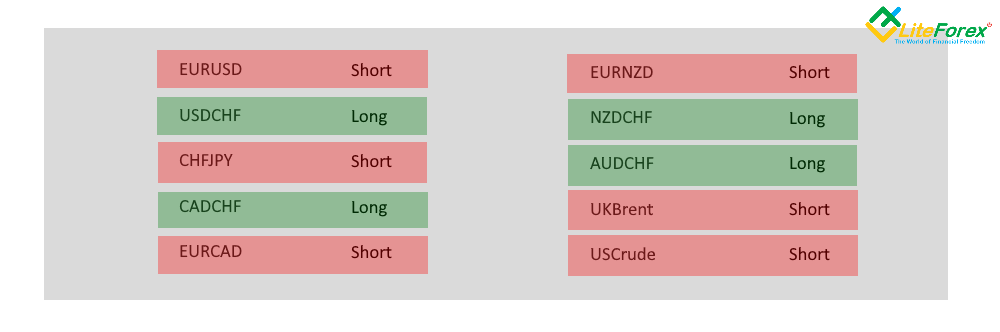
Below, I have listed the pairs with positive Forex swap. Under certain conditions, we can earn on swaps trading these pairs.

LiteFinance: What is swap in Forex trading? | How to Calculate FX Swaps: Examples | LiteFinance

At the moment, this is the entire list of instruments with positive forex swaps that my broker provides. However, their number may vary depending on market conditions. For example, if one of the central banks changes its underlying interest rate or your broker changes the markup value.

In general, if you know that a country has a negative net interest rate, this is the sign that positive Forex swap rates may appear in currency pairs containing the currency of this country. However, traders should remember that a small positive swap in Forex trading will be easily eaten up by a spread and can lead to a high risk of losing money rapidly.

But even if such situations are rare, there are some very simple Forex trading strategies to earn on interest and Forex swap rates differences.

Carry Trade

The most popular trading strategy for making money on swap rates is, of course, the carry trade.

LiteFinance: What is swap in Forex trading? | How to Calculate FX Swaps: Examples | LiteFinance

The principle of the strategy is to find the largest difference in interest swap rates of different countries. After that, we group the currency pairs that include the currencies of these countries and find a pair where the swap in one direction is greater than in the others.

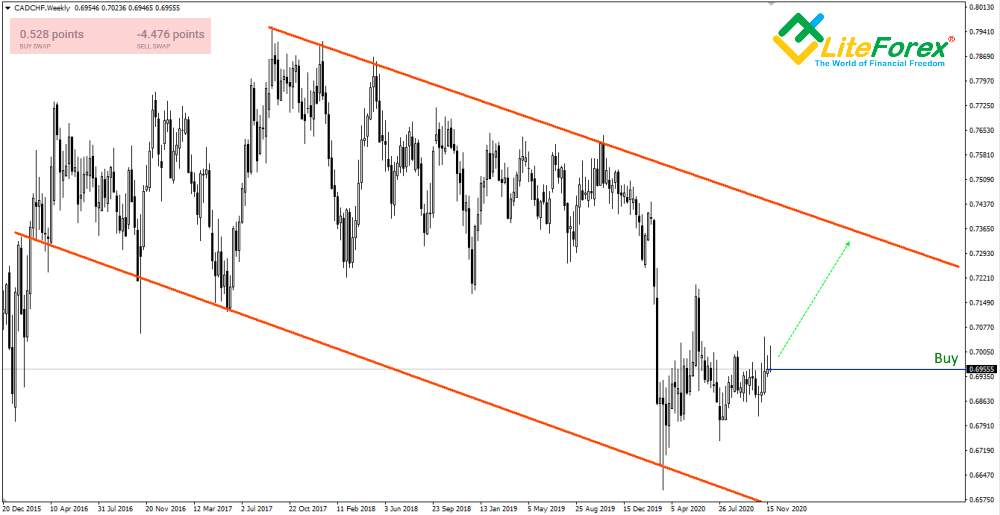
After a quick look, I have highlighted the CADCHF pair. Forex buy swap on it is 0.528 points. Therefore, if we buy this currency pair, we will be making money on a positive swap. Since the position must be held for a long time to make a profit, we need to analyze the global chart for growth prospects. This particular pair has a growth potential. Now all that remains is to buy and wait, making a profit from the growth of the rate and a positive swap. However, the strategy requires that we keep the position open for quite a long time.

Swap and Fly

There is another strategy that resembles the previous one — Swap and Fly. The strategy appeared after most forex brokers began to provide the trailing stop option.

LiteFinance: What is swap in Forex trading? | How to Calculate FX Swaps: Examples | LiteFinance

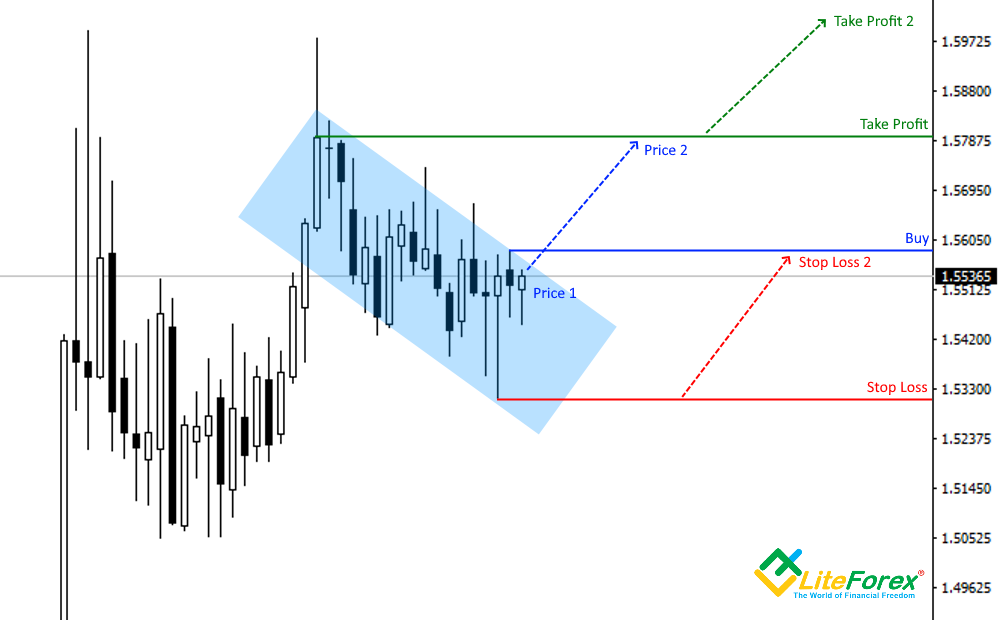
We choose an instrument similarly to the first strategy. After we’ve found the pair, we need to find a pattern that’s highly likely to be realized. Candlestick patterns are used more often, but geometric patterns will also work. In our case, this is a flag pattern, after which we expect growth. It’s important not to use mathematical indicators.

After that, order levels are placed with standard rules, which makes the ratio approximately 1:1. After the price starts to grow and goes above the entry point, you need to move Stop Loss to breakeven, I.e. at the level that a position opens. And that’s it. Then you just keep the position until the stop loss is triggered. Of course, you can use a trailing stop and also increase your profit by the rate difference. But this is not the essence of the strategy.

The essence of the strategy is to make money on a positive swap. In our case, it is equal to 0.834 points for a buy position. For a 1 lot trade, it’s about 80 cents. If we can maintain the position for a month, when closed by stop loss there will be no exchange rate difference, but the swap will bring us 21 * 0.8 = 16.8 dollars.

Currency futures strategy

LiteFinance: What is swap in Forex trading? | How to Calculate FX Swaps: Examples | LiteFinance

There is another good strategy. I sometimes use it myself. The essence of the strategy is to create an ordinary locked position but with different types of contracts. You know that besides currency pairs, there are also futures, options, trading CFDs, and many other contracts. So, futures are essentially no different from a currency pair. Their most important difference is the absence of a swap. Did you already guess what I’m getting at?

Exactly. I create a locked structure by buying a currency pair with a positive buy swap when trading Forex on market and at the same time selling futures for the same pair on another exchange. The currency pair and futures quotes are usually the same, as are the fluctuations. Therefore, wherever the price goes, I will always have 0 because one side is bought and the other is sold.

The profit will be formed from the positive swap when you trade Forex. Of course, there are nuances, such as the size of the spread and the commission. But you can always account for them in the strategy and compensate either by the duration of the position or by a short-term play on price fluctuations and their future performance.

If you want to know more strategies, learn more about trading CFDs for making money on swaps without a higt risk of losing money rapidly, I recommend that you get specialized training from your broker.

What is swap fee in Forex — islamic accounts

Forex brokers also have special swap-free accounts. They are also called Islamic accounts. An Islamic account is a trading account that does not have any swap charge or fees in the form of an interest rate. According to the laws of Islam, Muslims are prohibited from receiving or giving interest on any kind of activity. So Islamic accounts were created in order for Muslims to be able to use the services of the Forex brokers.

Despite the fact that this type of account was created for Muslims, anyone can open it now. In order to open an Islamic account for yourself, you need to submit an application to your broker.

However, we all understand that brokers are not charity organizations. And if the account is swap-free, the broker will get their money in other ways. Usually this means larger spreads or a fixed commission per trade.

Start trading right now

Conclusion

The topic of swap is quite important on the exchange. Many large investors make money not on the difference in exchange rates, but rather on the difference in net interest rates. When you trade Forex in the financial markets, most traders view forex swaps as another type of commission that brokers use to get rich. But if you understand how swap works, you can turn it from an enemy into a reliable ally that will bring you profit regardless of exchange rate fluctuations. Thus, using swap trading first on a demo account with a nominal position will help you understand how this efficient tool works with no need to risk money on complex instruments like trading cfds, or even avoid the high swap charges.

How a Currency Swap Works – FX Swap Examples

How a Currency Swap Works – FX Swap Examples

How a Currency Swap Works – FX Swap Examples

Now let’s take a closer look at how foreign exchange swap works.

I have already mentioned this above. At its core, Fx swap rates are the difference in the interest rates of the central banks of the two countries whose currencies are represented in the pair.

Above, I gave you the formula to calculate the base swap rate. The main parameters of this formula are basically unchanged during the year. And for some currencies, even for several years.

The main parameters are the values ​​of interest swap rates. Except for the current year 2020, changes in interest rates are not frequent. This happens once a year at best.

The variable parameters are the markup and the quote of the currency pair. These parameters can change even more often than once a day. Therefore, if we want to know the exact value of the swap, we need to constantly recalculate the value using a formula or a special calculator.

In addition to being positive and negative, swap rates can also be long and short positions open. In other words, a buy swap and a sell swap.

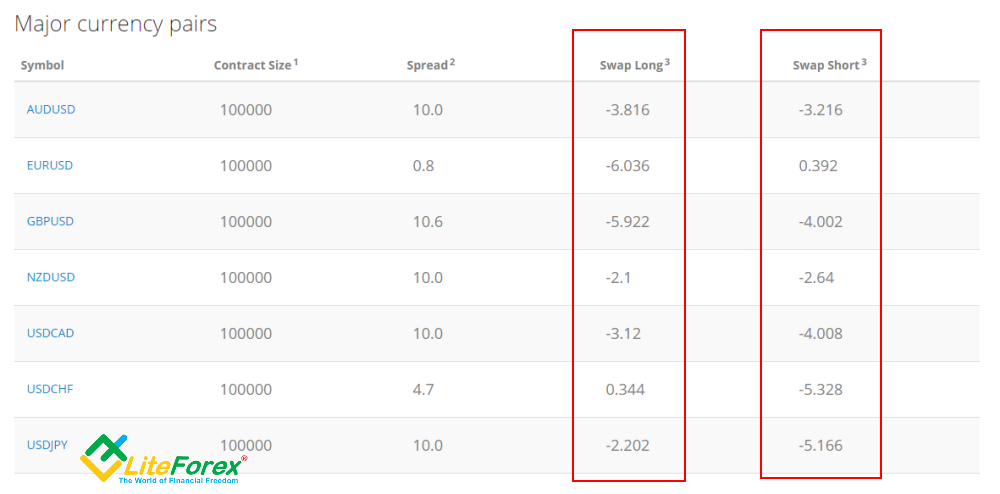
In my broker’s swap table, it looks like this:

LiteFinance: What is swap in Forex trading? | How to Calculate FX Swaps: Examples | LiteFinance

These values ​​in the red columns indicate the swap value in points per one full lot, which will be credited to or charged from the trader’s account if you have your positions open. In other words, if we have an open position to sell the AUDUSD pair, when we carry it overnight a swap short is applied to our position, which is equal to -3.216 points. If we have an open position to buy this pair, Swap Long will be applied, and it will be equal to -3.816 points.

The largest swap value is usually associated with exotic currency pairs such as USDRUB.

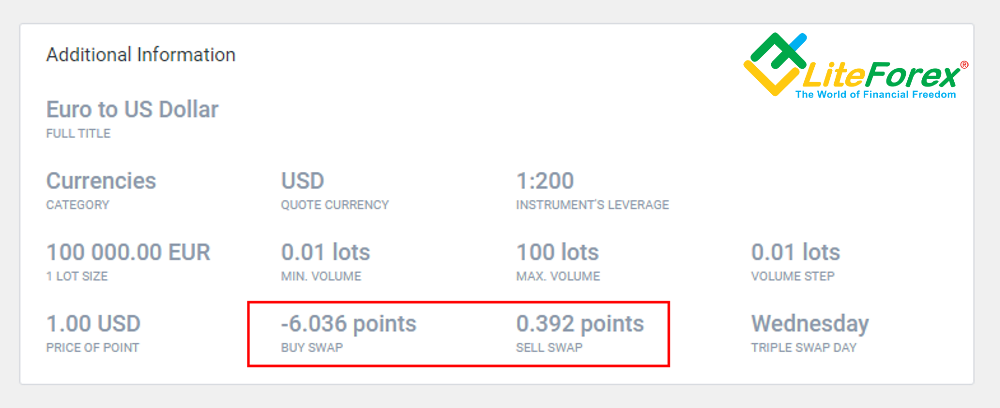
If you need to know the swap just before opening the position, you can use the contract specification table:

LiteFinance: What is swap in Forex trading? | How to Calculate FX Swaps: Examples | LiteFinance

The situation with swap rates will be slightly different for the euro/dollar pair. The buy swap pip value will be -6.036. In other words, an amount equal to this value per lot will be charged from your account. But the sell swap is equal to 0.392 points. A positive sign means that this value will be credited to your account. So you can actually earn money on a swap.

I have already explained why swap rates can be positive and negative. It’s all about the difference in interest swap rates. If the interest rates of the central banks of currencies differ greatly, then the swap sign will be different when buying and selling.

Calculating the swap fees on a short position

Now let’s take a closer look at how the total swap value is calculated on Forex trading for a sell trade in the EURUSD currency pair.

  • SWAP (short positions) = (Lot * (quote currency rate – base currency rate – markup) / 100) * current quote / number of days in a year.

However, it should be noted that the value will not be entirely accurate since we do not know the exact markup value.

If the positions open at 1 lot with the current quote at 1.19626 and markup at, for example, 0.20%, the swap size will be:

  • SWAP (short positions) = (100 000 *(0.25 – (0.0 – 0.20)/100) * 1.19626/365 = 0.163 EUR with an incorrect markup value.

If you perform this operation using a calculator on the broker’s website, you get 0.376 USD, so the difference is only in the markup value.

Swap on a long position

Now let’s look at how the total swap value is calculated for a buy when you trade Forex using the EURUSD pair.

  • SWAP (long positions) = (Lot * (base currency rate – quote currency rate – markup) / 100) * current quote / number of days in a year.

However, it should be noted that the value will not be entirely accurate since we do not know the exact markup value.

If we open a position of 1 lot with the current quote at 1.19626 and markup at, for example, 0.20%, the swap size will be:

  • SWAP (long positions) = (100,000 * (0.0 – (0.25 + 0.20) / 100) * 1.19626 / 365 = -1.474 EUR with an incorrect markup value.

If you perform this operation using a calculator on the broker’s website, you get -6.036 USD, so the value of the broker’s markup for a short trade is significantly different.

FX Swaps and Cross Currency Swaps

FX Swaps and Cross Currency Swaps

FX Swaps and Cross Currency Swaps

As I said above, there are several types of swaps. Now let’s take a look at the difference between the three main types of swaps.

Forex swap

Fx swap rates are the financial instrument that represents the difference between the paying interest rates of the banks of the two currencies in a pair, which is credited or charged when an open position is carried overnight.

Cross currency swap

A cross currency swap is a foreign exchange transaction that combines the purchase or sale of a currency on a spot basis with the simultaneous sale (or purchase) of the same currency for a specified period on a forward basis. This means the trader performs a combination of two opposite conversion transactions for the same amount, but with different value dates.

This is the official definition. Now let me explain it in simple terms:

A cross swap on Forex trading is a situation that occurs when two companies participating in trades on the foreign market enter into an agreement with each other. Within this agreement, they sell each other the same amount in different currencies based on their current rate immediately after the swap operation itself and not at a higher interest rate compared to the changes of the market. After a predetermined period, which they have set under the forward contract, they sell these amounts back to each other in accordance with their rate under the forward contract.

Currency interest rate swap on Forex

LiteFinance: What is swap in Forex trading? | How to Calculate FX Swaps: Examples | LiteFinance

A currency interest rate on the Forex swap is a simple interest rate swap that is carried out with different currencies.

Despite the fact that this operation is typical for large financial institutions, it also occurs in everyday life.

For example, you have a loan in foreign currency. The only option for you is to take out a new loan to cover the old one. But taking a new loan in foreign currency is a bad option as the stakes are high. But in local currency they are acceptable. At the same time, you happen to have a friend overseas with similar problems. So you take out a loan in your local currency, and he takes out one in his local currency, which is foreign for you. And then you simply exchange these amounts. As a result, you pay interest on his loan, and he does on yours. Everyone wins and you both saved on the interest rate without any risk involved.

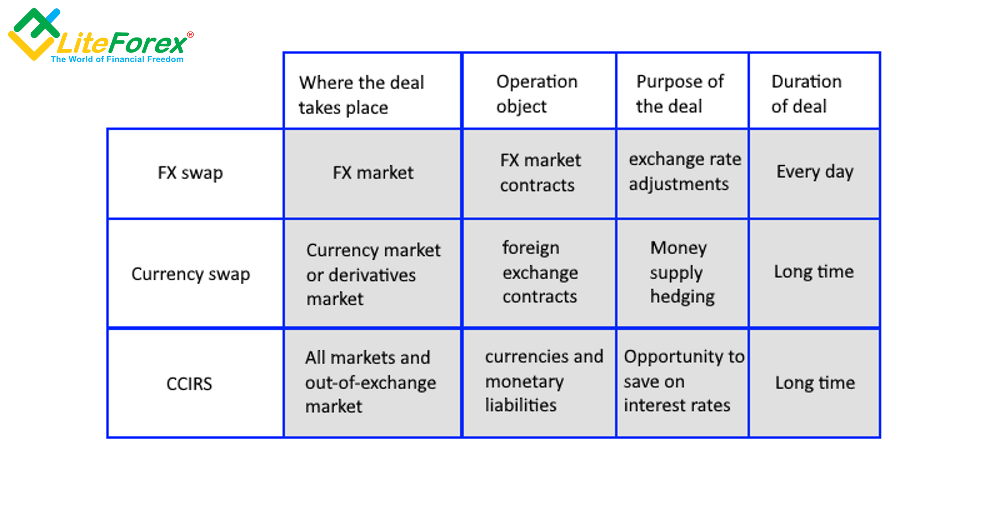
To help you understand the difference between the different types of currency swaps, I have made a comparison table:

LiteFinance: What is swap in Forex trading? | How to Calculate FX Swaps: Examples | LiteFinance

What is a Swap in Forex and How to Calculate

What is a Swap in Forex and How to Calculate

Everyone trading on the exchange must know and understand what a swap is. In my rather long professional career, I have come across many situations where people lost entire deposits simply because they didn’t know how swaps worked.

In other words, if you understand well what swap is and how it works, you can protect yourself from unnecessary losses and even use swaps for additional profit. This concept is as important as leverage.

The article covers the following subjects:

What are swaps and how are they calculated?

LiteFinance: What is swap in Forex trading? | How to Calculate FX Swaps: Examples | LiteFinance

Now let’s figure out what fx swap is.

Foreign exchange swap is the difference in the interest rates of the banks issuing the two currencies, which is credited to or charged from the account when the trading position is kept overnight.

The central banks of each country determine the key interest rate. This is the rate at which the central bank lends to other banks. This rate may change throughout the year. But its starting value is determined at the first meeting of the central bank of the year.

On the foreign exchange market currency pairs are traded. Two different currencies are involved in the transaction, and each of them has its own interest rate.

The currency pair contains the base and the quote currency. The former is the currency we buy and the latter is the currency we buy it with.

The base currency is also called the deposit currency. This is our currency and the exchange uses it on a daily basis. Therefore it must pay us a certain percentage for it.

The quote currency is also called the counter currency. It belongs to the bank and we borrow it from the bank. Therefore we pay interest to the bank for the use of its currency, like with a consumer loan.

A negative swap is when you pay it or a positive when it is paid to you.

If there is a negative swap (with a minus sign), its crediting to your trading account will end when you withdraw the funds (points). If the difference in the interest rates gives a positive swap, the money will not be withdrawn from your trading account, but rather a certain number of points will be credited.

Thus, if the client has an open position at the close of the New York trading session, a swap operation with currencies is enforced. This means the position is simultaneously closed and opened for the new day. But on the client’s trading account there is no actual closing and opening. Rather the credited or charged interest is simply displayed.

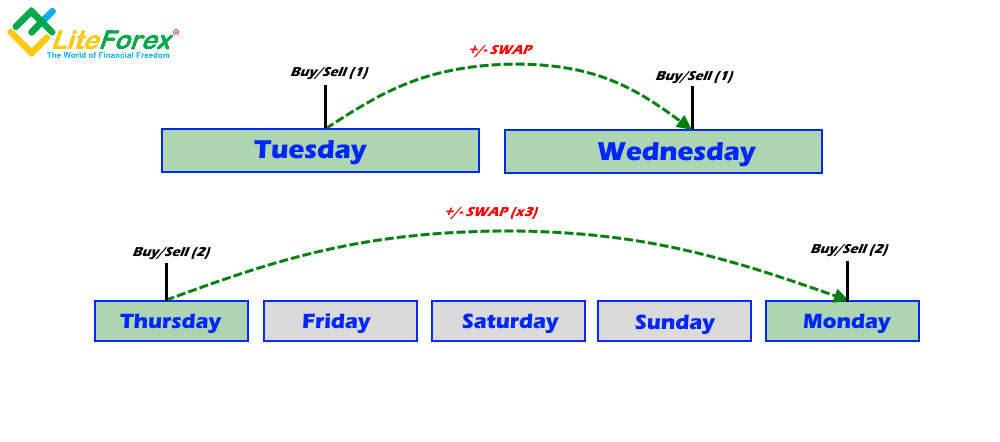
However, there is a day when this operation is tripled. This is called a triple swap day. For currency pairs on the forex market, this is Wednesday to Thursday night. This is because settlements on the exchange for a position open on Wednesday are made on Friday. Therefore, the calculations for the position carried over from Wednesday to Thursday are done for the next day. And the next business day after Friday is Monday. This adds up to 3 days and the weekend swaps charge triple.

LiteFinance: What is swap in Forex trading? | How to Calculate FX Swaps: Examples | LiteFinance

Swap as a trading strategy is different for each instrument. It wouldn’t be convenient to constantly calculate them, so brokers provide special swap tables. My broker has a swap table you can use here.

How to calculate swap in Forex?

In order to understand when we pay swap and when it is paid to us, let’s talk about how is swap rate calculated in Forex trading when buying or selling:

LiteFinance: What is swap in Forex trading? | How to Calculate FX Swaps: Examples | LiteFinance

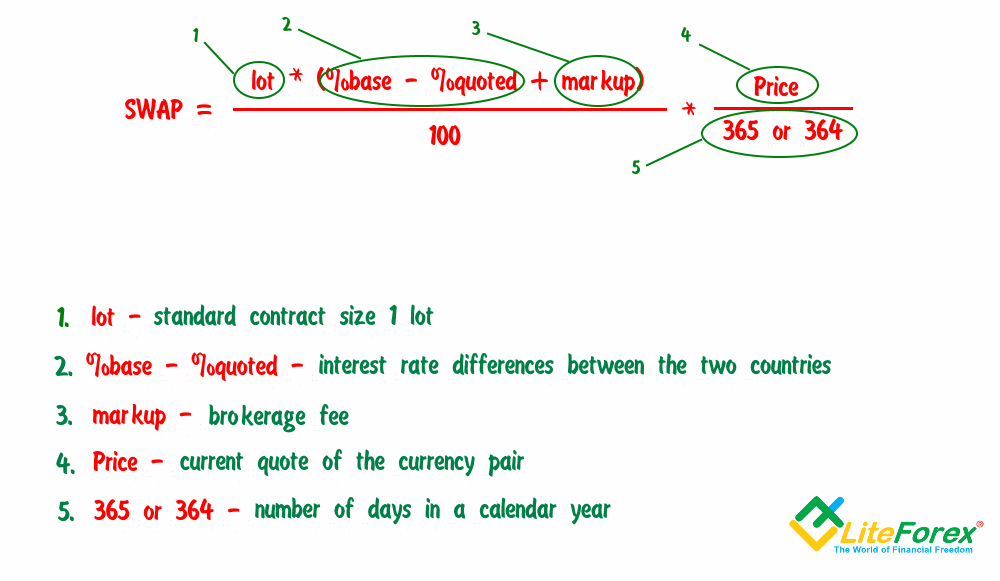
There is a simple formula, as shown above. The most important parameter of this formula is the rates of the central banks, or rather the difference in the interest rates of the base and quote currencies.

For example, let’s compare rates for one currency pair, the EURUSD for example. The ECB rate is now at 0% (loans are effectively free), and the Fed rate is set at 0.25%.

So if we buy a currency pair, we must subtract the quote currency rate from the base currency rate: 0 – 0.25 = -0.25. This means when buying this pair, the difference in rates is negative, and therefore the swap rate will be negative.

But when selling a pair, on the contrary, we need to subtract the base currency from the quote currency: 0.25 – 0 = 0.25. The swap rate will be positive.

This operation only gives us the positive or negative sign of the swap rate (which means either you pay or get paid). If we want to calculate the swap value itself, we need to substitute all the values ​​into the formula.

Today almost no one uses the formula to calculate the swap rate anymore. Traders either look it up in tables or find it using an fx swap calculator.

Islamic Forex trading accounts

Islamic Forex trading accounts

Islamic forex trading accounts also known as No riba accounts it is created to accommodate customers those are Islamic. Completely they are based on religious beliefs Islamic clients which are a state that customer should give all but no to expect something in return and while they do not receive and pay interest in the economic industry. This faith was immediately adopted by forex trading, and it is requested to create Islamic account forex trading that allows an Islamic client to trade and no need to pay in return with interest. In forex industry of trading, these companies charge huge interest on client’s positions has open overnight.

How to get more profit in forex trading Islamic accounts?

The issues that usually occurs in Islamic forex trading accounts that people who are not Islamic not get involved in those accounts and feels like that unfair happening this are the main issue occurs due to Islamic account forex trading. AS these accounts charges different interest as compare to other normal accounts depends on the forex companies whichever is higher spreads.

How to trade forex for profit by using Islamic forex accounts?

  • The condition offered in the accounts of Islamic clients for all types of accounts, except leverage and currency offered. In the case of any suspicion or abuse, the trading market might be at its discretion to end all open positions and also remove the free swap conditions.
  • The main and the only Islamic account determining factor is that customer must be of the Islamic religion. The hantec Markets reserves right to discontinue a swap/Islamic free account with no warning.
  • Mainly hantect markets do not accept that the Islamic forex trading accounts are made to worn for any carry arbitration and trades or some other strategy to take benefit from between currencies and interest differences.
  • Mainly customers take advantage of interest accounts by holding their positions for a particular period without taking any interest, but positions held more than one week will e charged according to per lot.
  • The Islamic account clients agree and acknowledges that if in case they hantec markets if suffered loss because to rollovers swap free accounts positions, then the market has the full right to earn loss from the customer by debiting any account of their account by some loss account.
  • If clients have insufficient balance amount to compensate, then for this client agrees to write a requested sum to their account upon the hantec market.

For swap accounts or Islamic forex trading accounts, the firms of forex book the loss or profit of daily swap, which allows practicing Muslims to stay at their positions without a charge or benefit. Day by day the forex trader’s population is increasing of other faiths but also they are attracted to this kind of trading accounts, as in this no one is burdened with this much additional benefits and losses with the interest as there are many traders don’t know even how to work and how to profit from forex.

visit us @ https://bit.ly/3jIIjaI

For whatsapp number: +2348058414433

US: February is expected to have been a strong month for hiring and wage growth

US: February is expected to have been a strong month for hiring and wage growth

Economists expect hiring remained strong in February and that wages grew even faster than they did in January.

February’s employment report is expected Friday at 8:30 a.m. ET. Economists forecast 225,000 new jobs were added in February, lower than January’s surprisingly strong 517,000 jobs, according to Dow Jones.

The unemployment rate is expected to hold steady at 3.4%. Average hourly earnings are forecast to rise by 0.4%, or 4.8% year over year. That is more than January’s 0.3% increase, or a 4.4% annualized rate.

If the report is as expected, it will do little to quell concerns about high inflation and it could even increase the odds for a half-point rate hike from the Federal Reserve at its next policy meeting in less than two weeks. Investors are also focused on whether there will be revisions to January’s startling report.

Investors are closely watching the employment data since it and the upcoming consumer price index due March 14 are two reports that could influence the Fed’s March 22 rate decision. The futures market Thursday was pricing a nearly 70% chance of a 50 basis point increase. A basis point equals 0.01 of a percentage point.

“I think an in-line number could lead to further selling, because we’re coming off such a wallop of a number last month,” said Peter Boockvar, chief investment officer at Bleakley Financial Group. “Not seeing any reversion of note could be taken negatively by the bond market.”

KPMG chief economist Diane Swonk said she expects to see 210,000 jobs were created in February. “The real issue is what kind of threshold would the Fed need to really stop the rate hiking cycle or stop from going 50 basis points,” she said. “You really need to get to below 100,000 to think 25 basis points is okay. They need to see signs of a major chill.”

The persistently strong jobs market and hotter-than-expected January inflation data changed the outlook for the Fed. Fed Chairman Jerome Powell told congressional committees this week that inflation could be harder to tame and the Fed may need to raise interest rates even more than anticipated.

Prior to those comments, markets were pricing in just a quarter-point hike for the March meeting. The futures market is now pricing an end point for Fed rate hikes near 5.75%, against the current target range of 4.50%-4.75%.

The Fed has tried to cool the economy, but employers still struggle to find workers in a tight labor market, which has helped force up wages.

“We’re expecting continued strength in leisure and hospitality hiring,” said Swonk. “Manufacturing activity is still trying to ramp up. Construction is starting to weaken, but infrastructure jobs are taking over for the housing market.”

Aditya Bhave, Bank of America senior U.S. and global economist, expects 230,000 jobs were added in February and that the January number was inflated. He said there could have been additional jobs created that month because of favorable weather, but that 50,000 jobs alone were added because of the end of a University of California strike.

“From our perspective, the true number was closer to 350,000,” he said.

If there are downward revisions or the February report is weaker than expected, Boockvar said, the stock market could rally and bond yields could fall. Yields move in the opposite direction of price, so that when bond prices fall, yields rise, and vice versa.

“It would be a huge pressure point that gets relieved, at least for tomorrow,” he said.

Economists said the Fed opened the door to a half-point hike this week, and the jobs report will likely influence expectations going in to the policy meeting later this month.

“I think the onus is on the data to convince the Fed to do 25,” Bhave said, noting that after Friday, Fed officials enter a blackout period ahead of their March 21 and 22 meeting.

USD/CAD sits above mid-1.3800s, highest since October ahead of Canadian/US jobs data

USD/CAD sits above mid-1.3800s, highest since October ahead of Canadian/US jobs data

The USD/CAD pair adds to its strong weekly gains and climbs to its highest level since October 17, 2022, around the 1.3860 area during the first half of the European session on Friday.

The selling pressure around Crude Oil prices remains unabated for the fourth straight day, which undermines the commodity-linked Loonie and acts as a tailwind for the USD/CAD pair. In fact, the black liquid remains on track to register its worst fall since early February amid worries that slowing global economic growth will dent fuel demand. Apart from this, the fact that the Bank of Canada (BoC) became the first major central bank to pause its rate-hiking cycle on Wednesday is seen as another factor weighing on the Canadian Dollar.

The aforementioned factors, to a larger extent, helps offset a modest US Dollar weakness and continue to push the USD/CAD pair higher. Data released on Thursday showed a larger-than-expected rise in the US Weekly Jobless Claims, which was seen as the first sign of a softening labor market. This, in turn, forced investors to re-evaluate the possibility of a  50 bps lift-off at the upcoming FOMC meeting on March 21-22, leading to a further decline in the US Treasury bond yields and exerting some follow-through pressure on the Greenback.

That said, the prevalent risk-off environment – amid looming recession risks – helps limit losses for the safe-haven buck, at least for the time being. The market sentiment remains fragile in the wake of worries about economic headwinds stemming from rising borrowing costs, which is reinforced by a further deepening of the yield curve. Adding to this, the incoming softer Chinese macro data dashed hopes for a strong recovery in the world’s second-largest economy. This, in turn, tempers investors’ appetite for perceived riskier assets.

The USD/CAD bulls, meanwhile, might prefer to take a breather amid a slightly overbought Relative Strength Index (RSO) on the daily chart and ahead of the closely-watched US monthly employment details. The popularly known NFP report is more likely to overshadow the Canadian jobs data and play a key role in influencing the pair’s near-term trajectory. The focus will then shift to the latest US consumer inflation figures, due for release next Tuesday.

China’s Consumer Spending Is Showing Signs of Strong Rebound

China’s Consumer Spending Is Showing Signs of Strong Rebound

Consumer spending in China has picked up rapidly in recent weeks, especially on eating out and travel, giving a boost to an economic recovery that’s become increasingly reliant on local demand.

High-frequency indicators of spending in some sectors have shown double-digit growth from a year ago, while leading travel companies and retailers have reported a strong increase in sales so far this year.

China’s consumers are in focus after a government meeting this week suggested officials would avoid large stimulus through infrastructure investment or the property market — leaving household spending to drive demand in the world’s second-largest economy.

A consumer rebound will also help offset the slump in exports as economic growth in some of China’s key markets, like the US and Europe, weakens. After three years of on-off Covid restrictions, economists are betting consumers will help drive China’s growth to above 5% this year.

High-frequency data support anecdotal reports of packed restaurants in cities such as Beijing. A rolling 30-day average of restaurant revenues in major cities tracked by BigOne Lab, a China-based data provider, recorded 24% year-on-year growth in early February.

Mobility indicators — such as road and subway travel — which tend to track consumer spending, also saw strong growth in recent weeks. An index of traffic congestion in China’s 15 largest cities compiled by BloombergNEF reached its highest reading in more than a year in February.

Investors remain cautious about the outlook, though, concerned by the lack of economic stimulus from officials at the National People’s Congress, the annual parliamentary gathering this week. The MSCI China Index erased all its gains for the year on Friday, dropping as much as 2.2%.

Beijing has refrained from the direct cash handouts to consumers seen in other countries, betting that a recovery in hiring will lead households to spend more.

Online retailer JD.com, whose shares slumped Thursday because of weak revenue last quarter, warned of a gradual rebound in sentiment. While social-contact related consumption, like restaurants and tourism, was recovering quickly, hiring by small and medium-sized companies “would take some time” to pass through to a full recovery in consumer confidence, the company’s Chief Executive Officer Xu Lei said on a conference call this week.

Retail Sales Rebound

After declining each month of the last quarter, retail sales for the first two months of the year — due to be released on March 15 — will likely show a year-on-year increase of 3.5%, according to economists in a Bloomberg survey.

That data probably won’t reflect recent strength in consumer spending, as it incorporates data from January, when China was hit by a wave of coronavirus infections that followed the government’s sudden ending of Covid restrictions.

A measure of Chinese consumer confidence by Morning Consult, a US consultancy, rose to the highest level in nine months in February.

“February should look much better than January,” especially in sectors such as car sales, said Larry Hu, head of China economics at Macquarie Group Ltd.

Car sales in China, a key component of retail sales, grew 10.4% in February from a year earlier, the China Passenger Vehicle Association said this week. The auto market is poised for a “period of steady growth,” the association’s Secretary General Cui Dongshu said.

Travel within China is picking up quickly, with the number of domestic flights in February up 17.2% on the same month in 2022, according to data from VariFlight Technology Co.

Short-haul travel has already reached nearly double the levels before the pandemic, Jane Sun, chief executive of online travel agency Trip.com told investors this week.

Some chains are already reporting better sales. Chinese budget retailer Miniso Group Holding Ltd. said on February 28 that sales in its physical stores have increased 20% year-on-year so far this quarter.

Consumers are also flocking to cinemas, with the value of movie ticket sales in the first nine weeks of the year rose 11.8% from the same period in 2022 to reach over 14 billion yuan ($2 billion), according to latest data from Maoyan Entertainment.

While consumer price inflation slowed to a one-year low of 1% in February, that doesn’t mean the consumption recovery was soft, Citigroup Inc. economists led by Yu Xiangrong wrote in a note.

“The rise in rent prices and solid domestic mobility data seem to suggest that recovery is in shape,” they said.

–With assistance from Danny Lee, Linda Lew and Fran Wang.