UN Secretary-General’s press encounter at G7 Summit

UN Secretary-General’s press encounter at G7 Summit

My message to G7 leaders is clear: while the economic picture is uncertain everywhere, rich countries cannot ignore the fact that more than half the world – the vast majority of countries – are suffering through a deep financial crisis.

The crushing economic impact of the COVID-19 pandemic, the climate crisis, Russia’s invasion of Ukraine, unsustainable levels of debt, rising interest rates and inflation are devastating developing and emerging economies.

Poverty and hunger are rising; development is sinking.

As I see it, the problems facing developing countries have three dimensions: moral, power-related, and practical.

First, moral.

There is a systemic and unjust bias in global economic and financial frameworks in favour of rich countries, which is naturally generating great frustration in the developing world.

Access to COVID-19 vaccines was deeply unfair.

The recovery has been extremely unbalanced. Rich countries recovered from the economic impact of the pandemic with expansionary monetary and fiscal policies. Trillions and trillions were spent. Basically, they printed money and spent their way out of trouble.

But developing countries, many with substantial debts, were unable to do so. If they did, they would have seen their currencies sinking.

On the other hand, the IMF allocated 650 billion US dollars in Special Drawing Rights – or SDRs – during the pandemic. The G7 countries, with a population of 772 million people, received 280 billion US dollars. The African continent, with 1.3 billion people, received only 34 billion US dollars.

And this was done according to the rules. It was done by the book, but from a moral point of view, there is something fundamentally wrong with the rules themselves.

Around the world, fifty-two countries are in technical default, at high risk of default, or face extremely expensive market financing. Middle Income Countries, including many small island developing states – with few exceptions – do not qualify for concessional funding and have no access to debt relief.

Second, the power dimension.

The Bretton Woods system and the Security Council reflect the power relations of 1945.

And many things have changed since then. The global financial architecture became outdated, dysfunctional and unfair.

In the face of the economic shocks from the COVID-19 pandemic and the Russian invasion of Ukraine, it has failed to fulfil its core function as a global safety net.

It’s time to reform both the Security Council and the Bretton Woods institutions.

This is essentially a question of redistributing power in line with the realities of today’s world.

Third, the practical problem.

Even within the present unfair global rules, more can and must be done to support developing economies.

We have proposed an SDG Stimulus that would provide an effective mechanism for debt relief and scale up long-term and contingency funding.

If Multilateral Development Banks would work together and changed their business models and approach to risk, they could leverage enormous amounts of private finance for developing countries at reasonable cost. And without a massive amount of private finance there would be no effective climate action and there would be no way to implement the Sustainable Development Goals.

Massively reallocating SDRs – as Japan has done and others should follow –and channelling them through Multilateral Development Banks would have a multiplying effect on finance for sustainable development.

Innovative financial tools could enable swaps that convert debt into investments in climate adaptation to build resilience in vulnerable communities around the world.

The list goes on.

But ladies and gentlemen of the media,

G7 countries are also central to climate action.

With the present policies, we are heading for a temperature rise of 2.8 degrees by the end of this century. The next five years are likely to be the hottest on record.

Climate action is working but not enough and we are clearly off track to limit temperature rise to 1.5 degrees Celsius by the end of the century.

The Acceleration Agenda I proposed aims to make up for lost time.

It calls for all G7 countries to reach net-zero as close as possible to 2040, and for emerging economies to do so as close as possible to 2050.

The Climate Solidarity Pact we suggested calls on all G7 countries, national and multilateral development banks, and the private sector, to mobilize financial and technical resources to support emerging economies that today are large emitters to accelerate decarbonization – so that we stay within the 1.5-degree limit of global heating.

And this requires faster timelines to phase out fossil fuels and ramp up renewables.

It means putting a price on carbon and ending fossil fuel subsidies.

It’s high time for developed countries to provide the promised $100 billion US dollars per year.

And the Loss and Damage Fund agreed in Sharm el-Sheikh must be operationalized.

Ladies and gentlemen of the media,

The city of Hiroshima is a testament to the human spirit. It’s my third visit to this city and I feel always very emotional when coming back.

Whenever I visit, I am inspired by the courage and resilience of the hibakusha.

The United Nations stands with them. We will never stop pushing for a world free of nuclear weapons.

I thank Japan for its generous support to the Youth Leader Fund for a World Without Nuclear Weapons. We must invest in and empower today’s young people to be changemakers for a safer and more secure world.

At the same time, Hiroshima is a global symbol of the tragic consequences when nations fail to work together and settle their differences peacefully.

In our multipolar world, as geopolitical divisions grow, no country or group of countries can stand by as billions of people struggle with the basics of food, water, education, healthcare, and jobs.

Here in Hiroshima, it’s time to demonstrate global leadership and global solidarity.

Thank you.

Question: Thank you very much for your time today and for making time for this news conference. You have very strong words for the current global institutions right now, calling them outdated and unfair. Do you think the same could be said for the G7 as well? And I think there was a lot of focus on engaging with the Global South at this summit? Perhaps with the understanding that traditional global institutions are becoming maybe obsolete and need to change. How successful do you think of this G7 Hiroshima Summit has been in engaging the Global South? Thank you.

Answer: So, the G7 is a voluntary association. It is not an institution that is the defined by international law. The G7 as a voluntary association is free to do whatever its members decide. The Bretton Woods system and the Security Council are supposed to do what they were created for.

What I believe is clear. It’s that there is a growing conscience in developed countries – and I felt it in the G7 – that not enough is being done,  both to reform outdated institutions and at the same time, to I would say remove the frustration of the Global South by an effective policy of solidarity with the Global South.

We’ll see now what is the impact of the discussions that were held here in Hiroshima, in which G7 members were able to discuss with some of the most important emerging economies in the world.

Question: Thank you, Secretary-General. My question is about G7 leaders’ Hiroshima Vision document. This document states that nuclear weapons should serve defensive purposes, different aggression and prevent war and portion. What is your question about this part of a document, which can be understood as just justifying the position of nuclear weapons? And I would also like to know your opinion about the title of the document containing this sort of justification being entitle Hiroshima vision. Thank you.

Answer: Well, I’m not a commentator of documents. I think it’s important to say, what I believe should be done. I don’t think we can give up on our main objective, which is to have a world free of nuclear weapons. And one thing that disturbs me is that disarmament that was moving forward quite positively during the last decades of the 20th century has completely stopped. And we are even seeing a new race to armaments. I think it is absolutely essential to reintroduce disarmament discussions about nuclear weapons and I think it is absolutely necessary that countries that own nuclear weapons commit not to do the first use of those weapons,, and I would say commit not to use them in any circumstance. And so, I think we need to be ambitious in relation to the capacity of one day, I hope still in my lifetime, to see this world without nuclear weapons.

Question: James Bays from Al Jazeera. Secretary-General, firstly, on what you were talking about your bold plans for major change to the global financial architecture. Do you find the G7 listening seriously to you? And secondly on Ukraine, President Zelenskyy. Here, it’s an issue that’s very important to this G7 and the key development seems to be that Ukraine is going to get F16 fighter jets. Is this an escalation or legitimate self defense?

Answer: Well, first of all, in relation to the needs for reform of the international financial system, I had the occasion to express to the members of the G7 exactly what I have said today. And I would say that that there is a growing conscience that our international financial system is not able to respond to the challenges of today. The system was created, as I mentioned, in 1945. It was created reflecting the world at the time and the power relations at the time. This has changed. The economy has grown. The World Bank, to give you an example, has today, a paid-in capital that is in percentage of GDP less than one fifth of what it was in 1960. And everybody agrees that this is not a situation in which the present system is able to work as the global safety net that is supposed to be. And so I felt that there was in the discussion a growing conscience that these questions of structural reform of the international financial system need to be addressed and there was an immediate positive response in relation to the reforms of the multilateral development banks.

So I hope that this difficult task will be able to start and I strongly encourage all countries developed and developing to work together to make it happen.

In relation to the decisions about the situation in Ukraine. I have to say that I am not the Secretary-General of the G7, I’m the Secretary-General of the United Nations.

Question: So is it a good thing or a bad thing Secretary-General?

Answer: I think it’s important that we reach a just peace based on international law, the charter of the United Nations and the respect for territory integrity.

Officials, scholars upbeat on high-quality growth trend of Chinese economy

Officials, scholars upbeat on high-quality growth trend of Chinese economy

China’s economy has posted better-than-expected recovery so far this year, with market demand continuously picking up and economic growth rebounding, Chinese officials and scholars said during a weekend key forum. While acknowledging there are some short-term challenges like that the endogenous driving force is still weak and demand insufficient, they predicted the economy’s long-term bright prospect and high-quality growth trend will remain unchanged.

Experts said domestic demand expansion is crucial for sustainable economic rebound, urging the authorities to come up with a slew of reform policies to elevate market confidence, expand effective social investment and cultivate new drivers for growth, especially consolidating the self-reliance and strength in science and technology.

“The Chinese economy follows a generally upward growth trajectory this year, and enters fast-lane of economic recovery,” Wang Yiming, deputy head of the China Center for International Economic Exchanges, said at the Tsinghua PBCSF Global Finance Forum held in Beijing over the weekend.

The country’s export growth has exceeded expectations, growing 10.6 percent year-on-year in yuan-denominated terms in the first four months in 2023. Consumption reported noteworthy rebound, with the retail sales of consumer goods surging 18.4 percent year-on-year in April. The investment sector maintains overall stability, while investment in manufacturing and infrastructure grew comparatively fast.

Currently, the key for the economy to steadily recover and pick up relies on the recovery and expansion of demand, Wang said, urging strengthened confidence and patience for sustainable economic recovery.

“Having been battered by the COVID-19 outbreak over the past three years, the Chinese economy will unlikely be restored overnight and the economic recovery will not repeat an old path,” Wang said. “We should turn the process of economic recovery into a process of transforming the country’s growth model, optimizing economic structure and cultivating new growth drivers in order to boost continuous rebound and start a new round of economic growth cycle.”

Ding Zhijie, director of the Foreign Exchange Research Center of the State Administration of Foreign Exchange (SAFE), said at the same forum that the long-term bright prospect and high-quality growth trend of the Chinese economy will remain unchanged despite short-term challenges.

China’s economic system as a super-large market is resilient, as the country’s per capita GDP hovered above $12,000 in 2022 and the added value of China’s manufacturing sector accounts for nearly 30 percent of global total, indicating continuous improvement in economic structure, he said.

In addition, China’s monetary policies and macro-economic measures are independent, and make adjustments in line with domestic macro-economic situation and consumer prices. The long-term stable inflation level in China enables the country to maintain monetary policy autonomy amid the US and European countries’ inflation tides, according to Ding.

Looking ahead, we project that China’s nominal resident spending will reach 10 to11 percent in 2023, as the recovery of urban service activities, especially those of smaller enterprises, will help increase employment and residents’ income, and the release of excess savings will also boost consumption recovery, UBS economists led by Wang Tao wrote in a research note they sent to the Global Times.

The economists maintained the forecast for China’s GDP growth rate of 5.7 percent. “China’s consumer price index (CPI) is expected to gradually rebound in the second half of the year, given joint effects of price rise in pork, services price rebound following economic reopening and lower base,” they noted.

Showing confidence in China’s development potential, international organizations and agencies like the World Bank and the IMF have also revised up their 2023 growth projections for China lately.

The UN launched the World Economic Situation and Prospects as of mid-2023 on May 16, updating China’s growth forecast from 4.8 percent to 5.3 percent for 2023.

Policy support

In order to maintain long-term economic growth with a certain scale, efforts are needed for continuous improvement of the socialist economic system with Chinese characteristics, Wu Xiaoqiu, dean of the China Capital Market Research Institute, told the Global Times on the sidelines of the forum.

Only by restoring the confidence of consumers from the roots, could the Chinese economy enter a normal development track and showcase vitality and competitiveness, he said.

Meanwhile, Wang also suggested authorities should come up with a series of reform policies to elevate confidence of private enterprises and entrepreneurs and expand effective social investment, nurture new drivers of economic growth and boost foreign investment.

A meeting convened by the Political Bureau of the Communist Party of China (CPC) Central Committee on April 28 pointed to efforts in making proactive fiscal policy more effectual and prudent monetary policy more targeted and effective so as to create synergy for expanding demand. The guiding role of government investment and policy incentives should be well leveraged to effectively stimulate private investment.

The meeting also noted that China needs to consolidate the foundation of technological self-reliance and self-improvement, and cultivate new driving forces for growth.

Zhang Yansheng, chief researcher from the China Center for International Economic Exchanges, told the Global Times on the sidelines of the forum that it’s urgent to raise the share of household disposable income in GDP, the share of consumer spending in GDP as well as the share of middle-income groups in the country’s total population in order to expand domestic demand.

He said this could be done through measures including initial, second and third distribution systems, improvement in public services, employment priority policy and increase in population quality.

As for the prospect of China’s foreign trade, Zhang expressed optimism despite weakening external demand and growing geopolitical tensions. “We should be confident of our government and private enterprises. The country’s foreign trade is more resilient as analysts expected, and will blaze a path toward stable growth enabled by green economy and technologies,” he said.

Yuan bounces from 5-month low after PBOC pledges to keep market stable

Yuan bounces from 5-month low after PBOC pledges to keep market stable

SHANGHAI/SINGAPORE: China’s yuan clambered off a five-month low against the dollar in early trade on Monday, after the central bank pledged to do its utmost to prevent large fluctuations in the local unit.

Investors have refrained from aggressively testing new lows for the yuan after the central bank on Friday vowed to curb speculation and urged key participants to keep the market stable, traders said.

More action might be taken to prevent yuan depreciation following the verbal warnings, they added.

On Friday, major state-owned banks were seen swapping yuan for dollars in the onshore forwards market – a sign that authorities were trying to manage the rapid fall in the currency.

Prior to Monday’s opening, the People’s Bank of China (PBOC) set the midpoint rate at 7.0157 per dollar, 199 pips or 0.28% firmer than the previous fix of 7.0356.

That was 16 pips weaker than a Reuters estimate of 7.0141. In the spot market, the onshore yuan was changing hands at 7.0194 as of 0233 GMT, compared with 7.0615 – its lowest point in more than five months – hit on Friday.

Implied volatility, an options market gauge of future volatility, also stabilised in morning deals after sharp rises last week.

China’s yuan plumbs fresh Dec lows after weak PBOC fixing

Goldman Sachs analysts revised down their yuan forecasts, saying a lack of confidence in China’s economy was the biggest risk to the country’s recovery outlook for the second half.

“If confidence continues to erode and the negative feedback loop takes hold, a soft patch in Q2 could turn into disappointing growth in subsequent quarters,” they wrote in a note to clients.

They predict the yuan to trade at 7.1 per dollar in three months, 7.0 in six months, and 6.8 in 12 months, down from 6.8, 6.7, 6.5.

Yuan weakness and widening yield differentials with the United States have also limited the scope for substantial monetary easing, and China on Monday kept its benchmark lending rates unchanged for a ninth straight month.

As of 0233 GMT, the global dollar index was down at 103.033 compared with its previous close of 103.198, while the offshore yuan was trading at 7.0298 per dollar.

Sanctioned Crypto Mixer Tornado Cash Hijacked By Hackers

Sanctioned Crypto Mixer Tornado Cash Hijacked By Hackers

Tornado Cash, a service that allows users to mask cryptocurrency transactions, suffered a hostile takeover by hackers through a malicious governance proposal.

Samczsun, a security researcher at crypto investment firm Paradigm, said on Twitter that an attacker granted themselves 1.2 million fake votes on Saturday. As the fake votes exceeded the 700,000 legitimate votes, it allowed the attacker to gain full control over the governance of Tornado Cash.

Tornado Cash couldn’t immediately be reached for comment via Twitter.

Tornado Cash is a blockchain protocol and TORN, its governance token, enables holders to vote on proposed changes in the service.

“Now that they have all the votes, they can do whatever they want. In this case, they simply withdrew 10,000 votes as TORN and sold it all,” Samczsun said in a tweet.

Soon after the news of the exploit, crypto exchange Binance said that it will temporarily pause deposits of TORN. The token steadied on Monday in Asia after sliding on Sunday. Its price is down by over a third to about $4.56 compared with an intraday high on Saturday, according to CoinGecko data.

Tornado Cash is allegedly the preferred tool for hackers and criminals to launder stolen or illicit funds. Data from Dune Analytics showed over $8 billion had been sent through Tornado Cash since the service started in 2019.

The US Treasury Department imposed sanctions on Tornado Cash in August after saying the service was used by North Korean hackers to launder illicit gains. North Korea’s Lazarus Group laundered about $450 million through the service, a Treasury official said then.

Crude Oil Price Creates a Range After Failing to Gain. Where to for WTI?

Crude Oil Price Creates a Range After Failing to Gain. Where to for WTI?

Crude oil continues to consolidate at the start of the Monday after posting a small gain last week with the US debt ceiling lurching toward the so-called X-date.

Negotiations between US President Joe Biden and House Speaker Kevin McCarthy are due to resume on Monday. Mr McCarthy said that a productive phone call transpired between the two on Sunday.

A softer US Dollar appears to be more pronounced in currency pairs and the gold price over the last few sessions. Higher Treasury yields saw some support for the ‘big dollar’ with the benchmark 2-year bond nudging 4.35% on Friday after having traded at 3.66% earlier this month.

US Federal Reserve Chair Jerome Powell made remarks on Friday that were seen as potentially less hawkish than previous commentary. In regard to future policy decisions, he said, “the risks of doing too much versus doing too little, have become more balanced.”

Minneapolis Federal Reserve President Neel Kashkari also stated that he would be open to skipping a hike at the next Federal Open Market Committee (FOMC) meeting in mid-June.

The futures and swaps markets are pricing in almost a 50-basis point cut to the Fed funds target rate by the end of the year.

The Alberta, British Columbia and Saskatchewan provinces in Canada are experiencing severe wildfires and the nation’s oil production output is expected to be reduced as a result. Current estimates are for a reduction of almost 250k barrels per day.

The weekly US Energy Information Agency (EIA) data will be released on Wednesday, and it will be closely watched after last week’s surprise leap in oil inventory.

5.04 million barrels were added to stockpiles which were way above the detraction of 920k that had been anticipated.

Update crude oil prices can be found here.

WTI CRUDE OIL TECHNICAL ANALYSIS

WTI failed to overcome resistance at 73.93 last Friday when it made a high at 73.58 and these levels may continue to offer resistance.

The 34- and 100-day Simple Moving Average (SMA) is just above these levels and may lend resistance.

On the downside, support might reside at the breakpoints and prior lows of 69.41, 66.82, 66.12, 64.36, 63.64 and 62.43.

image1.png

GBP/USD Price Analysis: Climbs firmly above 1.2450 ahead of Monday’s US borrowing cap talks

GBP/USD Price Analysis: Climbs firmly above 1.2450 ahead of Monday’s US borrowing cap talks

The GBP/USD pair has climbed back above the immediate resistance of 1.2450 in the early Asian session. An absence of positive development in US debt-ceiling talks this weekend has fueled worries of a default by the US Treasury. US President Joe Biden and House of Representatives Joseph McCarthy are scheduled to meet on Monday as less than two weeks are left for US Treasury to avoid a default on obligated payments.

S&P500 futures have added decent loss in early Tokyo amid sheer volatility. The US Dollar Index (DXY) is returning back to 103.00 after a short-lived pullback move. Rising chances of a steady interest rate policy by the Federal Reserve (Fed) and volatility associated with US debt-ceiling issues have restricted the upside for the USD Index.

The Pound Sterling is to remain in action ahead of preliminary United Kingdom’s S&P PMI (May) data.  Manufacturing PMI is seen higher at 48.0 while Services PMI is expected to soften to 55.5.

GBP/USD witnessed a steep fall after a breakdown of the upward-sloping trendline plotted from April 03 low at 1.2275 on a four-hour scale. The Cable is consistently making lower highs, indicating the strength of the US Dollar bulls. Potential support is placed from April 10 low at 1.2344.

The 50-period Exponential Moving Average (EMA) at 1.2486 is acting as a barricade for the Pound Sterling bulls.

Meanwhile, the Relative Strength Index (RSI) (14) has not shifted into the bearish range of 20.00-40.00 comfortably. An occurrence of the same will strengthen the US Dollar bulls further.

Should the asset decline below May 19 low at 1.2390, US Dollar bulls will get strengthened further and will drag the Cable toward April 10 low at 1.2344 followed by April 03 low at 1.2275.

On the flip side, a recovery move above May 09 high at 1.2640 will drive the major toward the round-level resistance at 1.2700 and 26 April 2022 high at 1.2772.

GBP/USD four-hour chart

GBP/USD


Is the Downward Correction in Gold Over?

Is the Downward Correction in Gold Over?

Last week’s drop to a six-week low could be a sign that cracks have started to emerge in gold’s uptrend. To be sure, it doesn’t mean ‘down’ is the only way forward – it probably means that the top side is now more or less defined.

XAU/USD slipped below a crucial floor at the mid-April low of 1970 – a fall below a vital price pivot for the first time since the rally began in early November – suggesting that the tide could be beginning to turn against gold. That is, the trend could be changing from up to sideways or down on the daily charts.

Given the pace and the extent of the gains since the end of 2022, and still-supportive upward momentum on higher timeframe charts, it could well be a sideways with a downward bias, rather than a unidirectional slide — and Friday’s rebound reinforces this point.

XAU/USD Daily Chart

image1.png

Gold rebounded on Friday after US Federal Reserve Chair Jerome Powell left the door open for a pause at the June meeting. Tighter credit conditions mean that “our policy rate may not need to rise as much as it would have otherwise to achieve our goals,” Powell said. The central bank chair reiterated that the central bank would now make decisions “meeting by meeting”. Markets are pricing in an 90% chance of a pause at the June FOMC meeting.

XAU/USD 240-minute Chart

image2.png

On technical charts, the trend varies depending on the timeframe of reference. On the intraday charts, XAU/USD’s trend has turned bearish – see the 240-minute colour-coded candlestick charts based on trending/momentum indicators. Hence, Friday’s rebound could run out of steam ahead of the tough barrier around 2005-2020 (including the 200-period moving average and the mid-March high on the 240-minute charts).

XAU/USD 240-minute Chart

image3.png

On the daily charts, as the colour-coded candlestick charts show, the trend has moved to a consolidation phase within the overall bullish structure. If history is any guide, consolidations can extend from a few days to a few weeks.

XAU/USD Daily Chart

image4.png

So far, XAU/USD is holding above the key converged cushion area of 1925-1950 (including the 89-day moving average and the lower edge of the Ichimoku channel on the daily charts). A break below could trigger a reassessment of the six-month-long bullish structure. In recent months, the momentum on higher timeframe charts has been a concern – see previous updateson March 28,April 16,April 24,May 10, and last week’s update “Is This the Moment of Reckoning for Gold?”, published May 17.

Note: In the above colour-coded charts, Blue candles represent a Bullish phase. Red candles represent a Bearish phase. Grey candles serve as Consolidation phases (within a Bullish or a Bearish phase), but sometimes they tend to form at the end of a trend. Note: Candle colors are not predictive – they merely state what the current trend is. Indeed, the candle color can change in the next bar. False patterns can occur around the 200-period moving average, or around a support/resistance and/or in sideways/choppy market. The author does not guarantee the accuracy of the information. Past performance is not indicative of future performance. Users of the information do so at their own risk.

AUD/USD Price Forecast: Aussie Slips on Chinese LPR & Risk Sentiment

AUD/USD Price Forecast: Aussie Slips on Chinese LPR & Risk Sentiment

AUSTRALIAN DOLLAR FUNDAMENTAL BACKDROP

The Australian dollar looks to be facing another challenging week after US factors weighed on the pro-growth AUD. Beginning late on Friday, Treasury Secretary Janet Yellen addressed bank CEO’s and stated there may be a need for additional mergers due to the slew of bank failures seen over the last few months. This dampened risk sentiment leaving the AUD on the backfoot against the US dollar. Market caution gained traction over the weekend as optimism around the US debt ceiling was quickly dispelled when President Joe Biden mentioned that the demands from Republicans were ‘unacceptable’. President Biden and House of Representatives Speaker Kevin McCarthy will hash it out once more later today as time runs out.

That being said, Fed Chair Jerome Powell relayed a rather dovish statement last week which was largely lost in the debt ceiling shadow, hinting that the Fed may pause their hiking cycle. In summary, the week should be dominated by debt ceiling negotiations but Fed monetary policy should be a close second.

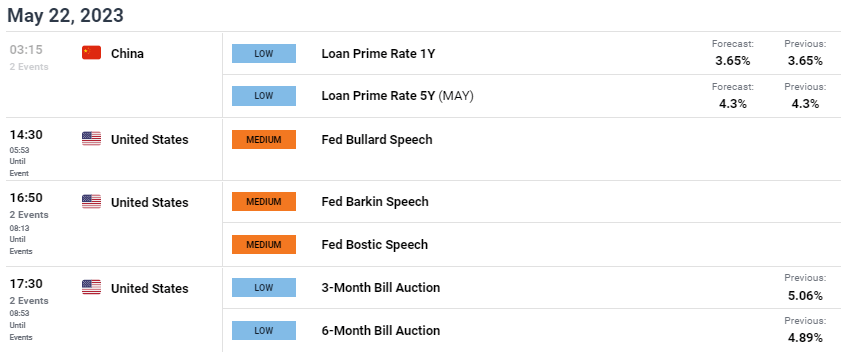
Earlier this morning China kept its 1 and 5-year Loan Prime Rates (LPR) unchanged. The increasing interest rate differential between the US and China has weighed on the Yuan and the PBoC’s desire to cut rates (as a stimulus measure) to meet their 5% GDP growth target. Commodity prices (Australian specific exports) have weakened thus exacerbating downside for the Aussie dollar.

The day ahead will be led by Fed speakers (see economic calendar below) and it will be interesting to see how the scheduled officials react to Fed Chair Powell’s recent comments.

ECONOMIC CALENDAR

image1.png

TECHNICAL ANALYSIS

AUD/USD DAILY CHART

image2.png

Chart prepared by Warren Venketas, IG

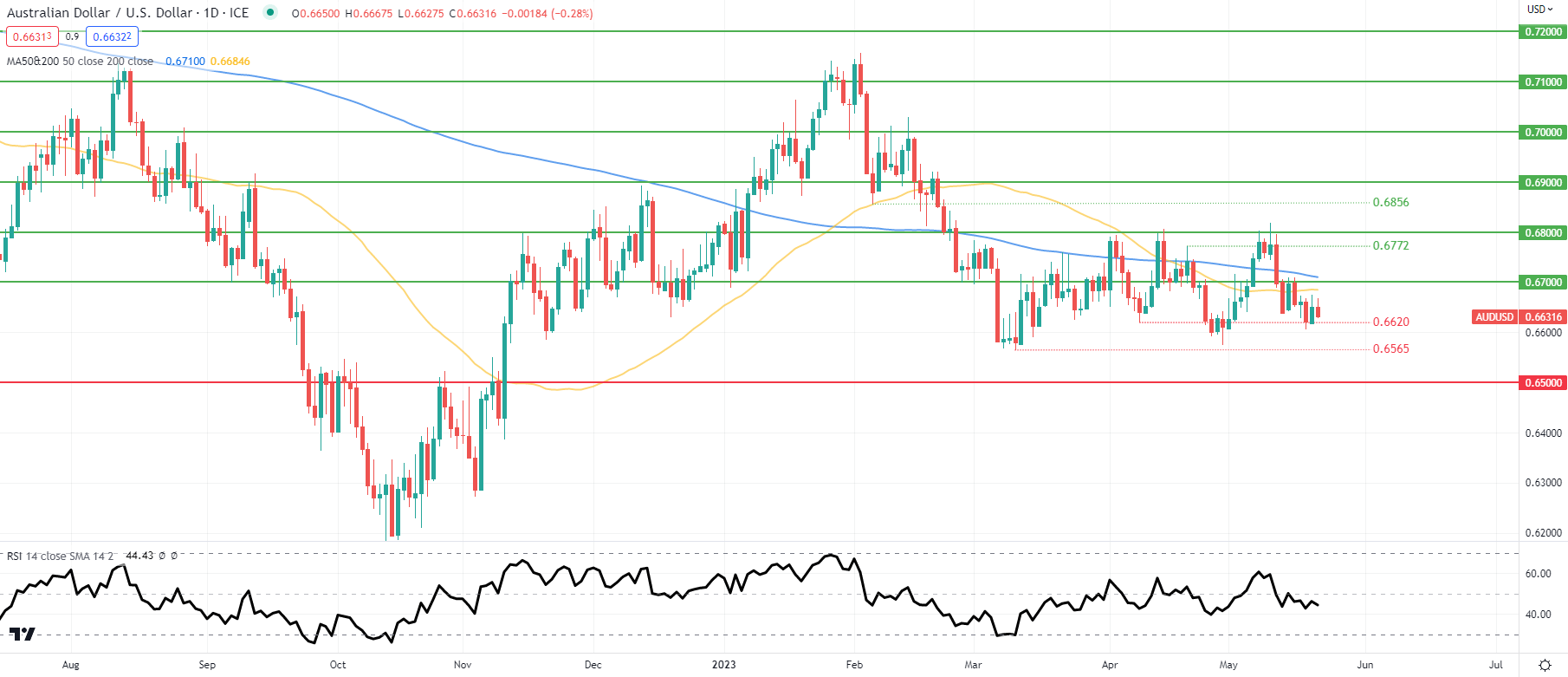
Daily AUD/USD price action reveals recent uncertainty in global markets as the pair fluctuates between the 0.6600 and 0.6800 psychological levels. The Relative Strength Index (RSI) further reiterates investor skepticism due to fundamental ambiguity. This week may be a ‘wait and see’ mindset from traders awaiting external cues.

EUR/CHF: Decline to persist on a break below support zone of 0.9710/0.9670 – SocGen

EUR/CHF: Decline to persist on a break below support zone of 0.9710/0.9670 – SocGen

Last week’s peak near 0.9770 must be overcome for affirming a meaningful up move

“EUR/CHF is now challenging the interim support zone of 0.9710/0.9670 representing the low of March and the 61.8% retracement from last year. An initial bounce is not ruled out however the peak achieved last week near 0.9770 must be overcome for affirming a meaningful up move.”

“Break below 0.9710/0.9670 could mean a persistent decline towards projections of 0.9600 and 0.9540.”

US Dollar Slides on Uncertainties While Japanese Yen Firms Despite Poor Data

US Dollar Slides on Uncertainties While Japanese Yen Firms Despite Poor Data

The US Dollar dipped again against the Suisse, Euro, Sterling and Yen to start the week with the US debt ceiling creating doubt in traders’ minds.

Talks are due to resume later today between US President Joe Biden and House Speaker Kevin McCarthy. The latter said that a phone call between the two on Sunday had been ‘productive’.

Treasury yields are a few basis points lower across the curve so far today and might be contributing to the weakening US Dollar.

US Federal Reserve Chair Jerome Powell made remarks on Friday that were seen as potentially less hawkish than previous commentary. In regard to future policy decisions, he said, “the risks of doing too much versus doing too little, have become more balanced.”

Minneapolis Federal Reserve President Neel Kashkari also stated that he would be open to skipping a hike at the next Federal Open Market Committee (FOMC) meeting in mid-June.

Interest rate markets are pencilling in a 25-basis point cut to the Fed funds target rate by November.

The Japanese Yen is firming even though core machine orders there for March came in much lower than forecasts today.

New orders fell -3.9% month-on-month in March rather than increasing by 0.4% as anticipated. Year-on-year, core machine orders dropped by -3.5% to the end of March, well below the estimates of a 1.3% increase.

USD/JPY is over a big figure lower from the 6-month peak 0f 138.75 seen last Thursday.

The People’s Bank of China (PBOC) left the 1- and 5-year loan prime rates unchanged at 3.65% and 4.30% respectively.

Hong Kong’s Hang Seng Index (HSI) is the best of the APAC equity indices, it was up over 1.5% at one stage. The rest of the major Asian bourses are mostly in the green although Australia’s ASX 200 is slightly in the red.

The buy now pay later (BNPL) sector is facing further scrutiny after the Australian government today announced measures to bring those debt providers under existing universal credit laws. The companies will now need to secure a credit license to operate.

Gold has held onto Friday’s gains but is little moved going into the European session, trading near US$ 1,980 at the time of going to print.

Crude oil is struggling today after making after spiking on Friday but remains in a broad range. The WTI futures contract is near US$ 71 bbl while the Brent contract is close to US$ 75 bbl.

It is a relatively quiet day ahead in terms of data releases, but several speakers from the ECB and the Fed will be making speeches.

USD/JPY TECHNICAL ANALYSIS

USD/JPY tried to run higher last week after breaking above a prior peak and making a high of 138.75.

It appears that the market has rejected the move for now with the price moving back below those previous resistance levels. This might be suggestive of a false and a new high will need to be made to allay these concerns.

Resistance might be at previous highs of 138.17, 138.75 and 139.90. On the downside, support may lie at the 200- and 260-day Simple Moving Averages (SMA) currently at 137.12 and 136.46 respectively.

image1.png