
image1.png

US Dollar Down as Treasury Yields Slip, Risk Appetite Picks Up

The US Dollar is weaker against all developed market currencies today as Treasury yields softened throughout the Asian session. The moves unwound the previous day’s gains. The benchmark 10-year note is holding above 4% for now.

Some positive risk sentiment also emerged after solid Japanese and Chinese PMI numbers. The Jibun Bank Japanese manufacturing PMI was 50.7 and the Caixin Chinese manufacturing PMI was 49.2, above estimates of 48.5.

The Chinese Yuan is one of the few currencies to weaken against the ‘big dollar’. It is at its lowest level since early 2008, with USD/CNY trading as high as 7.3270. That’s a long way from the March low of 6.3035.

Japan’s Ministry of Finance (MoF) revealed that they had spent 6.3 trillion Yen (42.5 billion USD) in October on currency intervention.

The Kiwi Dollar has been the best-performing major currency so far after building approvals data there showed an increase of 3.8% month-on-month in September.

AUD/USD had a run up toward 0.6450 but backed away after the RBA hiked their cash rate target by 25 basis points (bps) to 2.85%. It appears to be a case of “buy the rumour, sell the fact.”

APAC equities are all in the green with Hong Kong’s Hang Seng Index (HSI) leading the way, up over 4% at one stage. US futures are pointing to a positive start to their cash session after yesterday’s declines.

US President Joe Biden said that record profits of oil companies are a windfall of war and that producers that don’t reinvest their gains to increase output could face an extra tax.

Crude oil edged higher with the WTI futures contract above US$ 87 bbl while the Brent contract has surpassed US$ 93.50 bbl.

More PMI data is due out today from Switzerland, the UK, Canada and the US. The latter will also publish analogous ISM figures. The market remains anxious ahead of the Fed rate decision on Wednesday.

The full economic calendar can be viewed here.

DXY (USD) INDEX TECHNICAL ANALYSIS

The DXY index remains with an ascending trend channel and might be regaining bullish momentum after crossing above the 55-day simple moving average (SMA).

The lower bound of the ascending channel coincides with the 100-day SMA, currently intersecting at 108.60 and this might provide support.

Ahead of that level, the recent low and the break point at 109.54 and 109.29 respectively may provide support.

On the topside, resistance could be at break point of 111.77 or further up at the previous peaks of 113.92 and 114.78.
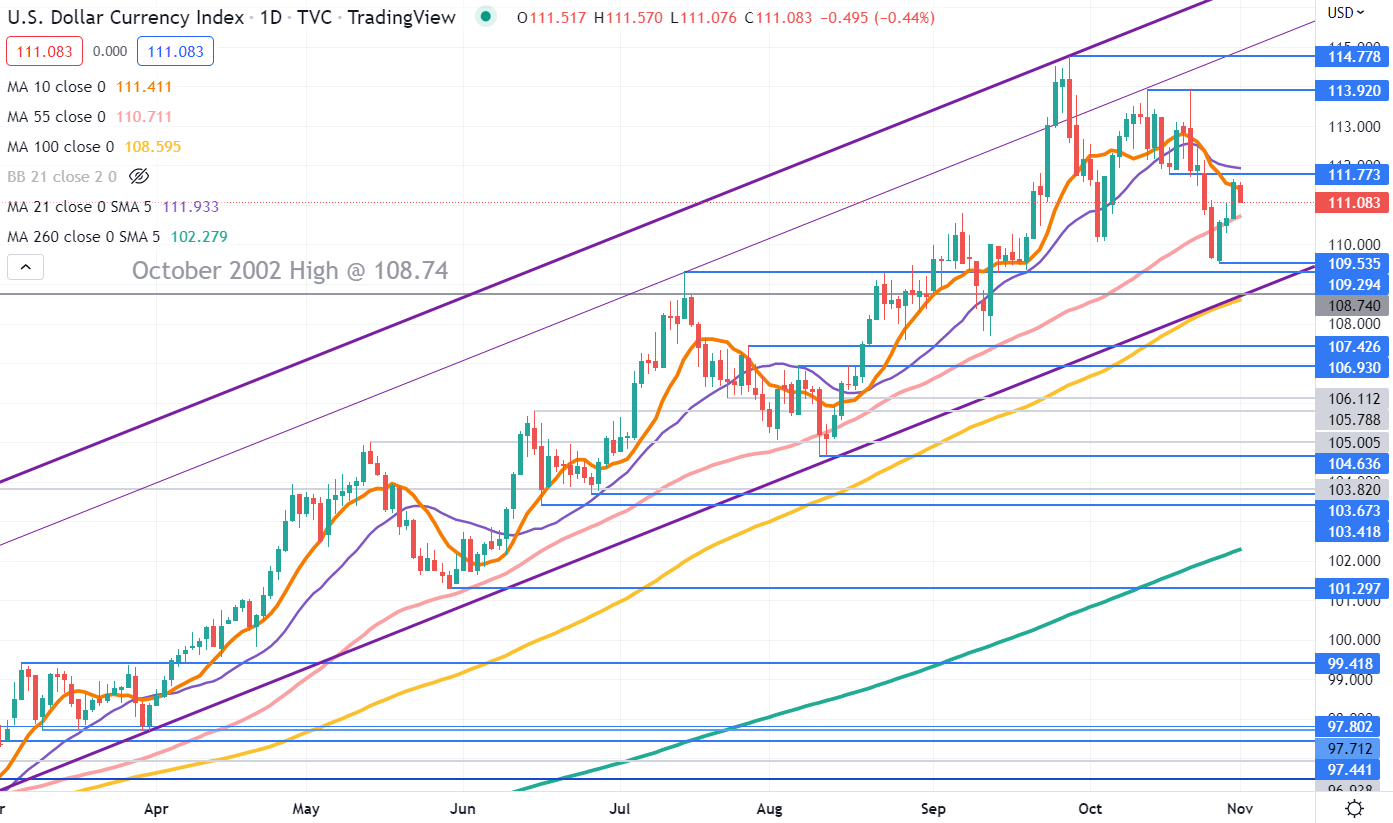
image1.png


UK gilt/Bund yield spread tightest since Sept. 20

LONDON: British government bond prices rallied on Tuesday, pushing down yields on 10-year gilts so they offered the smallest premium over similar German government bonds since Sept. 20, before the announcement of an ill-fated package of unfunded tax cuts.

The yield spread between 10-year gilts and German Bunds dropped by 6 basis points (bps) on the day to 130.2 basis points, its narrowest since Sept. 20 according to Refinitiv data.

Ten-year gilt yields were down 11 bps on the day in outright terms at 3.41%, close to a one-month low.

Britain’s ‘mini-budget’ on Sept. 23 caused gilt yields to soar, pushing 10-year yields as high as 4.63% and the gilt/Bund spread as high as 229 bps, and forced the Bank of England to intervene to stabilise the market.

Europe’s debt market strains force some governments to rework trading rules

Late on Monday, a British finance ministry source said broad-based tax rises were likely to be necessary to stabilise the public finances when new finance minister Jeremy Hunt presents fresh budget plans on Nov. 17.

image1.png

British Pound: GBP Dictated by USD Ahead of FOMC

GBP/USD FUNDAMENTAL BACKDROP

The pound opened the morning stronger against the dollar mostly driven by USD weakness but concerns over colder than expected temperatures over the winter months have heightened fears around energy supply shortages. While markets are mainly focused on the Federal Reserve’s interest rate announcement tomorrow, the Bank of England (BoE) announcement will quickly take center stage post-release. Money markets have been drawing down on rate hike expectations but still remains around 75bps – see table below, a likely overestimation of what could be a 50bps increment if recent BoE commentary is anything to go by.

BOE INTEREST RATE PROBABILITIES

image1.png

The economic calendar kicked off the day with a decline in housing prices for October – the biggest fall since COVID and may signal the beginning of a property slump. Higher interest rates have been the principal driver of this decline as the UK looks to quell inflationary pressures however, the average consumer remains the biggest loser. Later today, UK manufacturing PMI is due and is estimated to drop significantly highlighting the poor economic state in the UK. Moving over to the U.S., both S&P Global and ISM manufacturing PMI releases are scheduled but are unlikely to move the needle considering the U.S. is primarily a services driven economy. A miss below 50 will place the U.S. into contractionary territory and may extend the dollar’s decline today giving GBP bulls some support.

GBP/USD ECONOMIC CALENDAR

image2.png

TECHNICAL ANALYSIS

GBP/USD DAILY CHART

image3.png

Daily GBP/USD price action shows the continued development of the rising wedge formation (yellow) as prices hover around the 1.1500 psychological handle. My forecast favors a dollar bias which mirrors the traditional consequence of the falling wedge. Fundamental catalysts including the FOMC meet and BoE rate decision should provide the stimulus required for a wedge downside breakout or invalidation by way of GBP upside.