Remarks by Secretary of the Treasury Janet L. Yellen at Press Conference in Niigata, Japan

Remarks by Secretary of the Treasury Janet L. Yellen at Press Conference in Niigata, Japan

I. Debt Limit

Before we start, I’d like to briefly speak about a topic that is top of mind for many of us right now: the U.S. debt limit.

Earlier this month, I told the U.S. Congress that our best estimate is that the United States government will be unable to continue to satisfy all of its obligations by early June – and potentially as early as June 1 – if Congress does not address the debt limit before that time. That projection underscores the urgent need for Congress to act as soon as possible.

In my assessment – and that of economists across the board – a default on U.S. obligations would produce an economic and financial catastrophe. Millions of Americans could lose their jobs. Household incomes would be reduced. American businesses would see credit markets deteriorate. And millions of American families that receive government payments would likely be left without the resources that they were promised. This would make it dramatically harder for households to spend and businesses to invest. A default would threaten the gains that we’ve worked so hard to make over the past few years in our pandemic recovery. And it would spark a global downturn that would set us back much further. It would also risk undermining U.S. global economic leadership and raise questions about our ability to defend our national security interests.

Short of a default, brinksmanship over the debt limit can also impose serious economic costs. We know this from recent history. As we learned in 2011, just the serious threat of default can lead to a downgrade of our credit rating and a weakening of consumer confidence. We could see a rise in interest rates drive up payments on mortgages, auto loans, and credit cards. We are already seeing spikes in interest rates for debt due around the date that the debt limit may bind.

There is no good reason to generate a crisis of our own making. The U.S. Congress has raised or suspended the debt limit about 80 times since 1960. I urge it to act quickly to do so once again.

II. G7 Priorities

Let me now turn to our work at the G7. I’d first like to thank Finance Minister Suzuki and his team for hosting the G7 Ministerial. And thank you to Japan for its leadership of our group this year.

There are many issues that we will work on this week. But today, I would like to highlight three of my core priorities. The first is the global macroeconomy. We are taking a broad range of individual and joint actions to bring down inflation, sustain growth, and help mitigate the impact of external shocks, including to developing countries. The second is to redouble our commitment to support Ukraine as it defends itself against Russia. And the third is our longer-term work to bolster economic resilience and security.

As we advance these priorities, I look forward to working not only with my colleagues from the G7 – but those from several non-G7 partners that are here this week, including developing countries and emerging markets. We all have shared goals. I look forward to productive discussions about how we can better deliver for all.

Global Economy

First, even as we face downside risks, I believe that the global economy remains in a better place than many predicted six months ago. In most G7 countries – including the United States – annual headline inflation has fallen in recent months. And the growth outlook for the global economy is better than it was in the fall. In the United States, we have taken decisive action to tackle elevated inflation and strengthen confidence in the banking system, while also enacting a trifecta of historic legislation to raise our long-term growth potential. Other countries have taken actions to address their near-term challenges as well. We encourage our partners to make long-term investments in their productivity and in combating climate change. When we strengthen our own economies, we strengthen the global economy as well.

But we need to do more. It’s important that we take concerted actions to improve the economic outlook for the entire world – particularly in developing countries. That’s why we will coordinate on our efforts to push hard for timely and comprehensive debt treatments for countries in debt distress. And it’s why we have worked hard to take joint actions to lower food and energy costs during a volatile period. Many of these actions have had the largest impact on the poorest countries.

Of course, we remain attuned to economic headwinds and downside risks. The world was still recovering from the pandemic when Russia began its illegal full-scale war against Ukraine. These shocks continue to impose significant costs on the global economy. Further, markets are seeing the possibility of a U.S. debt limit breach as a growing downside risk.

I will continue to work with my counterparts on ways to strengthen the global economy over the next few days – and beyond.

Russia’s Illegal War Against Ukraine

Second, I look forward to coordinating with other G7 members to support Ukraine and degrade Russia’s ability to wage war. When the G7 finance ministers gathered together last spring, Russia’s full-scale war against Ukraine was less than three months old. Now, the war is approaching its 450th day. Since Day One, our countries have stood united to support the Ukrainian people as they have mounted a fierce resistance.

The United States is proud to have provided significant economic, security, and humanitarian assistance to Ukraine. And we are just as proud to be part of a broad coalition that has stepped up to assist Ukraine in its moment of need. We are pleased that the IMF’s program for Ukraine will provide critical financing for the country while putting it on a path of macroeconomic stabilization and future recovery. The program will bolster President Zelenskyy’s commitment to accountability and good governance. And it will help Ukraine’s economic officials provide a steady hand for its economy and reform agenda in the coming months and years.

We are also continuing to lead a multilateral coalition of over 30 countries to impose heavy economic costs on Russia for its war. Over the past year, our campaign has systematically degraded Russia’s military-industrial complex and helped reduce the revenues that Russia can use to fund its war. Because these sanctions are having an impact, Russia is trying to get around them. This year, a central piece of our strategy is to take further actions to disrupt Russia’s attempts to evade our sanctions. Our three-pronged approach involves improving information sharing and coordination among our allies and partners; putting pressure on companies and jurisdictions that we know are allowing or facilitating evasion; and identifying and shutting down specific channels used by Russia to equip and fund its military. We have taken a wave of actions in the past few months to crack down on evasion. And my team has traveled around the world to intensify this work.

Our innovative policies to support Ukraine extend to our joint efforts to restrict Russian oil export revenues. Last May, the G7 finance ministers discussed the price cap policy for the first time. Our goals were two-fold: to reduce revenues for the Kremlin while helping stabilize global energy markets. A few months into its implementation, we see clear signs that the price cap is working. The Russian government’s oil revenues from January through March of this year were over 40 percent lower than a year prior. And importantly, global oil markets have remained relatively stable since the imposition of the crude oil cap last December. In short, the price cap has helped stabilize the global economy just as it has hurt Russia’s ability to wage its illegal war. Members of the price cap coalition are committed to prohibiting or phasing out imports of Russian oil. But we continue to urge developing countries to save on their oil costs by taking advantage of the price cap to negotiate steep bargains on Russian oil.

As I’ve said before, we will stand with Ukraine for as long as it takes.

Economic Resilience and Security

Third, I will work with my counterparts on our longer-term initiative to build greater economic resilience and bolster economic security. Our goal is not only to enhance resilience for ourselves. It is also to build resilience for our allies and partners – including developing countries around the world.

We are advancing important work to build reliable and secure critical supply chains. This is part of an effort that I have called “friendshoring.” We also believe that our supply-chain diversification efforts can open up more trade and investment opportunities for developing countries that have traditionally only had limited footprints in global supply chains. During the upcoming G7 meetings, I am looking forward to discussing ways to partner with developing countries to help them better integrate into global trade – in a way that moves countries away from solely extractive industries into activities that provide greater support for the domestic economy and employment. This work will build on the investments already underway through the G7’s Partnership for Global Infrastructure and Investment. Our partnership is already helping bolster global supply chains by mobilizing private capital toward infrastructure projects in developing countries. We also look forward to building on our work with about a dozen countries through the Indo-Pacific Economic Framework that was launched this time last year in Japan.

The G7 will also advance our work to mitigate geostrategic risks in our economies. As I said in a speech last month, the United States has a broad suite of tools to mitigate risks to our national security. And we will take narrowly targeted actions when necessary. We are looking forward to working with the G7 to effectively counter economic coercion, which is a key focus of Japan’s presidency.

We also know that many of the threats to economic resilience are coming from the global challenges that we all face. Since last fall, the United States has worked with shareholders to evolve the multilateral development banks to better combat 21st century global challenges. Transboundary challenges like climate change, pandemics, and fragility and conflict are disproportionately impacting the most vulnerable among us. We are accelerating the momentum for our evolution initiative and aim to adopt a rolling set of World Bank reforms over the coming months. These G7 meetings present us with an opportunity to coordinate our collaboration with and support for lower-income countries.

With that, I will take your questions.

Bowman: The Evolving Nature of Banking, Bank Culture, and Bank Runs

Bowman: The Evolving Nature of Banking, Bank Culture, and Bank Runs

The Evolving Nature of Banking, Bank Culture, and Bank Runs

It is a pleasure to be with you here today.1 This symposium, focused on building the financial system of the twenty-first century, is very timely. Given the recent banking system stress many are welcoming a fresh look at whether the Dodd-Frank era changes to the financial system and the approach to supervision and regulation have kept pace with the evolving nature of banking, the evolving culture of banking, and how the risks of bank runs today have evolved to be meaningfully different from what we’ve seen in the past. While my remarks will largely focus on the United States, the lens through which regulators and policymakers should view these issues has some broader applicability and is worthy of an ongoing discussion.

I will begin by offering a few thoughts on U.S. monetary policy. At our most recent meeting last week, in light of the ongoing unacceptably high inflation, the Federal Open Market Committee (FOMC) increased the target range for the federal funds rate by 25 basis points. With this increase, the FOMC has raised the federal funds rate by 5 percentage points since March of last year. These increases, combined with the runoff of our balance sheet, are having the desired effect of tightening financial conditions. In my view, our policy stance is now restrictive, but whether it is sufficiently restrictive to bring inflation down remains uncertain. Some signs of slowing in aggregate demand, lower numbers of job openings and more modest gross domestic product (GDP) growth indicate that we have moved into restrictive territory. But inflation remains much too high, and measures of core inflation have remained persistently elevated, with declining unemployment and ongoing wage growth. And, as senior loan officers signaled beginning last summer, credit has continued to tighten.2 I expect this trend will continue given increased bank funding costs and reduced levels of liquidity.

While the U.S. banking and financial system remains sound and resilient, the recent failures of three U.S. banks with unique risk profiles have added to the uncertainty surrounding the economic outlook. This uncertainty is further complicated by stock price movements among regional banks.

Should inflation remain high and the labor market remain tight, additional monetary policy tightening will likely be appropriate to attain a sufficiently restrictive stance of monetary policy to lower inflation over time. I also expect that our policy rate will need to remain sufficiently restrictive for some time to bring inflation down and create conditions that will support a sustainably strong labor market. Of course, the economic outlook is uncertain and our policy actions are not on a preset course. I will consider the incoming economic and financial data during the intermeeting period and its implications for the economic outlook in determining my view of the appropriate stance of monetary policy. I will look for signs of consistent evidence that inflation is on a downward path when considering future rate increases and at what point we will have achieved a sufficiently restrictive stance for the policy rate. In my view, the most recent CPI and employment reports have not provided consistent evidence that inflation is on a downward path, and I will continue to closely monitor the incoming data as I consider the appropriate stance of monetary policy going into our June meeting.

My remarks today will address the recent bank failures in the United States and how the evolution of the banking industry has influenced and amplified bank deposit run risk. I will then discuss supervision, regulation, bank management culture, and technology, and how each of these changes the dynamics of our approach to building a stronger and more resilient financial system. Finally, I will close with my views on the importance of approaching the future in a deliberate, evidence focused, and thoughtful manner.

The Evolving Context of Banking and Bank Failures
Those who are involved in the business of banking will not find this shocking, but it is a fundamental fact that banking involves risk. It is inherent in, and foundational to, the business of banking: banks take demand deposits—a short-term liability—and make term loans—creating a long-term asset. Absent this intentional risk-taking, banks could not play their indispensable role of credit provision in the economy. There are many other risks, with the specific risks that banks face today as varied as the wide range of bank business models. The most fundamental banking risks include credit, concentration, interest rate, liquidity, cybersecurity, more recently operational risk and, of course, the risk of contagion.

Banking simply cannot work in its current and historical form without risk, so unless the goal is to change the nature of banking, the task of policymakers and regulators is not to eliminate risk from the banking system, but rather to ensure that risk is appropriately and effectively managed. Fundamentally, this is the basis for the bank regulatory frameworks that exist around the world. In countries with well-functioning and appropriately regulated banking systems, banks serve an indispensable role in credit provision and economic stability. The goal is to create and maintain a system that supports prudent banking practices, and results in the implementation of appropriate risk management. No efficient banking system can eliminate all bank failures. But well-designed and well-maintained systems can limit bank failures and mitigate the harm caused by any that occur.

In practice, the “maintenance” of the bank regulatory and supervisory framework has often been challenging, in part because maintenance requires vigilance in responding to evolving circumstances and risks. Lapses in this effort are revealed when something breaks, which could include fragilities resulting from the emergence of unidentified risks and financial stability threats; banking practices that expose shortcomings in the supervisory framework; or policymakers, regulators, and/or examiners who have lost sight of the fundamental goal of encouraging prudent banking practices and appropriate risk management.

The need for maintenance of the U.S. bank regulatory and supervisory framework has come into stark relief with the failures of two large banks in March, followed by a third at the beginning of May. The future and current policy choices made in responding to these failures will have important consequences for the U.S. banking system. Including the extent to which bank regulation will continue to drive banking activities from regulated banks and into shadow banks. While shoring up the resiliency of the banking sector is important, it is also important that we consider the consequences of any regulatory change.

Before discussing the direction of policy, I think it’s imperative that we pause and consider where we are and what has changed.

The Failure of Silicon Valley Bank
As financial services have evolved to meet the demands and expectations of sophisticated and wealthy businesses and individuals, risks inherent in the very nature of these services—instant accessibility and transferability of funds—created the potential for instability at an extensive and accelerated scale. For Silicon Valley Bank in particular, while the run was ignited by traditional concerns, it was much faster than previous bank runs, was fueled by the most modern communication methods and social media, and was enabled through new technology that allows customers to move money on a scale and at a velocity not previously accessible directly to customers.

On Thursday, March 9, SVB experienced a deposit outflow of more than $40 billion, and more than $100 billion was anticipated in queue for outflow on Friday, March 10. Let’s consider this in comparison to past bank failures and the pace and size of deposit outflows. Prior to SVB, the largest bank failure in U.S. history was the failure of Washington Mutual, which experienced two periods of large deposit outflows, the first lasted 23 days with outflows of $9.1 billion, and the second $18.7 billion over 16 days.3 In other bank failures resulting from deposit runs, deposits flowed out of the bank in significantly smaller volumes and over much longer time horizons than SVB experienced on March 9 and 10.4

The recent bank runs have many familiar elements. SVB relied on funding from extremely large deposits of technology and health care sector firms, which were mostly uninsured (more than 95 percent) and held in transaction accounts. In traditional banking, uninsured depositors have historically been exposed to credit risk on their bank deposits, which provides some incentive for them to impose market discipline on the bank, such as by discouraging excessive risk-taking. As we were very recently reminded, a disproportionate percentage of uninsured depositors can also present risk, since they may have strong incentives to withdraw their funds at the slightest sign of actual or perceived bank stress. These dynamics and incentives are certainly not new but have featured prominently in past bank runs.5

The most significant shift has been one of speed. This is where modern technology has played a significant role, both in facilitating the transfer of funds and in the access to, and expedited flow of, information among depositors.

Evolving Technology and Customer Expectations
Back-end money transfer systems have been gradually shifting to real-time payments, which are immediately available to customers upon transfer, rather than being subject to a waiting period while it is processed between financial institutions. Many bank websites provide capabilities that appear to allow customers to initiate funds transfers in real time. Sophisticated customers that hold uninsured deposits also have tools at their disposal—like the ability to initiate wire transfers between financial institutions—that allow faster transfers of funds.

The capacity to initiate transfers, and even the changed perceptions of customers that they can move their funds at any time of day or night, have caused important structural shifts. Large depositors may have less incentive to act as a force for market discipline, even for banks where they hold large uninsured deposits in their operational accounts. These depositors have a cheaper and more efficient mechanism at their disposal to protect against credit risk—they can pull their money out in banking’s new normal. These changes have exacerbated the potential flight risks of uninsured deposits, while changing some of the incentives for depositors imposing market discipline.

Bank Runs and the Rumor Mill
The speed and size of deposit withdrawals were a feature, not a cause, of the recent U.S. bank failures. We live in a world where a wide array of communication tools—text messaging, group chats, and social media postings—have enabled expedited, if not always more accurate, dissemination of information.

The spread of information has always played an important role in bank confidence and bank runs. When information is more readily and quickly accessible and shared among shareholders, creditors, customers, and depositors, bank management needs to be attuned to how it communicates, especially when remediating identified weaknesses.

The failure of SVB illustrates this dynamic. Uninsured depositors were connected by a closely linked network of business relationships and contacts, and strong ties with venture capital fund investors. The flow of information among these depositors—and the mechanisms that pushed them to act collectively—seem apparent in retrospect, but the closely linked relationships among this group exacerbated the risks involved in SVB’s public communication of its remediation strategy.

But while the risk of uninsured depositors acting collectively was a significant vulnerability, communications from management caused this group to begin to withdraw their deposits on a massive scale and in a coordinated fashion. We know that there were many supervisory issues at SVB over several years. At the time the bank failed, it had been selling securities to improve liquidity and raising capital to address some of these fundamental weaknesses in its funding and liquidity. Simply the act of announcing that the bank’s management was taking steps to remediate these issues created panic—highlighting the risks they were confronting—and the panic spread quickly.

Social media has also played a role in fueling stock price volatility, which can lead to other risks to a bank. In October of last year, rumors circulated about Credit Suisse’s stock price conflating stock price with capital and liquidity strength. Despite Credit Suisse management’s efforts to intervene and calm markets, its stock experienced significant volatility, resulting in an increase in the spreads on the firm’s credit default swaps and a decrease in the value of its bonds. Credit Suisse had been dealing with significant issues for an extended period of time, but this incident highlighted how quickly investor sentiment can change in the age of social media.

Bank Culture and Mindset
A more subtle way we are seeing banking evolve is most evident in the “culture” of banking for those banks whose business models directly involve funders of startups, transformative new technologies, or novel activities like digital and crypto assets. For many banks, innovation has been a long-term priority because it enables them to offer customers new products and services and remain competitive in the current financial services environment.6 But regardless of the business model, the culture of a bank must also prioritize the values and rules that make banks successful over time. This includes not only being responsive to the needs of their customers and communities, but also maintaining a strong risk-management culture.

The expansion from traditional bank business models brings an influx of non-bankers into bank management. Over the past several years, there have been a number of charter-strip acquisitions, where a new management group transforms a traditional bank’s business model. And we have seen consistent growth in banking-as-a-service partnerships—where the bank partners with a nonbank company, often a fintech, to offer new products and services. Even without these external influences, bankers who leverage innovation as a significant aspect of their business model often have a mindset that is compatible with continued innovation and are less sensitive to regulatory and supervisory communications. I view these trends as part of a cultural shift within these banks.

Some innovators espouse an “ask for forgiveness, not permission” mentality when it comes to regulation and compliance. This is a particularly dangerous mindset when it comes to banking. Bank supervisors often rely on their interactions with bankers to communicate supervisory concerns. This enables supervisors to provide feedback to bank management before these issues escalate and are cited in examination reports and as Matters Requiring Attention (MRAs), Matters Requiring Immediate Attention (MRIAs), or enforcement actions. But bank management must be receptive to these supervisory messages and should take proactive measures to address the issues identified. This kind of proactive approach may not be the most natural reaction for those who have been successful in a less-regulated tech or start-up environment.

The Policy Response
Given the recent banking sector stress, it is clear that we need to review the bank regulatory and supervisory framework to determine whether updates are needed. As we consider potential changes to improve supervision and regulation, we should start from a baseline understanding of the available tools and determine whether those tools have been utilized and implemented effectively. Before regulators seek new tools, it is necessary to understand the need—how would the use of those new tools address deficiencies in the existing regulatory toolkit? Imposing additional requirements on regulated institutions without understanding this need results in additional costs and can have unintended consequences like encouraging bank consolidation and constraining credit availability to critical business activities or geographies. In addition to these unintended consequences, we also need to carefully consider the broader implications of regulatory change for financial stability.

The policy response to a crisis should be multifaceted, as changes to different elements of supervision and regulation in combination may be the most efficient and effective response. We should have no illusions that “getting it right”—finding the right combination of regulatory and supervisory changes—is a simple task. This fine tuning is a core element of maintaining an effective system, constantly re-evaluating whether our tools are effective and used appropriately.

There are a few specific areas where I see a need to revisit our approach, specifically in supervision, regulation, and technology.

Supervision
Starting with supervision, effective bank supervision requires both transparency in expectations, and an assertive supervisory approach when firms fail to meet these expectations.

In the past, I have spoken about the virtue of transparency in supervision.7 Transparency in supervisory expectations builds legitimacy, promotes a compliance culture, and is critical to ensuring that we preserve due process. Transparency between a bank and its examiners can be a profoundly effective tool by allowing bankers to air issues early with their examiners. This type of communication promotes understanding—of the bank and its operation by examination staff, and of regulatory expectations by the bank’s management and board of directors. Amorphous standards or standards that change without prior notice frustrate this goal.

If regulators are clear in our expectations with banks, and banks fail to meet those expectations, regulators are well-positioned to take strong action and demand remediation of supervisory issues. When a bank fails to promptly address identified issues, the bank and the banking system run the risk that those issues can become far more damaging over time. There is a significant cost to delay.

While the specific timelines for remediation of supervisory issues vary significantly across firms, the Board has published statistics on the number of and general nature of supervisory findings, and how those have evolved over time.8 Remediation of technology infrastructure, data, and operational resilience issues often take longer to address than those in other business areas or related to risk management.9 Some variability is reasonable as these issues vary in complexity. And, to the extent that a bank is reliant on third parties, core providers, or others to help remediate issues, providing sufficient remediation time can be necessary and appropriate.

Providing time to remediate issues should not be a pretext for inaction or inattention to important supervisory issues. Ultimately, one of the primary goals of supervision is to hold the bank accountable for safety and soundness and consumer compliance. Accountability is critical for both the bank and for supervisors. Where regulators have failed in supervision, we must hold ourselves accountable.

Part of the solution to inaction may simply be to take a stronger approach when examiners have identified deficiencies in need of remediation. But for some banks, management’s responsiveness to supervision—traditionally an area that rewarded conservative and prudent management—has changed, with a greater emphasis on innovation, especially those that promise to transform the business of banking.

These shifts impact supervision, in that we need to reevaluate the effectiveness of formal and informal enforcement mechanisms. If moral suasion as an informal tool is less effective, and bank management and boards are less attuned to hear and respond to supervisory messages, we need to reconsider our supervisory toolkit. This may mean taking more formal remediation measures, with definitive timelines, and imposing meaningful consequences for firms that fail to remediate issues in a timely way.

In addition to being transparent, supervision must be nimble and responsive because the financial services landscape and bank risks evolve over time. The low interest rate environment following the 2008 financial crisis shifted the supervisory focus away from interest rate risk to other risks, just as the current rising rate environment required supervisors to return to interest rate and emerging credit risk.10

Supervision must also complement regulation. While regulation is a critical tool, it operates with a significant lag for most developed banking systems. This is where supervision can complement regulation to address emerging threats and risks by allowing supervisors to pivot to those fundamental risks that may be most salient based on that bank’s business model and evolving economic conditions.

Regulation
In response to the recent bank failures, it is tempting to engage in a wholesale revision of the bank regulatory framework. Before changing rules, we need to take a critical look at actual weaknesses, and acknowledge the strengths that should be preserved.

As a threshold matter, today’s regulatory system is fundamentally strong. But as the Federal Reserve continues to carefully monitor developments and changes to the banking system, we must recognize that the regulatory framework has been transformed through a broad range of changes in response to the 2008 financial crisis. These changes have led to a strong and resilient banking system. Overall, our regulatory framework is also strong. This framework has materially increased bank capital and liquidity and added a number of other requirements to improve resiliency, including new stress testing and resolution planning requirements.

Following the 2008 crisis, the U.S. regulators implemented changes designed to improve the quality and quantity of bank capital. This included the introduction of common equity tier 1 (CET1) as a measure of the highest quality form of regulatory capital, and the capital conservation buffer. Today, large U.S. banks are also subject to additional capital requirements, based on the tiering framework. For all banks with over $100 billion in assets, the requirements include the stress capital buffer and a number of additional GSIB and large firm-specific requirements. The U.S. capital requirements are described as “gold plating” the standards set in the Basel III reforms.

This is today’s starting point, and it is strong. With the commitment of U.S. regulators to implement Basel III capital reforms, there will soon be additional changes to the capital framework.11 I would like to better understand the U.S. approach to these reforms before passing judgement, but if changes are implemented in a way that takes costs and benefits into consideration and preserves capital neutrality, in my view, these reforms could improve the capital framework.

Prior to 2008, there were also no standardized, quantitative liquidity requirements for U.S. banks and their holding companies. Today, there are two: the Liquidity Coverage Ratio, which supports short-term resilience by requiring banks to have liquidity to cover net cash outflows in a 30-day stress period; and the Net Stable Funding Ratio, which requires firms to maintain stable funding over a one-year time horizon. There are also internal liquidity stress testing and liquidity buffer requirements.

With this in mind, we should be careful and intentional about any significant changes to the regulatory framework, including imposing new requirements that will materially increase funding costs, like higher capital requirements or the requirement of firms to issue long-term debt. Many of the issues related to the recent bank failures have been identified in bank management and supervision. Therefore, a broad-based imposition of new capital requirements on all banks with more than $50 billion in assets would be a far more costly solution than taking the time to specifically identify and address known management and supervisory process issues. Relying on the timeless adage to guide us: if it ain’t broke, don’t fix it.

I do not mean to suggest that regulation has worked perfectly and needs no improvement or maintenance. I think where we find improvements are necessary, we should make them. But we should also be working toward a defined goal and verifiable end state that incorporates the principle of efficiency. And of course, regulation should be durable throughout the economic cycle. Our regulatory framework is extremely complex with many overlapping and sometimes contradictory requirements. Engaging in a piece by piece, regulation by regulation approach will likely have a similar outcome.

Technology
We should also review and update the Fed services available to support banking system resiliency. In payments, the Federal Reserve offers payments-related services including Fedwire® to facilitate wire transfers. In the U.S., the Federal Reserve serves as the “lender of last resort” to the banking system, providing loans at the discount window since the early part of the twentieth century.

These tools are important but are not effective mechanisms to rescue troubled institutions. Discount window lending is available only to institutions that meet certain minimum eligibility standards, and that have collateral available to pledge. Its function is to provide a solvent institution with a vital backup source of liquidity to meet unexpected customer outflows. Similarly, the ability to process fast, efficient payments can also facilitate effective market functioning, but its utility is limited.

In light of the extensive recent use of these tools and the lessons that can be learned, I think it is time to review these tools—which operate during limited, fixed hours and rely to some extent on dated technology—to determine whether they have kept up with the pace of change for the future payments landscape and expectations of liquidity planning. These tools must be nimble and flexible to support the banking system during times of stress. I think it is important that we understand how well these tools functioned in early March as two U.S. banks experienced stress and ultimately failed, and what can be improved regarding timeliness or effectiveness of fulfilling the lender of last resort function.

The Path Forward
My views on the path forward are informed by serving as the bank commissioner for the state of Kansas as its lead regulator and supervisor, my experience as a banker, and especially by my service on the Board of Governors since 2018, during a time when the banking system has experienced many unique stresses including those associated with the COVID pandemic. There have already been some preliminary and expedited internal reports published on the failures of SVB and Signature Bank, and I fully expect to see additional reports and analysis of these failures, and the failure of First Republic, in the coming months.12 These preliminary reviews are an important first step for the U.S. bank regulators working to identify root causes of these bank failures and holding themselves accountable for supervisory mistakes. There are additional steps that we can take.

First, I believe that the Federal Reserve should engage an independent third party to prepare a report to supplement the limited internal review to fully understand the failure of SVB. This would be a logical next step in holding ourselves accountable and would help to eliminate the doubts that may naturally accompany any self-assessment prepared and reviewed by a single member of the Board of Governors.13 This external independent report should also cover a broader time period, including the events of the weekend following the failure of SVB, and a broader range of topics beyond just the regulatory and supervisory framework that applied to SVB, including operational issues, if any, with discount window lending, Fedwire services, and with the transfer of collateral from the Federal Home Loan Banks.

Second, I believe we need to do a better job identifying the most salient issues and moving quickly to remediate them. It is clearly evident that both supervisors and bank management neglected key, long-standing risk factors that should be an area of focus in any examination. These include concentration risk, liquidity risk, and interest rate risk. We have the tools to address these issues, but we need to ensure that examiners focus on these core risks and are not distracted by novel activity or concepts.

Finally, we should consider whether there are necessary—and targeted—adjustments we should make to banking regulation. This will likely include a broad range of topics, including taking a close look at deposit insurance reform, the treatment of uninsured deposits, and a reconsideration of current deposit insurance limits.14 We should avoid using these bank failures as a pretext to push for other, unrelated changes to banking regulation. Our focus should be on remediating known, identified issues with bank supervision and issues that emerge from the public autopsy of these events.

A debate about regulatory changes must also consider where we are today as compared to prior to the 2008 financial crisis. The banking system is strong and resilient despite recent banking stress. The Fed has refined regulatory standards over time at the direction of Congress, most recently pursuant to the bipartisan Economic Growth, Regulatory Relief, and Consumer Protection Act,15 and through so-called “tailoring” regulations designed to better align regulation with risk. Even with the implementation of these changes, banks today are better capitalized, with more liquidity, and are subject to a new range of supervisory tools that did not exist prior to 2008. This paints a picture of a banking system that is not only strong today but is well prepared to continue supporting the provision of credit and the broader economy.

Calls for radical reform of the bank regulatory framework—as opposed to targeted changes to address identified root causes of banking system stress—are incompatible with the fundamental strength of the banking system. I am extremely concerned about calls for casting aside tiering expectations for less complex institutions, given the clear statutory direction to provide for appropriately calibrated requirements for these banks.

I have heard the drumbeat calling for broad, fundamental reforms for the past several years, shifting away from tailoring and risk-based supervision. I believe this is the wrong direction for any conversation about banking reform. The unique nature and business models of the banks that recently failed, in my view, do not justify imposing new, overly complex regulatory and supervisory expectations on a broad range of banks. If we allow this to occur, we will end up with a system of significantly fewer banks serving significantly fewer customers. Those who will likely bear the burden of this new banking system are those at the lower end of the economic spectrum, both individuals and businesses.

The American economy relies on a broad and diverse range of businesses supported by a broad and diverse range of banks. The elimination of regional banks from the US banking system would be devastating to businesses and communities across America. Especially for those regions whose communities are not sufficiently served by larger institutions.

I appreciate your time and engagement, and I look forward to discussing how the participants view these issues, and what it might mean for the future of banking in your financial systems.

GDP monthly estimate, UK: March 2023

GDP monthly estimate, UK: March 2023

1. Main points

  • Monthly real gross domestic product (GDP) is estimated to have fallen by 0.3% in March 2023, after showing no growth in February 2023 (unrevised from our previous publication).
  • Looking at the broader picture, GDP grew by 0.1% in the three months to March 2023.
  • The services sector fell by 0.5% in March 2023, after an unrevised fall of 0.1% in February 2023, and was the main contributor to the fall in monthly GDP.
  • Output in consumer facing services fell by 0.8% in March 2023, after unrevised growth of 0.4% in February.
  • Production output grew by 0.7% in March 2023, which was its strongest monthly growth since May 2021, following a fall of 0.1% in February 2023 (revised up from a 0.2% fall in our last publication).
  • The construction sector grew by 0.2% in March 2023 after growth of 2.6% in February 2023 (revised up from a 2.4% growth in our previous publication).

2. Monthly GDP

Monthly real gross domestic product (GDP) is estimated to have fallen by 0.3% in March 2023 (Figure 1) following an unrevised flat February 2023. Monthly GDP is now estimated to be 0.1% above its pre-coronavirus (COVID-19) levels (February 2020).

Services sector output fell by 0.5% in March 2023, while production output grew by 0.7% and construction by 0.2%.

Looking more broadly, GDP grew by 0.1% in the three months to March 2023 when compared with the three months to December 2022, consistent with the output section in our GDP first quarterly estimate, UK: January to March 2022 bulletin. Services and production both grew by 0.1% in the three months to March 2023, while construction grew by 0.7%.

Monthly GDP grew by 0.3% in March 2023 compared with the same month last year. For comparison, monthly GDP grew by 0.6% between February 2022 and February 2023, revised up from 0.5% in our previous publication.

More about economy, business and jobs

Back to table of contents

3. The services sector

Services fell by 0.5% in March 2023, following an unrevised fall of 0.1% in February 2023, with falls in 9 of the 14 sub-sectors. Figure 3 shows the contributions from the services sector to gross domestic product (GDP) in March 2023.

Economists worry growing conflict with China will make Canada and the world poorer

Economists worry growing conflict with China will make Canada and the world poorer

Canadian domestic politics have helped magnify the most recent dispute between Beijing and Ottawa into a full blown tit-for-tat expulsion of diplomats.

While some experts who track relations between China and Canada play the spat down — one called it “pretty trivial” — it’s one more crack contributing to a far more dangerous long-term rupture.

Labelled “global fragmentation,” the issue was raised at a recent International Monetary Fund meeting in Washington, D.C. The current Canadian dispute may represent a further fracturing of the world into competing trade blocs that will not only make us all poorer, but impede crucial talks on shared global threats, including climate change and artificial intelligence.

Diplomacy’s economic impact

Critics of the Canadian government’s handling of threats against Conservative MP Michael Chong’s family in Hong Kong would not see the issue as trivial.

After being pressed by Tory Leader Pierre Poilievre, Foreign Affairs Minister Mélanie Joly cited China’s “interference in our internal affairs” in declaring Chinese diplomat Zhao Wei persona non grata. As expected, in reply China expelled a Canadian diplomat, Jennifer Lynn Lalonde.

While far less significant than previous disputes with Beijing that in the past led to the long-term imprisonment of innocent Canadians and may have contributed to persistent trade sanctions, the latest Canada-China spat is only one sign of hostility between the world’s free-market democracies and what appears to be an emerging alternative bloc.

Just this week, China vowed retaliation against European sanctions on Chinese companies accused of aiding Russia’s war in Ukraine. Also this week, the U.S. government announced it had arrested Litang Liang, an American citizen accused of pointing out to China its friends and enemies within the United States.

“Even as we need more international cooperation on multiple fronts, we are facing the spectre of a new Cold War that could see the world fragment into rival economic blocs,” warned IMF boss Kristalina Georgieva earlier this year. “This would be a collective policy mistake that would leave everyone poorer and less secure.”

Bank of Canada governor Tiff Macklem raised the issue in testimony to the Senate standing committee on banking, commerce and the economy last month after discussions in Washington.

EUR/USD bounces off recent lows near 1.0900

EUR/USD bounces off recent lows near 1.0900

Following fresh multi-week lows in the 1.0900 neighbourhood, EUR/USD now manages to pick up some upside traction and reclaims the 1.0930 zone on Friday.

EUR/USD looks bid on risk-on mood

EUR/USD partially reverses Thursday’s strong decline to the 1.0900 area on the back of the better tone in the risk complex, which in turn forces the Greenback to give away some of its recent strong gains.

The uptick in the pair, as well as the improvement in the risk appetite, appears also reflected in the US and German money markets, where yields reverse part of the recent weakness and attempt a tepid bounce.

Around the ECB, usual hawk Board member J. Nagel reiterated that inflation remains too high and advocated for a faster pace of the quantitative tightening (QT) process from July.

Nothing to write home about from the euro docket on Friday should leave the attention to the release of the advanced Michigan Consumer Sentiment for the current month later in the NA session.

What to look for around EUR

EUR/USD attempts a mild rebound following the reversal to 4-week lows in the 1.0900 neighbourhood recorded on Thursday.

The movement of the euro’s value is expected to closely mirror the behaviour of the US Dollar and will likely be impacted by any differences in approach between the Fed and the ECB with regards to their plans for adjusting interest rates.

Moving forward, hawkish ECB-speak continue to favour further rate hikes, although this view appears in contrast to some loss of momentum in economic fundamentals in the region.

Eminent issues on the back boiler: Continuation (or not) of the ECB hiking cycle. Impact of the Russia-Ukraine war on the growth prospects and inflation outlook in the region. Risks of inflation becoming entrenched.

EUR/USD levels to watch

So far, the pair is gaining 0.06% at 1.0921 and the surpass of 1.1095 (2023 high April 26) would target 1.1100 (round level) en route to 1.1184 (weekly high March 21 2022). Conversely, the next contention level emerges at 1.0899 (monthly low May 11) seconded by 1.0831 (monthly low April 10) and finally 1.0798 (100-day SMA).

GBP/USD rebounds toward 1.2550 area after mixed UK data

GBP/USD rebounds toward 1.2550 area after mixed UK data

GBP/USD has regained its recovery momentum and rises toward the 1.2550 area in the European morning on Friday. The data from the UK showed that the quarterly GDP grew 0.1% in Q1. Industrial Production and Manufacturing Production both expanded 0.7% in March.

GBP/USD trades near the lower limit of the ascending regression channel, which is currently located at 1.2570. The 50-period Simple Moving Average (SMA) reinforces that support as well. In case the pair confirms that level as resistance, 1.2520 (100-period SMA) aligns as next bearish target before 1.2500 (psychological level, static level) and 1.2460 (200-period SMA).

On the upside, 1.2600 (static level) forms interim resistance before 1.2650 (mid-point of the ascending regression channel). A four-hour close above the latter could attract buyers and fuel another leg higher toward 1.2700.

GBP/USD has retreated below 1.2600 early Thursday after having reached its highest level in a year at 1.2680 on Wednesday. The pair’s near-term technical outlook points to a bearish tilt as focus shift to the Bank of England’s (BoE) policy announcements.

On Wednesday, the US Dollar (USD) came under selling pressure after the data from the US showed that Consumer Price Index (CPI) rose 4.9% on a yearly basis in April, compared to the market expectation of 5%. The cautious market stance, however, didn’t allow GBP/USD to preserve its bullish momentum.

The BoE is widely expected to raise its key rate by 25 basis points to 4.5% following the May policy meeting. Although the UK economy proved to be more resilient than anticipated, inflation remains stubbornly high.

In the past few policy meetings, two external members of the Monetary Policy Committee (MPC), Silvana Tenreyro and Swati Dhingra, have voted to keep the policy rate unchanged. In case these members vote in favor of a rate increase, that could be seen as a hawkish surprise. Similarly, the GBP could gather strength if the policy statement shows that some members voted for a 50 bps rate increase.

On the other hand, Pound Sterling could come under selling pressure if more than two MPC members vote to keep the policy rate unchanged.

Investors will also pay close attention to revised projections. BoE policymakers, including Governor Andrew Bailey, have said that they are expecting inflation to fall “quite rapidly” before summer. If that view translates into downward revisions in inflation forecasts, markets could see that as a sign that the BoE could be approaching the end of its tightening cycle.

In case Bailey leaves the door for additional rate hikes in the near future, GBP could regain its strength. According to Reuters, markets are pricing in nearly an 80% probability of another 25 bps hike in June. Hence, Bailey might need to mention the possibility of one more rate increase after June for investors to assess his tone as being hawkish.

In the second half of the day, April Producer Price Index (PPI) and weekly Initial Jobless Claims data will be featured in the US economic docket. Nevertheless, the BoE event should remain as the primary driver of GBP/USD’s action.

US Dollar, Japanese Yen Gain as US Jobless Claims Spook Markets. AUD/USD at Risk

US Dollar, Japanese Yen Gain as US Jobless Claims Spook Markets. AUD/USD at Risk

US Jobless Claims Creeped Higher as Sentiment Soured

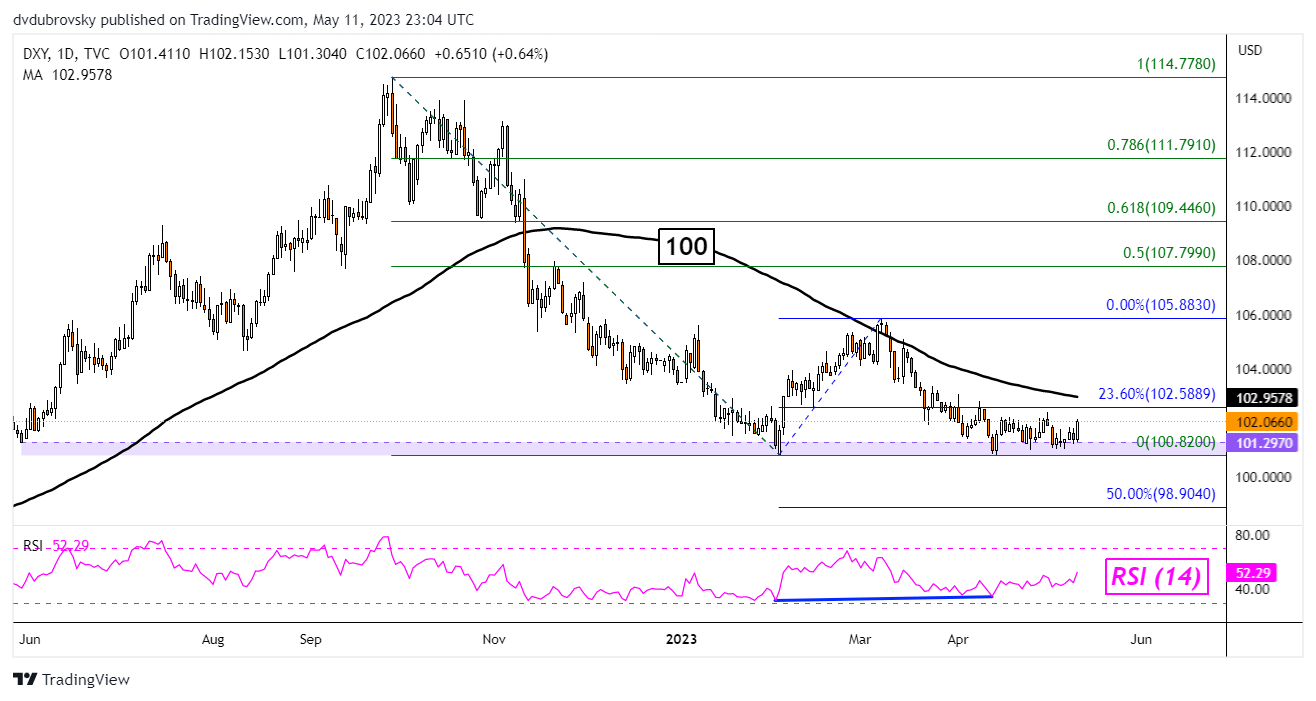
The anti-risk US Dollar and Japanese Yen outperformed their major counterparts on Thursday as haven demand boosted their appeal. Meanwhile, the sentiment-linked Australian and New Zealand Dollars underperformed. The DXY Dollar Index gained 0.64% over the past 24 hours, clocking in the best day since March 15th.

Last week, it was revealed that 264k jobless claims were filed in the United States. That was the highest outcome since October 2021, representing a 9% increase compared to the previous reading. This is an early sign that the labor market could be showing signs of cracking after remaining persistently tight despite aggressive monetary policy tightening from the Federal Reserve.

While the S&P 500 finished lower by the end of Thursday, tech stocks remained resilient, bolstered by a strong performance from Alphabet Inc, the Google parent company. This followed a demonstration of its A.I. tools and ambitions, which investors cheered. Still, economic jitters remained the focus for financial markets as traders flocked to the safety of Treasuries, pushing up prices as bond yields fell.

Heading into the remaining 24 hours, as well as Friday’s Asia-Pacific trading session, the US Dollar and Japanese Yen may continue capitalizing on US economic woes, which may coincide with a global growth slowdown. That may place regional indices at risk, such as Japan’s Nikkei 225 and Australia’s ASX 200. This may leave AUD/USD and NZD/USD tilted lower as well.

US Dollar Technical Analysis

On the daily chart, the DXY Dollar Index continues to hover above the critical 101.297 – 100.82 support zone. Key resistance is a combination of the 23.6% Fibonacci extension level at 102.58 as well as the 100-day Simple Moving Average (SMA). Clearing these could open the door to an extension higher. Otherwise, turning lower exposes the midpoint of the extension at 98.90.

DXY Daily Chart

DXY Daily Chart


Crude Oil Price Steadies After Taking a Tumble. Where to for WTI?

Crude Oil Price Steadies After Taking a Tumble. Where to for WTI?

Crude oil is steady at the start of trade on Friday after retreating overnight with the US Dollar finding firmer footing with the market taking some positives from US data.

Jobless claims were above estimates at 264k for last week rather than the 245k anticipated, but PPI came in at 2.3%, instead of the 2.5% expected and 2.7% previously.

The jobs data points toward an easing in the tight labour market while the PPI figures led to hopes that consumer price pressures might be softening down the track.

Both economic data points appeared to reaffirm the view that the Federal Reserve will pause its hiking cycle at the next Federal Open Market Committee (FOMC) meeting in June.

The futures and overnight index swap (OIS) markets are pricing in a Fed cut for September despite comments overnight from Minneapolis Federal Reserve President Neel Kashkari overnight. He said that while CPI has been coming down, it remains too high.

Undermining the crude price was data released by the US Energy Information Agency (EIA) on Wednesday. It showed an inventory build of 2.951 million barrels for the week ended May 5th, rather than forecasts for a drop of 917k barrels.

Earlier in the week, the White House announced that the Strategic Petroleum Reserve (SPR) may start to replenish stock as soon as next month. It had been tapped to deal with inflationary pressures emanating from higher energy prices as a result of the Russian invasion of Ukraine.

Update crude oil prices can be found here.

WTI CRUDE OIL TECHNICAL ANALYSIS

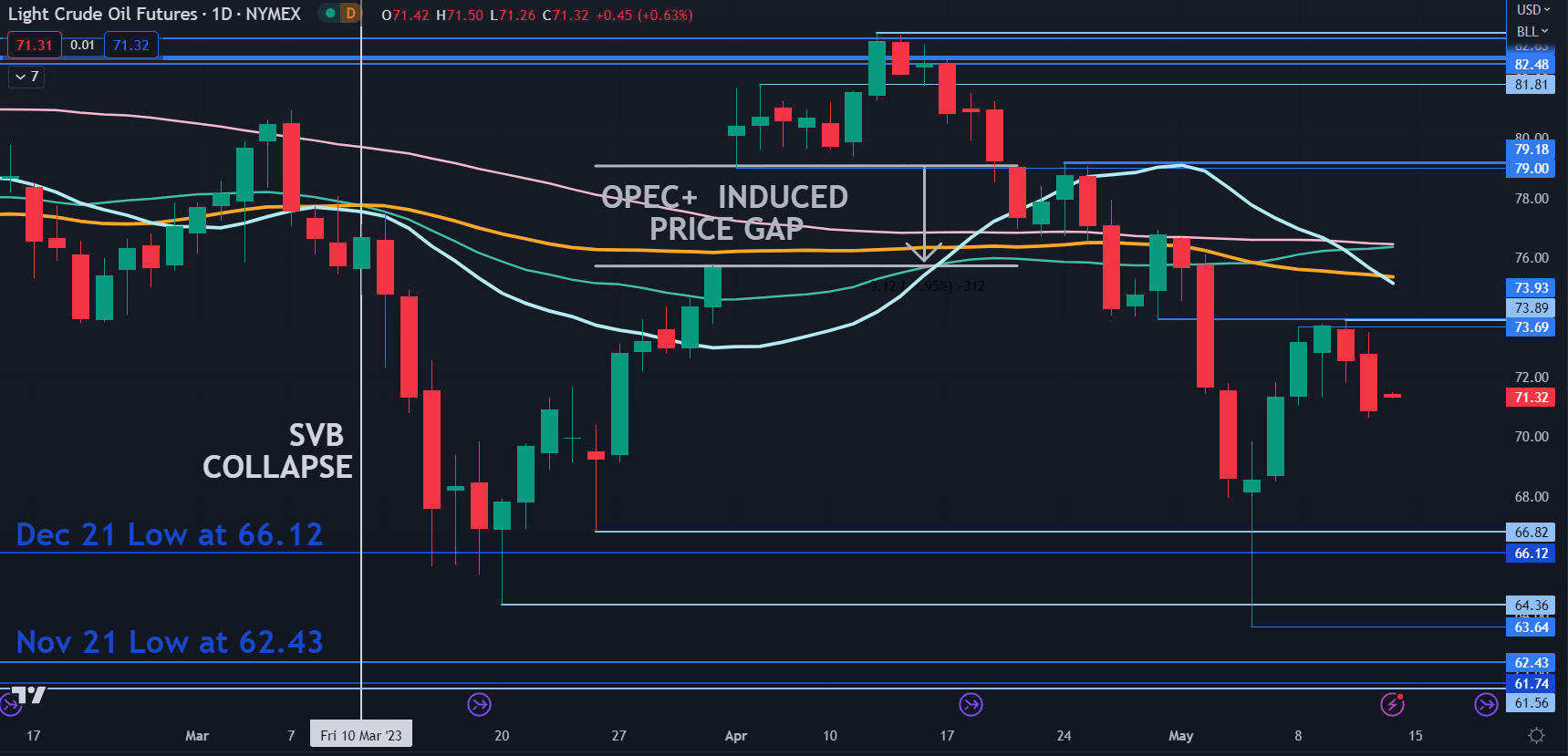
WTI failed to overcome breakpoint resistance at 73.93 this week when it made a high at 73.89 on Wednesday.

Those levels may continue to offer resistance ahead of a cluster of Simple Moving Averages (SMA). The 21-, 34-, 55- and 100-day daily SMAs all lie between 75.15 and 76.45.

The convergence of these SMAs could suggest further range trading in the near term.

On the downside, support might reside at the breakpoints of 66.82, 66.12 and 64.36 or further below at the prior lows of 63.64 and 62.43.

image1.png


Is New Zealand Dollar Turning Corners? Price Setup in NZD/USD, AUD/NZD, GBP/NZD

Is New Zealand Dollar Turning Corners? Price Setup in NZD/USD, AUD/NZD, GBP/NZD

The New Zealand dollar has rebounded sharply in recent weeks against its peers in the G10 space. Against the US dollar, the New Zealand currency needs to clear a final barrier for the outlook to improve materially.

NZD has gained sharply since late April – a possibility highlighted in the previous update “How Much More Downside in New Zealand Dollar: Price Setups in NZD/USD, AUD/NZD, EUR/NZD”, published April 20.

NZD has been boosted by growing expectations of another rate hike by the Reserve Bank of New Zealand at its May 24 meeting following a bigger-than-expected 50 basis points increase in April. New Zealand inflation is at 6.7% on-year, not too far from the three-decade highs of 7.3% hit in Q2-2022, NZ jobs market, including wage growth, is still strong. Unless there are material signs of moderation in inflation and the labour market, RBNZ rate cuts are distant.Key focus will be on the forward guidance of RBNZ – any indication of a pause could take the sting out of NZD’s rally.

In contrast, the US Federal Reserve has indicated a pause in its rate hiking campaign, and US CPI data earlier this week supports the case for a Fed pause. Money markets are pricing 75 basis points of Fed rate cuts by the year-end. The relative monetary outlook appears to be in favour of NZD for now. The risk, of course, is risk sentiment takes a back seat on lingering banking sector concerns and uncertainty related to the US debt ceiling, weighing on NZD.

NZD/USD Daily Chart

image1.png

Chart Created Using TradingView

NZD/USD: Rebounds from a strong cushion at the March low

NZD/USD rebounded at the end of last month from a strong cushion to the March low of 0.6085 (the previous updatehighlighted the case for a rebound from the March low). It is now testingcrucial resistance on the upper edge of the Ichimoku cloud cover on the daily and weekly charts, coinciding with the early-April high of 0.6375.

Any break above would trigger a double bottom pattern (the March and April lows), pointing to a potential rise toward 0.6650. Importantly, such a break would reinstate the higher-top-higher-bottom sequence. Interim resistance is at the February high of 0.6540 and the 200-week moving average at 0.6585. For the downward pressure to resume, NZD/USD would need to fall below 0.6085. Until then, the path of least resistance is sideways to up.

AUD/NZD Daily Chart

image2.png

Chart Created Using TradingView

AUD/NZD: Turns lower from a key barrier

AUD/NZD’s retreat from the upper edge of the Ichimoku cloud on the daily charts and the 200-day moving average, slightly below the February high of 1.1085 confirms that the path of least resistance remains sideways down. Any break below immediate support at the early-April low of 1.0585 could open the door initially toward the end-2022 low of 1.0470. Subsequent support is at the 2021 low of 1.0275.

GBP/NZD Weekly Chart

image3.png

GBP/NZD: Mean reverting?

The sharp retreat from a tough hurdle at the February 2022 and the October 2022 highs of 2.0300-2.0530 have raised the odds that GBP/NZD could be moving back within the range. The mid-point of the range is around 1.9400. For the outlook to turn bullish, GBP/NZD would need to cross above the February 2022 high of 2.0530.

Hawkish vs Dovish: How Monetary Policy Affects FX Trading

Hawkish vs Dovish: How Monetary Policy Affects FX Trading

You have probably heard a financial news presenter say something along the lines of “The central bank governor came out slightly hawkish today after bouts of strong economic data”. The terms Hawkish and Dovish refer to whether central banks are more likely to tighten (hawkish) or accommodate (dovish) their monetary policy.

Central bank policy makers determine whether to increase or decrease interest rates, which have significant impact on the forex market. Policy makers increase interest rates to prevent an economy from overheating (to prevent inflation from going too high) and they decrease interest rates to stimulate an economy (to prevent deflation and stimulate GDP growth).

Hawkish and dovish policies affect currency rates through a mechanism central bankers like to call “forward guidance”. This is policy makers trying to be as transparent as possible in their communications to the market about where monetary policy may be heading.

Keep reading to learn more about hawkish and dovish policies and how to apply this knowledge to your forex trades.

What does hawkish mean?

The term hawkish is used to describe contractionary monetary policy. Central bankers can be said to be hawkish if they talk about tightening monetary policy by increasing interest rates or reducing the central bank’s balance sheet. A monetary policy stance is said to be hawkish if it forecasts future interest rate increases. Central bankers can also be said to be hawkish when they are positive about the economic growth outlook and expect inflation to increase.

Currencies tend to move the most when central bankers shift tones from dovish to hawkish or vice versa. For example, if a central banker was recently dovish, stating that the economy still requires stimulus and then, in a later speech, stated that they have seen inflation pressures rising and strong economic growth, you could see the currency appreciate against other currencies.

Some words that could be used describing a hawkish monetary policy include:

  • Strong economic growth
  • Inflation increasing
  • Reducing the balance sheet
  • Tightening of monetary policy
  • Interest rate hikes

Generally, words used that indicate increasing inflation, higher interest rates and strong economic growth lean towards a more hawkish monetary policy outcome.

What does dovish mean?

Dovish refers to the opposite. When central bankers are talking about reducing interest rates or increasing quantitative easing to stimulate the economy they are said to be dovish. If central bankers are pessimistic about economic growth and expect inflation to decrease or become deflation and they signal this to the market through their projections or forward guidance, they are said to be dovish about the economy.

Some words that could be used to describe a dovish monetary policy, include:

  • Weak economic growth
  • Inflation decreasing/deflation (negative inflation)
  • Increasing the balance sheet
  • Loosening of monetary policy
  • Interest rate cuts

Hawkish vs Dovish Explained

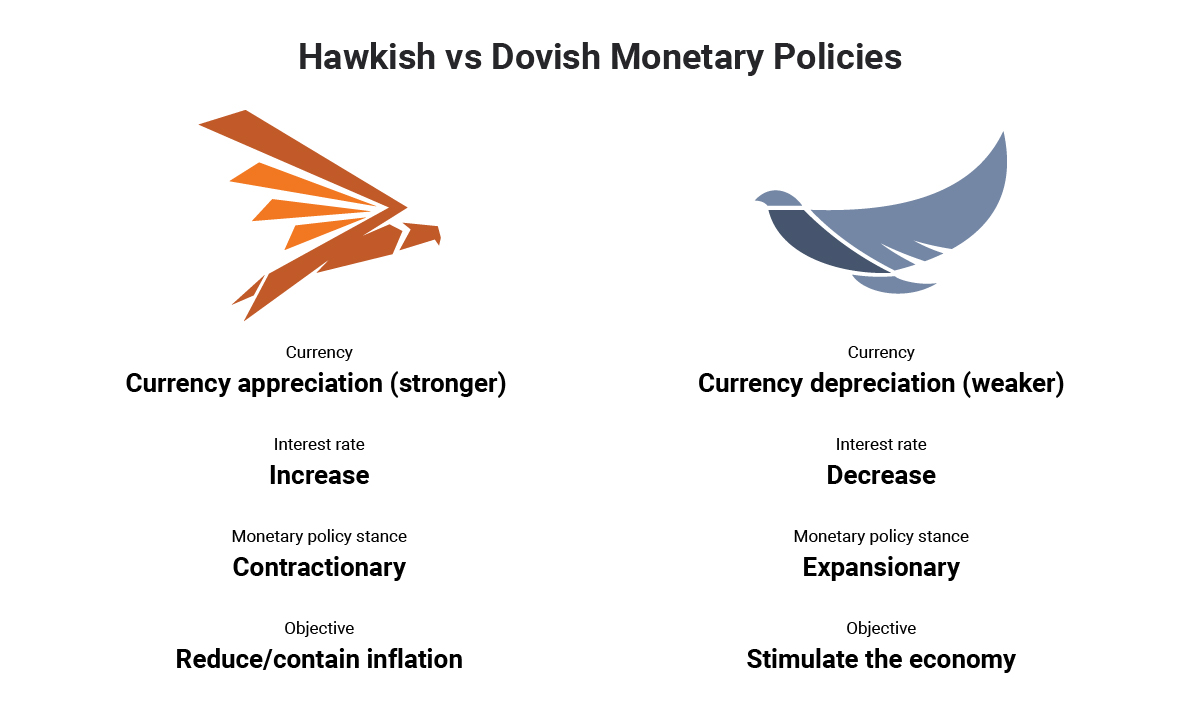
The below graphic provides a snapshot of the main differences between hawkish and dovish monetary policy:

hawkish vs dovish

The table below provides a more in depth comparison on dovish vs hawkish monetary policies, highlighting the differences between the two and how they impact currencies.

Hawkish monetary policies Dovish monetary policies
Increasing interest rates to stem inflation pressures

→ Currency could appreciate as capital flows to higher interest rate currency

Decreasing interest rates to stimulate the economy

→ Currency could depreciate as capital flows to a lower interest rate currency

Reducing the Federal Reserve balance sheet by selling mortgaged backed securities (MBS) and treasuries

→ Currency could appreciate as selling of treasuries and MBS could increase interest rates

Increasing the Federal Reserve balance sheet through quantitative easing (QE). QE is the purchasing of MBS and treasuries that increase the money supply in the economy to stimulate it.

→ Currency could depreciate as an increase in money supply decreases demand for the currency

Forward guidance from central banks include positive statements about the economy, economic growth, and inflation outlook.

→ Currency could appreciate as investors forecast further interest rate hikes

Forward guidance from central banks include negative statements about the economy, economic growth, and signs of deflation.

→ Currency could depreciate as investors forecast interest rate cuts

How to trade a Hawkish or Dovish Central Bank

A slight shift in tone from a central banker could have drastic consequences for a currency. Traders often monitor Federal Open Market Committee meetings and minutes to look for slight changes in language that could suggest further rate hikes or cuts and attempt to take advantage of this.

Monetary policy leaning dovish to hawkish

Monetary policy standing as at 1 January 2019

The image above shows the different central banks current monetary policy stance. When a central banks’ monetary policy stance moves more towards the left (dovish) their currency could depreciate against other currencies. If the monetary policy stance moves more towards the right (hawkish) their currency could appreciate.

Trading a hawkish or dovish central bank isn’t as easy as buying a hawkish central bank currency or selling a dovish central bank currency. It has to do with changing interest rate expectations. Let’s look at two scenarios:

Scenario 1:

If a central bank is currently in a rate hiking cycle, the market will have already forecasted future interest rate hikes. It is the job of the trader to watch for clues and economic data that could shift the tone of the central bank to either more hawkish than currently, or to dovish. Currencies could move a large amount when the monetary tones shift from what they are currently.

Scenario 2:

Likewise, if a central bank is currently cutting rates and economic data hasbeen negative, the market would have priced-in the current dovish monetary stance. Traders would have to watch the central bankers forward guidance and economic data, which you can find on an economic calendar, for clues to whether they may become more dovish than currently, or hawkish.

In late 2018 the federal reserve was quite hawkish. Federal Reserve Chairman, Jerome Powell, stated that “we’re a long way away from neutral at this point” which the market perceived as hawkish (2 Oct 2018). This implied that the Federal Reserve still had to hike rates many more times to get to the neutral rate. Then on the 28th of November, the FOMC released their statement of monetary policy in which Jerome Powell said he saw rates at “just below neutral”. This shift in tone is like scenario 1 above, where the central banks shifts tone from hawkish to slightly dovish. Leading to a depreciation of the currency- see the charts below that show what happened to the Dollar Index (DXY) on the October 2, 2018 and then on the November 28, 2018.

October 2, 2018 – Federal Reserve Chairman, Jerome Powell says “We’re a long way away from neutral at this point” leading to appreciation of the Dollar.

15min US Dollar index chart, vertical line indicating October 2, 2018.

2nd October Federal Reserve chairman states that rates are a far away from neutral

November 28, 2018 Federal Reserve Chairman says that interest rates are “just below neutral” indicating a shift in tone from hawkish to dovish. Dollar depreciations.

15min USD Dollar index chart

Federal reserve chairman Jerome Powell states that rates are just below neutral

Keeping up to date with central banks can be difficult. At DailyFX we have a Central Bank Weekly Webinar where we analyze central bank decisions and keep you up to date with central bank activity.

If you are just starting out on your trading journey it is essential to understand the basics of forex trading in our New to Forex guide. We also offer a range of trading guides to supplement your forex knowledge and strategy development.

Senior Analyst, Tyler Yell of DailyFX sat down with former Federal Reserve Advisor, Danielle Dimartino Booth in a podcast that covered global central bank developments and Danielle’s biggest lesson she learned as a Fed insider.