
I posted on this a while back: Here’s an interesting item that suggests China may soon dump the COVID zero policy. AUD, NZD, oil, China shares are all getting excited: AUD and NZD are moving higher as China reopening chatter spreads. I can confirm now that there is indeed a news conference being given by the Joint Prevention and Control Mechanism of the State Council in China at 3pm local time in Beijing. 0700 GMT. Update on Chinese stocks: Hong Kong’s Hang Seng is up 3.7%. Shanghai Composite is up 2%.
USD/JPY Fundamental Daily Forecast – Japan Retail Sales Rise for Eighth Straight Month
The Dollar/Yen is edging lower early Tuesday following a volatile trading session the previous day. Early selling pressure was fueled by investors buying the Japanese Yen for safe-haven protection as investors dumped risky assets in response to unrest in China. The Forex pair rebounded in a big way from its intraday low, however, after a Fed official sent a hawkish message to traders.
Japanese Yen Holds Steady as China’s COVID-related Worries Weigh
The Japanese Yen is up slightly against the U.S. Dollar as concerns about unrest in China over COVID-19 restrictions dampened market sentiment, however, its gains are being limited as hawkish remarks from Federal Reserve officials supported the greenback.
Rising tensions in China over the country’s stringent pandemic measures sent investors flocking to the safe-haven Yen. Police in China on Monday stopped and searched people at the sites of weekend protests in Shanghai and Beijing, after crowds there and in other cities demonstrated against the country’s strict zero-COVID policy.
Hawkish Fed Remarks Offset China Worries
The greenback may be getting some support today after Monday’s dramatic turnaround was fueled by hawkish comments from St. Louis Fed President James Bullard and New York Fed President John Williams.
Bullard said that the Fed needs to raise interest rates quite a bit further, while Williams said the U.S. central bank needs to press forward with rate rises but did not say how fast it will need to boost short-term borrowing costs.
Limited Reaction to Japanese Economic News
Japan’s Unemployment Rate came in unchanged at 2.6%, however, it was higher than the 2.5% forecast.
Retail Sales plunged from an upwardly revised 4.8% to 4.3%. This was less than the 5.0% estimate. However, it also marked an eighth successive month of annual growth in October after a full reopening of borders added to the boost from this year’s dismantling of internal pandemic control measures.
There was little growth from September, however, as Japanese households were squeezed by inflation running at its fastest pace in 40 years.
Short-Term Outlook
Traders are going to try to hold the USD/JPY in a trading range as they await key data due later this week that will provide insights into how the U.S. economy is faring amid high interest rates and inflation.
Data on Tuesday includes the Home Price Index (HPI), the S&P/CS Composite-20 HPI y/y and the Conference Board’s Consumer Confidence report.
A series of key labor market data is due also due this week, including ADP’s private business payroll figures and JOLTS job openings on Wednesday, as well as November Non-Farm Payrolls and Unemployment data on Friday.
All eyes will also be on comments from Fed Chair Jerome Powell on Wednesday. Traders will be watching for any new signals on further tightening. The Fed is widely expected to hike rates by an additional 50 basis points when it meets on December 13-14.
Chinese Stocks Rebound as Protests Ease, Property Support Added
Chinese assets rallied amid speculation that the government will further relax its Covid Zero policy after weekend protests, with new property measures also buoying sentiment.
The Hang Seng China Enterprises Index gained as much as 5.2%, while the offshore yuan jumped 1.1% against the dollar. Country Garden Holdings Co. led an advance in property stocks, with the bonds of key developers advancing.
Traders took solace after weekend protests against Covid restrictions subsided amid heavy policy presence, although uncertainty remains high over what the government will do next. A state media report that frequent PCR tests are unnecessary for low-risk people and a Covid briefing slated for later in the day helped fuel reopening bets.
Read: China Reopening Stocks Rise as Xinhua Eases Tone on Covid Tests
“There is growing speculation there will be an imminent announcement of the end of Covid-Zero policy and that’s driving the positive sentiment,” said Kiyong Seong, lead Asia macro strategist at Societe Generale SA in Hong Kong. “Markets will remain volatile as investors assess any policy shift.”
Chinese assets have been facing a potential turnaround moment following moves to relax Covid restrictions and a slew of support measures for ailing developers. Key equity indexes are headed for the best month in years, though the outlook for China’s Covid Zero pivot is now unclear as the nation grapples with a worsening outbreak.
Goldman Sachs Group Inc. said Monday that the nation may have a messy, but earlier-than-expected exit from its Covid Zero policy.
Tuesday’s stock-market moves tracked gains in the Nasdaq Golden Dragon China Index overnight, when the gauge closed up 2.8% despite a broader US market slump.
Property Rescue
The property sector got another boost after the securities regulator lifted a multi-year ban on share sales by builders. The removal of restrictions aims to support the “stable and healthy” development of the sector, according to a statement late Monday.
Read: Turmoil Grips China Markets as Covid Protests Cloud Reopening
The government has been taking bolder steps recently to rescue the property sector, after its piecemeal approach earlier this year failed to reverse a slump. In another sign of easier funding access, a key program to guarantee local bond sales from developers will now accept collateral beyond just their core assets, according to people familiar with the matter.
Read: China Stocks Defy US Gloom on Optimism Over Earnings, Reopening
A Bloomberg Intelligence gauge of developers jumped more than 9%, taking this month’s advance to 65%. The CSI 300 Index, a benchmark for mainland shares, advanced more than 3%. The Hang Seng Index rallied 4.4%.
The country’s junk dollar bonds, dominated by developers, rose at least 1 cent on the dollar, according to traders, with Seazen Group and Country Garden leading gains.
“The property measure is big for A-share developers, given the refinancing of developers in A-share has been technically suspended since 2010,” said Willer Chen, senior analyst at Forsyth Barr Asia Ltd. “This sends a strong signal to the market that CSRC wants to help developers” on their financing issues, he added.
China’s offshore and onshore yuan extended gains. The offshore pair jumped as much as 1.1% to 7.1654 per dollar. Traders also offloaded government bonds on bets of a faster economic recovery following new property measures.
“Investors will be happy if the protests accelerate a move to accepting Covid and opening up the country,” said Andrew Collier, a managing director at Orient Capital Research Inc. “However, Xi Jinping’s history of centralized decision making is going to make it difficult for local officials to decide exactly how open they should be.”
RBA’s Gov. Lowe: I am uncertain about the labour market and price reaction to supply shock
RBA'S GOV. LOWE: I AM UNCERTAIN ABOUT THE LABOUR MARKET AND PRICE REACTION TO SUPPLY SHOCK.
— Breaking Market News ⚡️ (@financialjuice) November 27, 2022
Westpac NZ Weekly Economic Commentary: It won’t happen overnight
We have revised our forecast for the Official Cash Rate higher. We now expect a 75 basis point rise in February, and a further 50 basis point rise in April (previously we had expected increases of 50bp and 25bp respectively at those meetings). Those increases would take the OCR to a peak of 5.50% – its highest level since 2008. Behind that change in our OCR forecast has been ongoing strength in inflation, and a related hawkish lurch from the RBNZ. The central bank delivered a 75 basis point rise in the Official Cash Rate at its November policy meeting. That was the largest ever increase in a single meeting,
Indo-Pacific strategy aims to counter ‘disruptive’ China with boosts to investment, security
Canada will attempt to balance its approach to an “increasingly disruptive” China by investing billions of dollars toward economic opportunities in the Indo-Pacific region while strengthening its security and intelligence networks, a long-awaited strategy released Sunday says.
The federal Indo-Pacific Strategy seeks to take advantage of the economic growth in the region — estimated to be home to over half the global economy by 2040 — while also pursuing Canadian priorities in climate change prevention, rights for women and girls and Indigenous reconciliation.
Yet the threat posed by China looms large over the plan, which aims to maintain diplomatic ties and find common ground where possible while also defending Canada’s interests and security.
“We will compete with China when we ought to and we will cooperate with China when we must,” Foreign Affairs Minister Melanie Joly told Mercedes Stephenson on The West Block shortly before the strategy was publicly released.
Pointing to China’s gradual bending of international norms for its own purposes and its buildup of military forces, Joly said the superpower’s aggressive moves underline “why we need to step up our game.”
“We need to invest more in this part of the world because it is extremely important for our own sovereignty and also our own peace and stability,” she said.
Indo-Pacific strategy includes $2.2B investment over five years
The strategy includes the deployment of additional military assets to the region, including frigates tasked with not only ensuring security in Chinese airspace and waters but also the continued implementation of sanctions on North Korea.
There will also be further investment in domestic and regional cybersecurity infrastructure — as well as in the RCMP, the Canadian Security Intelligence Service, and other security and border agencies — to protect Canada from cyberattacks and foreign interference.
The latter issue has received fresh scrutiny in recent weeks. Canadian intelligence officials have warned Prime Minister Justin Trudeau that China has allegedly been targeting Canada with a vast campaign of foreign interference, which includes funding a clandestine network of at least 11 federal candidates running in the 2019 election, according to Global News sources.
Canadian military to play stronger role in Indo-Pacific region: Trudeau
The RCMP is also investigating so-called “police stations” allegedly set up by Beijing in Toronto and Vancouver to crack down on the activities of Chinese-Canadians.
“When it comes to foreign interference in general, I think we have to do more to counter it,” Joly said. “And that’s why we’re putting $150 million on the table to deal with this, because we need to step up our game.
“We need to invest in intelligence agencies and also in the RCMP.”
US Dollar Rises on Haven Demand; Stocks Face Pressure
Shares slid while the dollar and Treasuries rose as growing unrest in China over Covid restrictions sent a shiver through global markets.
Chinese equities led stock-market declines in Asia, with weakness also evident European futures. US contracts dropped as modest customer traffic and heavy discounting by American retailers on Black Friday added to the downbeat tone.
The greenback strengthened on haven demand, showing notable gains against the currencies of Australia and South Korea, which are heavily exposed to trade with China. The onshore yuan dropped as much as 1% before trimming its loses.
The advance in Treasuries was accompanied by a rally in Australian and New Zealand government bonds. Meanwhile, the cost to insure Asia’s ex-Japan high-rated dollar bonds against default headed for its first increase in five days.
“Markets will respond negatively to the widespread protests and rising case numbers, which are likely to trigger new supply-chain disruptions and dampen consumption demand, at least in the short term,” said Gabriel Wildau, managing director at Teneo Holdings LLC in New York.
Oil slumped to the lowest level since December as the developments in China punished risk assets and clouded the outlook for energy demand, adding to stresses in an already-fragile global crude market.
Gold edged lower as the dollar strengthened, placing downward pressure on the precious metal.
The downbeat mood emanating from China contrasts with the boost to sentiment in global markets last week after the Federal Reserve’s Nov. 1-2 meeting minutes showed most officials backing slowing the pace of interest-rate hikes.
Fed Focus
Since the Fed’s latest meeting, investors have parsed a bevy of economic data that somewhat eased inflation concerns, further strengthening the case for smaller rate hikes.
The S&P 500 notched a weekly gain of 1.5% that took the index to the highest level since early September. The Nasdaq 100 also eked out a gain for the week.
All eyes will be on the US jobs report this week and on Fed Chair Jerome Powell and New York Fed President John Williams, who are among central bank officials scheduled to speak.
Amid the challenges in China, the nation’s central bank on Friday cut the amount of cash lenders must hold in reserve for the second time this year, an escalation of support for an economy that’s being weighed down by Covid curbs.
“Anything exposed to China is probably going to be vulnerable,” said Jessica Amir, a market strategist at Saxo Capital Markets in Sydney. “Forward earnings of Chinese exposed companies will be in question and investors will probably express that by selling.”

EUR/USD and a Return to $1.0450 in the Hands of ECB President Lagarde
It is a quiet start to the week for the EUR/USD on the economic calendar. There are no economic indicators from the Eurozone for investors to consider.
Following last week’s reaction to the private sector PMIs and business and consumer sentiment numbers, monetary policy will remain a focal point today.
Trading Derivatives carries a high level of risk to your capital and you should only trade with money you can afford to lose. Trading Derivatives may not be suitable for all investors, so please ensure that you fully understand the risks involved, and seek independent advice if necessary. A Product Disclosure Statement (PDS) can be obtained either from this website or on request from our offices and should be considered before entering into a transaction with us. Raw Spread accounts offer spreads from 0.0 pips with a commission charge of USD $3.50 per 100k traded. Standard account offer spreads from 1 pips with no additional commission charges. Spreads on CFD indices start at 0.4 points. The information on this site is not directed at residents in any country or jurisdiction where such distribution or use would be contrary to local law or regulation.
Last Thursday, the ECB monetary policy meeting minutes highlighted that “households were increasingly postponing major purchases and reducing their savings in order to maintain their consumption of basic necessities.”
Despite this, the ECB noted that there was still excess savings from the COVID-19 pandemic and, coupled with fiscal support and labor market conditions, should drive consumption.
Following the latest sentiment numbers, the markets will look for any shift in sentiment toward the economic outlook and monetary policy.
ECB President Christine Lagarde will speak today. While ECB member commentary has delivered uncertainty toward the December policy move, Lagarde has maintained the need for further rate hikes to tackle high inflation. Clues on the likely size of the next move would influence the EUR/USD.
EUR/USD Price Action
At the time of writing, the EUR was down 0.03% to $1.03819. A mixed start to the day saw the EUR/USD fall to an early low of $1.03655 before finding support.
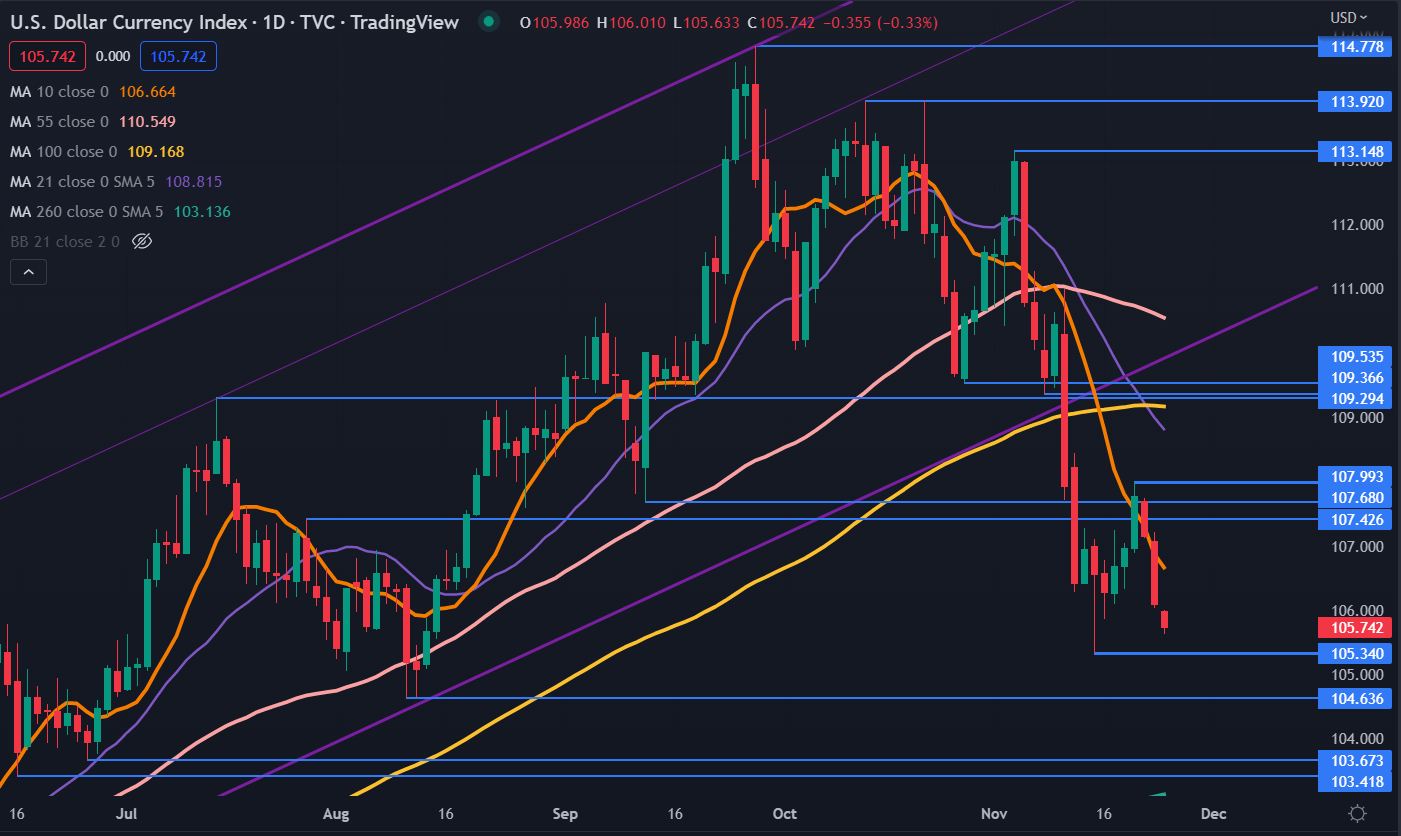
US Dollar Grabs the High Ground on Growth Risks. Will the USD (DXY) Index Bounce?
The US Dollar has gained some traction to start the week after a weekend that saw protests across China regarding their zero-case Covid-19 policy.
The policy had already raised concern among global investors with rolling lockdowns continuing to impede an economic recovery for the world’s second-largest economy.
The Greenback found support on the back of this perceived negativity and growth-linked currencies, such as the Australian Dollar, have seen the largest declines. The Japanese Yen is the only currency to outperform the ‘big dollar’ so far today.
Last saw week saw the dollar slide through a holiday-impacted trading environment on the back of a perceived dovish tilt emanating from the meeting minutes of the Federal Reserve.
The week ahead will see a swathe of vital economic data highlighted by US GDP and core PCE figures on Wednesday.
While equity markets took some joy from the Fed’s minutes, the bond market continues to foretell a challenging economic outlook. The benchmark 2s 10s yield curve is inverted to around 80 basis points, a level not seen since 1981.
The fixed-income market is implying that interest rates are going notably higher in the near term but will then ease significantly as the slowdown in economic activity takes hold.
For currencies, it is a game of relativity and once the noise around a potential pivot from the Fed dies down, the superior rate of return from US Dollar cash might move into focus again.
DXY (USD) INDEX TECHNICAL ANALYSIS
The DXY index might have a Double Bottom in place and a move above the recent peak of 107.99 would confirm this.
Support could be at the prior lows of 105.63, 105.34, 104.64, 103.67 and 103.42.
On the topside, resistance might be offered at the breakpoints in the 109.29 – 109.54 region or at the high of 107.99.

GBPJPY maintains weak bias in near-term; broader trend is bullish
GBPJPY is retreating somewhat above the downward sloping short-term simple moving averages (SMAs). The rebound off the 162.95 support level lasted until the 169.05 resistance level, with the technical oscillators confirming the recent sideways move. The RSI is flattening above the neutral threshold of 50, while the MACD is standing above its trigger line in the positive region, but the momentum is very weak.
Should prices reverse lower, immediate support could come from the 20-day SMA at 167.10 ahead of the 50-day SMA at 165.27. A drop below this area would take the pair closer to the 162.95 barrier and the 200-day SMA currently at 162.60. Further losses would open the way towards the 159.70 bottom, while a breach of this level would shift the outlook from positive to neutral.
To the upside, there is immediate resistance just above the 169.00 psychological mark, while above that, the next major resistance to watch is the almost seven-year peak of 172.10. If there are further advances, the bulls may extend the upside move towards the inside swing low from April 2015 at 175.00.
To summarize, GBPJPY has been in an ascending movement since March 2020 in the long-term timeframe; however, the short-term picture is lacking a clear direction. Any climbs above the multi-year peak would endorse the broader outlook again. 
Latest News
XM Research – 5 hours agoNeutral
Technical Analysis – GBPJPY maintains weak bias in near-term; broader trend is…
XM Research – 6 hours agoBearish
Technical Analysis – USDCAD retreats as latest recovery fades
XM Research – 23 hours agoNeutral
Technical Analysis – Apple stock in tight range after advance pauses
XM Research – 23 hours agoBullish
Technical Analysis – EURUSD bulls look exhausted near 1.0400
XM Research – 1 day agoNeutral
Technical Analysis – ETHUSD gains upside traction aft
 Chat now!