EUR/SEK: Riksbank has to pursue a more attractive monetary policy to see a stronger Krona – Commerzbank

EUR/SEK: Riksbank has to pursue a more attractive monetary policy to see a stronger Krona – Commerzbank

On Thursday, the Riksbank disappointed with its decision. Ulrich Leuchtmann, Head of FX and Commodity Research at Commerzbank, analyzes the Riksbank policy outlook and its implications for the Swedish Krona (SEK).

Thedéen does not have the funds to intervene

Riksbank governor Erik Thedéen does not have the funds to intervene. And empty threats are not only unproductive, but counterproductive.

One can only recommend to the Riksbank to pursue a more attractive monetary policy from the FX market’s point of view if it wants to see a stronger Krona.

EUR/USD struggles for a firm intraday direction, consolidates in a range above 1.0900 mark

EUR/USD struggles for a firm intraday direction, consolidates in a range above 1.0900 mark

The EUR/USD pair struggles to gain any meaningful traction on the first day of the new week and oscillates in a narrow trading band through the Asian session. Spot prices, however, manage to defend the 1.0900 mark, though remain below the 200-hour Simple Moving Average (SMA) resistance, warranting caution before positioning for an extension of Friday’s goodish rebound from a two-week low.

The shared currency continues to draw some support from rising bets for another 25 bps lift-off by the European Central Bank (ECB) in July and turns out to be a key factor lending some support to the EUR/USD pair. The preliminary report published by Eurostat showed that the annual Euro Zone Harmonised Index of Consumer Prices (HICP) decelerated from 6.1% to 5.5% in June. That said, the Core HICP rose by 0.3% MoM and edged higher to the 5.4% YoY rate, reaffirming expectations for more rate hikes by the ECB in the coming months.

That said, the emergence of some US Dollar (USD) buying, supported by the Federal Reserve’s (Fed) hawkish stance, is holding back bulls from placing aggressive bets around the EUR/USD pair and acting as a headwind. It is worth recalling Fed Chair Jerome Powell reiterated last week that borrowing costs may still need to rise as much as 50 bps by the end of this year. Moreover, the current market pricing indicates a nearly 85% chance of a 25 bps lift-off at the July FOMC meeting and the bets were reaffirmed by Friday’s mixed US PCE Price Index.

In fact, the Bureau of Economic Analysis reported that the annual PCE Price Index decelerated to 3.8% in May from 4.3% in the previous month. Additional details showed the Core PCE Price Index, excluding the volatile food and energy components, ticked down to 4.6% during the reported month from 4.7% in April. The gauge, however, remains well above the Fed’s 2% target and supports prospects for further policy tightening. This remains supportive of elevated US Treasury bond yields, which lend support to the USD and cap the EUR/USD pair.

Apart from this, worries about economic headwinds stemming from rapidly rising borrowing costs warrant some caution for bullish traders ahead of this week’s important macro releases, starting with the US ISM Manufacturing PMI on Monday. The focus, meanwhile, will remain glued to the FOMC meeting minutes on Wednesday, which will be followed by the closely-watched US monthly employment details – popularly known as NFP. This will play a key role in influencing the USD and provide a fresh directional impetus to the EUR/USD pair.

Asia Day Ahead: Lighter Start to the Week but Risk-On Prevails

Asia Day Ahead: Lighter Start to the Week but Risk-On Prevails

The second quarter has concluded with a further pull-ahead in risk sentiments last Friday, with the S&P 500 closing at its highest level in 14 months while the Nasdaq has turned in its second consecutive quarter of gains. Improving market breadth lately suggests that market gains have been broadening out, as a pushback in economic data against recession fears brought traction towards other economically sensitive sectors for some catch-up performance. The equal-weighted S&P 500 index is at its highest since February this year.

Small-cap stocks have been seeing some signs of life as well, with the Russell 2000 index back to retest its recent June 2023 high at the 1,900 level. Thus far, its Relative Strength Index (RSI) has retained above the 50 level, along with the formation of a new higher low last week, which kept the overall upward bias intact. The 1,900 level will serve as immediate resistance to overcome. Reclaiming this level could anchor in a new higher high and potentially pave the way for the index to retest the key psychological 2,000 level next, where its year-to-date high resides.

image1.pngOn the economic data front, market participants seem to take comfort in a lower-than-expected read from the US core PCE price index (4.6% versus 4.7% consensus), but more notably, the core services ex-housing component has come in at a new 10-month low on a month-on-month basis. Being highlighted previously by the Federal Reserve (Fed) as a gauge for inflation persistence, promising progress on that front has allowed the Fed more room to consider a rate pause after the July meeting. Fed funds futures continue to price for one last 25 basis-point rate hike from the Fed to conclude the hiking cycle.

The US dollar did not take the US inflation data well last Friday, turning in 0.45% lower despite some resilience in US Treasury yields. That allowed gold prices to see some relief (+0.53%) from recent sell-off, while silver prices are attempting to defend its 200-day moving average (MA) with some dip-buying towards the end of last week. Ahead, the US Independence Day holiday tomorrow may put a lighter trading session to start the week, with some focus on the US ISM manufacturing PMI data release tonight.

Asia Open

Asian stocks look set for a positive open, with Nikkei +1.35%, ASX -0.01% and KOSPI +1.13% at the time of writing. Following a retracement from previous overbought technical conditions, the Nikkei has formed a new higher low on the daily chart, with long-legged candles pointing to some dip-buying at around the 32,300 level. The index is just 1% away from June 2023 high, which may leave any formation of a new higher high on watch over the coming days to reiterate its overall upward trend.

Across the region, a series of PMI data was met with some hits and misses, particularly with Japan’s factory activities falling back into contractionary territory in June (49.8 versus previous 50.6) while South Korea’s PMI also marked a deeper contraction (47.8 versus previous 48.4) as a reflection of the global economic slowdown. The day ahead will leave China’s Caixin PMI reading in focus. Following the subdued read in the official manufacturing PMI last week, the Caixin PMI is expected to reinforce the lacklustre economic conditions in China, which may support more to be done by authorities.

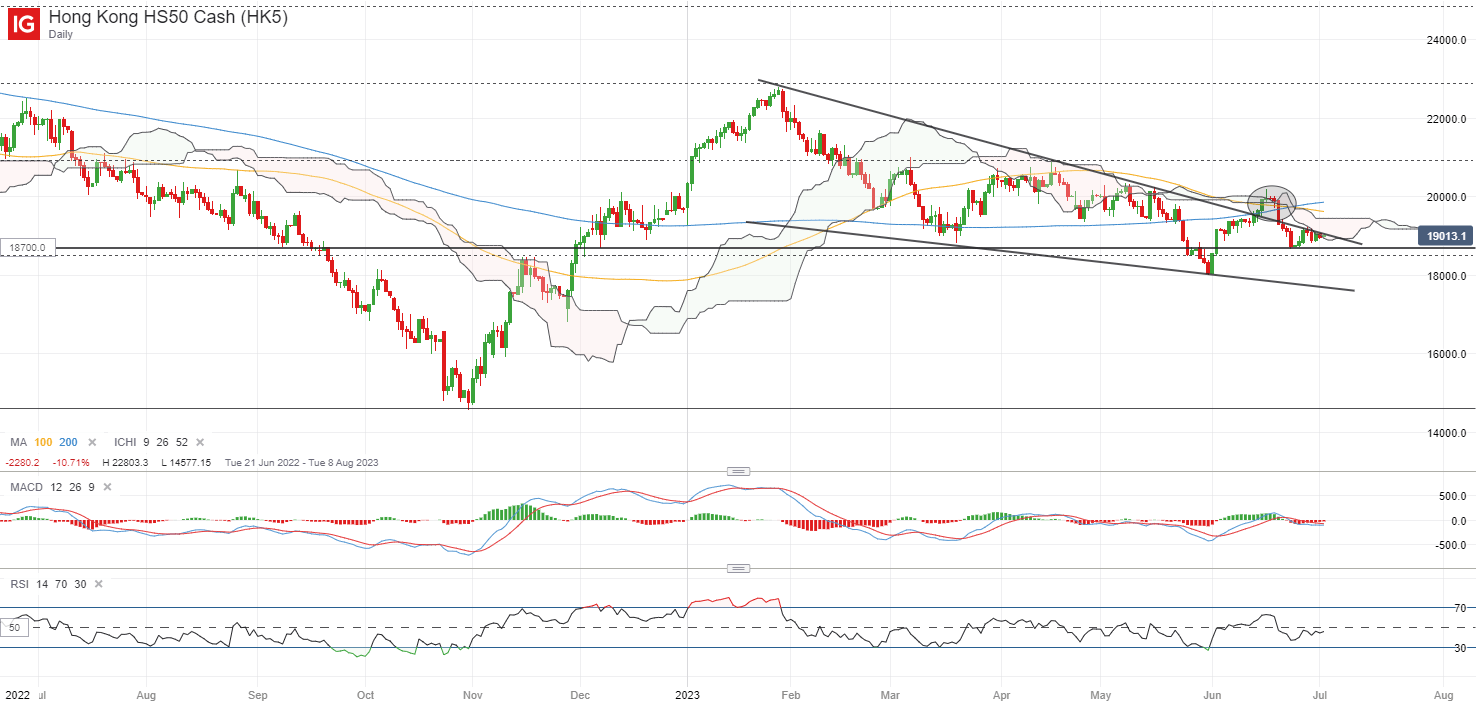
Thus far, the Hang Seng Index remains exhausted, with its RSI back below the 50 level while a descending wedge pattern stays in place after a short-lived attempt for a breakout. On the upside, it seems that a series of resistance need to be overcome to reflect greater control from buyers, particularly the psychological 20,000 level, where the upper edge of the Ichimoku cloud resides on the weekly chart.

image2.pngOn the watchlist: AUD/USD on watch ahead of RBA’s interest rate decision this week

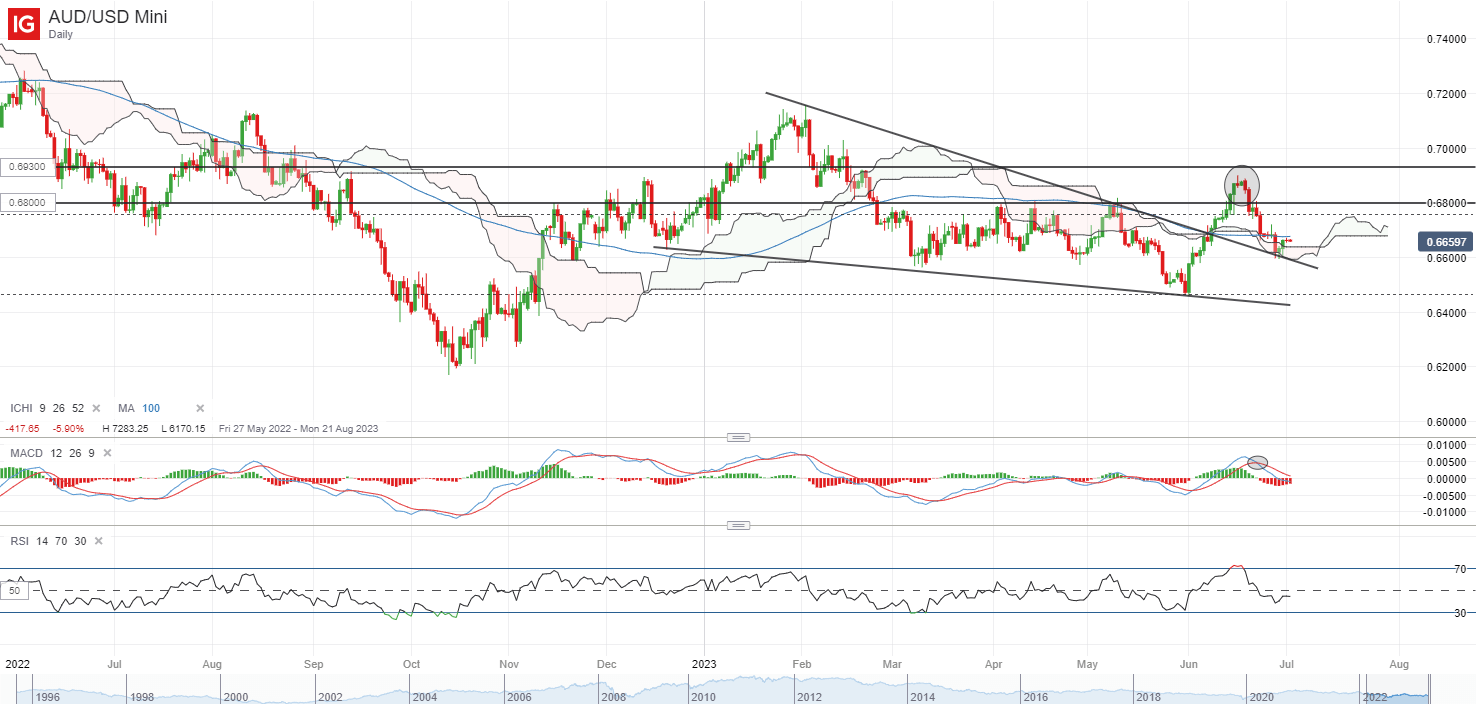
The AUD/USD has managed to touch its three-month high in mid-June, only to have a dovish surprise in the Reserve Bank of Australia (RBA) meeting minutes trigger a sharp retracement back below the 0.680 level. The strong pushback against previous hawkish expectations has forced a move back below its key 100-day MA for the pair, with the RSI hovering below the 50 level.

As the RBA meeting looms tomorrow, a significantly lower-than-expected Australia’s inflation data last week has left expectations leaning towards a rate pause but it may likely be a close call, with market still pricing for any pause to be a temporary move as compared to the end of tightening. The AUD/USD is currently back to retest a downward trendline support on the daily chart at the 0.660 level but much awaits. A series of resistance may have to be overcome to provide conviction of bulls taking back control, which includes its 100-day MA and the 0.680 level of resistance.

image3.pngFriday: DJIA +0.84%; S&P 500 +1.23%; Nasdaq +1.45%, DAX +1.26%, FTSE +0.80%

Australian Dollar Buoyed by Solid Data Locally and in China. Higher AUD/USD?

Australian Dollar Buoyed by Solid Data Locally and in China. Higher AUD/USD?

The Australian Dollar found firmer footing before retreating today with growth-orientated assets generally moving higher to start the week.

Australian building approvals for May rose by a whopping 20.6% month-on-month, well above the 3.0% anticipated and -8.1% prior.

Interest rate markets are placing a low probability of a hike from the RBA tomorrow, but these numbers could spice up the monetary policy meeting. The Aussie Dollar bumped higher on the news but struggled to run on with it.

APAC equities are a sea of green, following on from Wall Street’s solid gain seen on Friday. Some positive economic news out of North America gave markets the boost ahead of a holiday-impacted start to the week there.

Today, China’s Caixin PMI manufacturing data also added to the uptick in mood, coming in at 50.5 rather than the 50.0 forecast.

Washington announced that US Treasury Secretary Janet Yellen will visit China this week in further signs of a potential thawing in the sometimes-frosty relationship between the two largest economies.

Crude oil has had a quiet session as it continues to recover from a test lower last week. The WTI futures contract is near US$ 70.50 bbl while the Brent contract is a touch above US$ 75 bbl.

Likewise, spot gold has barely moved as it trades near US$ 1,920 at the time of going to print. Higher Treasury yields seen on Friday might undermine the precious metal if they continue north.

Looking ahead, a series of European PMIs could hold the market’s attention ahead of US ISM manufacturing figures. The full economic calendar can be viewed here.

AUD/USD TECHNICAL ANALYSIS

AUD/USD remains range-bound today after failing to penetrate breakpoint support levels toward the end of last week.

Those levels at .6574 and 0.6565 might continue to provide support ahead of the late May low of 0.6458.

Further down, support may lie at the prior low of 0.6387 and the nearby Fibonacci level of 0.6381. The latter is the 78.6% Fibonacci Retracement of the move from the low of 0.6170 to the peak of 0.7158.

On the topside, resistance could be at a potential breakpoint resistance zone in the 0.6800 – 0.6820 area.

Further up, resistance could be at the previous peaks of 0.7011 and 0.7030 ahead of a cluster zone in the 0.0.7137 – 0.7157 area.


image1.png