Australian Dollar Dips After RBA Pauses on Hiking Cycle. Will AUD/USD Go Lower?

Australian Dollar Dips After RBA Pauses on Hiking Cycle. Will AUD/USD Go Lower?

The Australian Dollar took a hit after the RBA paused in its tightening of monetary policy following a 25 basis point lift last month to leave the cash rate at 4.10%. The ASX 200 got a boost on the news.

The move appeared to have the echo of a similar stance by the US Federal Reserve at its June meeting with a ‘hawkish hold’ perspective.

In the accompanying statement on monetary policy, the RBA said, “Some further tightening of monetary policy may be required to ensure that inflation returns to target in a reasonable timeframe, but that will depend upon how the economy and inflation evolve.”

Going into today’s decision, the futures interest rate market priced in a less than 20% probability of a hike while a Bloomberg survey of economists saw 14 in favour of a pause and 13 looking for a lift.

That uncertainty could be explained by mixed signals from both the RBA and the economic data.

At the June meeting, the minutes hinted toward holding rates steady for today’s gathering. Consequent commentary from RBA board members lent a more hawkish voice to their outlook.

The monthly inflation gauge slipped below forecasts of 6.1% to be at 5.6% year-on-year to the end of May. This monthly read was introduced last year and is struggling for integrity in terms of identifying the true level of price pressures within the Australian economy.

The Australian Bureau of Statistics (ABS) publishes this monthly CPI figure by covering 62-73% of the weighted quarterly basket. The correlation between this monthly figure and the complete quarterly survey could be described, at best, as volatile. At worst it could be considered useless.

In the aftermath of that soft monthly CPI number, retail sales came in strong at 0.7% month-on-month for May rather than the 0.1% anticipated.

Then Australian building approvals data for May rose by an astounding 20.6% month-on-month, well above the 3.0% anticipated and -8.1% prior. The current unemployment rate of 3.6% is near multi-generational lows.

Looking forward, this now places the emphasis on the quarterly CPI figure that will be published on the 26th of July, a week ahead of the August monetary policy meeting. The RBA’s mandate to target inflation of 2–3%, on average, over time, is tied to this number and not the monthly CPI.

If the quarterly CPI remains elevated, it may provide a headache for the RBA that is cognisant of mortgage borrowers transitioning from fixed rate loans to much higher variable rates.

If price pressures have eased notably, there will likely be a sigh of relief at the top of Martin Place.

The RBA’s full monetary policy statement can be read here.

AUD/USD 1 MINUTE CHART PRICE REACTION TO RBA HIKE

Live prices can be found here.

image1.png


Gold Price Steadies with US Dollar Sidelined but an RBA Pause Sinks AUD/USD

Gold Price Steadies with US Dollar Sidelined but an RBA Pause Sinks AUD/USD

The gold price has steadied going into Tuesday’s trading session as markets appear somewhat lacklustre with the US out for a holiday.

Treasury yields have held onto the gains seen going into the end of last week with the benchmark 10-year bond trading near 3.85%. The policy-sensitive 2-year note is back above 4.90% as markets await the Fed meeting minutes that will be released on Wednesday.

Further hopes of an easing in tensions between the US and China took a hit today after Beijing announced restrictions on the export of gallium and germanium.

The metals are vital for semiconductors, telecommunications and electric vehicles. The move appears to be retaliatory measure for the US promoting chip restrictions to China.

Crude oil firmed after Saudi Arabia and Russia vowed to extend their cuts in production ahead of the OPEC+ meeting in Vienna this week. The WTI futures contract is oscillating around US$ 70 bbl while the Brent contract is nearing US$ 75 bbl. Live prices can be found here.

The RBA paused in its rate hike cycle today, leaving the cash rate target unchanged at 4.10%. AUD/USD went lower while the ASX 200 found firmer footing on the news.

Japan’s Nikkei 225 equity index dipped with USD/JPY going slightly lower. Other APAC equities have had a quiet session.

EUR/USD is little moved so far today despite yesterday’s hawkish comments from Joachim Nagel, Bundesbank President and European Central Bank (ECB) policymaker.

Mr Nagel will be speaking again today as well as fellow ECB Governing Council member Yannis Stournaras. ECB President Christine Lagarde will be speaking on Friday.

GOLD PRICE ANALYSIS

The rudderless gold price so far this week might be put down to a US holiday, but it is lacklustre performance is supported by lower volatility as measured by the GVZ index.

The GVZ index measures the implied volatility across a gold exchange-traded fund (ETF) in a similar way that the VIX index measure volatility across the S&P 500 equity index.

The DXY (USD) index has also been in a sideways price action this week and the inflation-adjusted return on the 10-year Treasury note (real yield) also appears to be waiting for the US to return from holiday.

image1.png


EUR/USD holds lower ground near 1.0900 amid thin markets

EUR/USD holds lower ground near 1.0900 amid thin markets

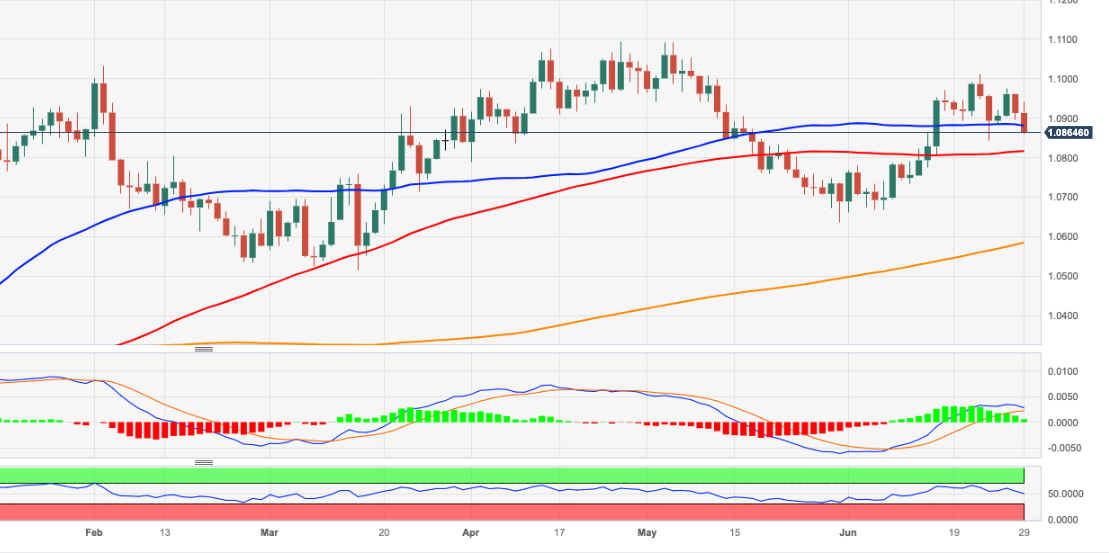
EUR/USD is trading close to 1.0900, holding lower ground in early Europe. The main currency pair is facing selling pressure as the market mood turns cautious and underpins the safe-haven US Dollar. Thin trading to extend on the US Independence Day.

The EUR/USD recovered after the release of weak US data and climbed back above 1.0900 during the American session. Markets could remain calm on Monday due to US holidays. However, the Greenback is losing momentum, and upcoming employment data and the release of the FOMC minutes will be crucial.

Economic data released on Monday showed a negative revision to the Eurozone June Manufacturing PMI, with the headline dropping to 43.4 from the preliminary 43.6. The Service sector data will be released on Wednesday. Despite the weak figures, and as inflation remains eleavted, the European Central Bank (ECB) is set to raise interest rates at the next meeting on July 22, and the odds of another hike in September are above 50%.

On Monday, a weaker US dollar boosted the rebound in EUR/USD from 1.0870 to 1.0935, as data from the US came in below expectations. The ISM Manufacturing PMI dropped from 46.9 to 46, against expectations of a modest increase to 47.2. The Prices Paid Index fell from 44.2 to 41.8, and the Employment Index fell from 51.4 to 48.1.

The Dollar has been supported by hawkish Federal Reserve comments. On Wednesday, the Fed will release the minutes of its latest meeting, and on Thursday and Friday, key labor market data is due, including ADP, Jobless Claims, JOLTS, and Nonfarm Payrolls. Weak data could weigh on Fed rate hike expectations, while the market is currently looking at a 25 basis points hike in July.

Spanish manufacturing output falls further amid worsening demand climate

Spanish manufacturing output falls further amid worsening demand climate

The Spanish manufacturing sector closed off the second quarter of the year still in contraction mode amid further signs of demand weakness. Downturns in output and new orders were both sustained, with the rate of decline in the latter the sharpest since January. Firms responded to lower workloads by readjusting their staff numbers, resulting in the first fall in employment levels since last November. Subdued demand also acted to alleviate cost pressures further. Input prices fell at the sharpest rate in over three years and output charges decreased again. The headline HCOB Spain Manufacturing Purchasing Managers’

Italian manufacturing sector in deepening downturn

Italian manufacturing sector in deepening downturn

Italy’s manufacturing sector rounded off a challenging second quarter of the year by registering its worst fall in output since the height of the COVID-19 pandemic in 2020. New orders were down sharply, whilst firms cut back on their purchasing to a severe degree. A lack of demand and a rapidly improving supply-side picture meant that input prices fell at a rate not seen since April 2009. Firms continued to take on additional staff, but growth slipped to a marginal pace as confidence in the outlook fell since May. After accounting for seasonal factors, the HCOB Italy Manufacturing Purchasing Managers

Yellen To Visit China, Raising Need To ‘Responsibly Manage’ Ties

Yellen To Visit China, Raising Need To ‘Responsibly Manage’ Ties

Treasury Secretary Janet Yellen is set to visit Beijing this week, the United States said Sunday, marking the second trip by a cabinet official to China since ties between the world’s top two economies deteriorated earlier this year.

Yellen is expected to discuss with her counterparts the importance for both countries “to responsibly manage our relationship, communicate directly about areas of concern, and work together to address global challenges,” said the Treasury Department in a statement.

Yellen’s planned July 6-9 trip comes just weeks after Secretary of State Antony Blinken met China’s top leader President Xi Jinping and Foreign Minister Qin Gang in Beijing in June.

Blinken was the highest-ranking US official to visit the Chinese capital in nearly five years, and Xi said on the rare trip that he saw headway in the strained relationship between Washington and Beijing.

In Beijing, Yellen will discuss how the United States views its economic relationship with China, a senior Treasury official said Sunday.

She will meet with senior Chinese officials and leading US firms, the American spokesperson said without providing specifics.

While the US seeks to secure its national security interests and protect human rights, actions to this effect are “not intended to gain economic advantage over China,” the official added.

Washington also looks towards “healthy” ties with Beijing and does not seek to decouple the economies, while pursuing cooperation on urgent challenges like climate change and debt distress, the American official said.

The United States does not expect “significant breakthrough” from this initial trip, but it does aim to build longer-term channels of communication with China, the Treasury official added.

“I think the US government is clearly trying to put some floor under the deterioration of the economic relationship,” Edward Alden, a senior fellow at the Council on Foreign Relations (CFR) told AFP, speaking on the Treasury secretary’s intentions to visit China.

A Yellen trip could “restart a steady pattern of engagement at lower levels,” he said, adding that the US has shifted from being ambiguous about how far it was supporting decoupling to explicitly adopting a strategy of “derisking” instead.

This means “focusing on a narrower range of items that have strategic importance, trying to build fences around those items, but otherwise trying to continue to nurture a reasonably robust US-China economic relationship,” Alden said.

But observers do not expect a quick resolution to tensions.

President Joe Biden‘s administration is considering a program to restrict certain US outbound investments involving sensitive technology with key national security implications — an issue that has riled Chinese officials.

Other possible sticking points include amendments to China’s anti-espionage law which recently broadened the definition of spying while banning the transfer of information relating to national security — a move that has spooked foreign and domestic businesses.

The senior Treasury official told reporters Sunday that Washington intends to communicate its concerns over the law.

While significant disagreements may not be resolved in a single trip, the US seeks to deepen and increase the frequency of communication with China and to “stabilize the relationship,” avoiding miscommunication and expanding collaboration where possible, the official said.

German manufacturers make deeper cuts to output in June as order book decline gathers pace

German manufacturers make deeper cuts to output in June as order book decline gathers pace

German manufacturing firms reported deeper cuts to production levels at the end of the second quarter, in response to a sustained weakening of demand, according to the latest HCOB PMI® survey conducted by S&P Global. Furthermore, expectations towards output prospects in the coming year reached their lowest since last November as surveyed firms cited numerous headwinds to growth. Goods producers in the eurozone’s largest economy meanwhile reported a fall in output prices for the first time since September 2020, reflecting a deepening decline in input costs and growing competitive pressures. The HCOB Germany

Prices charged for eurozone goods fall at strongest rate in three years as demand and production sink further in June

Prices charged for eurozone goods fall at strongest rate in three years as demand and production sink further in June

The downturn in the eurozone’s manufacturing sector intensified during June, latest HCOB PMI® survey data showed, with factory output declining at the sharpest rate since October last year when concerns regarding the price and supply of energy soared. Demand for eurozone goods fell sharply at the end of the second quarter, with weak sales performances particularly evident in Austria, Germany and Italy. Notably, manufacturing employment declined for the first time since January 2021 and business confidence dipped to a seven-month low. Eurozone factories advanced with destocking efforts in June amid continued

Forex Today: US Dollar finds a foothold, eyes on PMI surveys

Forex Today: US Dollar finds a foothold, eyes on PMI surveys

Here is what you need to know on Monday, July 3:

Following Friday’s uninspiring performance, the US Dollar (USD) holds its ground against its rivals early Monday. Ahead of the ISM Manufacturing PMI report for June, The US Dollar Index clings to small daily gains above 103.00. The European economic docket will feature revisions to HCOB Manufacturing PMIs. Markets will also keep a close eye on comments from central bank officials. It’s worth noting that stock and bond markets in the US will close early on Monday and remain closed on Tuesday in observance of the Independence Day holiday.

Annual inflation in the US, as measured by the change in Personal Consumption Expenditures (PCE) Price Index, fell to 3.8% in May from 4.3% in April, the US Bureau of Economic Analysis reported on Friday. In the same period, the Core PCE Price Index edged slightly lower to 4.6% from 4.7%. The initial reaction to soft inflation readings caused the USD to lose some strength ahead of the weekend.

During the Asian trading hours on Monday, June Caixin Manufacturing PMI in China came in at 50.5, down from 50.9 in May but better than analysts’ forecast of 50.2. The Shanghai Composite Index remains on track to post a daily gain of more than 1% and Hong Kong’s Hang Seng Index is up 2% on the day. Nevertheless, US stock index futures trade flat in the European morning.

Following Friday’s rebound, EUR/USD closed the week virtually unchanged. The pair stays under modest bearish pressure early Monday and trades below 1.0900.

GBP/USD gained nearly 100 pips on Friday and ended the week near 1.2700. With the USD staying resilient on Monday, the pair fluctuates slightly below that level.

USD/JPY staged a downward correction on Friday but regained its traction at the beginning of the week. As of writing, the pair was trading in positive territory near 144.80. “Japanese companies expect consumer prices to rise an average 2.6% a year from now, lower than their 2.8% projections three months ago,” the Bank of Japan’s (BoJ) noted in its quarterly Tankan survey. Meanwhile, the headline Tankan Large Manufacturing Index improved to 5.0 in Q2 from 1.0 and surpassed analysts’ forecast of 3.0.

Australian Trade Minister Don Farrell said early Monday that they will be announcing new measures to improve trade relations with China soon. AUD/USD edged higher in the Asian session but reversed its direction in the European morning. AUD/USD was last seen losing more than 0.3% on the day below 0.6650. On Tuesday, the Reserve Bank of Australia announce its interest rate decision.

Gold snapped a four-day losing streak on Friday and erased a large portion of its weekly losses. XAU/USD stays calm above $1,910 early Monday.

Bitcoin struggled to find direction over the weekend and extended its sideways grind above $30,500 early Monday. Ethereum gathered bullish momentum and reached its strongest level since May above $1,950.

NZD/USD: With the AUD leading the Kiwi, RBA meeting is key by association – ANZ

NZD/USD: With the AUD leading the Kiwi, RBA meeting is key by association – ANZ

The Kiwi ended June higher as the USD slipped, likely supported by month-end portfolio rebalancing flows. Tomorrow’s RBA decision will be key, economists at ANZ Bank report.

NFP on Friday, a key input into the July Fed decision

Rebalancing flows undoubtedly favoured the Kiwi, with the NZD up just 0.9% in June vs the S&P 500’s 6.5% gain, implying that investors wanting to maintain portfolio weightings would have sold US stocks and the USD. So the question is, was that a one-off flow, or can this bounce be sustained? Let’s see.

This week is another quiet one on the local data front, but with the AUD leading the Kiwi, tomorrow’s RBA meeting (we expect a hike) is key by association. We also get US Nonfarm Payrolls on Friday, a key input into the July Fed decision (we expect a +25 bps hike).