EUR/USD: Moderate consolidation is on the roll – OCBC

EUR/USD: Moderate consolidation is on the roll – OCBC


The Euro (EUR) traded a touch softer, but range remains subdued, OCBC FX strategists Frances Cheung and Christopher Wong note.

ECB may lower rate again on September 12

“Pair was last seen at 1.1055 levels. Daily momentum is mild bearish while RSI was flat. Support at 1.1026 (recent low), 1.10, 1.0930 (61.8% fibo retracement of 2024 high to low). Resistance at 1.12 (recent high) and 1.1280 (2023 high).”

“Slippage in CPIs out of Euro-area, Germany and Spain and softer mfg PMI print added to expectation that ECB may lower rate again at its upcoming meeting on September 12. Markets have priced in 25bp cut at this meeting and about 36bp cut for remainder of the year (another 1.5 cut).”

“This week, focus is on services PMI, PPI (Wednesday), retail sales (Thursday) and GDP (Friday). Another series of underwhelming data print could move the needle for markets to price in a more dovish ECB and for the EUR to trade lower”.

CAD: Another cut by the BoC – ING

CAD: Another cut by the BoC – ING

The Bank of Canada (BoC) is widely expected to cut rates for a third consecutive meeting today. As discussed in our BoC preview, we think the policy rate will be trimmed from 4.50% to 4.25%, in line with the consensus and market pricing. The Bank won’t release a new set of economic forecasts at this meeting, so all of the market’s attention will be on the forward-looking language used in the statement and press conference, ING’s FX strategist Francesco Pesole notes.

Risks are quite balanced given market pricing

“At the BoC cut in July, Governor Tiff Macklem was generally dovish on the rate outlook, stressing a greater focus on growth over inflation, and signalling there would be more cuts ahead. Since then, Canada had a soft employment read (-3k in July), cooler wage growth, and crucially another slowdown in all key inflation measures, both headline and core. All those measures now range between 2.4% and 2.7%, so well within the BoC’s 1-3% target range.”

“We expect Macklem to reiterate it is “reasonable” to expect more easing by year-end, effectively endorsing market pricing for rates to be taken to 3.75% by year-end – i.e. another two 25bp cuts after September. Our view is that the BoC is on a relatively predictable track to gradually ease policy to reach the 3.0% mark by mid-2025. That is also broadly in line with market pricing.”

“We doubt there will be huge implications for CAD from the BoC decision today. The risks are quite balanced given market pricing, and USD/CAD continues to be more responsive to US developments. We could see much more USD/CAD volatility on Friday when both US and Canadian jobs figures are released. For now, we continue to see USD/CAD as a 1.35-1.36 story in the near term, with risks slightly tilted to the upside as the external environment may not turn much more favourable for high-beta currencies like the loonie.”

USD/JPY: Trading sideways for now – OCBC

USD/JPY: Trading sideways for now – OCBC


USD/JPY turned lower after BoJ Governor submitted a document to government panel, which reiterated that the BoJ would continue to raise interest rates if the economy and prices perform as expected by the BoJ, OCBC FX strategists Frances Cheung and Christopher Wong note.

Sideways trading is likely

“Fed-BoJ policy shifts will bring about a narrowing of UST-JGB yield differentials and this should continue to underpin the broader direction of travel for USDJPY to the downside Elsewhere, the sell-off in equities (pullback in risk appetite) was also another factor weighing on USDJPY.”

“Pair was last seen at 145.20. Bullish momentum on daily chart intact while decline in RSI moderated. Sideways trading likely. Resistance at 146.10 (21 DMA), 147.20 (recent high). Support at 144.40, 143.45 (recent low).”

Gold extends downtrend despite global market sell-off

Gold extends downtrend despite global market sell-off

Gold (XAU/USD) trades about 0.70% lower on Wednesday and is exchanging hands in the $2,470s. Market sentiment remains negative after the global sell-off triggered by the release of weak US manufacturing data on Tuesday, and fears about the Artificial Intelligence (AI) tech bubble bursting.

Surprisingly, this has failed to translate into upside for Gold despite its safe-haven status, perhaps due to the overweight long positioning of Commodity Trading Advisors (CTA) and institutional investors. Despite the turmoil gripping risk assets Gold actually finished Tuesday down over a quarter of a percent.

Gold shrugs off increased probabilities of a 0.50% Fed rate cut

Gold also fails to capitalize on the significant rise in market-based probabilities of the US Federal Reserve (Fed) opting for a larger 0.50% interest rate cut at its September 18 meeting.

Prior to the release of the weak US Manufacturing PMI print, the CME FedWatch Tool – which uses the 30-day fed fund Futures price to estimate chances of future Fed decisions – calculated the probability of the Fed making a 0.50% cut at around 31%. Today the probability has increased significantly to 41%.

Such a big shift in expectations of interest rates falling would normally be expected to have a bullish effect on Gold since it lowers the opportunity cost of holding the non-interest-paying precious metal. However, on this occasion this does not seem to be the case.

US employment metrics, scheduled for release during the remainder of the week, could still impact the outlook for US interest rates either way. This is particularly the case given recent comments by Federal Reserve (Fed) Chairman Jerome Powell, who highlighted risks to the labor market as now being more important than inflation in his speech at Jackson Hole. This week the data will put his remarks to the test.

Wednesday sees the release of US JOLTS Job Openings, which are forecast to show a decline to 8.1 million in July from 8.184 million in June. A more pronounced decline in openings, however, would raise concerns regarding the state of the jobs market and further increase the chances of the Fed making a larger 0.50% cut.

ADP Employment Change and Jobless Claims follow on Thursday, but the main event on the calendar will be US Nonfarm Payrolls (NFP) on Friday. If NFPs increase less than expected it would further support the case of the larger cut.

On the geopolitical front, there are no major flare-ups that could pass through to increased demand for Gold. Although Russia launched a large missile and drone attack on Ukraine on Tuesday, killing 50 people in Poltava, it follows days of similar bombardments.

Out of Gaza, meanwhile, the Israeli populace continues to protest for a ceasefire to allow the safe release of hostages and the US criminally charged Hamas’s leaders for organizing the October 7 attacks.

Technical Analysis: Continues oscillating in a messy range

Gold (XAU/USD) continues meandering within a messy range below its previous all-time highs of $2,531.

It has now broken below the key $2,500 support level – a bearish turn of events from a technical perspective – but remains above the next key level at $2,470-$2,460, the top of the old range formed in July and early August.

XAU/USD Daily Chart
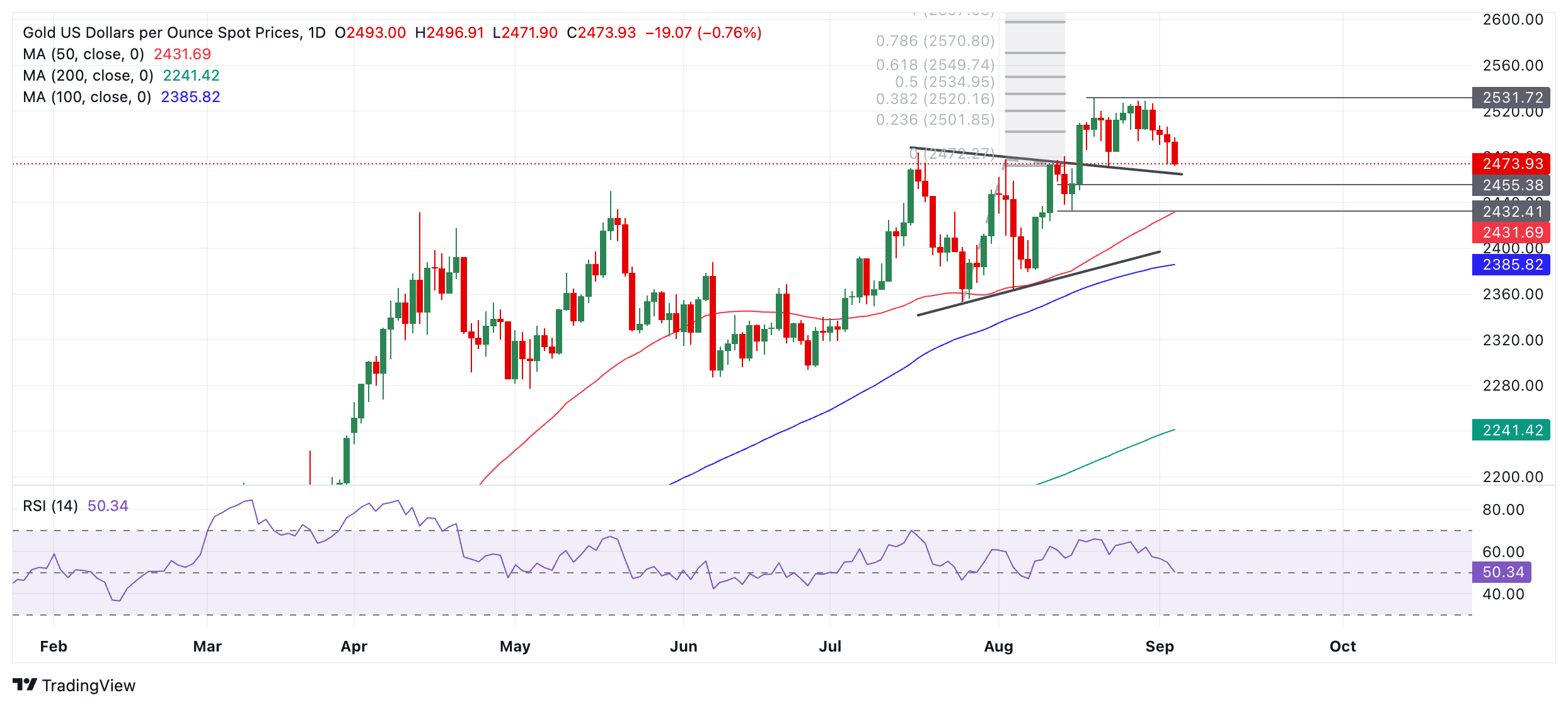

An as yet un-met upside target for Gold sits at $2,550 and remains active. This was generated after the original breakout from the July-August range on August 14.

Gold’s medium and long-term trends also remain bullish, which, given “the trend is your friend,” means the odds still favor an eventual breakout higher materializing.

A break above the August 20 all-time high of $2,531 would provide more confirmation of a continuation higher toward the $2,550 target.

If Gold continues steadily weakening, however, it is likely to next find support at the $2,470-$2,460 level. A decisive break below that level would change the picture for Gold and suggest that the commodity might be starting a more pronounced downtrend.

EUR/USD hovers around 1.1050 amid US Dollar softness

EUR/USD hovers around 1.1050 amid US Dollar softness

EUR/USD is defending bids at around 1.1050 in the European session on Wednesday. The pair stays supported due to soft US PMI data-led US Dollar weakness. Risk-aversion, however, could cap the pair’s upside ahead of US JOLTS Job Openings data.

The Relative Strength Index (RSI) indicator on the 4-hour chart stays near 40 after edging higher on Tuesday, reflecting a lack of buyer interest. On the downside, the pair could face first support at 1.1040 (Fibonacci 38.2% retracement of the latest uptrend) before 1.1000 (psychological level, Fibonacci 50% retracement) and 1.0975 (200-period SMA).

The 100-period Simple Moving Average (SMA) aligns as immediate resistance at 1.1075 ahead of 1.1100-1.1110 (Fibonacci 23.6% retracement of the latest downtrend, 50-period SMA) and 1.1160 (static level).

After closing marginally lower on Tuesday, EUR/USD holds steady near 1.1050 during the European trading hours on Wednesday. The pair’s technical outlook suggests that the bearish bias remains intact.

The negative shift seen in risk mood helped the US Dollar stay resilient against its major rivals on Tuesday and made it difficult for EUR/USD to stage a rebound. Meanwhile, the data from the US showed that the business activity in the manufacturing sector continued to contract in August, albeit at a slightly softer pace than it did in July.

The US Bureau of Labor Statistics will release JOLTS Job Openings data for July later in the day. Market expect the number of job openings to stand at 8.1 million. In case there is a big jump in this data, the immediate market reaction could provide an additional boost to the USD and force EUR/USD to stretch lower. On the other hand, a reading below 8 million could limit the USD’s upside.

In the meantime, US stock index futures were last seen losing between 0.2% and 0.6% on the day. If Wall Street’s main indexes open deep in the red and continue to push lower, EUR/USD could stay on the back foot regardless of the immediate reaction to the JOLTS Job Openings data.

Pound Sterling drops against US Dollar ahead of US Manufacturing PMI

Pound Sterling drops against US Dollar ahead of US Manufacturing PMI

The Pound Sterling (GBP) exhibits a subdued performance slightly above the crucial support of 1.3100 against the US Dollar (USD) in Tuesday’s London session. The GBP/USD pair edges lower as the US Dollar grips gains near an almost two-week high, with investors’ attention turning to the United States (US) Nonfarm Payrolls (NFP) data for August, releasing this Friday.

The US Dollar Index (DXY), which tracks the Greenback’s value against six major currencies, consolidates near 101.70.

Investors keenly await the labor market data as it is expected to drive market speculation for the magnitude of the Federal Reserve’s (Fed) interest rate cut this month. Currently, traders are split about whether the Fed will cut interest rates gradually by 25 basis points (bps) or aggressively by 50 bps.

The importance of the labor market data has increased significantly as comments from Fed Chair Jerome Powell at the Jackson Hole (JH) Symposium indicated that the central bank is more focused on preventing job demand, given that officials are confident about inflationary pressures remaining on track to sustainably return to bank’s target of 2%.

Investors will also get cues about the current labor market status from the US JOLTS Job Openings data for July and the ADP Employment Change data for August, which will be published on Wednesday and Thursday, respectively.

In Tuesday’s session, the US Dollar will be influenced by the S&P Global (final estimate) and ISM Manufacturing Purchasing Managers Index (PMI) data for August, which will be published in the North American session. Economists expect that activities in the manufacturing sector contracted at a slower pace, with the official PMI from the ISM coming in at 47.5 from July’s reading of 46.8.

Daily digest market movers: Pound Sterling falls despite BoE seems to be leaving interest rates steady at 5%

  • The Pound Sterling performs weakly against its major peers, except Asia-Pacific currencies, during the European trading hours. The British currency remains on the back foot even though the Bank of England (BoE) is expected to follow a shallow interest rate cut cycle this year compared to its peer central bankers.
  • Traders see little chance that the BoE will cut interest rates in September but are confident about November, Reuters reported. Market speculation for September interest rate cuts is weak as inflationary pressures in the United Kingdom (UK) are expected to remain sticky due to strong economic prospects. Also, comments from BoE Governor Andrew Bailey at the JH Symposium indicated that the central bank will be careful not to cut interest rates too quickly or by too much.
  • The final estimate of S&P Global/CIPS Manufacturing PMI showed on Monday that activities in the manufacturing sector in the UK expanded to a 26-month high at 52.5 in August, driven by the continuation of a strong recovery in output, new orders, and labor demand.
  • “The UK manufacturing sector remained a positive contributor to broader economic growth in August. The headline PMI hit a 26-month high of 52.5, reflecting solid expansions in output and new orders and the strongest jobs growth for over two years. The upturn is broad-based across manufacturing, with the investment goods sector the stand-out performer”, Rob Dobson, Director at S&P Global Market Intelligence, said.
  • For fresh interest rate clues, investors await BoE policymaker Sarah Breeden’s speech, which is scheduled at 12:45 GMT. Breeden was among policymakers who voted for cutting interest rates in August by 25 basis points (bps) to 5%, along with Andrew Bailey, Swati Dhingra, Dave Ramsden, and Clare Lombardelli.

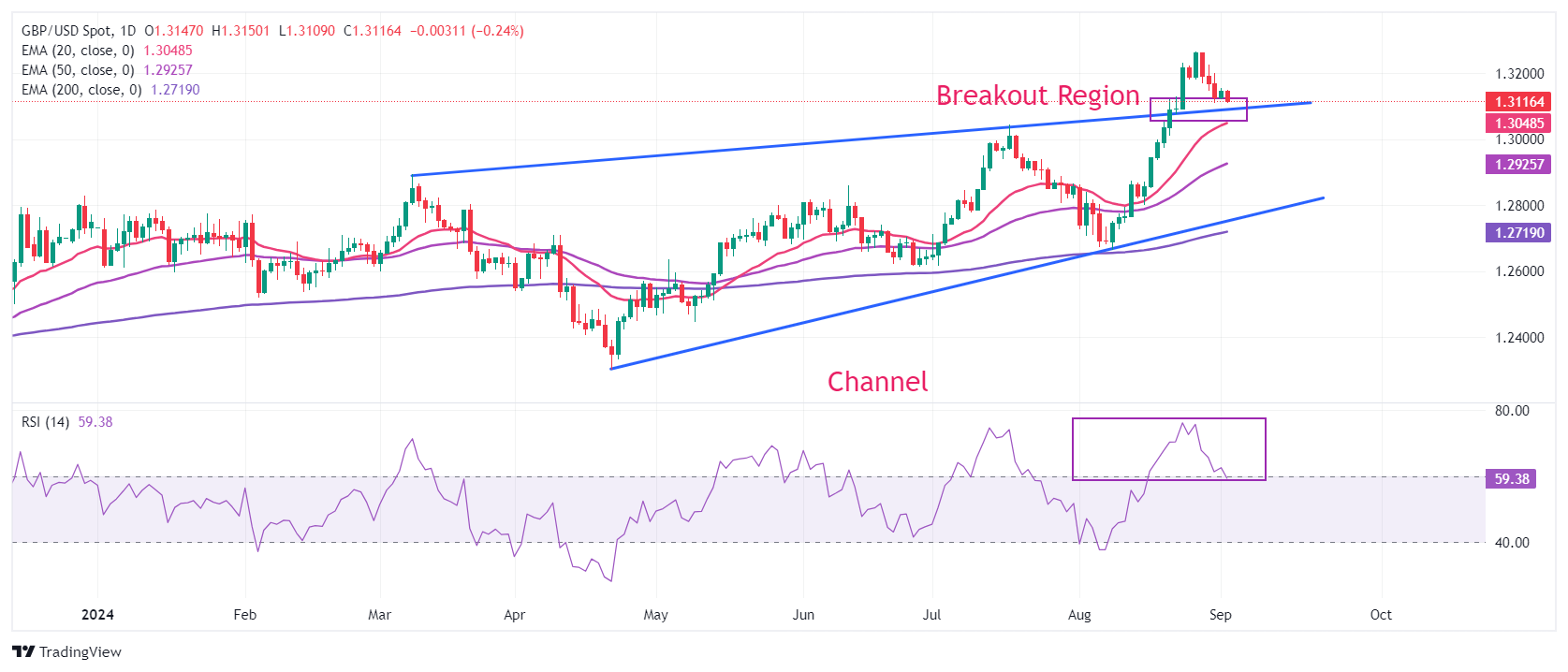
Technical Analysis: Pound Sterling sees support slightly below 1.3100

The Pound Sterling declines to nearly 1.3100 against the US Dollar. The GBP/USD pair faces pressure after declining below the round-level support of 1.3200 last week. The Cable may likely find buying interest near the breakout region of a Channel chart formation on a daily timeframe.

The 14-day Relative Strength Index (RSI) declines to near 60.00 after exiting overbought conditions, signaling a lack of bullish momentum at the moment.

However, upward-sloping short-to-long-term Exponential Moving Averages (EMAs) suggest a strong bullish trend.

If bullish momentum resumes, the Cable is expected to rise towards the psychological resistance of 1.3500 and the February 4, 2022, high of 1.3640 after breaking above a fresh two-and-a-half-year high of 1.3266. On the downside, the psychological level of 1.3000 will be the crucial support for the Pound Sterling bulls.

Bitcoin and Ethereum whale activity declines 50% while BTC, ETH accumulation continues

Bitcoin and Ethereum whale activity declines 50% while BTC, ETH accumulation continues

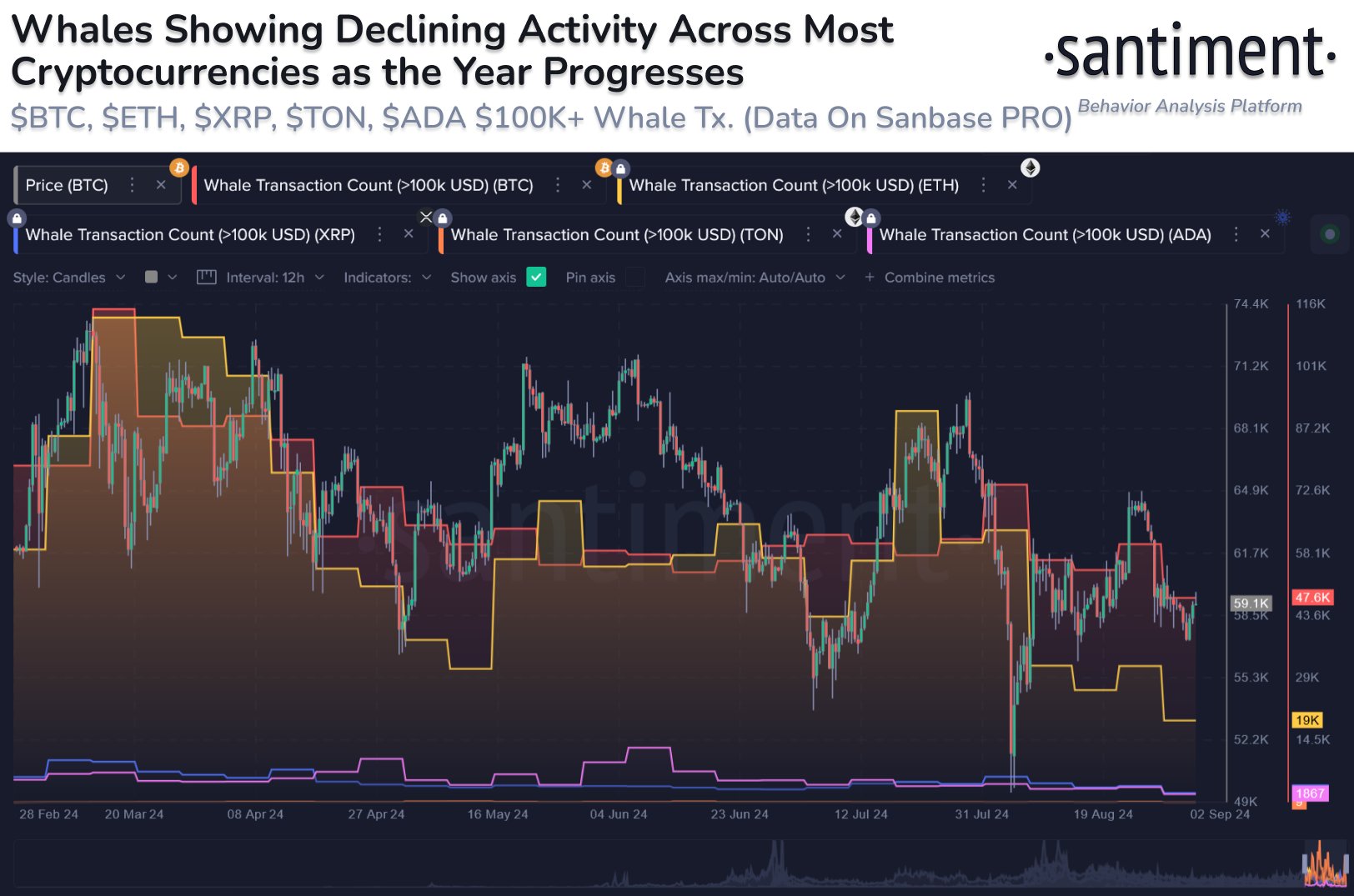
Bitcoin and Ethereum whale activity has slowed down since mid-March 2024 when it hit its peak this year. In March 2024, Bitcoin and Ethereum prices hit a peak of $73,777 and $4,093. The two largest cryptocurrencies have noted a correction in their prices since then.

On-chain analysts note declining whale activity in Bitcoin and Ether

Analysts at crypto intelligence platform Santiment noted a significant drop in the overall whale activity in Bitcoin and Ethereum, compared to the peak observed in March 2024. Data shows that whale activity, defined as transactions valued at $100,000 and higher, are down close to 50%.

Bitcoin whale transactions dropped from 115,100 to 60,200 from mid-March to August 2024. Similarly, Ethereum transactions took a hit, down from 115,100 to 31,800.

Bitcoin

Analysts explain that a decline in whale activity does not mean that large-wallet investors are shedding their token holdings at a loss. However, top addresses historically become most active during times when volatility is high.

Santiment researchers explain that the data indicates a steady flow of BTC, Ether accumulation by whales, even as overall transactions drop.

EUR/USD: Back to the downside of the trade – DBS

EUR/USD: Back to the downside of the trade – DBS

EUR/USD appreciated by 0.2% to 1.1072, brushing aside the victory of Germany’s far-right Alternative for Germany (AfD) in the eastern state of Thuringia, but now it’s back below 1.1048 at 1.1035, DBS Senior FX Strategist Philip Wee notes.

ECB to join Fed in lowering rates.

“The Euro had depreciated in the last three days of the previous week, dropping to 1.1048 from 1.1184, amid expectations of a second interest rate cut at the European Central Bank meeting on September 12.”

“Following the Eurozone CPI inflation decline to 2.2% YoY in August, down from 2.6% in July, the OIS market has priced in a 94% chance of a 25 bps cut in the deposit facility rate to 3.50%.”

“Last week, ECB Chief Economist Philip Lane cautioned that the mission to return to the 2% target was ‘not yet secure’, signalling concerns with the market pricing in a neutral rate of 2.00-2.50% by mid-2025.”

AUD/JPY moves below 98.50 as traders adopt caution due to China economic woes

AUD/JPY moves below 98.50 as traders adopt caution due to China economic woes

AUD/JPY halts its four-day winning streak, trading around 98.40 during the European session on Tuesday. This downside of the AUD/JPY cross is attributed to rising risk aversion as traders adopt caution due to concerns mounting over China’s economic woes.

Traders assess July manufacturing PMI data from China, a key trading partner of Australia. Official figures indicated the sharpest contraction in factory activity in six months, while private survey readings suggested that the manufacturing sector had expanded for the seventh time this year.

Traders are now focusing on Australia’s Q2 Gross Domestic Product (GDP) and July Trade Balance data, as well as an upcoming speech by Reserve Bank of Australia (RBA) Governor Michele Bullock later in the week, to gather more insights into the central bank’s hawkish stance on monetary policy.

On Tuesday, Japan announced the allocation of ¥989 billion to fund energy subsidies in response to rising energy costs and the resulting cost-of-living pressures. This government intervention could potentially contribute to inflation.

The Bank of Japan’s (BoJ) hawkish monetary policy stance has been further reinforced by a recent increase in Tokyo’s inflation. Consumer Price Index (CPI) increased to 2.6% year-on-year in August, up from 2.2% in July. Core CPI also rose to 1.6% YoY in August, compared to the previous 1.5%.

AUD/JPY moves below 98.50 as traders adopt caution due to China economic woes

AUD/JPY moves below 98.50 as traders adopt caution due to China economic woes

AUD/JPY halts its four-day winning streak, trading around 98.40 during the European session on Tuesday. This downside of the AUD/JPY cross is attributed to rising risk aversion as traders adopt caution due to concerns mounting over China’s economic woes.

Traders assess July manufacturing PMI data from China, a key trading partner of Australia. Official figures indicated the sharpest contraction in factory activity in six months, while private survey readings suggested that the manufacturing sector had expanded for the seventh time this year.

Traders are now focusing on Australia’s Q2 Gross Domestic Product (GDP) and July Trade Balance data, as well as an upcoming speech by Reserve Bank of Australia (RBA) Governor Michele Bullock later in the week, to gather more insights into the central bank’s hawkish stance on monetary policy.

On Tuesday, Japan announced the allocation of ¥989 billion to fund energy subsidies in response to rising energy costs and the resulting cost-of-living pressures. This government intervention could potentially contribute to inflation.

The Bank of Japan’s (BoJ) hawkish monetary policy stance has been further reinforced by a recent increase in Tokyo’s inflation. Consumer Price Index (CPI) increased to 2.6% year-on-year in August, up from 2.2% in July. Core CPI also rose to 1.6% YoY in August, compared to the previous 1.5%.