Gold seesaws as traders fold their arms ahead of labor market data

Gold seesaws as traders fold their arms ahead of labor market data

Gold (XAU/USD) oscillates around the $2,500 level on Tuesday as a measure of market calm descends, which does little to drive up demand for safe-haven Gold.

The US Dollar (USD) – to which Gold is negatively correlated – slows in its recovery rally, trading only marginally higher on Tuesday as traders keep their powder dry ahead of the release of potentially market-moving US labor market data later this week.

Investors appear to be calmly awaiting the final “test results” for the patient – in this case the US economy – before drawing any conclusions about the likely course of action ahead, in terms of the Federal Reserve’s (Fed) decision on how much to cut interest rates – a key driver of Gold.

Demonstrations in Tel Aviv, demanding a ceasefire in Gaza after seven Israeli hostages were found dead, and the calling of a general strike by Israeli workers have, if anything temporarily, dialed down the threat level in at least one key geopolitical hotspot, adding to the uneasy calm permeating markets.

Gold traders look ahead to US employment data

Gold price is most likely to see volatility from the release of US labor market data this week. At his pivotal speech in Jackson Hole, Fed Chairman Jerome Powell turned the spotlight away from inflation and onto the fragile-looking labor market, suggesting that downside risks to employment were now greater than upside risks to inflation.

If labor market data out this week in the form of the ISM Manufacturing Employment Index on Tuesday, JOLTS Job Openings on Wednesday, ADP Employment Change, Jobless Claims and ISM Services Employment Index on Thursday, and Nonfarm Payrolls (NFP) on Friday, come out weaker than expected and back up his concerns, it will probably lead to a tumble in the US Dollar (USD) but a rise in the price of Gold.

Markets are debating whether the Fed will need to make a 50 basis point (bps) cut to interest rates in September or just a standard 25 bps cut. The latter is fully expected whilst market-based probabilities for the former sit currently at around 30%, according to the CME FedWatch Tool.

If labor market data is decidedly under par, the chances of a bigger cut will increase, which in turn will give Gold a leg up on the charts. Lower interest rates are positive for the precious metal because they make it comparably more attractive to investors as a non-interest-paying asset.

Technical Analysis: Tests base of mini-range

Gold (XAU/USD) is testing the base of the mini-range it has been trading in since late August, between $2,500 and $2,531. It is currently eroding the range floor, positing marginally lower lows as it descends. There is a risk it could break lower and enter a new zone of activity between the sloping top of the old range highs at about $2,470 and $2,500.
XAU/USD 4-hour Chart
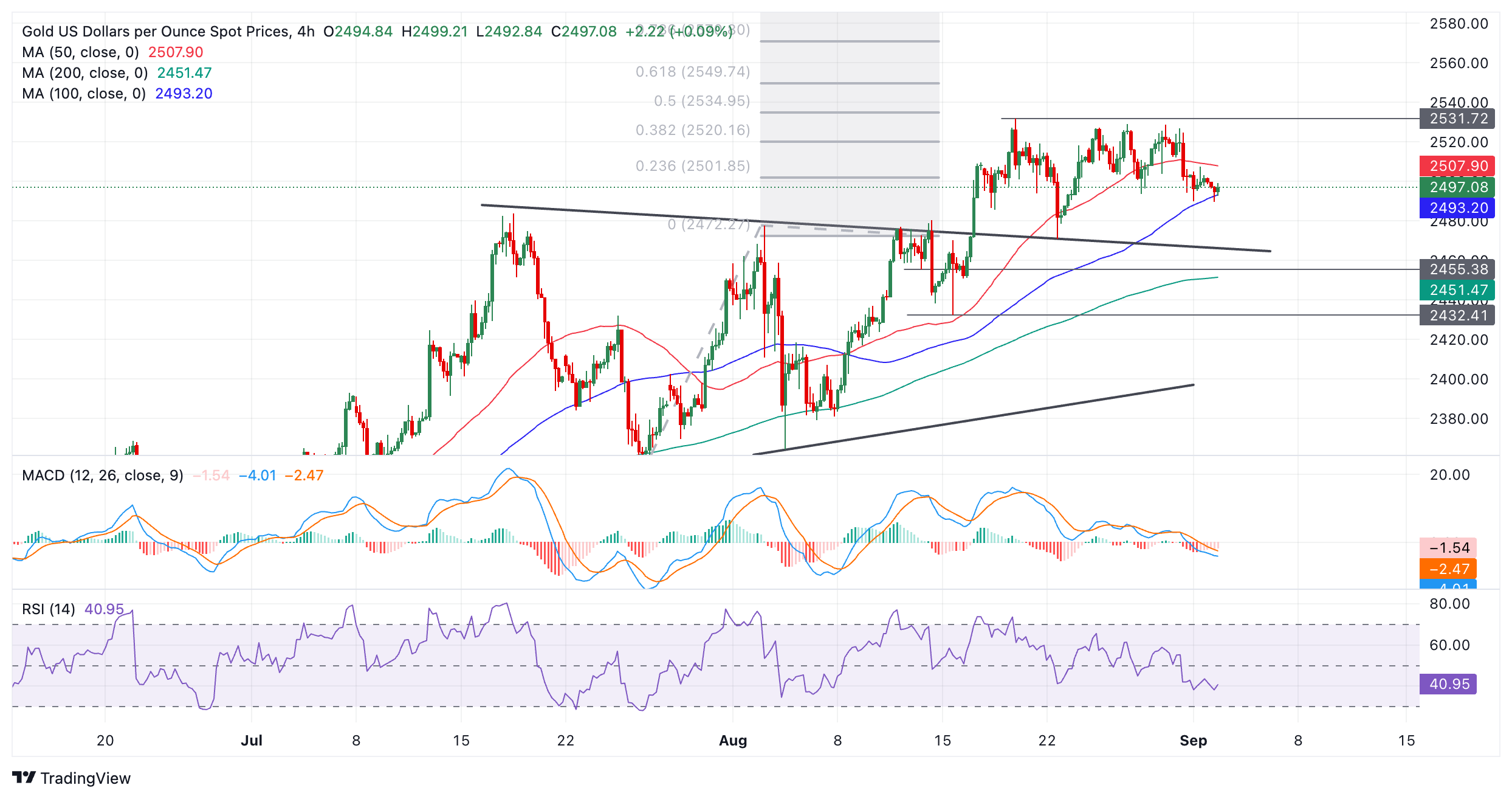
That said, the ultimate as yet un-met upside target for Gold sits at $2,550 and remains active. This was generated after the original breakout from the prior range that started in July, which also looks like a triangle pattern because of its sloping edges.

This upside target was calculated by taking the 0.618 Fibonacci ratio of the range or triangle’s height and extrapolating it higher. This target is the minimum expectation for the follow-through from a breakout based on principles of technical analysis.

Gold’s medium and long-term trends remain bullish, which, given “the trend is your friend,” means the odds favor an eventual breakout higher materializing.

Yet it would require a break above the August 20 all-time high of $2,531 to provide more confirmation of a continuation higher toward the $2,550 target.

Alternatively, a break back inside the previous range would negate the projected upside target. Such a move would be confirmed on a daily close below $2,470 (August 22 low). It would change the picture for Gold and suggest that the commodity might start a short-term downtrend.

EUR/USD stays depressed below 1.1100 amid cautious mood

EUR/USD stays depressed below 1.1100 amid cautious mood

EUR/USD is trading on the back foot below 1.1100 in the European session on Tuesday. The pair stays on a slippery slope, courtesy of the sustained US Dollar recovery, a cautious mood and uncertainty around the ECB’s rate outlook. US ISM Manufacturing PMI awaited.

EUR/USD retreated below the 100-period Simple Moving Average, currently located at 1.1070, on the 4-hour chart and closed the last two candles below this level. Additionally, the Relative Strength Index (RSI) indicator stays below 40, reflecting a lack of buyer interest.

EUR/USD could face immediate support at 1.1040 (Fibonacci 38.2% retracement of the latest uptrend) ahead of 1.1000 (psychological level, Fibonacci 50% retracement) and 1.0970 (200-period SMA).

On the upside, resistances are located at 1.1070 (100-period SMA), 1.1100 (Fibonacci 23.6% retracement) and 1.1160 (static level).

EUR/USD managed to register small daily gains on Monday but failed to gather recovery momentum. The pair stays on the back foot in the European morning on Tuesday and trades near 1.1050.

Thin trading conditions amid the Labor Day holiday in the US made it difficult for EUR/USD to make a decisive move in either direction at the start of the week. The cautious market stance helps the US Dollar (USD) hold its ground early Tuesday and makes it difficult for the pair to gain traction.

In the second half of the day, the ISM will release Manufacturing PMI data for August. The headline PMI is forecast to rise to 47.5 from 46.8 in July. In case this data comes in above 50 and shows an expansion in the manufacturing sector’s activity, the immediate market reaction could help the USD gather further strength.

If the headline PMI arrives near the market expectation, investors could react to the change in the Employment Index of the survey. In July, the Employment Index dropped to its lowest level in four years at 43.4. A significant recovery in this data could ease fears over loosening conditions in the labor market and provide a boost to the USD. On the other hand, a reading below 45, which would show an ongoing decline in the number of employed in the manufacturing sector, could weigh on the currency and open the door for a rebound in EUR/USD.

3 Things I Wish I Knew When I Started Trading Forex

3 Things I Wish I Knew When I Started Trading Forex

Everyone comes to the forex market for a reason, ranging between solely for entertainment to becoming a professional trader. I started out aspiring to be a full-time, self-sufficient forex trader. I had been taught the ‘perfect’ strategy. I spent months testing it and backtests showed how I could make $25,000-$35,000 a year off of a $10,000 account. My plan was to trade forex for a living and let my account compound until I was so well off, I wouldn’t have to work again in my life. I was dedicated and I committed myself to the plan 100%.

Sparing you the details, my plan failed. It turns out that trading 300k lots on a $10,000 account is not very forgiving. I lost 20% of my account in three weeks. I didn’t know what hit me. Something was wrong. Luckily, I stopped trading at that point and was fortunate enough to land a job with a forex broker. I spent the next couple of years working with traders around the world and continued to educate myself about the forex market. It played a huge role in my development to be the trader I am today. Three years of profitable trading later, it’s been my pleasure to join the team at DailyFX and help people become successful or more successful traders.

The point of me telling this story is because I think many traders can relate to starting off in this market, not seeing the results that they expected and not understanding why. These are the three things I wish I knew when I started trading Forex.

1) Forex is not a get rick quick opportunity

Contrary to what you’ve read on many websites across the web, Forex trading is not going to take your $10,000 account and turn it into $1 million. The amount we can earn is determined more by the amount of money we are risking rather than how good our strategy is. The old saying “It takes money to make money” is an accurate one, Forex trading included.

But that doesn’t mean it is not a worthwhile endeavor; after all, there are many successful Forex traders out there that trade for a living. The difference is that they have slowly developed over time and increased their account to a level that can create sustainable income.

I hear about traders all the time targeting 50%, 60% or 100% profit per year, or even per month, but the risk they are taking on is going to be pretty similar to the profit they are targeting. In other words, in order to attempt to make 60% profit in a year, it’s not unreasonable to see a loss of around 60% of your account in a given year.

“But Rob, I am trading with an edge, so I am not risking as much as I could potentially earn” you might say. That’s a true statement if you have a strategy with a trading edge. Your expected return should be positive, but without leverage, it is going to be a relatively tiny amount. And during times of bad luck, we can still have losing streaks. When we throw leverage into the mix, that’s how traders attempt to target those excessive gains. Which in turn is how traders can produce excessive losses. Leverage is beneficial up to point, but not when it can turn a winning strategy into a loser.

2) Leverage can be a winning strategy to lose money

This is a lesson I wish I had learned earlier. Excessive leverage can ruin an otherwise profitable strategy.

Let’s say I had a coin that when heads was hit, you would earn $2, but when tails was hit, you would lose $1. Would you flip that coin? My guess is absolutely you would flip that coin. You’d want to flip it over and over. When you have a 50/50 chance between making $2 or losing $1, it’s a no-brainer opportunity that you’d accept.

Now let’s say I have the same coin, but this time if heads is hit, you would triple your net worth; but when tails was hit, you would lose every possession you own. Would you flip that coin? My guess is you would not because one bad flip of the coin would ruin your life. Even though you have the exact same percentage advantage in this example as the example above, no one in their right mind would flip this coin.

The second example is how many Forex traders view their trading account. They go “all-in” on one or two trades and end up losing their entire account. Even if their trades had an edge like our coin flipping example, it only takes one or two unlucky trades to wipe them out completely. This is how leverage can cause a winning strategy to lose money.

3) Using sentiment as a guide can tilt the odds in your favor

The 3rd lesson I’ve learned should come as no surprise to those that follow my articles… using the IG client sentiment tool (IGCS). I’ve written many articles about this topic. It’s the best tool I’ve ever used and is still a part of almost every trading strategy I am using, present day.

IGCS is a free tool that tells us how many traders are long compared to how many traders are short each major currency pair. It’s meant to be used as a contrarian index where we want to do the opposite of what everyone else is doing. Using it as a direction filter for my trades has turned my trading career completely around.

How to Create a Trading Plan in 7 Steps

How to Create a Trading Plan in 7 Steps

What is a Trading Plan?

A trading plan is essentially a framework that guides traders through the entire trading process. It sets the conditions under which a trader enters trades, identifies markets, exits trades and manages risks along the way. The trading plan ensures accountability and keeps traders focused on their personal strategy.

How to Create a Trading Plan

1) Choose Your Analytical Approach

The analytical approach answers the question, “how do you identify trade set-ups?”. It could be a combination of price support and resistance, trend lines, chart patterns, Fibonacci levels, moving averages, Ichimoku Clouds, Elliott Wave Theory, sentiment or the use of fundamentals etc.

This initial step of the trading plan helps traders to narrow their focus on a handful of scenarios that the trader is comfortable with. Thereafter, traders can look for opportunities to trade based on preferred trade set ups.

2) Select Your Favourite Trade Set Ups

The trade setup is at the core of the trading process. But first, think of the analytical approach as the event that triggers the trade setup. An example of this would be viewing a consolidation pattern (listed in the analytical approach as a chart pattern) which then gives rise to subsequent action from the trader, i.e. the trader will decide to trade the breakout or wait for a pullback or combine breakouts with pullbacks only after the chart pattern has successfully played out.

Set ups are based on a number of factors that collectively lead to higher probability trades. If you are new to forex trading, this process may take some time to figure out but it is essential for traders to find a trade setup that works best for them.

3) Limit the Markets to Focus on

When starting out, it is important for traders to limit the number of markets in focus. No market is the same and limiting the scope of markets can assist traders to understand the nuances of the market in question. Traders can even focus on specific time frames in a single market to familiarize themselves with its characteristics and movements.

4) Think About Your Holding Period

Time frames will depend on the type of trader. Traders that focus on short-term trades (trades opened and closed on the same day) include scalpers and day traders. Medium-term traders usually hold trades for a few hours up to a few days and are referred to as swing traders. Long-term trading involves time frames ranging from a number of days, weeks, months and in some cases, years.

5) Know Your Risk Tolerance

Each step in the trading plan is important, however, if risk management is missing, the whole plan will fall apart. In this step, traders will need to discover their personal risk tolerance which corresponds with how far a trader is willing to set stop losses when limiting downside risk.

At DailyFX, we researched over 30 million live trades to discover that traders with a minimum risk to reward ratio of 1:1 were three times more likely to turn a profit than traders without any defined risk-to-reward. This and other information all traders should know can be found in our Traits of Successful Traders report.

6) Plan How You Will Handle Adversity (and Success)

All traders will eventually experience the dreaded drawdown, so it is important for traders to set a few rules to follow once this happens in order to manage emotions. An effective way to do this is to quantify an amount, or percentage loss, that would force the trader to take a step back and evaluate what went wrong/ is going wrong. Do not fall into the trap of setting this figure along the way, rather quantify this upfront.

Now the good news – what to do when trades are successful. Confidence is good, but overconfidence can quickly turn winning trades into losing trades. If the market moves favorably it is not unusual to increase risk/exposure however, this should be kept to a minimum.

7) Have a Routine For Staying on Track

Traders should set aside time to reflect on the week’s events and analyze individual trades. It’s a good idea to regularly review the trading plan and make tweaks if necessary. Periodical trade review and journaling are excellent ways to ensure you are following the process outlined in the trading plan. Make a note or save charts relating to successful/unsuccessful trade set ups that can be reviewed later on.

Trading plans should be rigid to begin with but should become a little more malleable as the trader becomes more familiar with the market in focus. The purpose of a trading plan is to give you a strong foundation and boundaries to operate within.

IG Client Sentiment Report: GBP/USD, AUD/USD Reveal a Common Flaw

IG Client Sentiment Report: GBP/USD, AUD/USD Reveal a Common Flaw

Retail traders as a collective tend to be trend fighters, which is not optimal when markets are trending. The trend is your friend, as the saying goes, and this forms the basis of why it is often useful to adopt a contrarian approach to client sentiment positioning.

Retail trader data for AUD/USD shows a sizeable shift towards short positions over the past week. While long positions have decreased, short positions have increased notably. This change in sentiment, with traders becoming more net-short, suggests that AUD/USD prices may continue to rise based on contrarian analysis. The combination of current positioning and recent changes strengthens a bullish outlook for AUD/USD.

GBP/USD Overview:

For GBP/USD, retail trader data reveals an even more pronounced short bias. The number of traders going long has decreased both daily and weekly, while short positions have increased significantly. This growing net-short sentiment typically indicates that GBP/USD prices may continue to rise. The current positioning, combined with recent trend changes, reinforces a bullish contrarian trading bias for GBP/USD.

10 Trading Mistakes to Avoid in Forex Trading

10 Trading Mistakes to Avoid in Forex Trading

Mistake 1: No trading plan

Traders without a trading plan tend to be haphazard in their approach because there is no consistency in strategy. Trading strategies have predefined guidelines and approaches to every trade. This prevents traders from making irrational decisions due to adverse movements. Devoting to a trading strategy is key because veering away may lead to traders plunging themselves into unchartered territory with regard to trading style. This eventually results in trading mistakes due to unfamiliarity. Trading strategies should be tested on a demo account. Once traders are comfortable and understand the strategy, this can be translated to a live account.

Mistake 2: Over-leveraging

Margin/leverage refers to the use of loaned money to open forex positions. While this feature requires less personal capital per trade, the possibility of enhanced loss is real. The use of leverage magnifies gains and losses, so managing the amount of leverage is key. Learn more on what is leverage in the forex market.

Brokers play an important role in protecting their customers. Many brokers offer unnecessarily large leverage levels such as 1000:1 which puts novice and experienced traders at significant risk. Regulated brokers will cap leverage to appropriate levels guided by respected financial authorities. This should be taken into consideration when selecting a fitting broker.

Mistake 3: Lack of time horizon

Time investment works hand in hand with the trading strategy being implemented. Each trading approach aligns itself to varying time horizons, therefore understanding the strategy will lead to gauging the estimated time frame used per trade. For example, a scalper will target shorter time frames whilst position traders favour longer time frames. Explore the forex strategies for varying time horizons.

Mistake 4: Minimal research

Forex traders are required to invest in proper research to employ and execute a specific trading strategy. Studying the market as it should be, will bring light to market trends, the timing of entry/exit points, and fundamental influences as well. The more time dedicated to the market, the greater the understanding of the product itself. Within the forex market, there are subtle nuances between the different pairs and how they work. These differences need a thorough examination to succeed in the market of choice.

Reacting to media and baseless advice should be avoided without verification from the employed strategy and analysis. This is a common occurrence with traders. This does not mean these tips and media releases should not be considered but rather investigated systematically before acting on the information.

Mistake 5: Poor risk-to-reward ratios

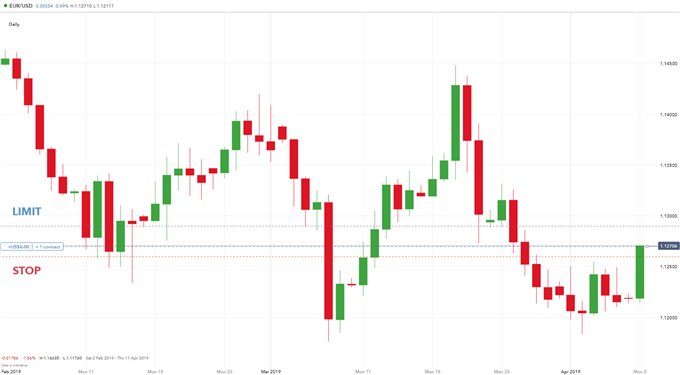
Positive risk-to-reward ratios are often overlooked by traders which can result in poor risk management. A positive risk-to-reward ratio such as 1:2 refers to potential profit being double the potential loss on the trade. The chart below shows a long EUR/USD trade with a 1:2 risk-to-reward ratio. The trade was opened at a level of 1.12698 with a stop at 1.12598 (10 pips) and a limit of 1.12898 (20 pips). An effective indicator to help identify stop and limit levels in forex is the Average True Range (ATR) which uses market volatility to base entry and exit points.

Having a ratio in mind helps to manage expectations of traders, this is important because, after much research by DailyFX, improper risk management has proven to be the number one mistake made by traders.

EUR/USD 1:2 risk-to-reward ratio:

EUR/USD risk-t-reward ratio

Mistake 6: Emotion based trading

Emotional trading often leads to irrational and unsuccessful trading. Traders frequently open additional positions after losing trades to compensate for the previous loss. These trades usually have no educational backing either technically or fundamentally. Trading plans are there to avoid this type of trading therefore, the plan must be followed closely.

Mistake 7: Inconsistent trading size

Trading size is crucial to every trading strategy. Many traders trade unsuitable sizes in relation to their account size. Risk then increases and could potentially erase account balances. DailyFX recommends risking a maximum of 2% of the total account size. For example, if the account contains $10,000 then a maximum of $200 of risk is suggested per trade. If traders observe this general rule, the pressure of overexposing the account will be removed. The inherent risk of overexposing the account on a particular market is extremely dangerous.

Mistake 8: Trading on numerous markets

Trading on a few markets lets traders gain the necessary experience to become proficient at these markets without scratching the surface of a few markets. Many novice forex traders look to trade on multiple markets without success due to a lack of understanding. This is something that should be done on a demo account if need be. Noise trading (irrational trading) often leads traders to place trades without the proper fundamental/technical justification on varying markets. For example, the Bitcoin craze of 2018 sucked in a lot of noise traders at the wrong time. Unfortunately, many traders entered at the ‘FOMO or Euphoria’ stage of the market cycle which resulted in significant losses.

Mistake 9: Not reviewing trades

Frequent use of a trading journal will allow traders to identify possible strategic flaws along with successful facets. This will enhance the trader’s overall understanding of the market and strategy for future. Reviewing trades not only highlights errors but beneficial aspects as well which must be reinforced constantly.

Mistake 10: Selecting an unsuitable broker

There are numerous CFD brokers globally, so choosing the right one can be difficult. Financial stability and proper regulation are essential before opening an account with a broker. This information should be readily available on the broker’s website. Many brokers are regulated in countries where guidelines are weak, to circumvent regulations in stricter jurisdictions such as the US (Commodity Exchange Act) and the UK (FCA).

Safety is the primary focus; however, a comfortable platform and ease of execution is also central to choosing a broker. Becoming accustomed with the platform and costing should be given ample time prior to trading with live funds.