Japan’s Kato wants to watch financial market with a sense of urgency including speculative moves

Japan’s Kato wants to watch financial market with a sense of urgency including speculative moves

Japan’s Finance Minister Katsunobu Kato on Thursday that he “wants to watch forex market with a sense of urgency including speculative moves.”

Further comments

Will communicate thoroughly with markets.

Will aim to exit deflation soon working closely with boj based on joint govt-BoJ statement.

Market reaction

USD/JPY holds the rebound near 146.85 following these above comments, adding 0.26% on the day.

GBP/JPY plummets to 192.20 area, fresh daily low after BoE Governor Bailey’s comments

GBP/JPY plummets to 192.20 area, fresh daily low after BoE Governor Bailey’s comments

The GBP/JPY cross continues with its struggle to find acceptance above the 195.00 psychological mark for the second time in two weeks and retreats sharply from a one-week high touched earlier this Thursday. The downward trajectory drags spot prices to the 192.25-192.20 area during the first half of the European session and is exclusively sponsored by the emergence of heavy selling around the British Pound (GBP).

In an interview with the Guardian, the Bank of England (BoE) Governor Andrew Bailey said that there was a chance that the central bank could become a bit more aggressive in cutting rates if there’s further good news on inflation. Traders upped their bets for another 25-basis points interest rate cut by the BoE at its November meeting. This, in turn, drags UK gilts lower, along with the GBP, and prompts aggressive selling around the GBP/JPY cross.

Apart from this, a further escalation of geopolitical tensions in the Middle East benefits the Japanese Yen’s (JPY) relative safe-haven status and contributes to the offered tone surrounding the currency pair. Iran launched over 200 ballistic missiles at Israel on Tuesday, while the latter conducted a precise air strike and bombed central Beirut in Lebanon during the early hours of Thursday, raising the risk of a full-blown war and undermining the risk sentiment.

The JPY bulls, however, refrain from placing aggressive bets in the wake of the uncertainty over future interest rate hikes by the Bank of Japan (BoJ). In fact, Japan’s new Prime Minister Shigeru Ishiba said on Wednesday that the country is not in an environment for an additional rate increase. Adding to this, Japan’s newly appointed economy minister, Ryosei Akazawa, expects the BoJ to make careful economic assessments when raising interest rates again.

Furthermore, BoJ board member Asahi Noguchi stated that the central bank must patiently maintain loose monetary conditions and will make gradual adjustments while carefully assessing whether inflation sustainably reaches the 2% target. This, in turn, warrants some caution before positioning for any further depreciating move for the GBP/JPY cross and supports prospects for an extension of the range-bound price action witnessed since the beginning of the current week.

AUD/JPY inches lower to near 100.50 due to risk aversion sentiment

AUD/JPY inches lower to near 100.50 due to risk aversion sentiment

AUD/JPY trims its intraday gains, holding some gains around 100.50 during the European hours on Thursday. The risk-sensitive Australian Dollar (AUD) depreciates as the rising geopolitical tensions have dampened the risk appetite and undermined the AUD/JPY cross.

The Israeli Broadcasting Authority (IBA) reported that Israel’s security cabinet has resolved to take decisive action in response to the recent Iranian attack. On Tuesday night, Iran launched more than 200 ballistic missiles and drone strikes targeting Israel.

However, the downside risk for the AUD may be limited due to the hawkish outlook surrounding the Reserve Bank of Australia (RBA). Data released earlier this week showed stronger-than-expected retail sales growth for August, lowering the likelihood of an early rate cut by the RBA.

On Thursday, Australia’s Trade Balance for August stood at 5,644 million month-over-month, surpassing market expectations of 5,500 million and slightly higher than July’s surplus of 5,636 million. However, both Exports and Imports declined by 0.2% month-over-month in August. Markets have almost fully discounted the possibility of a rate cut in November.

The AUD/JPY cross received support as the Japanese Yen (JPY) faced challenges following blunt comments on monetary policy from the new Prime Minister (PM) Shigeru Ishiba, who met with Bank of Japan (BoJ) Governor Kazuo Ueda on Wednesday.

Japan’s Prime Minister Ishiba stated, “I do not believe that we are in an environment that would require us to raise interest rates further,” according to Reuters. In the previous session, the Japanese Yen fell nearly 2% against the US Dollar (USD), marking its largest drop since February of last year.

Japanese Yen trims losses despite a solid US Dollar, ISM Services PMI awaited

Japanese Yen trims losses despite a solid US Dollar, ISM Services PMI awaited

The Japanese Yen (JPY) faced challenges against the US Dollar (USD) on Thursday following blunt comments on monetary policy from the new Prime Minister (PM) Shigeru Ishiba, who met with Bank of Japan (BoJ) Governor Kazuo Ueda on Wednesday.

Japan’s Prime Minister Ishiba stated, “I do not believe that we are in an environment that would require us to raise interest rates further,” according to Reuters. In the previous session, the Japanese Yen fell nearly 2% against the US Dollar (USD), marking its largest drop since February of last year.

Japan’s Chief Cabinet Secretary Yoshimasa Hayashi clarified on Thursday that “Prime Minister Ishiba did not ask BoJ Governor Ueda for any specifics regarding monetary policy during their meeting on Wednesday.” On Wednesday, Japan’s Economic Revitalization Minister Ryosei Akazawa stated that PM Ishiba expects the Bank of Japan to conduct thorough economic assessments before considering another interest rate hike.

Futures indicate that there is less than a 50% chance the Bank of Japan will raise rates by 10 basis points by December. Additionally, rates are projected to reach only 0.5% by the end of next year, up from the current 0.25%, per Reuters.

Traders are expected to closely monitor a series of key economic data from the United States (US) scheduled to be released on Thursday, including September’s ISM Services Purchasing Managers’ Index (PMI) and the weekly Initial Jobless Claims for the previous week.

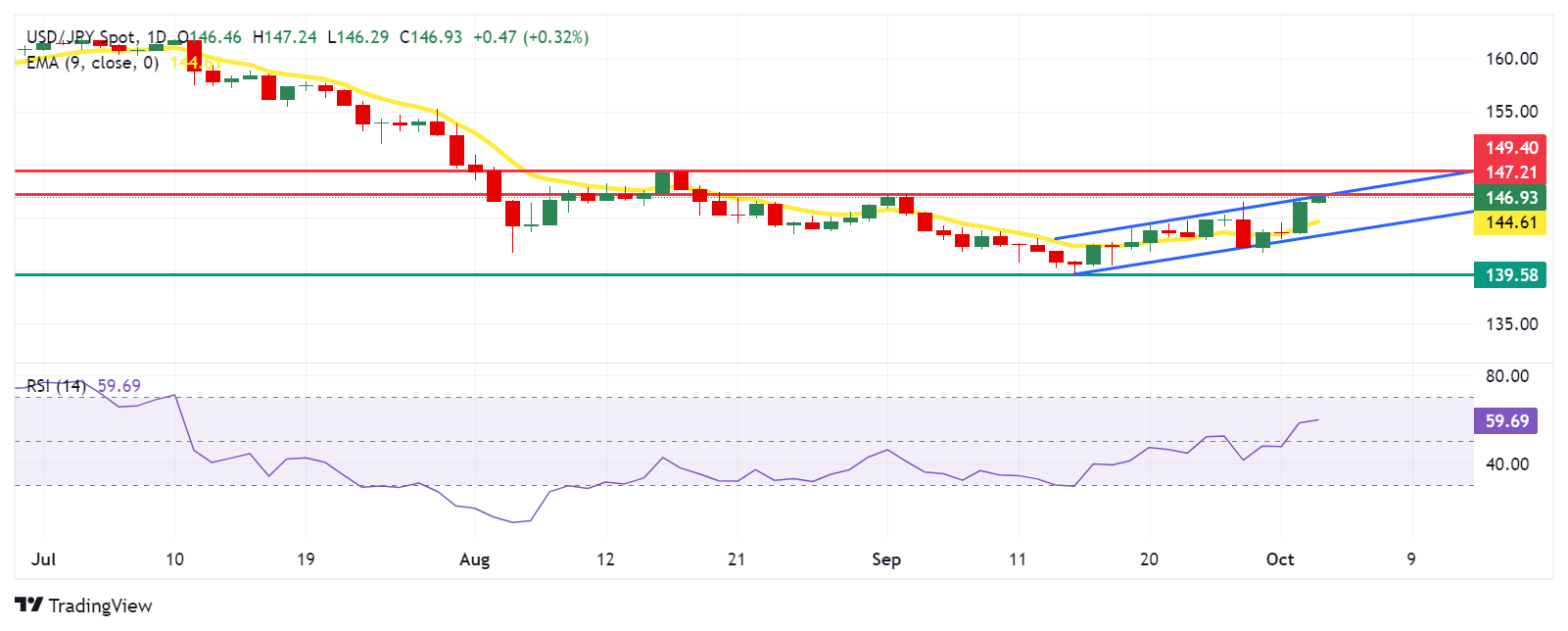
Technical Analysis: USD/JPY tests 147.00, the upper boundary of the ascending channel

USD/JPY trades around 146.80 on Thursday. Analysis of the daily chart indicates that the pair tests to breach above the ascending channel pattern, suggesting a strengthening bullish bias. The 14-day Relative Strength Index (RSI) also moves above the 50 level, confirming the bullish trend’s continuation.

The USD/JPY pair encountered resistance near the upper boundary of the ascending channel near the five-week high of 147.21, last reached on September 3. A break above this level could support the pair to test its seven-week high at 149.40.

On the downside, the USD/JPY pair could find support at the nine-day Exponential Moving Average (EMA) around 144.60, followed by the lower boundary of the ascending channel at 143.20. A break below this level could push the USD/JPY pair toward the 139.58 level, marking the lowest since June 2023.

USD/JPY: Daily Chart

GBP/USD falls hard toward 1.3150 on Bailey’s dovish remarks

GBP/USD falls hard toward 1.3150 on Bailey’s dovish remarks

GBP/USD extends its sell-off toward 1.3150 in the early European session on Thursday. The pair faces fresh supply after BoE Governor Andrew Bailey said that the central bank could become ‘more activist’ on rate cuts if inflation eases. Mideast concerns-led risk aversion also weighs on the pair.

The Relative Strength Index (RSI) indicator on the 4-hour chart stays well below 50, suggesting that the recent recovery attempt could be a technical correction rather than the beginning of a reversal.

On the downside, interim support is located at 1.3275 (Fibonacci 38.2% retracement of the latest uptrend) before 1.3250, where the 100-period Simple Moving Average (SMA) is located. A daily close below the latter could attract technical sellers and open the door for another leg lower toward 1.3180 (200-period SMA).

In case GBP/USD stabilizes above 1.3300 (static level), it could face next resistance at 1.3340-1.3350 (Fibonacci 23.6% retracement, 50-period SMA, 20-period SMA) before 1.3400 (round level).

GBP/USD turned south on Tuesday and lost nearly 0.7% on a daily basis. The pair edges higher toward 1.3300 in the European session on Wednesday but the technical outlook is yet to highlight a buildup of recovery momentum.

Following a bullish start to the week, the US Dollar (USD) continued to gather strength on Tuesday, forcing GBP/USD to push lower. The risk-averse market atmosphere amid escalating geopolitical tensions helped the USD outperform its rivals. Meanwhile, the US Bureau of Labor Statistics reported that the number of job openings on the last business day of August stood at 8.04, up from 7.71 million in July and above the market expectation of 7.65 million, further supporting the USD.

The Automatic Data Processing (ADP) will publish the private sector employment report later in the day. Investors expect the private sector payrolls to rise by 120,000 following August’s 99,000 increase. A disappointing print below 100,000 could cause investors to price in a negative surprise in Friday’s Nonfarm Payrolls data and cause the USD to come under selling pressure. On the other hand, a reading above the market forecast could help the USD hold its ground.

Investors will also pay close attention to headlines surrounding the crisis in the Middle East. Israel has vowed to retaliate after Iran has fired about 200 ballistic missiles. In the meantime, the Israeli Defense Forces has reportedly deployed additional troops to Lebanon, prompting the evacuation of 24 villages in Southern Lebanon. A further escalation of geopolitical tensions could allow the USD to benefit from safe-haven flows.

US Dollar Index (DXY) holds steady above 101.00, looks to US ADP for fresh impetus

US Dollar Index (DXY) holds steady above 101.00, looks to US ADP for fresh impetus

The US Dollar Index (DXY), which tracks the Greenback against a basket of currencies, consolidates its gains registered over the past two days and oscillates in a range, just above the 101.00 mark, through the early European session on Wednesday. The Index, for now, seems to have stalled this week’s goodish recovery move from the vicinity of its lowest level since July 2023, though the fundamental backdrop warrants some caution for bearish traders.

The Federal Reserve (Fed) Chair Jerome Powell earlier this week adopted a more hawkish tone and said that he sees two more 25 basis points interest rate cuts this year as a baseline if the economy performs as expected. Adding to this, the Job Openings and Labor Turnover Survey (JOLTS) published by the US Bureau of Labor Statistics (BLS) showed that the number of job openings unexpectedly increased after two straight monthly declines, to 8.04 million in August. The data pointed to a still resilient US labor market and forced investors to further scale back their expectations for a more aggressive policy easing by the Fed.

This, along with a further escalation of geopolitical tensions in the Middle East, turns out to be another factor acting as a tailwind for the safe-haven USD. Iran launched over 200 ballistic missiles at Israel on Tuesday in retaliation to the latter’s campaign against its Hezbollah allies in Lebanon. Furthermore, Israeli Prime Minister Benjamin Netanyahu promised that Iran would pay for its missile attack, while Iran said any retaliation would be met with vast destruction, raising the risk of a broader conflict in the region. This, in turn, tempers investors’ appetite for riskier assets and drives flows towards traditional safe-haven assets.

Meanwhile, the markets are still pricing in over a 35% chance that the Fed will lower borrowing costs by another 50 basis points in November, which is seen acting as a headwind for the DXY and warrants caution for bullish traders. Market participants now look forward to the release of the US ADP report on private-sector employment for a fresh impetus later during the early North American session. The focus, however, will remain glued to the closely-watched US monthly employment details, popularly known as the Nonfarm Payrolls (NFP) report on Friday, which will play a key role in determining the next leg of a directional move for the USD.

Silver Price Forecast: XAG/USD rises to near $31.50 due to rising geopolitical tensions

Silver Price Forecast: XAG/USD rises to near $31.50 due to rising geopolitical tensions

Silver price (XAG/USD) extends its gains for the second consecutive day, trading around $31.50 per troy ounce during the European hours on Wednesday. The upside of the Silver prices is attributed to the safe-haven flows amid escalating geopolitical tensions in the Middle East.

Iran launched over 200 ballistic missiles at Israel on Tuesday, shortly after the US had warned that a strike was imminent. The Israel Defense Forces reported that several of the missiles were intercepted, while reports indicated that one person was killed in the West Bank, according to Bloomberg.

Israeli Prime Minister Benjamin Netanyahu vowed to retaliate against Iran following a missile attack on Tuesday. In response, Tehran warned that any counterstrike would lead to “vast destruction,” raising concerns about the potential for a broader conflict.

On Tuesday, the weaker-than-expected ISM Manufacturing PMI made room for the US Federal Reserve (Fed) to continue lowering rates. The index came at 47.2 for September, matching the reading with August’s print but came in below the market expectation of 47.5. However, Fed Chair Jerome Powell said on Monday the central bank is not in a hurry and will lower its benchmark rate gradually ‘over time.’

The CME FedWatch Tool indicates that markets are assigning a 62.7% probability to a 25 basis point rate cut by the Federal Reserve in November, while the likelihood of a 50-basis-point cut is 37.3%, down from 57.4% a week ago. Prolonged higher interest rates keep the opportunity cost higher of holding non-yielding assets like Silver, making it less appealing to investors who seek more attractive, yield-bearing alternatives.

Silver demand has been bolstered by China’s fiscal and monetary stimulus, particularly benefiting industrial applications in one of the world’s largest manufacturing hubs. However, weaker-than-expected demand growth in China, compounded by data indicating a decline in manufacturing activity, might have limited the upside potential of the grey metal.

ADP report set to give clues about US labor market ahead of Friday’s NFP

ADP report set to give clues about US labor market ahead of Friday’s NFP

The Automatic Data Processing (ADP) Research Institute will release its monthly report on private-sector job creation for September on Wednesday. The so-called ADP Employment Change report is expected to show that the United States (US) added 120,000 new positions in September after creating 99,000 jobs in August.

The data is usually released two days ahead of the official Nonfarm Payrolls (NFP) report for the same month and is usually seen as an advanced indicator of the  Bureau of Labor Statistics (BLS) jobs report, despite a doubtful correlation between both indicators.

ADP Jobs Report: Employment and the Federal Reserve

US employment data has been in the eye of the storm for over a year amid its impact on the latest Federal Reserve (Fed) monetary policy decisions. The Fed’s dual mandate of maximum employment and price stability has been under siege in the pandemic aftermath, and the central bank opted to tighten monetary policy to put things back in balance.

The main issue was inflation, as price pressures skyrocketed throughout 2022. The Fed pushed rates to record highs and maintained them there amid the risks of a tight labor market further fuelling price pressures. Nevertheless, indicators have come into a better balance in the last few months, and the Fed finally decided to trim interest rates. US policymakers cut the benchmark rate by 50 basis points (bps) when they met in September while anticipating additional cuts on the way.

That said, market participants are now wondering whether the central bank will deliver a mode discretionary 25 bps cut when it meets in November or proceed again with a 50 bps trim. Ahead of data releases, the odds for a 25 bps stand at 66%, according to the CME FedWatch Tool.
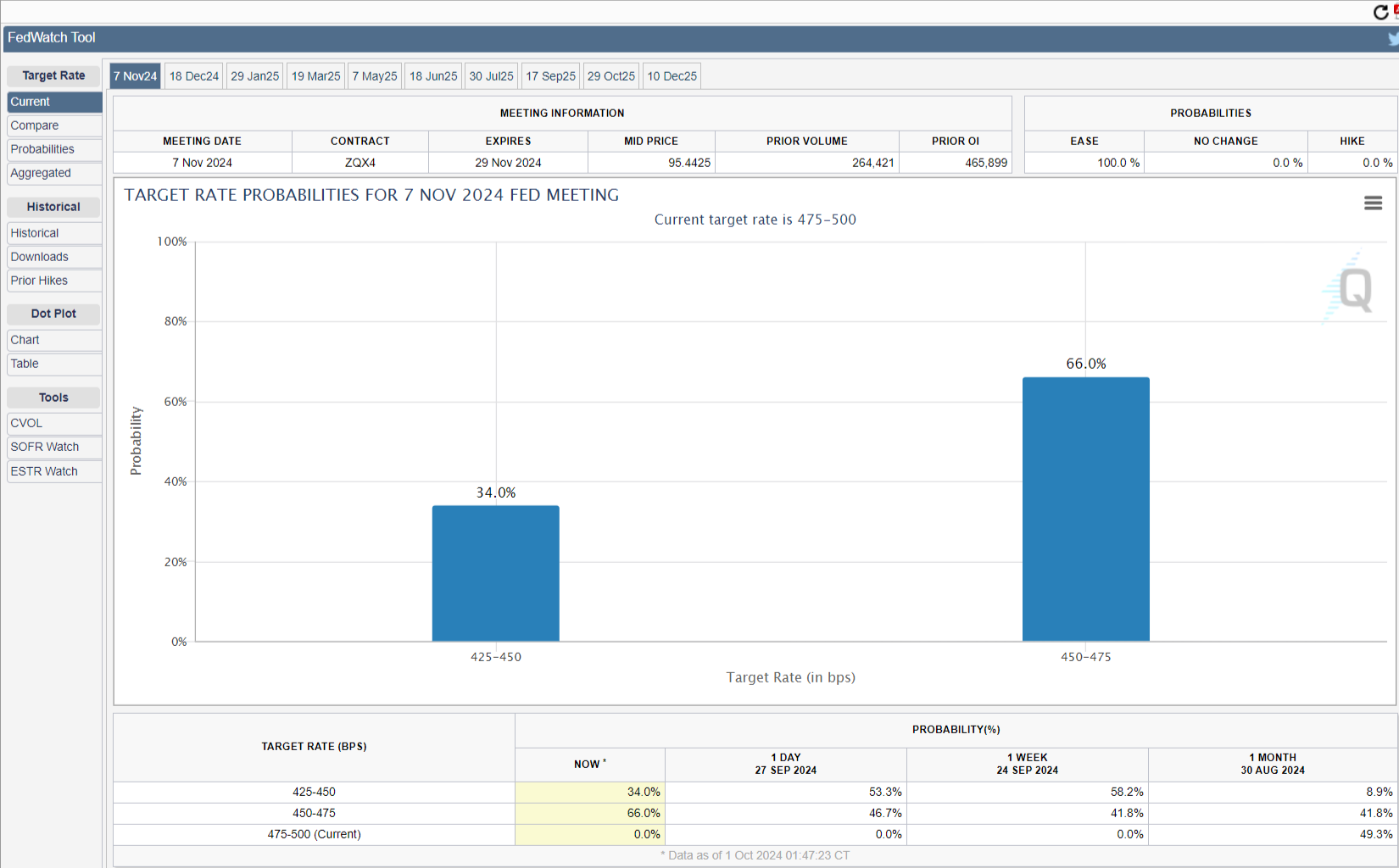
In the meantime, Fed officials have shifted their focus from inflation to employment. With price pressures receding, maintaining a “healthy” labor market is now their main goal.

With that in mind, a stronger-than-anticipated ADP report will likely weigh down the odds for another aggressive interest rate cut in November, giving near-term support to the US Dollar. On the contrary, a disappointing reading may force speculative interest to increase bets for another 50 bps interest rate cut, resulting in a weaker USD. Finally, it is worth remembering the report could have a short-lived impact, as market players will most likely wait until the NFP release scheduled for Friday.

When will the ADP Report be released, and how could it affect the USD Index?

ADP will release the US Employment Change report on Wednesday and it is expected to show that the private sector added 120,000 new positions in September.

Ahead of the release, the US Dollar Index (DXY) consolidates below the 101.00 mark after posting a fresh 2024 low of 100.16 by the end of September.

From a technical perspective, Valeria Bednarik, Chief Analyst at FXStreet, says: “The DXY has remained under pressure since the Fed’s monetary policy announcement mid-September, and technical readings in the daily chart suggest its bullish potential remains well-limited. A bearish 20 Simple Moving Average (SMA) provides near-term resistance around the aforementioned threshold, while a bearish 100 SMA gains downward momentum well above the shorter one, and after crossing below a flat 200 SMA.”

Bednarik adds: “Technical indicators, in the meantime, remain within negative levels, lacking directional momentum. Overall, the risk skews to the downside. Resistance beyond the 101.00 threshold comes at 101.47, followed by the daily low at 102.17 posted on August 5. Supports, on the other hand, can be found at 100.41 and the year-to-date low of 100.16. A break below the latter could anticipate a steeper decline towards the 99.00 figure.”


Eurozone: Inflation falls below ECB’s 2% target for first time since 2021 – UOB Group

Eurozone: Inflation falls below ECB’s 2% target for first time since 2021 – UOB Group

Preliminary figures showed that inflation in the Eurozone eased further to 1.8% in September, from 2.2% in August, as energy prices continued to decline. This marks the first time in three years that headline inflation has fallen below the European Central Bank’s (ECB) 2%-3% target, UOB Group economist Lee Sue Ann notes.

Energy prices continue to decline

“Eurozone inflation fell to 1.8% in September, from 2.2% in August, coming in below the ECB’s 2% target, according to preliminary data. Core inflation, which excludes more volatile energy, food, alcohol and tobacco prices, came in at 2.7%.”

“While we are cognizant that the risk of a rate cut in October certainly seems more likely than before, we maintain our view of the ECB cutting again only when policymakers convene in December for the final time this year.”

“We think that the widely watched services inflation, which eased slightly only to 4.0% in September, from 4.1% in August, is still high for the ECB. Furthermore, inflation dynamics are quite different across Eurozone countries.”