NZD/USD Price Analysis: Bears lurking below 0.6200, eyes on trendline support

As per the prior analysis, NZD/USD Price Analysis: Bulls seek out 0.6300 while bears eye signs of distribution, the bears indeed moved in and distribution has been in play.

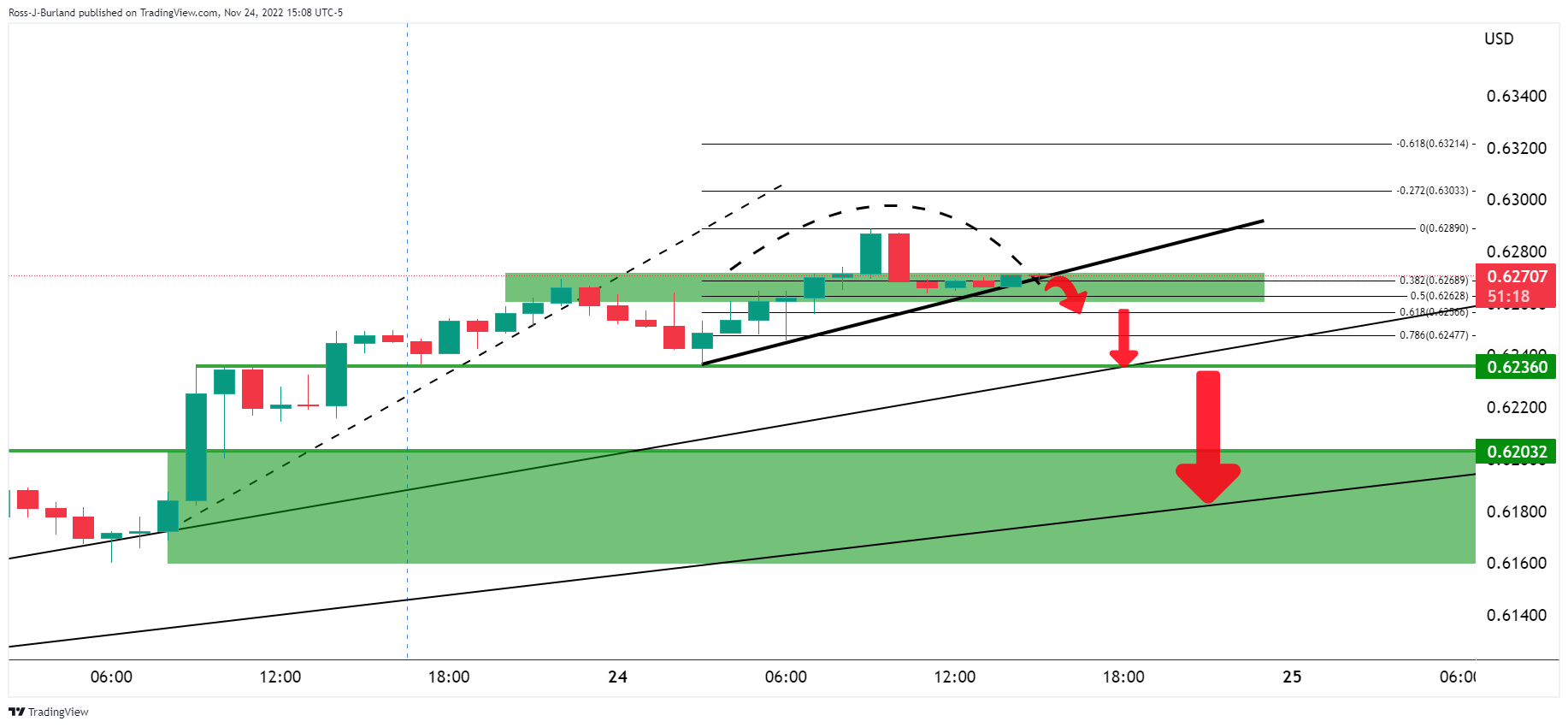
The tweezer top was highlighted as a dominant feature in the prior chart, a bearish candle stick combination pattern that showed sellers were in the market.

NZD/USD prior analysis

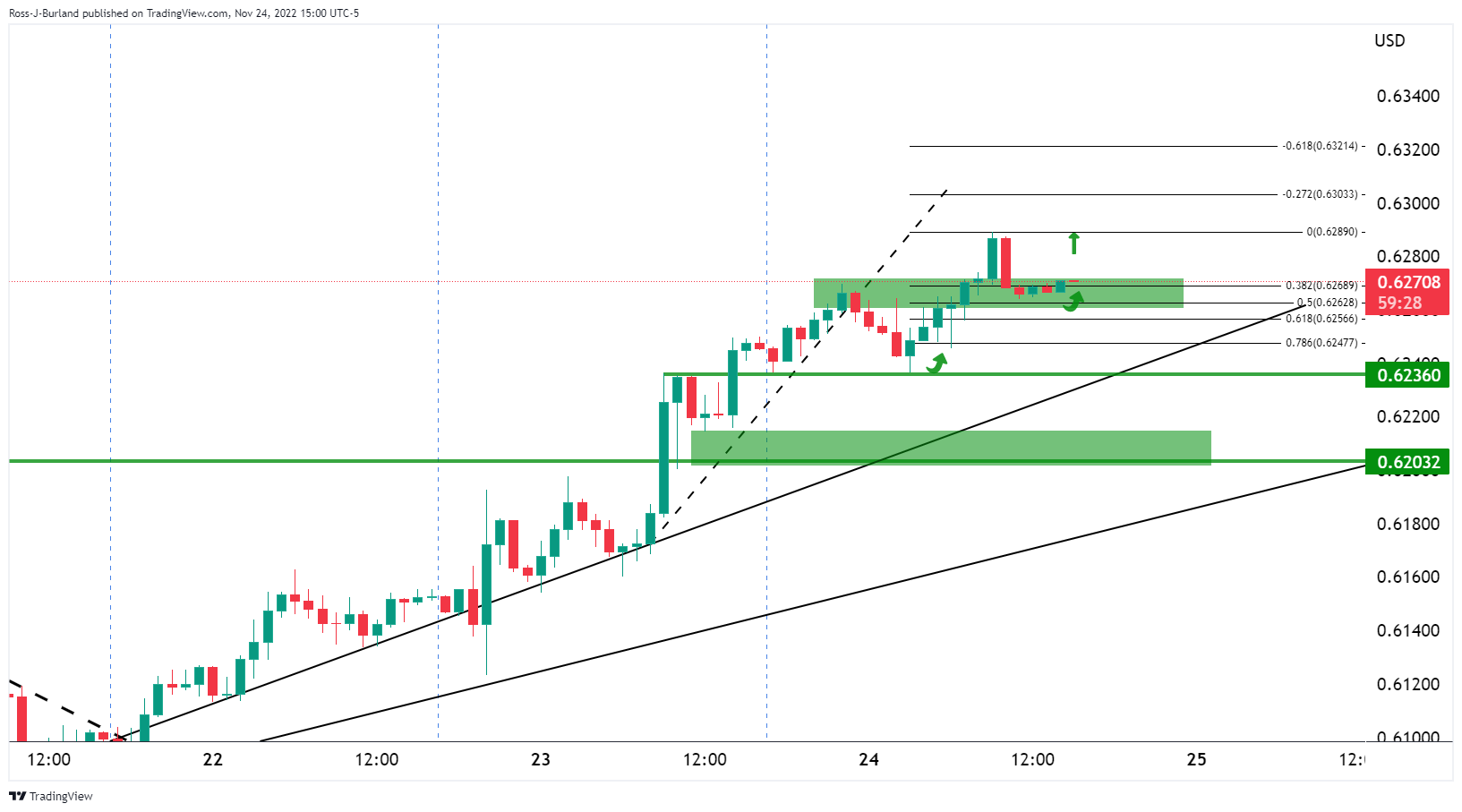
The price was now testing the next trendline support and a break there opened the risk of a move to the downside to test below 0.6250 and with eyes that were on 0.6236 as the prior lows and trendline before 0.6200:

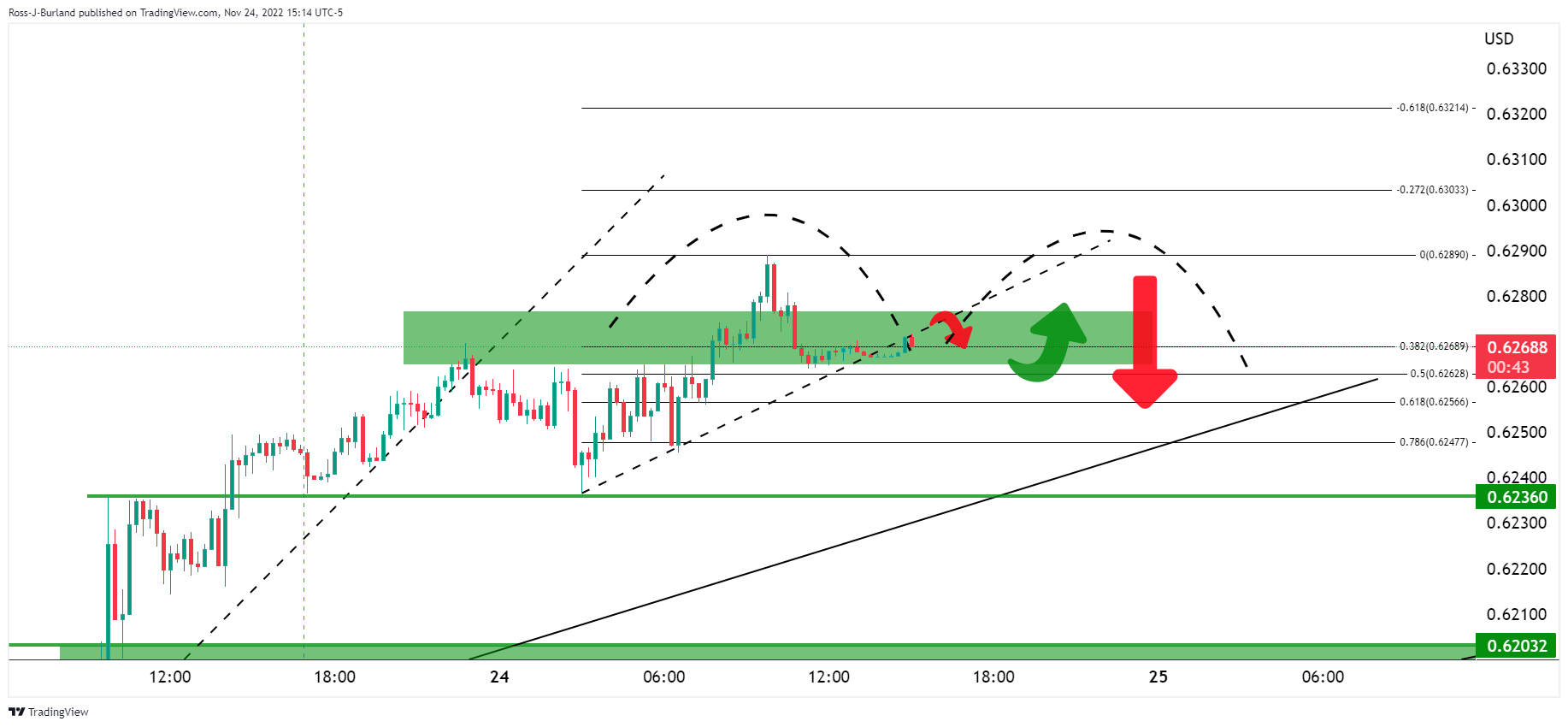
With that being said, it was explained that it would have been unusual for the market to simply melt without a revisit to the peak formation as distribution takes a while to play out, usually as per the following topping scenario shown on the 15-minute chart:

NZD/USD M15 chart

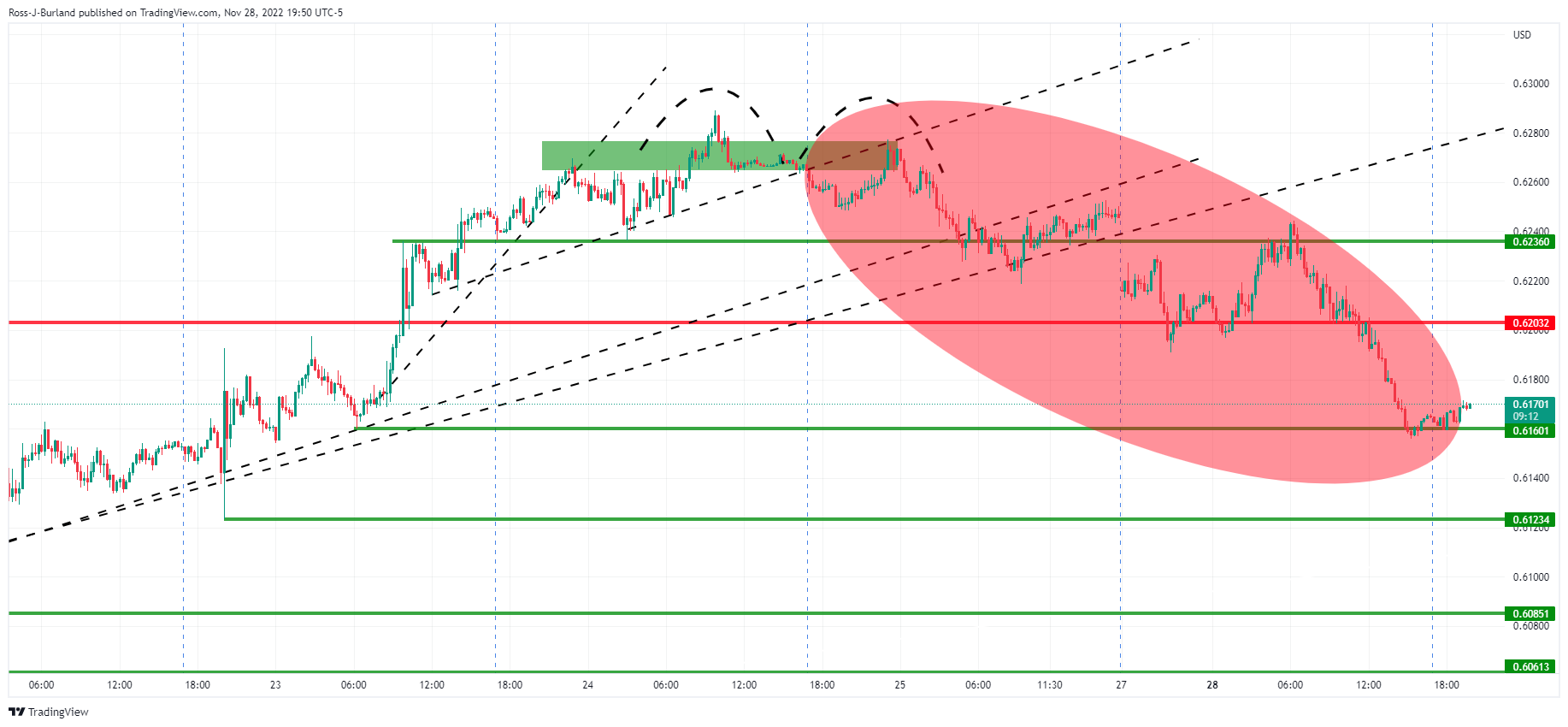
NZD/USD update

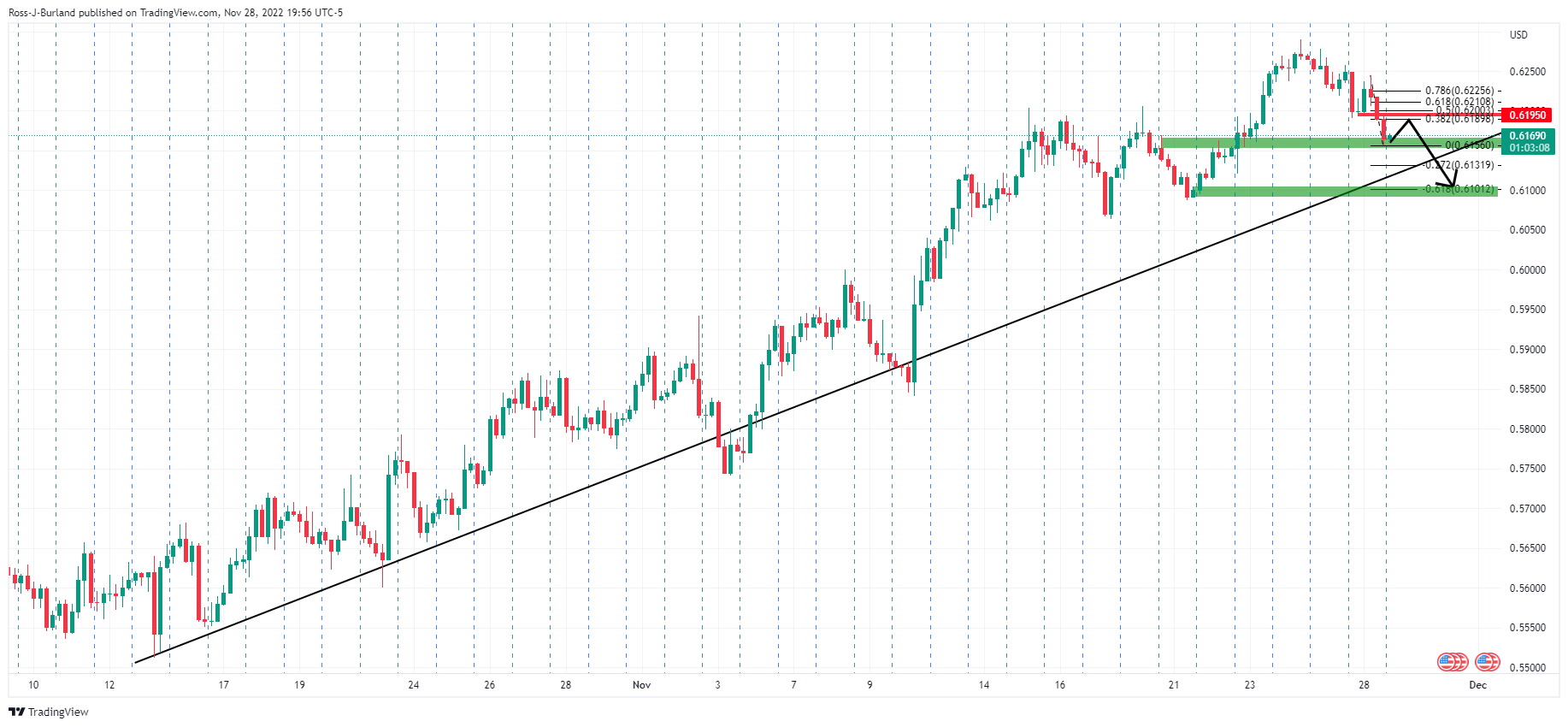
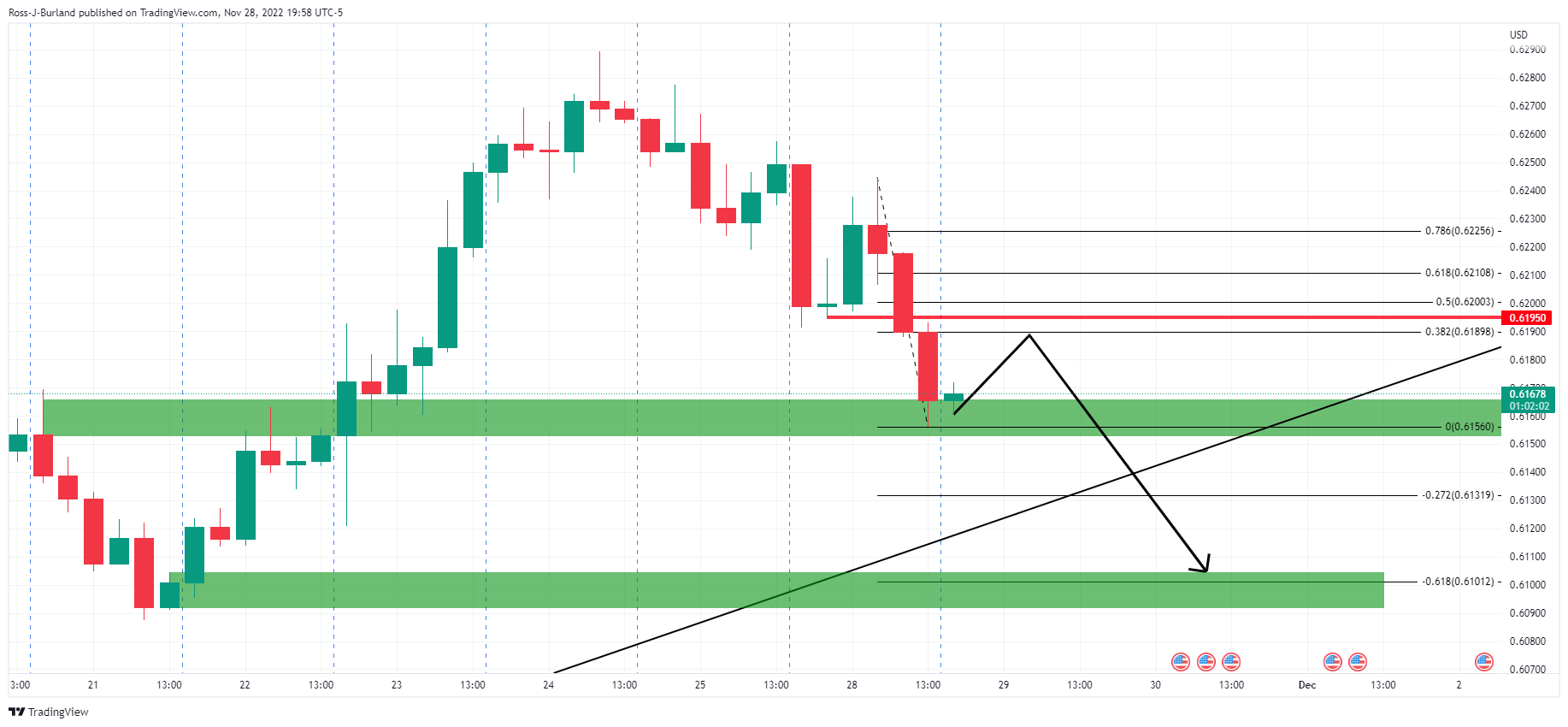
As can be seen, the price indeed returned the upside prior to the full breakdown into 0.6200 and then to the 0.6150s. Going forward a tougher challenge awaits the beats at trendline support:

Zoomed in, the current support near 0.6150 would be expected to hold and result in a meanwhile correction. So long as 0.6200 holds, 0.6100 will be eyed on a test of the trendline support.

All of the World’s Money and Markets in One Visualization (2022)

The era of easy money is now officially over. For 15 years, policymakers have tried to stimulate the global economy through money creation, zero interest-rate policies, and more recently, aggressive COVID fiscal stimulus. With capital at near-zero costs over this stretch, investors started to place more value on cash flows in the distant future. Assets inflated and balance sheets expanded, and money inevitably chased more speculative assets like NFTs, crypto, or unproven venture-backed startups. But the free money party has since ended, after persistent inflation prompted the sudden reversal of many of these

20221128 gbpusd daily bounce

GBP/USD: What’s with all that?

Just two months ago, GBP/USD was trading at its lowest level EVER, reaching a low print of 1.03565.  Today, the pair is trading near 1.1950!  A lot has happened in the last 2 months to bring the pair from the brink of collapse to today’s levels.  Many attributed the selloff to Liz Truss, or at least to her “mini-budget”, which would have left a gaping hole in the budget deficit.  Although this may have been the straw that broke the camel’s back, GBP/USD had been moving lower for months before the late September selloff.  GBP/USD had formed a Year-to-Date high on February 22nd at 1.4250!  The pair had been moving lower as it became apparent that the US Federal Reserve had to begin raising rates quickly. The board finally decided that rising inflation wasn’t transitory. On April 22nd, the pair crashed through 1.3000 and by mid-June the pair was trading 1.2000.  Once at 1.2000, GBP/USD continued lower in an orderly channel until Wednesday, September 21st.  The pair closed at 1.1235, below the bottom trendline of the channel.  Why had it been moving lower since 1.4200?

Source: Tradingview, Stone X
While inflation was flying high in the US, the Fed stepped up its pace of race hikes to 50bps in April.  By mid-June, the Fed was hiking 75bps at a clip.  Meanwhile, Bank of England was only hiking rates by 25bps at a time, as it was particularly concerned about driving the British economy into a recession.  It wasn’t until its last rate hike on November 3rd that the BOE finally hiked by 75bps to bring the cost of borrowing to 3%.  GBP/USD was moving lower due to interest rate differentials.  When the “mini-budget” proposal was presented, liquidity dried up in bonds, causing GBP/USD to collapse.  However, despite previously not raising rates aggressively enough, the BOE did save the UK bond market, which helped the Pound recover.  Now, with inflation at 11.1% YoY in the UK, and “only” 7.7% YoY in the US, its anticipated that the UK will have to hike rates higher and longer than in the US. However, there is also Prime Minister Sunak’s autumn budget which the markets still need to deal with:  Increased taxes and lower spending.  This may help with the BOE’s prediction of a recession coming down the pike.

20221128 gbpusd daily bounce

On daily timeframe, GBP/USD was on a mission to get to 1.2000.  The price rose in an ascending wedge formation and broke out above the top of the pattern.  Expectations are that price should break lower from an ascending wedge.  Will price continue lower from here?  Pullbacks are normal in an uptrend and a pullback to the 38.2% Fibonacci retracement level (at 1.1467) from the lows of September 26th to the highs of November 24th is not out of the question.  However, the pair must pass through support before that level.  The first support level is at the top trendline of the wedge near 1.1900.  If price breaks below there, the next level of support is at the top, downward sloping trendline from the long-term channel near 1.1650, then the bottom trendline of the wedge near 1.1550.  However, if price continues to move higher, resistance (previous highs) ahead of 1.3000 are 1.2293, 1.2660, and 1.2843.

So, if GBP/USD can move lower due to the Fed being more aggressive than the BOE, is the reverse true as well? Or is GBP/USD just having a bear market bounce?  Watch the key support levels to see if price holds.  If it does, then GBP/USD may be on its way towards 1.3000!

ECB Insight: Lagarde Unmistakably Hawkish; ‘It Would Surprise Me’ if Inflation Already at Its Peak

European Central Bank President Christine Lagarde on Monday showed herself from her hawkish side, making it considerably less clear whether the Governing Council would really temper its pace of rate hiking as soon as next month, but also raising the question of how bold forthcoming quantitative tightening decisions will turn out. Notwithstanding the relatively neutral tone of the prepared remarks she had just delivered at European Parliament, Lagarde said during the ensuing Q&A that ‘[h]eadline inflation, the one that we look at most, has hit its highest reading in October … core inflation as well has been very

China State Council press conference at 0700 GMT on COVID – rumours on ending COVID zero

I posted on this a while back: Here’s an interesting item that suggests China may soon dump the COVID zero policy. AUD, NZD, oil, China shares are all getting excited: AUD and NZD are moving higher as China reopening chatter spreads. I can confirm now that there is indeed a news conference being given by the Joint Prevention and Control Mechanism of the State Council in China at 3pm local time in Beijing. 0700 GMT. Update on Chinese stocks:  Hong Kong’s Hang Seng is up 3.7%. Shanghai Composite is up 2%.

USD/JPY Fundamental Daily Forecast – Japan Retail Sales Rise for Eighth Straight Month

The Dollar/Yen is edging lower early Tuesday following a volatile trading session the previous day. Early selling pressure was fueled by investors buying the Japanese Yen for safe-haven protection as investors dumped risky assets in response to unrest in China. The Forex pair rebounded in a big way from its intraday low, however, after a Fed official sent a hawkish message to traders.

Japanese Yen Holds Steady as China’s COVID-related Worries Weigh

The Japanese Yen is up slightly against the U.S. Dollar as concerns about unrest in China over COVID-19 restrictions dampened market sentiment, however, its gains are being limited as hawkish remarks from Federal Reserve officials supported the greenback.

Rising tensions in China over the country’s stringent pandemic measures sent investors flocking to the safe-haven Yen. Police in China on Monday stopped and searched people at the sites of weekend protests in Shanghai and Beijing, after crowds there and in other cities demonstrated against the country’s strict zero-COVID policy.

Hawkish Fed Remarks Offset China Worries

The greenback may be getting some support today after Monday’s dramatic turnaround was fueled by hawkish comments from St. Louis Fed President James Bullard and New York Fed President John Williams.

Bullard said that the Fed needs to raise interest rates quite a bit further, while Williams said the U.S. central bank needs to press forward with rate rises but did not say how fast it will need to boost short-term borrowing costs.

Limited Reaction to Japanese Economic News

Japan’s Unemployment Rate came in unchanged at 2.6%, however, it was higher than the 2.5% forecast.

Retail Sales plunged from an upwardly revised 4.8% to 4.3%. This was less than the 5.0% estimate. However, it also marked an eighth successive month of annual growth in October after a full reopening of borders added to the boost from this year’s dismantling of internal pandemic control measures.

There was little growth from September, however, as Japanese households were squeezed by inflation running at its fastest pace in 40 years.

Short-Term Outlook

Traders are going to try to hold the USD/JPY in a trading range as they await key data due later this week that will provide insights into how the U.S. economy is faring amid high interest rates and inflation.

Data on Tuesday includes the Home Price Index (HPI), the S&P/CS Composite-20 HPI y/y and the Conference Board’s Consumer Confidence report.

A series of key labor market data is due also due this week, including ADP’s private business payroll figures and JOLTS job openings on Wednesday, as well as November Non-Farm Payrolls and Unemployment data on Friday.

All eyes will also be on comments from Fed Chair Jerome Powell on Wednesday. Traders will be watching for any new signals on further tightening. The Fed is widely expected to hike rates by an additional 50 basis points when it meets on December 13-14.

Chinese Stocks Rebound as Protests Ease, Property Support Added

Chinese assets rallied amid speculation that the government will further relax its Covid Zero policy after weekend protests, with new property measures also buoying sentiment.

The Hang Seng China Enterprises Index gained as much as 5.2%, while the offshore yuan jumped 1.1% against the dollar. Country Garden Holdings Co. led an advance in property stocks, with the bonds of key developers advancing.

Traders took solace after weekend protests against Covid restrictions subsided amid heavy policy presence, although uncertainty remains high over what the government will do next. A state media report that frequent PCR tests are unnecessary for low-risk people and a Covid briefing slated for later in the day helped fuel reopening bets.

Read: China Reopening Stocks Rise as Xinhua Eases Tone on Covid Tests

“There is growing speculation there will be an imminent announcement of the end of Covid-Zero policy and that’s driving the positive sentiment,” said Kiyong Seong, lead Asia macro strategist at Societe Generale SA in Hong Kong. “Markets will remain volatile as investors assess any policy shift.”

Chinese assets have been facing a potential turnaround moment following moves to relax Covid restrictions and a slew of support measures for ailing developers. Key equity indexes are headed for the best month in years, though the outlook for China’s Covid Zero pivot is now unclear as the nation grapples with a worsening outbreak.

Goldman Sachs Group Inc. said Monday that the nation may have a messy, but earlier-than-expected exit from its Covid Zero policy.

Tuesday’s stock-market moves tracked gains in the Nasdaq Golden Dragon China Index overnight, when the gauge closed up 2.8% despite a broader US market slump.

Property Rescue

The property sector got another boost after the securities regulator lifted a multi-year ban on share sales by builders. The removal of restrictions aims to support the “stable and healthy” development of the sector, according to a statement late Monday.

Read: Turmoil Grips China Markets as Covid Protests Cloud Reopening

The government has been taking bolder steps recently to rescue the property sector, after its piecemeal approach earlier this year failed to reverse a slump. In another sign of easier funding access, a key program to guarantee local bond sales from developers will now accept collateral beyond just their core assets, according to people familiar with the matter.

Read: China Stocks Defy US Gloom on Optimism Over Earnings, Reopening

A Bloomberg Intelligence gauge of developers jumped more than 9%, taking this month’s advance to 65%. The CSI 300 Index, a benchmark for mainland shares, advanced more than 3%. The Hang Seng Index rallied 4.4%.

The country’s junk dollar bonds, dominated by developers, rose at least 1 cent on the dollar, according to traders, with Seazen Group and Country Garden leading gains.


“The property measure is big for A-share developers, given the refinancing of developers in A-share has been technically suspended since 2010,” said Willer Chen, senior analyst at Forsyth Barr Asia Ltd. “This sends a strong signal to the market that CSRC wants to help developers” on their financing issues, he added.

China’s offshore and onshore yuan extended gains. The offshore pair jumped as much as 1.1% to 7.1654 per dollar. Traders also offloaded government bonds on bets of a faster economic recovery following new property measures.

“Investors will be happy if the protests accelerate a move to accepting Covid and opening up the country,” said Andrew Collier, a managing director at Orient Capital Research Inc. “However, Xi Jinping’s history of centralized decision making is going to make it difficult for local officials to decide exactly how open they should be.”

Westpac NZ Weekly Economic Commentary: It won’t happen overnight

We have revised our forecast for the Official Cash Rate higher. We now expect a 75 basis point rise in February, and a further 50 basis point rise in April (previously we had expected increases of 50bp and 25bp respectively at those meetings). Those increases would take the OCR to a peak of 5.50% – its highest level since 2008. Behind that change in our OCR forecast has been ongoing strength in inflation, and a related hawkish lurch from the RBNZ. The central bank delivered a 75 basis point rise in the Official Cash Rate at its November policy meeting. That was the largest ever increase in a single meeting,