mun

Silver Price Forecast: XAG/USD climbs to $31.80-$31.85 zone; upside potential seems limited

Silver (XAG/USD) attracts buyers for the second straight day on Tuesday and moves further away from a nearly four-week low, around the $30.85-$30.80 region touched last Friday. The white metal climbs to the $31.80-$31.85 region during the first half of the European session, back closer to the overnight swing high, and seems poised to appreciate further.

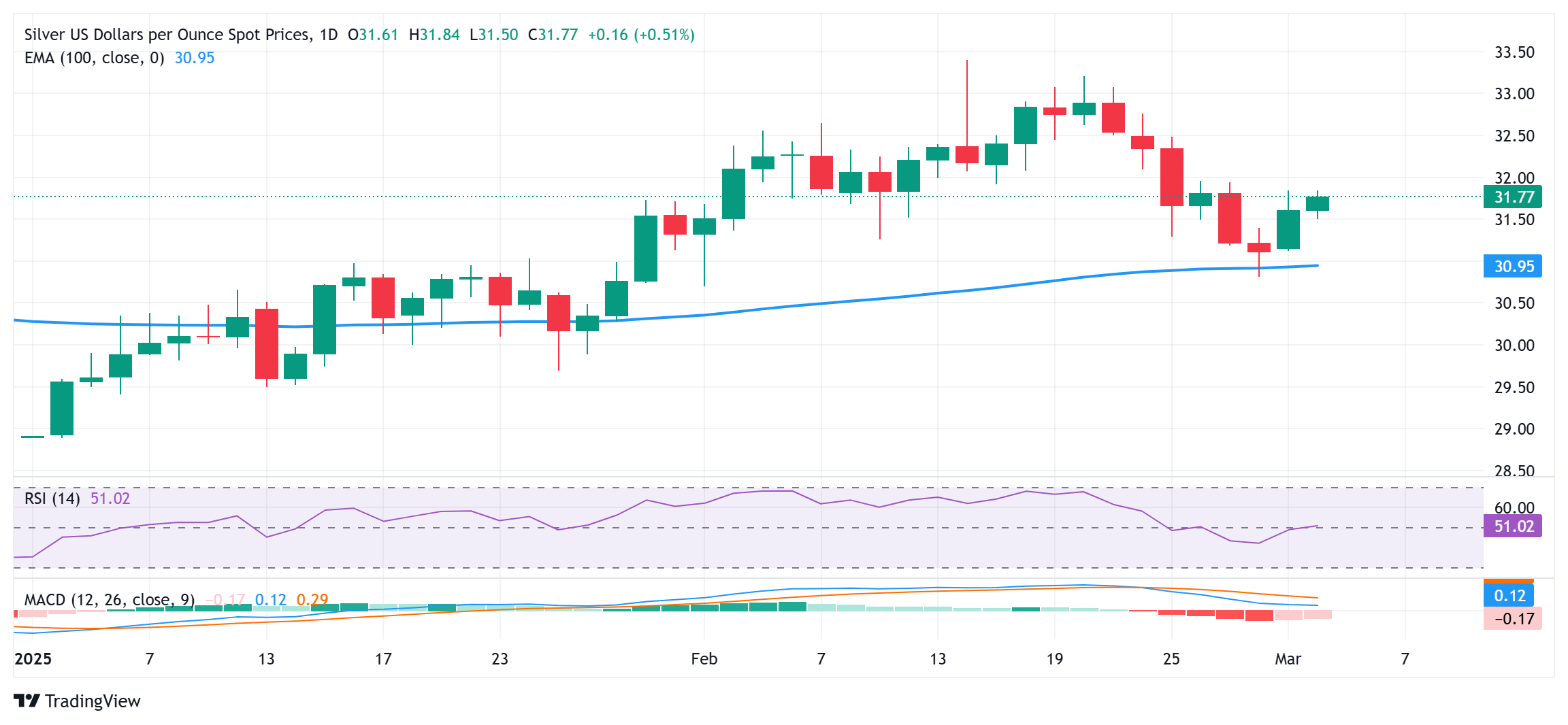
From a technical perspective, the XAG/USD showed some resilience below the 100-day Exponential Moving Average (EMA) last Friday. The subsequent move up validates the near-term constructive outlook for the commodity. That said, oscillators on the daily chart are yet to confirm a positive bias and warrant some caution before positioning for any further appreciation.

Hence, any further move up is likely to confront some resistance near the $31.65 region ahead of the $32.00 mark. Some follow-through buying beyond the latter could trigger a short-covering rally and lift the XAG/USD to the $32.40-$32.45 hurdle. Bulls might then aim to surpass the $33.00 round-figure mark and test the February monthly swing high, around the $33.40 area.

On the flip side, the daily trough, around mid-$31.00s, now seems to protect the immediate downside ahead of the $31.20 area and the $31.00 mark. The latter coincides with the 100-day EMA pivotal support, which if broken decisively will be seen as a key trigger for bearish traders and make the XAG/USD vulnerable to accelerate the fall towards the $30.25 support zone.

The downward trajectory could extend further toward the $30.00 psychological mark en route to the $29.55-$29.50 horizontal support. The XAG/USD could eventually drop to the $29.00 round figure and December 2024 swing low, around the $28.80-$28.75 area.

XAG/USD daily chart
fxsoriginal

mmm

EUR/USD treads water below 1.0500 amid risk-off mood

EUR/USD trades with caution below 1.0500 in the European session on Tuesday. The pair struggles as traders refrain from placing fresh bets on escalating global tariff war and US recession fears, fuelling a risk-off market environment. The focus remains Trump’s tariffs and Fedspeak.

EUR/USD is testing the critical 1.0500 barrier, reversing much of last week’s leg lower.

Should the pair stage a recovery, the first resistance appears at the monthly peak of 1.0528 (February 26), just before the YTD high of 1.0532 (January 27). Further up, traders will watch the 1.0572 Fibonacci retracement (of the September–January slide) and the December 2024 peak of 1.0629.

On the downside, immediate support lies at the weekly low of 1.0359 (February 28), followed by another weekly low of 1.0282 (February 10) and the February low of 1.0209 (February 3). Down from here comes the 2025 bottom of 1.0176 (January 13).

Momentum indicators offer mixed signals, as the Relative Strength Index (RSI) near 55 suggests a pick-up in the bullish momentum, while the Average Directional Index (ADX) near 12 indicates an overall weak trend.

EUR/USD staged a noticeable comeback on Monday, advancing more than a cent from Friday’s two-week lows and reclaiming the area beyond 1.0500 the figure on the back of a pronounced retracement in the US Dollar (USD).

The deep decline in the Greenback prompted the US Dollar Index (DXY) to abandon the area of recent highs and recede to the 106.50 zone amid declining US yields across the curve and steady jitters surrounding US tariffs.

Tariff tensions and geopolitical hopes

Trade issues remained centre stage as President Trump announced last week that 25% tariffs on imports from Canada and Mexico would take effect on March 4. Tariffs can influence currency markets in different ways: if they stoke inflation, the Federal Reserve (Fed) may lean toward tighter monetary policy, which often boosts the USD. However, a significant slowdown in economic activity caused by prolonged trade barriers could push the Fed to adopt a more dovish stance. In Europe, any US move to impose tariffs on EU goods carries the potential to weaken the Euro (EUR) and thus weigh on EUR/USD.

However, the geopolitical factor returned to the scene on Monday, as talks over a potential peace deal in the Russia-Ukraine war lifted spirits and lent much needed oxygen to the riskier assets, all following the disastrous Trump-Zelenskyy meeting at the White House last week.

Central banks in the spotlight

The Fed recently held its policy rate steady at 4.25%–4.50%, citing robust US growth, steady inflation, and a healthy labour market. Fed Chair Jerome Powell has emphasised that it is too soon to consider rate cuts given ongoing inflationary pressures and strong employment figures. Other Fed officials have echoed these concerns, particularly as trade disputes could boost consumer prices and complicate the inflation outlook.

Meanwhile, the European Central Bank (ECB) is expected to lower its main rate by 25 basis points at its meeting on Thursday, as it aims to stimulate sluggish eurozone growth.

Following the bank’s latest event, ECB President Christine Lagarde rejected calls for a larger 50-basis-point cut, choosing to remain data-dependent. Despite the uncertainty surrounding trade, she expressed confidence that inflation will reach the ECB’s target by 2025, implying that any additional easing will be measured.

Short-Term Outlook

For now, EUR/USD remains caught between shifting trade policies, contrasting central bank moves, subdued eurozone growth, and political developments in Germany. Until there is greater clarity on tariffs or a clearer stance from both the Fed and the ECB, the pair may continue to trade within a range.

usdchef

USD/CHF strengthens to near 0.8950 despite weak US economic data, tariff worries

The USD/CHF pair edges higher to near 0.8950, snapping the four-day losing streak on Wednesday during the early European trading hours. The US Dollar (USD) recovers from an 11-week low despite weak US economic data and tariff worries from US President Donald Trump.

The cautious stance from the US Federal Reserve (Fed) helps limit the USD’s losses. Richmond Fed President Thomas Barkin said late Tuesday that he will follow a wait-and-see approach regarding central bank interest rate policy until it is clear inflation is returning to the Fed’s 2% goal. Meanwhile, Chicago Fed President Austan Goolsbee stated on Monday that the US central bank needs greater clarity before considering interest rate cuts.

However, the soft US Conference Board’s Consumer Confidence Index could weigh on investor sentiment and exert some selling pressure on the Greenback. The US Consumer Confidence Index dropped to 98.3 in February from 105.3 in January, its largest fall since August 2021. The result added to other weak data, pushing expectations toward two quarter-point interest rate cuts by the Fed this year, with the next likely coming in July, according to the CME FedWatch tool.

The uncertainty and ongoing Russia-Ukraine conflicts could boost the safe-haven currency like the Swiss Franc (CHF). Russian President Vladimir Putin said on Monday that Europe’s participation in Ukraine peace talks will be needed eventually but Moscow first wants to build trust with Washington, adding that a deal to end the conflict may still be far off.

images

EUR/USD stays weak below 1.0500 on US Dollar rebound

EUR/USD is back in the red below 1.0500 in the European trading hours on Wednesday. The pair loses ground as the US Dollar stages a comeback in tandem with the US Treasury bond yields on US President Trump’s tax plans optimism. Focus remains on Fedspeak and Trump’s tariff talks.

A continued climb might see EUR/USD test 1.0527 (February 24 high), then 1.0532 (2025 top from January 27), followed by the 100-day Simple Moving Average at 1.0542, and eventually December’s high at 1.0629.

On the downside, the first support lies at 1.0282 (February 10 weekly low), then 1.0209 (February 3 monthly low). A break below that could target 1.0176, the 2025 low from January 13.

Technical signals, however, remain mixed: the Relative Strength Index (RSI) near 59 points to a pick-up of bullish momentum, while an Average Directional Index (ADX) reading below 14 suggests a weak overall trend.

Weakening US economic data put pressure on the Greenback. The Conference Board’s consumer confidence index fell by 7 points in February to 98.3, marking its third consecutive decline, according to data released on Tuesday.

Meanwhile, Federal Reserve (Fed) Bank of Richmond President Thomas Barkin predicted another drop in Personal Consumption Expenditure (PCE) inflation later this week, highlighting the Fed’s significant progress in controlling inflation. Despite his generally optimistic outlook, Barkin emphasized the need for a “wait and see” approach amid ongoing policy uncertainty.

The EUR/USD pair gained traction as the Euro found support from growing optimism around increased fiscal spending in Germany, following reports that Europe’s largest economy is considering a €200 billion emergency defense fund.

Adding to the bullish sentiment, Frederich Merz, leader of the Christian Democratic Union (CDU) and Germany’s soon-to-be chancellor, has not ruled out the possibility of reforming the debt brake to finance key initiatives such as tax relief, lower energy prices, and a significant boost in military spending.

Meanwhile, investors closely monitored remarks from European Central Bank (ECB) officials ahead of next week’s policy meeting, where the ECB is widely expected to cut interest rates for the fifth time in a row. ECB policymaker Joachim Nagel suggested that further rate cuts remain possible if inflation continues to ease toward the 2% target. However, his colleague Isabel Schnabel cautioned that the ECB may be approaching a point where it needs to pause or halt rate reductions.

Silver Price Forecast: XAG/USD hovers near $32.50 amid increased market caution

Silver Price Forecast: XAG/USD hovers near $32.50 amid increased market caution

Silver price (XAG/USD) edges higher after registering gains in the previous session, trading around $32.60 during the European hours on Monday. The dollar-denominated Silver attracts buyers as the US Dollar (USD) weakens following the downbeat US economic data including Jobless Claims and S&P Global Purchasing Managers’ Index (PMI) released last week.

The US Composite PMI fell to 50.4 in February, down from 52.7 in the previous month. In contrast, the Manufacturing PMI rose to 51.6 in February from 51.2 in January, surpassing the forecast of 51.5. Meanwhile, the Services PMI declined to 49.7 in February from 52.9 in January, falling short of the expected 53.0. US Initial Jobless Claims for the week ending February 14 rose to 219,000, exceeding the expected 215,000.

The safe-haven Silver receives support from ongoing trade and geopolitical uncertainties. Last week, US President Donald Trump threatened to impose tariffs on key sectors, including cars, semiconductors, pharmaceuticals, and lumber, keeping markets on edge. Trump also signed a memorandum on Friday instructing the Committee on Foreign Investment in the United States (US) to limit Chinese investments in strategic sectors.

Meanwhile, traders remain focused on developments related to the ongoing conflict between Russia and Ukraine, which enters its fourth year on Monday. European Union leaders are expected to convene for an extraordinary summit on March 6 to discuss additional support for Ukraine and European security assurances. This follows US President Donald Trump’s initiative to engage Russia in talks aimed at ending the war, though notably without the involvement of Ukraine or the European Union. Additionally, a senior Russian diplomat indicated that Russian and US teams plan to meet this week to explore ways to improve bilateral relations.

In Germany, preliminary results confirm the win for the Christian Democratic Union (CDU) and its ally, the Christian Social Union (CSU), led by chancellor candidate Friedrich Merz. Market attention now shifts to the coalition-building process, with stable leadership seen as crucial for advancing key fiscal reforms.

Solana drops below $160, liquidating $26 million in leverage as negative funding rate weighs in

Solana drops below $160, liquidating $26 million in leverage as negative funding rate weighs in

Solana (SOL) price extends its decline and trades around $160 on Monday after falling over 11% last week. The recent correction in SOL has triggered a wave of over $26 million in liquidations in the last 24 hours and $110 million last week. The technical outlook and funding rate suggest a further pullback targeting the $120 mark.

Solana price dips, wiping over $26 million in the last 24 hours

Solana’s price declined almost 11% last week and continued falling on Monday, reaching below $160 in the early European session. This correction has triggered a wave of liquidations, resulting in over $26.25 million in liquidations in the last 24 hours and $110 million last week, according to data from CoinGlass.

Strong liquidations like this could spark Fear, Uncertainty, and Doubt (FUD) among Solana investors, raising selling pressure and leading to a further decline in SOL price.

gold-bar-and-dollar-bills-42586628_XtraLarge

Gold price remains stuck in multi-day-old trading range near all-time peak

Gold price (XAU/USD) continues with its struggle to gain any meaningful traction and remains confined in a multi-day-old trading range through the first half of the European session on Monday. Investors remain worried that US President Donald Trump’s trade tariffs would trigger a global trade war, which, in turn, continues to act as a tailwind for the safe-haven bullion. Furthermore, worries that Trump’s protectionist policies would boost inflation further benefit the commodity’s status as a hedge against rising prices.

Meanwhile, worries about the US consumer health and economic growth outlook drag the US Dollar (USD) to its lowest level since December 10. This, along with geopolitical tensions, turn out to be other factors underpinning the Gold price. However, the growing acceptance that the Federal Reserve (Fed) will keep interest rates higher for longer amid sticky inflation caps the upside for the non-yielding yellow metal. Traders also opt to wait for the release of the US Personal Consumption Expenditures (PCE) Price Index on Friday.

Gold price remains confined in a familiar range amid slightly overbought daily RSI

fxsoriginal

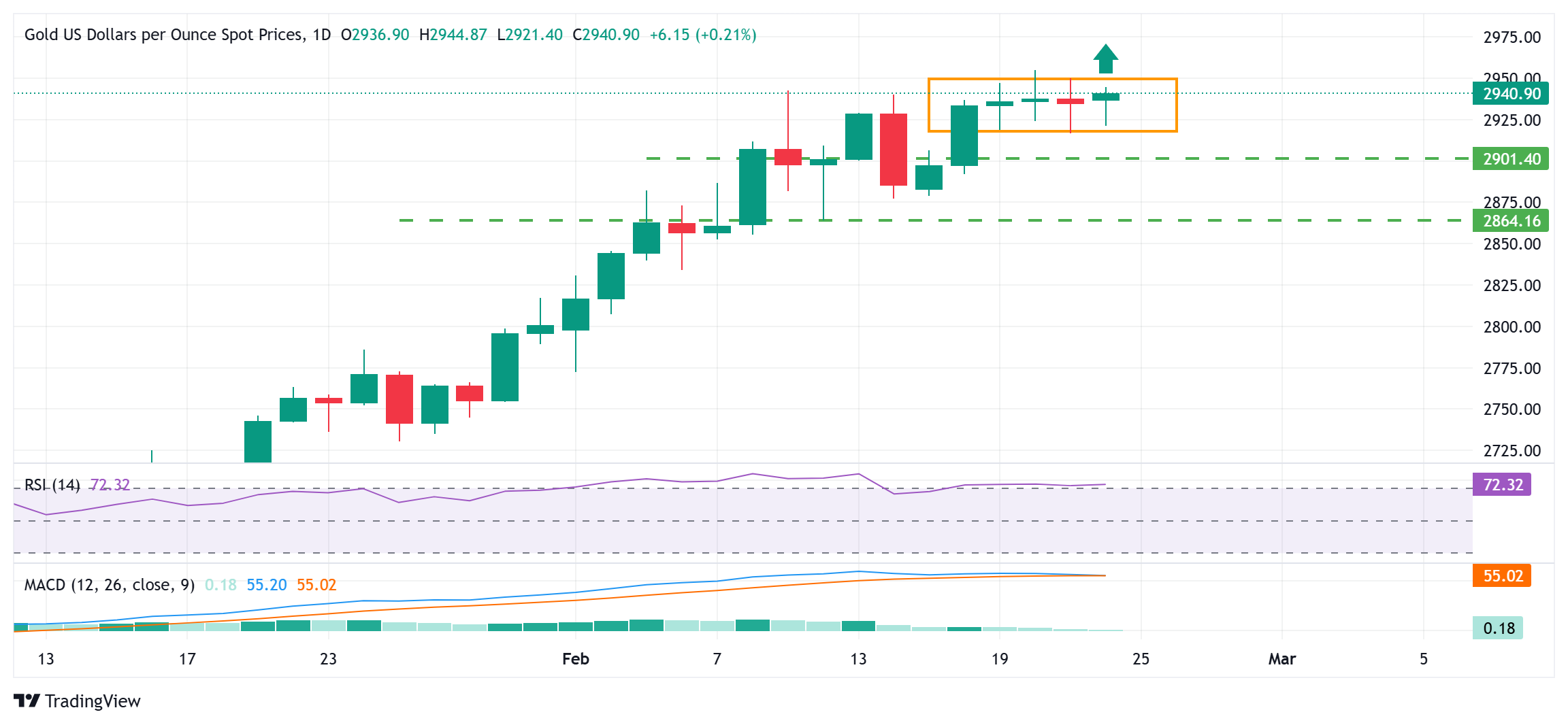
From a technical perspective, the daily Relative Strength Index (RSI) holds above the 70 mark and points to slightly overbought conditions. This might hold back traders from placing fresh bullish bets around the Gold price, which supports prospects for an extension of the range-bound price action. That said, some follow-through buying beyond the $2,950-2,955 area, or the all-time peak, would be seen as a fresh trigger for bulls and assist the XAU/USD to build on its recent well-established uptrend witnessed over the past two months or so.

Meanwhile, any corrective pullback might continue to attract some dip-buyers around the $2,920-2,915 region, or the lower end of a multi-day-old trading range. This is followed by the $2,900 mark and support near the $2,880 region, which if broken decisively could drag the Gold price to the $2,860-2,855 area en route to the $2,834 zone and eventually to the $2,800 mark.

mmm

EUR/USD stays strongly bid near 1.0500 on German Conservatives election win

EUR/USD stays strongly bid near 1.0500 in the European session on Monday. The pair cheers the German Conservatives Party win in the federal election, which revives hopes for better economic outlook. The further upside could remain elusive due to a cautious market mood. Germany’s IFO data eyed.

The Relative Strength Index (RSI) indicator on the 4-hour chart holds above 50, suggesting that the bullish bias remains intact.

EUR/USD faces the first resistance area at 1.0500-1.0510 (round level, Fibonacci 78.6% retracement of the latest downtrend). Once the pair flips that area into support, 1.0550 (static level) could be seen as the next resistance level before 1.0600 (beginning point of the downtrend).

Looking south, supports could be spotted at 1.0440 (Fibonacci 61.8% retracement), 1.0390-1.0400 (100-period Simple Moving Average (SMA), 50-day SMA, Fibonacci 50% retracement of the latest downtrend) and 1.0375 (200-period SMA).

EUR/USD edged lower on Friday and closed the previous week marginally lower. The pair opened on a bullish note and climbed above 1.0500 early Monday as investors reacted to the outcome of the German election outcome. Although the pair inches lower in the European morning, the technical outlook and the improving risk sentiment suggests that it could post additional gains in the near term.

The CDU/CSU, led by Friedrich Merz, won the German election by securing about 28.6% of total votes, while the far-right AfD came second with 20.8%. Finally, Olaf Scholz’s SPD received 16.4% of votes to drop to third. The Euro gathered strength as these results offered no major surprises. Experts now expect a two-party coalition to be formed with CDU/CSU and SPD.

In the second half of the day, the US economic calendar will not feature any high-impact data releases that could influence the US Dollar’s (USD) valuation in a noticeable way.

Meanwhile, US stock index futures were last seen rising between 0.3% and 0.45%. A bullish opening in Wall Street could make it difficult for the USD to stage a rebound and support EUR/USD.

On Tuesday, the Conference Board will release the US Consumer Confidence Index data for February.

Japanese Yen remains on the front foot against USD amid divergent BoJ-Fed expectations

Japanese Yen remains on the front foot against USD amid divergent BoJ-Fed expectations

The Japanese Yen (JPY) builds on steady intraday ascent heading into the European session on Wednesday, which, along with the emergence of fresh US Dollar (USD) selling, drags the USD/JPY pair to the 151.70-151.65 area in the last hour. Investors now seem convinced that the Bank of Japan (BoJ) will hike interest rates further amid signs of broadening inflation in Japan, which continues to underpin the JPY.

Apart from this, the narrowing of the rate differential between Japan and other countries contributes to driving flows towards the lower-yielding JPY. The USD, on the other hand, is pressured by expectations for additional rate cuts by the Federal Reserve (Fed). This suggests that the path of least resistance for the USD/JPY pair is to the downside, though traders might opt to wait for the release of the FOMC meeting minutes.

USD/JPY seems vulnerable to slide further; 151.00 round figure holds the key for bullish traders

fxsoriginal

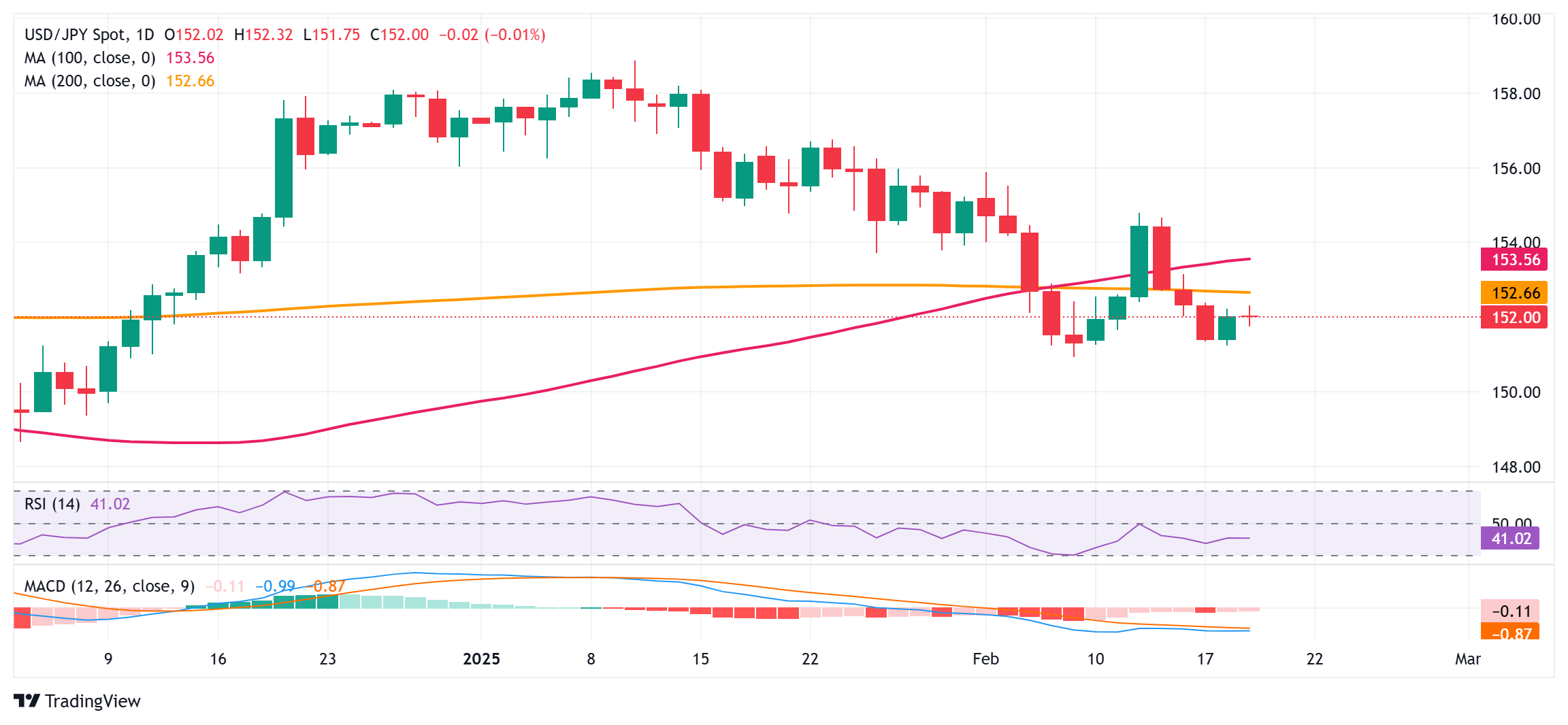
From a technical perspective, any subsequent move up is more likely to face stiff resistance near the 200-day Simple Moving Average (SMA), currently pegged near the 152.65 region. This is followed by the 153.00 mark and the 100-day SMA barrier, around the 153.30-153.35 zone, which if cleared decisively should pave the way for additional gains. The USD/JPY pair might then accelerate the positive move towards reclaiming the 154.00 mark en route to the 154.45-154.50 supply zone, last week’s swing high, around the 154.75-154.80 region, and the 155.00 psychological mark.

On the flip side, weakness below the 151.75 area, or the Asian session trough, could extend towards the overnight swing low, around the 151.25 region. Some follow-through selling, leading to a subsequent breakdown below the 151.00 mark, will be seen as a fresh trigger for bearish traders. The USD/JPY pair might then accelerate the fall towards the 150.60 intermediate support before eventually dropping to the 150.00 psychological mark. The downward trajectory could extend further towards the 149.60-149.55 region en route to the 149.00 mark and the December 2024 low, around the 148.65 region.

eur_456

Forex Today: Focus shifts to mid-tier US data, FOMC Minutes, after UK inflation and RBNZ cut

Investors observe heightened volatility in some currencies early Wednesday following key data releases and central bank decisions. In the second half of the day, Housing Starts and Building Permits data for January will be featured in the US economic docket. Later in the American session, the Federal Reserve (Fed) will release the minuted of the January policy meeting.

US President Donald Trump said late Tuesday that they are looking to impose auto tariffs “in the neighborhood of 25%” as early as April 2. He further added that they are also planning to charge similar duties on pharmaceutical and semiconductor imports. The US Dollar (USD) Index edged slightly higher in the American session and registered small gains for the day. Early Wednesday, the USD Index holds steady near 107.00.

The Reserve Bank of New Zealand (RBNZ) announced in the Asian session on Wednesday that it lowered the policy rate by 50 basis points (bps) to 3.75% from 4.25%, as anticipated. In the policy statement, the RBNZ noted that they have confidence to continue to lower rates and Governor Adrian Orr explained afterward that the policy rate is projected to be lowered by another 50 bps by July. After dropping to a daily low of 0.5677 with the immediate reaction to RBNZ announcements, NZD/USD regained its traction and was last seen trading in positive territory above 0.5700.

The UK’s Office for National Statistics reported early Wednesday that inflation in the UK, as measured by the change in the Consumer Price Index (CPI), climbed to 3% in January from 2.5% in December. In the same period, the core CPI increased by 3.7%, as anticipated. Other details of the report showed that the Retail Price Index declined by 0.1% on a monthly basis. GBP/USD holds steady above 1.2600 following these data releases.

EUR/USD lost about 0.4% on Tuesday but managed to find a foothold. In the European morning on Wednesday, the pair trades in a tight range at around 1.0450.

After snapping a three-day losing streak on Tuesday, USD/JPY came under renewed bearish pressure and declined below 152.00 on Wednesday. Bank of Japan (BoJ) Board Member Hajime Takata said on Wednesday that the BoJ must gradually shift policy, even after January’s rate hike, to avoid upside price risks from materializing.

Gold gathered bullish momentum and rose more than 1% on Tuesday. XAU/USD stays in a consolidation phase above $2,930 on Wednesday and remains within a touching distance of the all-time high it set at $2,942 earlier this month.