China’s Caixin manufacturing PMI shows slimmer profits for smaller manufacturers

The detail reveals a picture that is weaker than the headline numbers suggest

China’s Caixin manufacturing PMI surprised on the upside at 49.4 in November compared to 49.2 in October. It appears as though smaller manufacturers did not suffer as badly as had been expected by the consensus, which had forecast an index of 48.9.

But looking at the details of the sub-indices, it looks like manufacturing activity actually deteriorated faster in November.

The employment sub-index was the lowest it has been since March 2020. In contrast, the input price sub-index has been above 50 for the last two months due to high crude oil and metals prices. And even though the two sub-indices diverged, they point to slower sales growth and slimmer profit margins for smaller manufacturers, which is a more downbeat story than that suggested by the headline numbers.

Future depends on implementation of existing Covid measures

Weaker external demand is another headache for Chinese exporters. With even weaker external economic growth projected for 2023, it seems that there will be no immediate reversal of the weak trend for Chinese exporters any time soon.

One possible positive note is that although Covid cases in China continue to run high, Vice Premier Sun has stated that “…with the weakening of the pathogenicity of the Omicron virus, the popularisation of vaccination and the accumulation of experience in prevention and control, China is facing a new situation and new tasks in the prevention and control of the epidemic”.This hints that local government officials will likely exercise Covid measures with an intent to reduce their impact on the economy even if there are no further imminent changes in the overall Covid rules.

Asian Markets Gaining On Powell Comments

Asian stock markets are trading mostly higher on Thursday, following the broadly positive cues from global markets overnight, as traders cheered US Fed Chair Jerome Powell’s comments about interest rate hikes, which provided further evidence the central bank plans to slow its aggressive pace of interest rate hikes as soon as next month. Asian Markets closed mostly higher on Wednesday.

Powell noted during a speech at a hybrid Brookings Institution event that the full effects of the Fed’s rapid rate increases have yet to be felt.

“Thus, it makes sense to moderate the pace of our rate increases as we approach the level of restraint that will be sufficient to bring inflation down,” Powell said in prepared remarks. “The time for moderating the pace of rate increases may come as soon as the December meeting.”

The Fed’s next monetary policy meeting is scheduled for December 13-14, with CME Group’s FedWatch Tool currently indicating a 77.0 percent chance of a 50-basis point rate hike and a 23.0 percent chance of a fifth straight 75-basis point rate hike.

The Australian stock market is significantly higher on Thursday, extending the gains in the previous two sessions, with the benchmark S&P/ASX 200 at seven-month highs to move above the 7,300 level, following the broadly positive cues from global markets overnight, with strong gains across most sectors, led by technology and mining stocks, as traders cheered US Fed Chair Jerome Powell’s comments about interest rate hikes.

Powell’s remarks provided further evidence the central bank plans to slow its aggressive pace of interest rate hikes as soon as next month.

The benchmark S&P/ASX 200 Index is gaining 57.40 points or 0.79 percent to 7,341.60, after touching a high of 7,375.20 earlier. The broader All Ordinaries Index is up 59.70 points or 0.80 percent to 7,540.40. Australian stocks ended modestly higher on Wednesday.

Among major miners, BHP Group and Rio Tinto are gaining more than 2 percent each, while Mineral Resources and OZ Minerals are up almost 1 percent each. Fortescue Metals is adding almost 3 percent.

Oil stocks are mostly higher. Beach energy is gaining almost 2 percent, Santos is edging up 0.1 percent and Origin Energy is up more than 1 percent, while Woodside Energy is declining almost 2 percent.

In the tech space, Afterpay owner Block is surging almost 7 percent, Appen is soaring more than 10 percent, Xero is up more than 4 percent, WiseTech Global is adding more than 1 percent and Zip is gaining more than 2 percent.

Among the big four banks, Commonwealth Bank and Westpac are gaining almost 1 percent each, while ANZ Banking is adding more than 1 percent and National Australia Bank is edging up 0.4 percent.

Among gold miners, Northern Star Resources is gaining more than 5 percent, Gold Road Resources is adding almost 3 percent, Evolution Mining is surging almost 6 percent, Resolute Mining is soaring more than 9 percent and Newcrest Mining is advancing more than 4 percent.

In economic news, the manufacturing sector in Australia continued to expand in November, albeit at a slower pace, the latest survey from S&P Global revealed on Thursday with a manufacturing PMI score of 51.3. That’s down from 52.7 in October, although it remains above the boom-or-bust line of 50 that separates expansion from contraction.

Capital expenditure in Australia was down a seasonally adjusted 0.6 percent on quarter in the third quarter of 2022, the Australian Bureau of Statistics said on Thursday – coming in at A$33.878 billion. That missed forecasts for an increase of 1.5 percent following the 0.3 percent decline in the previous three months. On a yearly basis, overall capex rose 1.7 percent.

In the currency market, the Aussie dollar is trading at $0.680 on Thursday. The Japanese stock market is significantly higher on Thursday, snapping a four-session losing streak, with the Nikkei 225 nearing the 28,300 level, following the broadly positive cues from global markets overnight, with the gains led by technology stocks. Traders are cheering the US Fed Chair Jerome Powell’s comments about interest rate hikes.

Powell’s remarks provided further evidence the central bank plans to slow its aggressive pace of interest rate hikes as soon as next month. The benchmark Nikkei 225 Index closed the morning session at 28,281.04, up 312.05 points or 1.12 percent, after touching a high of 28,423.46 earlier. Japanese stocks closed modestly lower on Wednesday.

Market heavyweight SoftBank Group is gaining almost 2 percent and Uniqlo operator Fast Retailing is adding more than 2 percent. Among automakers, Toyota and Honda are edging down 0.4 to 0.5 percent each.

In the tech space, Screen Holdings is gaining more than 2 percent, Tokyo Electron is adding almost 4 percent and Advantest is advancing more than 3 percent.

In the banking sector, Mitsubishi UFJ Financial is losing almost 1 percent, Sumitomo Mitsui Financial is declining more than 1 percent and Mizuho Financial is down almost 2 percent.

Among the major exporters, Mitsubishi Electric is edging down 0.4 percent, Canon is losing almost 1 percent, while Sony is gaining 1.4 percent. Panasonic is flat.

Among the other major gainers, Eisai is surging more than 5 percent and Tokai Carbon is gaining more than 4 percent, while Nippon Sheet Glass, Shiseido and TDK are adding more than 3 percent. Yaskawa Electric is advancing almost 3 percent.

Conversely, Shizuoka Financial is losing almost 4 percent, while Sompo Holdings and Sumitomo Realty & Development are declining almost 3 percent each.

In economic news, the manufacturing sector in Japan fell into contraction in November, the latest survey from Jibun Bank showed on Thursday with a manufacturing PMI core of 49.0. That’s down from 50.7 in October, and it moves beneath the boom-or-bust line of 50 that separates expansion from contraction.

In the currency market, the U.S. dollar is trading in the higher 136 yen-range on Thursday.

Elsewhere in Asia, China, Hong Kong and Taiwan are surging between 1.0 and 1.4 percent each, while New Zealand, Singapore, South Korea Malaysia are higher by between 0.2 and 0.7 percent each. Indonesia is bucking the trend and is down 0.3 percent.

On Wall Street, stocks turned in a lackluster performance in morning trading on Wednesday but moved sharply higher in reaction to highly anticipated remarks by Federal Reserve Chair Jerome Powell. With the surge, the Dow reached a new seven-month closing high, while the Nasdaq and the S&P 500 reached their best closing levels in over two months.

The major averages saw further upside going into the close, ending the session at their best levels of the day. The Dow jumped 737.24 points or 2.2 percent to 34,589.77, the Nasdaq soared 484.22 points or 4.4 percent to 11,468.00 and the S&P 500 spiked 122.48 points or 3.1 percent to 4,080.11.

The major European markets also moved to the upside on the day. While the French CAC 40 Index jumped by 1.0 percent, the U.K.’s FTSE 100 Index advanced by 0.8 percent and the German DAX Index rose by 0.3 percent.

Crude oil futures surged on Wednesday after data showed a steep drop in U.S. crude inventories last week. Expectations of increased demand from China and a weaker dollar also contributed to the jump in oil prices. West Texas Intermediate Crude oil futures for January ended higher by $2.35 or 3 percent at $80.55 a barrel.

European Shares Seen Opening Up On Powell’s Dovish Remarks

European stocks are likely to open higher on Thursday as investors react to a dovish speech by Fed Chair Jerome Powell at the Brookings Institution in Washington.

Asian markets followed Wall Street higher, but overall gains were relatively modest on China growth concerns.

China’s manufacturing sector continued to contract in November due to the sustained reductions in output and sales, a closely watched survey showed earlier today.

The Caixin manufacturing Purchasing Managers’ Index rose moderately to 49.4 in November from 49.2 in October, data published by S&P Global revealed.

China’s vice-premier signaled a shift in the country’s COVID stance, with several regions including Shanghai beginning to lift lockdowns despite continuing high case numbers.

Meanwhile, Nato allies are concerned about China’s coercive policies, including its cooperation with Russia, U.S. secretary of state Antony Blinken told a news conference on Wednesday after a two-day meeting of foreign ministers from the defense alliance.

The dollar tumbled to a three-month low versus the Japanese yen on improved risk sentiment while gold traded at a two-week high on hopes for smaller U.S. rate hikes.

Oil prices fell slightly in Asian trade after having climbed about 3 percent on Wednesday.

A final PMI reading on S&P Global’s factory sector for Eurozone is due later in the session. Across the Atlantic, trading may be impacted by another batch of U.S. economic data, including reports on weekly jobless claims, personal income and spending and manufacturing activity.

U.S. stocks rallied overnight and recorded their first back-to-back monthly gains since 2021 after Powell indicated the central bank might moderate the pace of rate increases as soon as December.

At the same time, Powell noted that restoring price stability will require holding policy at a restrictive level for some time until signs of progress emerge on inflation.

Economic data painted a mixed picture, with private payrolls growth slowing in November and third-quarter GDP growth revised up to 2.9 percent from 2.6 percent.

The Dow jumped 2.2 percent to hit a new seven-month closing high, while the tech-heavy Nasdaq Composite and the S&P 500 surged 4.4 percent and 3.1 percent, respectively to reach their best closing levels in over two months.

European stocks snapped a three-day losing streak on Wednesday as data showed eurozone inflation slowed more than expected in November.

The pan European STOXX 600 gained 0.6 percent. The German DAX edged up 0.3 percent, France’s CAC 40 index climbed 1 percent and the U.K.’s FTSE 100 added 0.8 percent.

European Economics Preview: UK Nationwide House Prices Data Due

House prices from the UK and final factory Purchasing Managers’ survey results from the UK and other major euro area economies are the top economic news due on Thursday. At 2.00 am ET, UK Nationwide house price data is due. House price inflation is seen easing to 5.8 percent in November from 7.2 percent in October.

In the meantime, Germany’s retail sales figures are due. Economists forecast sales to fall 0.6 percent on month in October, in contrast to the 0.9 percent increase in September.

Half an hour later, the Federal Statistical Office is scheduled to publish Swiss retail sales and consumer price figures. Inflation is expected to remain unchanged at 3.0 percent in November.

At 3.15 am ET, S&P Global publishes Spain’s manufacturing Purchasing Managers’ survey data. The sentiment index is expected to rise to 45.6 in November from 44.7 in October.

At 3.45 am ET, manufacturing PMI survey results are due from Italy. Economists expect the PMI to rise to 47.0 in November from 46.5 a month ago.

Final PMI survey results are due from France and Germany at 3.50 and 3.55 am ET, respectively. At 4.00 am ET, Eurozone final factory PMI reading is due. According to the flash estimate, the index had advanced to 47.3 in November from 46.4 in the previous month. At 4.30 am ET, S&P Global releases UK final manufacturing PMI. The final reading is seen at 46.2 in November, unchanged from the flash estimate.

At 5.00 am ET, Eurostat publishes euro area unemployment data for October. The jobless rate is expected to remain at 6.6 percent.

Italy’s debt could be a worry for the Eurozone

Bloomberg reports that Italy has a €123.2 billion debt mountain from COVID-backed state support which, as of June 30, is outstanding. The debt has been rising too as it has increased from the previous quarter of €118 billion. Despite not being the largest country it has the largest government-guaranteed debt yet to be repaid in the Eurozone. Check out below the growing level of Italian debt from the state-backed loans.

The problem that is building is that the energy crisis is lingering on, inflation remains high, and Italy is expected to contract 0.2% in 2023, according to the IMF. This means that the debt burden can be a growing political worry as more and more companies will struggle to meet repayments on many of these loans (just under 50%) as they mature from 2024 onwards.

So, on one hand, this is not an immediate risk for the euro. However, the market is sensitive to Italian debt and if this looks like getting out of control it could start to weigh on the euro over the medium to longer term. The environment which will make this worse will be if the Russia-Ukraine crisis goes on, energy prices stay high, Italy’s economy contracts, and inflation pressures remain elevated. This would be the environment that would pressure not only Italy, of course, but the whole Eurozone. However, Italy’s debt problems have been a major factor for the euro in the past and this risk should be monitored in case it accelerates. Bear in mind that the bite of this risk would not really be felt until we approach 2024, so it is a risk in the medium-term horizon. You can read the full Bloomberg article here.

freight trains in Los Angeles

Congress leaders signal support for preventing US rail strike

United States congressional leaders have expressed support for quickly ending a threatened rail workers’ strike that could sow chaos in the US economy.

Speaking at the White House after a meeting with President Joe Biden Tuesday, Senate Majority Leader Chuck Schumer said the leaders of both his Democratic party and the Republicans support turning to a rarely used legislative power to resolve the union dispute.

Biden had warned Monday of a catastrophic economic impact if railroad services ground to a halt, saying up to 765,000 Americans “could be put out of work in the first two weeks alone”.

At Tuesday’s White House meeting, the president was asked if he was confident he could avert a rail strike and responded with: “I am confident.”

“All four of us agreed we’ve got to resolve this rail shutdown as quickly as possible,” Schumer said, adding that senior Republican Senator Mitch McConnell “agreed to try to get it done ASAP”.

Nancy Pelosi, the Democratic speaker of the House of Representatives, said the lower chamber would vote Wednesday on forcing unions to accept a deal averting a strike. It would then go to the Senate.

A strike by freight rail workers, who are integral to US supply chains, is expected to start December 9 unless Congress intervenes. Legislators would effectively be forcing hold-outs to accept a September preliminary deal on increased wages agreed to by a majority of unions.

freight trains in Los Angeles
An aerial view of shipping containers and freight railway trains at the BNSF Los Angeles Intermodal Facility rail yard in Los Angeles, California, US [File: Bing Guan/Reuters]

Workers in four rail unions rejected the tentative deal after criticising the lack of paid sick leave, while workers in eight unions approved it.

A rail traffic stoppage could freeze almost 30 percent of US cargo shipments by weight, stoke already surging inflation and cost the country’s economy as much as $2bn per day by unleashing a cascade of transport woes affecting the energy, agriculture, manufacturing, healthcare and retail sectors.

Association of American Railroads Chief Executive Ian Jefferies said: “Congress has historically acted with haste in a highly bipartisan manner and that’s our goal again here as we sit here today.”

Labour unions have criticised the railroads’ sick leave and attendance policies and the lack of paid sick days for short-term illnesses. There are no paid sick days under the tentative deal. Unions asked for 15 paid sick days and the railroads settled on one personal day.

The Brotherhood of Maintenance of Way Employees Division of the Teamsters sharply criticised Biden’s call to Congress to intervene, saying “the railroad is not a place to work while you’re sick. It’s dangerous…. it is unreasonable and unjust to insist a person perform critical work when they are unwell.”

On Monday, more than 400 groups called on Congress to intervene in the railroad labour standoff. Biden hailed the contract deal, which includes a 24 percent compounded wage increase over five years from 2020 through 2024 and five annual $1,000 lump-sum payments.

Biden had called the White House meeting to discuss the “lame duck” session of Congress ahead of January when Republicans will take control of the House of Representatives, after their narrow win in November’s midterm elections. Democrats will retain a thin majority in the Senate.

The White House said Biden and the congressional leaders also discussed maintaining funding for the US government and unprecedented military aid for Ukraine in its fight against Russian invasion.

Biden, who faces the next two years of his first term with Republicans blocking his legislation in the House, offered an olive branch, according to the White House.

He told his “Republican colleagues that whatever disagreements they may have, he is always interested in finding new common ground, and that he has an open door to hear their perspectives,” the statement said.

Biden meets with Congressional leaders

EuroZone CPI and What the ECB Could Do

Tomorrow we get our first look at this month’s inflation figures from the EuroZone. This data is critical for the shared currency because this is the data that the ECB will have when going into its interest rate decision two-and-a-half weeks from now. Since it’s flash data, it might be revised later, of course. But those revisions typically are rare and small, so it would be a major shake up if it were to happen. For now, what happens with the Flash November CPI is likely to define the Euro’s trajectory until the ECB meeting.

The thing is, the moment of the data release might not have the biggest reaction in the market because the two largest economies report ahead. Thus, the market has a pretty good idea of directionality. If both France and Germany’s inflation is below expectations, then the market will expect the Eurozone to have a similar pattern. If those two countries come in above expectations, then the same will be expected for the whole shared economy. But if both France and Germany go in different directions, then the market could hold off until the full data is released.

What to look out for

France reports its inflation figures fifteen minutes before the opening of the markets in Europe. Inflation is expected to tick up slightly to 6.3% from 6.2%, which is the opposite of what was expected for Germany. France has been able to keep a better lid on inflation lately thanks to its nuclear power making it less reliant on higher natural gas and crude prices. But that also means it doesn’t benefit from those commodities dropping in price, which has been the theme for the last couple of months.

Eurozone Flash November CPI annualized rate is expected to drop to 10.3%, down from 10.6% prior. Despite staying in double digits, it would be the second consecutive drop in prices since the start of the latest inflation crisis. Markets could take it as a sign that inflation is finally peaking. Of course if it were to come in above 10.6%, that would break a downward trend and might cause a reassessment of what’s expected from the ECB.

Lagarde insists on hiking

Yesterday, the ECB’s chief insisted that more rate hikes were coming, but refused to provide specific guidance. Lagarde said that policy is still “accommodative” and might have to move into restrictive territory before inflation is properly under control. She also said that the ECB would discuss quantitative tightening at the next meeting.

This mirrors comments from Fed officials, who also insist that a pause in rate hiking is nowhere near. For now, the trajectory of the EURUSD comes down to the differential expectations in rate policy. The Fed was first to raise, which gave the dollar a boost. But that also implies the Fed will likely be the first to start easing off, which would mean the ECB could keep hiking while the Fed does not.

That sets the conditions for the interest rate gap that drove the Euro below parity with the dollar to reverse. However, the timing for that still depends on how the respective inflation data from the two economies evolves.

AU: Inflation down but consumer pain continues

A key price gauge shows cost of living pressures are easing, but the treasurer warns Australia’s inflationary challenge is far from over.

Inflation fell to 6.9 per cent in the year to October after hitting 7.3 per cent in September, according to the monthly consumer price index.

Recently introduced by the Australian Bureau of Statistics to supplement the main quarterly index, the monthly measure of price pressures remains high and well above the two to three per cent inflation range targeted by the central bank.

Trimmed mean inflation declined slightly from an annual pace of 5.4 per cent in September to 5.3 per cent in October.

“This is very elevated and suggests inflation remains broad-based across the economy,” St George economist Jameson Coombs said.

ABS head of prices statistics Michelle Marquardt said a scheduled change to the way the bureau calculated the consumer index in order to reflect shifting spending patterns was partially responsible for the unexpected monthly decline.

Under the old weighting system, the headline inflation reading would have been 7.1 per cent rather than 6.9 per cent, she said.

Mr Coombs added the monthly index was more volatile than the quarterly version and said the monthly slip did not necessarily indicate a changing trend.

“The data, although softer, suggests that the inflation pulse remains strong and that domestic drivers of inflation remain acute,” he said.

Treasurer Jim Chalmers welcomed the slowdown in inflation but warned the recent floods and surging energy costs were yet to impact prices.

“While the slight easing in the indicator in October is welcome, we know there are further price pressures that will drive inflation this quarter,” he said.

Softening prices across some key categories helped pull the index lower as better growing conditions fed into lower inflation for fruit and vegetables.

Prices for the fresh food items increased at an annual rate of 9.4 per cent in October compared to 17.4 per cent in September.

Holiday travel and accommodation prices also moderated sharply, dropping from 12.6 per cent in September to 3.7 per cent annual growth in October after the end of school holidays and peak European and American travel seasons helped pull airfares down.

But the restoration of the full fuel excise appeared in the October reading, which showed automotive fuel prices increased by 11.8 per cent, up from 10.1 per cent in the year to September.

Low vacancy rates also fed into higher rents, which were up 3.5 per cent in October compared to 2.9 per cent in September.

Separate figures from the ABS showed new dwelling approvals continued tracking down in October, falling six per cent over the month after a 8.1 per cent drop in September.

Apartment approvals led the decline, while private-sector houses decreased by only 2.2 per cent.

The bureau also released completed construction work data, which rose 2.2 per cent in the September quarter as the industry continued to work through a significant backlog of work.

After a depressed June quarter reading, residential building activity lifted by 1.3 per cent over the September quarter.

Non-residential building activity increased by 1.1 per cent over the quarter, with activity expected to remain strong due to a sizeable pipeline of new projects.

image1.png

Australian Dollar Gains Despite Soft Chinese PMI and Mixed Domestic Data. Lower AUD/USD?

The Australian Dollar dunked lower twice today after local data showed slowing economic activity and then the Chinese PMI missed estimates. Not long after the brouhaha, the currency ended up near where it started before testing higher levels above 67 cents.

Chinese manufacturing PMI for October printed at 48.0 against the 49.0 anticipated and the non-manufacturing came in at 46.7, below the 48.0 forecast. This combined to give a composite PMI read of 47.1 against 49.0 previously.

The China PMI indices are the result of a survey of 3,000 manufacturers across China, mostly large firms. It is a diffusion index, so reading over 50 is viewed as a positive for the economic outlook of the world’s second-largest economy.

An hour before the Chinese PMI came out, Australian private sector credit for October showed growth of 0.6% month-on-month as expected. This contributed to an annual read of 9.5% year-on-year which was also in line with forecasts.

Additionally, building approvals for October showed a decline of -6.0% month-on-month, well below -2.0% anticipated and on the back of the previous figure of -5.8%.

For the first time, the Australian Bureau of Statistics (ABS) published a monthly CPI figure. There will be two such releases between the quarterly figures. These prints will cover 62-73% of the weighted quarterly basket. More details can be read

The official CPI reading for the purpose of the RBA’s target band of 2-3% will remain as the quarterly number.

Today’s year-on-year CPI came in at 6.9% to the end of October, way below forecasts of 7.6%.

Today’s data was on the back of Monday’s Australian retail sales for the month of October sliding by -0.2% month-on-month instead of rising by 0.5% as expected.

All of this stacks up as a conundrum for the RBA’s monetary policy meeting next Tuesday. While the data is overall softish for the Australian economy, the central bank will not be meeting again until early February.

Although today’s CPI is below expectations, it remains elevated, and the quarterly CPI revealed an acceleration in the third quarter.

In any case, Australian Commonwealth Government Bonds (ACGB) rallied with yields easing across the curve. The 3-year bond is near 3.20% against 3.30% at the end of last week.

The Australian Dollar is finding support on the back of hopes that Chinese authorities might look to add stimulus measures to re-ignite their economy.

AUD/USD SHORT-TERM CHART OVER THE DATA RELEASES

image1.png 

Former Japanese Prime Minister Hashimoto Ry?tar? gives a speech at Beijing’s Great Hall of the People to mark 30 years of Sino-Japanese ties. (© Izumi Nobumichi)

Japan, China Mark Half-Century of Ties with an Eye on the Future

A Milestone Year Marked by the Taiwan Issue

On September 12 this year, an online symposium took place connecting audiences in Tokyo and Beijing, marking the fiftieth anniversary of the 1972 normalization of diplomatic ties between Japan and the People’s Republic of China. Cohosted by the business organization Keidanren and the Chinese embassy in Tokyo, the event was attended by figures from the Japanese side including former Prime Minister Fukuda Yasuo, former speaker of the House of Representatives K?no Y?hei, and Keidanren Chairman Tokura Masakazu.

The mood at the event, though, was considerably less than celebratory. Chinese State Councilor and Foreign Minister Wang Yi, in a video message played at the event, stated baldly: “On major issues of principle essential to the very foundation of China-Japan relations, such as history and Taiwan, there must be no ambiguity, still less any wavering or backpedaling.”

Chinese Ambassador to Japan Kong Xuanyou, who delivered the keynote address at the event, noted that the previous half-century had indeed seen a welcome increase in Sino-Japanese exchange and cooperation. At the same time, though, he demanded that the Japanese government take a very cautious stance on the Taiwan issue, in effect firing shots across Tokyo’s bow with respect to the question of the island.

Taiwan is, indeed, the number-one stumbling block in the way of smooth relations between Japan and China, not to mention between the United States and China. When Nancy Pelosi, speaker of the US House of Representatives, visited Taiwan in early August this year, it triggered a fresh round of People’s Liberation Army military exercises displaying the capability to encircle the island, including China’s first-ever launch of ballistic missiles into Japan’s exclusive economic zone.

From Honeymoon to Harsh Weather

On September 29, 1972, Japanese Prime Minister Tanaka Kakuei and Chinese Premier Zhou Enlai signed the joint communiqué between the two governments that restarted diplomatic ties. In the following month, two pandas, the female Lang Lang and male Kang Kang, arrived at Tokyo’s Ueno Zoo, highlighting the launch of a warmer era in bilateral ties.

Japanese economic cooperation with China got its full-fledged start in December 1979, when Prime Minister ?hira Masayoshi visited Beijing, and this provided the impetus for the Chinese authorities to press ahead with their policy of reform and opening. A decade later this trend was cut off with the June 1989 Tiananmen protests and massacre, which sparked Western economic sanctions and cut China off from the international community. It was Japan, though, that moved first to bring about a thaw in this freeze, with the administration of Prime Minister Miyazawa Kiichi laying the groundwork for an October 1992 visit by Emperor Akihito and Empress Michiko to Beijing, Xian, and Shanghai.

The 1990s saw a change in this warming dynamic, though. Japan’s economic bubble collapsed, and the country headed into an extended period of sluggish growth. China, meanwhile, stepped out with a more muscular stance on the diplomatic and military fronts, including nuclear weapons tests in June and July 2006 that brought harsh condemnation from Tokyo. The economic front was no less stormy in the region, with July 1997 seeing the beginning of the Asian currency crisis. Add to this repeated standoffs between Beijing and Tokyo over history issues, and it was clear that the countries had entered a markedly cooler period in their bilateral relationship.

Once Koizumi Jun’ichir? took office as Japan’s prime minister in April 2001, his regular visits to the problematic Yasukuni Shrine triggered harsh responses from China. The five and a half years he spent in office would be viewed as perhaps the roughest period in Sino-Japanese ties since they were reforged in 1972.

During this period, though, an event took place at the Great Hall of the People in Beijing on September 28, 2002, to celebrate the thirtieth anniversary of the normalization of the relationship. In attendance from Japan were former Prime Minister Murayama Tomiichi, former Deputy Prime Minister Got?da Masaharu, and the celebrated painter Hirayama Ikuo; another former prime minister, Hashimoto Ry?tar?, gave a speech. Seated at the same head table were Vice Premier Hu Jintao and Deputy Prime Minister Wen Jiabao, both of whom would go on to serve in top Chinese leadership posts.
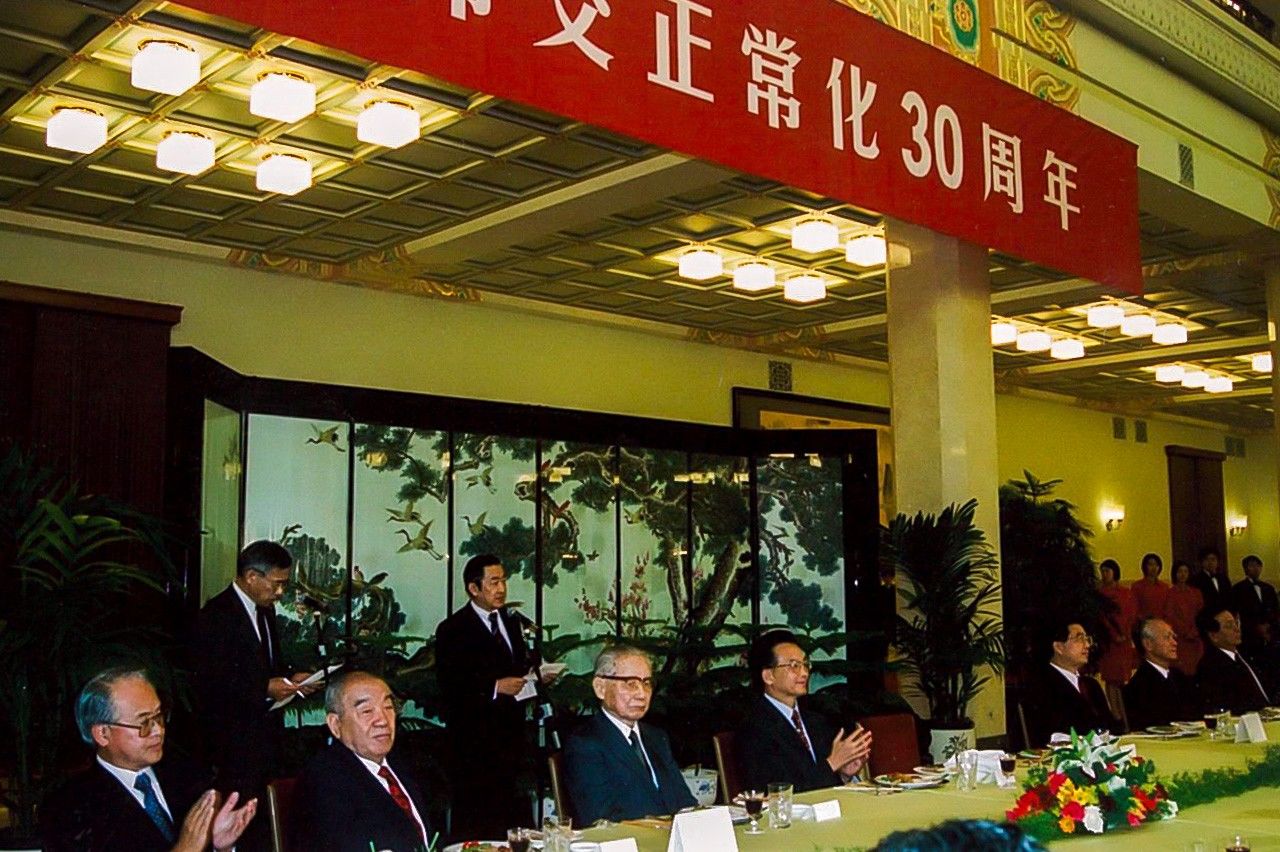
Former Japanese Prime Minister Hashimoto Ry?tar? gives a speech at Beijing’s Great Hall of the People to mark 30 years of Sino-Japanese ties. (© Izumi Nobumichi)
While I was stationed in Beijing, I heard Wang Yi, now foreign minister, describe the ties between Japan and China as follows. “When we normalized diplomatic ties we were like newlyweds. For a period thereafter we enjoyed a honeymoon, but as time passes, any couple will see some friction arise.” By this marriage-based reckoning, in 2002 our countries marked their pearl anniversary, the thirtieth; this year, September 29 was the golden anniversary for Japan and China.

Abe Shinz?’s Work for Warmer Ties

The beginning of the century was described as “politically cold, economically hot,” or frosty in political terms, while the countries forged ever-warmer economic connections. As noted above, the Koizumi administration marked a wintry era for the bilateral relationship. It was Abe Shinz?, lost to an assassin’s gun in July this year, who helped to bring about a thaw.

Soon after Abe took office for the first time as prime minister, on October 8, 2006, he visited China and met with Premier Wen Jiabao and President Hu Jintao. This was the first step toward rebuilding a “mutually beneficial strategic relationship” between China and Japan.

Laying the groundwork for this dramatic visit had been Wang Yi, then China’s ambassador to Japan. Born in 1953, Wang celebrated his birthday on October 8, and it was said he arranged the meeting with this date in mind. The Japanese phrase corresponding to the “mutually beneficial strategic relationship,” meanwhile, was apparently the brainchild of the diplomat Tarumi Hideo, who today serves as Japan’s ambassador in Beijing.

Abe would again take office as prime minister in December 2012. Just ahead of this, in September that year, the administration of Prime Minister Noda Yoshihiko nationalized the Senkaku Islands, part of Okinawa Prefecture, which China claims as its own territory. This took place just ahead of the National Congress of the Chinese Communist Party, held every five years, and it brought a severe chill to bilateral ties, with large-scale anti-Japanese protests erupting across China.

In November 2014, Abe again visited China, where he met with President Xi Jinping. The two sides recognized that they held differing views on the Senkaku issue, but reached a four-point agreement including a determination to use dialogue and consultation to prevent the deterioration of the situation. This short summit lasted just 25 minutes, and the leaders bore stern looks throughout the meeting, but they shook hands and took a commemorative photo at the end.
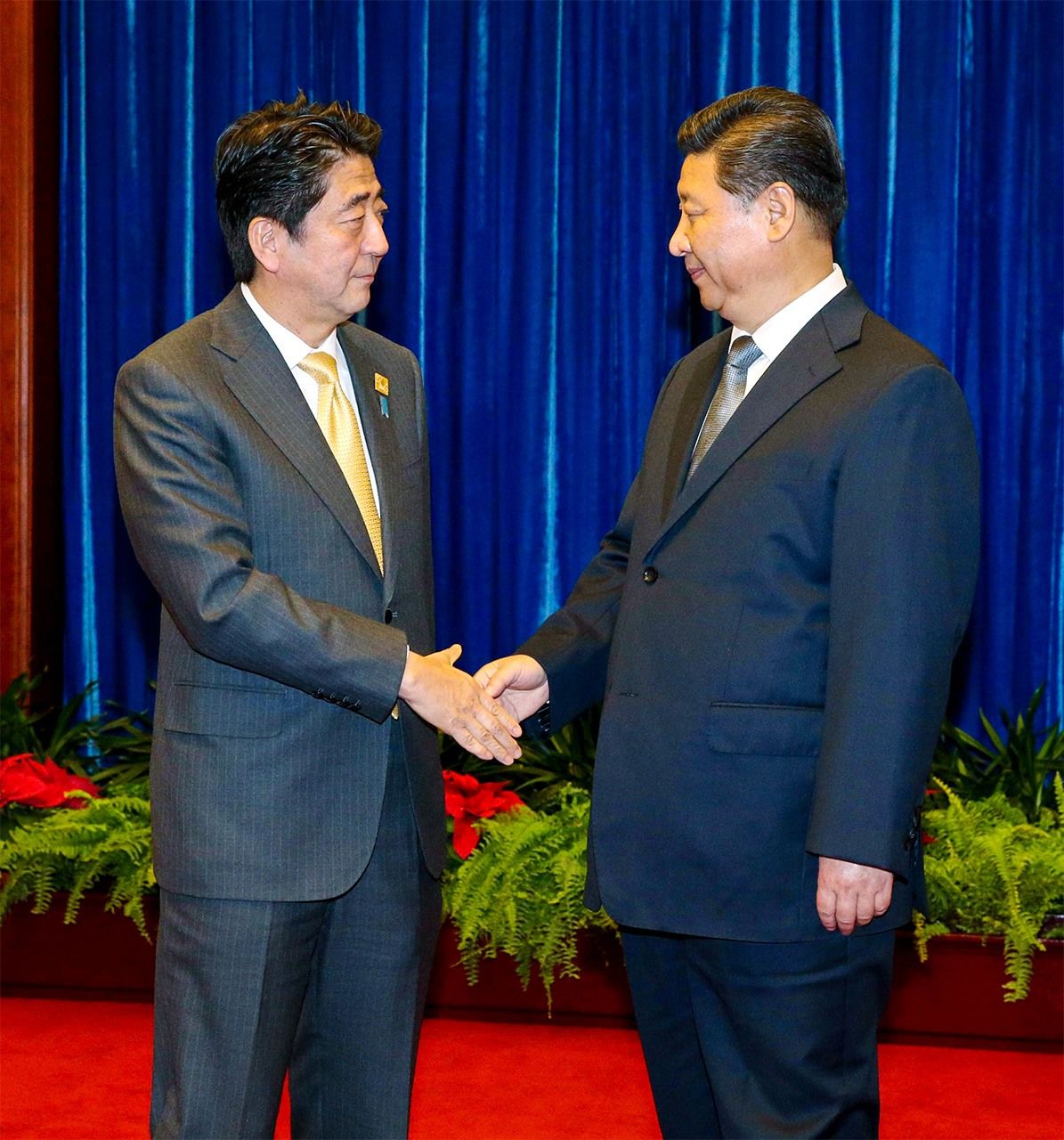
Xi Jinping, right, and Abe Shinz? shake hands after their brief summit meeting at the Great Hall of the People in Beijing on November 10, 2014. (© Jiji)
On July 9 this year, the day after Abe Shinz? died in a shooting attack in Nara, Xi sent a telegram of condolences to Prime Minister Kishida Fumio. In it he praised the late politician, stating: “Former Prime Minister Abe worked for the betterment of Sino-Japanese relations while in office, making valuable contributions.”

Turning back once more to the November 2014 Xi-Abe summit, we should note that it was Fukuda Yasuo, Japan’s prime minister in 2007–8, who laid the groundwork for this meeting. In July 2014 he paid a secret visit to China together with Yachi Sh?tar?, then director-general of the National Security Secretariat, where the two met with Xi. They also spoke with Foreign Minister Wang Yi and State Councilor Yang Jiechi, with whom they made progress on the four-point agreement that would be reached later that year between Xi and Abe.

Fukuda Yasuo and Wang Yi could be considered “old friends” of a sort, with a relationship going back some 20 years even at that point in 2014. In August 2008, when Fukuda was prime minister, he attended the Opening Ceremony of the Beijing Olympic Games; he also served as director-general of the China-driven Boao Forum for Asia, among other moves cementing his solid connections with Beijing.

In 1978, Fukuda Yasuo’s father, Prime Minister Fukuda Takeo (in office from 1976 to 1978), signed the Treaty of Peace and Friendship between Japan and China. From father to son, two generations of this family were involved in developing ties between the leaders of these two countries.

Trust-Building Politicians on Both Sides

If I may be permitted a personal recollection, in April 1988, I took my first trip to China as a newspaper journalist accompanying It? Masayoshi, then the chairperson of the Liberal Democratic Party’s General Council. This was the beginning of my true professional interest in China, and Asia more broadly.

Takeshita Noboru, then prime minister, had dispatched It? to Beijing as a personal envoy; on April 19, he met with Deng Xiaoping, chairman of China’s Central Military Commission and effectively the supreme leader of the country, at the Great Hall of the People.
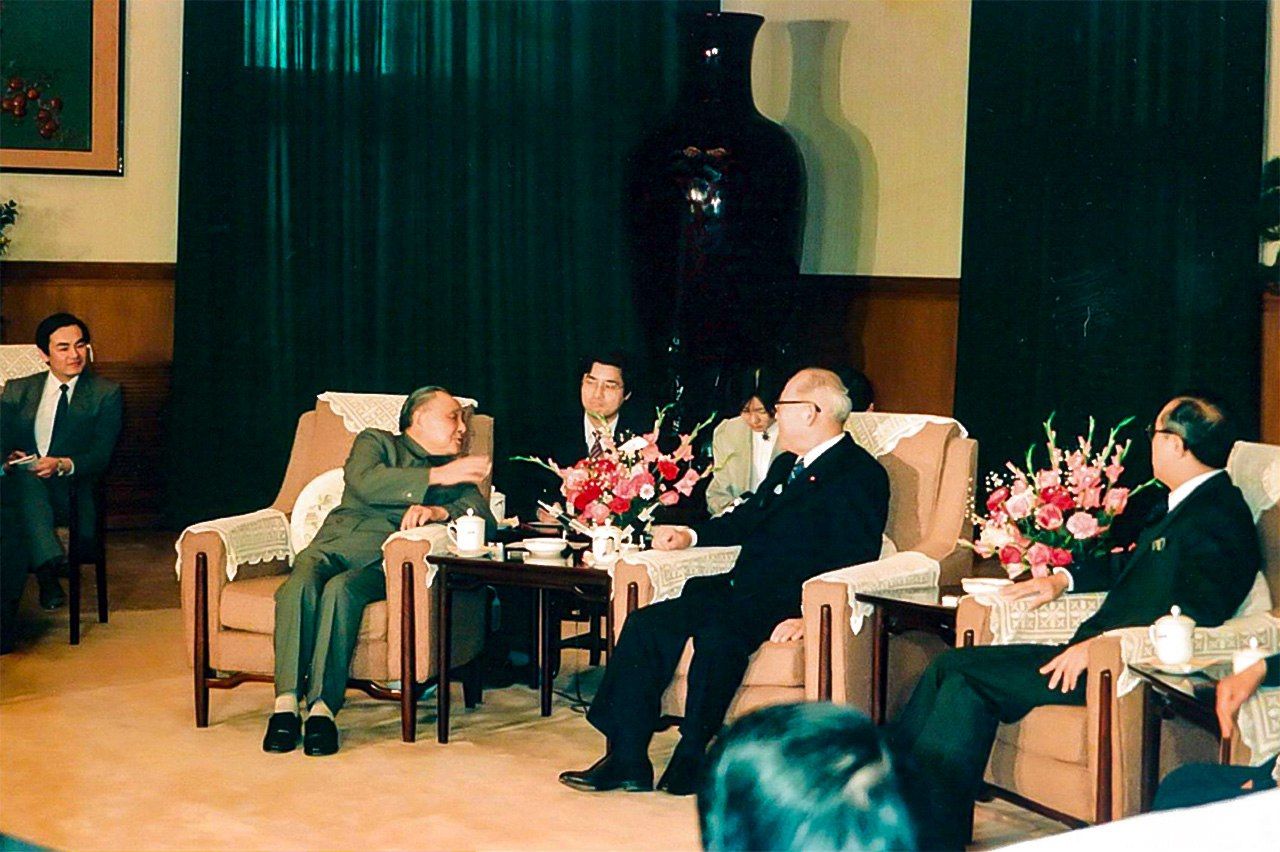
Chinese leader Deng Xiaoping, at left, speaks with the Japanese LDP’s It? Masayoshi on April 19, 1988, at the Great Hall of the People in Beijing. (© Izumi Nobumichi)
“I’ve met with any number of Japanese politicians,” said Deng to It?, “but I’ve met you more times than any of them. We truly are friends who can open our hearts to one another.” Camera in hand, I was present as a member of the press corps, but I remember feeling a sense of real closeness between these two elder statesmen.

Indeed, Deng (then 84) and It? (74) were taking part in their sixth meeting. In June the following year, the Tiananmen Square massacre took place, but soon afterward, it was once again It? who served as one of the first representatives of the world’s advanced democracies to go to China, where he saw Deng for the seventh time, helping to open a way for Beijing to return to the community of nations.

Why was It?, who served as head of the Japan-China Friendship Parliamentarians’ Union, able to win this level of trust from the Chinese side? Firstly, he had an intimate knowledge of the current state of affairs in China at the time. Also enhancing his reception in China was the fact that he had been critical of Japan’s military actions during the second Sino-Japanese War.

A graduate of the law department at the elite Imperial University of Tokyo, It? was a bureaucrat at the Ministry of Agriculture and Forestry before being seconded to the East Asia Development Board, an agency-level organization launched late in 1938 to coordinate Japan’s continental policy. While there he served in Shanghai. ?hira Masayoshi, who would go on to be prime minister in 1978–80, was seconded to the EADB from the Finance Ministry at the same time, and the two hit it off, becoming lifelong friends.

In 1943, It? received his orders calling him up for military service. He was qualified to become an officer, but something in his humble Aizu, Fukushima, roots made him averse to the idea, and he chose not to take the officer candidates’ examination. I remember him reminiscing about the rough treatment this brought him, like the time when a private first class had struck him, sending his eyeglasses flying.

Negative Impressions to Overcome on Both Sides

The history of ties between Japan and China actually goes back some 2,000 years. Premier Zhou Enlai, one of the architects on the Chinese side of the 1972 reestablishment of diplomatic ties, described this relationship as “2,000 years of friendship and 50 years of confrontation,” with the latter period being the half-century from the first Sino-Japanese War of 1894–95 through the end of World War II in 1945.

How, then, can we characterize the half-century that has passed since Japan and China restarted their diplomatic relationship in 1972? Fifty years ago, fewer than 10,000 people a year traveled between the two countries. This number had climbed as high as 12 million just before the COVID-19 pandemic brought the numbers crashing back down again. Economic ties have also blossomed, with China today being the largest trading partner for Japan.

Despite all this, national sentiment on both sides has been worsening for some time. In January this year Japan’s Cabinet Office published the results of the Public Opinion Survey on Diplomacy implemented in September–November 2021. Compared to the previous survey, carried out in October 2020, the percentage of respondents who thought Japan-China ties were good fell 2.6 points to 14.5%; those who did not think they were going well, meanwhile, climbed 3.4 points to 85.2%.

Similar results were produced by the Japan-China Public Opinion Survey carried out by Genron NPO, a nonprofit Japanese thinktank, and the China International Publishing Group in August–September 2021. In China, the percentage of respondents with a poor opinion of Japan rose 13.2 points from the previous year to 66.1%, while in Japan, those with a poor opinion of China climbed 1.2 points to 90.9%.

In September 1997, a quarter-century after the normalization of ties, Sun Pinghua, chair of the China-Japan Friendship Association—who had also laid the groundwork for Prime Minister Tanaka’s 1972 Beijing visit and was close to It?—contributed a series of pieces to the Watashi no rirekisho (My Resume) column in the Nihon Keizai Shimbun. In the first installment, he wrote:

“For both Japanese friendship with China and Chinese friendship with Japan, the most important thing is the same: relations between human beings. I believe it is key for people to get along with one another, heart to heart. In this sense, I fear that China-Japan ties in recent years have lacked these emotional underpinnings.”

Indeed, as the two nations marked the “silver anniversary” of their modern bilateral relationship, ties were not particularly good. Nevertheless, in the Japanese government’s Public Opinion Survey on Diplomacy carried out in September–October 1997, respondents with a positive view of Japan’s ties with China outnumbered those with a negative view, at 45.6% to 44.2%.

“A Duty to Our Descendants”

The Sino-Japanese relationship in the twenty-first century is no longer one to be analyzed simply in terms of bilateral ties. These are the second- and third-largest national economies in the world, and confrontation between these countries would have a severe impact on the global economy as a whole. World affairs remain unstable, with the Russian war against Ukraine added to the continuing pandemic. Today more than ever, Japan and China must work in partnership to maintain stable ties and contribute to the international community.

On September 12 this year, Japanese Minister for Foreign Affairs Hayashi Yoshimasa presented a video message at a symposium held to celebrate the fiftieth anniversary of the restoration of diplomatic ties. In it he laid bare his determination to improve ties with Beijing: “It is a responsibility handed down from our ancestors, and a duty to our descendants, to build a constructive, stable Japan-China relationship through conscious efforts by both countries.”

Before being tapped as foreign minister, Hayashi was chief of the Japan-China Friendship Parliamentarians’ Union. His father, Hayashi Yoshir?, also held this post while he was in the Diet, in addition to serving as head of the Japan-China Friendship Center. Father and son alike are deeply involved in their nation’s ties with China.

Prime Minister Kishida Fumio, of course, is another politician whose career runs in the family—his father, Kishida Fumitake, and grandfather, Kishida Masaki, both held seats in the House of Representatives. The prime minister served a lengthy term as foreign minister (2012–17), meeting numerous times with key members of the Chinese leadership. His counterpart in Beijing, President Xi Jinping, is yet another dynastic political figure: His father, Xi Zhongxun, was among the first generations of leaders in the People’s Republic of China, serving in posts including vice-premier under Zhou Enlai.

Looking ahead to the next 50 years, how will the Japan-China relationship continue to develop? The current leaders of the countries, both hailing from long-standing political lineages, bear great responsibility for the construction of this relationship.
