
Chart 1: Global Vehicle Sales by Region

Global Auto Sales Recovery Stalls Again in October While Sales Climb in North America

Global auto sales posted another month-over-month decline in October following a similar pull-back in September, still driven by a deceleration in Asia Pacific (-4.7% m/m sa) and South America (-9.2% m/m sa). Auto sales in China contracted again by -7.0% m/m (sa) in October as the impact of the lockdown lingers—making it the third consecutive month of decline—but still up 11.2% from a year ago. Experiencing a series of slowdowns in the second half of the year, South American auto sales plunged across the board in October, with Brazil and Peru leading the drop. Sales recovery in Western Europe also lost some momentum and recorded a -0.3% m/m (sa) dip in October. Sales in the largest market—Germany—have influenced headline numbers with its pullback of -4.9% m/m, though sales were down in many others (i.e., France -7.7% m/m, Spain -5.3% m/m). A strong rebound in the UK (23.2% m/m sa) offsets the majority of the losses in the region.
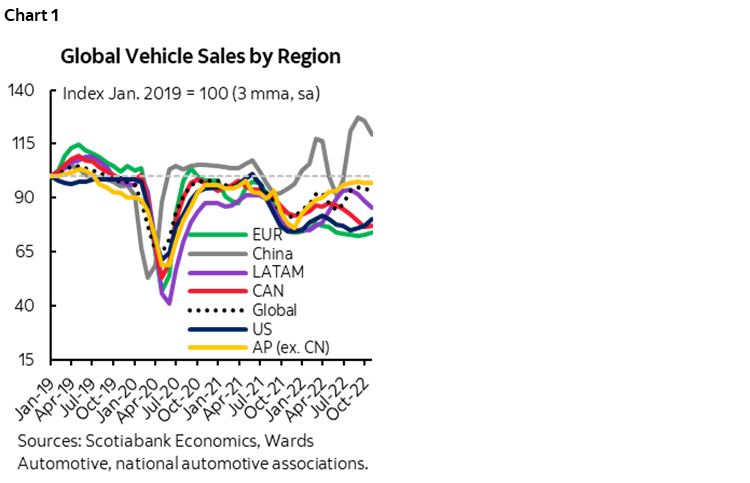
Chart 1: Global Vehicle Sales by Region

In contrast to the weak headline number, North American sales saw clear signs of a turnaround in October with sales jumping by 9.7%, building up on the 1.7% gain last month. The US drove the improving trend with sales up 10.1% m/m (sa). Canada saw its first gain after five months of consecutive declines, posting a double-digit growth of 12.9% m/m (sa).

The strong sales in October on the back of improving inventory will likely persist—in line with our expectations of a gradual recovery for the rest of the year. We are holding the line on our outlook for Canadian and US auto sales, with our 2022 forecast for Canada and the US standing at 1.5 mn and 13.6 mn units, respectively. We see auto sales continuing to improve by over 8% in both countries in 2023 as supply improves, but with considerable bandwidths around those figures in light of economic (and policy) uncertainty, layered on top of weak sight lines on auto production plans.

A SLOW REBALANCING OF SUPPLY AND DEMAND IN NORTH AMERICA

After limited inventory took a toll on sales for most of the year, North American markets saw some early signs of easing supply constraints in recent months. Inventory levels in the US stood at 51% higher than in the same month a year ago in October, and light vehicle days’ supply reached the highest level since May 2021 (chart 2). While inventory levels showed some improvement, they remained low by historical standards, especially for some Asian non-luxury brands and Japanese and European luxury brands, according to Cox Automotive. The rate at which inventory is picking up is not fast enough to bring the inventory-to-sales ratio back to a normal level, which has been bottoming yet without any material sign of a turnaround. Proprietary data in Canada also suggests a slight uptick in inventory relative to a year ago, but the market conditions remain just as tight as in the US, if not more.
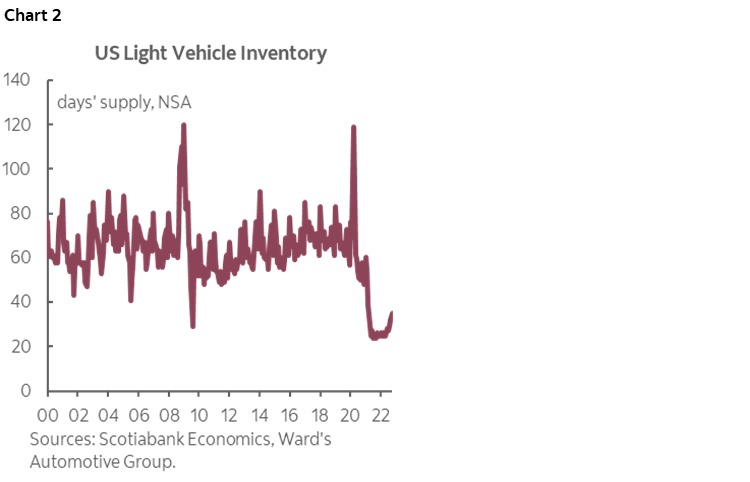
Chart 2: US Light Vehicle Inventory

Demand-side factors have been holding up strong amid rising interest rates, especially in Canada. Canadian GDP surprised to the upside in Q3 and posted a strong q/q growth rate of 2.9%, pushing the anticipated slowdowns into later this year/early next year. The household saving rate edged up to 5.7% as of Q3, well above the pre-pandemic average of 3–4%. Primary household income rose 8.7% since the same quarter last year on the back of strong wage growth. Soaring immigration could give vehicle demand a decent boost moving forward—Canada is on track to beat the upper range of its 2022 immigration target of 445k people, which would be close to a 10% increase from last year’s record-level immigration. The Government of Canada also increased its immigration targets for the coming two years (chart 3), planning to welcome 447k new permanent residents in 2023 and 451k in 2024.
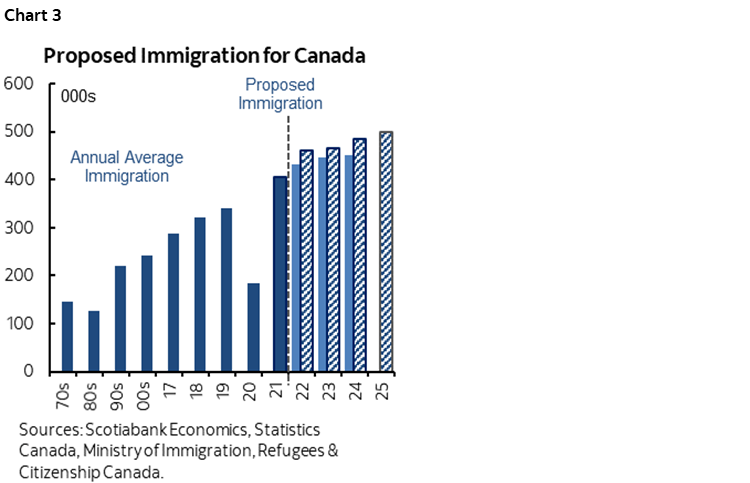
Chart 3: Proposed Immigration for Canada

Car ownership is getting more expensive, but wages are catching up. In the US, new vehicle inflation stood at 8.4% y/y in October, down from the peak of over 13% in April (chart 4). JD Power reported the average monthly finance payment at $712 in November, up 7.2% from a year ago. As the pace of new vehicle price growth slows, wage growth remains steady at an annualized rate of 4% m/m as of October, bringing average hourly earnings 4.7% higher than in the same month a year prior. In Canada, new vehicle inflation stood at a similar level as in the US at 7.9% y/y, but wages have been growing faster at an annualized 8.8% m/m as of October, 5.5% higher than a year ago (chart 5).
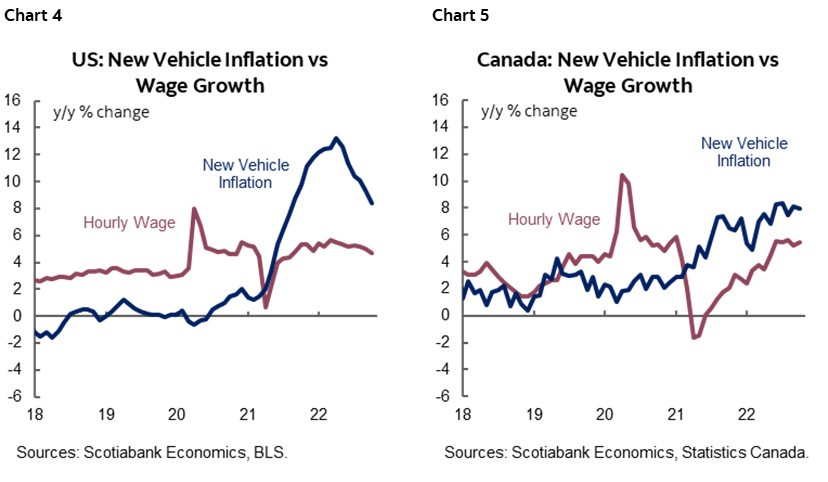
Chart 4: US: New Vehicle Inflation vs Wage Growth; Chart 5: Canada: New Vehicle Inflation vs Wage Growth

But the headwinds to auto demand in the near term are mounting. In our latest forecasts, we see central banks to raise policy rates further by early next year given the persistent inflationary pressures. A mild recession is likely in the first half of 2023 along with some uptick in unemployment, but with policy actions in the coming weeks to play a determining role in whether this baseline holds. As interest rates still have rooms to rise in both Canada and the US, broader cost of living pressures along with uncertainties on the financial markets will likely weigh on sentiment and curtail purchases down the road—but so far these impacts have been masked by limited inventory.

Replenishing inventory in an environment of still-solid demand will take time despite the improving trend in production. As of October, North American production is still down -13.5% year-to-date compared to 2019. Wards Automotive forecasts light vehicle production to end the year 11% (1.4 mn units) higher relative to 2021 and pick up by another 7% (1.1 mn units) in 2023. Domestically produced vehicles account for roughly 78% of North American sales, and with an average sales loss of close to 3 mn per year since the pandemic, the forecasted recovery won’t be able to catch up to sales without an expansion in capacity. Currently, as production is highly constrained by elevated input costs and tight labour markets, we don’t expect to see the markets fully restoring the supply-demand balance in 2023.
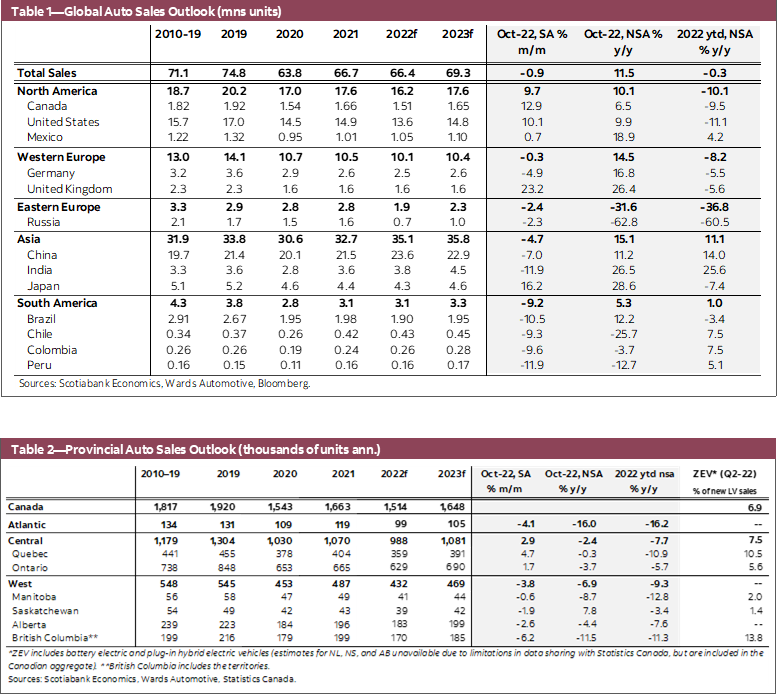
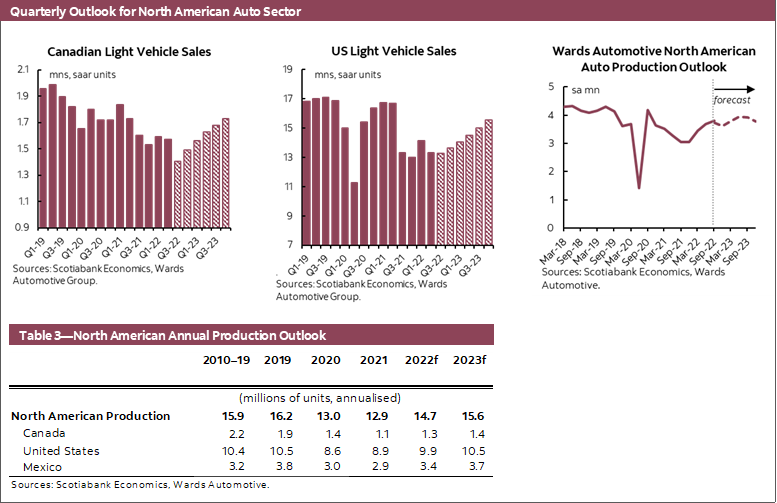
Table 1—Global Auto Sales Outlook (mns units); Table 2—Provincial Auto Sales Outlook (thousands of units ann.); Table 3—North American Annual Production Outlook
Table 3—Global Auto Sales Outlook (mns units)

Asian Markets Mostly Lower Amid Cautious Trades

Asian stock markets are trading mostly lower on Friday, following the mixed cues from global markets overnight, as traders largely cautious and refrained from making significant moves ahead of the release of the closely watched US monthly jobs data later in the day, which could affect the outlook for interest rates. Meanwhile, traders are optimistic over a Chinese demand recovery amid easing Covid curbs in China. Asian markets ended mostly higher on Thursday.

The Australian stock market is notably lower on Friday, giving up some of the gains in the previous three sessions, with the benchmark S&P/ASX 200 falling below the 7,300 level, following the mixed cues from global markets overnight, with losses in energy and financial stocks partially offset by gains in gold miners.

The benchmark S&P/ASX 200 Index is losing 55.20 points or 0.75 percent to 7,299.10, after hitting a low of 7,296.30 earlier. The broader All Ordinaries Index is down 55.60 points or 0.74 percent to 7,498.40. Australian markets ended significantly higher on Thursday.

Among major miners, BHP Group and Rio Tinto are losing almost 1 percent each, while Fortescue Metals is edging down 0.5 percent. Mineral Resources is edging up 0.5 percent and OZ Minerals is flat.

Oil stocks are weak. Santos is losing more than 1 percent, Woodside Energy is declining almost 2 percent and Beach energy is edging down 0.4 percent, while Origin Energy is edging up 0.1 percent.

Shares in Warrego Energy are surging almost 9 percent after Beach energy sweetened its acquisition offer for the next generation oil and gas company amid receipt of competing bids from two others.

Among tech stocks, WiseTech Global and Xero are losing almost 1 percent each, while Afterpay owner Block and Zip are gaining almost 1 percent each. Appen is flat.

Among the big four banks, National Australia Bank, Westpac and ANZ Banking are losing almost 1 percent each, while Commonwealth Bank is declining more than 1 percent.

Gold miners are higher. Northern Star Resources is gaining more than 2 percent, Newcrest Mining is advancing more than 3 percent, Evolution Mining is adding almost 3 percent. Gold Road Resources is up almost 2 percent and Resolute Mining is surging 5.5 percent.

In economic news, the value of retail sales in Australia was down a seasonally adjusted 0.2 percent on month in October, the Australian Bureau of Statistics said on Friday – coming in at A$35.017 billion. That missed forecasts for an increase of 0.2 percent following the 0.6 percent gain in September. On a yearly basis, retail sales climbed 12.5 percent.

Meanwhile, the value of owner-occupied home loans issued in Australia in October was down a seasonally adjusted 2.9 percent on month, coming in at A$17.16 billion. That exceeded expectations for a decline of 4.5 percent following the 9.3 percent drop in September. On a yearly basis, home loans stumbled 17.2 percent.

In the currency market, the Aussie dollar is trading at $0.680 on Friday.

The Japanese stock market is sharply lower on Friday, giving up all of the gains in the previous session, with the benchmark Nikkei 225 falling below the 27,700 level, following the mixed cues from global markets overnight, with weakness across all sectors, led by exporters and financial stocks.

The benchmark Nikkei 225 Index closed the morning session at 27,679.84, down 546.24 points or 1.94 percent, after hitting a low of 27,662.12. Japanese stocks closed significantly higher on Thursday.

Market heavyweight SoftBank Group is edging down 0.5 percent, while Uniqlo operator Fast Retailing is losing more than 1 percent. Among automakers, Honda and Toyota are declining more than 2 percent each.


read moreRTTNews2d

Exela Pharma Recalls Sodium Bicarbonate Injection Top Biotech IPOs Of 2021 That Soared As Much As- 500%- Share Story
Facebook LinkedIn Twitter Telegram WhatsApp

Copy About Login


In the tech space, Advantest, Screen Holdings and Tokyo Electron are edging down 0.2 to 0.4 percent each.

In the banking sector, Mizuho Financial and Mitsubishi UFJ Financial are losing almost 2 percent each, while Sumitomo Mitsui Financial is down almost 1 percent.

Among major exporters, Canon is losing 2.5 percent, Sony is declining almost 2 percent, Panasonic is slipping almost 3 percent and Mitsubishi Electric is down more than 3 percent.

Among the other major losers, Daiichi Sankyo, Mitsubishi Motors and T&D Holdings are losing almost 5 percent each, while Fujikura, Japan Steel Works, NTN and Minebea Mitsumi are slipping more than 4 percent each. MS&AD Insurance Group and Olympus are down almost 4 percent each, while JFE Holdings, Citizen Watch, Yamaha Motor, JGC Holdings, Sompo Holdings and Seiko Epson are declining more than 3 percent each.

Conversely, CyberAgent is surging almost 6 percent.

In economic news, the monetary base in Japan was down 6.4 percent on year in November, the Bank of Japan said on Friday – coming in at 616.820 trillion yen. That follows the 6.9 percent annual contraction in October. The seasonally adjusted monetary base was up 17.0 percent after tumbling 33.0 percent in the previous month.

In the currency market, the U.S. dollar is trading in the lower 135 yen-range on Friday.

Elsewhere in Asia, South Korea is down 1.1 percent, while New Zealand, China, Hong Kong, Singapore, Malaysia, Taiwan and Indonesia are lower by between 0.1 and 0.7 percent each.

On Wall Street, stocks turned in a relatively lackluster performance during trading on Thursday after skyrocketing over the course of Wednesday’s session. The Nasdaq and the S&P 500 spent the day bouncing back and forth across the unchanged line, while the narrower Dow gave back ground.

The major averages eventually ended the session mixed. While the Nasdaq crept up 14.45 points or 0.1 percent to 11,482.45, the Dow slid 194.76 points or 0.6 percent to 34,395.01 and the S&P 500 edged down 3.54 points or 0.1 percent to 4,076.57.

The major European also turned in a mixed performance on the day. While the U.K.’s FTSE 100 Index edged down 0.2 percent, the French CAC 40 Index crept up 0.2 percent and the German DAX Index climbed 0.7 percent.

Crude oil futures settled higher Thursday on easing concerns about the outlook for energy demand, while a weaker dollar amid rising prospects of smaller rate hikes by the Fed also contributed to the increase in oil prices. West Texas Intermediate Crude oil futures for January gained $0.67 or 0.8 percent at $81.22 a barrel.

S Labor Market to Cool Further But Not Enough Yet to Assure Fed

The remarkably resilient US jobs market is beginning to cool, but Friday’s employment report will fall far short of the turning point Federal Reserve officials are seeking in their battle to beat back inflation.

The median projection in a Bloomberg survey of economists calls for payrolls to rise 200,000 in November and hourly earnings to climb 4.6% from a year ago. There are signs labor demand is ebbing, but a bigger slowdown is needed to bring that demand more in line with labor supply in order to contain the wage growth that’s helped fuel inflation.

“The Fed has probably succeeded in stopping imbalances from getting larger” in the labor market, said Michael Gapen, head of US economics at Bank of America Corp. “We’re now all starting to look for reasons to suggest those imbalances are getting removed.”

Here’s a snapshot of the labor market leading up to the November jobs report:

Mixed October Report

The October jobs report suggested differing degrees of labor market cooling. The Bureau of Labor Statistics monthly employment report is made up of two surveys — one of households and the other of businesses. Most of the time, they point in the same direction but that wasn’t the case in October.

Payrolls rose a stronger-than-expected 261,000 in the month after an upwardly revised September gain. And while that was the smallest advance since December 2020, the establishment figures indicated robust labor demand.

The survey of households, however, pointed to more joblessness. The number of employed Americans sank by 328,000 as the unemployment rate climbed to 3.7%.

While the projected gain in November employment represents a further moderation, it’s nonetheless historically strong. That said, data out Thursday from LinkedIn showed that hiring fell by 4.9% in November and was down 20.5% from a year earlier. Hiring is now also 11.8% below February 2020 levels.

Job Openings

Job openings fell in October, reversing a surprise jump in the prior month, according to data out Wednesday. While the figures suggest labor demand is moderating, vacancies still remain well above longer-run levels.

Fed Chair Jerome Powell said at an event Wednesday that while the drop in openings is a “positive thing,” the “jobs-workers gap is about four million.” He noted that the job market is only showing “tentative signs” of getting back into balance.

There were 1.7 job openings for every unemployed worker, a historically elevated figure, but matching the lowest ratio in year.

Still, data from LinkedIn suggest that figure may be overstating the tightness of the labor market. The company’s ratio of active job openings to active applicants, which takes into account the recruiting intensity by firms with vacancies, was 0.9 in September and October.

Layoffs

A slew of companies across industries such as technology, finance and real estate have announced thousands of layoffs in recent months, and the high-profile job cuts from companies like Amazon.com Inc. and Redfin Corp. have prompted many to worry about the health of the labor market.

According to a report by Challenger, Gray & Christmas Inc., employers announced 76,835 cuts in November — more than double the October number.

The latest JOLTS data, which are for October, showed layoffs rose only modestly in the month. That said, the layoff rate for the information sector, where many tech jobs are concentrated, did increase.

Applications for unemployment benefits have begun to creep up as well. The four-week moving average, which helps to smooth out week-to-week volatility, has steadily increased since the end of September. For continuing claims, which are filings by those who have already filed an initial application, the average stands at an eight-month high.

Consumer Surveys

Consumer surveys also paint differing pictures. The Conference Board’s November survey showed nearly 46% of Americans said jobs were “plentiful.” That’s lower than the share seen earlier this year when job openings were at record highs, but still a historically strong level and up from a month earlier.

Yet, looking ahead, that same survey showed a greater share of Americans expect fewer jobs in the next six months. Meanwhile, unemployment expectations sank to the worst level since 2011 in a University of Michigan survey of consumers.

Even so, four in 10 respondents saw zero probability of losing their job over the next five years. Another 31% said the likelihood was less than 25%.

Wages

Wages have generally pointed to a labor market that is moderating but remains extremely tight.

Average hourly earnings, while trending lower, remain elevated, with economists expecting a 4.6% year-over-year rise in November. Powell said that wage gains are running 1.5% to 2% above what would typically be consistent with the central bank’s inflation goals.

Private sector wage growth increased 5.2% in the 12 months through September, a step down from the 5.7% seen in the prior quarter but among the highest readings on record, according to the government’s employment cost index data.

The Federal Reserve Bank of Atlanta’s wage growth tracker has eased slightly from the record 6.7% seen over the summer, but remains extremely elevated at 6.4%.

“There are signs of moderation,” said Nick Bunker, head of economic research at Indeed Hiring Lab. “But there’s still lots of underlying resilience and strength in the labor market.”

US Dollar sinks to 3-month low vs yen as Powell says Fed to go slow

TOKYO : The dollar tumbled to a three-month low versus the yen on Thursday as traders focused on comments by Federal Reserve Chair Jerome Powell that interest rate hikes could be scaled back “as soon as December.”

Powell said on Wednesday that “slowing down at this point is a good way to balance the risks” but added that controlling inflation “will require holding policy at a restrictive level for some time”.

The greenback last stood down 0.98 per cent at 136.755 yen, having plunged as much as 1.2 per cent earlier to 136.50 – its lowest level since Aug. 26. The dollar-yen pair is extremely sensitive to changes in long-term U.S. yields.

The 10-year yield fell after Powell’s comments to hit a near two-month low overnight at 3.6 per cent. It last stood at 3.6275 per cent in Tokyo.

“Obviously the speech was less hawkish than feared,” said Rodrigo Catril, senior FX strategist at National Australia Bank.

“The yen is leading the charge, and that makes sense when you look at the big, big move in long-term U.S. rates.”

However the market reaction “is somewhat surprising,” Catril added. “The Fed chair really just reiterated the view of late, which is a smaller hike should be expected next week, but he re-emphasized they’re not done yet and we should be expecting a much higher terminal rate.”

Markets are currently pricing in a 91 per cent probability that the Fed increases rates by 50 basis points on Dec. 14, and see a 9 per cent chance of another 75-basis-point hike that day. The peak is seen below 5 per cent around May.

In November, the dollar dropped 7.15 per cent versus the yen, its worst month in 14 years, as investors positioned for a Fed pivot.

The dollar index – which measures the currency against six major peers including the yen and euro – extended Wednesday’s more than 1 per cent drop into Thursday, dipping a further 0.09 per cent to 105.69. It tumbled 5.2 per cent in November, its worst monthly showing since September 2010.

The euro rose 0.21 per cent to $1.04325, heading back toward the five-month high of $1.0497 marked at the start of this week.

The gains came even as a European survey on Wednesday showed euro zone inflation easing far more than expected in November, raising hopes that price growth is past its peak and bolstering the case for slower tightening by the European Central Bank.

Sterling added 0.23 per cent to $1.2086, edging toward last week’s three-month peak of $1.2153.

The risk-sensitive Antipodean currencies also gained, with the Aussie dollar last 0.15 per cent stronger at $0.6799, after earlier touching $0.68155 for the first time since Sept. 13. New Zealand’s kiwi added 0.37 per cent to $0.6320 after touching $0.6325, the highest since Aug. 17.

The Aussie and kiwi have also been buoyed by signs the Chinese government will relent on its zero-COVID policy.

The giant Chinese cities of Guangzhou and Chongqing announced an easing of COVID curbs on Wednesday, while officials in Zhengzhou, the site of a big Foxconn factory making Apple iPhones that has been the scene of worker unrest over COVID, also announced the “orderly” resumption of businesses.

In cryptocurrencies, bitcoin stuck close to Wednesday’s two-week high of $17,223, last changing hands at around $17,133. Ether traded at around $1,283, not far for the previous session’s nearly three-week peak of $1,310.

Spanish manufacturing sector remains deep in contraction territory

Spain’s manufacturing sector continued to experience challenging operating conditions during November as output and new orders once again fell sharply, leading to job cuts amid evidence of excess capacity at plants. Confidence in the future remained subdued as firms feared further drops in sales and demand against the backdrop of ongoing global macroeconomic uncertainty. There was some positive news on the inflation front as prices for inputs rose at the slowest rate for two years, although prices related to energy, transportation and raw materials were all reported to have remained at elevated levels.

ACCRA, GHANA - NOVEMBER 05: Ghanaians march during the 'Ku Me Preko' demonstration on November 5, 2022, in Accra, Ghana. People took to the streets of Ghana's capital to protest against the soaring cost of living, aggravated since the Russian invasion of Ukraine

Fed hikes and a stronger US dollar are fueling risks of political instability in Africa

The U.S. Federal Reserve’s monetary policy tightening and a strengthening dollar are having a knock-on effect on African nations’ balance sheets and public debt burdens, according to a new report.

In early November, the Fed implemented a fourth consecutive three-quarter point interest rate increase to take its short-term borrowing rate to its highest level since January 2008.

Meanwhile, a combination of rate hikes, the war in Ukraine and fears of recession have driven the traditional “safe haven” greenback higher. Despite a recent tail-off since its peak in late September, the DXY U.S. dollar index

is up more than 11% year-to-date.

Government debt in sub-Saharan Africa has risen to its highest level in more than a decade as a result of the Covid-19 pandemic and Russia’s invasion of Ukraine. In a report Tuesday, risk consultancy Verisk Maplecroft highlighted that debt is now 77% of gross domestic product on average across six key African economies: Nigeria, Ghana, Ethiopia, Kenya, Zambia and Mozambique.

These nations have added a median of 10.3 GDP percentage points to this debt burden since 2019, the report noted.

As the supply chain disruptions provoked by the post-pandemic surge in demand and the Ukraine war have driven central banks to raise interest rates, the increase in sovereign debt yields has further constrained African balance sheets.

“Consecutive base rate rises by the U.S. Federal Reserve have resulted in reduced capital inflows into Africa and widened spreads on the continent’s sovereign bonds,” said Verisk Maplecroft Africa Analyst Benjamin Hunter.

“Exposure to international interest rate changes is exacerbated by the large proportion of African public debt that is held in dollars.”

The ability of African governments to service their external debt will continue to be weakened by scarcer financing and higher interest rates, Verisk Maplecroft said, while domestic rate rises in response to soaring inflation are also intensifying the overall public debt burden of many sub-Saharan African countries.

“High public debt levels and elevated borrowing costs will constrain public spending, which will likely result in a deteriorating ESG and political risk landscape across the continent,” Hunter added.

“Weaker sovereign fundamentals and higher ESG+P risks will in turn deter investors, further weakening Africa’s market position.”

Verisk Maplecroft expects the Fed’s hawkish stance to take its base rate from 3.75% in November to between 4.25% and 5% in 2023, prolonging the downward pressure on African sovereign debt markets.

The firm does not foresee a substantial loosening of Africa’s domestic monetary conditions over the next 12 months either, which Hunter said will keep borrowing costs high and “disincentivise inflows into African sovereign debt markets.”

ACCRA, GHANA - NOVEMBER 05: Ghanaians march during the 'Ku Me Preko' demonstration on November 5, 2022, in Accra, Ghana. People took to the streets of Ghana's capital to protest against the soaring cost of living, aggravated since the Russian invasion of Ukraine

China slows sharper than expected

China slows sharper than expected

In addition to the riots against tight covenant restrictions since the weekend, China is also facing broader adverse effects of the strict anti-Covenant policy, PMI data shows.

The official survey showed the manufacturing index falling from 49.2 to 48.0 – well below the median forecast of 49.0. The non-manufacturing sector activity index fell from 48.7 to 46.7 against the expected 48.8. This is the lowest level since April, when the fall was also due to covid restrictions.

We recall that values below 50 indicate a contraction in activity, and Chinese manufacturing activity indices have marginally and sporadically exceeded this waterline since August 2021. The service sector is more energetic, but the PMI is also more volatile. The latest dip in the indices signals that the economy is choking on excessive austerity policies.

At the same time, markets are betting that the government has picked up on this signal by announcing small relaxations in regulations time after time since the start of the week.

Separately, the Chinese government is trying to cautiously improve the investment climate by allowing distressed developers to raise capital via equity issues and lowering the reserve requirement rate last week. So, while the IMF warns that it will reduce China’s GDP forecasts, markets are waving off hopes for a turnaround after more than a year and a half of negativity.

China’s equity markets posted their most substantial monthly gain in years in November, turning strictly to the upside on the first day of November. An upbeat end to the month, with the Hang Seng and H-shar indices rallying more than 10% from the opening week and recovering to September levels, sets a positive tone. The strong rally after 20 months of a down-trend suggests that the beginning of the new month will also be bullish. From here on, however, China will have to provide demand from investors with improved data or progress in policy.

The Chinese renminbi has gained over 2.4% against the dollar in the last two days, indicating further capital inflows into domestic assets. Interestingly, the dollar has generally strengthened in the global market these days. The performance of the renminbi reinforces expectations of a worldwide change in the dollar trend from bullish to bearish.

However, a longer-term view of PMI trends clearly shows how the Middle Kingdom’s economy is fading with the start of trade wars in 2018. With a solution for this issue, China is likely to accelerate sharply.