image1.png

USD/JPY Technical Outlook: How Much More Upside for the Japanese yen?

USD/JPY SHORT-TERM TECHNICAL FORECAST – NEUTRAL

The Japanese yen is testing a major ceiling against the US Dollar, a break above which could seal an interim low for the Japanese currency.

USD/JPY is now at an important crossroads – the September highs of 145.00-145.90. This support is crucial as the pair hasn’t broken below a previous high since the major ascent began earlier this year. Hence, a modest rebound wouldn’t be surprising. However, any potential rebound could be short lived.

USD/JPY Daily Chart

image1.png

Negative momentum divergence on the daily and weekly charts (rising price associated with falling momentum) at the October ceiling of 151.95 indicates that the multi-month rally is running out of steam,as we highlighted last week. Moreover, USD/JPY has run into a significant barrier on longer-term charts, including the 1998 high of 147.65, coinciding with the 200-quarter moving average and the upper edge of a rising channel from 2012 (see chart).

Any break of the 145.00-145.90 floor would at the very least confirm a short-term peak in USD/JPY, being the October high of 151.95. If it holds below the end-October high of 148.85, the odds of a break below 145.00-145.90 are growing.

USD/JPY Quarterly Chart

image2.png

Any break below 145.00-145.90 could open the door toward key converged support at the July high, coinciding with the 89-day moving average, at about 139.50-141.00, which could serve as a floor for another leg higher. Major support is on the 200-day moving average (now at about 132.50). The odds of a test of this support, at least in this move, appear to be trivial. In the event, USD/JPY were to test the long-term moving average, it would be a strong sign that the medium-term uptrend had changed. For now, though, the focus is on the 145.00-145.90 floor.

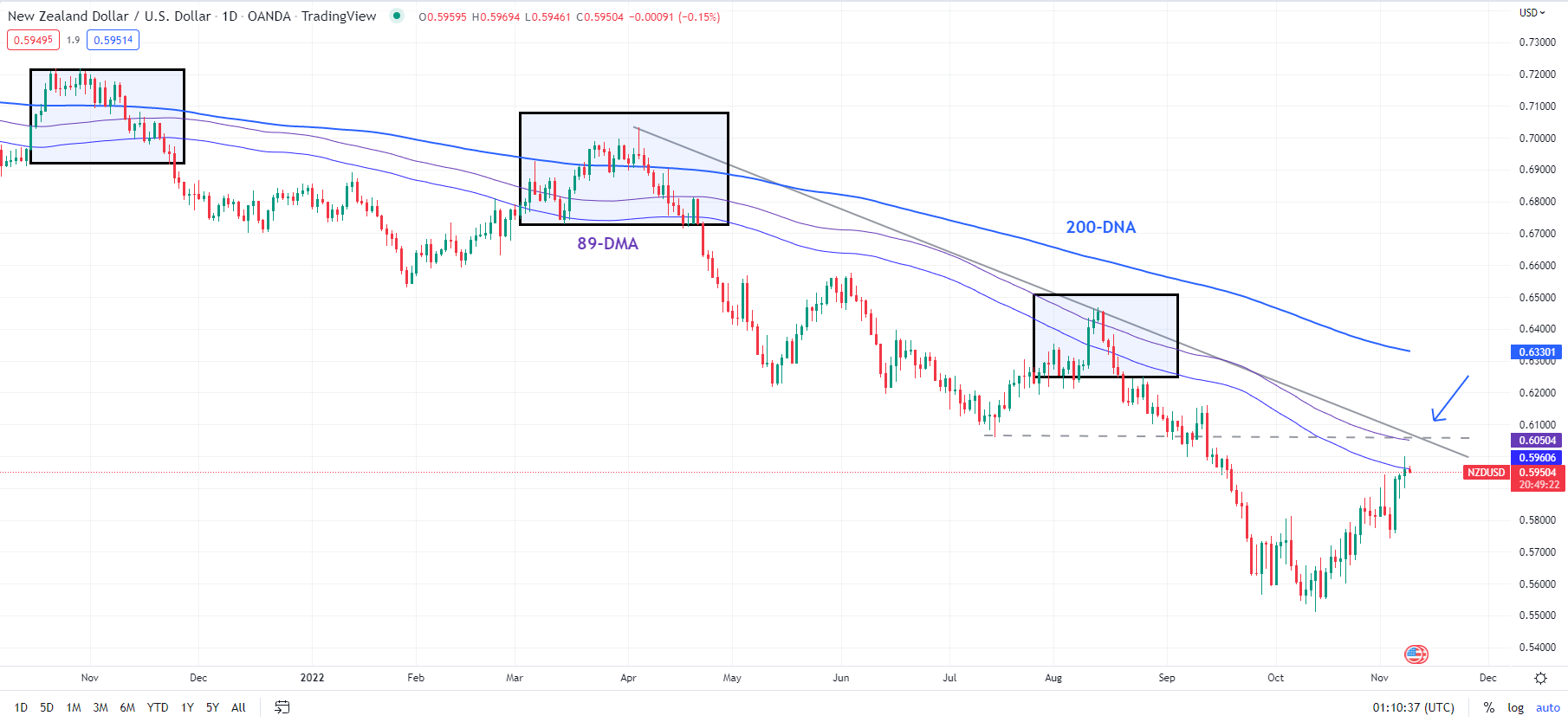
image1.png

US Dollar Under Pressure as Treasury Yields Ease Ahead of US CPI. Where to for USD/JPY?

The US Dollar continues to languish after yesterday’s slide lower as midterm election results roll in. Treasury yields dipped lower through the North American session with the benchmark 10-year note near 4.14%

This is ahead of crucial US CPI data that is due out tomorrow and can be followed live on the DailyFX calendar.

USD/JPY is eyeing a move below 145.00 but currency markets have been quiet through the Asian session. The Japanese government announced a second supplementary budget today with a number of additional fiscal stimulus measures.

Gold continues to trade above US$ 1,700 on the weaker US Dollar.

Wall Street finished in the green, but APAC equities have been sluggish with Chinese markets leading the way lower after another increase in Covid-19 cases. They are at the highest level in six months, and this dragged crude oil lower on concerns about the global growth outlook.

China’s inflation data revealed another month of cooling in price pressures there through October. Year-on-year CPI to the end of last month came in lower than expected at 2.1%, instead of 2.4% and 2.8% previously.

PPI over the same period saw a similar result, printing at -1.3% rather than -1.5% anticipated and 0.9% prior.

The Yuan dipped lower, with the offshore USD/CNH rate nudging above 7.2600 before retreating back toward 7.2500.

Bitcoin collapsed to its lowest level in 2-years in the aftermath of FTX being swallowed up by Binance.

It has been reported that there had been a liquidity crunch for FTX where there had been a run on their FTT token. Other cryptocurrencies and related stocks have been impacted by the news.

Looking ahead, there is some second and third tier data from both Europe and North America as well as several central bank speakers that will be crossing the wires.

USD/JPY TECHNICAL ANALYSIS

USD/JPY has been eyeing the recent low of 145.10 today after moving below the breakpoint at 145.47, which was established from the low in the aftermath of the Bank of Japan’s intervention.

Further down, support could be at the break points and previous lows at 143.53, 141.50, 140.35 and 139.39. Support may also be at an ascending trend line and the 100-day simple moving average (SMA) in the 140.30 – 140.40 area.

Nearby resistance might be at the prior peaks at 148.85 and 151.95.

154.88 may offer resistance as it is the 161.8% Fibonacci Extension of the mid-September pullback from 145.90 to 140.35. Another potential resistance is at 155.95, representing the Fibonacci Extension level of the move from 151.95 to 145.47.

image1.png


image1.png

New Zealand Dollar Technical Outlook: Now Facing Solid Resistance

NZD/USD SHORT-TERM TECHNICAL FORECAST – NEUTRAL

The New Zealand Dollar has maintained a steady ascent against the US Dollar in recent weeks and there is no sign of a reversal of the uptrend. However, NZD/USD is now at one of the most significant resistance areas that it has faced in months.

NZD/USD is testing a converged ceiling on the 89-day moving average, a downtrend line from April and the July low of 0.6060. Slightly above the zone is the major hurdle on the 200-day moving average (now at 0.6325). Since the end of 2021, corrective rallies in NZD/USD have been capped by the two averages. If the rebound from October is corrective, then this resistance zone should hold, and a reversal from there is possible.

NZD/USD Daily Chart

image1.png

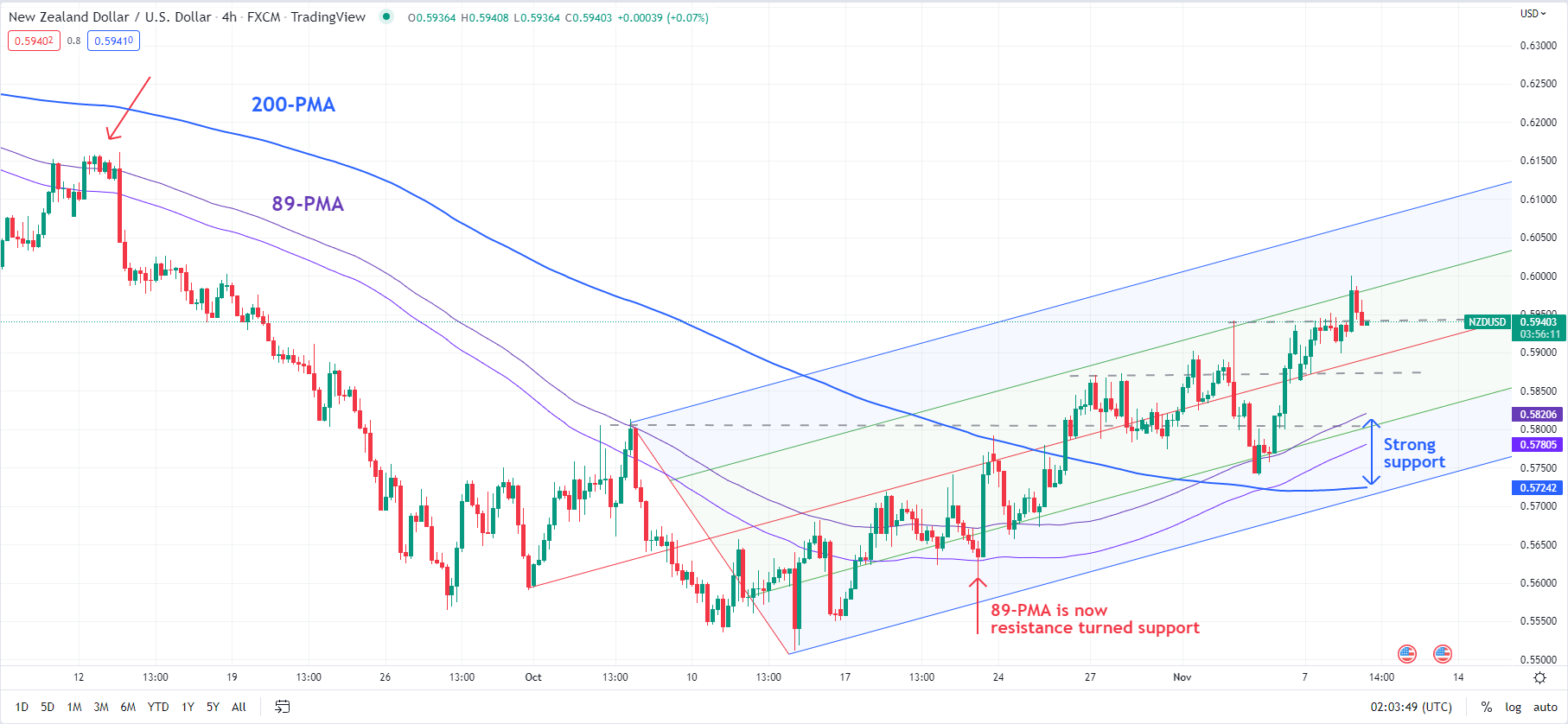
To be sure, there is no sign of reversal of the near-trend uptrend, nor did last week’s setback change the outlook to bearish, as we highlighted. NZD/USD continues to make new highs on the daily chart. As the 240-minute chart shows, the break of the internal trendlines within a rising channel from October indicates that the pair has gradually been shifting to ‘higher gears’ over the past few weeks.

So, for any reversal to occur, the pair needs to stop making new highs at the very least. A continuation of the higher-highs-higher-lows pattern could push the pair toward the 200-day moving average, which would be tough to crack, at least on the first attempt.

NZD/USD 4-Hour Chart

image2.png

On the downside, one of the initial signposts to watch for a stalling in the rally would be a fall below a horizontal trendline from the end of October at about 0.5870. This would be an early indication that short-term upward pressure is beginning to fade. There is strong support at the 89-period moving average and the 200-period moving average on the 240-minute charts (at about 0.5700-0.5800). NZD/USD needs to hold above this area if the rebound from October is to continue.

US Dollar Is Down, But Not Out, as Fed Prepares for More Rate Hikes

Bloomberg) — The three-day selloff in the US dollar on the back of a global stock rally and just the possibility — yet to materialize — of an end to China’s Covid-zero policy, has caught market players’ attention.

But betting against the greenback at this juncture, they warn, is a bit too soon and a bit too risky.

If anything, they say, it’s hard to see the currency weakening much further from here in the short term after the US Federal Reserve last week stuck to its hawkish stance and signaled that the ultimate level for rates would be higher than previously expected. That, on top of a global slowdown in growth, raises the possibility of other central banks being forced to slow their own pace of rate increases, which in turn may contribute to the weakening of their currencies.

“It’s a doom loop–the weaker the rest of the world, the better the outlook for the dollar,” Jane Foley, a strategist at Rabobank in London, said. “While the stronger the dollar goes, the harder it is on other countries, especially commodity-importing nations.”

As the greenback surged to its highest level in decades earlier this year, other currencies weakened, the yen has been pushed to 30-year lows, while the pound briefly lost about a fifth of its value. The Bank of Japan is one of the few central banks to maintain rock-bottom rates, making it the worst performing currency among G-10 peers this year.

Other countries have already started tapping the brakes on tightening. Canada surprised investors last month by raising its overnight lending rate 50 basis points instead of 75. Last week, the Bank of England pushed back against market expectations for the scale of future increases, saying they were too high and warning that following that path would induce a two-year recession. It did, though, deliver its biggest interest rate increase in 33 years Thursday.

Chart  Description automatically generated with medium confidence

GBP/USD Surrenders 1.15 Confluence Area, Short-Term Upside Remains a Possibility

GBP/USD Fundamental Backdrop

Cable has started the day on the back foot against the greenback surrendering the key confluence area around 1.1500. This sour start to the day comes on the back of a reported slowdown in sales in the UK as consumers prioritize essential purchases. The figures came courtesy of a report by the British Retail Consortium with the group noting a shift in spending behavior as the busy holiday season approaches.

Cable enjoyed gains of around 3% against the greenback over the previous two sessions yet the slowdown in sales provides further indication of the challenges ahead. Cable is being helped by a weaker dollar to start the week as the greenback struggles to hold on to early session gains.

Bank of England Chief Economist Huw Pill commented that the central bank has been trying to give a more realistic view as to where rates are heading while warning that more rate hikes are needed. Pill stated that risks in the UK are tilted towards higher inflation moving forward while confirming that rate hikes will be driven by the economic outlook.

US Dollar Index, Daily Chart- November 8, 2022

Chart  Description automatically generated with medium confidence

Markets have seen a slight increase in risk appetite since Friday as rumors continue to swirl around a potential re-opening in China. This in part could be the reason for the greenbacks slump. There remains little in the form of major economic releases from the UK this week with the main risk event the US Inflation numbers due out on Thursday.

Given the lack of data there is a real possibility cable could benefit from broad-based dollar weakness heading into Thursday’s CPI release. This could see GBP/USD reclaim the 1.1500 area and make a run for September highs resting at the 1.1750 area.

For all market-moving economic releases and events, see the DailyFX Calendar

GBP/USD Daily Char

Chart, histogram  Description automatically generated


image1.png

Euro (EUR) Latest: Hawkish ECB Talk Boosts the Euro, EUR/USD Parity Being Tested

A number of ECB policymakers have been doubling down on the central bank’s position on interest rates and inflation, saying that higher rates are needed for longer to quell double-digit price pressures. In what looks like a concerted effort to re-assert the central bank’s authority and will on the rates market, the financial wires are full of hawkish ECB speak.

  • ECB’s Martins Kazak recently said that there is no need to halt rate hikes this year and that the central bank should continue raising rates into 2023 as any recession is likely to be shallow and brief and won’t require any rate cuts.
  • Board member and President of the Deutsche Bundesbank Joachim Nagel recently stated that large rate hikes are needed and that the ECB must not let up too early on normalizing.
  • ECB Vice-President Luis De Guindos said that the central bank must continue raising rates to a level that ensures that inflation comes back into line.

The ECB hiked rates by 75 basis points at the end of October to 1.50%, its third consecutive hike and the highest level seen since 2009. The central bank is expected to raise rates by another 50 basis points at the December 15 meeting.

While the Euro has been boosted by expectations of higher rates, the US dollar is under pressure as traders start to look through higher US rate expectations and instead focus on when the Fed may pause its tightening cycle. Although this may be months away, the fact the markets are already looking for a turnaround is weighing on the greenback. Add into the mix this week’s US midterm elections, and which party may control either or both of the House and the Senate, and the US dollar will likely remain volatile in the days and weeks ahead.

EUR/USD is trading on either side of parity at the moment with momentum looking to push the pair higher. A series of short-term higher lows from late September is underpinning the move and a re-test of the late October double top around 1.0093 is the next target. A confirmed break of this level would nullify the medium-term series of lower highs and allow the pair to move back toward 1.0200.

EUR/USD Daily Forex Price Chart November 8, 2022

image1.png


Australia, NZ dollars hold onto gains as risk appetite rebounds on China

SYDNEY: The Australian and New Zealand dollars held onto their recent gains on Tuesday, buoyed by a broad pick-up in risk appetite as markets clung onto hopes that China’s costly zero-COVID policy will eventually ease.

The Aussie was hanging at $0.6467, after rising 0.2% overnight, building on strong gains seen since Friday when speculation that Beijing will loosen anti-pandemic restrictions surfaced.

Resistance is at around 65 cents. The kiwi touched a seven-week high of $0.5951 on Tuesday, having also edged up 0.2% in the previous session.

Resistance is around $0.5988.

The two currencies, which had tumbled on concerns about global growth this year, have been edging higher in recent sessions as markets priced in a slowdown in the global tightening cycle, although near-term downsides remain with the United States expected to report its inflation readings on Thursday.

“The AUD is likely to trade in a wide range in the near term, tracking news on potential policy support out of China and swings in the USD/risk sentiment,” analysts at Barclays said.

“Domestic data is less likely to be driver with the RBA now behind us.” The Aussie did not react much to domestic surveys showing Australian businesses had another strong month for sales and profitability in October, though confidence eased.

In New Zealand, a survey from the Reserve Bank of New Zealand showed the near-term rate of inflation is expected to ease over the coming year but will be higher than previously predicted.

Australian government bond yields jumped following a move in the US Treasures market.

Yields on 10-year bonds jumped 12 basis points to 4.046%, the highest in two weeks. Yields on three-year bonds gained by a similar margin to 3.512%.

The foreign trade figure: Quarterly analysis of the 3rd quarter 2022

On the 3rd quarter of 2022, French exports of goods continue to grow in value (+5.1%), at a rate slightly higher than that of the 2nd quarter (+4.0%). The three quarters of this growth are due to manufactured goods, whose dynamism is driven by sales of mechanical, electronic and computer equipment, those of automobiles, as well as the strong rebound in aeronautical exports – the latter are, however, far from having regained their pre-health crisis level. Exports agriculture, driven by wheat, reached a record level since 2009. Imports continue their strong growth in value, at a rate similar to that from 2 e quarter

image1.png

Crude Oil Forecast: Brent Limited by China’s COVID Policies and Stronger USD

BRENT CRUDE OIL FUNDAMENTAL BACKDROP

Brent crude oil prices have been marginally curtailed this morning after Chinese health officials reiterated this importance of their ‘zero-COVID’ policies, suppressing optimism around a Chinese reopening. This has left commodity prices largely in the red while a stronger USD adds to downside momentum.

 U.S. midterm elections are this main focus for today and much talk has centered around a possible gridlock within the government leaving future policies extremely difficult to pass from either Democrats or Republicans. The importance of this could surface in 2023 should inflation subside and the economy requires fiscal stimulus. Because this is unlikely to pass through congress in a divided government, the responsibility almost has to fall on the Fed to cut interest rates in order to stimulate the economy. In theory this should weaken the greenback giving added support to crude oil prices.

Later this evening, API weekly stock data (see economic calendar below) is due and after last weeks surprise decline, another slip could give brent crude some support.

ECONOMIC CALENDAR

image1.png

TECHNICAL ANALYSIS

BRENT CRUDE (LCOc1) DAILY CHART -UNDATED

image2.png

Daily brent crude price action shows a developing rising wedge chart formation (yellow). The RSI reading suggests slowing bullish momentum but still has room to push higher depending on the upcoming fundamental catalysts discussed above. Traditionally, a rising wedge points to impending downside after a bullish consolidation but confirmation needs to come from a candle break and close below wedge support which is a long way away at this point.

Key resistance levels:

  • 100.00
  • Wedge resistance

Key support levels:

  • 95.00/100-day EMA (yellow)

China’s Long Lockdowns Struggle to Contain Growing Outbreaks

(Bloomberg) — Some of China’s most persistent virus hotspots have been locked down for weeks, and in some cases months, showing the limitations of the country’s contentious Covid Zero policy.

Xinjiang reported the fourth-highest number of new cases nationally for Monday, according to data compiled by Bloomberg, despite some cities in the region in China’s northwest locked down for 90 days. Inner Mongolia, which was sealed off in early October, saw cases jump to almost 1,800 from 1,033 a day earlier, while Henan province’s infections more than doubled in a day to 747.

Explore Bloomberg’s Exclusive China Covid Dashboard on the Terminal

Guangdong province has the biggest outbreak right now, the main driver of China’s national caseload rising to 7,323 new infections, the highest tally since April 30. Most of the cases are in the southern metropolis of Guangzhou, which reported 2,377 infections and has taken a targeted approach to virus containment so far.

While entertainment venues and restaurants are shut in most of the city, just one district, Haizhu, has been locked down. It’s where most of the cases are being found, and the stay-at-home order was extended on Monday night.

Restrictions continue to be imposed at various levels in other Chinese cities, with Shanghai consistently locking down apartment blocks and neighborhoods where cases and close contacts are found since its city-wide lockdown was ended earlier in the year.

The swelling outbreaks show the strain China’s Covid Zero strategy is facing, with even harsh lockdowns and constant mass testing failing to quickly get them under control. Health officials over the weekend reaffirmed the country’s unswerving commitment to the policy, even as it hammers the economy, dashing hopes that authorities will soon move toward easing some of their strictest rules.

What We Know About China’s Covid Plans After Week of Turmoil

China’s absolutist approach to Covid almost three years in to the pandemic is leading to rising tensions on the ground.

A clash between residents and virus prevention staff — known locally as Dabai, or “Big Whites” for their full-body PPE — in Shandong province led to seven arrests on Monday, police in the city of Linyi said on Weibo.

A video posted online purporting to be of the fight showed groups of Dabai surrounding a man on the street, then dragging him by his clothes before punching and kicking him on the road, joined by what appears to be police officers. Onlookers scream and yell. Bloomberg News was unable to verify the the footage, posted across Weibo and also on Twitter.

China quarantines all Covid cases and their close contacts in makeshift hospitals, a policy that has led to frictions in the past as people object to being taken away.

Incidences of pushback and protest are increasing in China the longer Covid Zero drags on. In the lead-up to the all-important Communist Party congress in Beijing last month, a protester hung banners from a bridge criticizing the lockdowns in a rare, high-profile show of defiance in the capital. Videos of protests during Shanghai’s lockdown earlier this year were censored online.

China’s Tolerance for Xi’s Unyielding Covid Fight Is Cracking