
ECB's Knot: We Are Certainly Not Done With Interest Rate Hikes
— *seven (@sevenloI) April 7, 2023

ECB's Knot: We Are Certainly Not Done With Interest Rate Hikes
— *seven (@sevenloI) April 7, 2023

US inflation was largely unwavering in March, with economists projecting a monthly increase in consumer prices on par with advances seen over the previous half year that will test the Federal Reserve’s mettle.
Government figures Wednesday are expected to show a 0.4% monthly gain in the core consumer price index, which excludes food and energy and better reflects the scope of underlying inflation facing American households.
While softer than the 0.5% advance in the prior month, such an increase would match the September-February average and keeps year-on-year figures stubbornly high. That may help tip the scales toward another interest rate hike at the Fed’s May meeting, despite stress in the banking system and signs of a slowing economy.
Meanwhile, minutes of the Fed’s March 21-22 meeting, also released on Wednesday, may provide clues about the appetite for further policy tightening as well as views on the health of the banking system and lending.
The Fed’s speaking calendar is busy in the coming week and includes appearances by regional bank presidents John Williams, Patrick Harker, Austan Goolsbee, Neel Kashkari and Thomas Barkin.
US core CPI is seen rising 5.6% from a year ago, which would be an acceleration from February’s annual gain. Including food and fuel, the price gauge is forecast to climb by 5.1%, the smallest advance in nearly two years. The central bank’s goal, based on a different inflation metric, is 2%.
Since soaring to a four-decade high of 9.1%, the overall CPI has been retreating in step with falling energy prices. Those costs, however, may start to rise again after the OPEC+ announcement on April 2 of a surprise cut in crude production. Rising crude oil prices may bleed through to gasoline and jet fuel just as Americans begin their summer vacation planning.
Read more: Oil Price Jolt Compounds Inflation Puzzle for Central Banks
Among other US economic reports, the government will release March retail sales. Economists project sales fell for the fourth time in the past five months, with high inflation restraining goods purchases and consumers allocating more of their discretionary incomes to services.
What Bloomberg Economics Says:
“The March CPI report will offer glimmers of good news on disinflation. Plunging natural gas prices in California, aided by a state government credit, helped. But the goods news is likely transitory – oil prices are rising again after OPEC+ announced production cuts. If that results in persistently rising gasoline prices, it could offset any disinflation gains in the next few months.”
—Anna Wong, Stuart Paul, Eliza Winger and Jonathan Church, economists. For full analysis, click here
Elsewhere, Washington will steal the limelight as finance ministers and central bankers flock there for spring meetings of the International Monetary Fund and World Bank. The IMF’s new economic forecast will be published on Tuesday, while a Group of 20 gathering of finance chiefs begins the next day.
Meanwhile, central banks in Canada, South Korea and Peru may all keep rates unchanged in the coming days.
Click here for what happened last week and below is our wrap of what’s coming up in the global economy.
Canada
Bank of Canada Governor Tiff Macklem will likely stick to the sidelines for a second time on Wednesday. He’s seen holding the benchmark overnight rate at a 15-year high of 4.5%, despite few signs the economy is gearing down.
Employment blew past expectations for a fourth-straight month in March, with wage gains again coming in beyond a level policymakers view as consistent with bringing inflation back to target. Economic growth in the first quarter is also tracking well beyond the bank’s projections.
Traders will look for any shift in language around a willingness to hike again if needed, given financial stability concerns that have potentially shifted the balance of risks. Swaps markets see the Bank of Canada’s next likely move as a cut later this year.
Macklem’s decision will be released alongside a new set of forecasts that will likely push back the timing of an expected stall, with inflation still falling to 2% some time next year. The governor will take questions from reporters afterward.
Asia
The Bank of Japan’s new Governor Kazuo Ueda starts his term, inheriting a decade of massive stimulus policy from Haruhiko Kuroda. He’s expected to head to the IMF Spring meetings with Finance Minister Shunichi Suzuki, participating in his first high-profile international conference as central bank chief.
On Tuesday, the Bank of Korea meets to deliver its latest policy decision. Amid concerns over the economic growth and inflation, the Korean central bank may hold its benchmark interest rate steady again, after it kept rates unchanged in February for the first time in over a year.
China’s inflation data on Tuesday will likely show subdued price pressures as growth slowly recovers, while trade figures on Thursday are expected to show exports still contracting amid a slump in global demand.
Australia’s jobs data will be closely watched on Thursday after central bank Governor Philip Lowe paused his year-long tightening campaign.
Europe, Middle East, Africa
In a week shortened throughout much of the region by the Easter holiday on Monday, the focus is likely to be on Washington. Several central-banker appearances are scheduled, with speeches by the governors of Spain, France and Germany, as well as the Bank of England chief Andrew Bailey.
Data will be correspondingly light. For the euro region, the highlight may be industrial production on Wednesday, which may give an indication of the strength of growth during the second quarter. Final estimates of inflation in major economies are also expected.
The UK, meanwhile, will release monthly gross domestic product for February, which will give another indication of whether a recession is being avoided.
Turning to the Nordic region, inflation data will be released throughout Scandinavia. Sweden’s number on Thursday may attract particular focus, with a drop in the headline rate expected, yet that may not be enough to deter further hikes in borrowing costs by the Riksbank.
Looking south, Egyptian inflation due Monday is likely to show another acceleration but potentially at a slower pace after the state intervened on food supplies and moderated prices.
Data on Wednesday may show Ghana’s inflation rate in March fell below 50% for the first time in five months on the back of a stable currency and base effects.
On Friday, data from Nigeria will probably show that price growth softened in March, due to cash shortages affecting the ability to spend by businesses and consumers alike.
Latin America
If President Luiz Inacio Lula da Silva was furious at Brazil’s central bank over high rates when inflation was near 6%, what happens when it falls back to within the 1.75%-to-4.75% target range, as some economists expect with the March data?
Hard to say, but Lula’s focused on jump-starting the economy of Latin America’s slumbering giant, and so may be less than keen to hear how base effects are driving a short but pronounced bout of disinflation and that year-end inflation of 6% is a good bet.
The minutes of Banxico’s March meeting may do little more than affirm the data-dependent stance policymakers adopted in their post-decision statement, issued after a quarter-point hike to 11.25%.
Peru’s central bank on Thursday is likely to keep its key rate at 7.75% for a third month. Julio Velarde, Latin America’s longest-serving central bank chief, said in March that inflation in the Andean nation may well fall back to the top of the 1%-to-3% target range by year-end.
Wrapping up the week, Argentine inflation is widely expected to have accelerated for a 14th month from February’s 102.5% reading, shaking off currency controls, multiple exchange rates and price freezes on thousands of items.
The median estimate of 17 analysts surveyed by Bloomberg puts the year-end rate at 100%, which would be the 16th triple-digit print since 1974.

The US-led banking turmoil is driving money into Asian assets, with investors betting that China and the region’s emerging economies are in a better position to weather the fallout.
A Citibank analysis of global financial conditions shows Asian financial markets have tightened less than in the US and most Asian currencies have gained ground against the US dollar. An index of financial stocks in the region, excluding Japan, has risen since March 10 — the day Silicon Valley Bank collapsed — compared with an almost 10% drop in the American banking index over the same period.
“We think Asia still remains relatively well-insulated,” said Johanna Chua, managing director and head of Asia-Pacific economic and market analysis at Citi. “A US-centric slowdown means the US dollar will track lower, which is more supportive of capital flows in Asia.”
Economists say one factor working in favor of Asia-Pacific is a generally softer pivot in monetary policy, with central banks in Australia, South Korea, Indonesia and India among those pausing their tightening cycles. China, with its easing monetary policy and a belated re-opening from Covid, is the top attraction for investors.
That’s reflected in the $5.5 billion of funds that flowed into emerging-market equity funds over the four weeks up to the end of March, led by Asia, according to figures from TD Securities, citing EPFR Global data. More than 70% of that money went to China. At the same time, developed-market equities suffered net outflows of $8.6 billion, with the US hardest hit.
“Investors are still looking at EM Asia as perhaps the most-favored region, followed by Europe and then perhaps by the US,” David Chao, global markets strategist for the Asia-Pacific at Invesco Asset Management told Bloomberg Radio on April 4. “If you think that the Fed is going to hit a pause button on interest-rate hikes, that would certainly drive capital flows back to EM Asia.”
An end to the cycle of Fed hikes, amid the financial stability risks and signs of cooling demand, could aid Asia by easing pressures from a strong dollar on external finances and reducing the appeal of the greenback as a safe haven.
The Asian Development Bank this week said that Asia’s developing economies, led by China, are on course for faster growth and slower inflation this year and next, while advanced economies are contributing to a darker global outlook.
China’s rebound is expected to percolate throughout the region, which also benefits from supply-chain diversification, booming commodities and a lack of excessive debt growth, said Frederic Neumann, chief Asia economist at HSBC Holdings Plc in Hong Kong.
Citi’s Chua reckons that Hong Kong and Thailand, which benefit from China’s re-opening, and domestic services-led economies like India and the Philippines “look relatively more resilient” to a global growth shock. “Small, open economies” like Singapore, Vietnam, South Korea, Malaysia and Taiwan would likely be more vulnerable to those spillovers.
The banking turmoil may also mean that Asian tech money invested in the US could now begin to make its way back.
“Within Asia, I think Singapore will be the major beneficiary,” said Prashant Newnaha, macro strategist at TD Securities. “Singapore has strong legal and banking frameworks and is looking to establish itself as the leader in tech and crypto within the region.”
Still, there are risks. Recent gloomy factory data from China damped confidence about the speed of the nation’s rebound. And China’s worsening relationship with the US increases the potential risks of investing in places such as Hong Kong and Taiwan, Invesco’s Chao said.
Moreover, Asia isn’t totally immune to the financial instability that spread from the US.
“The outlook really depends on whether things stabilize in Europe and North America,” said Jonathan Kearns, chief economist at Sydney-based investment management firm Challenger Ltd and a former Reserve Bank of Australia official. “If there is some degree of ongoing turmoil, it will spill to Asia as well.”

Bank shares rose in Japan and Europe for the second consecutive week, but the KBW US bank index fell nearly 2% after increasing 4.6% in the last week of March. Emergency borrowing from the Fed remains elevated ($149 bln vs. $153 bln). Bank lending has fallen sharply (~$105 bln) in the two weeks through March 29. This appears to be a record two-week decline. Commercial and industrial loans had fallen a little in the first two months of the year (before the bank stress become apparent). At the same time, the Fed’s balance sheet continues to shrink. Over the past two weeks, it has fallen by a little more than $100 bln.
The US two-year yield was above 5% before the flare-up of banking stress and dropped to 3.55%. It bounced to peak near 4.17% at the end of March but tumbled back to around 3.65% last week on disappointing US data and the banking pressure. The Fed funds futures imply a year-end rate of about 4.18%, up from the 3.37% low reached in mid-March but still sharply below the 5.55% peak seen on March 9. The dollar found less traction than we had expected, given the recovery in short-term rates. Still, we expect the dollar to correct higher in the coming days.
The week ahead highlights include US March CPI. The headline may slip below 5.5% from 6% in February as last March’s 1.0% monthly gain drops out of the 12-month comparison. However, the core rate looks poised to rise year-over-year for the first time since last September. China reports its inflation gauges and the politically sensitive trade balance. Consumer price pressures may tick up a little but remain modest, around 1.2%, while deflationary forces likely strengthened producer prices. China’s exports have been falling year-over-year since the start of Q4 22, and the March surplus may be 10% smaller than reported for March 2022. The Bank of Canada meets on April 12, and there is little reason to expect a change from its standpat stance articulated in late January. Lastly, Australia’s labor market report is unlikely to repeat the strength seen in February when it created almost 75k full-time positions after averaging nearly 43k a month in 2022.
United States: A 0.3% increase in March CPI would mean that US consumer prices rose at an annualized rate of about 4.8% in Q1 23 after a 3.2% pace in Q4 22 and 2.4% in Q3 22. Fed officials will be unhappy with the lack of improvement in the core measure. A 0.4% increase in March translates into a 5.2% annualized rate in Q1, accelerating from 4.0% in Q4 22. The year-over-year rate would edged back to 5.6% from 5.5%. Retail sales are expected to have fallen in March for the fourth time in the past five months. While the PMI and ISM surveys warn of a contracting manufacturing sector, industrial output is expected to have edged up in March, but even with a 0.1-0.2% increase, the gain in Q1 23 is not sufficient to offset the decline in Q4 23 (~1.6% vs. -2.5%). The US also reports producer prices and import/export prices, which typically are less impactful than the CPI. Still, unchanged producer prices in March (which translates into about a 0.8% annualized pace in Q1) could see the year-over-year rate fall to around 3.5%, the lowest since February 2021. The University of Michigan publishes its preliminary April results. The long-term (5-10 year) inflation expectation (median) has been stable at 2.9% since mid-2022, including the last four months. It seems anchored, though it averaged 2.5% in 2018 through 2020. Meanwhile, the US banking stress continues to appear contained. Still, the knock-on effect from reduced lending is a crucial transmission channel to other parts of the economy. The March employment report showed slower job growth and a downward trend in average hourly earnings.
The Dollar Index has been trending lower since reaching 105.90 on March 8. It recorded a low last week near 101.40. It has fallen for four consecutive weeks and five of the previous six. And the week that it rose (the week ending March 10), it posted a gain of less than 0.1%. So it is “due” for a bounce. The momentum indicators are beginning to turn higher. A move above 102.50 targets 103.00-25.
China: Data from the world’s second-largest economy is notable, but not because of its market impact. Indeed, the currency is managed in a way that seems immune to the vagaries of high-frequency economic data. China may have been spared most of the volatility stemming from the banking stress in the US and Europe, but it is not because it does not have its own banking/debt challenges, as the property market illustrates. Lending appears to have soared in Q1 23 to a record of CNY13.8 trillion (~$2 trillion) and may have exceeded Q1 22 by as much as 15%. It has also deviated from the other large countries by not experiencing a sustained rise in inflation. Indeed, it was temporary. CPI peaked at 2.8% last September and fell to 1.0% in February. Food prices are the key driver. Prices are expected to have a 1.2% year-over-year gain in March, which means inflation does not stand in the way of monetary easing should the recovery falter. Meanwhile, producer price deflation is expected to have deepened in March. Producer prices on a year-over-year basis turned negative in Q4 22, and the March print is expected to be -2.4%, matching the biggest decline since June 2020. No longer are people trying to link China’s PPI to US CPI. Falling producer prices, though, warn of a squeeze on income for an important part of the economy.
Chinese exports have lost momentum and have fallen on a year-over-year basis, likely declining for a sixth consecutive month in March. Still, think about the performance. In March 2021, exports rose nearly a third from the previous March. It was a recovery in foreign demand after the Covid shock and supply chain disruption. In March 2022, exports were another 14% higher year-over-year. Last month, exports were expected to have declined by nearly 7.5% year-over-year. In yuan terms, exports have still softened but less dramatically. In fact, they were up 5.2% from a year ago in February. China’s trade balance tends to be noisy in the first part of the year but often improves. Still, the weakness seen in the manufacturing PMI, especially the Caixin iteration, suggests the softness of exports continued. The median forecast in Bloomberg’s survey calls for a $40 bln March surplus, broadly in line with the March 2022 surplus of almost $44.4 bln.
The Chinese yuan was virtually flat last week, and the dollar was confined to a narrow trading range (~CNY6.8660-CNY6.8945). In fact, over the past two weeks, the greenback has been remarkably steady. The dollar has fallen for six consecutive weeks against the euro and five of the past six weeks against the Japanese yen. Moreover, it has fallen in four of the past six weeks against the yuan. Still, the rolling 30-day correlations between the yuan, euro, and yen changes remain notable at 0.63 and 0.54, respectively. This is off their best levels but still suggests the PBOC is allowing the yuan to mostly shadow the broad dollar movement.
Canada: The Bank of Canada meets on April 12. It acknowledges that the economy has begun the new year more resilient than expected but, apparently, not sufficiently to prompt it to change interest rates. The March employment data were mostly better than expected. The 34.7k increase in employment was nearly five-fold higher than the median forecast in the Bloomberg survey, and it was almost evenly split between full- and part-time positions. Although the participation rate unexpectedly slipped (65.6% vs. 65.7%), the unemployment rate held steady at 5.0%. The hourly wage for permanent employees slowed to 5.2% year-over-year from 5.4%. The stimulative fiscal efforts by the government (central and provincial) are seen hampering the central bank’s efforts to rein in inflation. Still, the swaps market thinks that the Bank of Canada is done raising rates and has the first cut fully priced in by early Q4.
The US dollar snapped a six-day decline on Tuesday and will take a four-day advance into the start of next week. It reached CAD1.3530 after the US employment report. The momentum indicators are curling up. A move above the CAD1.3550-60 area could spur gains toward CAD1.3600-20.
Eurozone: Aggregate February retail sales and industrial output figures are due for release, but they are not market movers. In volume terms, retail sales look soft after a 0.3% gain in January. On the other hand, industrial output could surprise on the upside after stronger readings from Germany (2.0%) and France (1.2%). That said, the reports lend credence to our view that the market is too pessimistic about activity here in Q1. The Bloomberg survey from mid-March found a median forecast of a 0.1% quarter-over-quarter contraction in the eurozone in Q1. This is an improvement from -0.2% in the previous survey, but so far, most data points to expansion. As a result, the swaps market sees another 50 bp of hikes by the end of Q3.
The euro recovered from last Monday’s low, slightly below $1.0790, to approach $1.0975 before stalling. That was its best level since the Q1 high was recorded on February 2, near $1.1035. The rally from the March 15 low (~$1.0515) has stretched the momentum indicators, which are turning lower. The initial target is near $1.08, where the 20-day moving average is found and the (38.2%) retracement of the advance from mid-March. A convincing break of $1.07 weakens the technical outlook.
Japan: The Tankan survey and the PMI show Japan’s manufacturing sector is struggling. However, the service sector is improving, and capex is improving. The 60-day rolling correlation between changes in the exchange rate and the 2-year US yield remains firm, around the middle of a 0.45-0.55 range that has largely been in place since last August. The correlation with the US 10-year yield has risen to about 0.47, this year’s high, from almost 0.35 in late January, the lowest since early Q2 21. The week’s data highlights include March machine tool orders and bank lending figures. Japanese bank shares continued to recover. Recall that after the multiyear high was set on March 9, the Topix bank index tumbled nearly 19% the following week. It has recouped more than a third of those losses. Japan will report its February current account to start the new week. It has not failed to improve from January since at least 1996. Japan’s trade balance (on the balance of payments basis) posted a record deficit in January (~JPY3.18 trillion or ~$24 bln). A new era will begin on April 8 as BOJ Kuroda’s 10-year (two terms) ends. The new leadership, led by Ueda, is expected to adjust policy with many seeing the first moves in June-July. The swaps market is pricing in a year-end overnight rate of almost 10 bp compared with the current target of -10 bp and an effective rate about half of a basis point.
The dollar peaked at the start of last week near JPY133.80, the (50%) retracement of its decline from the March 8 high (almost JPY138). Although it pulled back (~JPY130.65 at midweek), the upside correction does not appear over. A push above last week’s high could signal a test on the upper end of the recent range (~JPY134.75-JPY135.00).
United Kingdom: Economists were most pessimistic about the outlook for the UK economy among the G10 countries. Yet, it has been surprisingly resilient, and after spending six months through January below the 50 boom/bust level, the composite PMI rose to 52.2 in March, its best level since last June. January’s monthly GDP surprised on the upside (0.3% vs. the median forecast in Bloomberg’s survey for 0.1%). The UK reports February GDP figures and details on April 13. Recall that in February 2022, the British economy contracted by 0.1% and stagnated for the following two months. The market is pricing about a 70% chance of another hike by the Bank of England when it meets next on May 11. Sterling rose last week to its best since June 2022, pushing up to $1.2525 after stalling near $1.2450 for the past few months. Sterling drifted lower in the second half of last week and slipped to $1.2390 in thin pre-weekend activity. It nevertheless closed higher for the fourth consecutive week. It has come a long way since setting the low in Q1 on March 8, near $1.18. The momentum indicators are stretched and rolling over. The $1.2300-30 area may offer initial support and then $1.2250-70.
Australia: The Reserve Bank of Australia did not hike rates last week, and the market thinks it is done, even if the central bank preserved some wiggle room. The most important high-frequency report in the week ahead will be the jobs data on April 13. Full-time job growth averaged 43k a month last year. It is expected to slow this year. The RBA sees inflation falling from 6.6% last year to 4.8% at the end of this year. It stood at 6.8% in February after peaking at 8.4% in December 2022. The Australian dollar was turned back last week slightly below $0.6800, which met the (38.2%) retracement objective of its drop since the February 2 high (~$0.7160), its best level since last June. It recorded a new low for the week in thin pre-weekend activity near $0.6640 after the US employment. We suspect the risk is on the downside and anticipate a test on the four-month lows set in March (~$0.6565). A convincing break of the $0.6550 could initially target the $0.6400 area.
Mexico: Minutes from last month’s Banxico meeting will be scrutinized for the shift to a more neutral setting that some saw accompanying the 25 bp hike to 11.25%. The minutes will be released on April 13. Last week, March’s CPI slowed to 6.85% (from 7.62%), and the core eased to 8.09% (from 8.29%). The governor of the central bank had suggested that the core rate peaked. The central bank meets on May 18. The swaps market has about a 1-in-4 chance of a hike discounted, which is less than the odds of another Fed hike. Still, given the high rates, carry-trade strategies may remain attractive, especially if implied volatility falls further. Three-month implied volatility jumped to almost 15.4% in the mid-March frenzy but pulled back to 12% last week and finished near 12.4% before the weekend. It averaged slightly below 11% in February. Volatility and the dollar are tending to move in the same direction. The greenback found support at the start of last week, slightly below MXN18.00. What appears to have been a short squeeze lifted it to MXN18.40 in the middle of the week. It fell back to almost MXN18.10 before the weekend, a slightly deeper retracement than we expected. Still, the momentum indicators warn that the corrective pressures have yet to be exhausted. The next upside target is in the MXN18.45-55 area.

According to revised forecasts in OPEC’s monthly report for March, Q2 remains likely to see a drop in global oil demand compared to Q1, although the group now sees a slight improvement of an additional 70,000 barrels per day (bpd) compared to last month’s figures. In Q2, OPEC anticipates global oil demand of 100.77 million barrels per day (mbpd), down from the Q1 figure of 101.28 mbpd.
This article delves into the fundamental factors surrounding oil. For a full technical forecast, see our guide belo
OPEC World Oil Demand Forecast – March Update
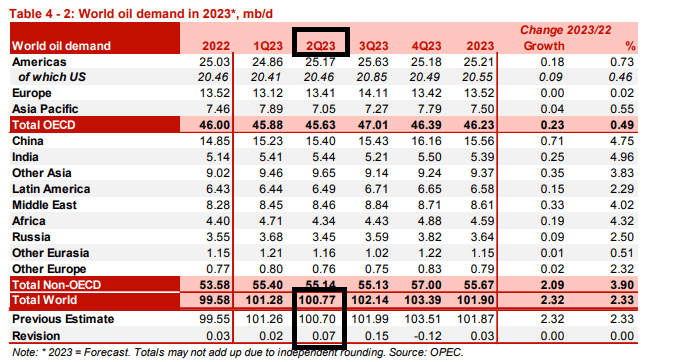 Source: OPEC
The drop in global oil demand is less concerning when considering we are entering a period of seasonally lower usage as winter comes to an end and there is a sizeable gap before the start of the summer driving period.
Continuing with OPEC’s March monthly report, the cartel makes reference to the fact that it is pumping about 28.92 mbpd, which is around 300,000 bpd more than it anticipates will be required in Q2. Furthermore, the actual surplus could be even more if Russian production continues to show signs of resiliency despite heavy sanctions. Recent diplomatic discussions between Chinese President Xi Jingping and Russian President Vladimir Putin, have solidified relations between the two nations as China has been seen increasing its share of global oil purchases from Russia. OPEC’s output forecasts assume a large decline in output for Q2, opening the door to an even larger oversupply.
World oil demand growth for 2022-2023 reveals a sizeable drop off in non-OECD, non China regions along with a decline in OECD Americas. Global oil demand growth would certainly have suffered if it were not for the reopening of the Chinese economy as the zero-covid policy came to an end in 2022. However, even with the massive increase in Chinese demand, overall demand growth lags behind that witnessed in 2022. Thus far, the effect of the Chinese reopening has done little to bring about higher oil prices even at a time when OPEC implemented a planned 2 mbpd cut in production with varied success. Despite this, OPEC estimates that global consumption will reach a record of 101.9 mbpd this year.
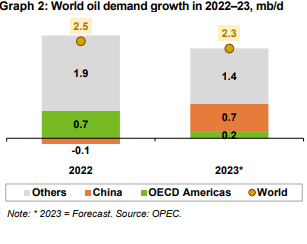 Source: OPEC Monthly Report (March)
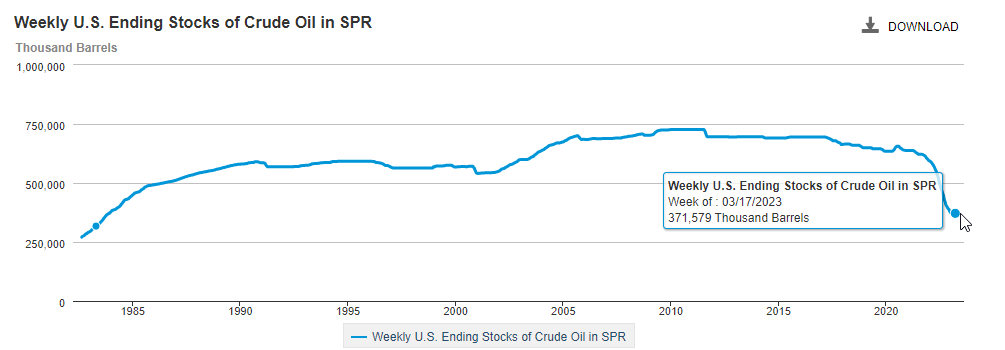
Energy Secretary Jennifer Granholm told US representatives at a congressional hearing that it could take years to refill the country’s Strategic Petroleum Reserves (SPR). The desired level to refill greatly diminished oil reserves was said to be between $67 and $72, or when prices were seen to be trading below $70 for an extended time. Therefore, this level has held up consistently whenever WTI prices dipped, as markets foresaw the possibility of mass buying from the US government. That has now been removed.
Despite persuading congress to cancel further sales of 140 million barrels between 2024 through to 2027, the Department of Energy is still due to sell 26 million barrels from the SPR to help with the federal budget.
The chart below showing the current level of reserves almost looks identical to levels we saw in last quarter’s update, confirming that such large-scale purchases to replenish diminished stocks are yet to take place
Weekly Chart of US Crude Oil Inventories in the SPR

GBP/USD seesaws around 1.2155-60 while printing the first daily gains in three amid early Good Friday morning in London. In doing so, the Cable pair cheers hawkish hopes from the Bank of England (BoE) while also portraying the cautious mood ahead of the key US Nonfarm Payrolls (NFP).
Andrew Goodwin, Chief UK Economist at Oxford Economics suggests another 0.25% rate hike from the “Old Lady”, as the BoE is informally known, amid persistent inflation pressure.
That said, the UK’s house price index signaled intact price pressure even if the BoE’s Monthly Decision Maker Panel (DMP) survey hints at likely easing the Consumer Price Index (CPI), from 5.9% expected in February to 5.8% for one-year ahead measure.
On the other hand, fears that the new Brexit deal will deter the European Union (EU) imports, per BBC News, seem to challenge the GBP/USD prices. The news quotes a Cold Chain Federation while stating that new plans for post-Brexit border checks on goods coming into the UK will deter many EU suppliers and push up food prices.
Elsewhere, downbeat US data raise fears of no rate hikes from the Federal Reserve (Fed) in May and weigh on the US Dollar. However, the same US statistics trigger recession woes and put a floor under the greenback. With this, the US Dollar Index (DXY) clings to mild gains around 102.00.
Talking about the US data, Initial Jobless Claims improved to 228K for the week ended on March 31 versus 200K expected and upwardly revised 246K prior. It’s worth noting that the Challenger Job Cuts for the said month rose to 89.703K from 77.77K prior. Previously, US JOLTS Job Openings dropped to the 19-month low in February while the ADP Employment Change for March also disappointed markets with 145K figures. Further, the US ISM Services PMI for March also amplified pessimism as it dropped to 51.2 versus 54.5 expected and 55.1 prior.
Amid these plays, market sentiment remains sour and the yields seem to pause recent downside, which in turn challenges the GBP/USD buyers. However, it all depends upon the US employment report for fresh calls.
A one-month-old ascending trend channel, currently between 1.2375 and 1.2550, defends GBP/USD bulls.

The US Bureau of Labor Statistics (BLS) will release the March jobs report on Friday, April 7 at 12:30 GMT and as we get closer to the release time, here are the forecasts by the economists and researchers of 11 major banks regarding the upcoming employment data.
Nonfarm Payrolls in the US are forecast to rise by 240K following the 311K increase recorded in February, with the unemployment rate seen steady at 3.6% and average hourly earnings declining to 4.3% year-on-year vs. 4.6% in February.
“At 240K, we expect a smaller increase in payrolls in March than in January (+504K) and February (+311K). However, the figures for the first two months were probably somewhat inflated by the unusually mild weather, and mid-March was rather too cold. If our forecast materialized, the number of new jobs created would continue to exceed the monthly average increase in new workers of an estimated maximum of 100K, which is fed by population growth. The labor market would thus remain tight, and the unemployment rate would probably remain at a very low 3.6%.”
“While we remain nervous about the outlook for jobs given the rise in job lay-off announcements and the inevitable tightening of lending conditions resulting from banking stresses that will be a major headwind for struggling businesses, this will take time to be reflected in payroll numbers. Anything over 200K in terms of March payroll growth will likely boost expectations for a 25 bps rate hike.”
“We think employment growth remained upbeat in March, and look for 250K NFP gain.”
“We expect payroll growth to have decelerated to 190K, which would remain very solid given the increasingly limited number of people remaining on the sidelines. The household survey is expected to show a similar gain, something which would leave the unemployment rate unchanged at 3.6%, assuming the participation rate stayed put at 62.5%.”
“Our NFP projections are for a moderation. Our forecast absolute gain of 215K in March is still strong, but if realised, would be the softest since December 2021. We view monthly gains in excess of 150-175K as strong since over time, such a pace would further reduce the unemployment rate. With the unemployment rate at 3.6%, labour markets are tight. Wages are likely to grow by 0.3% mom in March, similar to the previous reading. This would mark a deceleration in wage growth. Average hourly earnings are not the best measure for compensation pressures, but the data is monthly and earlier than other data, so it is closely watched. A softening in wages may reflect management strategies to resist demands. If employers see labour requirements as being met and fear a potential layoff round in coming quarters, their willingness to boost wages to retain and attract workers diminishes.”
“We expect nonfarm payrolls to gain +250K and both the unemployment rate and hourly earnings growth to remain unchanged (3.6% and +0.2%, respectively).”
“Jobless claims remained low in the March payroll survey reference period, signaling a healthy 220K pace of hiring. Although our forecast of 0.3% growth in average hourly earnings doesn’t preclude reaching ontarget inflation, a 220K pace of hiring is roughly double what Powell has suggested is consistent with sustainable on-target inflation, and we, therefore, continue to expect a final 25 bps rate hike ahead, assuming no proliferation of banking sector issues. With private measures of job openings easing, and previously announced layoffs still coming to fruition, we expect to see a further cooling in the pace of hiring ahead, in combination with a deterioration in cyclical sectors, which will likely leave the Fed on pause after the May FOMC. We’re a little below the consensus on payrolls, but likely not by enough to put downwards pressure on bond yields, as the fading of banking sector concerns is an overriding factor.”
“US payrolls will be released on Good Friday this year (thus producing the rare case of Canadian jobs arriving earlier). We expect it will be worth the wait, with a solid gain of around 240K likely on tap, lifting the tally for all of Q1 to above 1 million net new jobs – making a mockery of recession talk, at least at the start of the year.”
“We expect monthly payroll growth to continue to slow in March, but to a still strong pace of 250K jobs added, although with slight downside risks due to some more signs of job losses in rate-sensitive sectors. We also expect a 0.3% MoM increase in average hourly earnings in March with roughly balanced risks of a larger or smaller increase. On the one hand, tightness in the US labor market should continue to put upward pressure on wages and expect that underlying wage growth is running at least 4-6% annualized. On the other, changes in the sector composition of payroll employment in recent months have likely put downward pressure on average hourly earnings and could continue to do so in March. And after rising somewhat unexpectedly to 3.6% in February, we expect the unemployment rate to decline to 3.5% in March. This is based on a similar expectation for employment growth in the household survey that determines the unemployment rate and the labor force participation rate remaining unchanged after a few months of recent increases.”
“We look for job growth to slow to 240K in March. The still-tight state of the labor market is likely to be reflected by the unemployment rate ticking back down to 3.5% and March’s rise in average hourly earnings edging up to 0.3%.”
“We expect the March jobs report to show that payrolls grew with 270K and while this is a slight slowdown from stronger prints in Jan-Feb, it still suggests an above-trend pace of job growth in March. The unemployment rate is projected to stay unchanged at 3.6%. Finally, wage growth will probably print a firm 0.3% MoM.”
Euro bulls take a breather as the EUR/USD pair sits around 1.0920, awaiting the key United States employment numbers during early Friday. In doing so, the Euro pair also bears the burden of the Good Friday holidays in the major Western markets, including Europe.
It’s worth noting, however, that the comparatively more hawkish bias for the European Central Bank (ECB) than the Federal Reserve (Fed) keeps the EUR/USD on the way to posting the third consecutive weekly gain, despite recent recession woes.
EUR/USD remains firmer overall as the latest data from Germany and the Eurozone appear to keep the European Central Bank (ECB) hawks on the table, unlike their US counterparts.
That said, Germany’s Industrial Production (IP) rose 0.6% YoY in February versus -2.7% market forecasts and -1.6% previous readings. The monthly figures also came in firmer than 0.1% expected, to 2.0% versus 3.7% prior. On Wednesday, Germany Factory Orders improved to -5.7% YoY for February from -12.0 revised down prior and -10.5% market forecasts while the MoM growth came in at 4.8% compared to 0.3% expected and 0.5% previous readings.
On a broader front, Eurozone S&P Global Composite PMI eased to 53.7 in March versus 54.1 first readings whereas Services PMI also declined to 55.0 during the stated month from 55.6 preliminary forecasts.
Elsewhere, the US Initial Jobless Claims improved to 228K for the week ended on March 31 versus 200K expected and upwardly revised 246K prior. It’s worth noting that the Challenger Job Cuts for the said month rose to 89.703K from 77.77K prior. Previously, US JOLTS Job Openings dropped to the 19-month low in February while the ADP Employment Change for March also disappointed markets with 145K figures. Further, the US ISM Services PMI for March also amplified pessimism as it dropped to 51.2 versus 54.5 expected and 55.1 prior.
Considering the upbeat data, European Central Bank (ECB) Chief Economist Philip Lane signaled in a university lecture in Cyprus that the May decision depends on three factors, namely inflation outlook, underlying dynamic and how quickly these interest rate increases are restricting the economy and bringing down inflation.” The policymaker also said that due to these reasons they haven’t indicated or pre-announced what the expectation is for the next meeting or the upcoming meetings.
On the other hand, St. Louis Federal Reserve President James Bullard said on Thursday he thinks inflation is going to be sticky going forward.
With the comparatively more hawkish ECB policymaker’s tone, the EUR/USD remains firmer ahead of the key data.
It should be noted that the Federal Reserve’s (Fed) preferred gauge of economic health cited the recession woes and put a floor under the EUR/USD prices. “Research from the Fed has argued that the ‘near-term forward spread’ comparing the forward rate on Treasury bills 18 months from now with the current yield on a three-month Treasury bill was the most reliable bond market signal of an imminent economic contraction,” per Reuters.
On the same line are comments from International Monetary Fund (IMF) Managing Director Kristalina Georgieva who said in her prepared remarks on Thursday that she expects the global economy to grow by less than 3% in 2023, down from 3.4% in 2022, per Reuters.
Given the recently downbeat US employment clues, as well as the hopes of no rate hikes from the Federal Reserve (Fed), today’s US jobs report for March becomes crucial even as the Good Friday holiday is expected to limit the EUR/USD pair’s reaction to data.
Market forecasts suggest a softer print of the headline Nonfarm Payrolls (NFP), to 240K from 311K prior, as well as no change in the Unemployment Rate of 3.6%. However, the mixed expectations for the Average Hourly Earnings make the outcome even more interesting.
EUR/USD stays within a three-day-old descending triangle chart pattern, suggesting further upside on the bullish breakout.
Adding strength to the hopes of witnessing further Euro gains is the steady Relative Strength Index (RSI) line, placed at 14, not to forget the quote’s successful trading above the 200-Hour Moving Average (HMA).
That said, the EUR/USD bulls need validation from 1.0930 to retake control.
Following that, the latest peak of 1.0973 and the yearly high of around 1.1035 can test the Euro buyers ahead of directing them to the March 2022 high of near 1.1185.
Meanwhile, a downside break of the 1.0885 level comprising the triangle’s lower line will defy the bullish chart pattern and can lure the EUR/USD bears. Even so, the 200-HMA level of 1.0880 can act as an extra filter towards the south before delivering the quote to the bear’s door.
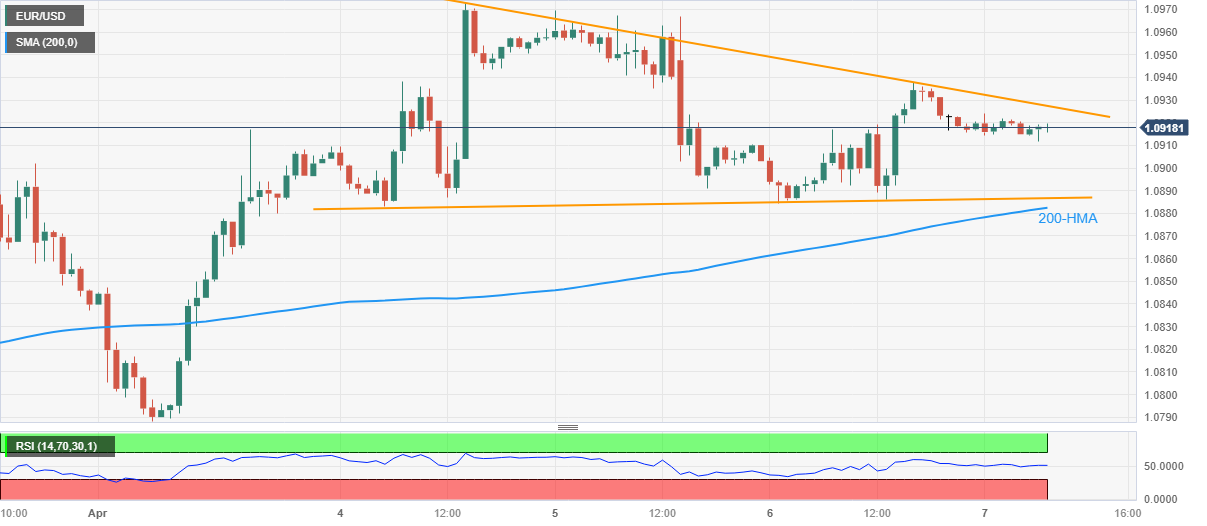
Trend: Further upside expected

Analysts at TD Securities (TDS) offer a sneak peek of the top three market-moving events due on the cards next week.
“US CPI: Core prices likely cooled off modestly in March, with the index still rising a strong 0.4% m/m, as we look for recent relief from goods deflation to turn into inflation this month. Shelter prices likely remained the key wildcard, while slowing gas prices and softer food-price gains will likely dent non-core inflation. Our m/m forecasts imply 5.1%/5.6% y/y for total/core prices.”
“BoC rate decision: We look for the BoC to hold at 4.50% in what should be an easy decision, with recent banking stress removing some pressure after the rebound in Q1 GDP. The more interesting element will be how the Bank incorporates banking stress in the April MPR. Balancing stronger growth and a more ominous outlook should result in a mixed tone, but one that supports the conditional pause.”
“FOMC Minutes: The rate hike at the March FOMC meeting was widely viewed as dovish. The distribution of the March dot plot for 2023, however, suggested a more hawkish sentiment across the FOMC. With banking stress now appearing to be somewhat contained, the minutes for this meeting might emphasize this hawkish sentiment given continued elevated inflationary pressures.”

Economists at Australia and New Zealand bnaking group (ANZ) provide their afterthoughts on the Reserve Bank of India’s (RBI) surprise policy move on Thursday.
“The monetary policy committee (MPC) delivered a surprise pause against expectations of a 25bp hike, citing a need to assess the impact of previous hikes amid an uncertain economic environment.”
“For FY24, the growth forecast was nudged up by 10bps to 6.5% and the inflation projection trimmed by 10bps to 5.2%. Lower oil price assumption was cited as the reason for the improved growth-inflation outlook.”
“We believe that India’s rate hike cycle is over for now. However, by maintaining its “withdrawal of accommodation” stance, the MPC has preserved the scope for further hikes, if needed. Upside inflation risks from a surge in oil prices and poor monsoon will be on our radar.”
 Chat now!