Rate Cut Bets Build in Bond Markets From Australia to Sweden

Rate Cut Bets Build in Bond Markets From Australia to Sweden

A submersible carrying five people to tour the wreck of the Titanic on the Atlantic seabed went missing on Sunday. The dive craft’s command ship lost contact with the submersible and its occupants less than two hours after launch, after which it informed the US Coast Guard.

Extensive rescue operations are currently underway, with the craft’s air supply thought to last a little under three more days. Here’s what we know about the missing vessel, the company behind the tours, and its Chief Executive Officer Stockton Rush, who is believed to be on board:

What is the Titan submersible?

The missing craft is owned by OceanGate and is named Titan. The sub is designed to carry five people — a pilot and four passengers — and is made of carbon fiber and titanium, according to OceanGate’s website. It measures 6.7 meters in length and is designed to reach depths of 2.5 miles (4 kilometers). The Titanic sits on the seabed 2.4 miles down.

What is it like on board?

It’s cramped and there are few facilities. Travelers are sealed into the cylindrical capsule from the outside. Inside the air is breathable and is recycled in a similar way to a spacecraft, and internal pressure remains constant. Facilities are sparse. At one end is a viewing portal 21 inches in diameter, which allows two passengers to look outside at once. There is a very small bathroom on board.

What happened to the Titan?

Right now, nobody knows. According to the US Coast Guard, about an hour and 45 minutes after the sub launched on Sunday, the submersible’s command ship, the Polar Prince, lost contact with the vessel about 900 miles (1,450 kilometers) east of Cape Cod, Massachusetts.

How much air does the Titan have left?

Authorities said the sub is able to provide occupants with about 96 hours of air, citing information from the company. During a press conference in Boston at 4:30 p.m. on Monday, Rear Adm. John Mauger of the US Coast Guard estimated that the air capacity may, at that time, have been reduced to as little as 70 hours.

How is the Titan launched?

The craft sits on a platform until it reaches about 30 feet below the water’s surface, where it can start its journey to the seabed without the turbulence of waves and currents. Upon its return, it docks with the platform and ballast tanks are filled with air, bringing the craft and its passengers back to the surface.

How is the submersible controlled?

The sub can travel at a speed of three knots and descend at 55 meters per minute, with propulsion coming from four electric thrusters. Attached equipment includes powerful external lights, cameras and a laser scanner. David Pogue, a CBS journalist who took a trip in the Titan to view the Titanic in 2022, said he was surprised to discover the craft was controlled with a video game controller.

Who built the sub?

The Titan was built by Washington-based private company OceanGate Expeditions, which runs underwater vessels for charter and scientific exploration. It was the brainchild of CEO Stockton Rush, who, according to several newspapers, is on board. Rush, who holds a degree in aerospace engineering from Princeton University and an MBA from UC Berkeley’s Haas School of Business, worked with NASA and Boeing on the craft’s design.

What does OceanGate offer tourists hoping to see the Titanic?

OceanGate charges at least $250,000 for expeditions to the Titanic shipwreck. According to its website, the expedition lasts over a week and sets off from the Canadian city of St. John’s in Newfoundland. Single dives take six to eight hours to reach the Titanic site, explore, and return to the surface.

Bank of England’s conundrum deepens as inflation and labor market stay hot

Bank of England’s conundrum deepens as inflation and labor market stay hot

LONDON — The Bank of England is “caught between a rock and a hard place” as it prepares for a key monetary policy decision against a backdrop of sticky inflation and a tight labor market, economists say.

May’s consumer price index figure will be published Wednesday morning, the day before the Bank’s Monetary Policy Committee (MPC) announces its next move on interest rates.

Data points since the last meeting have indicated persistent tightness in the labor market and strong underlying inflationary pressures, alongside mixed but surprisingly resilient growth momentum.

Economists therefore now expect the Bank to prolong its tightening cycle and lift interest rates to a higher level than previously anticipated.

British 2-year government bond yields

rose to a 15-year high of 5% on Monday ahead of the expected announcement of yet another 25 basis point rate increase on Thursday.

Since November 2021, the the central bank has embarked on a series of hikes to take its base rate from 0.1% to 4.5%, and market pricing now suggests it may eventually top out at 5.75%.

Headline CPI inflation came in at 8.7% year-on-year in April, down from 10.1% in March, but core CPI (which excludes volatile energy, food, alcohol and tobacco prices) increased by 6.8% compared to 6.2% the previous month.

The Organization for Economic Cooperation and Development projected earlier this month that the U.K. will post annual headline inflation of 6.9% this year, the highest level among all advanced economies.

Adding to policymakers’ collective headache, labor market data last week came in far stronger than expected. Unemployment defied expectations to fall back to 3.8% while the inactivity rate also fell by 0.4 percentage points.

Regular pay growth (excluding bonuses) was 7.2% in the three months to the end of April compared to the previous year, also exceeding consensus forecasts. Growth in regular private sector pay, the Bank’s key metric, hit 7.6% year-on-year.

In terms of economic activity, May PMIs moderated slightly below consensus but remained in expansionary territory, and U.K. gross domestic product unexpectedly contracted by 0.3% month-on-month in March before rebounding partially with 0.2% growth in April.

Terminal rate forecasts raised

In a research note Thursday, Goldman Sachs Chief European Economist Sven Jari Stehn said that although some uncertainty remains over Wednesday’s CPI release, there is a “high hurdle” for the Bank of England to deem it necessary to step up its hiking increments to 50 basis points.

Stehn highlighted that “inflation expectations have remained anchored, recent comments have signalled no appetite for stepping up the pace and the meeting will have no press conference or new projections.”

“We look for the MPC to retain its modal assessment that underlying inflation pressures will cool as headline inflation declines but acknowledge the firmer recent data and note that risks to the inflation outlook remain skewed significantly to the upside. We also expect the MPC to keep its loose forward guidance unchanged,” Stehn added.

Goldman Sachs expects the MPC to retain its relatively dovish position given resilient growth, sticky wage pressures and high core inflation, and to continue being pushed into more 25 basis point hikes by stronger-than-expected data, eventually reaching a terminal rate of 5.25% with risks skewed upside.

BNP Paribas economists also expect a 25 basis point hike on Thursday, as inflation expectations remain lower than they were when the Bank was lifting rates in 50 basis point increments last year.

The French lender also upgraded its terminal rate forecast to 5.5% in a note last week, from 5% previously, in response to “clear evidence of more persistent inflation.”

Though the tightening cycle is expected to be longer than higher in order to reel in inflation, BNP Paribas suggested the MPC would be “wary of over-tightening” and will be looking to gauge how rate rises to date affect households, particularly as fixed-rate mortgage renewals roll in through the second and third quarter.

U.K. mortgage borrowers are being pushed to the brink as rising borrowing costs hit deal renewals and products are pulled from the market.

Laith Khalaf, head of investment analysis at AJ Bell, said the MPC is “caught between a rock and a hard place” as it chooses between pushing more mortgage borrowers to a cliff edge and allowing inflation to run riot.

“Current interest rate pricing reflects alarm bells ringing in the market, but some moderation in inflationary pressures over the summer would pour balm on the situation. The Bank of England will also be cognisant of the fact the full force of its tightening to date is still working its way through the economy,” Khalaf said.

“Having said that, should inflation data remain ugly, the Bank will be under pressure to take action, and so will the Treasury, if it looks like the Prime Minister’s pledge to halve inflation is at risk of falling short.”

EUR/USD: Gradual appreciation of the Euro towards the end of the year – Commerzbank

EUR/USD: Gradual appreciation of the Euro towards the end of the year – Commerzbank

The EUR is likely to appreciate somewhat further against the USD with a view to the end of the year, if interest rate cuts become tangible in the US, in the opinion of economists at Commerzbank.

Is the ECB the more hawkish central bank?

In the medium term, we expect the Fed to lower its key rate again next year as the US economy cools. At the same time, the ECB is likely to keep interest rates on hold despite declining inflation and increasing headwinds for the Eurozone economy. This means that the ECB is taking a more hawkish stance than the Fed, which should benefit the Euro. However, the exact timing of the currency market’s reaction to the monetary policy divergence described above is difficult to predict. We, therefore, forecast a gradual appreciation of the EUR towards the end of the year.

In the long run, however, EUR strength is unlikely to be sustainable. According to our economists, the ECB is likely to succeed in controlling inflation to a lesser extent than the Fed in the long term. Regardless of which of the two central banks offers the highest real interest rate on its respective currency, this is likely to result in the Euro suffering from an increased inflation risk premium.

Japan’s Industry Minister says FX stability is important

Japan’s Industry Minister says FX stability is important

apan’s Industry Minister represents real businesses that are impacted by forex swings, so he has a case to comment. Earlier we had the same sort of remark from the finance minister. Its his department that’d be ordering intervention in the currency, if it comes to that: • Japan finance minister Suzuki says FX stability is important. What to watch: The 4 phrases from Japanese officials to listen for signaling imminent yen intervention. USD/JPY update

Minutes of the Monetary Policy Meeting of the Reserve Bank Board

Minutes of the Monetary Policy Meeting of the Reserve Bank Board

International economic developments

Members commenced their discussion of the global economy by noting that inflation in many economies remained well above central banks’ targets. Although headline inflation had continued to decline as energy prices fell and food price inflation eased, members noted that core inflation had remained sticky and shown little sign of easing. Services inflation, which had become the primary source of inflationary pressures across advanced economies, had continued at a high rate. This partly reflected strong wages growth, which remained above rates consistent with inflation targets in many economies. This, in combination with subdued growth in labour productivity, had resulted in a rapid rise in unit labour costs over the preceding year. Members acknowledged the implications of this for Australia, given the high degree of commonality in inflation experience globally since the pandemic. While central banks in advanced economies expected inflation to return to target, most do not see this as likely to occur in the coming year.

Members noted that economic growth in advanced economies was slowing gradually as contractionary monetary policy settings took effect. GDP in major advanced economies had risen only slightly in the March quarter and had declined in some euro area countries. Consumption growth had been subdued in the March quarter and indications were that this had continued into the June quarter. Business investment was yet to surpass pre-pandemic levels in most advanced economies. Other indicators of economic activity had been more resilient in recent months. Housing prices appeared to have stabilised in several countries, following significant declines over 2022, and survey measures of business conditions pointed to services sector activity having increased further in May.

In China, the growth momentum had waned in April after a strong bounce-back following the end of pandemic restrictions and the reopening of the international border in late 2022. As a result, the strength of the economic recovery had become more uncertain than a month earlier. Retail sales and industrial production had declined markedly in April and conditions in the property market had deteriorated.

Members noted that the price of iron ore had been broadly stable over the prior month, despite the soft run of Chinese data. More broadly, the soft outlook for global growth had led to falls in a range of commodity prices since the start of the year. Bulk commodity prices had declined and were now close to pre-pandemic levels. Prices of energy commodities had declined the most, with thermal coal and spot prices for liquified natural gas falling in response to relatively high levels of inventories and broader concerns about the outlook for growth. Oil prices had also fallen. If sustained, these declines would further dampen consumer price inflation globally over the second half of the year.

Domestic economic conditions

Members noted that growth in economic activity in Australia had slowed since mid-2022, as the post-pandemic recovery in spending faded and the substantial tightening in monetary policy worked its way through the economy. The national accounts, to be released the day after the meeting, were expected to show only modest growth. Members noted that the new policies announced in the Australian Government Budget had not had a material effect on the staff forecasts for economic activity and inflation.

There was growing evidence that household consumption growth had been subdued in the first half of 2023. Retail volumes had declined in the March quarter, despite strong population growth, and liaison with retailers suggested that conditions had softened further in the June quarter. Growth in spending on consumer services, including cafes and restaurants, had generally slowed but by less than other forms of consumption. Members discussed the significant financial pressure facing many households and the effect of this on communities and the economy as a whole. They also discussed the unevenness in household spending, noting that some households had drawn on the substantial additional savings built up during the pandemic, while other households were facing considerable budget constraints.

National housing prices had increased in recent months and households’ expectations for future rises in housing prices had strengthened. Members noted that, if sustained, this would imply less of a drag on consumption in the year ahead than had previously been envisaged. The increase had been broadly based across capital cities in May and was consistent with developments in a number of other countries. Members discussed the reasons for the unexpected strength in housing prices. They noted that strong population growth had supported demand for housing and that this was largely affecting the established housing market. Expectations that the interest rate cycle was near its peak might also have played a role. Orders for newly constructed housing remained weak and residential construction firms continued to report that high materials costs and shortages of skilled tradespeople were contributing to low margins and delays in work being completed.

Members noted that the labour market remained very tight. Nonetheless, conditions had eased slightly, alongside slower growth in economic activity. Employment growth over the prior six months had been a little less than growth in the working-age population over that period. Firms in the Bank’s liaison program had reported some improvement in labour availability. Acknowledging that the monthly data are volatile, members noted that the unemployment rate had ticked up to 3.7 per cent in April and the number of people employed had been little changed.

A range of measures suggested that wages growth had been in the 3½ to 4 per cent range. The pace of increase in the Wage Price Index (WPI) had risen to 3.7 per cent over the year to the March quarter, broadly in line with earlier expectations. The average size of wage changes in the private sector for those who received an increase had remained at around 4 per cent for the third consecutive quarter. In the public sector, wages growth had picked up to 3 per cent and a further increase was expected. Information from the Bank’s liaison program was also signalling that firms’ expectations were for wages growth to remain stable at around current levels over the year ahead.

The recent Annual Wage Review decision of the Fair Work Commission (FWC) had increased award wages by 5.75 per cent. This was higher than the expectation embedded in staff forecasts and would add directly to WPI growth in the September quarter, relative to the prior forecasts. In addition to this, a range of public sector enterprise agreements were being negotiated and it appeared likely that some of these would contain wage rises of at least 4 per cent for the first year, followed by smaller increases in subsequent years. Members observed that the FWC decision would support wages growth for around 30 per cent of workers (but a significantly smaller share of the total wage bill) whose wages are either directly or indirectly affected by award rates. Recently struck enterprise bargaining agreements would similarly see wages growth for those on enterprise bargaining agreements rise from current levels. Members observed that it was understandable that the lowest paid workers would be compensated for high inflation, but that it would be concerning if wages across a broad range of jobs were to become implicitly indexed to high inflation.

Timely indicators pointed to a gradual easing in inflation in the June quarter. The monthly CPI indicator for headline inflation had increased to 6.8 per cent over the year to April, a little higher than had been expected. However, this was partly due to the timing of price changes for volatile items, and growth in the indicator excluding volatile items and holiday travel had slowed, particularly in six-month-annualised terms. The easing in global upstream cost pressures and the more recent declines in commodity prices and shipping rates could be expected to lower firms’ costs, but the easing in consumer goods price inflation had been limited. Members acknowledged that additional information on the momentum of services prices inflation would become available over subsequent months.

Members noted that there were various other considerations that created upside risk for inflation. Retail electricity prices had risen over the preceding year, but – unlike in other countries – there would be an even larger increase in the year ahead. Rent inflation had been high in April, reflecting very tight rental market conditions across the capital cities, and appeared to be drifting up further. There had also not been as clear a moderation in goods price inflation in Australia as there had been in some other countries. In considering the outlook for inflation, members discussed the importance of productivity growth, noting that output per hour worked had not increased over the preceding three years.

International financial markets

Members commenced their discussion of international financial conditions by observing that the US Federal Reserve, the European Central Bank, the Bank of England, Norges Bank and the Reserve Bank of New Zealand (RBNZ) had increased policy rates further over the prior month to address high and persistent core inflation. Some central banks, including the RBNZ, had communicated that policy rates were now likely to be sufficiently restrictive or close to sufficiently restrictive. However, central banks had also emphasised that policy rates were unlikely to decline over coming months, in contrast to market-implied expectations.

Market expectations for the path of central bank policy rates had shifted higher over the prior month in response to stronger-than-expected inflation and labour market data. The suspension of the US debt ceiling and easing of concerns about stress in some parts of the US banking system had also contributed to these moves.

Government bond yields in advanced economies had also increased over the prior month. Members noted that the increase in nominal yields mostly reflected higher real yields, while market measures of longer term inflation expectations remained anchored in most economies. This implied that markets expected central banks to raise policy rates sufficiently to return inflation to target.

Private sector financial conditions had been little changed. US funding markets had stabilised after the banking stress in March and deposit outflows from banks had slowed. Members noted that US banks’ funding costs were likely to remain under pressure for some time, particularly for smaller banks.

In China, financial conditions had remained accommodative, with bond yields having declined a little in response to concerns around the strength of the economic recovery and expectations of further policy easing. Credit growth had eased alongside a slump in property sales and many highly leveraged property developers continued to face considerable financial stress.

The Australian dollar had ended the month little changed on a trade-weighted basis. Members observed that there had been two countervailing forces on the exchange rate over preceding months. Interest rate differentials between Australia and major advanced economies had generally been supportive, and members noted that the Australian dollar had appreciated noticeably in response to the decision to raise the cash rate in May. Meanwhile, the decline in commodity prices and concerns about the strength of China’s economic recovery had weighed on the value of the Australian dollar.

Domestic financial markets

Members noted that increases in the cash rate continued to be passed through to higher lending rates. Scheduled mortgage payments had increased further and equated to around 9 per cent of household disposable income in April. The increase in average variable mortgage lending rates over the tightening phase had been less than the rise in the cash rate, reflecting competition in the banking sector. There were, however, some signs that competition for borrowers had started to ease. The continuing rollover of low fixed-rate loans into higher rate loans would contribute to a further increase in scheduled payments over the months ahead. Members noted that, based on increases in the cash rate to date, payments were projected to rise to the equivalent of around 10 per cent of household disposable income by the end of 2024.

Net flows into borrowers’ offset and redraw accounts remained positive to April, although extra mortgage payments were well below the highs seen during the pandemic. Increases in scheduled mortgage payments would reduce some borrowers’ ability to make these extra payments, but higher rates were also creating an incentive to hold savings in these accounts. The value of non-performing housing loans had risen a little but from a very low level. Measures of personal insolvencies also remained at low levels.

Members observed that new housing loan commitments had stabilised over preceding months, following declines of around 30 per cent from the peak in early 2022. Commitments had steadied among both owner-occupiers and investors, and across states. This pattern was consistent with housing prices having steadied after prior declines. Housing credit growth was also showing signs of levelling out after a period of deceleration.

Members noted that the decision to increase the cash rate in May had been unexpected by many market participants and contributed to bond yields in Australia rising by around 30 basis points over the prior month. For the June meeting, markets were pricing in about a 50 per cent chance of an increase in the cash rate and a little less than half of market economists expected an increase. These expectations had increased over the prior week, following the release of the monthly CPI and the FWC’s decision. Further ahead, around half of economists surveyed expected 50 basis points of tightening by August, which was broadly in line with the probability implied by market pricing.

Considerations for monetary policy

In turning to the policy decision, members noted that inflation had passed its peak but remained well above target and was forecast to return to the top of the target range only by mid-2025. There was little spare capacity in the economy, with the unemployment rate very low. At the same time, members noted that consumer spending had softened significantly, with both higher interest rates and high inflation weighing on household purchasing power. Members observed that the economy still looked to be traversing a narrow path on which inflation comes back to target while the unemployment rate rises but remains low. They noted that there were significant risks and uncertainties to staying on this path.

Members discussed two options: increasing the cash rate by 25 basis points; or holding the cash rate unchanged.

The case for raising the cash rate by a further 25 basis points focused on the increased risk that inflation would take longer to return to target than had been expected. Members observed that inflation was already projected to be above target for a number of years and was expected to take somewhat longer to return to target in Australia than in some other countries. This extended timeframe reflected the Board’s desire to bring inflation down while, at the same time, preserving as many of the gains in employment as possible. While this remained the Board’s objective, members noted that a more prolonged period of above-target inflation would increase the risk that firms’ and households’ expectations for inflation rise. If this occurred, high inflation would become more persistent with the result that interest rates would need to be higher for longer. This would increase the risk of a sharp rise in unemployment.

In discussing the risks to the inflation outlook, members observed that the monthly indicator of headline inflation had surprised on the upside in April and that the decline in goods price inflation had been less than observed in other countries. In addition, services price inflation had not yet shown signs of moderating and the evidence from abroad suggested that it may prove to be persistent.

Members noted that wages growth was still consistent with the inflation target, provided productivity growth picked up to around the average pace that had been recorded before the pandemic. While future trends in productivity were uncertain, the outcomes over recent times had been disappointing. Members discussed the possibility of implicit indexation of wages to past high inflation and the potential for this to become widespread. Similarly, members observed that some firms were indexing their prices, either implicitly or directly, to past inflation. These developments created an increased risk that high inflation would be persistent, which would make it more difficult to keep the economy on the narrow path.

Members observed that the resumption of growth in housing prices would – if sustained – imply less drag on consumer spending in the coming year than had been envisaged. Members also noted that the stabilisation in housing loan approvals suggested that financial conditions may not have been as tight as they had previously judged. The downside risks to global growth had also abated a little as conditions in the US banking sector had stabilised.

Members concluded that these developments had shifted the balance of risks on inflation to the upside compared with a month earlier, although they also noted that there were some downside risks to inflation, including from developments in global markets and the slowdown in household spending in Australia.

The case for holding the cash rate unchanged at this meeting rested on the slowing in the economy and the possibility that the significant increases in interest rates to date would lead to the economy slowing more sharply than expected. Members noted that consumption growth was already quite weak, especially in per capita terms. Real disposable incomes were falling, especially for home loan borrowers, and many renters were experiencing difficult financial conditions. Members also noted that the scale of increase in the cash rate over the preceding year, lags in the transmission of monetary policy through the economy and the large number of fixed-rate loans scheduled to expire over coming months would see financial conditions tighten further. Given these developments, there was a risk of the economy slowing and unemployment rising by more than expected.

Members also discussed some of the downside risks to inflation. They observed that commodity prices had fallen quite significantly over preceding months, as had the price of international shipping, which could be expected to reduce pressure on consumer prices over time. Members noted that medium-term inflation expectations in financial markets had been little changed to date and that the moderation occurring in headline inflation could mitigate the risk of inflation expectations rising. They also observed that the staff forecasts had overestimated wages growth for a prolonged period prior to the pandemic and that productivity could prove stronger than expected.

In light of these considerations, members discussed the possibility of holding the cash rate unchanged at this meeting and then reconsidering at subsequent meetings, with the benefit of additional data.

Members recognised the strength of both sets of arguments, concluding that the arguments were finely balanced. They judged, though, that the case to raise the cash rate at this meeting was the stronger one.

The Board affirmed that its priority is to return inflation to target within a reasonable timeframe. The recent data suggested that inflation risks had shifted somewhat to the upside. Given this shift and the already drawn-out return of inflation to target, the Board judged that a further increase in interest rates was warranted. This increase would provide greater confidence that inflation would return to target over the period ahead. An extended period of high inflation would distort the economy and exacerbate cost-of-living pressures, hurting those on low incomes the most. Sustained high inflation would also lead to even higher interest rates in the future and a worse outlook for the labour market.

In taking the decision to increase interest rates again, members acknowledged the considerable uncertainty regarding the outlook for household spending and the financial stresses facing some households. Given this, they agreed to continue to monitor trends in household spending closely and consider the implications for the inflation outlook, as well as developments in the global economy and the domestic labour market. Members reaffirmed their determination to return inflation to target and their willingness to do what is necessary to achieve that.

Members agreed that the Governor’s speech the following day would provide an opportunity to explain the decision in more detail.

The decision

The Board decided to increase the cash rate target by 25 basis points to 4.1 per cent and to increase the interest rate on Exchange Settlement balances by 25 basis points to 4 per cent.

EUR/USD rises toward 1.0950 as US Dollar retreats

EUR/USD rises toward 1.0950 as US Dollar retreats

EUR/USD is advancing toward 1.0950 in the early European trading hours, looking to gain meaningful traction. The US Dollar is retreating across the board, pausing its three-day recovery mode ahead of mid-tier US data and Fedspeak.

The EUR/USD pair trades in the 1.0910 price zone,  posting modest losses in a quiet Monday. Following the central banks’ frenzy from last week, speculative interest became optimistic, as the end of the tightening cycle is close enough to help avoid potential recessions, while inflation keeps easing from record highs achieved mid-2022.

The US Dollar gained amid position adjustments after it sold off last week, although it remains intrinsically weak, given the continued appetite for riskier assets.

On Monday, the Eurozone macroeconomic calendar had little to offer, although European Central Bank (ECB) members hit the wires, maintaining the stakes high for additional rate hikes. Executive Board  Member Philip R. Lane said another hike in July seems appropriate, while September’s decision will depend on data. Meanwhile, Isabel Schnabel expressed concerns about the central bank underestimating inflation in the past, noting the interest rate path should have been steeper and suggesting they may continue to hike rates this year.

On Tuesday, the EU will publish the April Current Account and Construction Output, while the United States (US) will release May Building Permits and Housing Starts. It is worth adding that Federal Reserve (Fed) Chairman Jerome Powell will testify before Congress on Wednesday and could provide fresh clues on the future of monetary policy.

GBPUSD Lower But Well Supported As Markets Expect BoE Hike

GBPUSD Lower But Well Supported As Markets Expect BoE Hike

The British Pound remains close to fourteen-month peaks against the United States Dollar on Monday as markets look to the Bank of England with near-certainty that rates will be going up again this week.

The United Kingdom’s central bank has been particularly concerned to stop inflation expectations from becoming entrenched within the domestic economy. It will announce its June monetary policy decision on Thursday. The markets are looking for another quarter-percentage-point rise in the key Bank Rate, which would take it up to 4.75%. That would be the highest since April 2008.

The decision will come a day after official inflation figures for the UK are released. The broad Consumer Price Index is expected to have risen by a chunky 8.7% compared with May 2022, with the narrower ‘core rate’ gaining by 6.8%. That would be unchanged from April.

As-expected outcomes here will be seen as nailing down a rate rise within 24 hours, so expect to see sterling climb after the data should they meet forecasts. In any case it would seem vanishingly unlikely that the numbers will do anything to dent expectations that rates will rise this week.

Monday doesn’t offer any first-tier economic data likely to affect any major currency, and for sterling the session is likely to be something of a lull before the two major local events later on.

The currency is well underpinned against the US Dollar by expectations that the Bank of England will continue to tighten monetary policy even as the Federal Reserve holds off to gauge the effect of rate hikes it has already made. The UK economy has also performed rather better than some of the more bearish forecasts made at the start of this year predicted. The prognosis that the economy is still running too hot for there to be a meaningful fall in inflation without significantly higher rates should also keep Sterling buyers coming,

GBPUSD Technical Analysis

GBPUSD soared last week above a well-respected uptrend channel on its daily chart, a channel which in any case was only a continuation of the steady rises seen since the lows of last September.

Bulls are now attempting to close the gap between current levels and a trading band from March 4-March22 which now bars progress higher. The Pound will need to break above 1.29513 to get back into that band. That’s some way above the current market and, with strong rises already booked, there may need to be some consolidation before a serious attempt higher can be made.

Still, the previous uptrend channel now offers support at 1.27239, with May 10’s high of 1.26841waiting just below that, and that’s before we get to Fibonacci retracement support at 1.22507.

Sentiment toward the pair from traders on IG’s platform is perhaps unsurprisingly mixed, but there is a clear bias to go short at current levels. Given the clear fundamental support sterling has, this is likely to be no more than a desire to consolidate some gains and it’s hard to see a meaningful reversal for sterling while inflation remains off the leash.

USD/ZAR: Price Forecast: Rand Rally Possibly Fading

USD/ZAR: Price Forecast: Rand Rally Possibly Fading

USD/ZAR FUNDAMENTAL BACKDROP

The South African rand opened the week on the front foot once again looking for its fourth straight week of weekly gains. Locally, loadshedding (blackouts) have somewhat diminished allowing for businesses to run more efficiently and if this trend is to continue the rand may gain additional traction. Overall the economy remains weak but the SARB has ensured an attractive carry trade for investors looking for added risk. This morning began with optimism between Chinese and US discussions as well as markets keenly anticipating stimulus by the Chinese government to bolster economic growth. This could have positive ramifications for the rand as a strong Chinese economy traditionally correlates to stronger demand for South African commodity products and hence a supportive function for the ZAR.

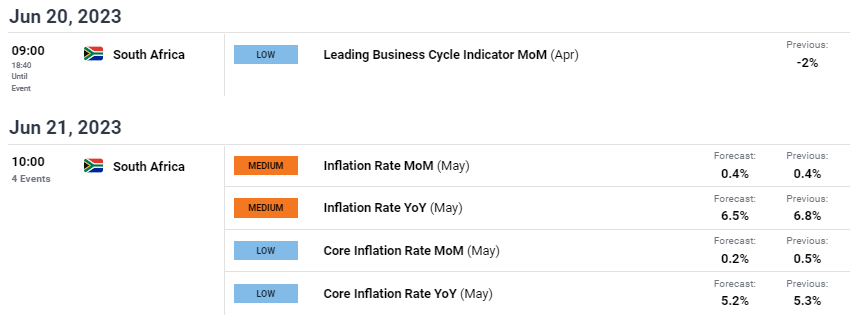
The economic calendar from a South African perspective is relatively light this week but focus will be on the upcoming CPI print on Wednesday (see economic calendar below). Headline inflation is expected significantly lower but core inflation will carry most of the attention for investors. Core inflation has been sticky and although estimates are marginally lower at 5.2%, markets will be, looking for something more significant. If this should come to fruition, the rand may lose some ground to the greenback as easing monetary policy may ensue especially with a less hawkish Federal Reserve (possibly reaching the peak of their hiking cycle).

USD/ZAR ECONOMIC CALENDAR (GMT +02:00)

image1.png

TECHNICAL ANALYSIS

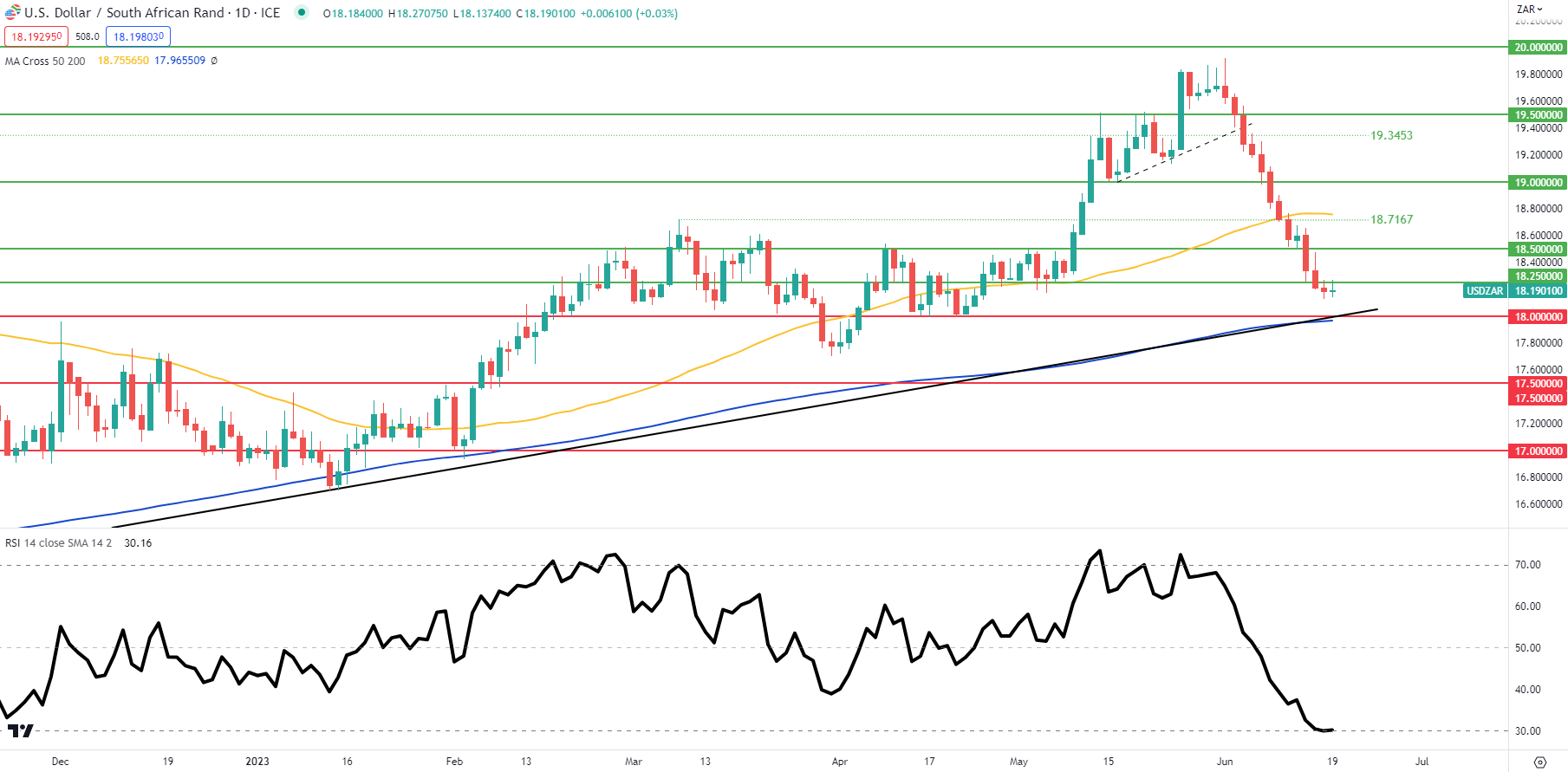
USD/ZAR DAILY CHART

image2.png

Daily USD/ZAR price action has remained below the psychological 18.2500 handle for now looking to push lower towards 18.0000 for the first time since late April this year. The Relative Strength Index (RSI) has since pushed into oversold territory and may coincide with a pullback around the long-term trendline (black) and 200-day MA (blue) respectively.

EUR/USD Outlook: ECB Hawks Welcome Further Hikes but for How Long?

EUR/USD Outlook: ECB Hawks Welcome Further Hikes but for How Long?

Hawks Favour More Hikes but Divisions within the ECB May Soon Appear

Isabel Schnabel and Peter Kazimir, hawks within the ECB’s ranks, have communicated their preference to see more rate hikes before witnessing a peak in interest rates. Schnabel opted for an approach that risks doing too much as opposed to doing too little, substantiating that it is trickier to tame inflation once it has become entrenched in the economy.

On the other side of the debate is well known dove and ECB Chief economist, Philip Lane, who suggested that one more hike in July is most likely appropriate while refusing to commit to the same outcome in the following meeting – stating a preference for a data dependent approach.

EUR/USD Key Technical Levels Assessed and Analysed

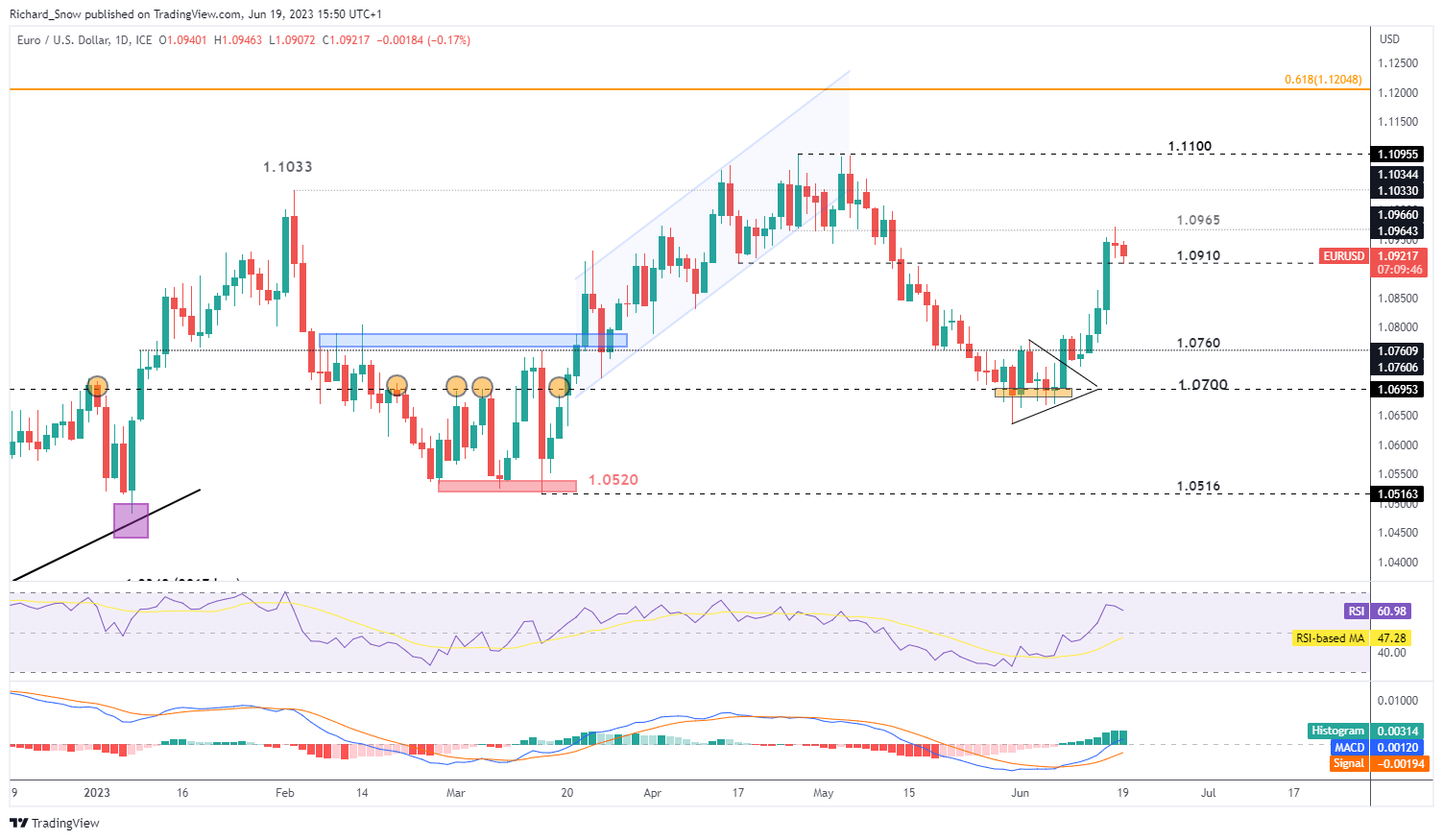
EUR/USD has enjoyed a massive week to the upside last week, rising just short of 200 basis points. Despite a confusing ECB press conference, the overall message from the ECB remained in tightening mode, while US bond markets appear at odds with the hawkish Fed policy statement and economic projections.

1.0965 appeared to be a stretch too far last week and remains the most immediate level of resistance. Heading into this week, with the US on holiday today in observance of Juneteenth, it appears markets are content with a slight countertrend move although, the true test of this short-term direction will be revealed tomorrow when the US is back online.

Immediate support lies at 1.0910 where a break and hold below this level could see prices trading down towards 1.0760 – the next level of support. For now, the MACD suggests that bullish momentum has not yet been wiped out as bulls may eye bullish continuation plays after assessing the extend of the retracement.

EUR/USD Daily Chart

image1.png

 Client Sentiment Favors Bullish Continuation Setups after Sentiment Reversal

EUR/USD IG Client Sentiment

image2.png

Source: IG/DailyFX, prepared by Richard Snow

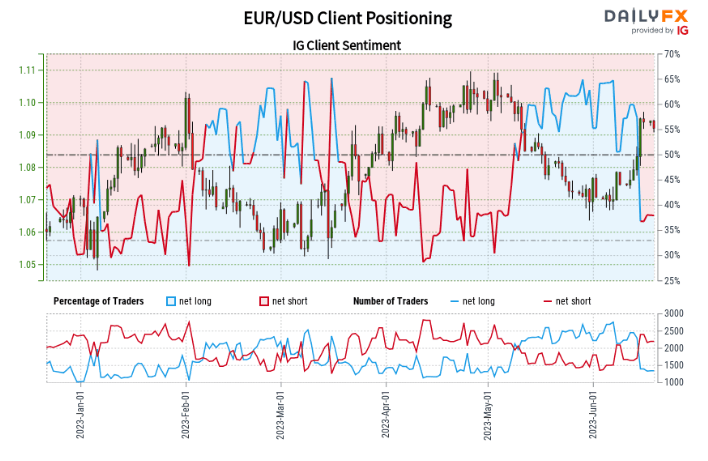
EUR/USD:Retail trader data shows 38.00% of traders are net-long with the ratio of traders short to long at 1.63 to 1.The number of traders net-long is 4.37% higher than yesterday and 39.12% lower from last week, while the number of traders net-short is 4.45% higher than yesterday and 30.37% higher from last week.

We typically take a contrarian view to crowd sentiment, and the fact traders are net-short suggests EUR/USD prices may continue to rise.

Traders are further net-short than yesterday and last week, and the combination of current sentiment and recent changes gives us a stronger EUR/USD-bullish contrarian trading outlook.

Risk Events for the Week Ahead

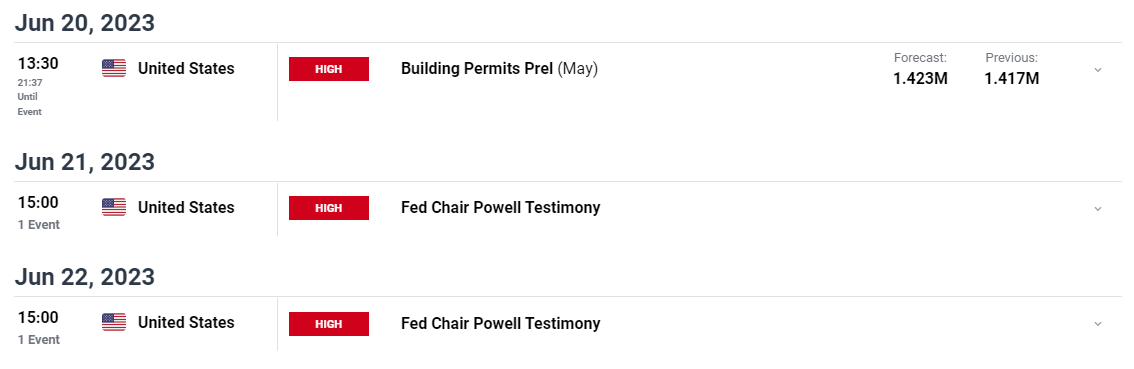
Scheduled risk events experience a significant drop-off this week with Jerome Powell’s testimony in front of the US Senate Banking Committee the major event.

image3.png


AUD/USD Price Forecast: Aussie Sinks on Lackluster RBA and Chinese Rates

AUD/USD Price Forecast: Aussie Sinks on Lackluster RBA and Chinese Rates

AUSTRALIAN DOLLAR FUNDAMENTAL BACKDROP

The Australian dollar is on offer this morning against the US dollar even though the greenback remains relatively flat as measured by the DXY index. The selloff stemmed initially from concerns around the Chinese economy as the PBoC cut both the 1-year and 5-year loan prime rates by only 10bps respectively (refer to economic calendar below). In a push to stimulate economic growth, we may see further rate cuts going forward and with China’s low inflation relative to other major global economies, there is little in the way of limitations to continue easing monetary policy. Being a major trading partner with China, the grim outlook will hinder commodity exports from Australia thus weighing negatively on the Aussie dollar.

AUD/USD ECONOMIC CALENDAR (GMT +02:00)

image1.png

The Reserve Bank of Australia (RBA) minutes then followed which highlighted the indecision in the last meeting to hike rates but with the surprise hike, July’s expectations are slightly skewed towards a rate pause as depicted in the table below – following the trend of the Fed. Economic data inputs will be of utmost importance leading up to the meeting as data dependency becomes more and more important for the RBA.

Later today, focus shifts to Fed speak as well as building permit data for the US. Recent releases have ben on the decline but estimates point to a marginal uptick that could be a net positive for the dollar.

RBA INTERST RATE PROBABILITIES

image2.png

TECHNICAL ANALYSIS

AUD/USD DAILY CHART

image3.png

Daily AUD/USD price action is now marginally above the 0.6800 psychological level after slipping below briefly during the Asian trading session. Coming off overbought levels as measured by the Relative Strength Index (RSI) makes the move unsurprising from a technical analysis point of view and has rom to move further. That being said, there may be the possibility of a bullish crossover known as the golden cross where the 50-day MA (yellow) crosses above the 200-day MA MA (blue). This could mean the current downward bias may be short-lived in the medium-term.

Key resistance levels:

  • 0.6900
  • 0.6856

Key support levels:

  • 0.6800
  • 0.6772
  • 0.6700

IG CLIENT SENTIMENT DATA: MIXED

IGCS shows retail traders are currently net HORT on AUD/USD, with 51% of traders currently holding short positions. At DailyFX we typically take a contrarian view to crowd sentiment resulting but due to recent changes in long and short positioning, we arrive at a short-term cautious disposition.