


French services activity growth slows in May as demand wanes and output price inflation accelerates
Growth was sustained across France’s servicer sector midway through the second quarter, although the upturn lost momentum as new business intakes fell. May’s slowdown was the first since the sector returned to expansion territory in February. The decline in new orders reflected weakness domestically as sales to foreign customers rose once again in May, streching the current run of job gains to nearly two-and-a-half years. Meanwhile, input cost inflation eased to a 20-month low, but firms were more aggressive in price setting, with output charges rising at the strongest pace since February. The seasonally adjusted

China’s MOF: The fiscal situation is healthy in general; China has enough room to cope with risks; undertaking transfer payments
#China's MOF:
????The fiscal situation is healthy in general.
????The distribution of local government debt is uneven, and some regions have higher debt risks.
????China has enough room to cope with risks.
????The central is undertaking transfer payments.
Source: Xinhua— CN Wire (@Sino_Market) June 5, 2023

AUD/USD refreshes day low below 0.6600 despite mixed views for Fed policy, RBA policy eyed
The AUD/USD has refreshed its day’s low at 0.6587 in the London session. The Aussie asset has witnessed immense selling pressure despite the street holding mixed views on the interest rate decision by the Federal Reserve (Fed) for June’s monetary policy meeting.
S&P500 futures are holding nominal gains in the European session, indicating that the risk appetite theme is being underpinned by the market participants. The overall upbeat market mood seems biased toward the US equities and not supporting the risk-sensitive currencies. The US Dollar Index (DXY) has turned sideways after printing a fresh day’s high at 104.32. The USD Index is expected to extend its upside journey amid the absence of signals of exhaustion in the upside momentum.
Meanwhile, the street is divided about Fed’s interest rate policy stance. A scrutiny of the Friday’s Nonfarm Payrolls (NFP) report showed that the Unemployment Rate jumped to its seven-month high at 3.7%. Contrary to that, additions of fresh payrolls in the United States labor market in May were at 339K, significantly higher than the estimates of 190K. The situation is a little surprising on whether to consider consistent solid payroll additions and support more rate hikes or pause the same due to a sudden rise in the jobless rate.
On the Australian Dollar front, the interest rate decision by the Reserve Bank of Australia (RBA) will remain in focus. Considering the fact that Australian inflation has turned stubborn again as the monthly Consumer Price Index (CPI) indicator rose to 6.8% in April from March’s 6.3% figure, one more interest rate hike of 25 basis points (bps) which will push the Official Cash Rate (OCR) to 4.10%, cannot be ruled out.

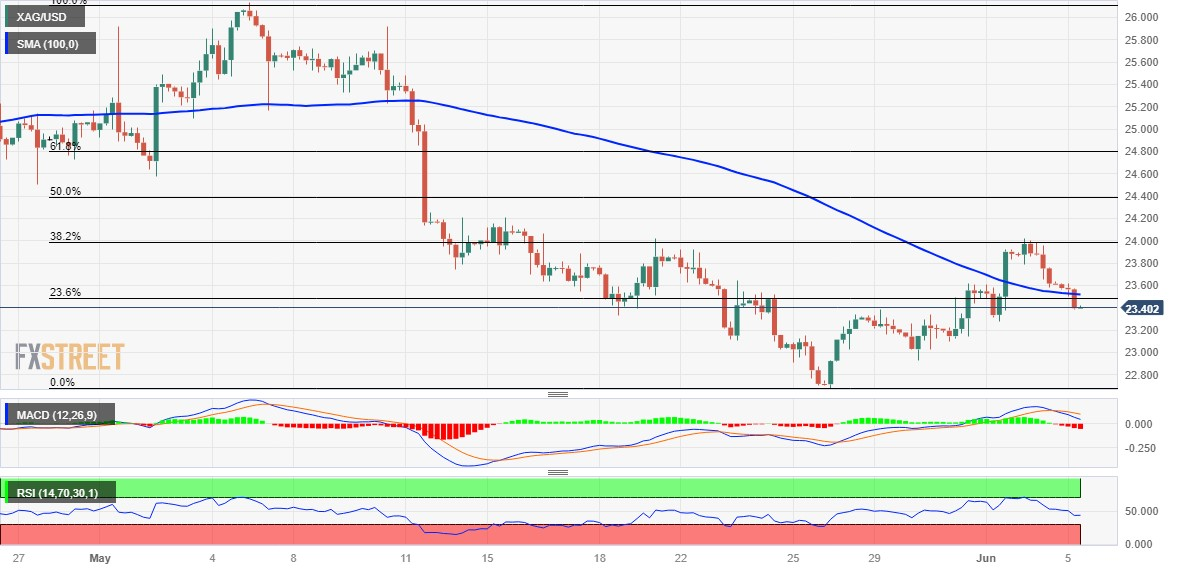
Silver Price Analysis: XAG/USD turns vulnerable below $23.55 confluence support
Silver extends Friday’s rejection slide from the $24.00 mark, or the 38.2% Fibonacci retracement level of the downfall witnessed in May and drifts lower for the second successive day. The white metal maintains its offered tone, just below the $23.50 level through the early European session on Monday and seems vulnerable to weaken further.
From a technical perspective, the intraday slide drags the XAG/USD below the $23.55 confluence support, comprising the 23.6% Fibo. level and the 100-period Simple Moving Average (SMA) on the 4-hour chart. Moreover, bearish oscillators on daily/4-hour charts add credence to the negative outlook and support prospects for a further intraday depreciating move.
Hence, a subsequent slide, towards testing the $23.00 round figure, looks like a distinct possibility. Some follow-through selling will expose the $22.70-$22.65 region, or over a two-month low touched in May, below which the XAG/USD could eventually drop to the $22.00 mark. The latter represents the very important 200-day SMA and should act as a pivotal point.
On the flip side, sustained strength beyond the $23.55 confluence support breakpoint could allow the XAG/USD to make a fresh attempt towards conquering the $24.00 mark. This is closely followed by the $24.15-$24.20 horizontal resistance, above which the momentum could push the commodity further towards the 50% Fibo. level, around the $24.45-$24.50 region.
The XAG/USD might eventually climb to the $24.80 zone, or the 61.8% Fibo. level, and aim to reclaim the $25.00 psychological mark for the first time since May 11. The upward trajectory could get extended further towards the $25.30-$25.35 supply zone en route to the $26.00 round figure and over a one-year high, around the $26.10-$26.15 area touched in May.
Silver 4-hour chart

USD/CAD sticks to gains on stronger USD, remains below mid-1.3400s amid bullish Oil prices
The USD/CAD pair attracts some buying near the 200-day Exponential Moving Average (EMA) on Monday and sticks to its modest intraday gains through the early part of the European session. The pair currently trades around the 1.3430-1.3435 region, up nearly 0.10% for the day, and for now, seems to have snapped a three-day losing streak to the 1.3400 mark, or a nearly three-week low touched on Friday.
The US Dollar (USD) gains some follow-through traction for the second successive day and turns out to be a key factor acting as a tailwind for the USD/CAD pair. Despite the mixed US monthly employment details, the markets area still pricing in another 25 bps lift-off by the Federal Reserve (Fed) later this month. This remains supportive of a further rise in the US Treasury bond yields and pushes the Greenback higher on the first day of a new week. That said, the prevalent risk-on mood might hold back traders from placing aggressive bullish bets around the safe-haven buck.
The markets continue to cheer the optimism over the passage of legislation to lift the government’s $31.4 trillion debt ceiling to avert an unprecedented American default. Adding to this, a private-sector survey showed on Monday that China’s services activity picked up in May and boosted investors’ confidence, which is evident from a generally positive tone around the equity markets. This, along with an intraday rally in Crude Oil prices, which tends to underpin the commodity-linked Loonie, further contributes to capping any meaningful upside for the USD/CAD pair.
In fact, Oil prices opened with a bullish gap on Monday in reaction to an OPEC+ agreement over the weekend to extend at least 3.66 million bpd of cuts till end-2024 from end-2023. Adding to this, Saudi Arabia pledged to cut its production by about 1 million bpd in July to 9 million bpd and lends additional support to the black liquid. This, in turn, makes it prudent to wait for a strong follow-through buying around the USD/CAD pair before positioning for any further appreciating move ahead of the release of the US ISM Services PMI later during the early North American session.

USD/JPY sits near multi-day peak, around 140.25-30 area amid stronger USD
The USD/JPY pair builds on Friday’s strong intraday positive move and gains some follow-through traction for the second successive day on Monday. The pair maintains its bid tone through the first half of the European session and currently trades around the 140.25-140.35 region, just a few pips below a four-day high touched in the last hour.
The post-NFP US Dollar (USD) recovery from over a one-week low remains uninterrupted on the first day of a new week and is seen as a key factor acting as a tailwind for the USD/JPY pair. Despite the mixed US jobs data released on Friday, the markets are still pricing in the possibility of another 25 bps rate hike by the Federal Reserve (Fed) at its policy meeting later this month. This, in turn, remains supportive of a further rise in the US Treasury bond yields and continues to underpin the Greenback.
The Japanese Yen (JPY), on the other hand, is weighed down by a more dovish stance adopted by the Bank of Japan (BoJ). Apart from this, the prevalent risk-on mood – as depicted by a generally positive tone around the equity markets – further dents the JPY’s relative safe-haven status and lends additional support to the USD/JPY pair. That said, the prospect of Japanese authorities intervening in the markets helps limit deeper losses for the JPY and caps any further gains for the major, at least for now.
This, in turn, warrants some caution for aggressive bullish traders and before positioning for any further intraday appreciating move. The fundamental backdrop, however, suggests that the path of least resistance for the USD/JPY pair is to the upside. Trades now look to the US ISM Services PMI, due later during the early North American session. Apart from this, the US bond yields will drive the USD, which, along with the broader risk sentiment, should provide fresh impetus to the major.

Strong growth signalled by UK service sector in May
UK service providers maintained a strong rate of business activity expansion during May, with growth holding close to April’s 12-month peak. Survey respondents commonly cited resilient customer demand and cautious optimism about the near-term growth outlook, despite pressure on budgets from elevated inflation. Input costs increased at a rapid pace in May and the latest round of inflation was the strongest for three months. Higher operating expenses were overwhelmingly linked to rising staff wages. Efforts to pass on higher payroll costs resulted in a further steep increase in average prices charged. The headline

Industrial producer prices down by 3.2% in the euro area and by 2.9% in the EU
In April 2023, industrial producer prices fell by 3.2% in the euro area and by 2.9% in the EU, compared with March 2023, according to estimates from Eurostat, the statistical office of the European Union. In March 2023, prices decreased by 1.3% in both the euro area and the EU. In April 2023, compared with April 2022, industrial producer prices increased by 1.0% in the euro area and by 2.3% in the EU. chart Industrial producer prices in the euro area in April 2023, compared with March 2023, decreased by 10.1% in the energy sector and by 0.6% for intermediate goods, while prices increased by 0.2% for durable

Asia Day Ahead: US debt ceiling resolution brings focus back to Fed’s rate outlook
With the US debt default crisis averted which has been largely priced by markets previously, central focus this week could be shifted back to the US Fed rate outlook. Following yet another stronger-than-expected read in the US May non-farm payroll, interest rate expectations are finding some conviction for the need of another 25 basis-point move from the Fed in July, while views have also adjusted towards a more prolonged pause in rates this year. At least for now, a promising uptick in unemployment rate and softer-than-expected wage growth still suggest that additional tightening could come as one-off moves as opposed to an extended process.
The US dollar has resumed its way higher (+0.6%), alongside a broad-based upmove in Treasury yields, which kept the pressure on gold and silver prices. Headlines of potential oil production cuts by Saudi Arabia in July has provided an initial boost for oil prices, but optimism were quick to fizzle out in today’s session. Market participants could be reminded of the short-lived rally back in April this year, where downside surprises in global economic data eventually overshadowed previous headlines of production cuts.
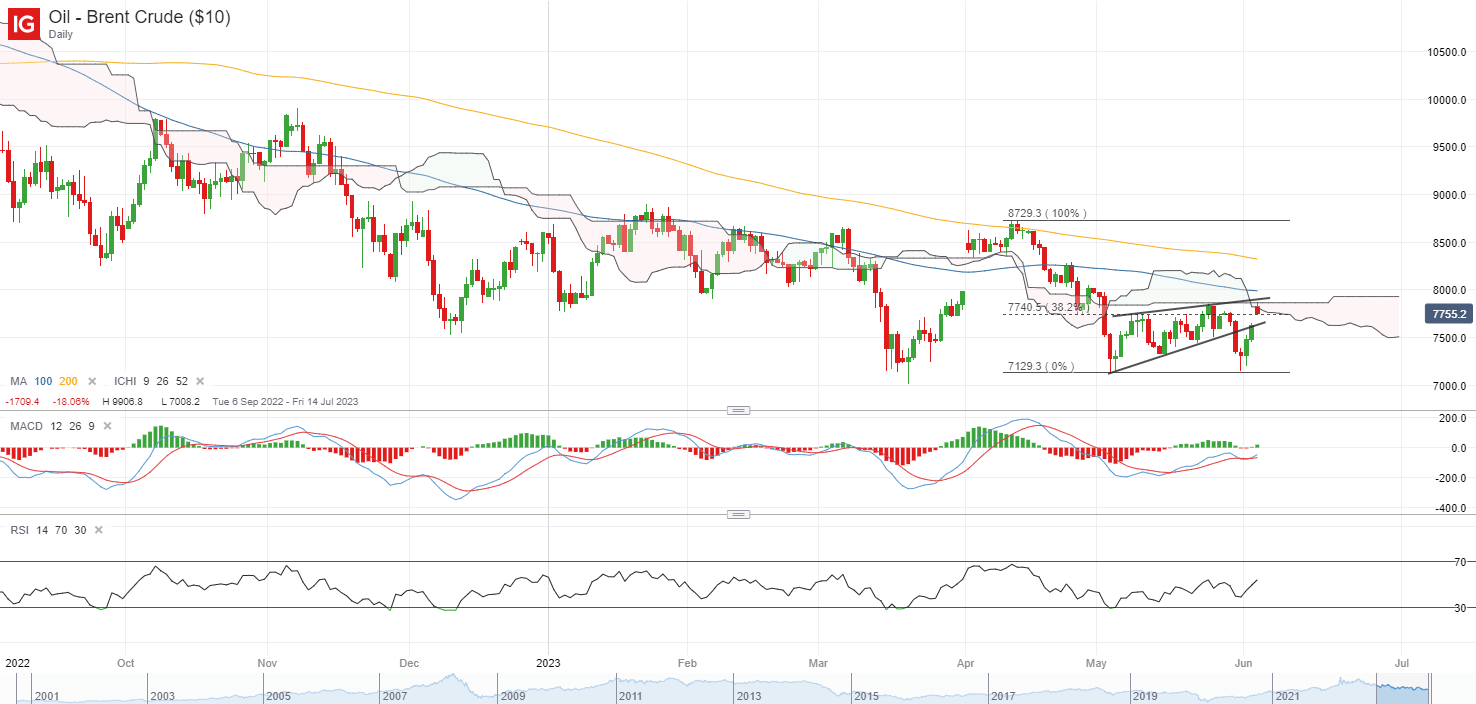
To see a more sustained upside in Brent crude prices, a series of resistance lies ahead to overcome. Prices are back to retest the US$78.60 level, where a near-term upward trendline stands alongside the Ichimoku cloud resistance. Greater conviction could have to come from a move back above the US$80.00 level in order to set the ground for a retest of its April 2023 high.
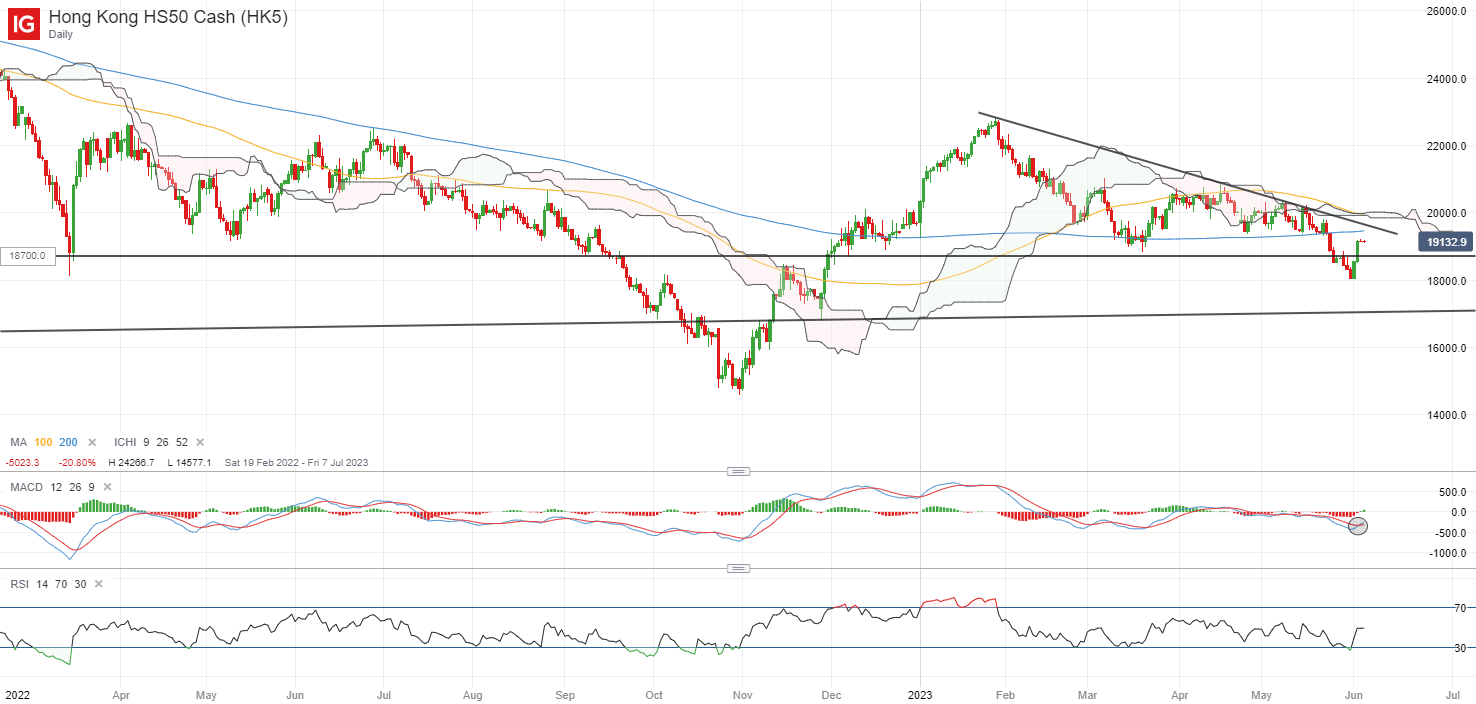
Asian stocks look set for a positive open, with Nikkei +1.30%, ASX +1.21% and KOSPI +0.60% at the time of writing, largely displaying a follow-through from Wall Street’s rally to end last week. The eye-catching performance could be the 4% gain in the Hang Seng Index last Friday, potentially reflecting some expectations for upcoming policy support following the downside surprises in economic data thus far. Further validation may have to be sought on that front, while the economic calendar today will bring the release of the Caixin services PMI data. Economic resilience may be the key to provide any follow-through in gains.
For the Hang Seng Index, a bullish crossover on moving average convergence/divergence (MACD) may provide some relief for the bulls in the near term, but a series of resistance still stand in the way ahead. This includes a downward trendline resistance since January this year and the key psychological 20,000 level, which coincides with the upper edge of the Ichimoku cloud on the weekly chart. These levels may need to be overcome to provide greater conviction of a more sustained upside.
US Treasury yields have found a broad-based move higher last Friday, following the stronger-than-expected US non-farm payroll figure which suggests that US interest rates could likely stay high for longer through the rest of the year. The two-year yields were up around 16 basis-points, with higher Treasury yields prompting gold prices to give back almost of its past week’s gains. The latest CFTC data has revealed further unwinding of net-long positioning among money managers for the third consecutive week, with potentially more room for moderation from previous bullish build-up if Treasury yields remain supported.
On the technical front, last week’s move has brought gold prices back to retest a key trendline support at the US$1,950 level. Any further move below its May 2023 low could mark a downward break of a key support confluence zone, where its 100-day moving average (MA) and Ichimoku cloud resides. That could pave the way to retest the US$1,875 level next.
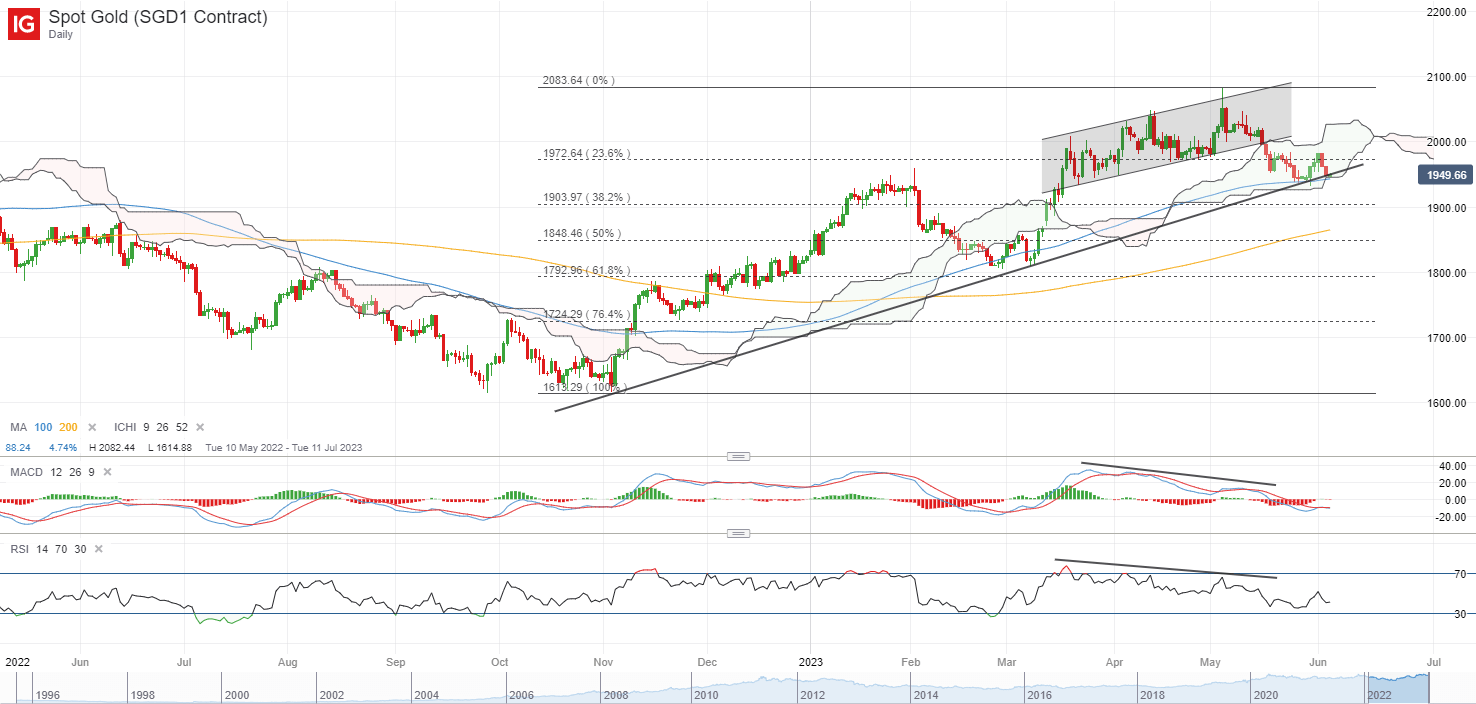
Source: IG charts
 Chat now!