Pound Sterling Holds Recovery against Euro, US Dollar but December GDP Slump to Undescore Poor Sentiment

Pound Sterling Holds Recovery against Euro, US Dollar but December GDP Slump to Undescore Poor Sentiment

The British Pound looked to defend a weekly advance against the Euro and Dollar as it was revealed the UK economy shrank by more than expected in December.

UK GDP declined 0.5% in December, which was deeper than the 0.3% decline the market was looking for.

The ONS said that overall the economy grew 0% in the final quarter of the year, meaning the UK has avoided a technical recession by a whisker. (A recession requires two consecutive quarters of decline, and the economy shrank 0.2% in the third quarter).

The data underscores the difficult position facing the UK economy which is widely expected to contract in 2023; expectations that continue to harm investor sentiment towards Pound Sterling.

“December’s 0.5% contraction in monthly GDP, which was worse than expected, can be largely blamed on either strikes (visible most clearly in transport and health, both of which shrank by close to 3% on the month) or, more bizarrely, a lack of Premier League football games in December due to the World Cup,” says James Smith, Developed Markets Economist at ING Bank.

Smith says the football ‘shortfall’ was enough to drive the recreation/entertainment category down almost 8%.

Nevertheless, the Pound has recovered over recent days amidst a technical unwind of the previous week’s sharp selloff and supportive global investor sentiment.

The Pound to Euro exchange rate has recovered a percent this week to trade at 1.1287 at the time of writing, the Pound to Dollar exchange rate is up 0.42% at 1.2105. Both exchange rates were boosted by softer U.S. data and communications from members of the Federal Reserve.

“The GBP managed to outperform the EUR and was generally better able to hold its ground vs the resurgent USD so far this week. We think that the recent moves in EUR/GBP reflect the correction of the significant overvaluation of the cross relative to its short-term fair value,” says Valentin Marinov, Head of G10 FX Strategy at Crédit Agricole.

Where the Pound ends the week could well depend on how markets behave and whether optimistic sentiment can extend, or is ultimately reversed.

A reversal would see the recent gains shaved from the Pound’s weekly tally.


Above: GBP/EUR (top) and GBP/USD showing this week’s recovery. Consider setting a free FX rate alert here to better time your payment requirements.

The soft UK GDP data was widely anticipated and could therefore be considered to be ‘in the price’ of the Pound at this juncture.

The domestic outlook nevertheless remains challenging and the economy would have suffered a recession were it not for a better-than-expected outturn in fourth-quarter private consumption which read at 0.1%, beating expectations for -0.1% and improving on the third quarter’s -1.1%.

Growth also came from business investment which increased by an impressive 4.8% in the quarter, recovering from -2.5% and beating expectations for -0.3%.

UK GDP


Growth of 0.3% in construction was meanwhile offset by a 0.2% fall in the production sector in the fourth quarter.

Looking at the year as a whole, UK GDP increased by an estimated 4.0% in 2022, following a 7.6% increase in 2021.

“Although a distinct chill descended in December, as bad weather, strikes and more painful price hikes blew in, the downturn wasn’t deep enough to push Britain into recession. There is still a chance the economy will still suffer two back-to-back quarters of negative growth this year, but the murky stretch of water ahead is set to be shallower and less lengthy than predicted in the Autumn when the country was also wracked with financial instability,” says Susannah Streeter, head of money and markets, Hargreaves Lansdown.

The Bank of England last week revised higher its growth projections for the economy, although it still foresees a lengthy, shallow recession ahead.

But the independent NIESR raised their forecasts this week and said the economy would likely avoid a recession.

Looking ahead, economists at Pantheon Macroeconomics expect UK GDP to decline by almost 1% between the fourth quarter and the second quarter of 2023.

Declines are expected to be a response to the tightening of both monetary and fiscal policy, which will squeeze households’ real disposable incomes further, spur businesses to cut employment and investment, and trigger a sharp decline in residential investment.

“Admittedly, the recent collapse in wholesale energy prices suggests that households’ real expenditure will be picking up in the second half of this year, dragging GDP up with it,” says Samuel Tombs,
Chief U.K. Economist at Pantheon Macroeconomics.

In 2023 as a whole, Pantheon Macroeconomics estimates GDP will be about 0.8% lower than 2022.

“With other countries facing less severe headwinds from monetary and fiscal policy, the U.K. probably will be alone among advanced economies in seeing GDP drop this year,” says Tombs.

Given that exchange rates are ultimately decided by the relative performance of economies, this view is therefore consistent with Pound Sterling underperformance in 2023.

ING’s Smith says recession remains his base case expectation, “especially if we include the contraction in the third quarter of last year. But this looks like it is going to be very mild by historical standards.”

Japanese yen jumps on report Kazuo Ueda will be next governor of the central bank

Japanese yen jumps on report Kazuo Ueda will be next governor of the central bank

The Japanese yen

weakened past 150 against the U.S. dollar Thursday, hitting a key psychological level that hasn’t been seen since August 1990.

The Bank of Japan’s two-day meeting is slated for next week. Policymakers have ruled out a rate hike in order to defend against further weakening of the currency.

On Thursday, Japan’s 10-year government debt yields

breached the 0.25% ceiling that the central bank vowed to defend – last standing at 0.252%. The yield on the 20-year bond also rose to its highest since September 2015.

The Bank of Japan also announced emergency bond-buying operations Thursday. It offered to buy 100 billion yen ($666.98 million) worth of Japanese government bonds with maturities of 10-20 years and another tranche worth 100 billion yen with maturities of 5-10 years.

The central bank has repeatedly vowed to buy an unlimited amount of bonds at a fixed rate in order to cap 10-year government debt yields at 0.25% as part of its stimulus measures for the economy.

On Thursday, Reuters reported Japanese Finance Minister Shunichi Suzuki said the government will take “appropriate steps against excess volatility.”

“Recent rapid and one-sided yen declines are undesirable. We absolutely cannot tolerate excessively volatile moves driven by speculative trading,” he said.

Levels ‘not destabilizing’

When asked how concerning is USD/JPY reaching levels around 150, ANZ chief economist Richard Yetsenga said he’s “not that worried.”

“I don’t think we’re into destabilizing currency territory yet,” he said on CNBC’s “Squawk Box Asia.”

“There’s lots of emotive words around it, but what problems has it engendered?” he said.

Shortly after the Bank of Japan’s latest decision to maintain low interest rates to support the country’s sluggish economy last month, officials confirmed they intervened to support the currency against further weakening.

That intervention briefly pushed the yen to 142 against the dollar. The spread between the highest and lowest points intraday was also at its widest since 2016.

In April 1990, the yen traded around 159.8 against the dollar and last breached 160 in December 1986.

China welcomes US treasury secretary’s willingness to visit China

China welcomes US treasury secretary’s willingness to visit China

China welcomes U.S. Treasury Secretary Janet Yellen’s willingness to visit the country, a spokesperson of the Ministry of Commerce said on Thursday.

Spokesperson Shu Jueting made the remarks at a press conference when commenting on media reports that Yellen has recently said she still hopes to visit China.

It is very important that the two sides maintain normal communications, Shu said, noting that Chinese Vice Premier Liu He held constructive talks with Yellen over half a day in Switzerland last month.

When answering questions on the Biden administration’s move to stop providing U.S. companies with licences to export to Huawei, Shu said China has always opposed the United States’ generalization of the concept of national security to impose unreasonable sanctions on and suppress Chinese companies in violation of market economy and international trade rules.

Such moves jeopardized global technological innovation and industrial and supply chain stability, said the spokesperson, adding that China will resolutely defend the legitimate rights and interests of Chinese companies.

Regarding the U.S. release of its “notorious markets” list, Shu said such a move is highly unprofessional and irresponsible, and China is firmly opposed to it.

She said the Chinese government attaches great importance to the protection of intellectual property rights, and is constantly improving its legislative system, improving the efficiency of law enforcement, guiding industry self-discipline, and resolutely punishing infringements in accordance with the law.

“China is willing to continue strengthening cooperation with other countries on the protection of intellectual property rights, and help create a fair business environment for global companies,” Shu said.

China Jan new bank loans jump more than expected to record 4.9 trln yuan

China Jan new bank loans jump more than expected to record 4.9 trln yuan

BEIJING, Feb 10 (Reuters) – New bank loans in China jumped more than expected to a record 4.9 trillion yuan ($720.21 billion) in January as the central bank looks to kickstart a recovery in the world’s second-biggest economy after the lifting of harsh pandemic controls.

A strong rebound in credit demand will be essential for an economic revival this year after harsh COVID measures and a crisis in the property sector dragged China’s growth down to 3% in 2022, one of its worst rates in nearly half a century.

January’s new loans more than tripled December’s tally and exceeded analysts’ expectations, according to data released by the People’s Bank of China (PBOC) on Friday.

Analysts polled by Reuters had predicted new yuan loans would jump to 4 trillion yuan in January, from 1.4 trillion yuan in December and above the previous monthly record of 3.98 trillion yuan in January 2022.

Chinese banks tend to issue more loans at the beginning of the year to gain higher-quality customers and win market share, but the size of the increase spurred hopes that business and consumer confidence is improving rapidly after the anti-COVID curbs were suddenly lifted in December.

“China’s credit data came in stronger than expected, suggesting that the credit support remains strong at the beginning of the year,” Zhou Hao, chief economist at Guotai Junan International, said in a note.

“Overall, this is a positive credit report, and is likely to help the economy to rebound significantly in the first quarter of 2023. The next focus for the markets will be property sales, which are highly correlated to bank credit.”

USDCAD’s upside could be tested

USDCAD’s upside could be tested

USDCAD has been on the sidelines this week, constrained between the familiar 1.3450 resistance and key upward-sloping line from August 2021 at 1.3400.The technical picture is leaning softly to the bullish side as the RSI is flattening slightly above its 50 neutral mark. Meanwhile, the MACD is gradually recovering above its red signal line but within the negative zone, while the Stochastic oscillator has already reached its 80 overbought level, reflecting fading upside pressures ahead of the Canadian employment report.

Nevertheless, sentiment will remain jittery if the pair continues to face limitations around the 23.6% Fibonacci retracement of the 1.2006-1.3976 upleg at 1.3511. The tentative resistance trendline from October’s top of 1.3976 is cementing that ceiling. Hence, a clear close above that wall would attract buyers’ attention, likely lifting the price straight to the 1.3600 number. Then, another victory here may prompt an extension towards the 1.3700-1.3745 boundary.

In the event of a downside reversal, the bears will fight for a break below the 1.3400 floor and the 20-day simple moving average (SMA) with scope to reach the support trendline from June’s low at 1.3330. Slightly lower, the 200-day SMA could immediately calm selling tendencies near the 38.2% Fibonacci of 1.3223. If it fails, the decline may pick up steam towards the 1.3130 handle.

Summing up, USDCAD is maintaining a neutral short- and medium-term outlook. A decisive close above 1.3511 or below 1.3330 could navigate the market accordingly.

UK economy narrowly avoids recession despite December hit from strikes

UK economy narrowly avoids recession despite December hit from strikes

A negative figure would have met the technical definition of a recession because the economy contracted over the previous three months to September as the cost of living crisis took a heavy toll on consumer spending.

Economic activity has stalled largely as a result of energy-led price pressures on households and businesses – with the Bank of England even predicting in November last year that the economy was already likely in recession.

The narrow miss, which is subject to revision by the ONS when more data becomes available, reflects an economy that is stagnating at best in the face of a continuing squeeze on spending power.

Output in December fell by 0.5% compared to the previous month, the ONS said, with contributions to the decline also coming from some early winter snow disruption and strikes including the Royal Mail dispute.

Businesses had reported a drop in orders due to delivery uncertainties across the month.

The report also pointed to a negative impact from the World Cup, having credited strong bar sales for lifting output during November.

ONS director of economic statistics, Darren Morgan, said of the performance: “The economy contracted sharply in December meaning, overall, there was no growth in the economy over the last three months of 2022.

“In December public services were hit by fewer operations and GP visits, partly due to the impact of strikes, as well as notably lower school attendance.

“Meanwhile, the break in Premier League football for the World Cup and postal strikes also caused a slowdown.

“However, these falls were partially offset by a strong month for lawyers, growth in car sales and the cold snap increasing energy generation.

“Despite recent squeezes in household incomes, restaurants, bars and travel agents had a strong year. Meanwhile, health and education also began to recover from the effects of the pandemic”.

Economists widely believe that recession during the first half of this year is inevitable, with the International Monetary Fund predicting last month that the UK would be the worst performer in the developed world including sanctions-hit Russia.

However, others have argued that a recession could be avoided despite continued pressure on budgets from inflation.

The government’s critics are urging the chancellor to use his spring budget next month to boost activity, accusing him of taking a miserly approach to the public finances.

Jeremy Hunt said in response to the ONS figures: “The fact the UK was the fastest growing economy in the G7 last year, as well as avoiding a recession, shows our economy is more resilient than many feared.

“However, we are not out of the woods yet, particularly when it comes to inflation.

“If we stick to our plan to halve inflation this year, we can be confident of having amongst the best prospects for growth of anywhere in Europe.”

Gold Prices Held Hostage by Fed Expectations – What Next for XAU?

Gold Prices Held Hostage by Fed Expectations – What Next for XAU?

Gold futures have struggled to recover from last week’s declines which drove XAU/USD below $1900. After climbing to a nine-month high of $1975.2 last week, the release of strong US economic data and a break of trendline support ended the three-month rally that has been driving the recovery from the October low of $1618.3.

Visit DailyFX education to learn more about gold trading and factors influencing gold prices

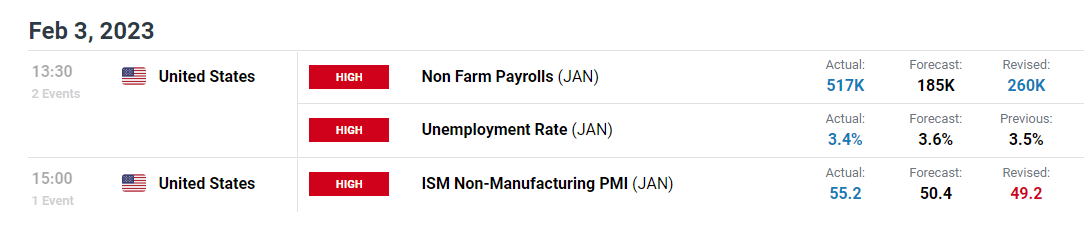
In response to the robust job data and positive ISM figures, recession fears were overshadowed by prospects of further rate hikes. As the 22% rally from the October lows fizzled out, both technical and fundamental factors contributed to Gold’s decline.

DailyFX Economic Calendar

Although gold and silver are safe-haven assets that are often used as a hedge against inflation, the non-yielding commodities are sensitive to rising interest rates.

After the Federal Reserve announced a softer 25 basis-point rate hike at the FOMC meeting earlier this month (1 Feb), gold prices temporarily surged before peaking at $1975.2. With investors interpreting the slower rate hike as a sign that the Fed could continue to slow down the pace of tightening, the announcement did not catch markets off-guard.

Trading Forex News: The Strategy

Trading Forex News: The Strategy
Recommended by Tammy Da Costa
Trading Forex News: The Strategy
Get My Guide

Gold (XAU/USD) Technical Analysis

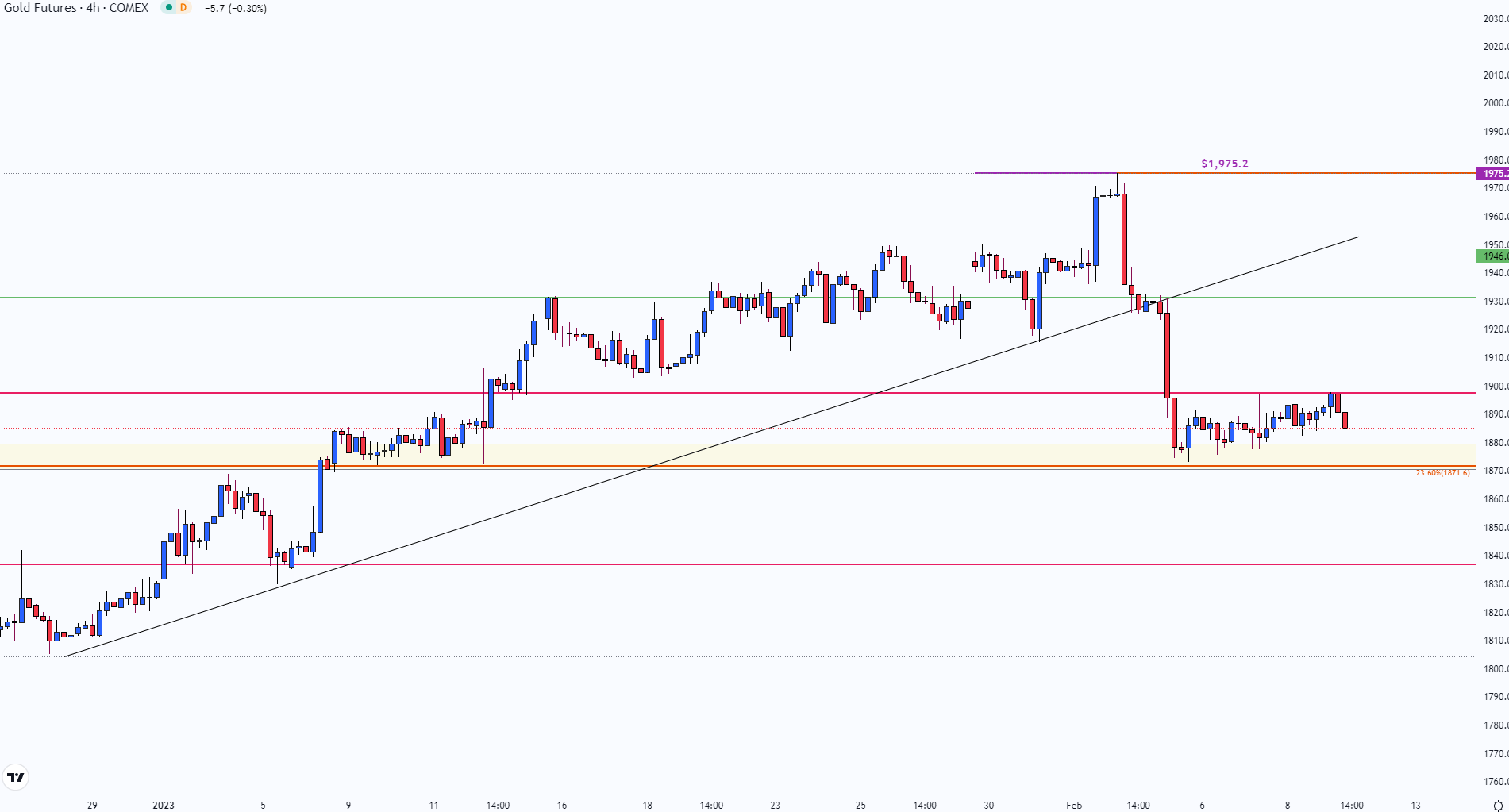
Since market participants had already priced in a 99% probability of a 25-basis point rate hike, gold’s upside was limited. As gold futures rose above the March 4th 2022 high of $1974.9, a series of doji candles appeared on the four-hour chart, indicative of indecision.

With the 24 February 2022 (the onset of the war in Ukraine) high holding at $1976.5, the firm barrier of resistance held firm, allowing bulls to go no further than $1975.2.

Gold (XAU/USD) four-hour chart

Chart, histogram  Description automatically generated

Chart prepared by Tammy Da Costa using TradingView

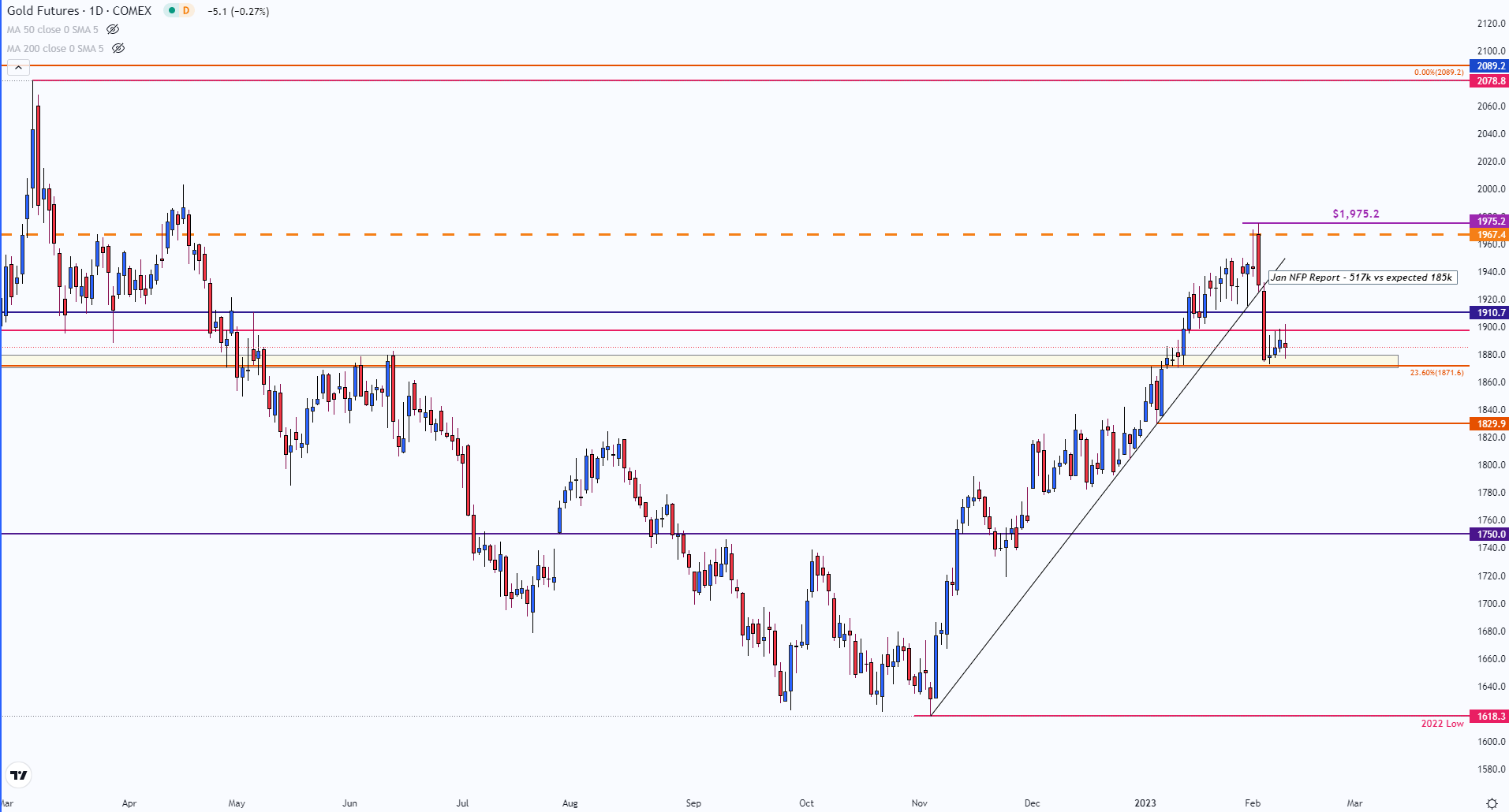
As sellers forced prices lower, a break of prior trendline support (from the October low) drove XAU/USD back below $1930. Then, there was the release of the US NFP report which came in well-above estimates. With 517,000 jobs being added to the US economy in January, Gold prices continued to decline before stabilizing around $1880.

Gold Daily Chart

Graphical user interface, chart, line chart  Description automatically generated

Chart prepared by Tammy Da Costa using TradingView

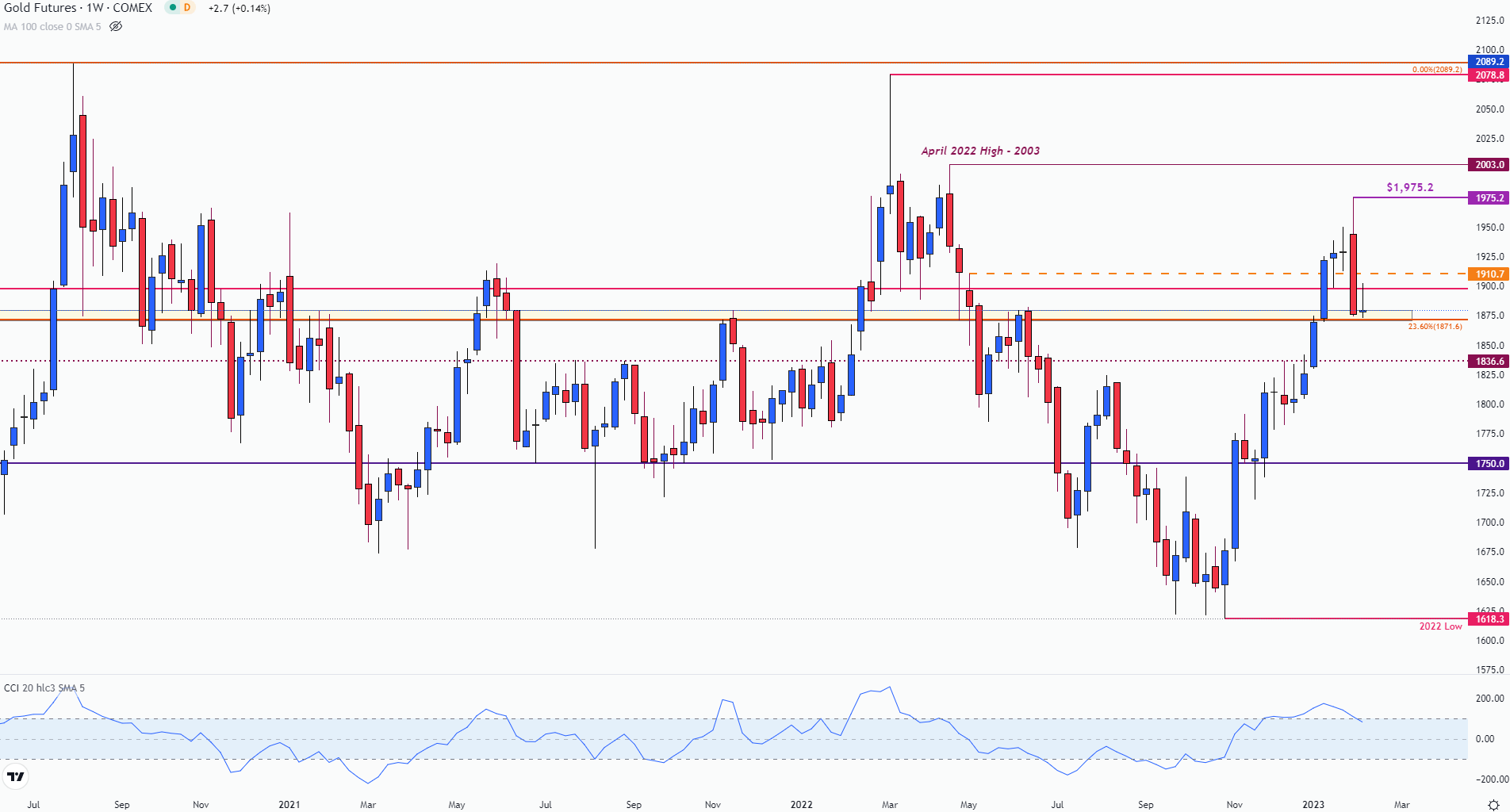
On the weekly chart below, a rejection of the upper wick at the current monthly high was accompanied by a sharp pullback and a retest of $1873.2. Simultaneously, the weekly CCI (commodity channel index) eased back from overbought territory suggesting that bulls had run out of steam. With the current weekly candle showing little movement, a tight range has formed between $1873 and $1880.

Gold (XAU/USD) Weekly Chart

Chart, bar chart, histogram  Description automatically generated

Chart prepared by Tammy Da Costa using TradingView

Just below that, the 23.6% Fibonacci of the 2018 – 2020 move has formed an additional zone of support at $1871.6. If prices fall below this level, prices could continue to decline, towards the next support target of $1836.6.

Gold Prices Sink as US Dollar Rallies on Fading Fed Pivot Bets, Where to?

Gold Prices Sink as US Dollar Rallies on Fading Fed Pivot Bets, Where to?

Asia-Pacific Market Briefing – Gold Prices Sink as Treasury Yields Climb

Gold prices sank 0.77% on Thursday which was the worst single-day performance in almost one week. The yellow metal sank as the US Dollar and front-end Treasury yields climbed during the Wall Street trading session. XAU/USD tends to function as the anti-fiat trading instrument in financial markets. That is because of its lack of yield when holding the precious metal outside of expected returns.

XAU turned lower following a couple of notable events. The first is that we had commentary from Federal Reserve Bank of Richmond President Thomas Barkin. He said that it is important to continue tightening to rein in inflation. We also had weekly US jobless claims cross the wires. While the 196k outcome was higher than the 190k estimate, it remains historically low.

All this continues to pour cold water on market expectations that the central bank will pivot to interest cuts later this year. This follows last week’s non-farm payrolls report blowout, which underscored a relatively tight labor market that might be able to withstand the most aggressive tightening in decades. Since then, the markets have been pricing rate hikes back in.

Friday’s Asia-Pacific trading session is notably quiet in terms of economic data. That may continue allowing general risk appetite to set the tone for markets. If bond yields and the US Dollar continue climbing, this may pressure gold prices heading into the University of Michigan sentiment data later today. A higher-than-expected print would likely further compound this dynamic.

Gold Technical Analysis

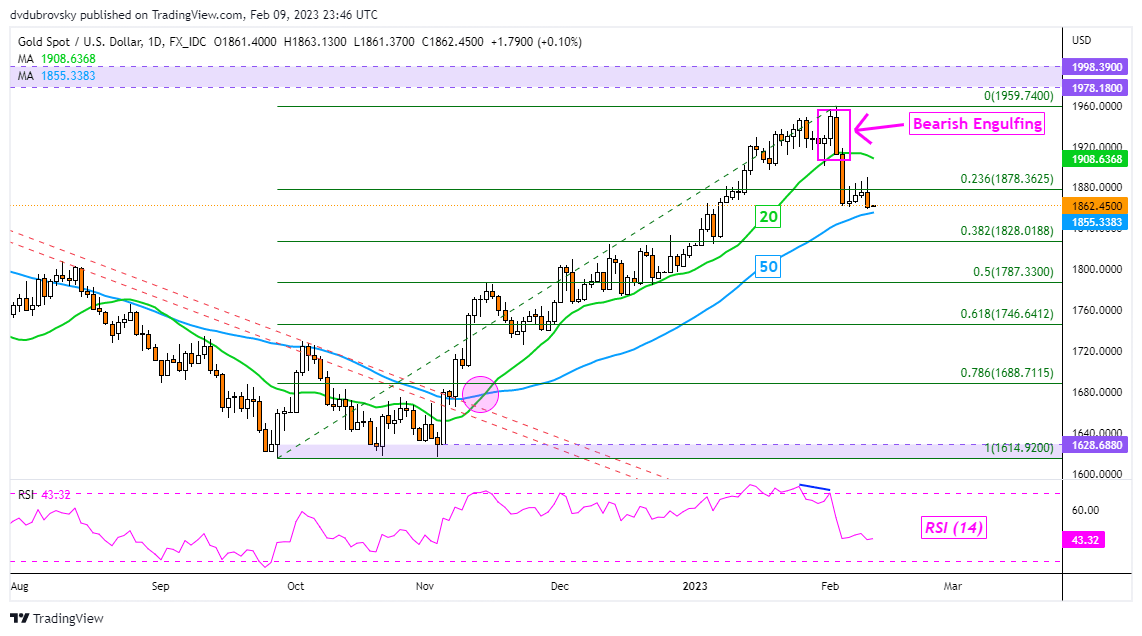
On the daily chart, gold has closed at its lowest since January 6th, just barely taking out lows from earlier this week. Still, prices remain above the 50-day Simple Moving Average (SMA). The latter may hold as support, maintaining the upside focus. That would undermine the Bearish Engulfing from earlier this month. Otherwise, extending lower would increasingly offer a bearish posture.

XAU/USD Daily Chart

XAU/USD Daily Chart

Swedish Krona Bolts Higher, Norwegian Krone Follows. Where to for EUR/SEK and EUR/NOK?

Swedish Krona Bolts Higher, Norwegian Krone Follows. Where to for EUR/SEK and EUR/NOK?

The Swedish Krone piled on a staggering rally in the aftermath of the Riksbank lifting its target rate to 3.0% from 2.5% and paved the way for further tightening of monetary policy.

Before the meeting, the market had been leaning toward a pause in the hiking cycle, but it signalled that it is now looking at more rate rises at the next meeting in April and beyond.

The bank said that inflation remains too high. CPI year-on-year to the end of December was 12.3%. In addition, PPI is running rampant, coming in at 18.7% for the same period.

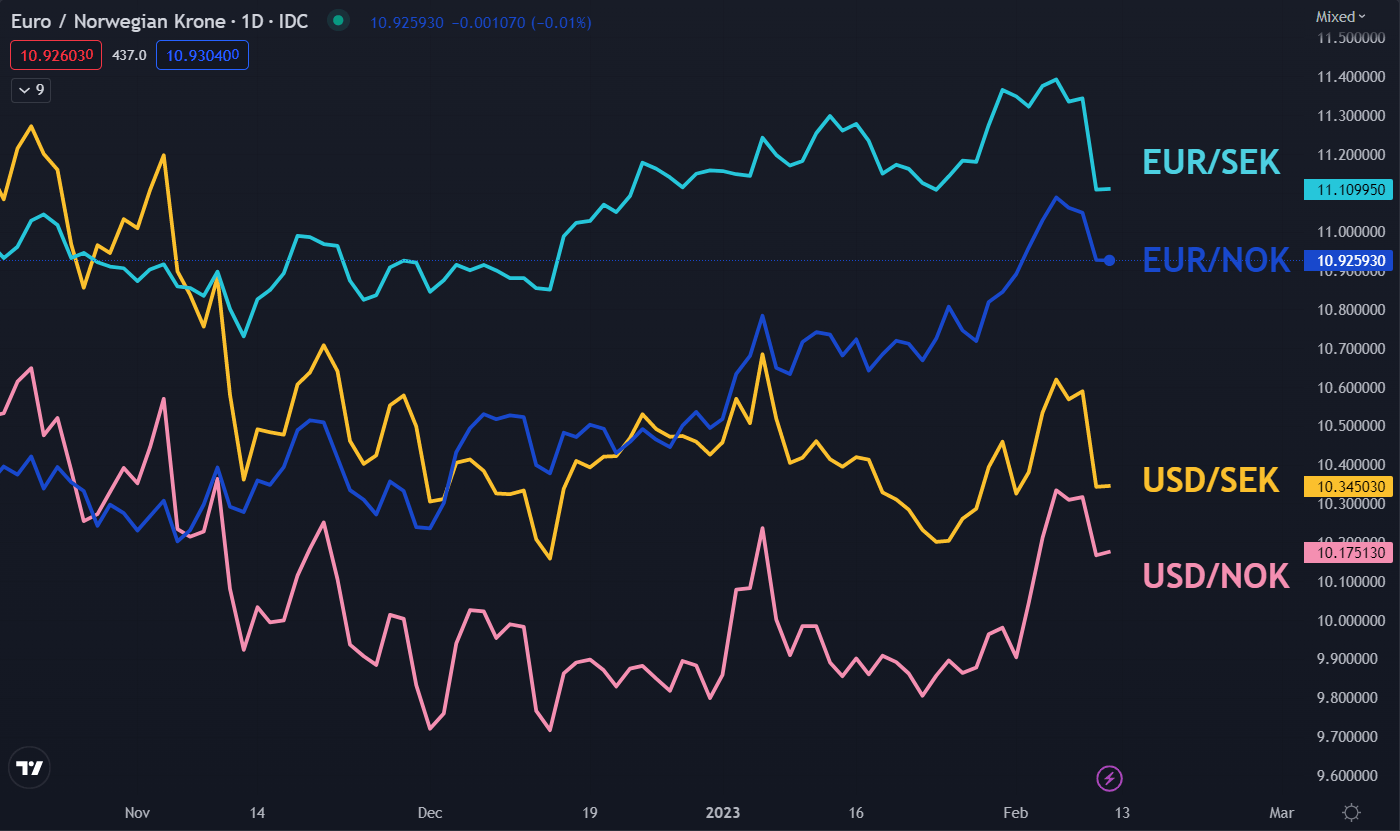
USD/SEK hit an all-time high last October at 11.4964 but SEK has since recovered around 10%. However, EUR/SEK was at a 13-year high of 11.4425 on Monday and the bank acknowledged the problem of a weakening domestic currency that can lead to importing inflation.

Although the hike had mostly been anticipated, the world’s oldest central bank (founded in 1668) also announced that it would pick up the pace of reducing its asset holdings.

They will continue to sell government bonds from their stockpiles. The action is essentially a quantitative tightening (QT).

The re-acceleration of tightening comes after the European Central Bank (ECB) also re-asserted its effort to rein in inflation with a 50 bp lift in its target rate last week. They also signalled that similar size moves could be forthcoming at future meetings.

Not to be left out, neighbouring Norway saw their currency go for a gallop with EUR/NOK sliding away from the 27-month high seen earlier in the week.

Norges bank left rates unchanged at 2.75% at their January meeting and don’t gather again until late March. They do not face the same inflation problem that Sweden and the Euro-zone are staring at.

The NOK is more prone to sways in global sentiment due to its massive supply of energy. Crude oil prices eased overnight after recovering from a 2-month low through the early part of this week.

Globally, it appears that the race is on in many countries to get the inflation genie back in the bottle. The central bank’s policy adjustments may play a large role in currency movements going forward

EUR/SEK, USD/SEK, EURNOK, USD/NOK

image1.png