US Economic Update: 2022 Q4 GDP looks solid but weakness emerging

US Economic Update: 2022 Q4 GDP looks solid but weakness emerging

In our December update we noted that early data for Q4 was looking positive but that net trade was looming (again) as a large swing factor, this time in a negative direction. However, a plunge in goods imports in November (-7.4% m/m), even after allowing for another large fall in exports (-2.6%m/m), suggests that the net trade detraction will be much smaller than previously expected. As a result, we have substantially revised up our estimate for Q4 GDP to 2.7% q/q annualised (1.1% q/q previously). The BEA also revised up its estimate of growth in Q3 from 2.9% q/q to 3.2% q/q annualised.

UK business chief urges green growth to boost economy as forecast warns of deeper recession

UK business chief urges green growth to boost economy as forecast warns of deeper recession

Chief executive of the Confederation of British Industry (CBI) will use a speech on Monday afternoon to demand the chancellor reverses “the UK’s trajectory” of falling investment through a series of actions, with a focus on green growth.

Tony Danker will argue that the country is lagging behind international rivals in the sphere – and that Jeremy Hunt’s looming spring budget provides an opportunity for government to help business achieve it.

This could be done in areas including reform of the consent process for green infrastructure.

He is also seeking new regulation to stimulate domestic demand for green technologies.

Mr Danker was due too to complain about huge uncertainties for UK firms over the Retained EU Law Bill, which says that at the end of this year all retained EU law in the UK expires.

A permanent successor to the super deduction tax that ends in April is needed to prevent the UK from dropping from fifth to 30th place among the 38 Organisation for Economic Co-operation and Development (OECD) advanced economies for capital investment, Mr Danker was also expected to say.

“The PM set out less than a year ago what is needed to transform our economy. The ideas are there. Let’s stop second guessing ourselves and get on because there is money on the table to capture right now.”

Mr Danker’s remarks chime with warnings that the UK economy, which could yet be in recession, may see a deeper downturn than initially expected.

It added that the following two years were also the subject of a downgrade due, partly, to less government support and higher taxes.

The predicted performance for 2023 was far worse than the 0.3% dip it had expected just three months ago.

The recession was not tipped to last longer than beyond the first half of this year.

Official figures are yet to show whether the UK fell into recession during the second half of 2022.

“The UK’s economic outlook has become gloomier than forecast in the autumn, and the UK may already be in what has been one of the mostly widely anticipated recessions in living memory,” said EY’s UK chair Hywel Ball.

He added: “The economy is still expected to return to growth during the second half of 2023 and has been spared any significant new external shocks in the last three months from energy prices, Covid-19 or geopolitics.

“Meanwhile, the chief headwind to activity over the last year – high and rising inflation – may be starting to retreat, while energy prices are falling too.”

AUD/USD Forecast: Higher Australian Inflation Expectations Keep Aussie Bid

AUD/USD Forecast: Higher Australian Inflation Expectations Keep Aussie Bid

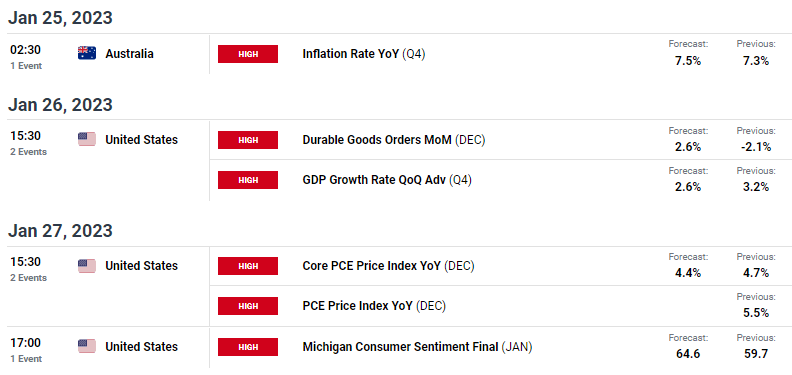
The pro-growth Australian dollar did not react to rising COVID death statistics released on Saturday by the Chinese Centre for Disease Control and Prevention showing markets focus on the upcoming Australian CPI report on Wednesday and a weaker USD – see economic calendar below. Estimates point to a 0.2% increase from the prior read and could throw a spanner in the works considering the Australian economy could be pushed into a recession should the Reserve Bank of Australia (RBA) hike rates again. Taking into account softening housing prices and lower consumer demand, another hike will hurt and already wounded Australian consumer. The week rounds off with high impact U.S. data which should shift AUD/USD price movement over to dollar-based factors.

ECONOMIC CALENDAR

image1.png

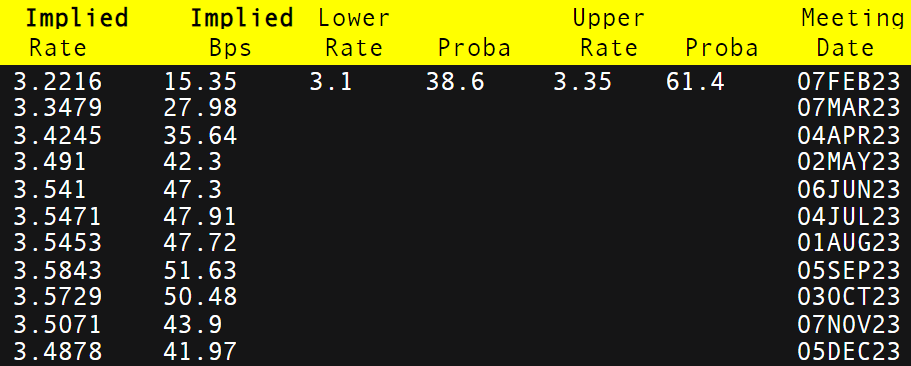
The RBA has not ruled out another interest rate hike for the February meeting as mentioned in their previous minutes and with money market (refer to table below) pricing divided between no change and a 25bps increment, Wednesday’s inflation print could result in more clarity. On a positive note for the Aussie dollar, commodity prices are projected to remain elevated throughout 2023 largely based on a China re-opening and coal exports to European countries who now look to hedge their exposure to Russian energy sources.

RBA INTEREST RATE PROBABILITIES

image2.png

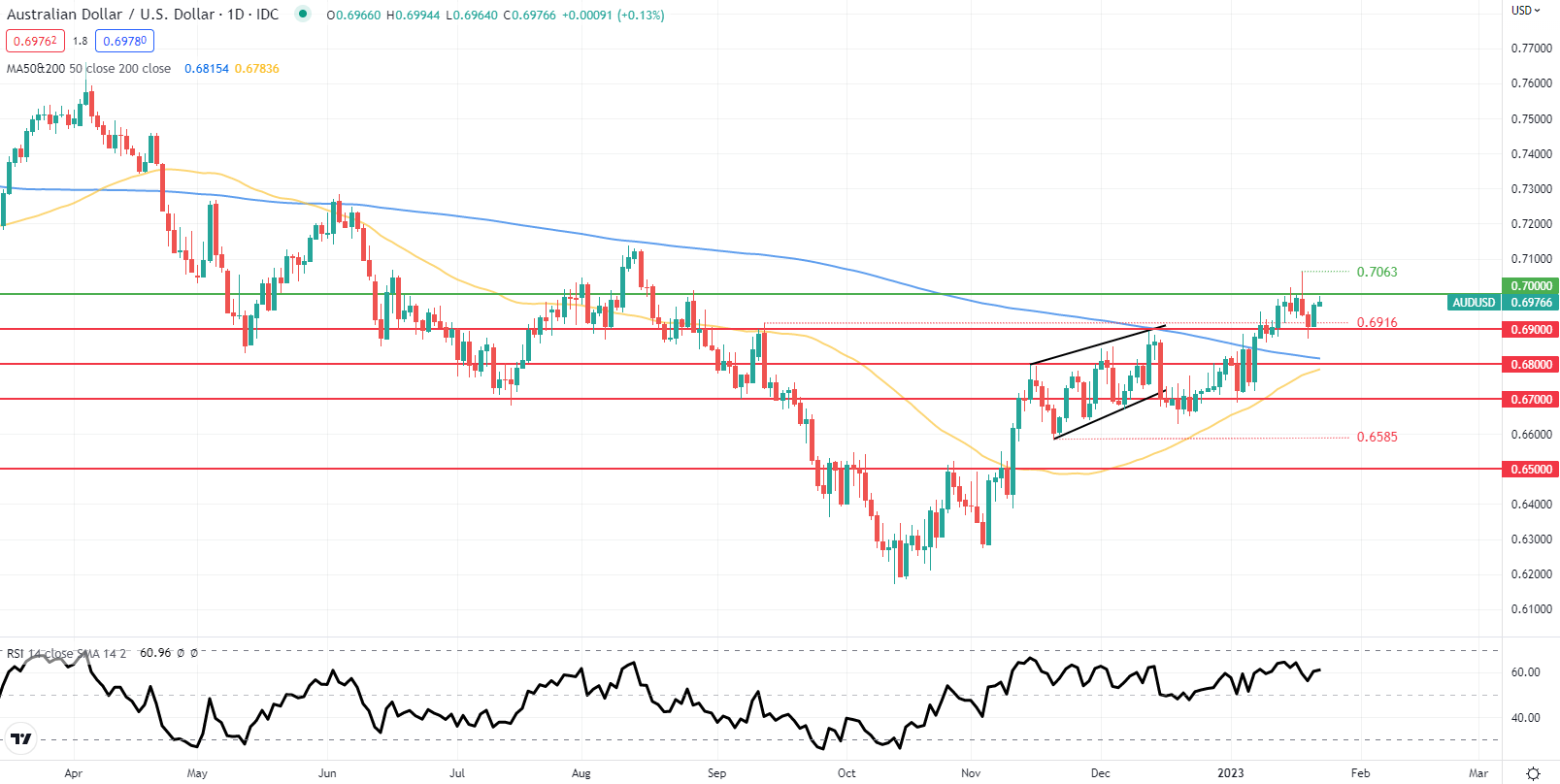
TECHNICAL ANALYSIS

IAUD/USD DAILY CHART

image3.png


Crude-Oil

Natural Gas Prices Week Ahead: Downside Remains in Focus After Head & Shoulders

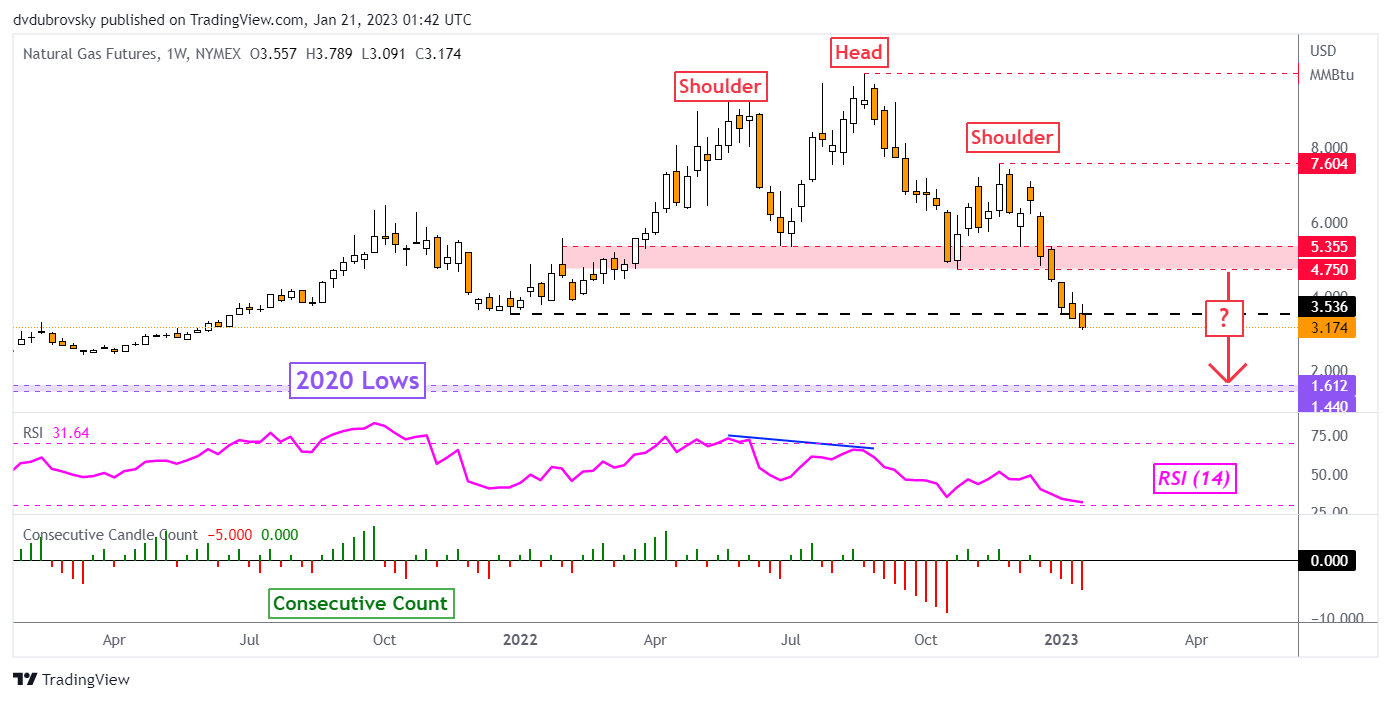
Natural gas futures fell 7.17% this past week, in line with a recent string of losses since the middle of December. The commodity declined for a fifth consecutive week, marking the longest losing streak since the middle of September. What is the road ahead looking like for natural gas this week?

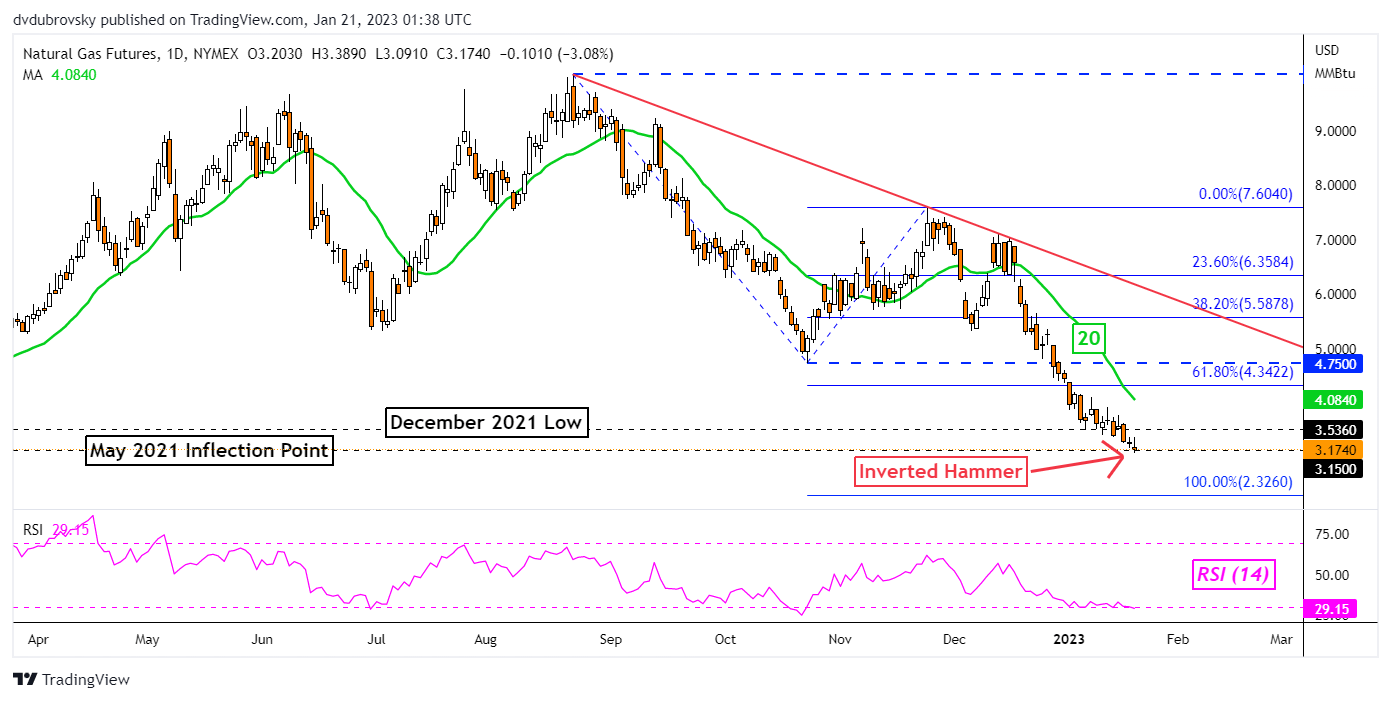
From a technical standpoint, there was a notable confirmatory downside breakout under the December 2021 low at 3.536. That has opened the door to resuming the dominant downtrend since August 2022, exposing the 2020 low at 1.44.

Moreover, prices continue trading downward in the direction anticipated by a Bearish Head and Shoulders chart formation. The estimated trajectory of this chart formation may eventually take prices down to the 1.44 – 1.61 support zone.

Weekly Chart – Fifth Consecutive Week of Losses Underscores Downtrend

Daily Chart – Inverted Hammer in Focus

On the daily setting, prices confirmed a breakout under 3.5536, bringing natural gas towards the May 2021 inflection point at 3.15. However, prices were unable to close under the latter last week, reinforcing it as immediate support.

An Inverted Hammer candlestick pattern was left behind as well. While this is not necessarily an early indication of a reversal, it would be worth paying attention to see if prices bounce in the coming session. That would confirm the Inverted Hammer.

Such an outcome would place the focus on the 20-day Simple Moving Average (SMA). It could hold as key resistance, maintaining the downside focus. Otherwise, confirming a breakout under 3.15 exposes the 100% Fibonacci extension level at 2.326 towards the 2020 low.

Daily Chart – Inverted Hammer in Focus

The Most Volatile Currency Pairs and How to Trade Them

The Most Volatile Currency Pairs and How to Trade Them

Forex markets are susceptible to a range of factors which affect their volatility, and many traders look to tailor their strategies to capitalize on the most volatile currency pairs.

Currency volatility, often measured by calculating the standard deviation or variance of currency price movements, gives traders an idea of how much a currency might move relative to its average over a given time period. Traders can also gauge volatility by looking at a currency pair’s average true range or by looking at range as percent of spot.

The higher the level of currency volatility, the higher the degree of risk, and vice versa. Volatility and risk are usually used as interchangeable terms.Different currency pairs have different levels of volatility on average.

Some traders enjoy the higher potential rewards that come with trading volatile currency pairs. Although, this increased potential reward does present a greater risk, so traders should consider reducing their position sizes when trading highly volatile currency pairs.

What are the most volatile currency pairs?

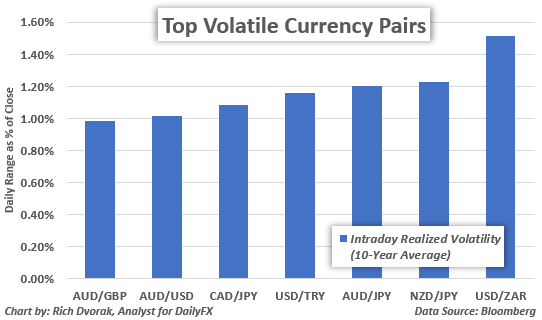
The most volatile major currency pairs are:

Most Volatile Currency Pairs

Other major currency pairs, like EUR/USD, USD/JPY, GBP/USD and USD/CHF, are generally more liquid and less volatile as a result. That said, emerging market currency pairs, such as USD/ZAR, USD/TRY and USD/MXN, can clock some of the highest volatility readings.

MOST VOLATILE CURRENCY PAIRS

Majors – AUD/JPY, NZD/JPY, AUD/USD, CAD/JPY, GBP/AUD

Emerging Markets – USD/ZAR, USD/TRY, USD/MXN

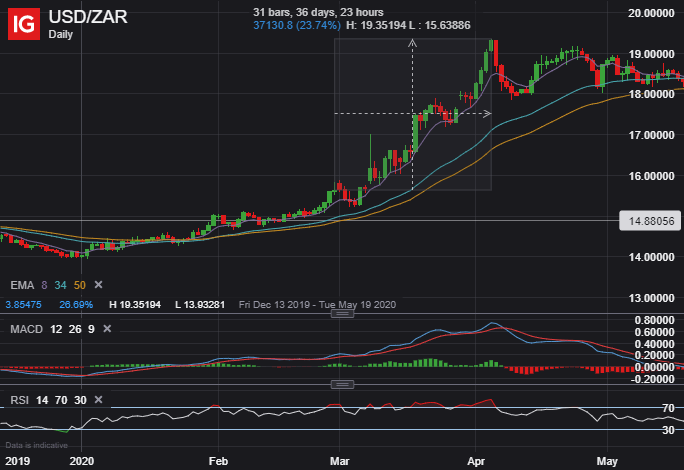
Aside from relatively low liquidity, emerging market currencies tend to be highly volatile in particular due to inherent risk underpinning emerging market economies. The chart below gives an example of how volatile emerging market currencies can be, which shows USD/ZAR (US Dollar/South Africa Rand) exploding nearly 25% higher in just over a month’s time. There are several other examples of emerging market currency pairs swinging drastically like this throughout history.

USDZAR Daily Price Chart

What about the least volatile currency pairs?

The least volatile currency pairs tend to be the major currency pairs which are also the most liquid. Also, these economies tend to be larger and more developed. This attracts more trading volume and facilitates greater price stability in turn. To that end, considering EUR/USD, USD/CHF and EUR/GBP trade with high volumes of liquidity, it comes as little surprise they are among the lease volatile currency pairs.

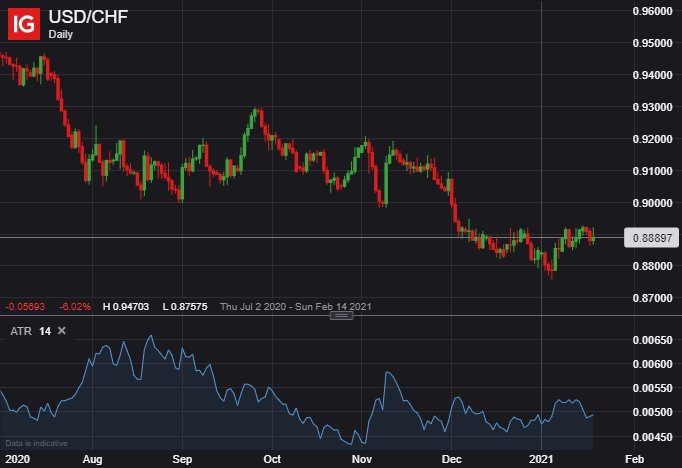
Illustrated below, the average true range (ATR) on USD/CHF ranges between 45-pips and 65-pips, a low average true range compared to other pairs. The average true range of a currency is one of the many ways to measure the volatility of a currency pair. Bollinger Band width is another popular technical indicator used to measure volatility.

USDCHF Daily Price Chart

Correlation between two currencies can also have an impact on their volatility. The more positively two currencies are correlated to one another might lead to less volatility. Continuing with our USD/CHF example, we note that the US Dollar and Swiss Franc are both viewed as safe-haven currencies.

The US Dollar and Swiss Franc tend to strengthen against their sentiment-linked peers when the market experiences episodes of risk aversion, but the two currencies may not deviate much from each other. This contributes to relatively low volatility readings for USD/CHF.

How to trade currency pair volatility

Forex traders should take into account current readings of volatility and potential changes in volatility when trading. Market participants should also consider adjusting their position sizes with respect to how volatile a currency pair is. Trading a volatile currency pair might warrant a reduced position size.

Awareness of volatility can also help traders determine appropriate levels for stop loss and take profit limit orders. Furthermore, it is important to understand the key characteristics separating themost volatile currencies from currencies with low volatility readings. Traders should also know how to measure volatility and have an awareness of events that might create big changes in volatility.

The difference between trading currency pairs with high volatility versus low volatility

  1. Currencies with high volatility will normally move more pips over a certain period than currencies with low volatility. This leads to increased risk when trading currency pairs with high volatility.
  2. Currencies with high volatility are more prone to slippage than currency pairs with low volatility.
  3. Due to high-volatility currency pairs making bigger moves, you should determine the correct position size to take when trading them.

There are several ways to measure volatility

To determine the correct position size, traders need to have an expectation of how volatile a currency can be. A variety of indicators can be used to measure volatility like:

Traders can also look at implied volatility readings, which reflect the level of expected volatility derived from options.

Trading Economic Data Means Looking Past the Numbers

Trading Economic Data Means Looking Past the Numbers

Economic Data, Foreign Exchange Trading, Central Banks – Talking Points

The foreign exchange market’s reaction to economic data is one of the most important subjects for traders to consider, but also one of the most vexed.

The monthly round of official and private releases from around the world covers everything from inflation and employment to the forward-looking views of corporate purchasing managers. Together with central bank pronouncements, it forms what we might call the framework of foreign exchange trading.

Major Economic Releases Can Dominate Trade

Markets may well hunker down, losing both volume and volatility, in the run-up to an eagerly anticipated number. Official US labor market statistics are perhaps the most obvious example here. When the trading community expects serious gains or crushing losses the session can be subdued from Asia’s open and right across Europe as participants nurse suspicions or hopes. Even when the market expects neither many traders will – in financial journalism’s enervating cliché – “wait and see.”

This makes sense of course, enervating or not. Obviously, there’s a link between the economic performance of a country with a freely floating currency and the performance of that currency against its peers. At the most basic level a strong piece of economic data will boost a currency, a weaker one will tend to see it fall.

However, to take the matter no further would be a grave error. For one thing, individual pieces economic data tend to influence currencies in a very fleeting way. The gains provided by even a blockbuster, expectation-shattering number can be undone by the end of a day’s session, and well before that in some cases. It may even mean no more than a few minutes’ spike one way or another.

So, there’s clearly more to know about data and its effects.

The first and perhaps most important thing is that, while data provide the rhythm, the world moves to a monetarist cadence and central banks will always play lead. So, ultimately, the longer-term effects any piece of economic news must be considered with a view to how it might change monetary policy. No single data release is ever likely to do that, and markets would have caused to worry if it did. Central banks like to be ahead of the numbers, ready to tighten or loosen policy as needed before trends turn.

Therefore, we might see the markets only very briefly cheer strong retail sales, say, or powerful job creation. They might be great for the politicians, but, if inflation remains docile, they might not mean anything at all in terms of central bank policy changes. And if rates aren’t going up or coming down, then the longer-term effect of the data on the currency won’t amount to much.

Of course, these days docile inflation is little more than a happy memory across much of the world as war in Ukraine boosts both food and fuel prices at a time when post-Covid supply chain storms are still raging.

Currencies Can Fall Even When Interest Rates Rise

In July of this year, the United States Federal Reserve delivered a three-quarter point interest rate rise, something which would have been considered extraordinary monetary action for most of the past thirty years. And yet the US Dollar actually lost ground by the end of the session for, in its post-rate-hike remarks, the Fed left markets reasonably sure that future actions were going to be a lot more measured.

So, we can on occasion see the phenomena of a ‘dovish’ rate hike, or even a ‘hawkish’ rate cut. That’s when a central bank takes action but strongly implies that it has finished doing so, or that the barrier to more is extremely high. Higher interest rates have not been terribly helpful to rare-breed Sterling bulls this year either. The United Kingdom’s political and economic turmoil has left the market wondering if its economy can bare higher borrowing costs. The US certainly looks much better placed to do so.

With all this in mind, merely watching and reacting to pieces of economic news is unlikely to make for a satisfactory trading strategy. Indeed, the Dollar’s broad gains this year have rendered data watching all-but meaningless in many countries. Their currencies have fallen against the Greenback regardless of the numbers as the US currency reveals itself as the ultimate safe-haven play.

Competent traders know where the market is focused and where in the business cycle we are. What that tends to mean in practice is which specific data releases are most likely to trigger changes in the monetary mood music.

These can change dramatically over time. Older readers may well recall the days when western industrial production figures were the ones to watch for the best central bank steer. In more recent times unemployment figures took over. Policymakers were leery of wage inflation and, poised to “withdraw the punchbowl” if the labor market party showed any sign of getting out of hand.

Now of course inflation figures themselves are perhaps the ones which traders look at most obsessively, with prices’ stubborn elevation. One day, the focus will move on again. It always does. But a nuanced approach to trading economic data should remain a constant.


usd

US Dollar Slips as Markets Weigh Fed Perspectives in Thin Trade. Lower USD?

The US Dollar is on the back foot to start the week as the slowing in rate hikes from the Federal Reserve is becoming apparent. Thin trading conditions through the Asian session may have exaggerated the moves.

APAC markets might be in for a quiet week with many parts of the region celebrating the Lunar New Year. Mainland China will be joined by Hong Kong, Seoul and Singapore in taking a break and Australia also will take a holiday on Thursday.

Asian equity cash markets that were open were mostly in the green. Hong Kong’s Hang Seng index futures contract was also up over 1%.

This followed a positive finish to last week for Wall Street. Fed speakers Esther George, Patrick Harker and Christopher Waller pointed toward the central bank being less hawkish with future rate hikes – citing 25 basis points as the most appropriate steps going forward.

The word ‘restrictive’ also got plenty of airplay from them. The next Federal Open Market Committee (FOMC) meeting will be held Wednesday the 1st of February.

The commentary appears to have boosted risk assets such as equities and undermined the US Dollar.

The biggest gainers so far today have been the Kiwi Dollar, Euro and the Nordic bloc of DKK, NOK and SKK. ECB President Christine Lagarde is due to speak later today. The Japanese Yen is the only G-10 currency that is struggling to make headway against the ‘big dollar’.

Treasury yields have added a couple of basis points across most of the curve.

Crude oil is a touch softer and a gold smidge higher with the WTI futures contract under US$ 81.50 bbl while the Brent contract is below US$ 87.50 bbl. Spot gold is trading near US$ 1,930 at the time of going to print.

A data point of note later today will be the Conference Board US Leading Index.

DXY (USD) INDEX TECHNICAL ANALYSIS

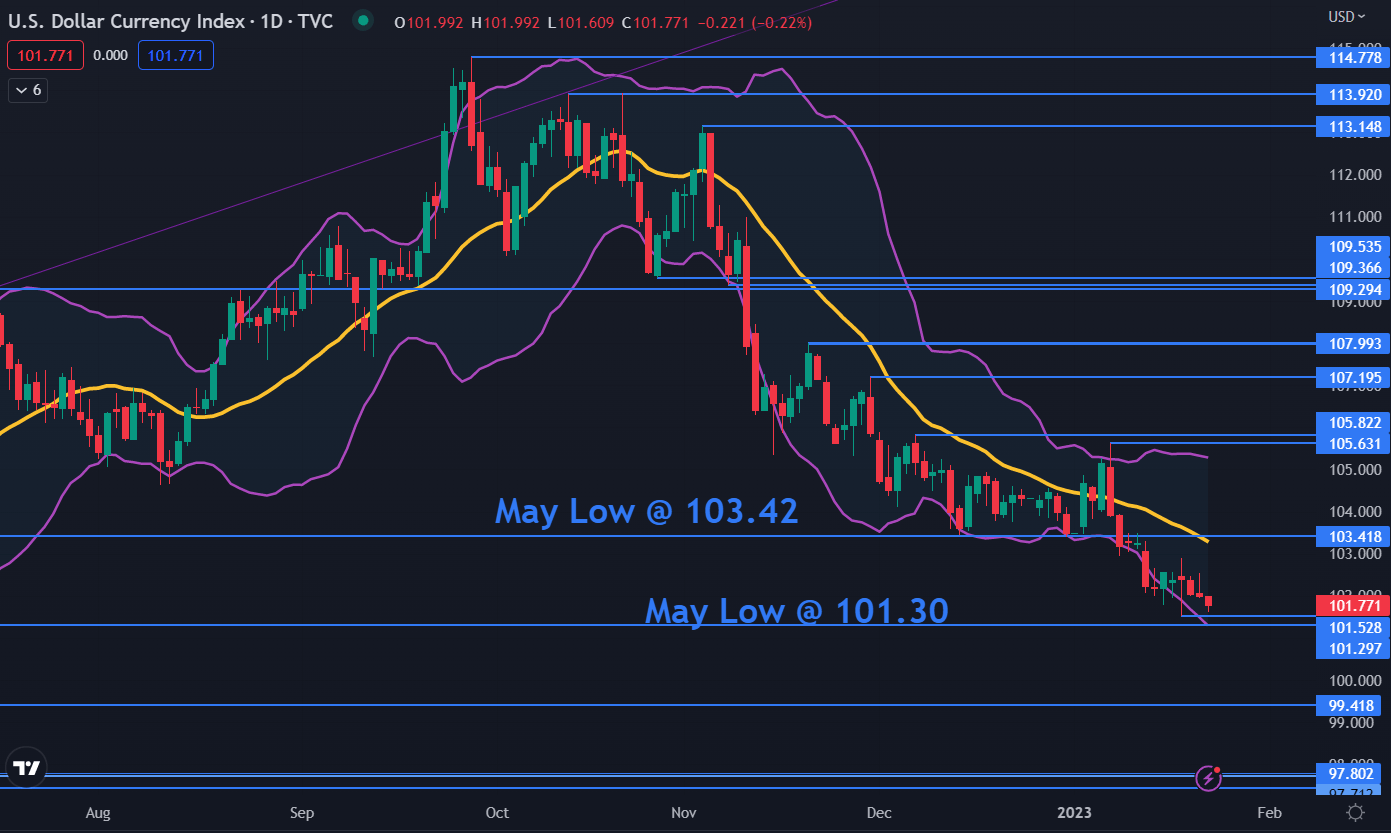
The DXY index continues to languish near the May 2022 low of 101.30 which may provide support ahead of the April 2022 low of 99.42.

After trading below the lower band of the 21-day simple moving average (SMA) based Bollinger Band and then moving back inside it, the price has moved sideways.

This pause in direction could suggest a reversal if it rallies back above the breakpoint of 103.42. The 21-day SMA is near that level, and it might offer resistance.

Further up, the prior peaks may offer resistance at 105.63, 105.82, 107.20 and 108.00.

image1.png


Britain Braces for High Borrowing Costs to Linger for Longer

Britain Braces for High Borrowing Costs to Linger for Longer

The Bank of England is likely to keep interest rates in painful territory through this year or longer even as the economy falls into recession.

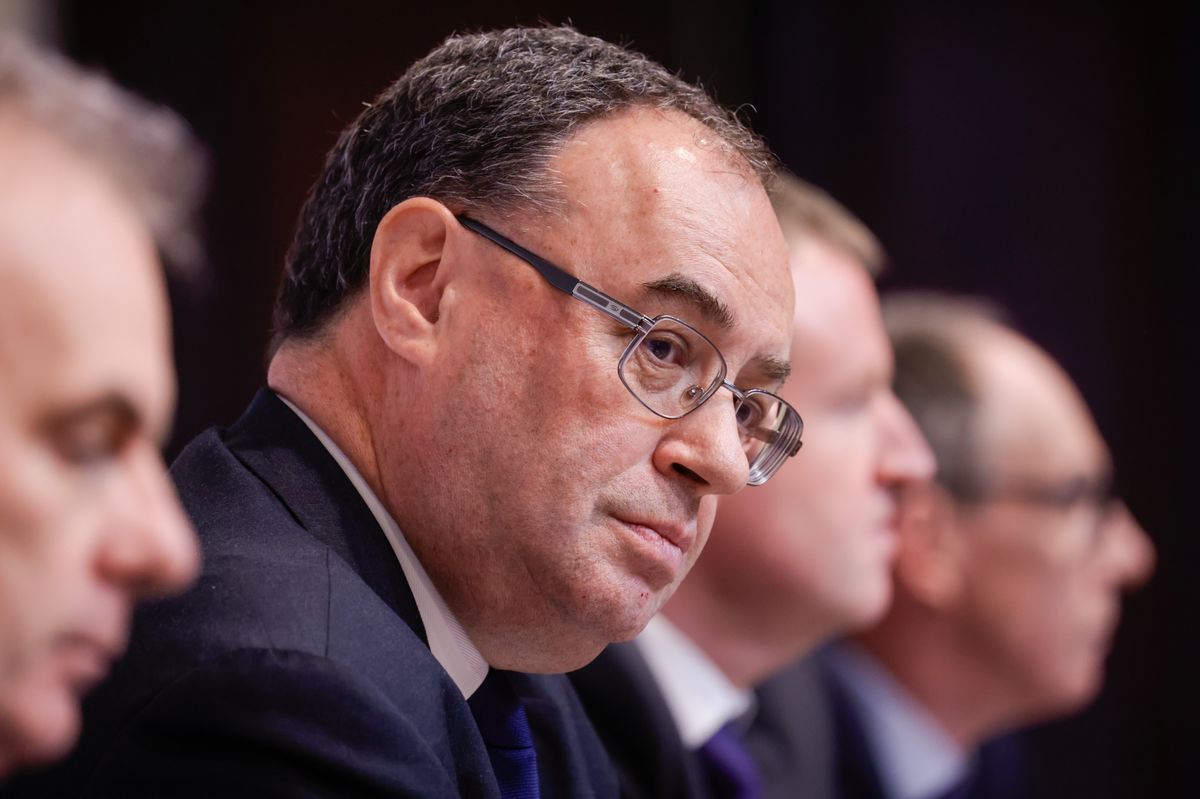
Inflation is running five times above the BOE’s target, and Governor Andrew Bailey is concerned that worker shortages are feeding wage pressures. The market is betting on another 1 point increase in the benchmark lending rate this year and has walked back bets for a reduction thereafter.

That’s in sharp contrast with the US, where investors anticipate the Federal Reserve to deliver the first cuts in borrowing costs since the start of the pandemic as soon as November.

“The BOE is going to have to keep bearing down on inflation for quite a long time,” said Robert Wood, chief UK economist at Bank of America. He said the UK “stands out” as having the worst of problems in the US and Europe, adding that underlying price pressures and strong pay growth mean “this inflation is going to last.”

The latest economic data reported this week showed wage pressures at record levels, except for the period directly after the pandemic. Inflation ticked down for a second month to 10.5%. Bailey said he hoped a corner has been turned on inflation, but he also noted the scarcity of workers is leading to pay raises that may feed into higher prices.

The result means the quickest monetary tightening cycle in three decades has further to run. Markets have almost fully priced in a half-point increase from the BOE in February to 4%, the highest since 2008, and then another half point by the third quarter. In the US, investors see the Federal Reserve reversing some of its increases in the second half of the year.

For British households, that means more pain. Families are already struggling with the tightest cost-of-living squeeze in a generation and wages falling short of inflation. The central bank has warned that 4 million households will have to remortgage this year at significantly higher rates — adding hundreds of pounds to monthly repayments.

Those factors solidify forecasts that the economy will struggle to grow before 2024. While the rest of the Group of Seven nations have recovered pre-pandemic levels of output and are planning for growth, albeit sputtering at times, the UK is headed into a long but shallow recession. That’s adding to pressure on Prime Minister Rishi Sunak to come up with a growth plan.

Some strategists believe divisions on the nine-member Monetary Policy Committee could even force the BOE to return with more rate hikes after a pause in its tightening cycle expected later this year.

The majority of the MPC backed a half-point increase last month. But Silvana Tenreyro and Swati Dhingra are pushing for no change while Catherine Mann wanted bigger hikes. Chief Economist Huw Pill has said the UK has the worst features of both the US and European Union economies — a high level of workforce dropouts and an energy supply crisis.

Sanjay Raja, chief UK economist at Deutsche Bank AG, said the UK is in a “unique situation” because of “stubbornly resilient” underlying price pressures and services inflation that is yet to peak.

Britain’s inflation rate is also well above the 6.5% level in the US, adding to concerns that long-term expectations about where prices are headed have come loose from the 2% anchor. Core inflation in the UK that excludes volatile food and energy costs remained stubbornly stable at 6.3%, and price growth accelerated in services.

“We don’t expect any rate cuts this year as inflation will likely stay uncomfortably above the Bank’s 2% mandate,” said Raja. “The BOE will need to keep up pressure on inflation by leaving rates in sufficiently restrictive territory for a little longer.”

The first cut for the BOE’s base rate is not fully priced in by investors until February 2024. The UK’s key lending rate will then remain around 4% until at least the summer 2024, according to money-markets bets.

“At the next meeting I think they will go for 50 (basis points), and then the question is what happens next,” said Guillermo Felices, global investment strategist at PGIM Fixed Income. A downshift in hikes from the Fed could put pressure on others to scale back tightening.

Aaron Rock, investment director at Abrdn Plc, expects the BOE to pause on rate hikes when it reaches 4.25%, but he warned of the risk that the MPC needs to restart its tightening cycle.

“I would not absolutely rule out stickier inflation and a tighter than expected labor market forcing the MPC to return with another 25 basis points hike or two either,” Rock said. He said investors should “not price in deep and rapid rate cuts at the first sight of a moderation in headline inflation.”

Japan PM keeps markets guessing on new BOJ governor

Japan PM keeps markets guessing on new BOJ governor

TOKYO, Jan 22 (Reuters) – Japanese Prime Minister Fumio Kishida said on Sunday he would nominate a new Bank of Japan governor next month, as markets test whether the central bank will change the ultra low-rate policy of the dovish Haruhiko Kuroda.

Kishida initially told a TV Tokyo programme that he would decide on Kuroda’s replacement by considering the economic situation for April, but when pressed he acknowledged this would likely be in February, “considering parliament’s schedule.”

He did not elaborate.

Kuroda, whose five-year term ends on April 8, has stuck with policies aimed at stoking price rises and growth, even with inflation at 41-year highs and double the BOJ’s target, and as central banks elsewhere have been raising interest rates.

The terms of Kuroda’s two deputies end on March 19. The three nominations must be approved by both houses of parliament.

The BOJ stuck to its ultra-easy policy on Wednesday, defying investors who have recently sought to break the bank’s cap on the 10-year government bond yield. But with even Kuroda sounding bullish about wage rises, expectations are growing that the BOJ will end its expansionist experiment this year.

Last week’s test followed the BOJ’s surprise December decision to double the target band for the yield to 0.5% above or below zero.

Former BOJ board member Sayuri Shirai, an advocate of reviewing the current stimulus who is considered a candidate for deputy governor, said on Sunday the BOJ should make its government bond buying more flexible but that low interest rates are warranted.

There is also speculation about changes to a policy accord between the central bank and the government, in which the BOJ pledges to achieve its 2% inflation target as early as possible.

Kishida said it was too early to comment on whether the accord needed to be altered but said there will be no change to the “basic stance” that his government and the BOJ work together “to achieve economic growth that involves structural wage hikes and reach the price-stability target stably and sustainably”. (Reporting by Tetsushi Kajimoto; Editing by William Mallard)

The Worst Fears for Global Growth May Be Subsiding

The Worst Fears for Global Growth May Be Subsiding

Grounds for more hope that the global economy can avoid a major slump may emerge in the coming week in business surveys showing gradual improvement across much of the advanced world.

Purchasing manager indexes for both the US and the euro zone are anticipated by economists to tick higher. While several gauges will still suggest contraction, the upward direction of travel could add to a growing narrative that a soft landing is achievable.

At the same time, the full effects of concerted policy tightening by central banks have yet to be felt.

Global PMI Activity

Bolstering such prospects are China’s reopening after pandemic lockdowns, evidence of slowing inflation, and the assured views of some senior European officials that their economies won’t suffer recessions. The International Monetary Fund may even soon raise its outlook for the year, its chief hinted on Friday.

“We have, demonstrably, strength of labor markets translating into consumers spending and keeping the economy up,” Kristalina Georgieva said at the World Economic Forum in Davos, Switzerland. “With the reopening of China, we expect growth this year to again exceed the global average.”

How the US fares will also be crucial, however, and the first estimate of fourth-quarter gross domestic product there, due on Thursday, may prove instructive. The economy is seen expanding at a 2.7% annualized rate in the final three months of 2022 after a 3.2% pace in the third quarter.

While such a print suggests solid growth, recent data — including retail sales, home construction and industrial production — showed momentum starting to peter out in late 2022.

Economists surveyed by Bloomberg see GDP in the US declining over consecutive quarters in the middle of this year as steep interest-rate hikes from the Federal Reserve take a bigger bite out of demand.

While Asian momentum could provide a fillip to that outlook, the IMF chief suggested there’s a risk its contribution to the world economy might yet go awry.

“What if the good news of China growing faster translates into oil and gas prices jumping up, putting pressure on inflation?” she said.

What Bloomberg Economics Says:

“Fourth-quarter GDP to a large extent will be boosted by robust consumer spending on services, even as they pulled back on goods. Households continued to tap into excess savings brought on by stimulus and to benefit from solid wage gains. Tighter monetary policy means 2023 will see significantly weaker demand.”

—Anna Wong, Eliza Winger and Niraj Shah, economists. For full analysis, click here

Elsewhere, multiple rate decisions may include a potential final Bank of Canada hike for the cycle, and a 12th consecutive increase in Colombia. Australia and New Zealand may report slowing consumer-price gains, while euro-zone policy makers have a final chance to speak out before their own meeting the following week.

Click here for what happened in the past week and below is our wrap of what’s coming up in the global economy.

US and Canada

Aside from the PMI and GDP reports in the US, the government is projected to report on Friday that inflation-adjusted personal spending on goods and services fell in December for the first time in a year. The data are also expected to show inflation cooled on an annual basis, while remaining elevated.

Fed officials, who are observing a blackout period ahead of their Jan. 31-Feb. 1 policy meeting, will take into account indications of a slowing economy and moderating inflation.

Other reports are expected to show declines in new-home sales and core capital goods.

Read more: Fed Set to Slow Hikes Again and Debate How Much Further to Go

Looking north, the Bank of Canada appears set to cap one of the most aggressive tightening campaigns in its history with what economists and markets expect to be a final 25-basis point increase in borrowing costs on Wednesday.

Policy makers led by Governor Tiff Macklem will probably stop short of declaring an outright halt to hikes, opting instead to hold the benchmark overnight night rate 4.5% while keeping a hawkish tone as they monitor how quickly the economy gears down.

The decision is complicated by conflicting data. Canada’s ultra-tight labor market continues to add jobs with unemployment near a record low, and economic output is set to expand in the final quarter of 2022 at about twice the pace of the central bank’s previous forecasts.

Annual inflation is still uncomfortably high at 6.3%, but underlying pressures show clear signs of abating. Canada’s heavily indebted households, meanwhile, are feeling the pinch of higher rates and starting to curb their spending.