USD/CHF touches fresh daily high amid risk-on mood, softer USD acts as a headwind

USD/CHF touches fresh daily high amid risk-on mood, softer USD acts as a headwind

The USD/CHF pair attracts some buyers near the 0.9135 region on Tuesday and spikes to a fresh daily high during the early part of the European session. The pair is currently placed around the 0.9180 area and has now reversed a major part of the previous day’s losses.

Receding fears of a full-blown banking crisis remain supportive of a generally positive risk tone, which, in turn, undermines the safe-haven Swiss Franc (CHF) and pushes the USD/CHF pair higher. The takeover of Silicon Valley Bank by First Citizens Bank & Trust Company calmed market nerves about the contagion risk. Furthermore, regulators reassured that they stood ready to address any liquidity shortfalls helped reverse the recent negative sentiment and boosted investors’ appetite for perceived riskier assets.

The US Dollar (USD), on the other hand, remains under some selling pressure for the second successive day and might hold back traders from placing aggressive bullish bets around the USD/CHF pair. The USD continues to be weighed down by the fact that the Federal Reserve toned down its approach to reining in inflation. This, along with a modest decline in the US Treasury bond yields, turn out to be another factor weighing on the buck and warrants caution before positioning for any further appreciating move for the major.

Market participants now look to Tuesday’s US economic docket – featuring the Conference Board’s Consumer Confidence Index and the Richmond Manufacturing Index. Apart from this, the US bond yields, might influence the USD price dynamics and provide some impetus to the USD/CHF pair. Traders will further take cues from the broader risk sentiment to grab short-term opportunities. The focus, however, will remain on the release of the Fed’s preferred inflation gauge – the US Core PCE Price Index on Friday.

AUD/USD Rises on Positive Retail Sales Data, CPI Ahead

AUD/USD Rises on Positive Retail Sales Data, CPI Ahead

AUDUSD FUNDAMENTAL BACKDROP

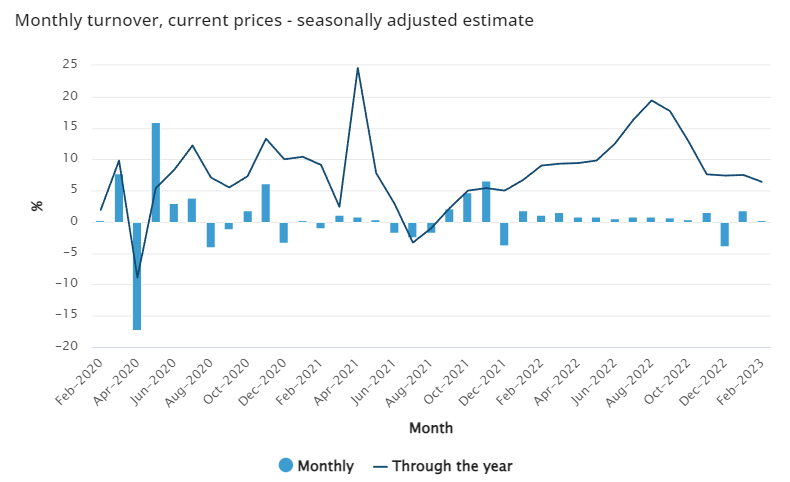
AUDUSD caught a fresh bid in the Asian session with a retest of the 0.6700 level helped by marginally better than forecast retail sales numbers. The preliminary MoM retail sales data came in 0.2% against forecasts of 0.1% yet displayed a sharp drop from the January print of 1.8%. The Aussie Dollar has also benefitted from an improvement in risk sentiment and a lackluster start to the week by the US Dollar.

image1.png

Source: Australian Bureau of Statistics

The retail sales print may be an indication of the lagging effects of rate rises by the Reserve Bank of Australia and suggests that consumers are tightening their spending habits. This makes the case for a pause from the RBA at its upcoming April meeting all the more compelling, given the global landscape as well as the domestic one.

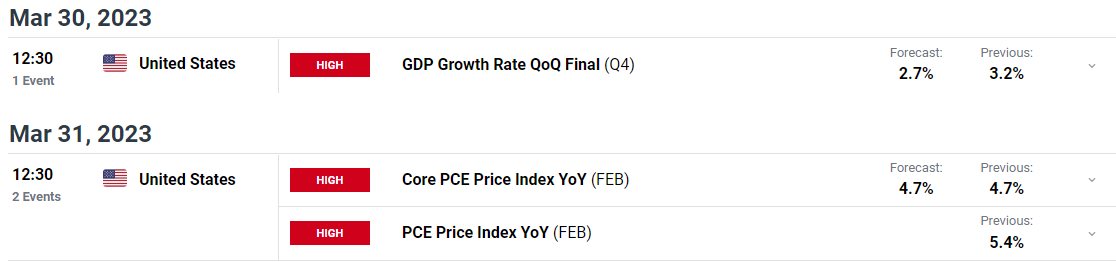
We do have quite a bit of economic event risk ahead on the calendar this week starting with today’s US CB Consumer Confidence data, as well as the GDP and Feds preferred inflation gauge the Core PCE numbers due out on Thursday and Friday respectively. On the Australian front we have the CPI data out tomorrow which could further add credence to a pause from the RBA while a higher-than-expected figure could see those bets fade ahead of the April meeting.

image2.pngimage3.png

TECHNICAL OUTLOOK AND FINAL THOUGHTS

The US Dollar has had an underwhelming start to the week as sentiment improves. A continuation of that today could see the Aussie Dollar continue to rise ahead of the inflation data release tomorrow.

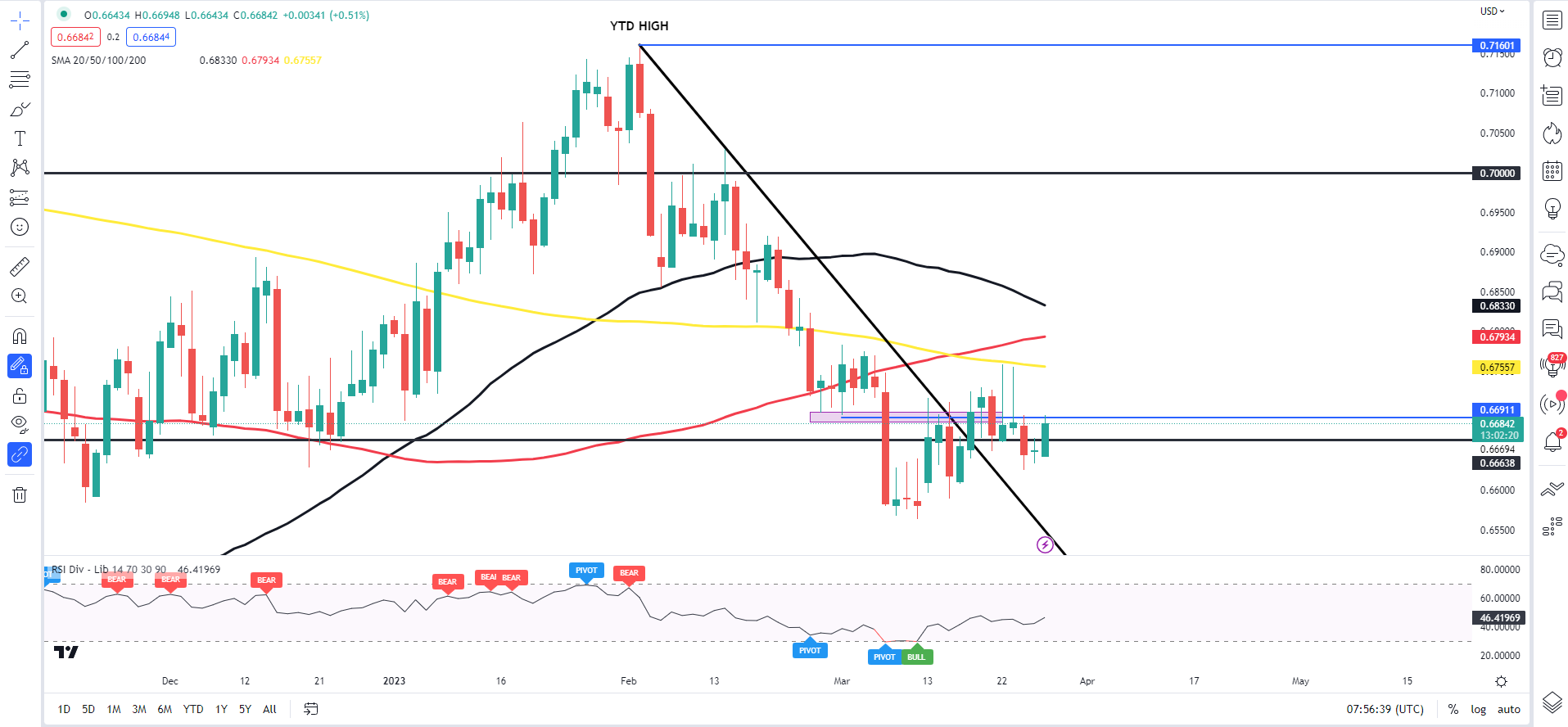
The technical outlook on AUDUSD is showing higher highs and higher lows since bottoming out on March 10. Price does however remain below the key 0.6700 level and has been struggling to find any momentum above. The 200-day MA rests above at the 0.6750 handle and could cap any gains should we find some momentum above the 0.6700 level today ahead of the CPI data release.

Alternatively, a rejection of 0.6700 today and a return for dollar bulls could see price return toward the 0.66250 support area and potentially a retest of the YTD at 0.6560.

AUD/USD Daily Chart – March 28, 2023

image4.png

Source: TradingView

KEY RESISTANCE LEVELS:

  • 0.6750 (200-Day MA)
  • 0.6830 (50-day MA)

KEY SUPPORT LEVELS:

  • 0.6625
  • 0.6560 (YTD Low
USD/CAD bears move in and print a fresh low for the week

USD/CAD bears move in and print a fresh low for the week

The Canadian dollar has strengthened against its US counterpart in Asia in a continuation of the start of the week´s rally. It is printing a fresh high vs. the greenback with USD/CAD down to 1.3641 after notching up its biggest advance in two weeks on Monday. Signs of easing stress in the banking sector contributed to a surge in oil prices and risk appetite that combined are favoring the Loonie.

Turning to the question of near-term BoC policy, April looks like a pretty easy hold for the Bank at this point, analysts at TD Securities argued. ´´Even with a benign outcome, the residual impact on short-end pricing from recent financial market uncertainty is likely to linger well into Q2; more importantly, the Bank can credibly argue that the economy is unfolding in line with the forecast underpinning its conditional pause. We continue to look for the BoC to remain on hold for all of 2023.´´

Meanwhile, Canada’s budget is due on Tuesday. It will introduce a system to lock in future carbon credit prices, a move meant to boost investments by giving businesses certainty to develop low-carbon technologies, a senior government source with knowledge of the document told Reuters.

As for positioning, speculators’ net short CAD positions increased notably last week, oil prices and the signaled pause in policy from the BoC are in view.

US, Japan strike trade deal on electric vehicle battery minerals

US, Japan strike trade deal on electric vehicle battery minerals

WASHINGTON :The United States and Japan on Tuesday announced a trade deal on electric vehicle battery minerals that is key to strengthening their battery supply chains and granting Japanese automakers wider access to a new $7,500 U.S. EV tax credit.

The swiftly negotiated agreement prohibits the two countries from enacting bilateral export restrictions on the minerals most critical for EV batteries, according to senior Biden administration officials. The minerals include lithium, nickel, cobalt, graphite and manganese.

The deal also aims to reduce U.S.-Japanese dependence on China for such materials by requiring collaboration to combat “non-market policies and practices” of other countries in the sector and on conducting investment reviews of foreign investments in their critical minerals supply chains.

Minerals-focused trade deals are one way that the Biden administration hopes to open up access for trusted allies to the $7,500 per vehicle EV tax credits in last year’s climate-focused Inflation Reduction Act.

Half of the credit for purchasing consumers is reserved for North American-assembled vehicles and batteries, a source of considerable tension with the European Union, Japan and South Korea, who worry that their car and battery makers will be rendered uncompetitive.

The other half of the credit is contingent on at least 40 per cent of the value of critical minerals in the battery having been extracted or processed in the United States or a country with a U.S. free trade agreement or recycled in North America.

Japan was working with the United States to sign the agreement in Washington on Tuesday, trade minister Yasutoshi Nishimura told reporters in Tokyo.

“As the demand for electric vehicle batteries is expected to grow significantly, securing important minerals essential for their production is an urgent issue,” Nishimura said.

The U.S. Treasury is expected to define sourcing requirements for the EV tax subsidies by the end of this week, providing eagerly awaited guidance to the auto, battery and clean energy sectors.

But asked whether the trade agreement would qualify Japan-sourced batteries, components and vehicles for that part of the tax credit, the officials said that determination was up to Treasury.

Nishimura said that EVs made with minerals mined or processed in Japan were expected to meet tax exemption requirements under the U.S. act.

The U.S. officials said that the U.S. Trade Representative does not intend to seek approval by Congress for the minerals trade agreement because it falls under the agency’s authority to negotiate sectoral trade agreements at the executive level.

But they said provisions in the deal to promote labor rights and recycling in their battery mineral supply chains would help both countries.

“Japan is one of our most valued trading partners and this agreement will enable us to deepen our existing bilateral relationship,” U.S. Trade Representative Katherine Tai said in a statement.

“This is a welcome moment as the United States continues to work with our allies and partners to strengthen supply chains for critical minerals, including through the Inflation Reduction Act.”

The two countries agreed to review the minerals agreement every two years, including whether it is appropriate to terminate or amend it.

EUR/USD clings to gains above 1.0800 amid weaker US Dollar

EUR/USD clings to gains above 1.0800 amid weaker US Dollar

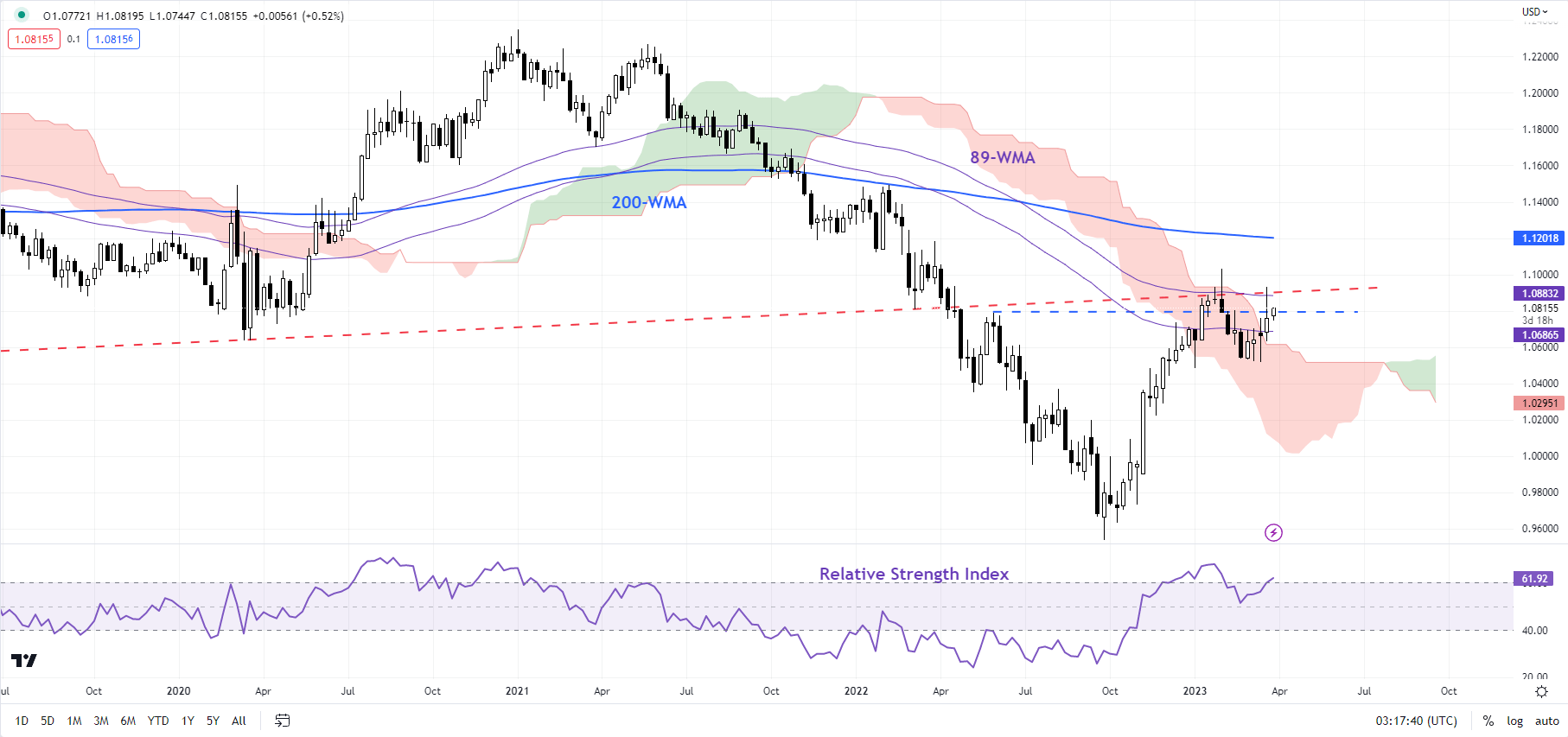
EUR/USD is trading sideways above 1.0800, consolidating gains in early Europe. The pair is struggling, despite a better risk tone and a broadly weaker US Dollar. Growing recession fears are capping the upside in the pair. ECB-speak awaited.

Technical Overview

The EUR/USD held well above the 20-period Simple Moving Average (SMA), currently at 1.0670 on the daily chart. Also, above 1.0720/40, a key support area (Fibonacci retracement of recent rally, 55-day SMA and horizontal support), keeping the risk tilted to the upside. However, gains seem limited while unable to consolidate above 1.0900. A slide below 1.0620 would negate the positive outlook.

Ahead of the Asian session, the 4-hour chart shows EUR/USD moving with a bullish bias, near 1.0800 but without much conviction. The outlook looks set for more consolidation ahead, probably in a broader price range. A flat 20-period SMA awaits at 1.0815, which could prove to be a strong barrier, and then emerges 1.0860. A failure to recover 1.0800 would favor a test of 1.0775 and then 1.0750, which should limit the downside.

Fundamental Overview

GMT
Event
Vol.
Actual
Consensus
Previous
Tuesday, Mar 28
04:00
04:15
06:45
104
103
105
08:00
102.5
102.8
08:00
104
104
08:45
11:00
12:30
0.6%
-0.4%
12:30
$-91.0B
$-90.1B
12:55
3.2%

The EUR/USD rose on Monday toward the 1.0800 area, recovering some of Friday’s slide, supported by an improvement in market sentiment, amid easing concerns on the banking sector. Deutsche Bank shares recovered ground, but the German lender is still in the eye of investors. Concerns about the health of the banking sector in Europe and in the US linger. Late on Sunday, the Federal Deposit Insurance Corporation (FDIC) announced First Citizens is buying all of Silicon Valley Bank’s deposits, loans and branches.

Regarding economic data, inflation will take center stage this week. On Thursday, Spain, France and Germany will release their estimates of March inflation, and on Friday, the US Core Personal Consumption Expenditure Index is due. Until those figures, market participants will focus on risk perception.

Data released on Monday showed the German IFO Business Climate Index rose to 93.3 in March from 91.1, surpassing expectations. In the US, the Dallas Fed Manufacturing Business Index fell to -15.7 in March against the market consensus of -10.9. On Tuesday, US CB Consumer Confidence and home price data are due.

The Euro remains supported by expectations that the European Central Bank (ECB) will raise interest rates again in May. There will be plenty of ECB speakers over the following days amid the ongoing internal debate about what to do next.

Crude Oil Price Surges on Easing Banking Woes and Supply Issues. Higher WTI?

Crude Oil Price Surges on Easing Banking Woes and Supply Issues. Higher WTI?

Crude oil streaked higher overnight as sentiment was given a boost by the rescue of SVB Financial announced by the Federal Deposit Insurance Corporation (FDIC). A sinking US Dollar and supply concerns also appear to have provided some impetus for the lift.

The sale of SVB to First–Citizens Bank & Trust Company has allayed concerns of contagion of banking problems for now. The statement from the FDIC highlighted mismanagement as the key cause for the demise of the tech industry focussed bank.

The FDIC had previously underpinned the troubled Signature Bank. Combined with the Swiss regulators backstopping Credit Suisse with a tie-up to UBS, markets seem to have taken a breath of relief.

Republic Bank shares have also rallied overnight on speculation that the FDIC may step in to assist there as well.

The US Dollar was softer against most major currencies despite Treasury yields resuming their march higher. The entire curve lifted in a bear-flattening (inversion) moves with the benchmark 2-year note back above 4.0% after touching 3.56% on Friday.

It is being reported that an international arbitration court ruled in favour of Iraq and it will mean that Turkey will no longer be able to access oil from Kurdistan via a pipeline.

It is estimated that the impact might be around 400k – 450k fewer barrels per day hitting the global market.

In and of itself, it is not a large amount in the change of supply, but it perhaps reflects the nervousness within the energy sector against the backdrop of the Ukraine war given the move in price.

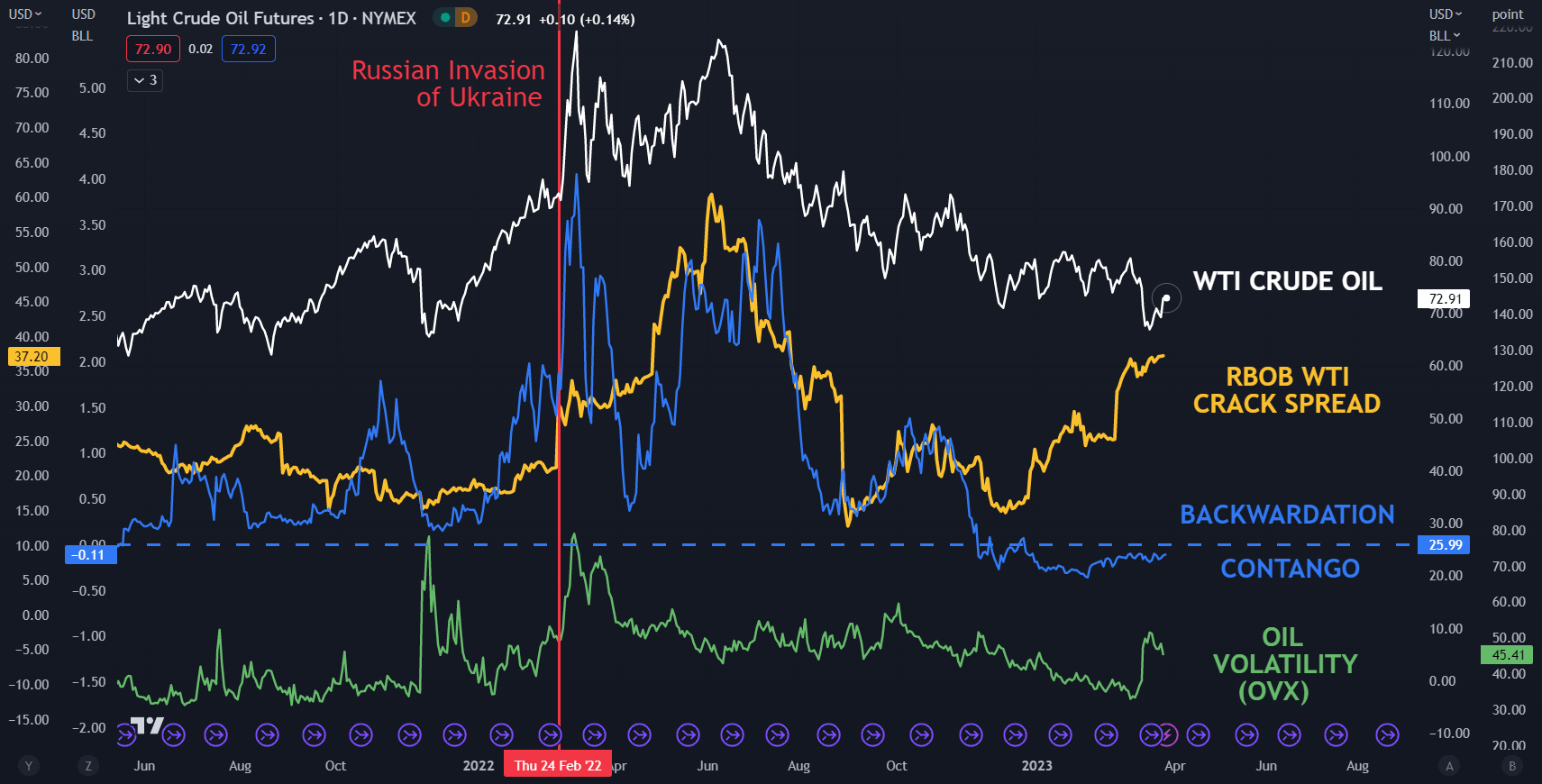
The US session saw the WTI futures contract finish up over 5% for the day as it eclipsed USD 73. At the same time, oil volatility eased from the peak seen last week, which may indicate a degree of comfort with the rally.

The crack spread between the WTI crude and RBOB gasoline futures contracts might also be supportive of the current price action. The crack spread bifurcates the difference in price between WTI crude oil and refined RBOB gasoline.

WTI CRUDE OIL, CRACK SPREAD, BACKWARDATION/CONTANGO, VOLATILITY (OVX)

image1.png

Gold Could Find It Tough to Crack $2000

Gold Could Find It Tough to Crack $2000

GOLD TECHNICAL OUTLOOK – NEUTRAL

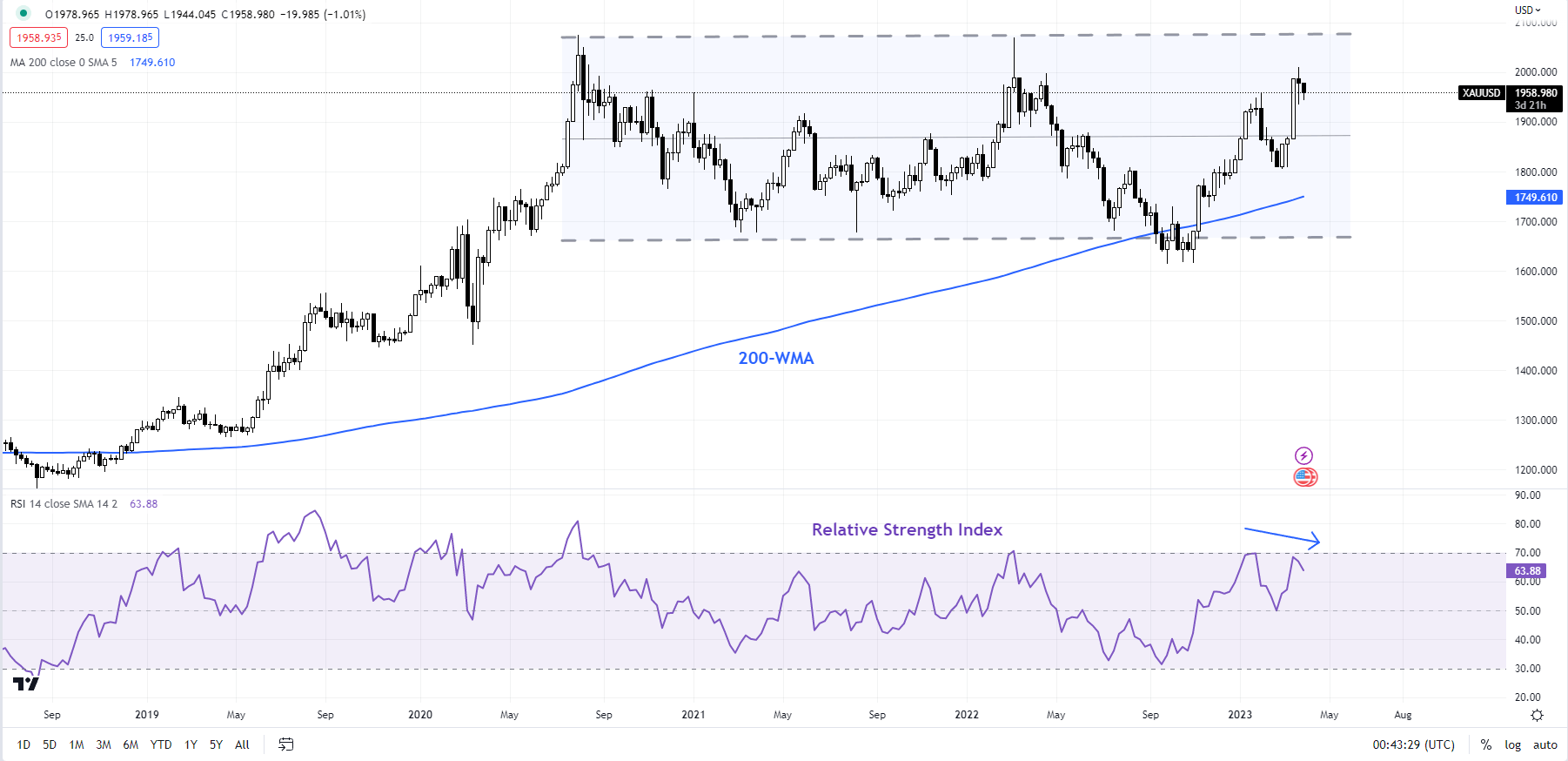
Gold could find it tough to break above the key psychological $2000 as risk appetite appears to be stabilizing.

First Citizens BancShares takeover of a large part of Silicon Valley Bank, UBS’ move to acquire Credit Suisse, and the willingness of regulators to provide liquidity/backstop facilities have provided comfort to investors that the worst banking shock since the Great Financial Crisis would be contained.

XAU/USD Daily Chart

image1.png

Chart Created Using TradingView

XAU/USD has risen over 10% since the end of February as worries regarding the global financial sector have overshadowed still-strong US data (US Economic Surprise is at a fresh 10-month high), boosting the safe-haven appeal of the yellow metal. Moreover, expectations of a sooner-than-expected pause in the US Fed rate hiking cycle have weighed on US yields, supporting the non-interest-bearing asset.

XAU/USD Weekly Chart

image2.png

Chart Created Using TradingView

The key focus is now on US Core PCE Price Index for February due on Friday, which is expected flat at 4.7% on-year. A stronger-than-expected print could dent expectations regarding a Fed rate cut. Last week, the Fed indicated it was on the verge of pausing further rate hikes, prompting markets to price in a rate cut as early as Q3-2023.

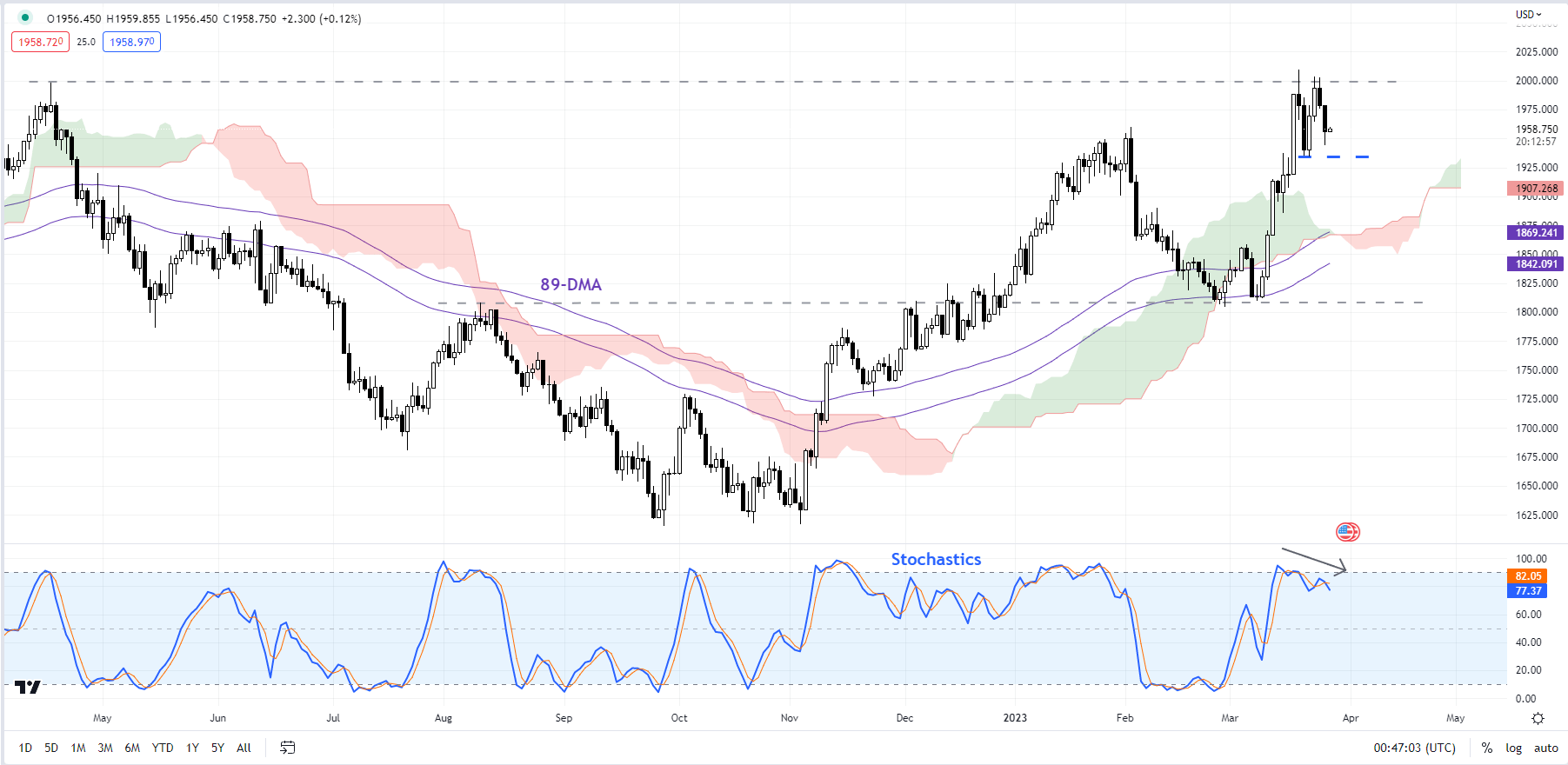
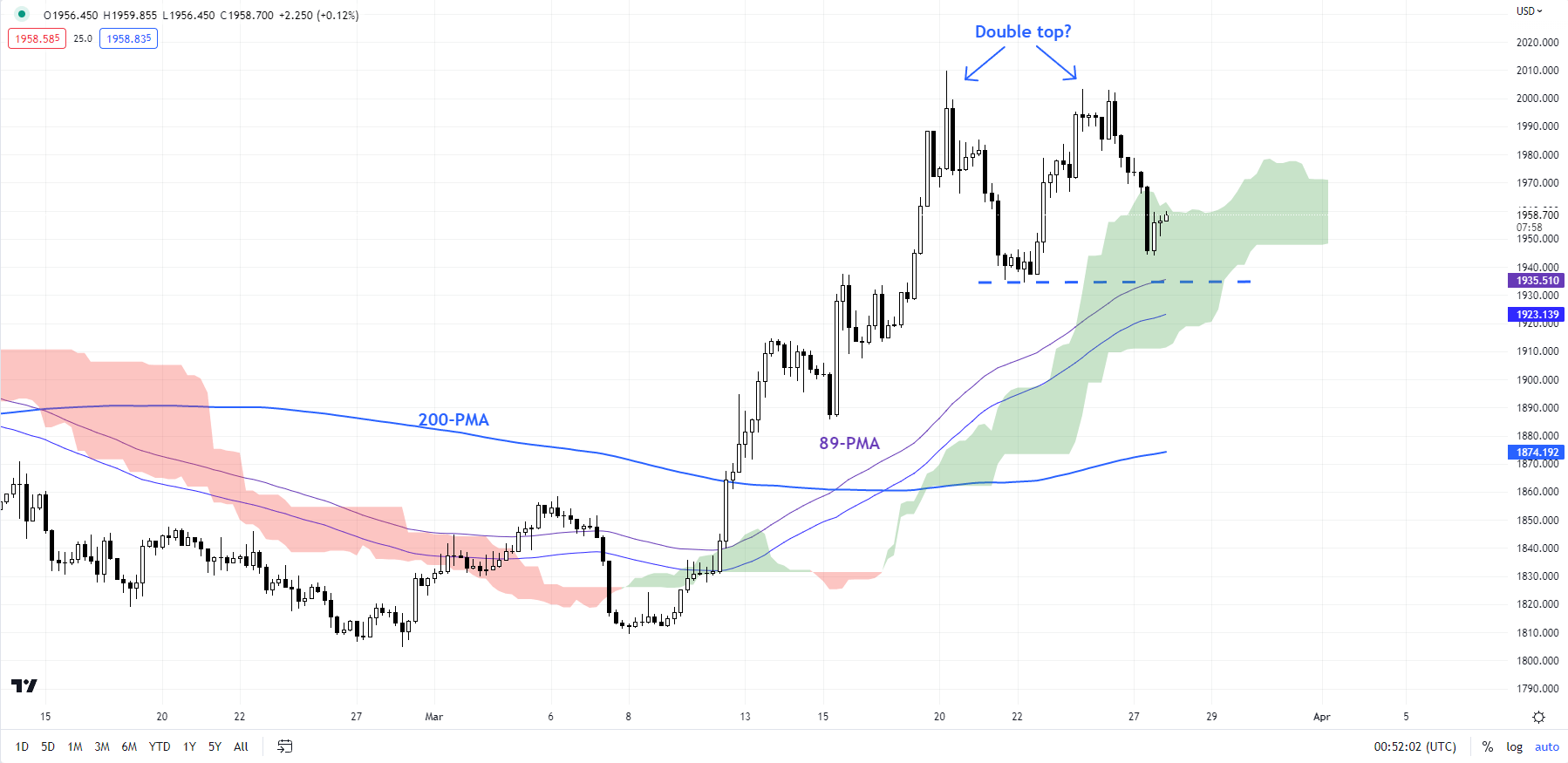
On technical charts, a negative divergence on the daily and weekly charts indicates XAU/USD’s rally is showing signs of fatigue as it tests crucial psychological and technical resistance (including the April 2022 high) at 2000. To be sure, a retreat isn’t imminent.


XAU/USD 240-minute Chart

image3.png

Chart Created Using TradingView

Any break below immediate support at the mid-March low of 1934 would confirm that the upward pressure had faded in the interim. Such a break would trigger a minor double top (the late-March highs), opening the way toward 1875.

Gold’s sharp rebound came about from near-strong support at the end-February low of 1804, coinciding with the 89-day moving average. See “Gold Technical Outlook: A Turnaround on the Cards?”, published March 1.

US Dollar Struggles to Gain Ground as Treasury Yields Leap. Where to for USD?

US Dollar Struggles to Gain Ground as Treasury Yields Leap. Where to for USD?

The US Dollar sunk further today, adding to losses seen into the New York close on Monday.

The general reversal in fortunes for risk assets continued through the Asian session on Tuesday with Australia’s ASX 200 adding over 1%. Retail sales data there printed in line with expectations at 0.2% month-on-month for February.

The fairly benign number underscored perceptions of the RBA pausing in its rate hike cycle on Tuesday next week.

Other APAC equity markets have been mostly positive, with mainland Chinese indices the only ones in the red.

The rescue of SVB Financial announced yesterday appears to have calmed market concerns of the banking crisis enlarging.

This perspective saw further oscillation in the pricing on what the Fed will do at the next Federal Open Market Committee (FOMC) meeting in early May. The interest rate market is now pricing in a roughly 50/50 bet for a 25 basis point (bp) hike then.

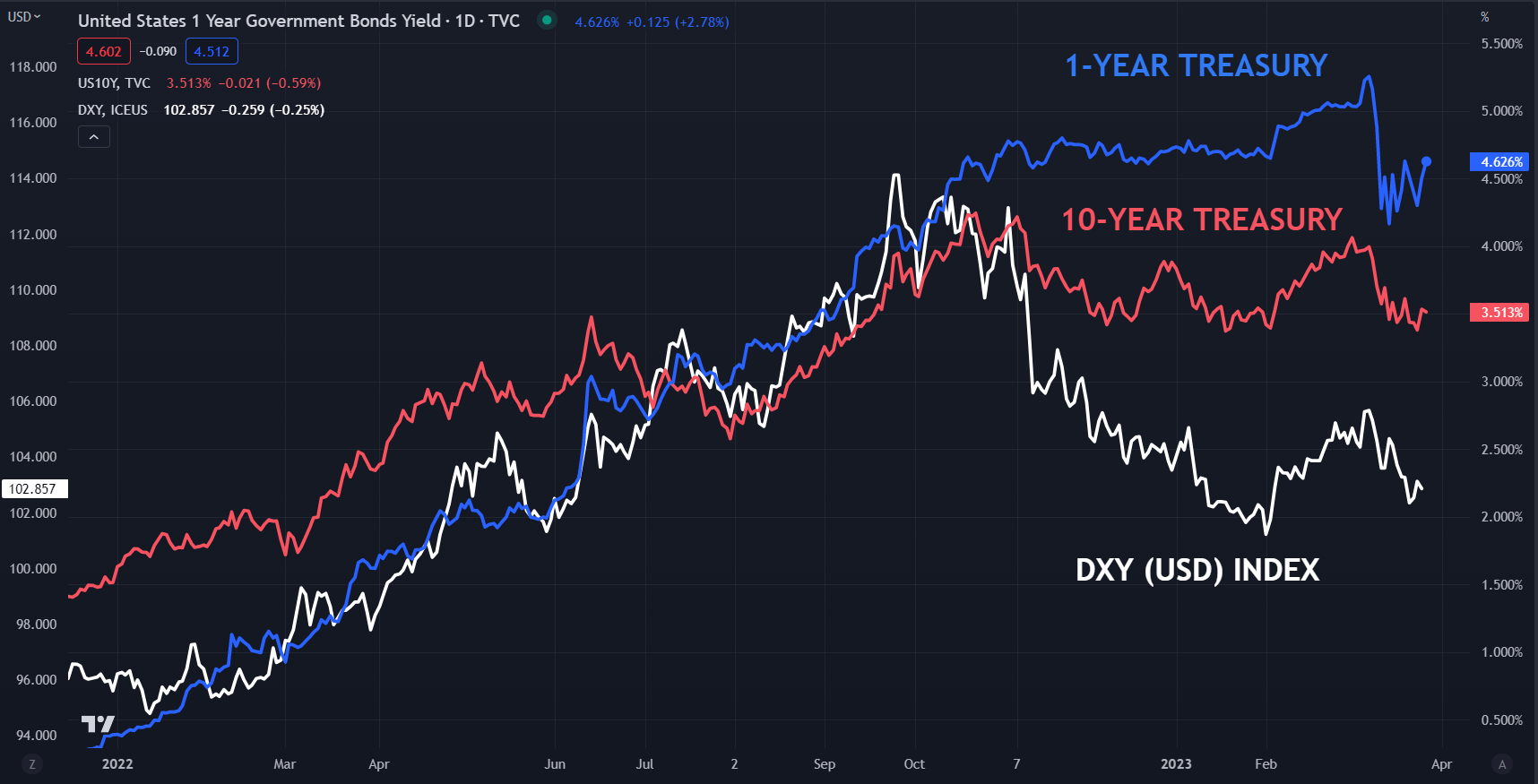
Treasury yields leapt higher across the curve yesterday but has given up a few bp today, with the exception of the 1-year bond. It has jumped 60 bp from the low seen 2-weeks ago to be back above 4.60%.

Crude oil has consolidated yesterday’s outsized gains with the WTI futures contract near USD 73 bbl while the Brent contract is a touch under USD 78 bbl. Natural gas failed to be swept up in oil’s rally as it continues to languish.

Gold has made a slight recovery from yesterday’s selloff, trading above USD 1,950.

The Japanese Yen has been today’s outperformer in currency land with USD/JPY edging toward 130.50. All other G-10 currencies are firmer to some degree against the greenback.

There will be a number of speakers from the European Central Bank (ECB) and the Bank of England (BoE) today.

DXY (USD) INDEX AND TREASURY YIELDS

The DXY index has not moved up with the increase in Treasury yields so far this week. This dislocation might be worth watching and could provide clues for risk appetite across different asset classes.

If yields continue higher, but the US Dollar struggles to gain traction, it may indicate an increased appetite for other risk assets, such as AUD and NZD for example.

image1.png


EUR/USD Doesn’t Look Ripe for a Break Above 1.10 Ahead of H.8 Data

EUR/USD Doesn’t Look Ripe for a Break Above 1.10 Ahead of H.8 Data

The break last week above an important resistance has boosted hopes of a fresh leg higher in EUR/USD. However, it may be premature to conclude an unambiguously bullish view just yet.

Both the European Central Bank and the US Federal Reserve delivered the widely expected rate hikes this month with a dovish tilt, with both central banks underscoring a data-dependent approach going forward. However, financial markets are pricing in roughly two more rate hikes by the ECB by September, compared with no more rate hikes by the Fed on the view that tightened US financial conditions via reduced credit availability would compensate for rate hikes.

Whether the impact of the tightening of lending standards is large or small (hence overcompensates or under compensates for rate hikes) would be important for the dollar’s trend. If the actual tightening from lending conditions isn’t as large as some expect, the US dollar could benefit as the focus would shift back to Fed rate hikes.

EUR/USD Daily Chart

image1.png

In this regard, the Fed’s H.8 banking data, an estimate of the weekly aggregate balance sheet of the US banking system, due on Friday will be closely watched. Analysts note the H.8 data released last Friday showed a significant shift in deposits from small banks to large banks, as well as the first outright decline in small banks’ deposits in nearly four decades. Any signs that liquidity strains have been contained could support USD.

Furthermore, the relative macro data is USD supportive: the US Economic Surprise Index continues to run around a 10-month high. In comparison, Euro area data have been less upbeat – the Economic Surprise Index is still in positive territory but retreated since the beginning of February.

EUR/USD Weekly Chart

image2.png

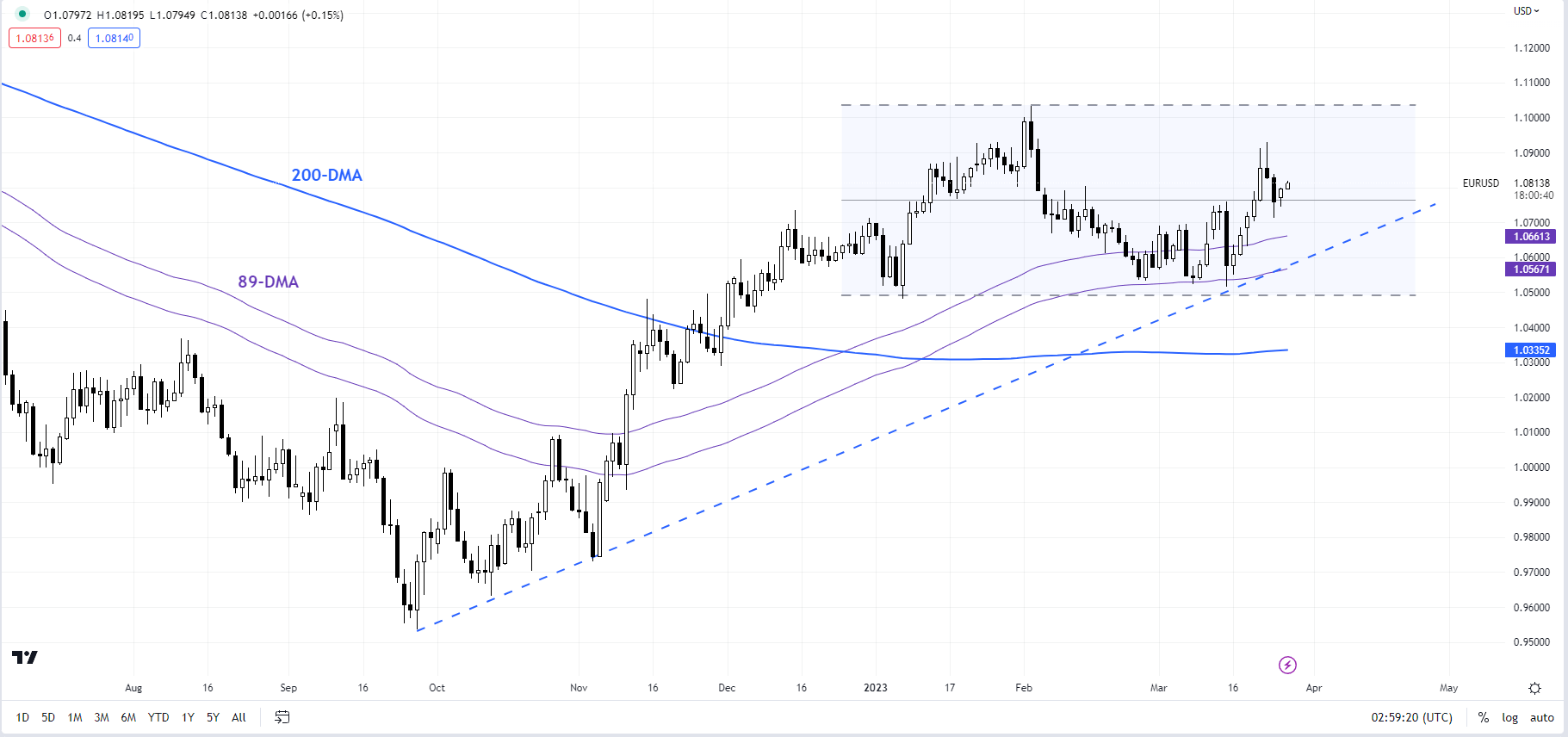
On technical charts, EUR/USD’s rebound from near-strong support at the January low of 1.0480, coinciding with the 89-day moving average confirms that the broader trend remains up (a break below would have disrupted the higher-top-higher-bottom pattern since September). The subsequent break above the hurdle at the mid-March high of 1.0800 confirms that the immediate downward pressure has reduced.

However, the resistance break wasn’t accompanied by strong momentum, suggesting that EUR/USD could find it tough to break above the early February high of 1.1035. At the same time, prospects of additional ECB tightening could cushion the euro’s downside. In sum, there is a chance that the pair could hover in a 1.0500-1.1000 in the near term.

Ethereum struggles to keep up with Bitcoin ahead of Shanghai upgrade

Ethereum struggles to keep up with Bitcoin ahead of Shanghai upgrade

Ethereum (ETH) Shanghai upgrade is drawing close and it is key for ETH holders and bulls to defend critical support at $1,680 to fight further decline in the altcoin’s price. Ethereum whales holding between 1,000 and 10,000 ETH have been scooping up the altcoin consistently for a week. The altcoin’s demand among retail investors has climbed as ETH holders fight consolidation.

Ethereum bulls need to defend against a drop below $1,680, here’s why

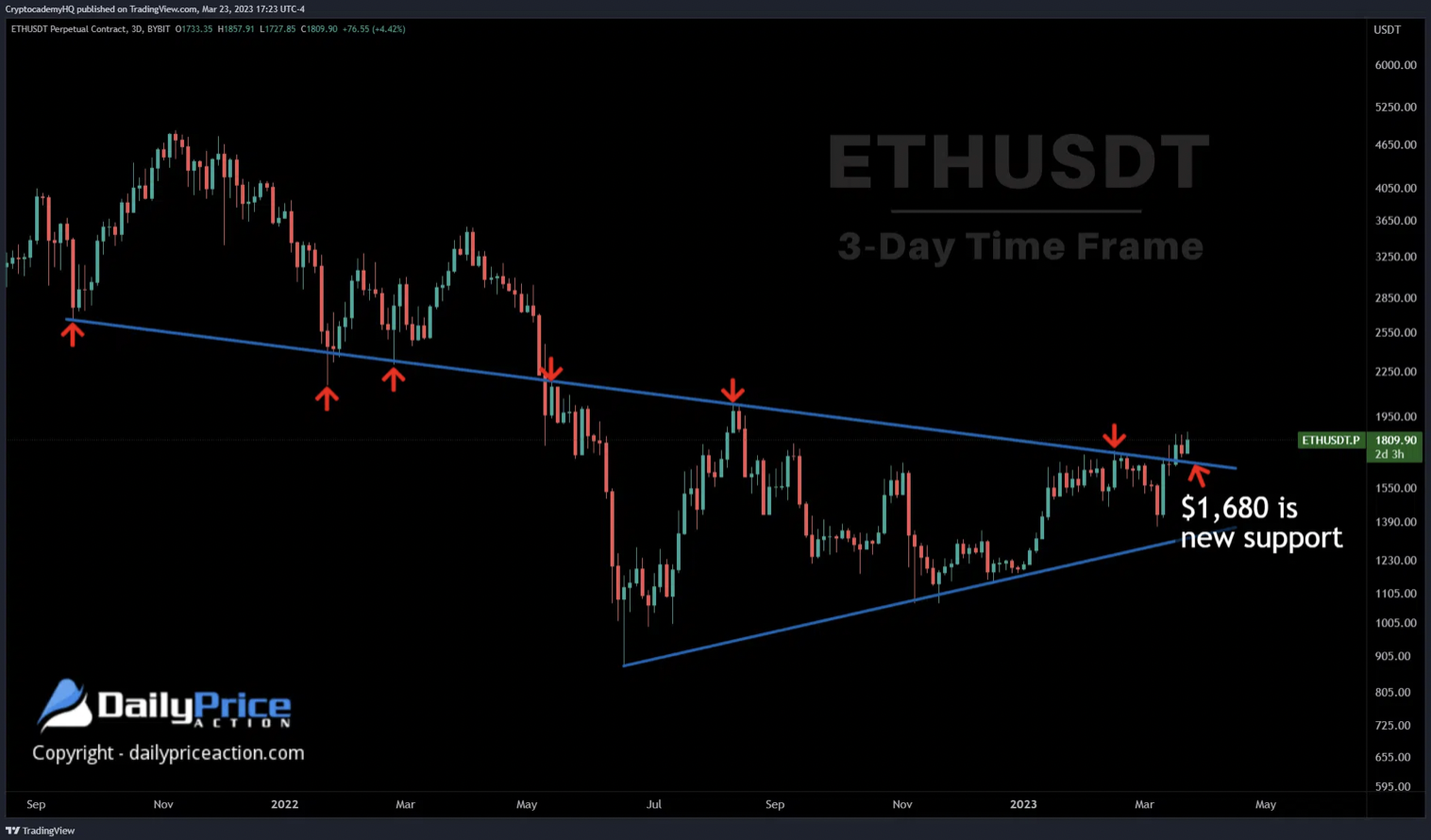
On the Ethereum price chart, the $1,680 level represents the top of a symmetrical triangle that dates back to September 2021.

ETHUSDT Perpetual Contract

$1,680 is therefore key support for the altcoin and bulls need to defend against a drop below this level. While crypto market participants remain indecisive it is key for Ethereum to sustain above its critical support level to defend against further decline in the days leading up to the ETH token unlock event.

Ethereum whales accumulate ETH ahead of Shanghai upgrade

Ethereum network’s large wallet investors have continued accumulation of the altcoin as the Shanghai upgrade draws close. The upgrade aims at making Ethereum accessible and scalable. Importantly, ETH token unlock will occur post the Shanghai upgrade; this is an event that the Ethereum holder community has anticipated since the launch of the ETH2 deposit contract.

Based on data from Santiment, ETH wallet addresses holding between 1,000 and more than 10,000 ETH, and 1 million to 10 million ETH tokens have added the altcoin to their balance consistently in the last seven days. Large wallet addresses are accumulating the largest altcoin by market capitalization.

ETH accumulation

ETH accumulation by large wallet investors

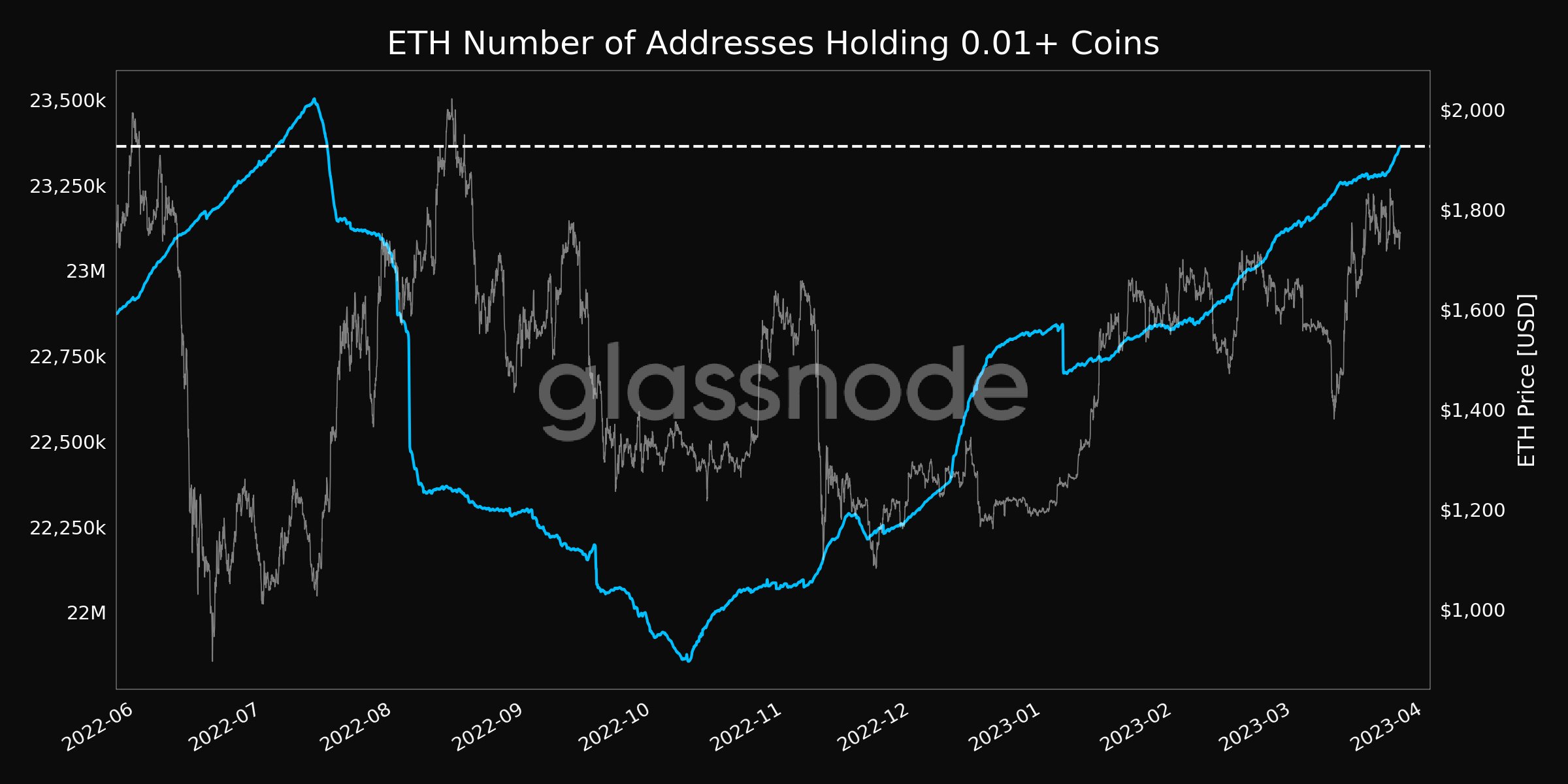
Retail investors match whale’s enthusiasm. There are currently over 23.3 million addresses that have at least 0.01 ETH and the address count has hit an eight month high according to Glassnode.

ETH number of addresses

Interestingly, Total Value Locked (TVL) in the ETH2 deposit contract hit an all-time high above 17 million ETH. These metrics fuel a bullish thesis for the second-largest cryptocurrency by market capitalization.

With the rising uncertainty in the crypto ecosystem, despite the bullish thesis, influencers and crypto analysts question why the narrative has turned bearish.

Ethereum struggles to keep up with Bitcoin performance

Ethereum, the largest altcoin in the crypto ecosysten is still struggles to keep the pace with Bitcoin performance in 2023. Analysts on crypto Twitter noted that ETH held more steady during the FTX collapse, than it is ahead of the Shanghai upgrade.

ETH vs BTC