The Federal Reserve Bank: A Forex Trader’s Guide

The Federal Reserve Bank: A Forex Trader’s Guide

What is the Federal Reserve?

The Federal Reserve is the central bank of the United States. It was founded to create a stable, flexible monetary and financial system for the nation. Its general duties are to set monetary policy and oversee effective economic operation, ultimately serving the public interest.

To meet these top-level directives, the Fed performs five general functions:

  1. Promote maximum employment, stable pricing and moderate interest rates long term
  2. Reduce risk where possible to create a stable financial system
  3. Develop safety within financial institutions
  4. Champion safety within payment and settlement systems
  5. Advocate consumer protection through a supervisory stance.

To execute day-to-day operations, the nation is divided up into 12 Federal Reserve Districts, each of which is served by a separately incorporated Reserve Bank. These districts and member banks operate independently while being supervised by the Federal Reserve Board of Governors.

Who owns the Fed?

The Fed is both a private and public institution. The Board of Governors is a government agency, while the banks themselves are structured like private corporations – member banks hold stock and earn dividends.

Who is the Federal Reserve chairman?

As of August 2019, the chairman of the Federal Reserve is Jerome Powell, who has served in this office since February 5, 2018. He is the 16th person to have held the position and will serve a four-year term. Before his appointment, Mr Powell served as a member of the Board of Governors from May 25, 2012. He also currently serves as Chairman of the Federal Open Market Committee, which looks after monetary policy.

Which banks make up the Fed?

The 12 Federal Reserve Districts, each with their own Reserve Bank, are:

  • Boston
  • New York
  • Philadelphia
  • Cleveland
  • Richmond
  • Atlanta
  • Chicago
  • St. Louis
  • Minneapolis
  • Kansas
  • Dallas
  • San Francisco

How is the Fed held accountable to its functions?

The Fed is accountable to the public, as well as to the US Congress. The Chair and Federal Reserve officials testify in front of Congress, while the system of setting monetary policy is designed to be clear and transparent. In the interests of accountability, the Federal Open Market Committee (FOMC) will publish statements following all annual meetings. All financial statements are audited independently once a year to ensure financial accountability as well.

Key Economic Mandates of the Federal Reserve System

US monetary policy is the core mandate of the Federal Reserve bank. The statutory objectives of this monetary policy are outlined by the Congress and are:

  • Maximum employment: The monetary policy set out by theFOMC should ensure unemployment remains low, working to boost the economy where needed so that businesses thrive, make a profit and hire more staff to grow
  • Price stability: The Fed defines price stability as an inflation rate of 2% in the long term
  • Moderate long-term interest rates: This works alongside price stability – when an economy is stable, long-term interest rates remain at a moderate level

The Fed aims to achieve its monetary policy through its influence over interest rates and the general financial climate. This can lead to volatility of the US Dollar, ahead of Fed announcements and changes to policies.

Federal Open Market Committee

Monetary policy is set by the Federal Open Market Committee (FOMC), which oversees the open market operations of the Federal Reserve System. They set a target for the federal funds rate at FOMC meetings; this is the interest rate that they want banks to offer to each other for overnight loans. While the FOMC doesn’t control the rate, it can influence it in three main ways:

  • Open market operations. This means the buying and selling of government bonds on the open market – selling bonds decreases monetary supply with the aim of increasing interest rates. Buying bonds puts money back into the economy, with the aim of decreasing interest rates
  • Discount rate. This is the rate that banks pay to borrow money from the Fed. When this rate is lower, then it is also more likely the federal funds rate will be lower too
  • Reserve requirements. Banks need to hold a certain percentage of customers’ deposits to cover withdrawals – this is the reserve requirement. When these are raised, banks can’t loan as much money and must ask for higher interest rates. When lowered, banks can loan more money and ask for lower interest rates.

How Does the Federal Funds Rate Affect the US Dollar?

The Fed’s interest rate, also known as the Fed funds rate, is set by the Board of Governors of the Federal Reserve System. The current interest rate and the expectations of future interest rate changes can both affect the value of the US Dollar. If traders anticipate a change in interest rates based on announcements from the Board of Governors, this can cause the Dollar to appreciate or depreciate in value against other currencies.

This table sets out the way in which market expectations and rate changes can affect the value of the dollar:

Market expectations Actual Results Resulting FX Impact
Rate Hike Rate Hold Depreciation of currency
Rate Cut Rate Hold Appreciation of currency
Rate Hold Rate Hike Appreciation of currency
Rate Hold Rate Cut Depreciation of currency

Find out more about the impact of interest rates on the foreign exchange market.

As you can see in the chart below, the Dollar strengthened against the Yen in the leadup to the Fed’s interest rate announcement in December 2016 because it was widely expected that the fed funds rate would increase. The pair peaked at around 118.371 on the day of the announcement, December 14, 2016.

USD/JPY chart before and after Fed hikes in 2016
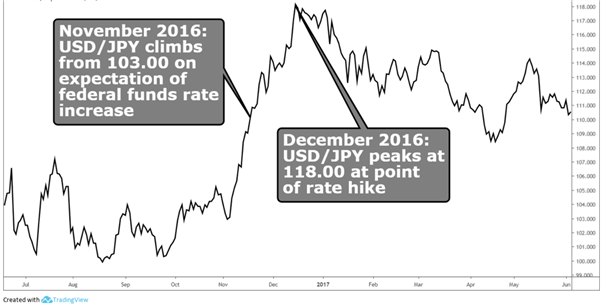
Chart to show the impact of Fed hikes on USD/JPY

How to Trade the Fed Monetary Policy Decisions

In order to prepare for Fed rate change decisions, traders should follow these two key steps:

  1. Keep up with news from the Fed. The FOMC holds eight regular meetings a year, where policies and interest rates are discussed and agreed upon. Keeping up with news ahead of these meetings is the best way to make predictions about interest rates, and whether to buy or sell the US dollar
  2. Keep with news from the markets. Rest assured that it won’t just be you speculating on interest rates – ahead of Federal Reserve meetings and announcements, many forex traders will be watching what happens very closely. Keep an eye out for others’ predictions and forecasts, and stay well informed enough that you can have your own opinions and add your own logic to that of others

No method of predicting interest rate decisions can ever be completely accurate and surprises do occur. It’s always important to protect yourself when trading forex, so make sure you place stops in advance to ensure you keep your losses to a minimum should the markets move against you.

Remember to stick to your trading plan and never place a trade where you wouldn’t be able to afford the losses. Trades can go both ways. No matter how sure you feel that they will work in your favour, there’s always the chance that they might not.

Top Takeaways on the Fed and Forex Trading

Gold Price Forecast – Gold Markets Rally on Tuesday

Gold Price Forecast – Gold Markets Rally on Tuesday

Gold Market Technical Analysis

Gold markets have rallied a bit during the trading session on Tuesday, as we have continued the bounce from the 200-Day EMA. Ultimately, this is a market that I think continues to go much higher, but whether or not it happens right away is a completely different question altogether. When I look at this chart, it’s obvious to me that we have a potential recovery just waiting to happen and you could make an argument that we have just found a bit of a “double bottom.”

Trading Derivatives carries a high level of risk to your capital and you should only trade with money you can afford to lose. Trading Derivatives may not be suitable for all investors, so please ensure that you fully understand the risks involved, and seek independent advice if necessary. A Product Disclosure Statement (PDS) can be obtained either from this website or on request from our offices and should be considered before entering into a transaction with us. Raw Spread accounts offer spreads from 0.0 pips with a commission charge of USD $3.50 per 100k traded. Standard account offer spreads from 1 pips with no additional commission charges. Spreads on CFD indices start at 0.4 points. The information on this site is not directed at residents in any country or jurisdiction where such distribution or use would be contrary to local law or regulation.

The 200-Day EMA is quite often widely followed as a major trend indicator, but at this point in time it also ties in quite nicely with the previous support level. With that being the case, the market is going to continue to be very noisy, but at this point in time it’s going to come down to the US dollar and probably whatever happens during the Jackson Hole symposium.

After all, this is a market that I think continues to see a lot of questions asked of the interest rate policy coming out of central banks, so it’ll be interesting to see how that comes into play when it comes to the gold market. After all, the higher interest rates mean that gold suffers a bit, but if we start to see signs that the interest rates out there start to drop, that will most certainly drive gold higher in and of itself. That being said, there is also the negative correlation to the US dollar, and the fact that Christine Legarde and Jerome Powell are speaking on Friday almost certainly will bring a lot of volatility into this market.

As long as we can stay above the $1900 level, I don’t have any interest in trying to short this market, and therefore I think it’s probably a move toward the $2000 level as a potential outcome. After all, that would just be a certain amount of consolidation more than anything else, and it would not take a lot to make that happen. However, if we were to break down below the $1900 level, then it opens up a potential move toward the $1800 level.

Silver Price Forecast – Silver Continues to Rally on Softer US Dollar

Silver Price Forecast – Silver Continues to Rally on Softer US Dollar

Silver Markets Technical Analysis

Silver continues to see upward pressure, as it looks like we are trying to reach toward the 50-Day EMA. The 50-Day EMA is closer to the $23.65 level, if we can break above there is likely that the market could go looking to the $24 level. Above that you have the $25 level which is the top of the overall consolidation area. Remember, silver is highly sensitive to the US dollar, as it has a huge negative correlation. If the US dollar continues to soften, it will drive the price of silver higher.

Trading Derivatives carries a high level of risk to your capital and you should only trade with money you can afford to lose. Trading Derivatives may not be suitable for all investors, so please ensure that you fully understand the risks involved, and seek independent advice if necessary. A Product Disclosure Statement (PDS) can be obtained either from this website or on request from our offices and should be considered before entering into a transaction with us. Raw Spread accounts offer spreads from 0.0 pips with a commission charge of USD $3.50 per 100k traded. Standard account offer spreads from 1 pips with no additional commission charges. Spreads on CFD indices start at 0.4 points. The information on this site is not directed at residents in any country or jurisdiction where such distribution or use would be contrary to local law or regulation.

On the other hand, if the US dollar starts to turn things around and strengthen again, the market will then go looking to the downside in this market, reaching toward the $22.50 level, perhaps even down to the $22 level. If we were to break down below that level, it would open up a significant drop down to the $20 level, which of course is a large, round, psychologically significant figure and an area where we rallied from to kick off all of the positivity that we had seen.

All things being equal, I think this is a market that you need to be very cautious with, as the volatility is extraordinarily difficult in this market. The position sizing is crucial, and therefore you don’t want to jump “all in” into the silver market as it can be quite wild at times. Nonetheless, it does look like we are trying to get to the top of the overall consolidation range, and therefore I think we have a potential sizable run. However, if we were to break above the $25.50 level, then the market could go up to the $26.50 level where we had peaked during the month of May.

All things being equal, this is a market that continues to be noisy so therefore you have to be very cautious, and you also have to recognize that this is a situation where the currency crosswinds will continue to be a major thing to pay attention to, so remember not to trade silver in a vacuum, as it can be highly sensitive.

XRP Legal Battle: SEC Acknowledges Non-Security Status

XRP Legal Battle: SEC Acknowledges Non-Security Status

Bitcoin, Ethereum and XRP Forecast Video for 22.08.23 by Tim Smith

In a recent court filing, the U.S. Securities and Exchange Commission (SEC) has acknowledged that digital assets, including Ripple Labs’ native token XRP (XRP), are not inherently securities. This admission comes as part of the SEC’s appeal against a ruling in favor of Ripple.

Trading Derivatives carries a high level of risk to your capital and you should only trade with money you can afford to lose. Trading Derivatives may not be suitable for all investors, so please ensure that you fully understand the risks involved, and seek independent advice if necessary. A Product Disclosure Statement (PDS) can be obtained either from this website or on request from our offices and should be considered before entering into a transaction with us. Raw Spread accounts offer spreads from 0.0 pips with a commission charge of USD $3.50 per 100k traded. Standard account offer spreads from 1 pips with no additional commission charges. Spreads on CFD indices start at 0.4 points. The information on this site is not directed at residents in any country or jurisdiction where such distribution or use would be contrary to local law or regulation.

The SEC stated in its appeal that it “does not seek appellate review of any holding relating to the fact that the underlying assets here are nothing but computer code with no inherent value,” thereby acknowledging that digital assets are not inherently securities. Pro XRP attorney John E. Deaton attributes the SEC’s shift in stance to a class action lawsuit leveled at the securities watchdog by 75,000 XRP investors. “I have to say there is no doubt 75k Ripple holders are a major reason the SEC is conceding this. We fought to have the judge actually write that the token itself is not the security. In fact, it was the first section in our argument in the brief,” Deaton tweeted to his 290,000 followers.

SEC’s Initial Appeal Game Plane

The SEC intended to appeal Judge Analisa Torres’ rulings on Ripple’s programmatic exchange sales of XRP and its distributions of XRP as payment for services, asserting that those offerings were not securities. However, it did not wish to appeal the court’s ruling that Ripple’s institutional XRP sales satisfied the Howey test, a tool used to determine whether an offer is an investment contract.

Last month, a New York judge ruled that XRP does not constitute a security. This ruling will likely set a precedent in cases filed by the SEC against Binance and Coinbase, two of the world’s largest centralized cryptocurrency exchanges. It may also help pave the way for issuers gaining regulatory approval for cryptocurrency spot exchange-traded funds (ETFs). Below, we use technical analysis to outline important trading levels in XRP, Bitcoin (BTC), and Ethereum (ETH).

Technical Analysis:  XRP, Bitcoin and Ethereum

XRP

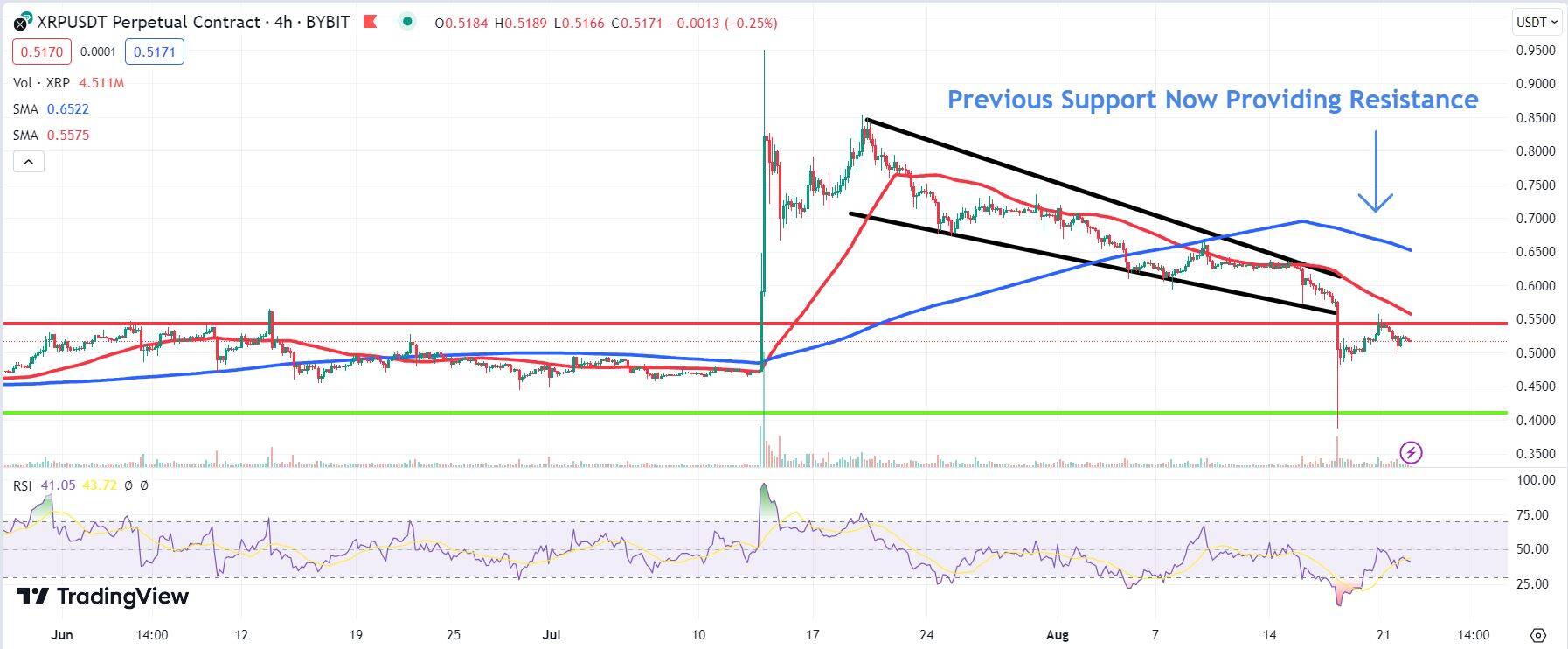
After a liquidation-style capitulation below previous support at $0.54, XRP’s price has staged a modest recovery. However, that level has now flipped into resistance, with bears quick to book profits on the retest. Volume remains weak, increasing the risk of short-term volatility. A convincing close back above the closely-watched $0.54 level could see bulls make a run toward overhead resistance at around $0.61. Alternatively, further selling may see prices revisit the next level of lower support at $0.42.

Chart depicting the XRP price.

Bitcoin

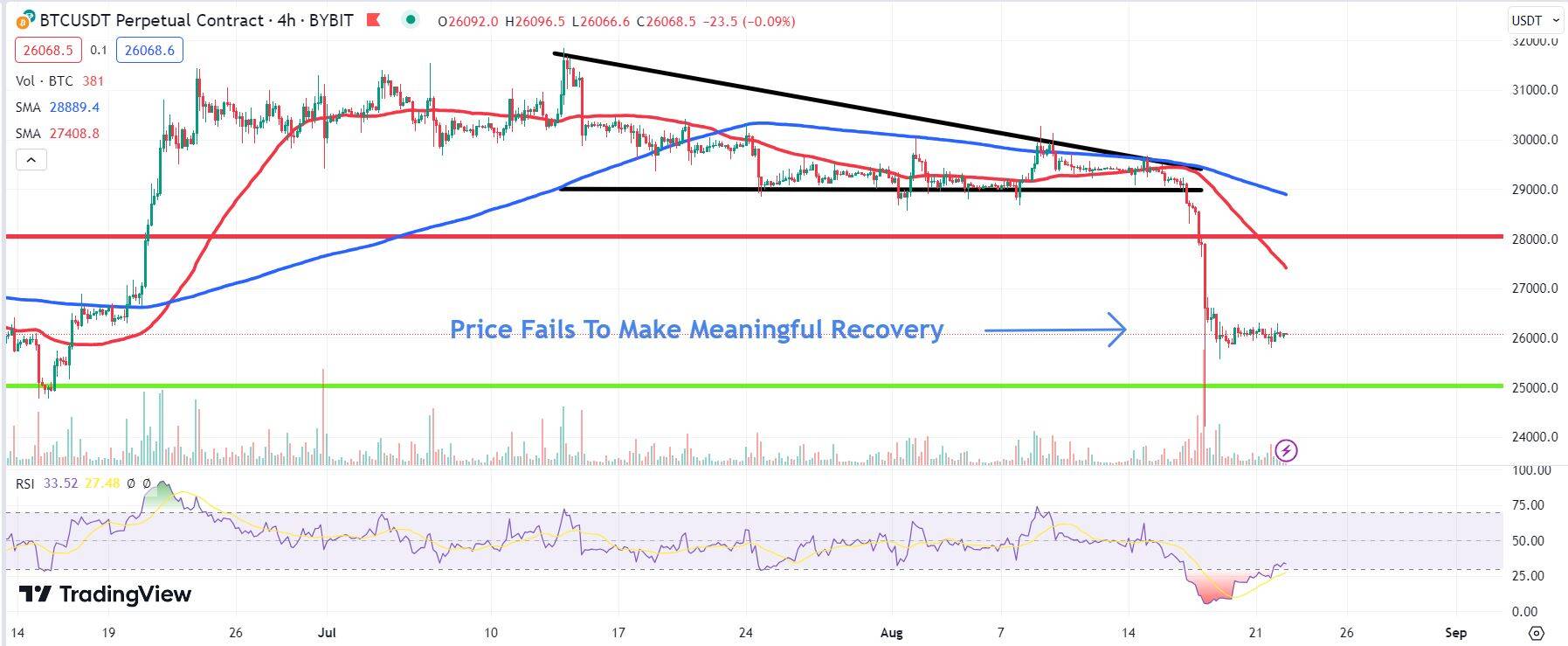
Since breaking down from a descending triangle, the King’s price has failed to make any sort of meaningful recovery. With lackluster trading volume accompanying the sharp sell-off, Bitcoin’s price too, is prone to short-term price fluctuations in either direction. Further selling could see falls to key longer-term support at the psychological $25,000 level. Conversely, a bargain hunters’ rally could spark a retrace to overhead resistance at $28,000.

Chart depicting the BTC price.

Ethereum

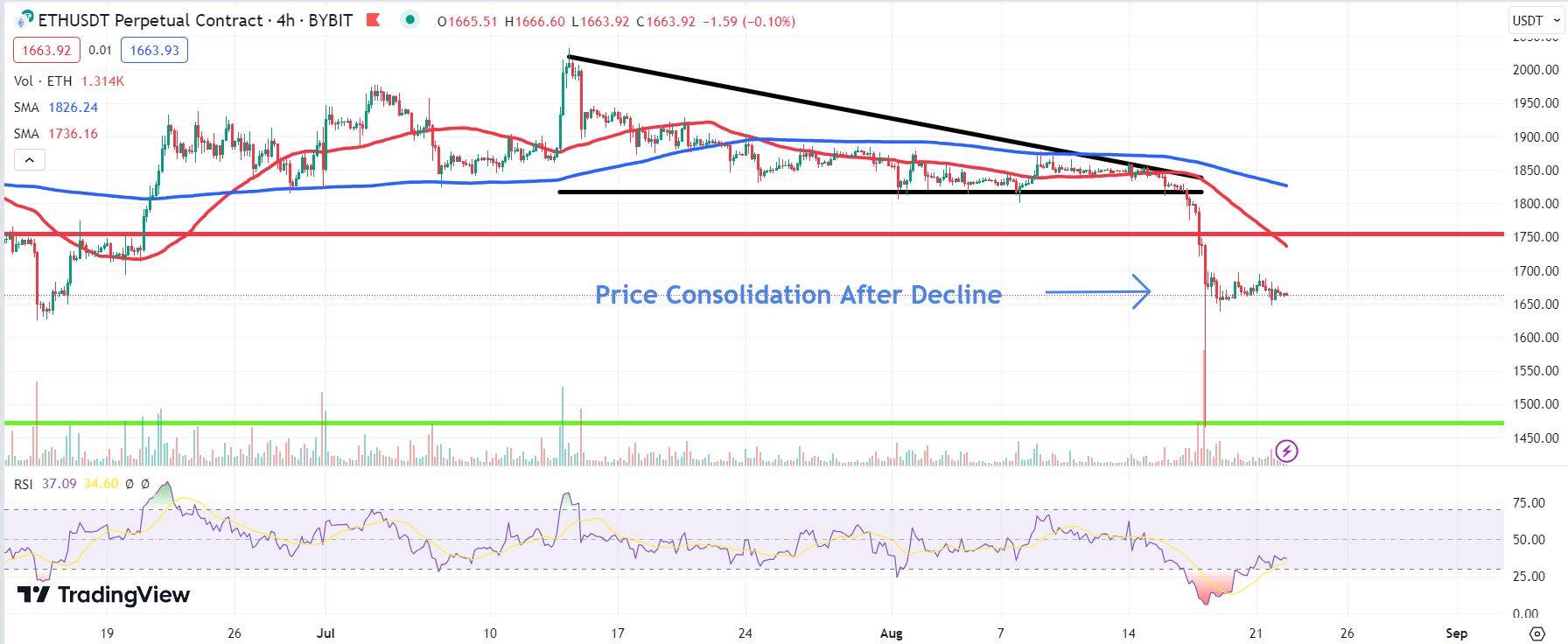
Ethereum’s price also remains firmly in the bear’s grasp after Friday’s steep decline. Directionless choppy trade over the weekend appears like consolidation before the next big move. Another leg lower could see bears claw falls to crucial support slightly below the closely-watched $1,500 level. Alternatively, a breakout above the week’s range could see a move to $1,757, where the price finds a confluence of resistance from a previous support level and the falling 50-period SMA.

Chart depicting the ETH price.


Natural Gas Prices Forecast: Futures Waver Amid Weather Variability, Potential Australian LNG Strike

Natural Gas Prices Forecast: Futures Waver Amid Weather Variability, Potential Australian LNG Strike

US Natural Gas Futures React to Mixed Signals

US natural gas futures are experiencing a setback on Tuesday, despite a strong upturn the previous day. Factors include varying weather projections, demand concerns, potential strikes in Australia, and fluctuations in US LNG consumption.

Weather and Demand Dynamics

The hot weather forecasted until early September, especially in Texas, fueled a 3% rise in U.S. natural gas futures on Monday. This heatwave sustains high air conditioning demand. Still, Refinitiv reports that even with temperatures remaining high, U.S. gas demand might drop in the coming weeks due to the seasonal shift. Meanwhile, NatGasWeather points out impressive heatwaves hitting the US interior, forecasting a cooler pattern for the last week of August.

Trading Derivatives carries a high level of risk to your capital and you should only trade with money you can afford to lose. Trading Derivatives may not be suitable for all investors, so please ensure that you fully understand the risks involved, and seek independent advice if necessary. A Product Disclosure Statement (PDS) can be obtained either from this website or on request from our offices and should be considered before entering into a transaction with us. Raw Spread accounts offer spreads from 0.0 pips with a commission charge of USD $3.50 per 100k traded. Standard account offer spreads from 1 pips with no additional commission charges. Spreads on CFD indices start at 0.4 points. The information on this site is not directed at residents in any country or jurisdiction where such distribution or use would be contrary to local law or regulation.

Supply Landscape

US gas output showed a slight dip in August from 101.8 billion cubic feet per day (bcfd) in July to 101.7 bcfd. Despite this, May saw a record monthly supply of 102.2 bcfd. However, gas flows to major U.S. LNG export plants decreased from 12.7 bcfd in July to 12.3 bcfd in August, largely due to reductions at Cheniere Energy’s facility in Louisiana.

Geopolitical Implications

Australia, the world’s leading LNG exporter, is amidst labor tensions. Workers at Woodside’s North West Shelf and Chevron’s projects threaten to strike over wage concerns. This possibility has spurred global LNG prices as any disruption in Australia’s supply would have a profound global impact. Woodside’s CEO, Meg O’Neill, underscores the company’s focus on understanding workers’ concerns while also emphasizing their responsibility to stakeholders.

Short-Term Forecast

The potential strike in Australia, alongside other bullish factors, could support an upward trend in natural gas futures. Mixed demand and varying weather forecasts introduce volatility, but supply disruptions, especially from a significant player like Australia, are likely to have a pronounced bullish effect on prices.

At this time, the focus seems to be on the mixed weather-demand outlook, but this could change quickly if a strike is announced.

Technical Analysis


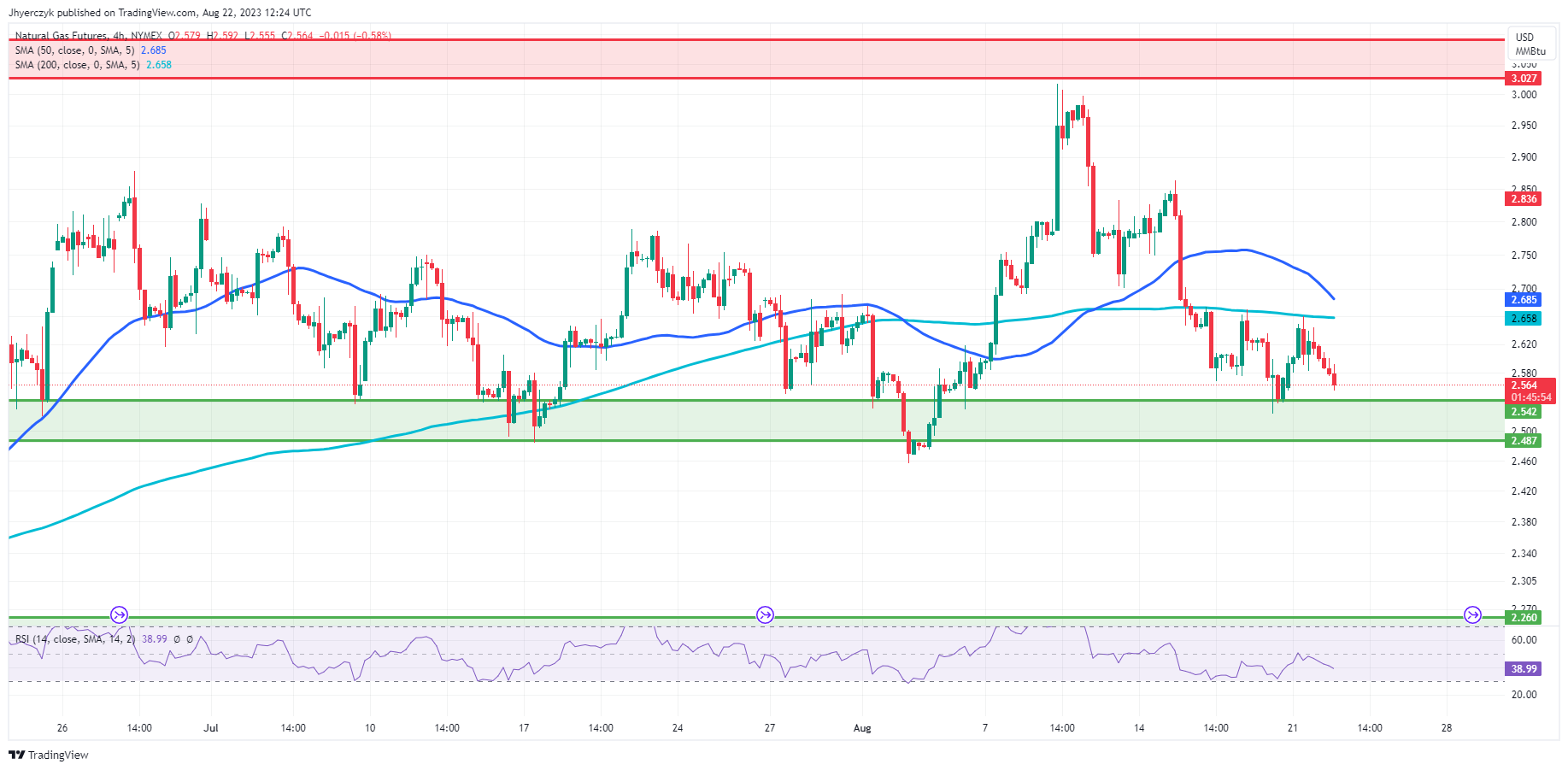
4-Hour Natural GasNatural Gas is currently trading at 2.571, slightly below its previous 4-hour close of 2.579. When analyzing the moving averages, the current price resides below both the 200-4H and 50-4H moving averages, with values at 2.658 and 2.685, respectively. This indicates a bearish momentum in the short term. Further supporting this bearish outlook is the 14-4H RSI which stands at 39.13, suggesting weakening momentum but not yet in the oversold territory.

The current price is positioned closer to the main support area (2.542 to 2.487) rather than the main resistance zone (3.027 to 3.091), underlining the bearish sentiment in the market.

S&P 500, Nasdaq 100 News: AI Optimism Propels Nvidia; Wall Street Awaits Powell’s Forecast.

S&P 500, Nasdaq 100 News: AI Optimism Propels Nvidia; Wall Street Awaits Powell’s Forecast.

Wall Street Looks Up as Nvidia Boosts Tech Stocks

Wall Street gears up for a positive open, propelled by growing optimism around Nvidia’s imminent earnings report and a retreat in longer-dated government bond yields. Nvidia’s stock, approaching its all-time high, has risen by 1.9% in pre-market trading, following a 9% boost from Monday. This uptick in tech stocks, especially with Nvidia leading the charge due to its role as an AI industry bellwether, has invigorated market sentiment. Beyond the tech sector, Tesla also made notable gains, advancing by 4.0%.

Economic Climate & Central Bank Watch

Recent bond sell-offs, driven by the robustness of the U.S. economy, have tempered expectations of the Federal Reserve easing its monetary policies in the near future. Investors remain on high alert for hints on future U.S. interest rate movements, with the forthcoming Jackson Hole meeting of central bankers poised to offer clarity. Fed Chair Jerome Powell’s forthcoming speech is especially anticipated, with traders pricing in an 86.5% chance of interest rate stability next month.

Trading Derivatives carries a high level of risk to your capital and you should only trade with money you can afford to lose. Trading Derivatives may not be suitable for all investors, so please ensure that you fully understand the risks involved, and seek independent advice if necessary. A Product Disclosure Statement (PDS) can be obtained either from this website or on request from our offices and should be considered before entering into a transaction with us. Raw Spread accounts offer spreads from 0.0 pips with a commission charge of USD $3.50 per 100k traded. Standard account offer spreads from 1 pips with no additional commission charges. Spreads on CFD indices start at 0.4 points. The information on this site is not directed at residents in any country or jurisdiction where such distribution or use would be contrary to local law or regulation.

Equity Movements & Financial Indicators

Interestingly, despite the 10-year Treasury yield soaring to levels unseen since November 2007, the Nasdaq Composite and the S&P 500 managed to carve gains. This development is unusual, given tech stocks’ historical adversity to high-rate scenarios. However, the Wall Street consensus remains divided, with some analysts apprehensive about the sustainability of this bullish momentum. Rising yields, they argue, could strain debt refinancing and potentially deter growth in tech stocks with elevated PE multiples.

Retail Giants & Market Performance

In the retail sector, Lowe’s and Macy’s unveiled their quarterly earnings. While Lowe’s observed a 2.5% premarket gain after confirming its annual guidance, Macy’s faced an approximately 8% decline due to a more cautious yearly outlook. Dick’s Sporting Goods reported a 23% drop in profits and slashed its earnings guidance for the year after it saw an uptick in retail theft and slow sales in its outdoor category, the company announced Tuesday.  As the week progresses, investors remain focused on Nvidia’s Wednesday earnings, viewing it as a key indicator of the AI industry’s health and overall market sentiment.

Short-term Outlook: Tech in Spotlight with AI-Driven Optimism

The upcoming days are pivotal for Wall Street, as traders await key insights from the Jackson Hole symposium and Jerome Powell’s statements on inflation. Concurrently, Nvidia’s earnings will serve as a crucial barometer for tech sector health. Despite uncertainties, recent tech stock performances hint at a potential alignment between the equity market and rising rates, painting a cautiously optimistic short-term forecast.

BRICS Summit Aims to Challenge US Dollar with Potential Boost to Gold, Silver

BRICS Summit Aims to Challenge US Dollar with Potential Boost to Gold, Silver

BRICS’ Emerging Influence and Implications for Precious Metals and the Dollar

The BRICS (Brazil, Russia, India, China, South Africa) summit in Johannesburg could have far-reaching ramifications for the world of finance, specifically for precious metals and the US dollar. As the bloc contemplates expansion and expresses discontent over the dominance of the US dollar in global trade, investors worldwide should be attentive to these seismic shifts in economic power dynamics.

Gold and Silver’s Renewed Importance

Historically, in periods of political and economic instability, gold and silver have been considered safe-haven assets. As BRICS nations push for a greater role in shaping the global financial landscape and challenge Western supremacy, uncertainties could cause a surge in demand for these precious metals. Additionally, the inclusion of Saudi Arabia, the world’s second-largest oil producer, could provide a further boost. If the bloc promotes trading oil in currencies other than the dollar or even in gold, it could drive up the prices of these metals.

The Dollar’s Hegemony Challenged

The US dollar’s preeminence in global transactions is under scrutiny. As highlighted in the summit, there’s a growing consensus among BRICS nations to conduct trade in local currencies. While the immediate dethroning of the dollar seems unlikely, a gradual move towards a multipolar financial world, where several currencies co-exist in global trade, is plausible.

Cobus van Staden’s, an analyst at the China Global South Project, analogy of “a lot of paper cuts” perfectly encapsulates the situation. BRICS may not deliver a knockout punch to the dollar, but a series of smaller actions could erode its dominance. These “paper cuts” may include bilateral trade agreements in local currencies, establishment of alternative payment systems, or even gold-backed financial instruments.

Ripple Effects on Precious Metal Markets

An erosion of confidence in the US dollar could trigger a bull market for precious metals. As nations seek to diversify away from dollar-centric systems, they might increase their gold and silver reserves. A multipolar currency world, where local currencies gain prominence, would likely have fluctuating exchange rates. This volatility could further push central banks and investors towards the stability offered by gold.

A New Geopolitical Gameboard

The US and its allies are closely watching the geopolitical aspirations of BRICS, especially the inclusion of nations like Saudi Arabia. As the bloc grows and its influence expands, it might create a counterweight to Western financial institutions. While the geopolitical repercussions are vast, from a financial perspective, it introduces a new set of players determining global precious metal demand and currency flows.

Summary

In conclusion, while the BRICS bloc grapples with internal differences, their united front against the dollar’s dominance signals a transformative phase in global finance. Precious metal investors and dollar watchers alike should keep a keen eye on the bloc’s decisions, as they have the potential to reshape the world’s economic landscape.

Inflationary Pressures Challenge German Economic Resilience

Inflationary Pressures Challenge German Economic Resilience

German Economy and Inflation Overview: Key Takeaways

The global economic environment has recently been dominated by a subdued activity, even though there are marked differences across regions. The German economy, the heartbeat of Europe, offers a case in point, showing only a marginal growth amid stubbornly high inflation rates.

Global Inflation Patterns

Despite a general decline in consumer price inflation rates worldwide, many economies are grappling with figures higher than desired. Advanced economies, for instance, posted an inflation rate of 4.3% by July, attributed largely to lower energy costs. However, the rates still loom above central bank targets, causing concerns. A significant reason for persistent inflation is the continuous pressure on wages and unrelenting commodity markets, with crude oil prices witnessing a surge since the end of June.

Central Bank Responses

In response to these challenging inflationary trends, central banks globally have opted to tighten their monetary policies. The European Central Bank (ECB) has been at the forefront, raising its key interest rates twice in succession by 25 basis points in June and July 2023. The intention is to rein in the inflationary tendencies and achieve a 2% medium-term target.

Credit Growth and Economic Activity

Credit growth in the Eurozone seems to be on the decline, majorly due to monetary policy tightening and a weakening economy. By the end of June 2023, the broad monetary aggregate M3 had fallen to just over ½%. The German economy, a significant part of the Eurozone, remains in a weak phase, with the economic output showing stagnation in the second quarter of 2023.

Short-Term Outlook

The inflation trend, especially core inflation, continues to be a challenge. German consumer prices, as indicated by the HICP, surged by a seasonally adjusted 1.0% in the second quarter. With the core rate of 5.6%, inflation remains a concern. On the brighter side, the labor market remains somewhat resilient, even though employment growth has slowed. From a policy standpoint, the high inflation environment mandates a cautious fiscal approach to avoid exacerbating the inflationary pressures.

In conclusion, while the German economy treads on uncertain grounds due to inflationary pressures, the central banks’ response and the labor market’s resilience offer some optimism for the coming months.

The Crypto Market Has Fallen Victim to the Safe-haven Demand

The Crypto Market Has Fallen Victim to the Safe-haven Demand

Bitcoin’s Drop Below Moving Averages Indicates Bearish Trend

The financial markets have been under pressure due to the trend of moving out of risky assets as government bond yields rose, said Alex Kuptsikevich, the FxPro senior market analyst. Cryptocurrencies seemed to be immune to this trend for a while, but last week, there was a switch to a sell-off mode amid rising US Treasury yields to 16-year highs and fears about China’s debt problems.

Crypto market capitalisation fell 9.7% last week to stabilise at $1.058 trillion, finding buyers on dips below $1.05 trillion. Technically, the market is still above the previous local lows of June, giving hope for a continued uptrend. However, it is worrying that July’s highs are lower than April’s.

Trading Derivatives carries a high level of risk to your capital and you should only trade with money you can afford to lose. Trading Derivatives may not be suitable for all investors, so please ensure that you fully understand the risks involved, and seek independent advice if necessary. A Product Disclosure Statement (PDS) can be obtained either from this website or on request from our offices and should be considered before entering into a transaction with us. Raw Spread accounts offer spreads from 0.0 pips with a commission charge of USD $3.50 per 100k traded. Standard account offer spreads from 1 pips with no additional commission charges. Spreads on CFD indices start at 0.4 points. The information on this site is not directed at residents in any country or jurisdiction where such distribution or use would be contrary to local law or regulation.

Bitcoin weekly chartBitcoin closed the week with a notable drop below its 200-week and 200-day moving averages, signalling a shift to a bearish trend. From current levels near $26.0K, the following area of decline appears to be the last pivot area at $24.7K.

Crypto News

According to JPMorgan, Bitcoin miners are exploring new lines of business ahead of the halving. According to the bank, miners could find it lucrative to provide computing services in the fast-growing artificial intelligence market.

The US Securities and Exchange Commission (SEC) is ready to approve the first applications for Ethereum futures ETFs in October, Bloomberg reported, citing sources. The SEC is now reviewing 11 applications to launch such ETFs.

Payments giant Mastercard has launched a CBDC innovation research partner programme with companies in the blockchain industry, including Ripple, ConsenSys and Fireblocks. Mastercard notes that 93% of the world’s central banks are experimenting with digital currency, and four retail CBDCs are already in circulation.

Oil Prices Forecast: WTI, Brent Futures Strength Reflects Tightening Supplies

Oil Prices Forecast: WTI, Brent Futures Strength Reflects Tightening Supplies

Oil Prices Climb Amid Tightening Global Supply

Oil prices witnessed a surge on Monday, with Brent and WTI crude futures observing an uptick, reflecting tighter global supply dynamics. Key exporters such as Saudi Arabia and Russia are trimming down their supply, rendering the overall supply-demand landscape intriguing for traders and investors.

Reduced Exports by Key Players

The tightening of global oil supply can be attributed to decisions made by significant oil exporters. Preliminary data from ship-tracking firm Kpler indicated a second consecutive month of falling OPEC+ crude exports in August. Saudi Arabia, in particular, has decreased its shipments to China by a significant 31% in July from June. Despite this decrease, Russia, offering its crude at discounted rates, has maintained its position as China’s top supplier.

Trading Derivatives carries a high level of risk to your capital and you should only trade with money you can afford to lose. Trading Derivatives may not be suitable for all investors, so please ensure that you fully understand the risks involved, and seek independent advice if necessary. A Product Disclosure Statement (PDS) can be obtained either from this website or on request from our offices and should be considered before entering into a transaction with us. Raw Spread accounts offer spreads from 0.0 pips with a commission charge of USD $3.50 per 100k traded. Standard account offer spreads from 1 pips with no additional commission charges. Spreads on CFD indices start at 0.4 points. The information on this site is not directed at residents in any country or jurisdiction where such distribution or use would be contrary to local law or regulation.


China’s Shift and Economic Concerns

As oil prices soared above $80 a barrel due to supply cuts by OPEC and allies, including Russia, China has opted to utilize its record inventories accumulated earlier this year. This has led Chinese refiners to cut back on new purchases. Additionally, amidst China’s deepening property crisis and potential sluggish economic growth, concerns about sustained oil demand growth have arisen. However, to capitalize on strong export margins, Chinese refiners have amplified their refined product exports in July.

US Oil Output and Interest Rate Concerns

On the American front, a drop in the number of operating oil rigs was noted, marking their lowest count since March 2022, according to Baker Hughes’ recent report. This comes alongside concerns about a persistent robust US dollar, given speculations that interest rates might remain elevated for an extended period.

Short-term Outlook

The prevailing scenario reflects a bullish short-term outlook for oil. With global supplies reducing and demand surging, unless an unforeseen economic downturn occurs, it seems OPEC+ holds the reins. The next movements, especially concerning interest rates and global economic health, will be critical for the oil market’s trajectory.

Technical Analysis

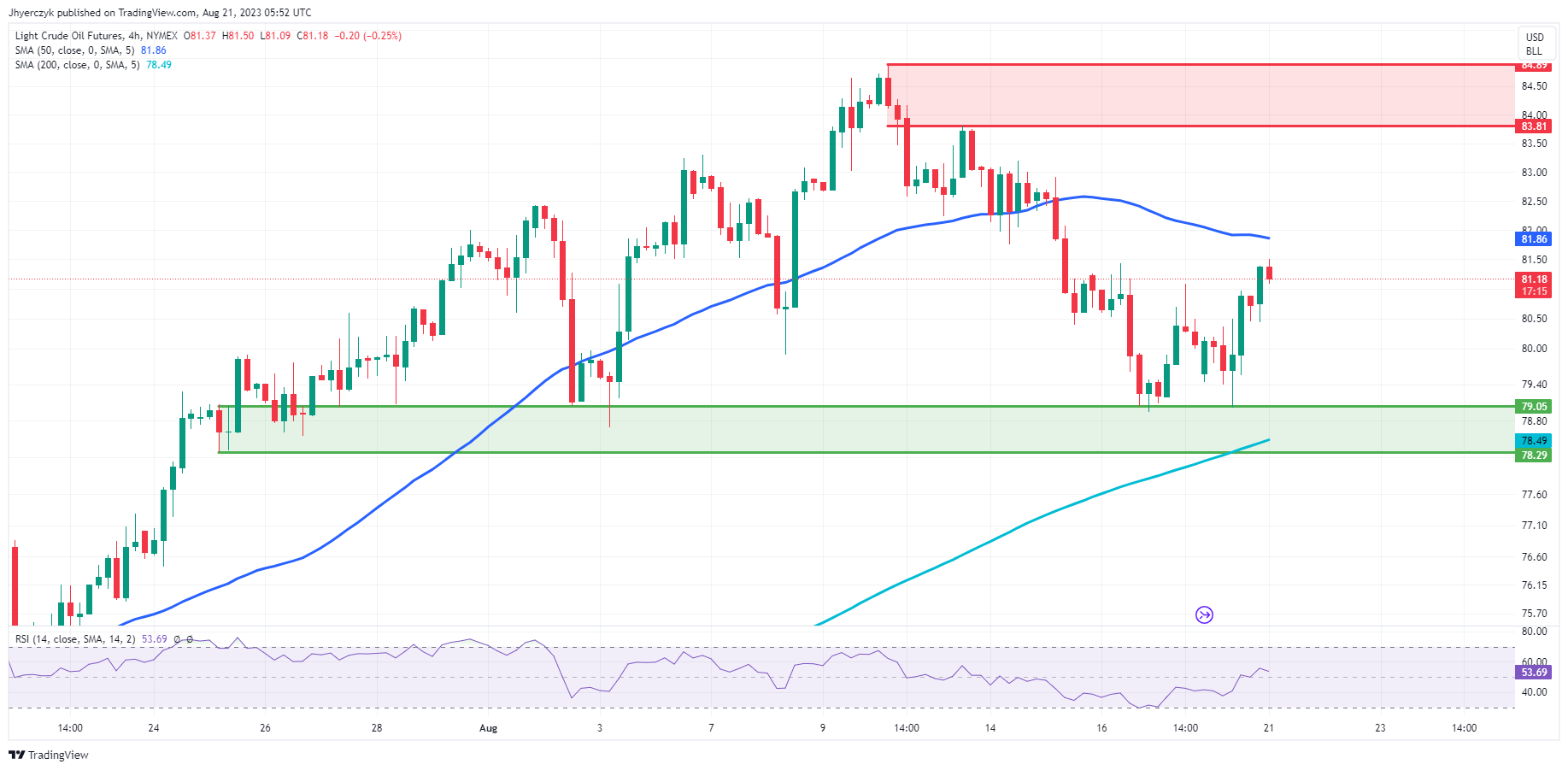
4-Hour Crude OilThe current 4-hour price for Crude Oil stands at $81.18, slightly below the previous 4-hour close of $81.38. This price resides comfortably between the 200-4H moving average of $78.49 and the 50-4H moving average of $81.86, suggesting a consolidation phase. The 14-4H RSI reads 53.49, slightly above the neutral 50 mark, indicating a tad stronger momentum.

With respect to key levels, the price is hovering just above the main support area of $79.05 to $78.29 and below the main resistance zone of $83.81 to $84.89. Given these technical indicators, the market sentiment for Crude Oil on a 4-hour timeframe appears to be mildly bullish but largely neutral.