

DAX Thursday Overview
On Thursday, the DAX slipped by 0.20%. Reversing a 0.10% gain from Wednesday, the DAX ended the day at 15,070.
The ECB and US Jobless Claims Affected the DAX
German trade data for August had a limited impact on early DAX movements. While the trade surplus widened, exports fell more than expected, sending more gloomy signals about the German economy.
Trading Derivatives carries a high level of risk to your capital and you should only trade with money you can afford to lose. Trading Derivatives may not be suitable for all investors, so please ensure that you fully understand the risks involved, and seek independent advice if necessary. A Product Disclosure Statement (PDS) can be obtained either from this website or on request from our offices and should be considered before entering into a transaction with us. Raw Spread accounts offer spreads from 0.0 pips with a commission charge of USD $3.50 per 100k traded. Standard account offer spreads from 1 pips with no additional commission charges. Spreads on CFD indices start at 0.4 points. The information on this site is not directed at residents in any country or jurisdiction where such distribution or use would be contrary to local law or regulation.
While investors brushed aside the latest trade data, comments from the ECB monetary policy conference influenced buyer appetite. The theme of the higher-for-longer interest rate path weighed on investor sentiment.
US 10-year Treasury yields remained in the driving seat ahead of the US jobless claims figures.
A more modest-than-expected increase in US jobless claims drove US 10-year Treasury yields to a session high. The better-than-expected initial jobless claims report raised uncertainty ahead of the US Jobs Report. While US job openings unexpectedly rose in August, the US ADP nonfarm report highlighted a weak increase in nonfarm employment.
A jump in 10-year US Treasury yields, responding to the jobless claims, left the US equity markets with modest losses. 10-year US Treasury yields retreated ahead of the US Jobs Report, allowing the US equity markets to recover from heavier losses.
The US equity markets ended the Thursday session with modest losses. On Thursday, the NASDAQ Composite Index and the S&P 500 saw losses of 0.12% and 0.12%. The Dow slipped by 0.03%.
The Thursday Market Movers
Adidas was the worst performer, sliding by 3.68%. The loss came in response to news of a gloomy analyst report on the outlook for Puma earnings.
However, the auto sector continued to struggle. BMW and Volkswagen declined by 1.16% and 0.99%. Mercedes-Benz Group and Continental ended the session down 0.79% and 0.55%, with Porsche falling by 0.41%.
Bank stocks were in recovery mode after a string of losses. Deutsche Bank and Commerzbank ended the day with gains of 0.30% and 0.49%.
German Factory Orders and the US Jobs Report in Focus
On Friday, the German economy will be in the spotlight again. Economic indicators continue to point to a German recession. Another slump in German factory orders will likely test investor resilience ahead of the US Jobs Report.
Economists forecast factory orders to rise by 1.8% in August vs. an 11.7% slump in July.
Beyond the economic indicators, ECB commentary also needs consideration after the ECB conference. While investors assume no further ECB rate hikes, uncertainty lingers about how long. A continued affirmation to keep interest rates higher would reduce the chances of a near-term rate cut.
US Jobs Report Will Have the Final Say
Later today, the all-important US Jobs Report will affect the appetite for riskier assets.
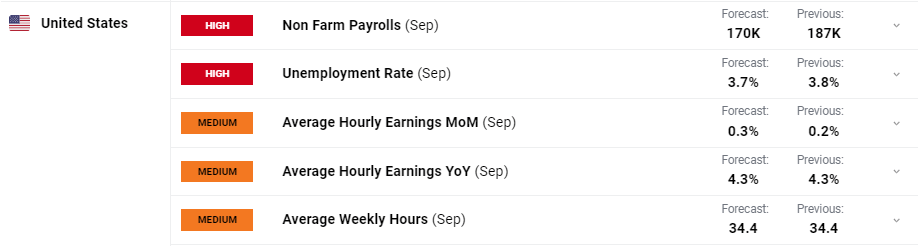
Economists forecast average hourly earnings to increase 0.3% in September (August: 0.2%). Significantly, economists predict a 170k increase in nonfarm and the unemployment rate to fall from 3.8% to 3.7%.
A pickup in wage growth and tighter labor market conditions would refuel bets on a Fed rate hike.
A Fed reaction to the US Jobs Report will also influence market risk sentiment. FOMC voting member Christopher Waller is on the calendar to speak after the Jobs Report is out.
The DAX and NASDAQ mini were down 28 and 8 points this morning.
Short-Term Forecast
The Futures market points to a negative start to the Friday session. Near-term trends will likely hinge on the US Jobs Report and the influence on US Treasuries and Fed rate hike bets. A pickup in wage growth and tighter labor market conditions would likely send the DAX toward 14,500 over the near term.
DAX Technical Indicators
Daily Chart
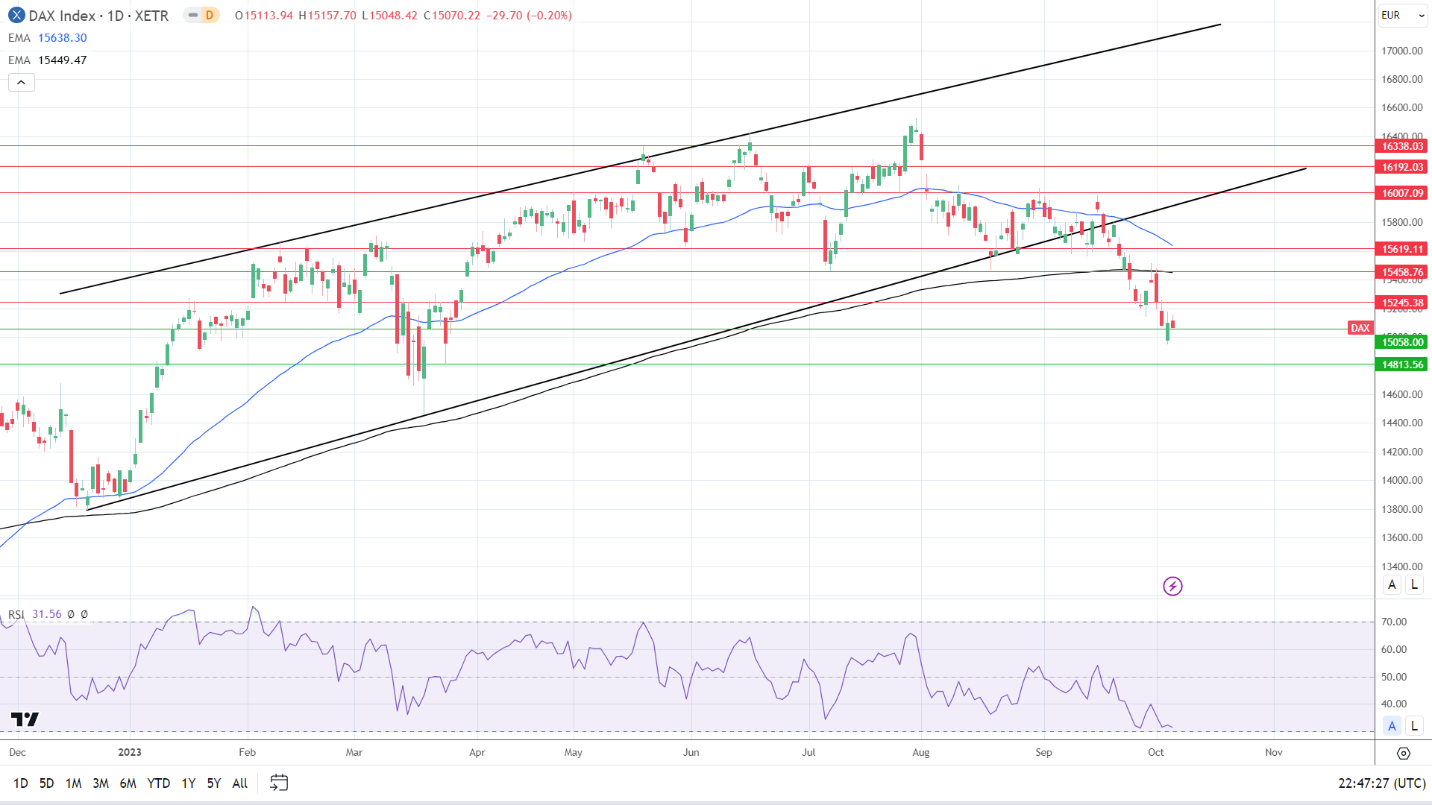
The DAX sat below the 50-day and 200-day EMAs, reaffirming bearish price signals. A move through the Thursday high of 15,158 would support a DAX move to the 15,245 resistance level.
A weaker-than-expected US Jobs Report would ease hawkish Fed bets and drive demand for riskier assets.
However, a fall in the US unemployment rate and more marked wage growth would test buyer appetite. A break below the 15,058 support level would give the bears a run at the 14,814 support level.
The 14-day RSI reading of 31.56 suggests a DAX fall through the 15,058 support level before entering oversold territory.
4-Hourly Chart
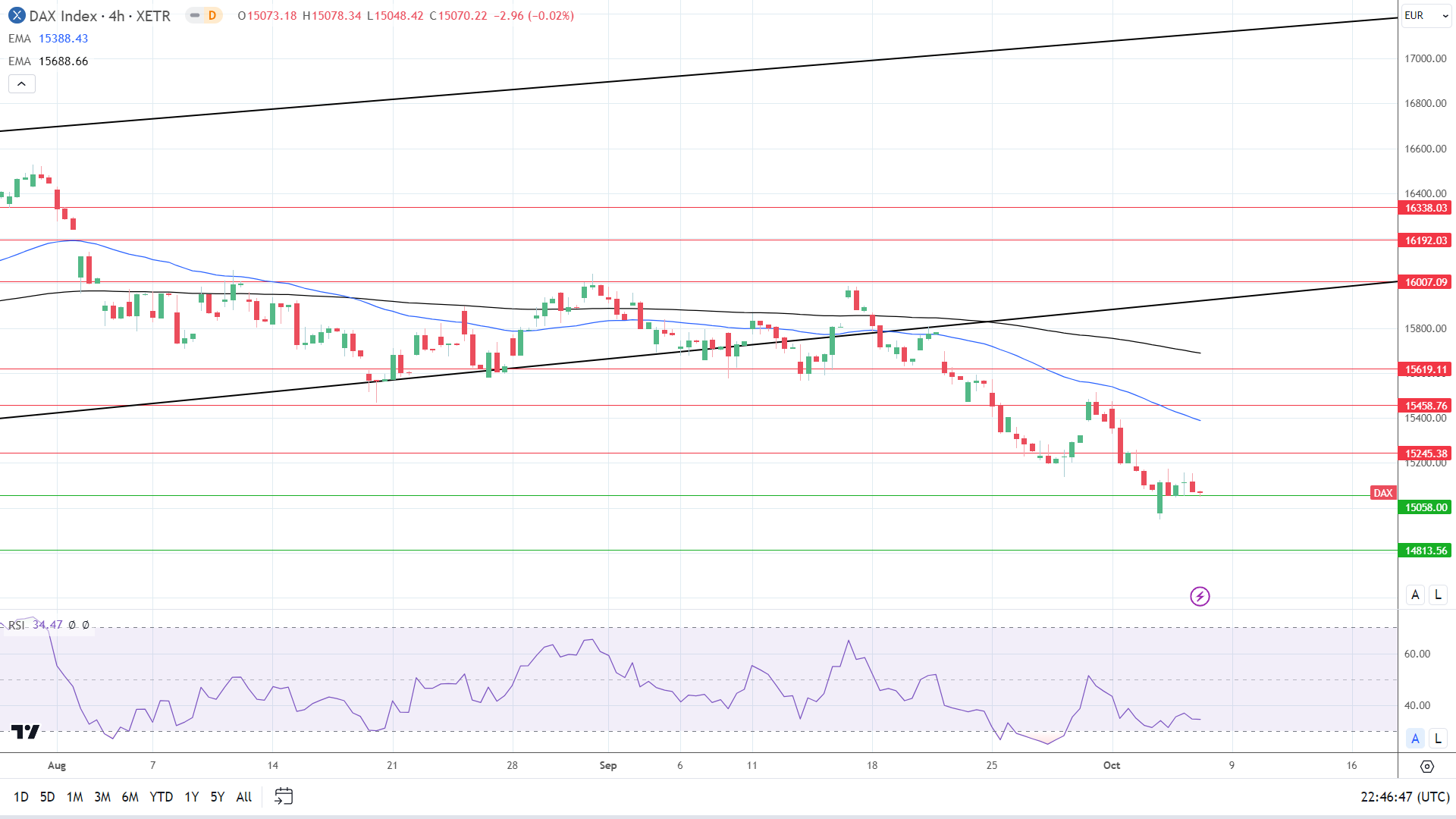
The DAX, remaining below the 50-day and 200-day EMAs, reaffirms the bearish price signals. A DAX move through the Thursday high of 15,158 would support a move to the 15,245 resistance level.
However, a break below the 15,058 support level would bring the 14,814 support level into play.
The 34.47 RSI reading supports a DAX fall below the 15,058 support level before entering the oversold territory.









 Chat now!