German Business Confidence Dips: ifo Index Reveals Economic Struggles

German Business Confidence Dips: ifo Index Reveals Economic Struggles

German Business Sentiment Wanes as ifo Index Declines

The ifo Business Climate Index, a key indicator of German business sentiment, has seen a notable decline in December 2023. Dropping to 86.4 points from November’s 87.2, the downturn reflects a growing dissatisfaction among companies regarding their current business status and a more skeptical view of the first half of 2024. This decline underscores the continued weakness in the German economy as the year concludes.

Sectoral Perspectives

In manufacturing, the dip in the Business Climate Index is particularly evident. Firms are reporting a significant deterioration in their current business conditions and a turn towards pessimism in their future expectations. Energy-intensive sectors are facing heightened challenges, with a general trend of shrinking order books. Conversely, the service sector shows a slight improvement. Service providers express increased satisfaction with their current state and a less skeptical outlook for the upcoming six months. However, the restaurant and catering industry, despite current improvements, anticipates a grim future.

Retail and Construction Concerns

The trade sector is experiencing its own struggles, with a marked downturn in both current conditions and future expectations. Retailers are feeling the pinch, evidenced by lackluster holiday trade results. The construction industry is not immune to this negative trend, recording its lowest Business Climate Index since September 2005. A significant number of construction firms foresee a further decline in business activities in the near future.

Short-Term Forecast

The collective sentiment across these varied sectors points to a bearish outlook for the German economy in the short term. The widespread decline in business confidence, especially in critical sectors like manufacturing and construction, signals potential challenges ahead.

Implications and Outlook

Clemens Fuest, President of the ifo Institute, highlights these findings as indicative of broader economic challenges. The mixed but generally pessimistic views across different sectors suggest that the German economy may face continued hurdles in the coming months. The situation calls for cautious monitoring, especially considering the potential impacts on the broader European economic landscape.

Gold Prices Forecast: XAU/USD Steady Amid Fed Moves, Global Economic Signals

Gold Prices Forecast: XAU/USD Steady Amid Fed Moves, Global Economic Signals

Gold Nearly Flat as Fed Influences Yields and Dollar

Gold (XAU/USD) is showing little change early Monday, trading at $2024.33, as traders consider the impact of the Federal Reserve’s recent policy shift on Treasury yields and the U.S. Dollar, alongside assessing recession risks for 2024.

Fed’s Influence on Market Dynamics

The Fed’s dovish pivot is a key factor influencing both U.S. Treasury yields and the dollar’s strength, which in turn affects gold prices. While market activity is expected to slow down heading into the Christmas holiday, key economic reports such as the U.S. Core PCE Price Index, Final GDP, and consumer sentiment data, as well as the U.K.’s CPI and Retail Sales figures, are anticipated to provide further direction.

Trading Derivatives carries a high level of risk to your capital and you should only trade with money you can afford to lose. Trading Derivatives may not be suitable for all investors, so please ensure that you fully understand the risks involved, and seek independent advice if necessary. A Product Disclosure Statement (PDS) can be obtained either from this website or on request from our offices and should be considered before entering into a transaction with us. Raw Spread accounts offer spreads from 0.0 pips with a commission charge of USD $3.50 per 100k traded. Standard account offer spreads from 1 pips with no additional commission charges. Spreads on CFD indices start at 0.4 points. The information on this site is not directed at residents in any country or jurisdiction where such distribution or use would be contrary to local law or regulation.

Global Central Banks and U.S. Economic Data

In addition to the Fed, the Bank of Japan’s policy meeting this week, where a shift from negative interest rates is on the table, is drawing attention. U.S. economic indicators, particularly the core PCE index report, are watched for clues on inflation trends and potential Fed actions.

Gold Prices Amid Economic Uncertainty

Gold prices are currently hovering around $2024.33, reflecting the market’s balancing act between the Fed’s dovish signals, fluctuating Treasury yields, and a shifting dollar. These factors, coupled with global central bank policies and upcoming economic reports, are key to determining gold’s short-term movement.

Short-Term Outlook for Gold

In the near term, gold’s direction will likely be shaped by the interplay of the Fed’s rate expectations, Treasury yield trends, and dollar fluctuations, against a backdrop of global economic data. Traders should remain vigilant to these influences to gauge gold’s trajectory.

Technical Analysis

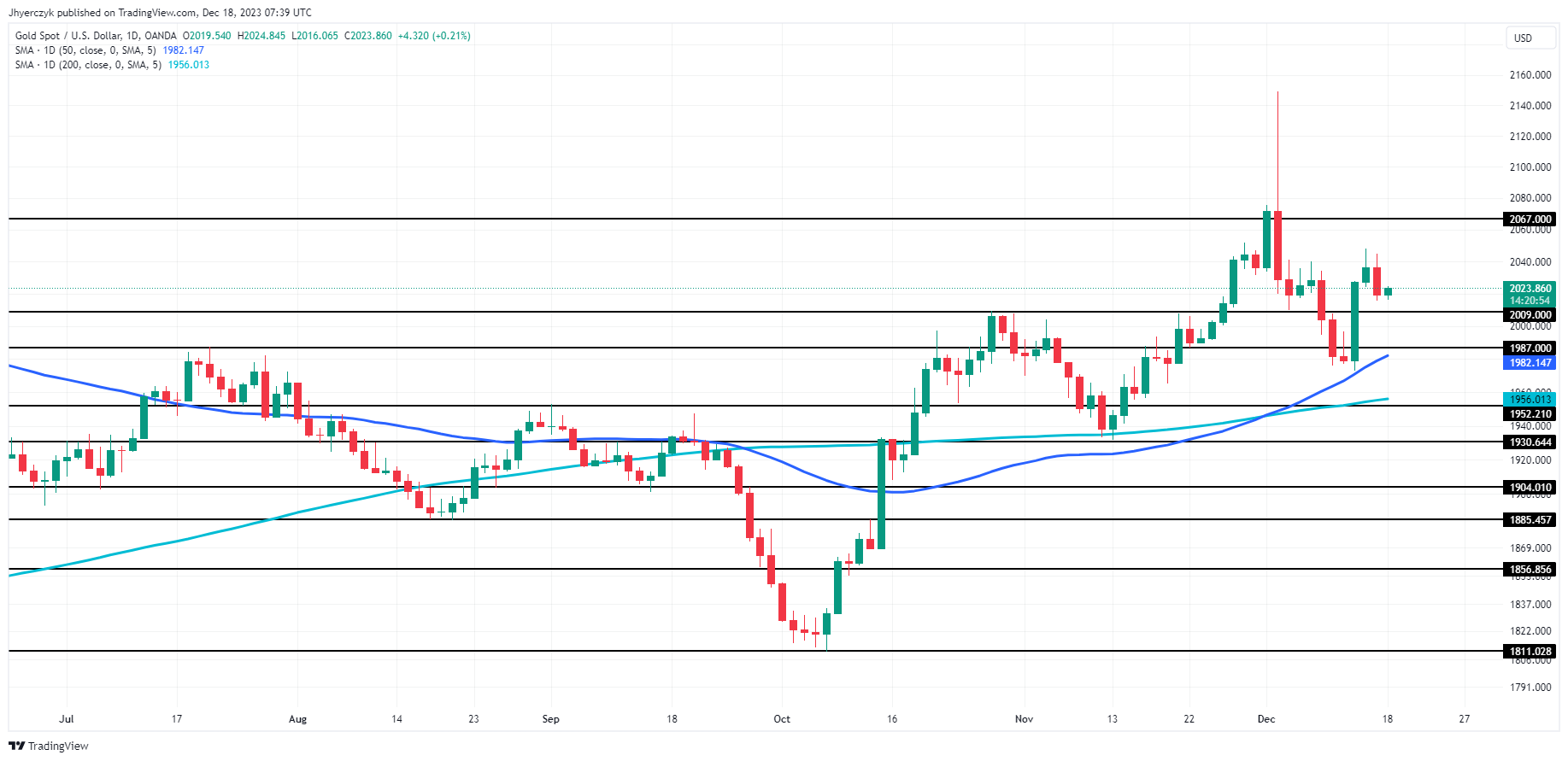
Daily Gold (XAU/USD)Gold (XAU/USD), currently trading at 2023.92, is showing a cautious upward movement as it sits above both the 200-day and 50-day moving averages, which are at 1956.01 and 1982.14 respectively. This positioning above the moving averages typically suggests a bullish trend in the medium to long term.

However, the price is hovering near the minor support level at 2009.00, indicating potential volatility and the need for close monitoring. The presence of main resistance at 2149.00 and minor resistance at 2067.00 sets clear benchmarks for further bullish momentum.

Overall, the market sentiment leans towards bullish, but with a note of caution due to the proximity of the support level and potential resistance challenges ahead. Relatively low volume could also be influencing the price action.

British Pound (GBP) Latest: GBP/USD on Hold Ahead of Inflation Report

British Pound (GBP) Latest: GBP/USD on Hold Ahead of Inflation Report

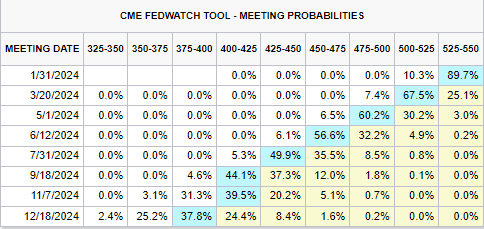
Sterling retains most of last week’s gains as we head towards the festive break, with cable testing 1.2700 as the US dollar slips in early trade. The greenback picked up a bid on Friday after Federal Reserve voting members, John Williams and Raphael Bostic both pushed back against market expectations of a series of rate cuts next year. Mr. Williams said in an interview that the Fed ‘isn’t really talking about rate cuts right now’, while Mr. Bostic said that the US central bank will likely cut rates twice next year, starting ‘sometime in the third quarter’. Current market pricing sees the Fed cutting rates six times, starting in March, for a total of 150 basis points.

image1.png

While Friday’s remarks from Williams and Bostic reversed the recent US dollar sell-off, it is unlikely that the recent strength in the US dollar will last for too long.

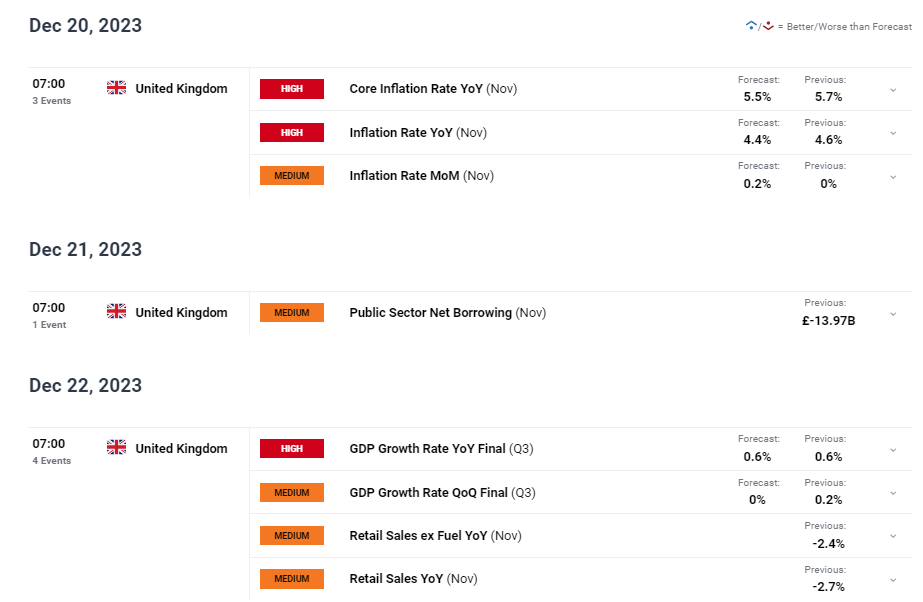
Ahead this week, the latest look at UK inflation and the final Q3 GDP report. UK inflation has been moving lower over the past months and a further move lower will increase pressure on BoE Governor Andrew Bailey to acknowledge that rates will move lower next year, in contrast to his hawkish tone at the last MPC meeting.

image2.png

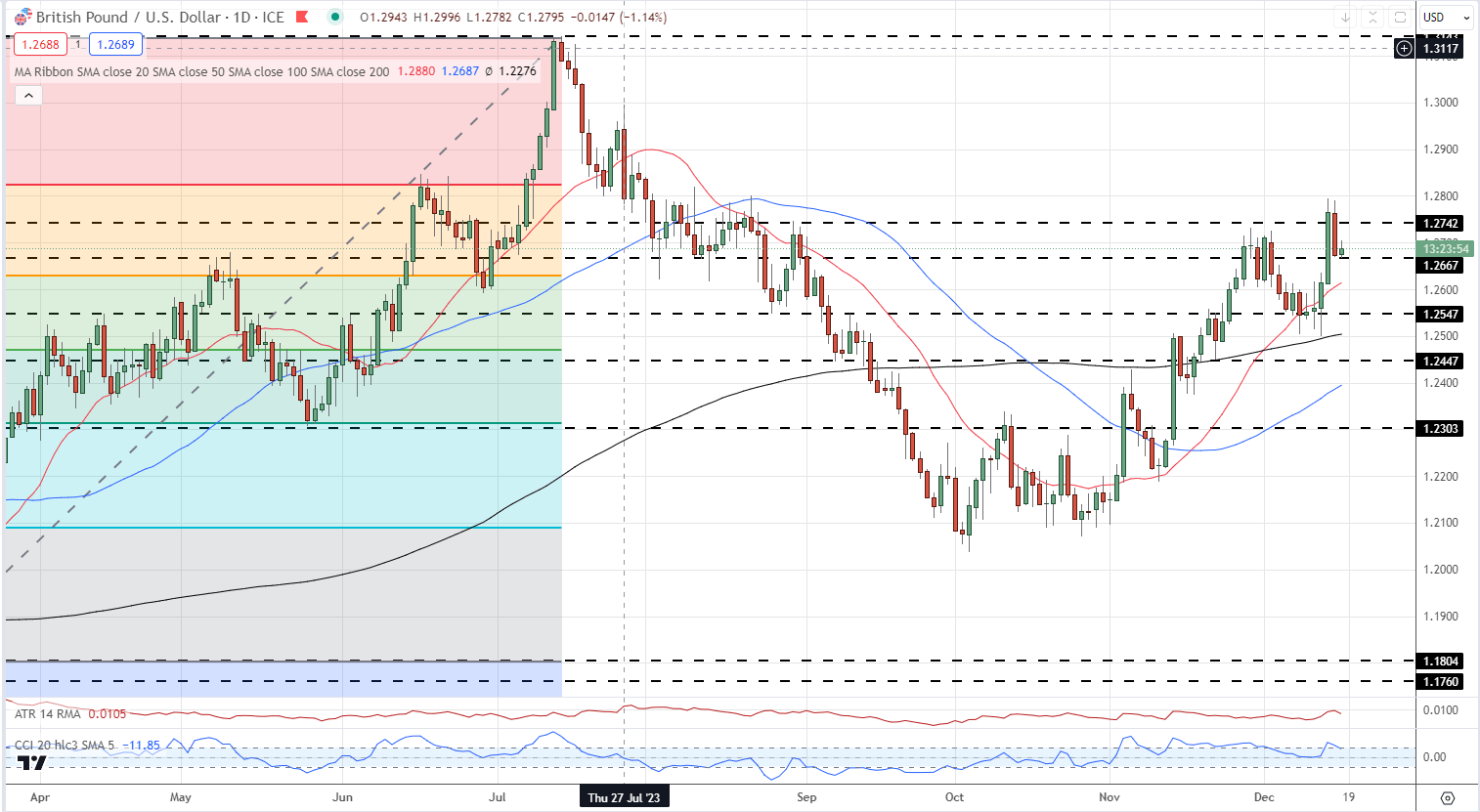
GBP/USD is just under 1.2700 in early turnover after Friday’s sell-off. Support for the pair starts around 1.2630 down to 1.2600 and this should hold going into the end of the year. The recent multi-week high at 1.2791 and the 23.6% Fibonacci retracement at 1.2826 will provide resistance in the coming days.

GBP/USD Daily Price Chart

image3.png

Retail trader GBP/USD data show 49.10% of traders are net-long with the ratio of traders short to long at 1.04 to 1.The number of traders net-long is 5.35% higher than yesterday and 8.44% lower than last week, while the number of traders net short is 5.86% higher than yesterday and 1.17% lower than last week.

What Trading Style Best Suits Your Personality?

What Trading Style Best Suits Your Personality?

Trading style often correlates with the personality of the trader. It is important to reflect internally on personality and lifestyle before choosing a trading strategy and creating a trading plan. This is because using a trading style contrary to your personality will lead to difficulties down the road in sticking to your trading plan.When a trader finds the trading style that suits them best; the style generally endures long term. A trader who isn’t comfortable with a trading style or has not found a home in a specific trading style is the one who most often makes the most common trading mistakes.

Trading Styles for Highly-Organized Individuals Short on Time

Strategies to consider:

  • Swing Trading– Swing trades are considered medium-term as positions are generally held anywhere between a few hours to a few days. The time investment is minimal which is suitable for traders short on time. Orders to open and close may be used which will automatically trigger once certain price levels are reached.
  • Automated Trading – Another approach for traders short on time, or trading in their spare time, is automated trading. Traders merely set their entry and exit criteria along with the size of the trade and allow the market to do the rest.

Trading Style for Cautious Individuals with Time to Research

Strategies to consider:

  • Position Trading – This is suitable for traders looking to hold positions for a prolonged period (months/years), often basing decisions on long-term fundamental factors. Large capital is required to withstand any potential volatility during the lifetime of the trade in order to avoid a margin call. Cautious individuals will also tend to trade smaller sizes, make use of stops, and avoid highly volatile markets.

Trading Style for Decisive Individuals who Prefer Instant Results

Strategies to consider:

  • Scalp Trading – A scalp trader looks to open and close a trade within minutes, often takingadvantage of small price movements usually with high leverage. Profits and losses are realized swiftly due to the fast-moving nature of this trading strategy. Decisive traders that seek instant results often trade the news by formulating an opinion of how the market is likely to react and plan accordingly.
The Bank of Japan: A Forex Trader’s Guide

The Bank of Japan: A Forex Trader’s Guide

What is the Bank of Japan?

The Bank of Japan, or Nichigin, is the Japanese central bank. It implements monetary policy and issues currency to maintain stability of the financial system. The bank’s Policy Board holds regular monetary policy meetings, deciding on their approach to interest rates, and how they intend to influence inflation.

Who Owns the Bank of Japan?

The government of Japan has a 55% ownership of the bank, and 100% voting interest. The remaining 45% is a public float, traded as JASDAQ. As of August 2019, the BoJ governor is Haruhiko Kuroda, who has held the position since March 2013 and is currently serving his second five-year term, which is due to run until April 2023.

Key Economic Mandates of Japan’s Central Bank

The BoJ considers its core mandates to be:

  1. Maintaining stability of the financial system
  2. Maintaining price stability

Maintaining stability of the financial system

The BoJ implements its monetary policy with the aim of maintaining financial system stability, which involves currency control, monetary control and the issuing of banknotes. This also feeds into the BoJ’s other core aim, as currency and monetary control is part of the plan to achieve price stability and develop the economy.

Maintaining price stability

Maintaining price stability is the other central aim of the BoJ. Exports are essential to Japan, so the BoJ tries to keep prices as stable as possible and will manipulate interest rates with the intention of developing the national economy. The bank defines ‘price stability’ as a 2% increase year on year in the Consumer Price Index (CPI).

How does the BoJ carry out its mandates?

The BoJ holds regular monetary policy meetings (MPMs), where it sets the official interest rate and other monetary policies in the hope that they will achieve price stability and financial system stability. MPMs are held eight times a year and last for two days, during which time the Policy Board (the Governor, two Deputy Governors and six other members) will discuss and implement monetary policy. As of July 2018, the base rate remains set at -0.1% in the hope of growing the economy.

How Bank of Japan Monetary Policies Affect the Yen

Japan has suffered from an ailing economy with very low inflation over the course of the last few decades, consistently failing to achieve 2% inflation. The BoJ has adopted what is known as a loose monetary policy, maintaining a low interest rate in the hope of boosting the economy.

When there is little incentive to save due to a low interest rate, the idea is that people will spend more, put money into the economy and encourage inflation. This has seen the yen becoming increasingly weak against major currencies, including the US Dollar and the Euro, ever since Kuroda took office.

USD/JPY went from 94.00 in March 2013 to over 125.00 in June 2015, after Kuroda announced his first raft of policy measures. And while it has fluctuated since then, the yen’s value has remained well below its level when he became governor, with USD/JPY sitting around 108.00 in July 2019.

USD/JPY chart showing the fluctuations in value around major BoJ announcements

Chart showing USD/JPY fluctuations around major BoJ announcements

Following a period from 2012 to 2013 when the yen was relatively strong against the US Dollar, it fell to USD/JPY 125.00 in June 2015 after the announcement of Kuroda’s initial policy measures. The value fell once again in January 2016, when Kuroda made the shock announcement that the bank would implement a negative interest rate for the first time ever, charging -0.1% on deposits held with the bank. This policy aims to get financial institutions to withdraw their cash to invest elsewhere, rather than making a loss by hoarding cash.

This announcement caught the markets by surprise as Kuroda had only recently told the parliamentary budget committee that he was not looking to introduce any policy changes for the time being. The yen fell against currencies including the dollar and pound, while the Japan 225 went up in the hours following his announcement.

ow to trade BOJ interest rate decisions

BoJ interest rate decisions are made with the aim of increasing spending and investment, influencing inflation. Changes in demand for stocks and currency as interest rates change can create forex trading opportunities. Even when interest rates remain the same, the anticipation surrounding important events like monetary policy meetings can affect the forex market.

Short-term interest rates are fundamental in determining currency valuation, so traders will watch them closely. Here’s the general pattern:

US Dollar Sinks on Fed Dovish Pivot, Setups on EUR/USD, USD/JPY, GBP/USD

US Dollar Sinks on Fed Dovish Pivot, Setups on EUR/USD, USD/JPY, GBP/USD

The U.S. dollar, as measured by the DXY index, plummeted nearly 0.9% on Wednesday, dragged lower by the massive plunge in U.S. Treasury rates after the Federal Reserve’s guidance surprised on the dovish side, catching investors, who were anticipating a different outcome, off guard and on the wrong side of the trade.

For context, the U.S. central bank today concluded its last meeting of the year. Although policymakers kept borrowing costs unchanged at multi-decade highs, they gave the first signs of an impending strategy pivot by embracing a more benevolent characterization of inflation and admitting that talk of rate cuts has begun.

Will the US dollar keep falling or reverse higher? Get all the answers in our quarterly outlook!

The Fed’s Summary of Economic Projection reinforced the view that a policy shift is on the horizon, with the dot plot showing 75 basis points of easing next year, far more than contemplated in September. While Wall Street’s rate-cut wagers have been extreme, the Fed’s forecasts are slowly converging toward the market’s outlook – this should be bearish for the greenback and yields moving into 2024.

With the broader U.S. dollar in a tailspin, EUR/USD soared towards the 1.0900 handle while GBP/USD jumped past an important ceiling near 1.2600. Meanwhile, USD/JPY nosedived, rapidly falling towards its 200-day simple moving average – the last line of defense against a larger retreat.

This article focuses on the technical outlook for major U.S. dollar pairs such as EUR/USD, USD/JPY and GBP/USD, examining key price levels after Wednesday’s outsize moves in the FX space.

For a complete overview of the euro’s technical and fundamental outlook, download your complimentary trading forecast now!

EUR/USD TECHNICAL ANALYSIS

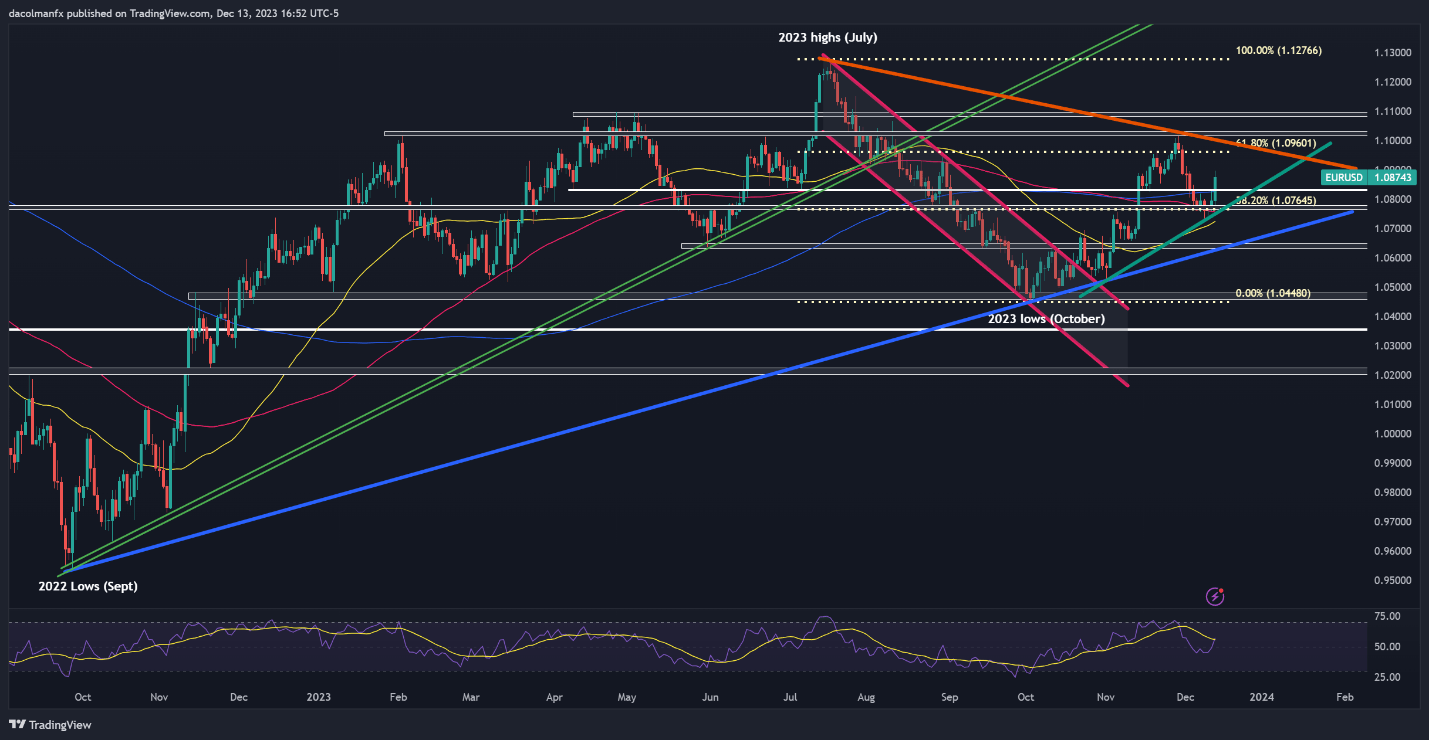
EUR/USD jumped on Wednesday, clearing technical resistance near 1.0830, corresponding to the 200-day simple moving average. If this bullish move is sustained in the coming days, the upside momentum could accelerate, setting the stage for a rally towards 1.0960, the 61.8% Fib retracement of the July/October decline. On further strength, attention would shift towards 1.1015, last month’s high.

On the other hand, if the upward impetus fades and prices resume their descent, the first support to monitor is located at 1.0830, but further losses could be in store for the pair on a push below this threshold, with the next area of interest at 1.0765. Continued weakness might draw focus towards trendline support, currently traversing the 1.0640 region.

EUR/USD TECHNICAL CHART

A screen shot of a graph Description automatically generated

EUR/USD Chart Prepared Using TradingView

For tips and expert insights on how to trade USD/JPY, download the yen’s guide!

USD/JPY TECHNICAL ANALYSIS

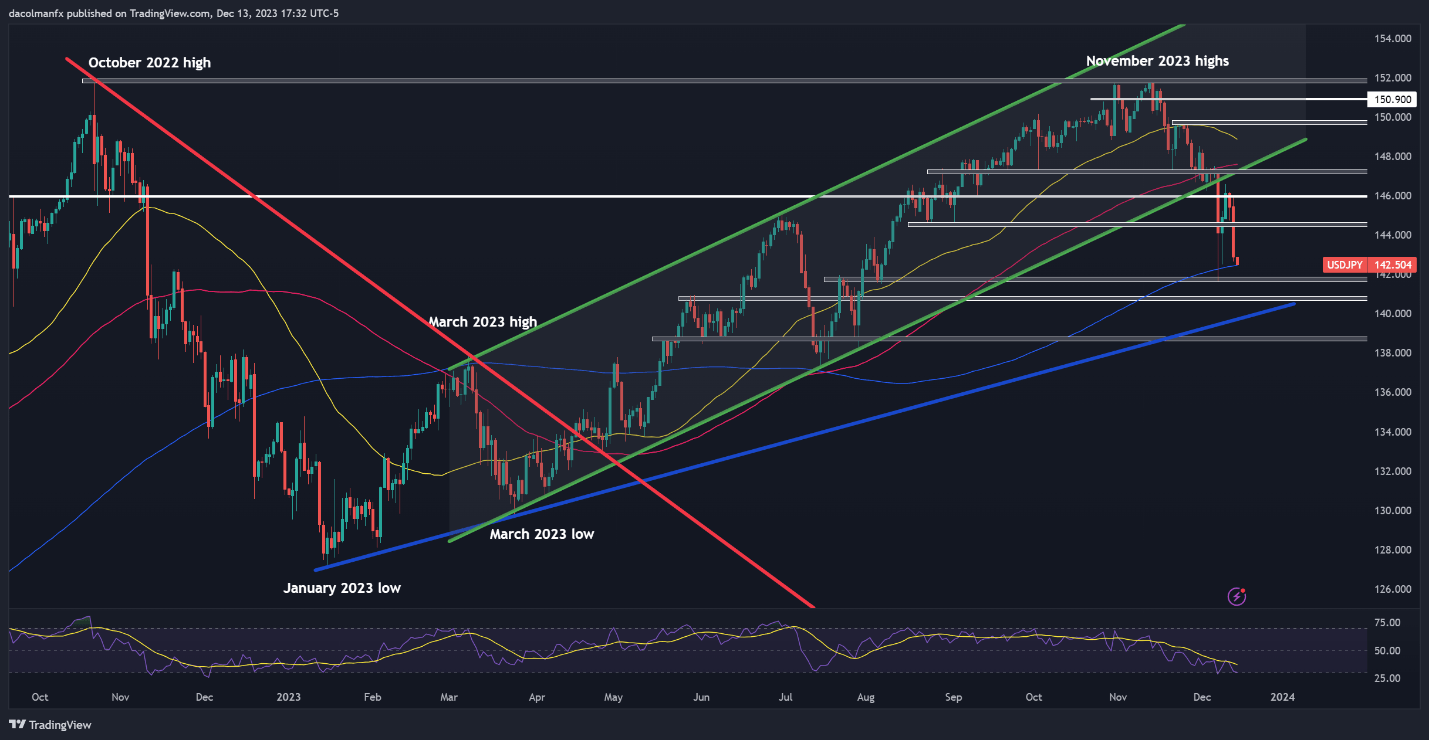
USD/JPY saw an upward push earlier this week, but this ascent hit an abrupt halt on Wednesday when the Fed triggered a massive U.S. dollar selloff. This drove the pair sharply lower, sending the exchange rate towards its 200-day SMA, the next major floor to watch. Bulls will need to staunchly defend this floor; failure to do so could spark a drop towards 141.70 and 140.70 thereafter.

Conversely, if USD/JPY resumes its rebound, technical resistance looms at 144.50. Buyers may have a difficult time breaching this barrier, but if they manage to drive prices above this ceiling, we could see a rally towards the 146.00 handle. On further strength, all eyes will be on 147.20.

USD/JPY TECHNICAL CHART

A screen shot of a graph Description automatically generated

USD/JPY Chart Created Using TradingView

Keen to understand the role of retail positioning in GBP/USD’s price action dynamics? Our sentiment guide delivers all the essential insights. Get your free copy now!

GBP/USD Mixed

Data provided by
of clients are net long.
Change in Longs Shorts OI
Daily -10% 1% -5%
Weekly -6% -8% -7%
What does it mean for price action?
Get My Guide

GBP/USD TECHNICAL ANALYSIS

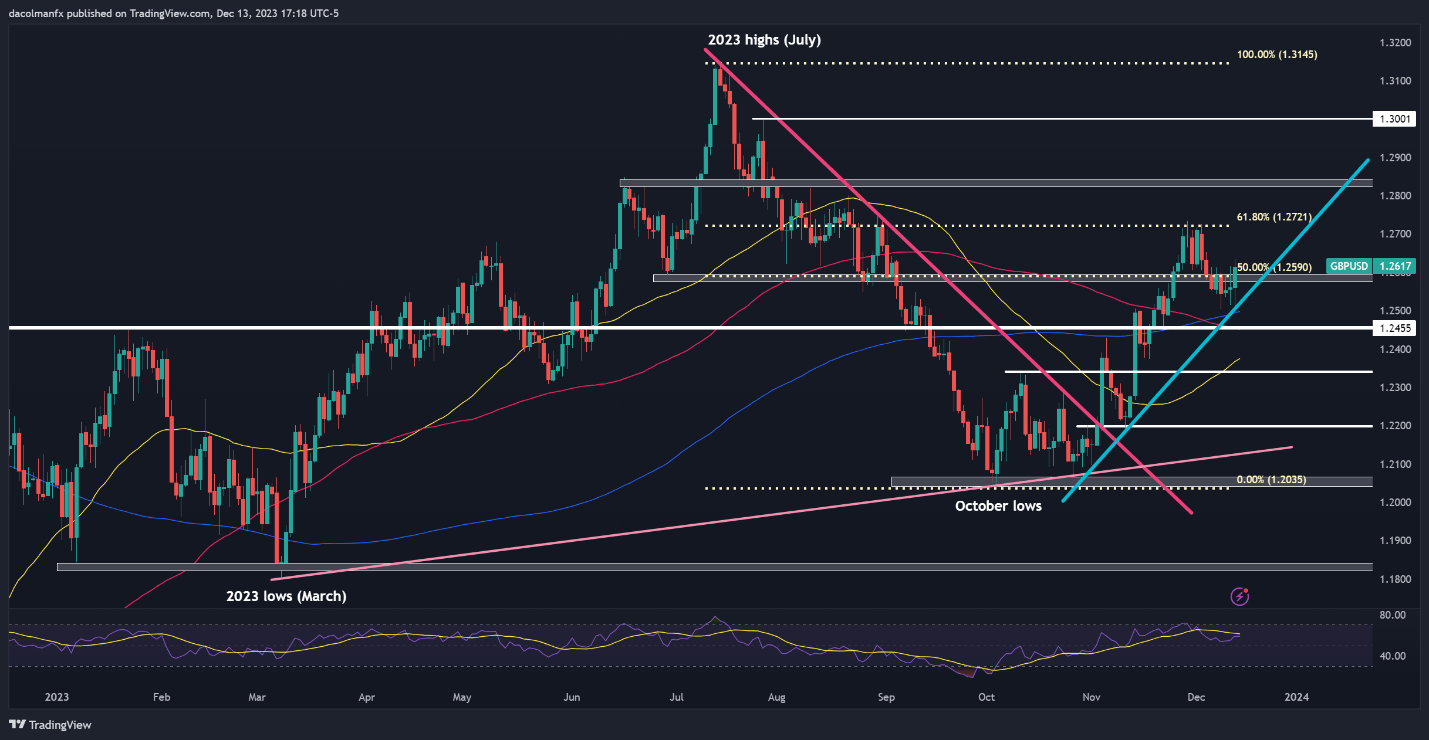
GBP/USD climbed and pushed past resistance at 1.2590 on Wednesday after bouncing off trendline support near 1.2500, with the advance reinforced by the broader U.S. dollar downturn. If the pair manages to hold onto recent gains and consolidates to the upside little by little, we could soon see a retest of 1.2720 level, the 61.8% Fib of the July/October retracement. Further up, all eyes will be on 1.2800.

On the other hand, if sellers return and trigger a bearish reversal, initial support appears at 1.2590, followed by 1.2500, near the 200-day simple moving average. Looking lower, the focus turns to 1.2455. Cable is likely to stabilize in this region on a pullback before mounting a possible comeback, but in the event of a breakdown, a move down to 1.2340 becomes a plausible scenario.

GBP/USD TECHNICAL CHART

A graph of stock market Description automatically generated

The Bank of England: A Forex Trader’s Guide

The Bank of England: A Forex Trader’s Guide

What is the Bank of England (BOE)?

Established in 1694, the Bank of England is the banker to, and owned by, the British government but is independent when setting monetary policy. Its roles include the setting of monetary policy – which includes targeting interest rates and using other tools to stimulate or contract the economy – producing the UK’s bank notes, supervising some bank payment systems, and ensuring the stability and safety of the financial system.

For traders, the BOE’s setting of monetary policy is a key factor to consider as it can have a big impact on the financial markets. Other factors, like the independence of the central bank are also important but are more prevalent issues in emerging market economies.

Key Economic Mandates of the Bank of England

According to the Bank of England, their two core purposes or mandates are:

1) Monetary stability – which is price stability or inflation

2) Financial stability – which is the stability and health of the economy

Monetary Stability

Monetary policy is extremely important for the entire economy. It prevents runaway inflation and attempts to ground inflation expectations so that the economy can grow at a regular pace. In order to maintain price stability, the Bank of England and their monetary policy committee (MPC) have set an inflation target of 2%.

If inflation goes above the target of 2% the Bank of England may increase interest rates. The increase in interest rates may cause an appreciation in the Pound as investors increase capital flows into the higher yielding currency. It may also have a negative affect on the stock market, as businesses will have to pay higher rates to lend and equity valuations will be discounted at a higher interest rate. Monetary policy data can be found on our economic calendar.

However, it is not always the case that the Bank of England will increase interest rates if inflation is above target. In some cases, like when GDP growth is still low or negative, the Bank of England may keep interest rates low to stimulate the economy. It is important to know the Bank of England will be looking for a balance between healthy inflation and economic growth.

Join our central bank webinar to watch our senior currency strategist discuss and analyze current central bank trends.

Financial Stability

The resilience of the financial system is paramount to the health of the UK economy and therefore necessary for the Bank of England to accommodate. To support Financial Stability mandates, the bank also has a Financial Policy Committee or FPC which was established in June 2011. From an FX point of view, the Monetary Stability is the key driver of spot rates for the GBP.

How BOE interest rates affect the Pound

Interest rate impact on the Pound

The Bank of England can affect the value of the Pound through changes in interest rate expectations. Traders should understand that currencies appreciate when interest rate expectations increase, not just from increases in the nominal interest rate.

For example, if the Bank of England keeps interest rates unchanged but issues forward guidance (tells the market) that they expect more interest rate hikes in future, the value of the Pound will appreciate. Likewise, decreases in future interest rate hike expectations, or expectations of an interest rate cut can lead to a decrease in the value of the Pound.

This is the general principle for how interest rates affect the Pound and stock market, although they sometimes react differently:

  1. Higher interest rate expectations increase the strength of the Pound (GBP) and negatively affect equity values.
  2. Lower interest rate expectations decrease the strength of the Pound (GBP) and positively affect equity values.

Interest rates aren’t the only monetary policy tool that can affect the currency, tools like quantitative easing can also lead to increases and decreases in the value of a currency. If the Bank of England announces that it plans to start a quantitative easing program (QE), the pound will likely depreciate as a large amount of liquidity enters the market, increasing the supply of money in the market and leading to a decrease in interest rates, or, simply to maintain current rates.

Interest rate impact on the economy

The Bank of England lowers interest rates when it is trying to stimulate the economy (GDP) and increases interest rates when it is trying to contain inflation caused by an economy operating above potential (overheating).

Lower interest rates stimulate an economy in a few ways:

  1. Businesses can borrow money and invest in projects that will receive more than the risk borrowing rate.
  2. When interest rates are lower the stock market is discounted at a lower rate, leading to an appreciation in stock market values which causes a wealth effect.
  3. People invest their money into the economy (stocks and other assets) because they can earn more in these assets than at currently low interest rates.

How to trade BOE interest rate decisions

The table below displays the possible scenarios that come from a change in interest rate expectations. Traders can use this information to forecast if the currency is likely to appreciate or depreciate and how to trade it.

Market expectations Actual Results Resulting FX Impact
Rate Hike Rate Hold Depreciation of currency
Rate Cut Rate Hold Appreciation of currency
Rate Hold Rate Hike Appreciation of currency
Rate Hold Rate Cut Depreciation of currency

Let’s look at the example below on GBP/USD. On August 4, 2016 the Bank of England cut interest rates and announced a stimulus package (quantitative easing program). The market reacted negatively and the Pound depreciated.

Bank of England cuts interest rate to new low

How Central Banks Impact the Forex Market

How Central Banks Impact the Forex Market

The role of central banks in the forex market

Central banks are mainly responsible for maintaining inflation in the interest of sustainable economic growth while contributing to the overall stability of the financial system. When central banks deem it necessary they will intervene in financial markets in line with the defined “Monetary Policy Framework”. The implementation of such policy is highly monitored and anticipated by forex traders seeking to take advantage of resulting currency movements.

This article focuses on the roles of the major central banks and how their policies affect the global forex market.

What is a central bank?

Central Banks are independent institutions utilized by nations around the world to assist in managing their commercial banking industry, set central bank interest rates and promote financial stability throughout the country.

Central banks intervene in the financial market by making use of the following:

  • Open market operations: Open market operations (OMO) describes the process whereby governments buy and sell government securities (bonds) in the open market, with the aim of expanding or contracting the amount of money in the banking system.
  • The central bank rate: The central bank rate, often referred to as the discount, or federal funds rate, is set by the monetary policy committee with the intention of increasing or decreasing economic activity. This may seem counter-intuitive, but an overheating economy leads to inflation and this is what central banks aim to maintain at a moderate level.

Central banks also act as a lender of last resort. If a government has a modest debt to GDP ratio and fails to raise money through a bond auction, the central bank can lend money to the government to meet its temporary liquidity shortage.

Having a central bank as the lender of last resort increases investor confidence. Investors are more at ease that governments will meet their debt obligations and this helps to lower government borrowing costs.

FX traders can monitor central bank announcements via the central bank calendar

Major central banks

Federal Reserve Bank (United States)

American flag representing the US central bank

The Federal Reserve Bank or “The Fed” presides over the most widely traded currency in the world according to the Triennial Central Bank Survey, 2016. Actions of The Fed have implications not only for the US dollar but for other currencies as well, which is why actions of the bank are observed with great interest. The Fed targets stable prices, maximum sustainable employment and moderate long-term interest rates.

European Central Bank (European Union)

European unio flag representing the European Central Bank

The European central bank (ECB) is like no other in that it serves as the central bank for all member states in the European Union. The ECB prioritizes safeguarding the value of the Euro and maintaining price stability. The Euro is the second most circulated currency in the world and therefore, generates close attention by forex traders.

Bank of England

English flag representing the Bank of England

The Bank of England operates as the UK’s central bank and has two objectives: monetary stability and financial stability. The UK operates using a Twin Peaks model when regulating the financial industry with the one “peak” being the Financial Conduct Authority (FCA) and the other the Prudential Regulating Authority (PRA). The Bank of England prudentially regulates financial services by requiring such firms to hold sufficient capital and have adequate risk controls in place.

Bank of Japan

Japanese flag representing the Bank of Japan

The Bank of Japan has prioritized price stability and stable operations of payment and settlement systems. The Bank of Japan has held interest rates below zero (negative interest rates) in a drastic attempt to revitalize the economy. Negative interest rates allow individuals to get paid to borrow money, but investors are disincentivised to deposit funds as this will incur a charge.

Central bank responsibilities

Central banks have been established to fulfil a mandate in order to serve the public interest. While responsibilities may differ between countries, the main responsibilities include the following:

1) Achieve and maintain price stability: Central banks are tasked with protecting the value of their currency. This is done by maintaining a modest level of inflation in the economy.

2) Promoting financial system stability: Central banks subject commercial banks to a series of stress testing to reduce systemic risk in the financial sector.

3) Fostering balanced and sustainable growth in an economy: In general, there are two main avenues in which a country can stimulate its economy. These are through Fiscal policy (government spending) or monetary policy (central bank intervention). When governments have exhausted their budgets, central banks are still able to initiate monetary policy in an attempt to stimulate the economy.

4) Supervising and regulating financial institutions: Central banks are tasked with the duty of regulating and supervising commercial banks in the public interest.

5) Minimize unemployment: Apart from price stability and sustainable growth, central banks may have an interest in minimising unemployment. This is one of the goals from the Federal Reserve.

Central Banks and interest rates

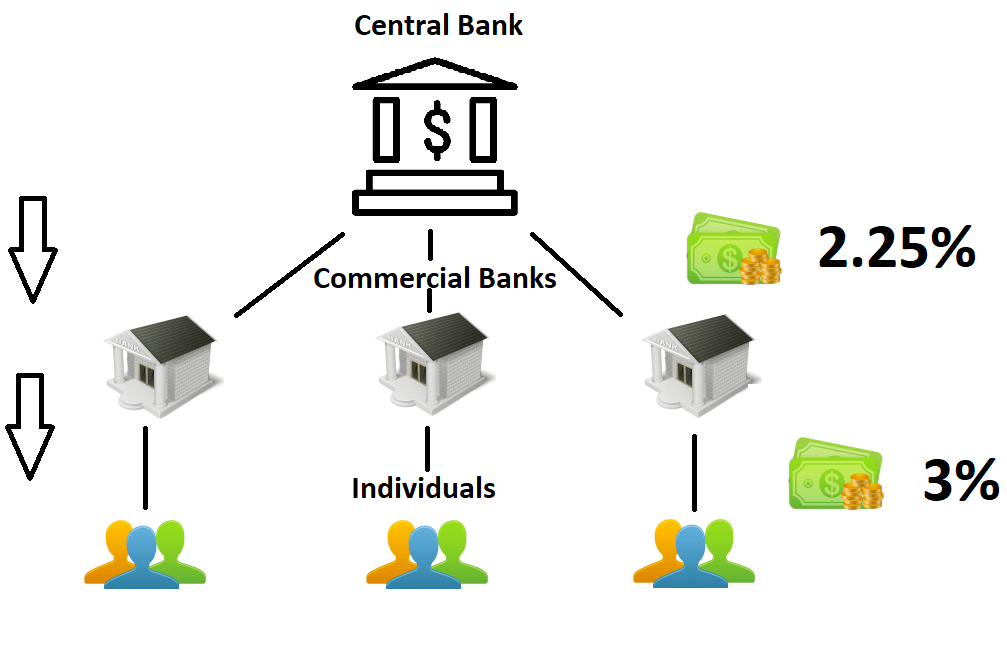
Central banks set the central bank interest rate, and all other interest rates that individuals experience on personal loans, home loans, credit cards etc, emanate from this base rate. The central bank interest rate is the interest rate that is charged to commercial banks looking to borrow money from the central bank on an overnight basis.

This effect of central bank interest rates is depicted below with the commercial banks charging a higher rate to individuals than the rate they can secure with the central bank.
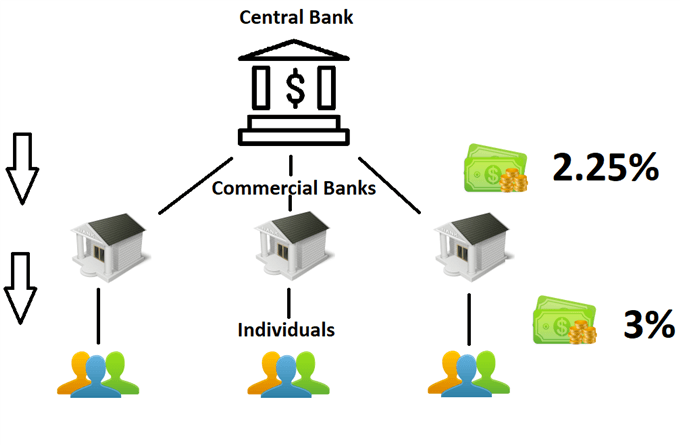
Central bank FX rates filtering down the system

Commercial banks need to borrow funds from the central bank in order to comply with a modern form of banking called Fractional Reserve Banking. Banks accept deposits and make loans meaning they need to ensure that there is sufficient cash to service daily withdrawals, while lending the rest of depositors’ money to businesses and other investors that require cash. The bank generates revenue through this process by charging a higher interest rate on loans while paying lower rates to depositors.

Central banks will define the specific percentage of all depositors’ funds (reserve) that banks are required to set aside, and should the bank fall short of this, it can borrow from the central bank at the overnight rate, which is based on the annual central bank interest rate.

FX traders monitor central bank rates closely as they can have a significant impact on the forex market. Institutions and investors tend to follow yields (interest rates) and therefore, changes in these rates will result in traders channelling investment towards countries with higher interest rates.

How central banks impact the forex market

Forex traders often assess the language used by the chairman of the central bank to look for clues on whether the central bank is likely to increase or decrease interest rates. Language that is interpreted to suggest an increase/decrease in rates is referred to as Hawkish/Dovish. These subtle clues are referred to as “forward guidance” and have the potential to move the forex market.

Traders that believe the central bank is about to embark on an interest rate hiking cycle will place a long trade in favour of that currency, while traders anticipating a dovish stance from the central bank will look to short the currency.

ZAR Price Update: Rand Rallies on Dovish Fed

ZAR Price Update: Rand Rallies on Dovish Fed

USD/ZAR FUNDAMENTAL BACKDROP

The South African rand attempts to extend yesterday’s gains after the Fed decided to increase its rate cut forecast for 2024 by an additional 25bps. Although the central bank was expected to hold rates, the dovish response by Fed Chair Jerome Powell was hailed by risk assets across financial markets including most Emerging Market (EM) currencies. Key metrics cited by Mr. Powell were slowing GDP, softening inflation and a normalizing labor market. The focus moving forward from this point will be timing and size of upcoming rate cuts and where the Fed will end up settling between their forecasts for 2024 of –75bps and current money market pricing revealing –150bps.

From a South African perspective, inflation data was clearly overshadowed yesterday but the actual data is encouraging for the South African Reserve Bank (SARB). A negative MoM print and a miss on YoY brings inflation back on the downward trend after recent upside surprises.

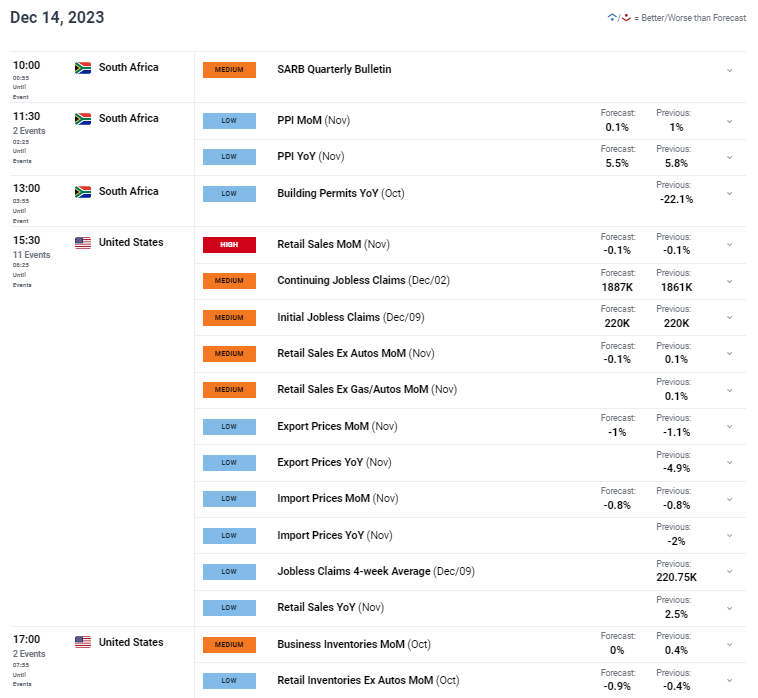
Later today (see economic calendar below), USD/ZAR will be shaped by the SARB’s Quarterly Bulletin, SA PPI and US retail sales data with the latter being the most influential. Jobless claims will be closely monitored particularly the initial jobless claims line item. Other ZAR crosses including GBP/ZAR and EUR/ZAR should provide more volatility as both the Bank of England (BoE) and European Central Bank (ECB) are scheduled to announce their rate decisions. Should they follow on from the Fed, the rand may find additional support across these currency pairs as well.

USD/ZAR ECONOMIC CALENDAR (GMT +02:00)

image1.png

Want to stay updated with the most relevant trading information? Sign up for our bi-weekly newsletter and keep abreast of the latest market moving events!

TECHNICAL ANALYSIS

USD/ZAR DAILY CHART

image2.png


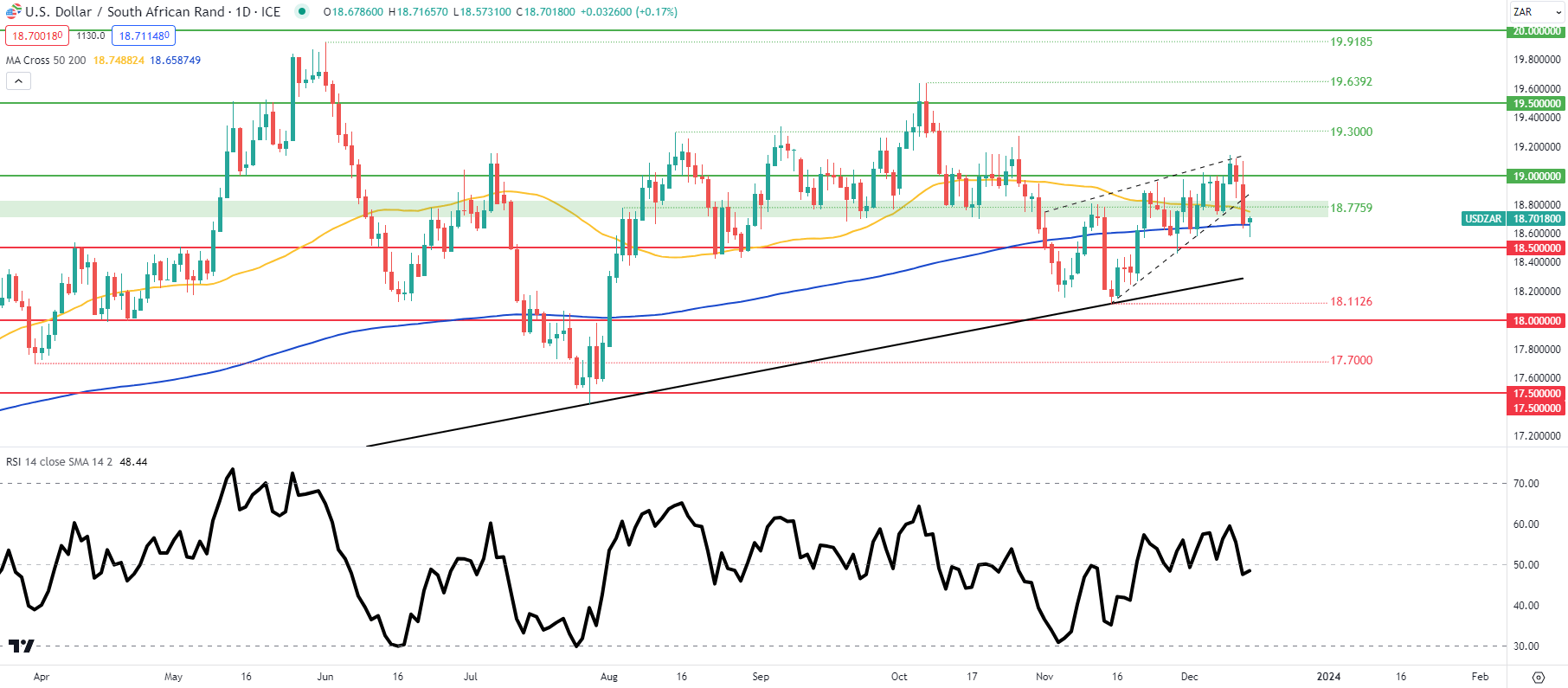
The daily USD/ZAR chart has broken below the rising wedge chart pattern (dashed black line) but is not confirmed in my opinion. I would want to see a confirmation close below the 200-day moving average (blue) which may then expose the 18.5000 psychological handle and potentially a retest of the long-term trendline support level (black). The current daily candle reflects a long lower wick and could see the pair pullback higher should it close in this fashion.

Gold Prices Forecast: XAU/USD Steady Amid Fed Moves, Global Economic Signals

Gold Prices Forecast: XAU/USD Rallies on Federal Reserve’s Rate Cut Projections

Gold Prices Soar as Fed Signals Rate Cuts

Gold (XAU/USD) has reached a one-week high, propelled by the U.S. Federal Reserve’s indications of an impending end to its rate-hiking cycle and potential lower borrowing costs in 2024. This development has pressured the dollar and bond yields, making gold more appealing to foreign buyers. As of early Thursday, Gold is trading at $2035.01, showing a modest increase, while February Comex Gold futures have surged significantly.

Federal Reserve’s Impact on Markets

The Federal Reserve’s decision to maintain steady interest rates, combined with projections of a rate decrease by the end of 2024, has significantly influenced market sentiments. Jerome Powell, the Fed Chair, suggested that the cycle of rate hikes might be concluding, leaving room for future adjustments if necessary. The market now anticipates a high likelihood of a rate cut by March.

Trading Derivatives carries a high level of risk to your capital and you should only trade with money you can afford to lose. Trading Derivatives may not be suitable for all investors, so please ensure that you fully understand the risks involved, and seek independent advice if necessary. A Product Disclosure Statement (PDS) can be obtained either from this website or on request from our offices and should be considered before entering into a transaction with us. Raw Spread accounts offer spreads from 0.0 pips with a commission charge of USD $3.50 per 100k traded. Standard account offer spreads from 1 pips with no additional commission charges. Spreads on CFD indices start at 0.4 points. The information on this site is not directed at residents in any country or jurisdiction where such distribution or use would be contrary to local law or regulation.

Treasury Yields and Dollar Dynamics

Treasury yields have hit their lowest level since August, aligning with the Fed’s policy direction and rate cut forecasts for the coming years. This shift has led to an eased inflation forecast for 2024. Concurrently, the dollar has weakened in response to these developments, enhancing the attractiveness of non-yielding assets like gold.

Global Central Bank Policies and Gold

The outcome of the Federal Reserve’s meeting is likely to overshadow other imminent central bank decisions and economic data releases. As investors turn their attention to the European Central Bank and the Bank of England’s upcoming decisions, gold’s status is bolstered by its appeal in a lower interest rate environment.

Short-Term Outlook

The short-term outlook for gold is bullish. The anticipated decline in interest rates diminishes the opportunity cost of holding gold, a non-interest-bearing asset. The increase in holdings of the SPDR Gold Trust ETF underscores this positive sentiment, as investors await further global economic updates and central bank decisions.

Technical Analysis

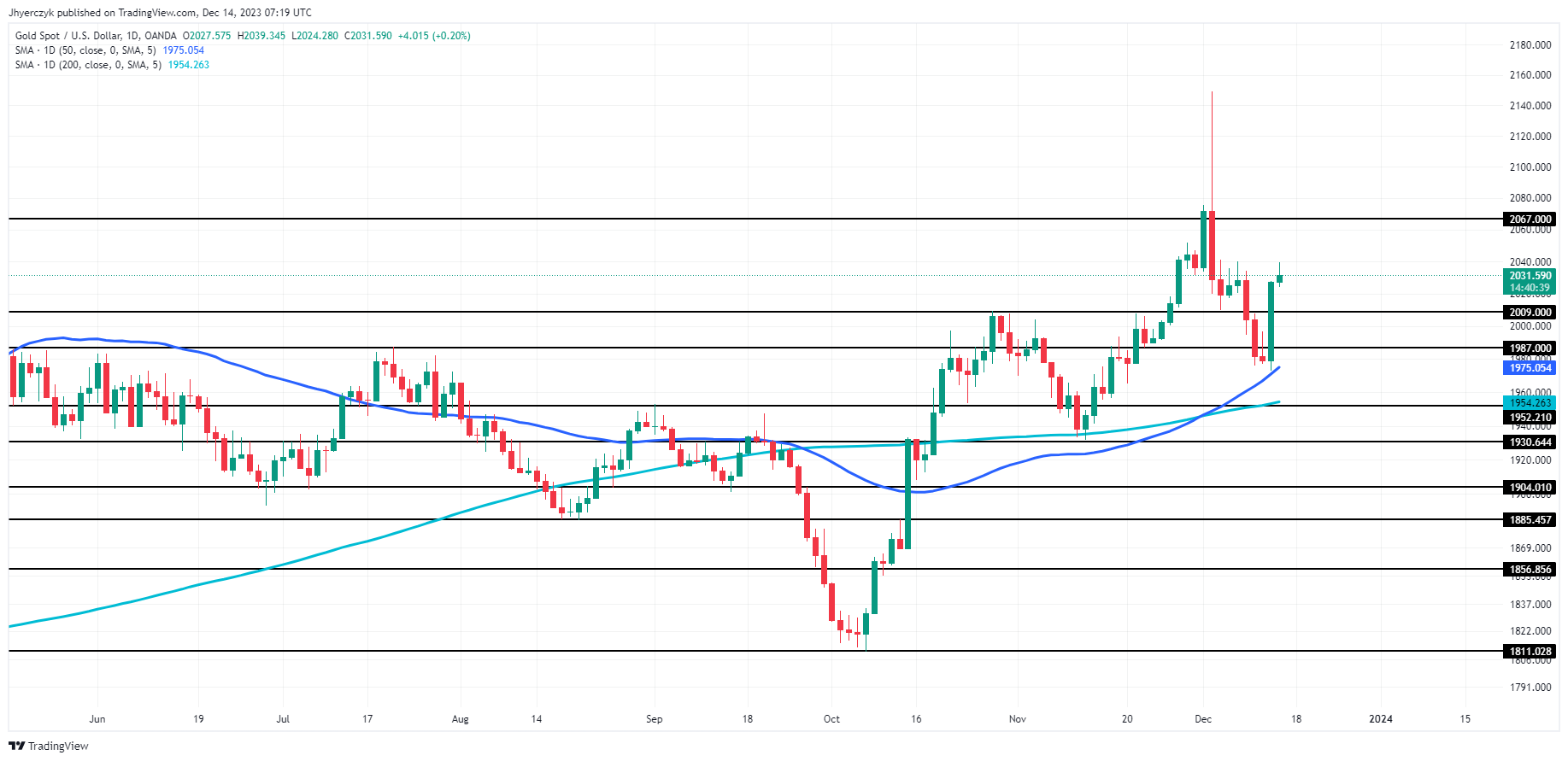
Daily Gold (XAU/USD)Gold (XAU/USD) is currently trading at 2032.21, which positions it above both the 200-day and 50-day moving averages, indicating a bullish trend in the medium to long term.

This current price is also between the identified minor support at 2009.00 and minor resistance at 2067.00, suggesting a consolidation phase. The fact that the price is closer to the minor resistance than to the minor support could be interpreted as a positive sentiment, with potential for an upward breakout.

Overall, the market sentiment for Gold appears bullish, supported by its position relative to key moving averages and its proximity to breaking through the minor resistance level.