Silver Prices Forecast: XAG/USD Awaits Direction from US Inflation, Fed Signals

Silver Prices Forecast: XAG/USD Awaits Direction from US Inflation, Fed Signals

Silver Market Awaits Central Bank Decisions Amid Economic Tensions

Silver (XAG/USD) is currently at a crucial phase, trading nearly flat early Monday following last week’s decline. Investors are now focusing on several key central bank meetings and U.S. inflation data for future market direction. Amid a strong dollar and mixed global economic signals, silver’s price movements are expected to be heavily influenced by these upcoming financial events and policy decisions.

Influence of the Dollar and U.S. Economic Data

The recent strengthening of the dollar, has impacted silver, making it more expensive for holders of other currencies. This trend, combined with the robust U.S. jobs report indicating a resilient labor market, has led to dampened expectations of immediate rate cuts by the Federal Reserve. This scenario has lessened silver’s traditional appeal as a hedge against currency devaluation.

Trading Derivatives carries a high level of risk to your capital and you should only trade with money you can afford to lose. Trading Derivatives may not be suitable for all investors, so please ensure that you fully understand the risks involved, and seek independent advice if necessary. A Product Disclosure Statement (PDS) can be obtained either from this website or on request from our offices and should be considered before entering into a transaction with us. Raw Spread accounts offer spreads from 0.0 pips with a commission charge of USD $3.50 per 100k traded. Standard account offer spreads from 1 pips with no additional commission charges. Spreads on CFD indices start at 0.4 points. The information on this site is not directed at residents in any country or jurisdiction where such distribution or use would be contrary to local law or regulation.

Global Economic Factors Impacting Silver

Deflationary pressures in China and a complex global economic landscape add further dimensions to the environment for silver. Key to the market’s direction will be Wednesday’s Federal Open Market Committee (FOMC) meeting and the upcoming U.S. consumer inflation data. Signals from the Fed could either weaken the dollar and boost silver prices or reinforce the strong dollar and apply downward pressure on silver.

Central Bank Decisions and Silver’s Response

Decisions from major central banks, such as the ECB, BoE, and others, are poised to influence global interest rate expectations. Lower interest rates generally increase the appeal of non-yielding assets like silver, making these meetings critical for investors tracking silver’s price movements.

Short-Term Outlook for Silver

In the short term, silver faces both bullish and bearish pressures. On one hand, the reduced expectations for a March Fed rate cut and a firm dollar present challenges.

On the other, geopolitical risks and global economic uncertainties offer potential support. This week’s central bank meetings and economic data releases are expected to be pivotal in determining silver’s near-term trajectory.

Investors are eagerly awaiting these developments for cues that could challenge or validate silver’s current market value. In the meantime, traders should brace for heightened volatility.

Technical Analysis
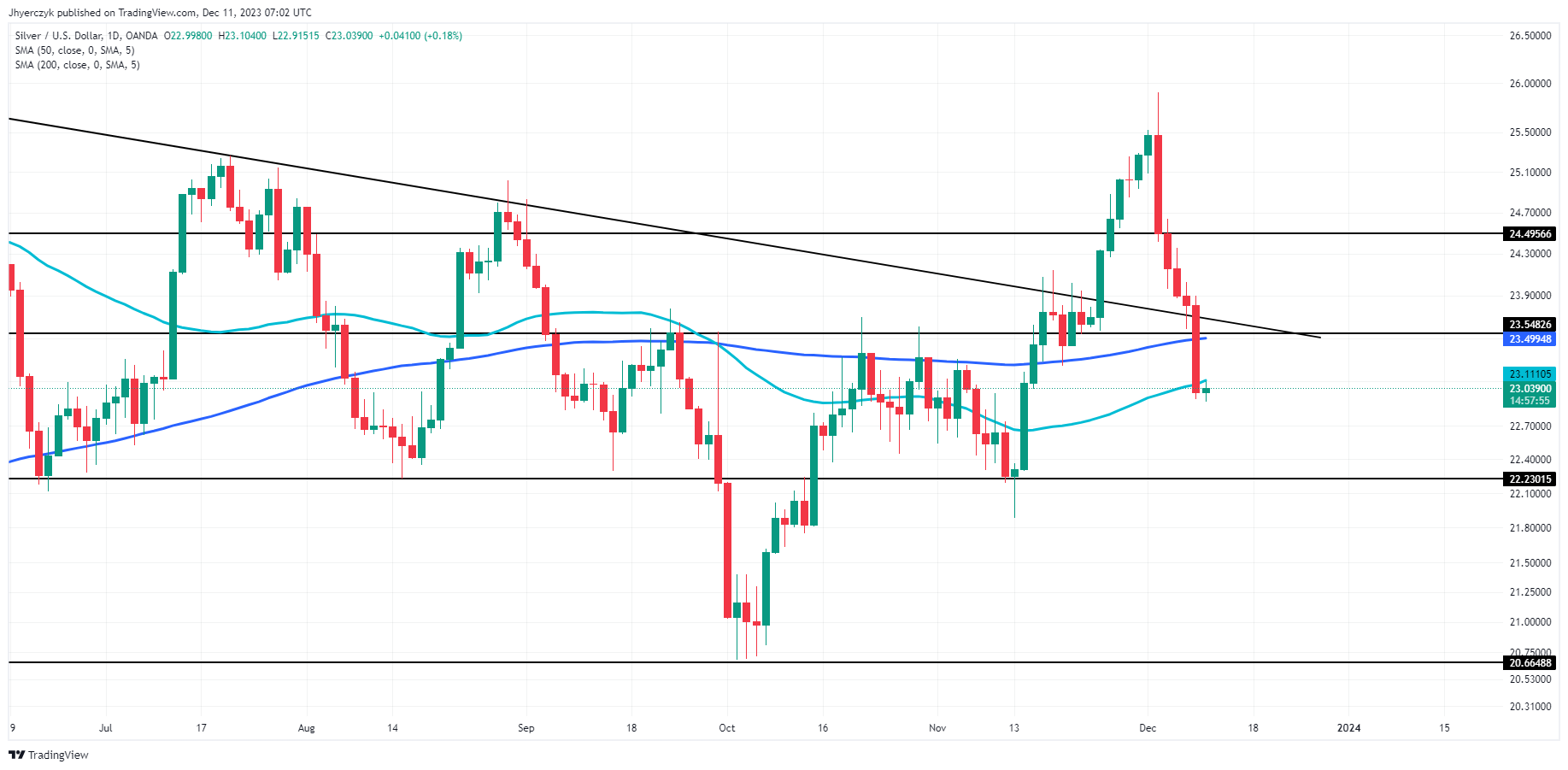
Daily Silver (XAG/USD)Silver (XAG/USD), currently at 23.05, is exactly at its 50-day moving average and slightly below the 200-day moving average of 23.50. This positioning indicates a neutral to slightly bearish sentiment in the medium term.

The price is just below the minor resistance level at 23.55, suggesting a testing phase that could define short-term market direction.

If it breaks above this resistance, there could be an uptrend towards the main resistance at 24.50. However, failure to breach this level could see the price retreating towards the minor support at 22.23.

The close proximity to both the 50-day and 200-day moving averages, along with the resistance level, suggests a potentially pivotal moment for the silver market, with the possibility of a balanced, yet cautious, market sentiment.

Essentially, we’re going to treat the 50-day moving average at $23.05 as our pivot on Monday.

Gold Market Anticipates Central Bank Meetings Amid Economic Uncertainties  Gold (XAU/USD)

Gold Market Anticipates Central Bank Meetings Amid Economic Uncertainties Gold (XAU/USD)

Gold Market Anticipates Central Bank Meetings Amid Economic Uncertainties

Gold (XAU/USD) is trading nearly flat early Monday after a series of declines last week, with investors eyeing several pivotal central bank meetings and key U.S. inflation data for further direction. Amidst a strong dollar and mixed global economic signals, gold’s direction will be closely tied to upcoming financial events and policy decisions.

Impact of Currency Movements and Economic Data

The dollar’s strength, notably its rise against the yen and sterling’s dip, generally weighs on gold as it makes the metal more expensive for holders of other currencies. Friday’s robust U.S. jobs report, indicating a resilient labor market, has dampened expectations of immediate rate cuts by the Fed. This scenario typically lessens gold’s appeal as a hedge against currency devaluation.

Trading Derivatives carries a high level of risk to your capital and you should only trade with money you can afford to lose. Trading Derivatives may not be suitable for all investors, so please ensure that you fully understand the risks involved, and seek independent advice if necessary. A Product Disclosure Statement (PDS) can be obtained either from this website or on request from our offices and should be considered before entering into a transaction with us. Raw Spread accounts offer spreads from 0.0 pips with a commission charge of USD $3.50 per 100k traded. Standard account offer spreads from 1 pips with no additional commission charges. Spreads on CFD indices start at 0.4 points. The information on this site is not directed at residents in any country or jurisdiction where such distribution or use would be contrary to local law or regulation.


Global Economic Landscape and Gold Prices

Deflationary pressures in China and global economic uncertainties contribute to a complex environment for gold. The focus on Wednesday’s FOMC meeting and U.S. inflation data will be crucial, as dovish signals from the Fed could weaken the dollar and potentially boost gold prices. Conversely, hawkish tones might reinforce the strong dollar, pressuring gold.

Gold’s Response to Central Bank Decisions

The upcoming decisions from the ECB, BoE, and other central banks will influence global interest rate expectations. Lower interest rates can enhance the attractiveness of non-yielding assets like gold. Investors are thus closely monitoring these meetings for clues about the future monetary policy landscape.

Short-Term Gold Market Outlook

In the short term, gold prices face a mix of bullish and bearish pressures. Reduced expectations for a March Fed rate cut and a firm dollar present headwinds.

However, geopolitical risks and global economic uncertainties could provide some support.

This week’s central bank meetings and economic data releases are likely to be pivotal in setting gold’s near-term direction, with investors looking for signals that could either challenge or support the precious metal’s value.

Technical Analysis

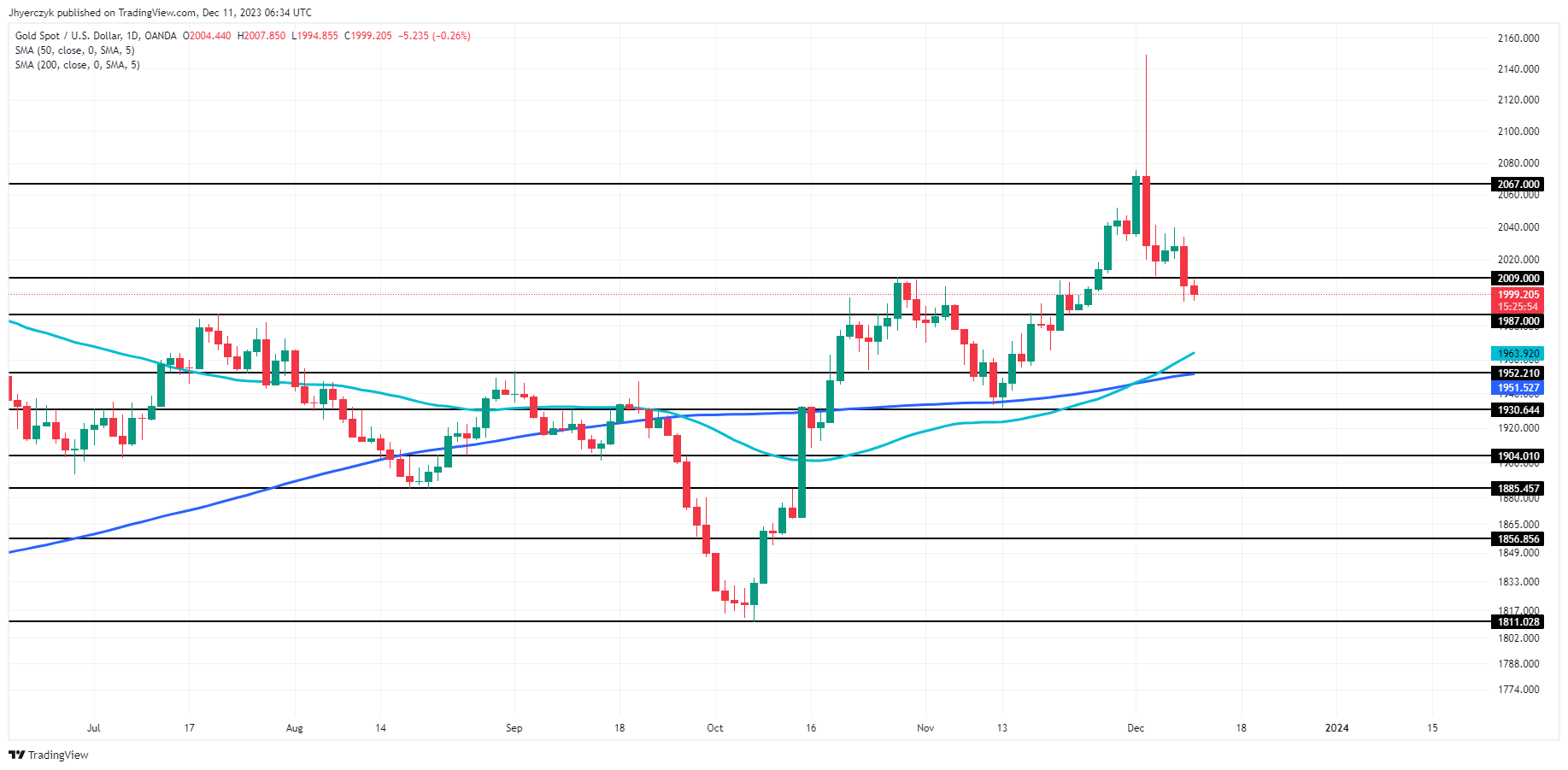
Daily Gold (XAU/USD)With Gold (XAU/USD) currently priced at 1998.94, it’s trading above both the 200-day moving average (1951.53) and the 50-day moving average (1963.92). This positioning above key moving averages typically indicates bullish sentiment in the medium-term trend.

The metal is situated between its minor support at 1987.00 and minor resistance at 2009.00, suggesting a consolidation phase within this range. Its stance above the main support level of 1952.21 and near the minor resistance level points to potential upside momentum.

However, the proximity to minor resistance at 2009.00 also indicates that gold is at a crucial juncture, where a breakout above this level could further reinforce the bullish trend.

Overall, the market sentiment for gold, considering its position relative to the moving averages and key support and resistance levels, leans towards a bullish outlook in the short to medium term. But given the downside momentum, it’s going to have to consolidate before the bullish tone will return.

XRP News: Senator Warren’s Influence and Market Dynamics

XRP News: Senator Warren’s Influence and Market Dynamics

Senator Elizabeth Warren Remained the Focal Point on Sunday

On Saturday, amicus curiae John E. Deaton targeted Senator Elizabeth Warren, saying,

Trading Derivatives carries a high level of risk to your capital and you should only trade with money you can afford to lose. Trading Derivatives may not be suitable for all investors, so please ensure that you fully understand the risks involved, and seek independent advice if necessary. A Product Disclosure Statement (PDS) can be obtained either from this website or on request from our offices and should be considered before entering into a transaction with us. Raw Spread accounts offer spreads from 0.0 pips with a commission charge of USD $3.50 per 100k traded. Standard account offer spreads from 1 pips with no additional commission charges. Spreads on CFD indices start at 0.4 points. The information on this site is not directed at residents in any country or jurisdiction where such distribution or use would be contrary to local law or regulation.

“As a Senator, sitting on the Banking Committee, Senator Warren violated her oath. Her job is to provide and engage in actual oversight of the SEC. Instead, she conspired with her close friend Gary Gensler, not only giving him the exact questions she would ask before a hearing, but also the suggested answers to those same questions.”

Deaton went on to say,

“That isn’t oversight – it’s fraudulent, coached testimony before Congress. She literally said that she didn’t want to place Gensler in a tough spot. HER JOB is to place the Chairman of the SEC in a tough spot – asking hard-hitting or “tough” questions.”

Significantly, Deaton highlighted a relationship with the parents of former FTX CEO SBF. Deaton asked why Senator Warren had not asked Chair Gensler about missing SBF’s fraudulent activity.

The crypto community continued reacting to Wednesday’s Banking Committee hearing. Senator Warren invited US bank CEOs to support her stance against crypto and focus on the use of crypto in terrorist financing. JPMorgan Chase (JPM) CEO Jamie Dimon took the sternest stance against crypto, saying,

“If I was the government, I would close it down.”

The increased push for banking equivalent oversight would give the SEC greater reach over the digital asset space. However, US lawmakers have yet to introduce legislation that dictates whether cryptos are commodities or securities. The lack of legislation limits the influence of Senator Warren as the courts continue to rule on cryptos.

In July, Judge Analisa Torres ruled that sales of XRP on digital asset exchanges were blind bid/ask transactions and did not qualify as securities. Judge Torres also rejected an SEC motion for interlocutory appeal in October.

However, the markets expect the SEC to appeal the Programmatic Sales ruling upon the conclusion of the SEC v Ripple case.

XRP Price Action

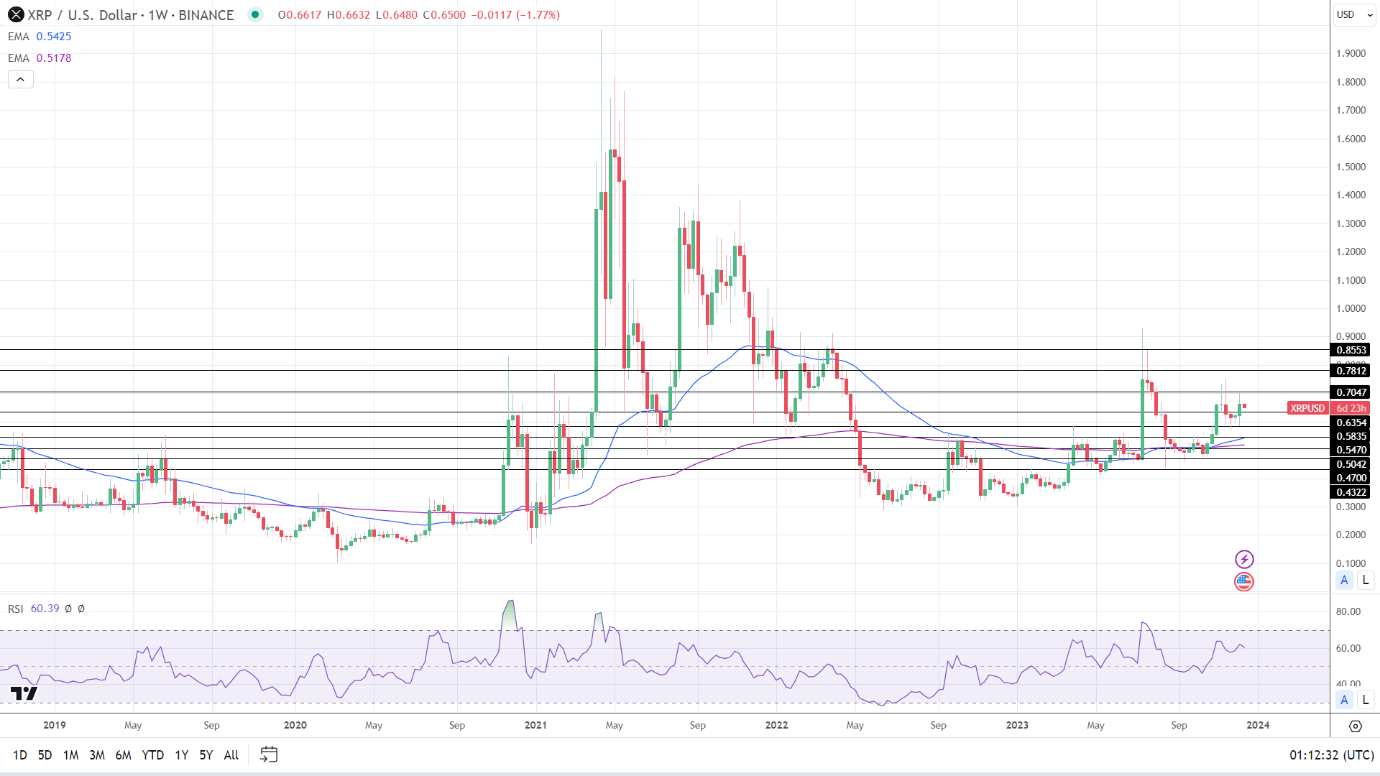
Weekly Chart sends bullish price signals.
XRPUSD 111223 Weekly Chart

Daily Chart

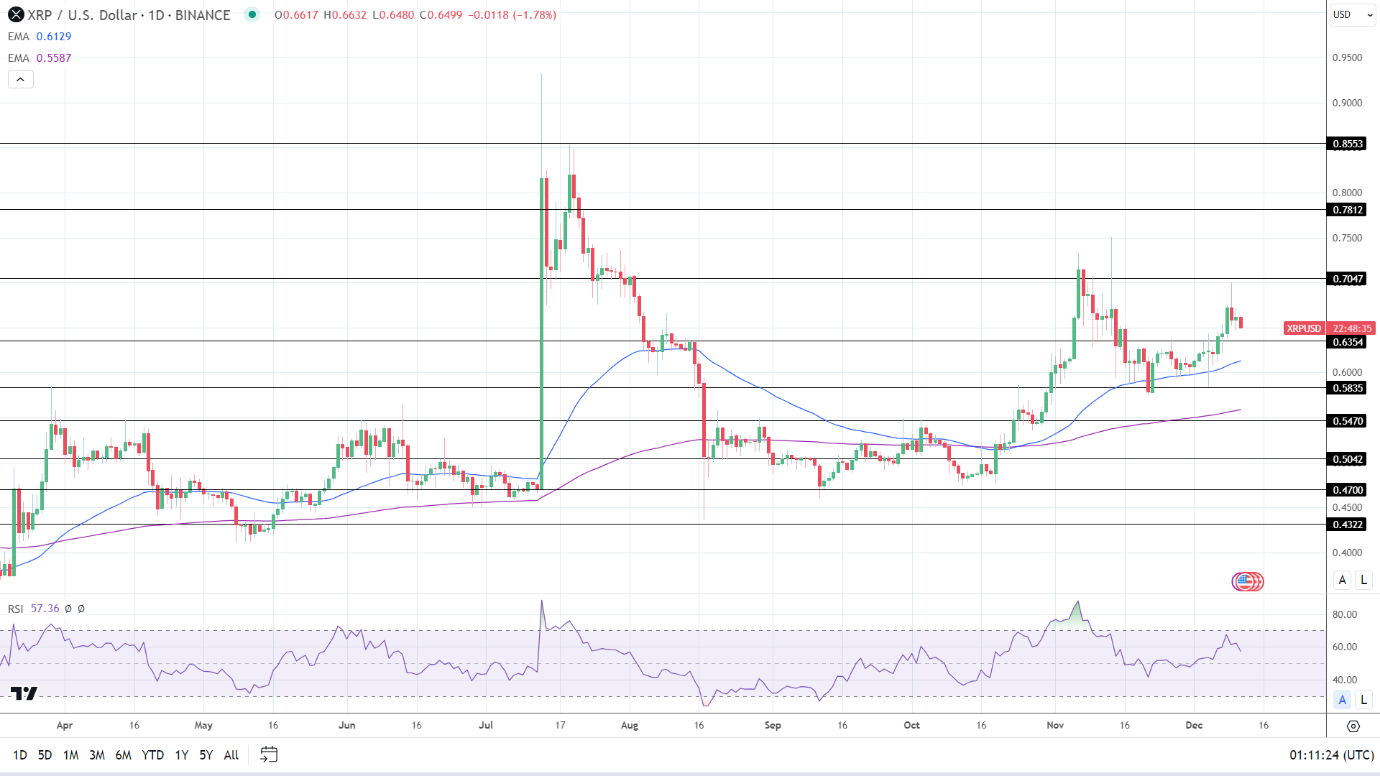
XRP held above the 50-day and 200-day EMAs, sending bullish price signals.

An XRP break above the $0.7047 resistance level would support a move to the $0.75 handle and the $0.7812 resistance level.

Crypto-spot ETF-related news, US lawmaker chatter, and SEC v Crypto case-related commentary remain focal points.

However, a fall through the $0.6354 support level would give the bears a run at the 50-day EMA.

The 14-day RSI reading, 57.36, indicates a move to the $0.7047 resistance level before entering overbought territory.

XRP Daily Chart affirms bullish price signals.
XRPUSD 111223 Daily Chart

4-Hourly Chart

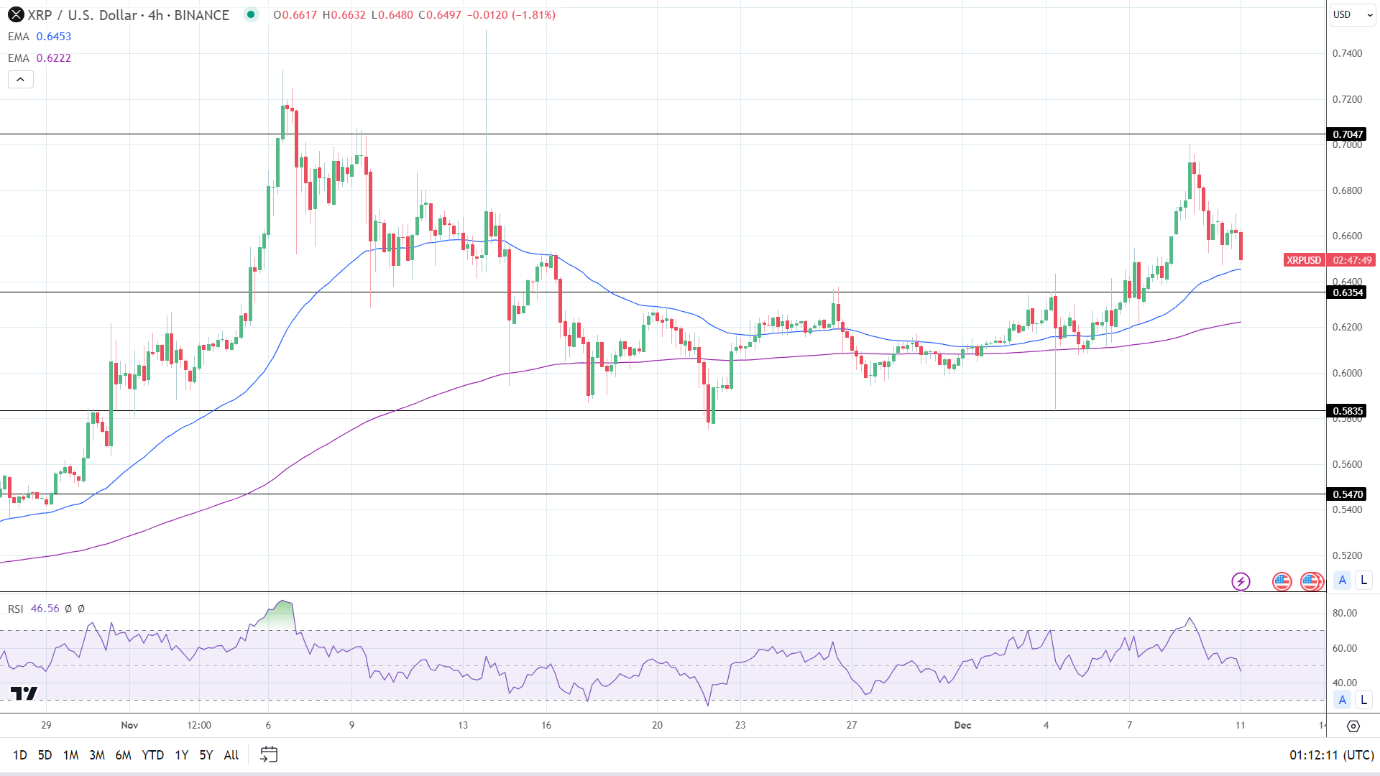
On the 4-hourly, XRP sat above the 50-day and 200-day EMAs, reaffirming bullish price signals.

An XRP move through the $0.7047 resistance level would support a run at the $0.7812 resistance level.

However, an XRP fall through the 50-day EMA would bring the $0.6354 support level into play.

The 4-hourly RSI, with a reading of 46.56, suggests an XRP fall to the $0.6354 support level before entering oversold territory.

XRP 4-Hourly Chart reaffirms bullish price signals.
XRPUSD 111223 4-Hourly Chart
US CPI, Fed Decision to Guide US Dollar, Setups on EUR/USD, USD/JPY, GBP/USD

US CPI, Fed Decision to Guide US Dollar, Setups on EUR/USD, USD/JPY, GBP/USD

The week-ahead economic calendar will be packed with high-impact events for the U.S. dollar, but the most important ones that may help define its near-term path will be the November U.S. consumer price index report to be released on Tuesday morning and the Federal Reserve’s monetary policy announcement scheduled for Wednesday afternoon.

Over the past month, the Fed’s interest rate outlook has shifted in a dovish direction, with markets pricing in about 100 basis points of easing over the next 12 months. Although recent data, such as last month’s employment numbers, have been strong and inconsistent with an economy in urgent need of central bank support, traders have held firm in their belief that aggressive cuts are just around the corner.

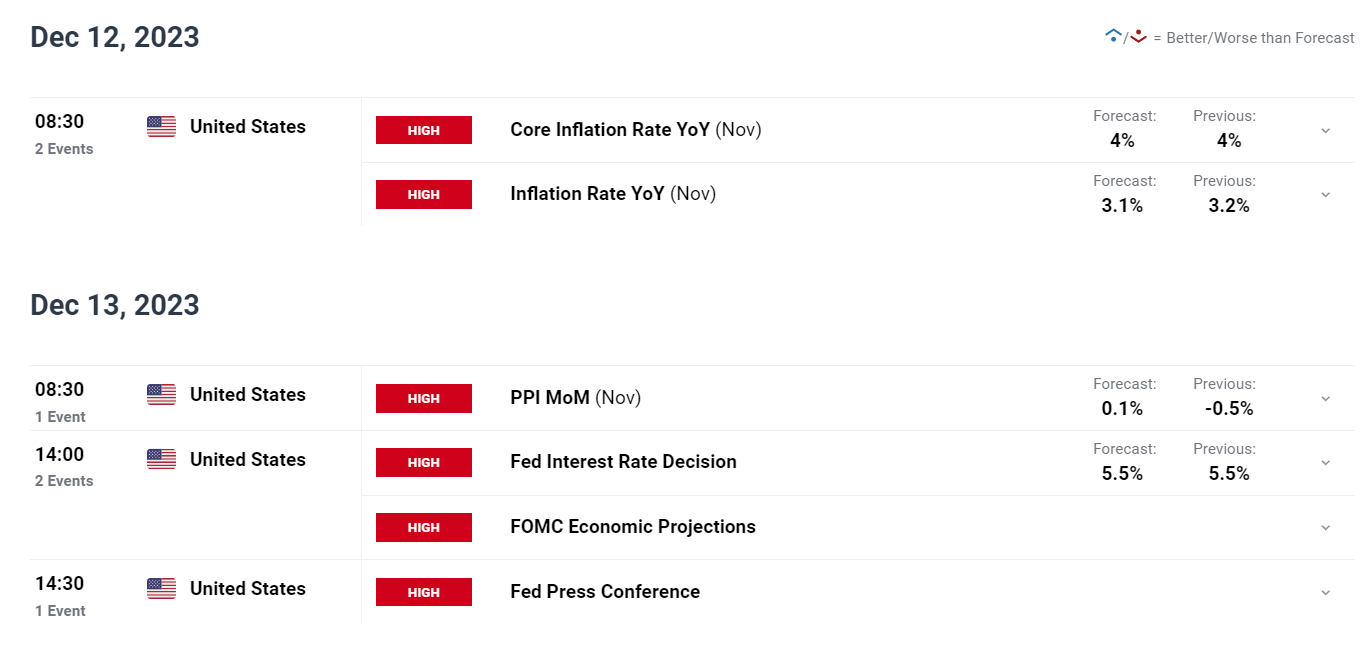
Projections, however, could become less dovish in the coming days if the latest inflation figure surprises to the upside or displays limited progress towards the Fed’s 2.0% target. In terms of estimates, November headline CPI is forecast to have slowed slightly to 3.1% y-o-y from 3.2% y-o-y previously, while the core gauge is anticipated to remain steady at 4.0% y-o-y.

Wondering about the U.S. dollar’s technical and fundamental outlook? Gain clarity with our Q4 forecast. Download a free copy of the guide now!

INCOMING US DATA

image1.png

The December FOMC gathering may be another driver for the reassessment of policy prospects. Although officials are seen holding borrowing costs unchanged when they end their last meeting of the year on Wednesday, they may be inclined to push back against Wall Street’s dovish expectations to prevent financial conditions from easing further.

If the FOMC resists pressure to pivot, comes out swinging and pledges to keep interest rates higher for longer in a convincing manner, U.S. Treasury yields are likely to push upwards, reversing part of their recent pullback. This scenario will be quite bullish for the U.S. dollar, paving the way for further recovery heading into 2024.

With the significant relaxation of financial conditions posing a threat to ongoing efforts to restore price stability and the U.S. economy holding up remarkably well against all odds, the stage seems set for a potentially hawkish outcome at the December FOMC conclave. Whatever unfolds, increased volatility is anticipated in FX markets in the days ahead.

EUR/USD FORECAST – TECHNICAL ANALYSIS

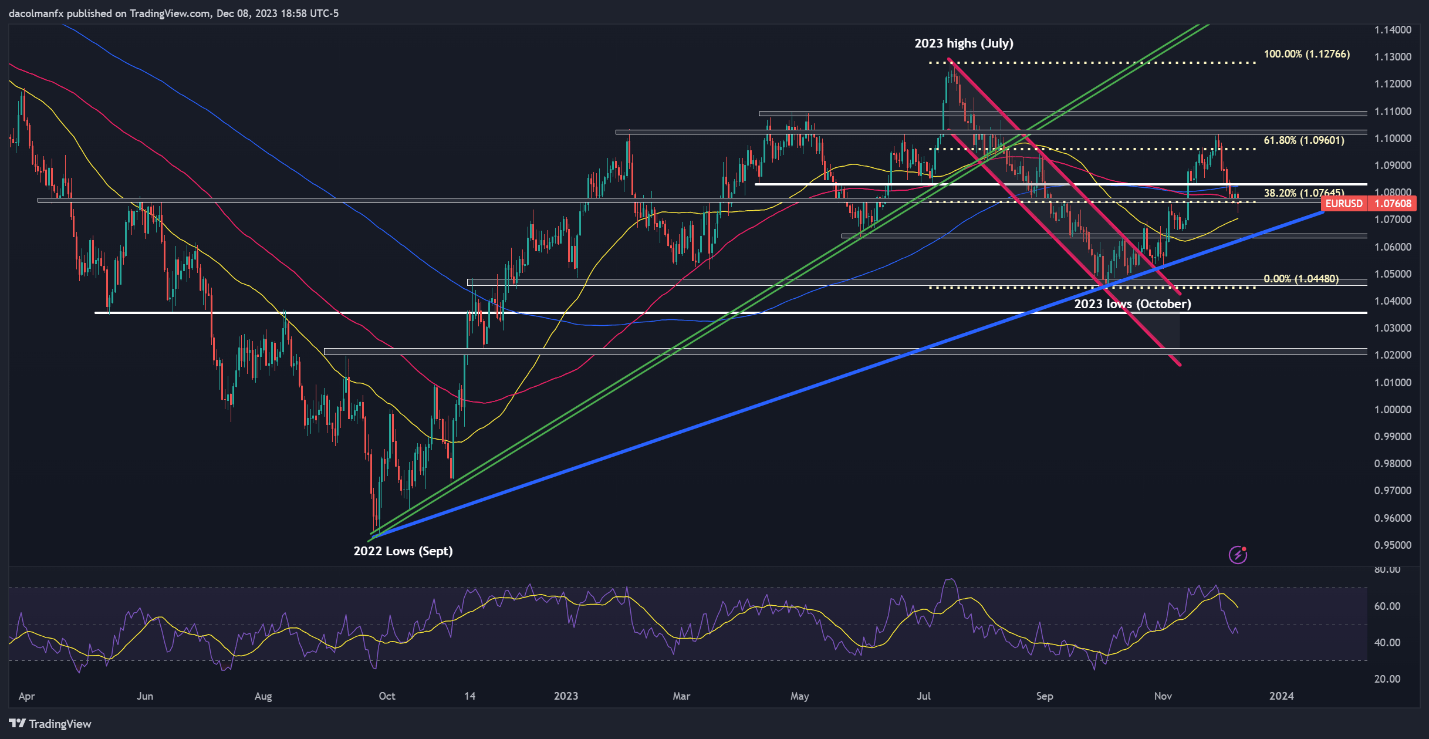
EUR/USD rallied vigorously last month, but has sold off in recent days, with prices slipping and closing below the 200-day moving average last week – a bearish technical event. If the pair deepens its pullback in the coming days, a retest of the 50-day SMA could come any minute. Continued weakness may shift focus towards trendline support near 1.0620.

Conversely, if EUR/USD stages a turnaround and charges higher, technical resistance is visible near 1.0820, but further gains could be in store on a push above this threshold, with the next area of interest at 1.0960, the 61.8% Fibonacci retracement of the July/October decline. Continued strength may catalyze a retest of November’s highs.

EUR/USD TECHNICAL CHART

A screenshot of a computer screen Description automatically generated

Interested in learning how retail positioning can offer clues about USD/JPY’s short-term direction? Our sentiment guide has all the answers you seek. Get the complimentary guide now!

USD/JPY FORECAST – TECHNICAL ANALYSIS

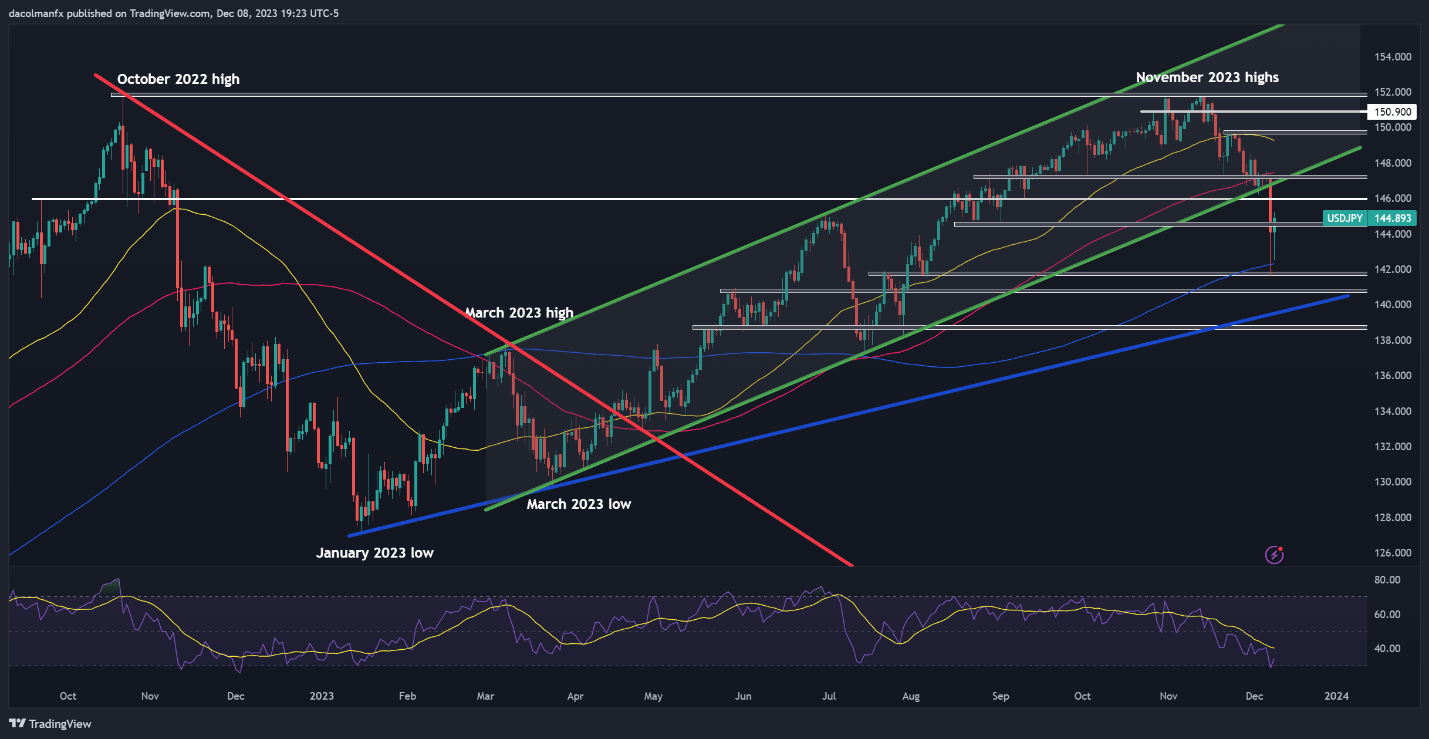
The Japanese yen appreciated significantly last week on speculation that the Bank of Japan would end its policy of negative rates soon, with USD/JPY falling sharply before regaining some ground after bouncing off its 200-day simple moving average. If the rebound extends over the next few trading sessions, resistance appears at 146.00, followed by 146.90-147.30.

On the other hand, if downward impetus resurfaces and sparks new losses for the pair, the 200-day is likely to be the first line of defense against a bearish assault and 141.75 thereafter. USD/JPY may find stability in this region during a pullback before mounting a comeback; however, in the event of a breakdown, the focus turns to 140.70, then trendline support at 139.50.

USD/JPY TECHNICAL CHART

A screen shot of a graph Description automatically generated

Stay ahead of the curve and improve your trading strategies. Claim the GBP/USD forecast for a thorough overview of the British pound’s outlook!

GBP/USD FORECAST – TECHNICAL ANALYSIS

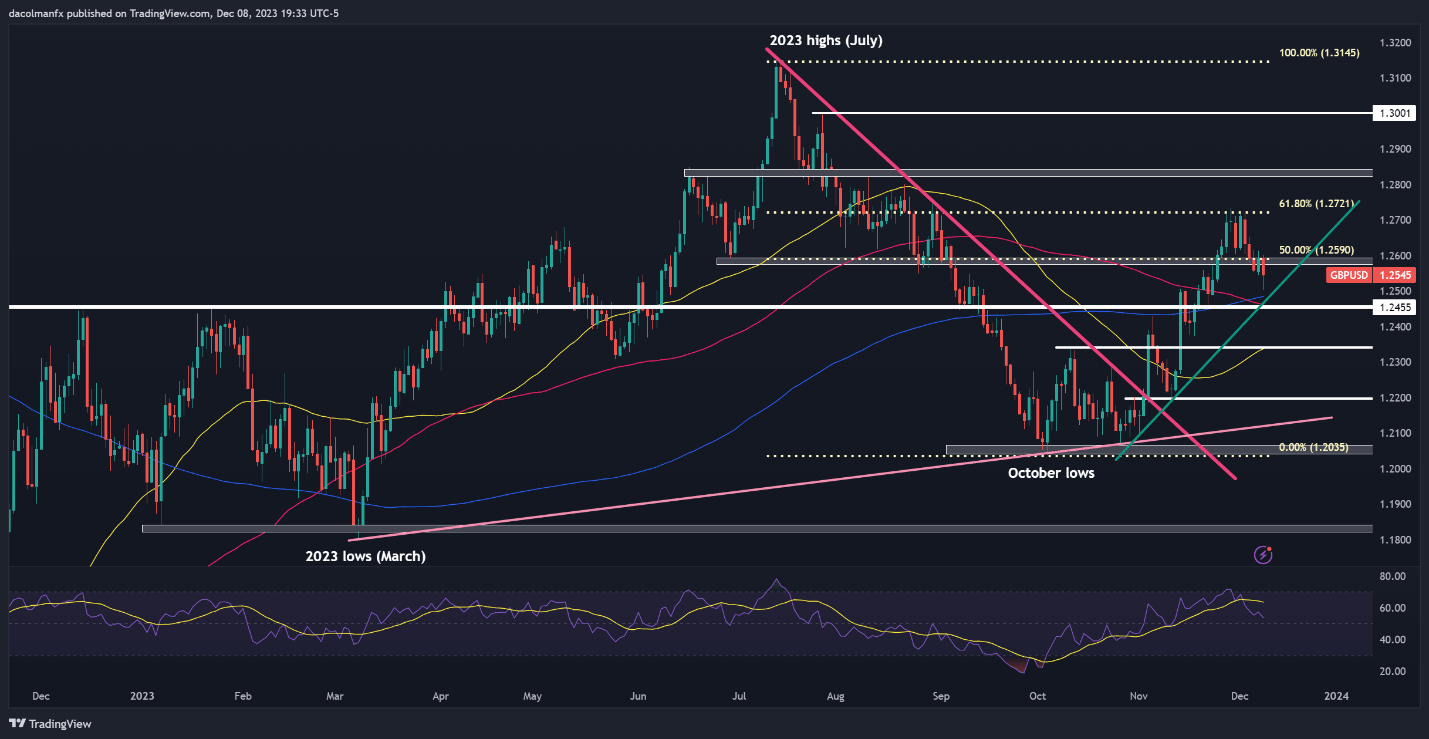
GBP/USD has trended lower over the past few trading sessions after failing to take out a key ceiling near 1.2720, which corresponds to the 61.8% Fibonacci retracement of the July/October decline. Should losses accelerate in the coming week, support stretches from 1.2480 to 1.2455, where the 200-day SMA converges with a short-term rising trendline. On further weakness, the focus shifts to 1.2340.

Conversely, if cable manages to rebound from its current position, overhead resistance is situated around the 1.2590 mark. To rekindle bullish impetus, the pair needs to take out this technical barrier decisively. The materialization of this move may invite new buyers into the market, creating the right conditions for an upward thrust towards 1.2720.

GBP/USD TECHNICAL CHART

A graph of stock market Description automatically generated


Markets Week Ahead: Gold, EUR/USD, GBP/USD, USD/JPY, US Inflation, Fed, ECB, BoE

Markets Week Ahead: Gold, EUR/USD, GBP/USD, USD/JPY, US Inflation, Fed, ECB, BoE

The week ahead is likely to bring elevated market volatility, courtesy of impactful and high-risk events on the economic calendar, including US inflation data, UK GDP figures, and significant monetary policy announcements from the FOMC, the Bank of England and the European Central Bank. Against this backdrop, precious metals, stocks and currency pairs, such as USD/JPY, EUR/USD and GBP/USD could experience large swings, creating interesting trading opportunities.

Traders should keenly monitor the U.S. inflation report to assess the validity of prevailing interest rate expectations for the upcoming year. Although price pressures are projected to continue to cool, progress towards the Fed’s target is likely to be limited, a situation that could reduce the likelihood of the Federal Reserve adopting a more pessimistic stance at its December meeting.

In terms of the central bank announcements, the Fed, ECB and BoE are seen holding their policy settings steady. For this reason, it is vital to pay close attention to their forward guidance and projections.

With growth flagging in both the Eurozone and the UK, there is little appetite for Lagarde or Bailey to be aggressive in their outlook. Powell, however, may have room to be somewhat more hawkish, given the remarkable resilience of the American economy. This may leave the U.S. dollar well positioned to extend its recovery against its major peers, such as the euro, British pound and the Japanese yen, to name a few.

In the event of a US dollar rally resulting from a resurgence in Treasury yields, gold (XAU/USD) and silver (XAG/USD) are likely to suffer. Risk assets could also come under pressure, sending the Nasdaq 100 sharply lower. For a thorough analysis of the forces that may shape financial markets and drive volatility in the coming days, consult DailyFX’s meticulously prepared week-ahead forecasts.

For a complete analysis of the euro’s medium-term outlook, request a copy of our latest forecast!

KEY ECONOMIC EVENTS THIS WEEK

image1.png

Wondering about the U.S. dollar’s technical and fundamental prospects? Find all the answers you are looking for in our quarterly forecast. Download a free copy of the guide now!

FUNDAMENTAL AND TECHNICAL FORECASTS

British Pound Outlook: GBP/USD Rattled by NFPs, BoE, ECB, Fed Decisions Ahead

Cable dropped around half-a-point after a slightly stronger-than-expected NFP report hit the screens, but next week is all about three central bank policy decisions.

USD/JPY Weekly Forecast: Markets Peel Back Hopes for BoJ Policy Change

JPY upside may be slowing as NFPs showed a robust US labor market. This week sees the FOMC in action and US inflation to drive volatility.

Euro Weekly Forecast: ECB Expected to Hold Rates but How Will Projections Differ from Market Expectations?

The ECB projections will hold the key in the week ahead as market participants still price in 125bps of rate cuts in 2024. Can the Central Bank arrest the Euro’s slide?

Gold, Silver & Oil Forecast: Commodities Prepare for a Busy Week

The updated Fed forecast next week can guide the dollar, and by extension, gold prices in the last weeks of 2023 as can the US CPI report. Oil hints at a bullish pullback.

US CPI, Fed Decision to Guide US Dollar, Setups on EUR/USD, USD/JPY, GBP/USD

This article examines the technical outlook for major US dollar FX pairs such as EUR/USD, USD/JPY and GBP/USD, dissecting the critical price thresholds that could come into play this week ahead of US inflation data and the Fed’s decision.

The Federal Reserve Bank: A Forex Trader’s Guide

The Federal Reserve Bank: A Forex Trader’s Guide

What is the Federal Reserve?

The Federal Reserve is the central bank of the United States. It was founded to create a stable, flexible monetary and financial system for the nation. Its general duties are to set monetary policy and oversee effective economic operation, ultimately serving the public interest.

To meet these top-level directives, the Fed performs five general functions:

  1. Promote maximum employment, stable pricing and moderate interest rates long term
  2. Reduce risk where possible to create a stable financial system
  3. Develop safety within financial institutions
  4. Champion safety within payment and settlement systems
  5. Advocate consumer protection through a supervisory stance.

To execute day-to-day operations, the nation is divided up into 12 Federal Reserve Districts, each of which is served by a separately incorporated Reserve Bank. These districts and member banks operate independently while being supervised by the Federal Reserve Board of Governors.

Who owns the Fed?

The Fed is both a private and public institution. The Board of Governors is a government agency, while the banks themselves are structured like private corporations – member banks hold stock and earn dividends.

Who is the Federal Reserve chairman?

As of August 2019, the chairman of the Federal Reserve is Jerome Powell, who has served in this office since February 5, 2018. He is the 16th person to have held the position and will serve a four-year term. Before his appointment, Mr Powell served as a member of the Board of Governors from May 25, 2012. He also currently serves as Chairman of the Federal Open Market Committee, which looks after monetary policy.

Which banks make up the Fed?

The 12 Federal Reserve Districts, each with their own Reserve Bank, are:

  • Boston
  • New York
  • Philadelphia
  • Cleveland
  • Richmond
  • Atlanta
  • Chicago
  • St. Louis
  • Minneapolis
  • Kansas
  • Dallas
  • San Francisco

How is the Fed held accountable to its functions?

The Fed is accountable to the public, as well as to the US Congress. The Chair and Federal Reserve officials testify in front of Congress, while the system of setting monetary policy is designed to be clear and transparent. In the interests of accountability, the Federal Open Market Committee (FOMC) will publish statements following all annual meetings. All financial statements are audited independently once a year to ensure financial accountability as well.

Key Economic Mandates of the Federal Reserve System

US monetary policy is the core mandate of the Federal Reserve bank. The statutory objectives of this monetary policy are outlined by the Congress and are:

  • Maximum employment: The monetary policy set out by theFOMC should ensure unemployment remains low, working to boost the economy where needed so that businesses thrive, make a profit and hire more staff to grow
  • Price stability: The Fed defines price stability as an inflation rate of 2% in the long term
  • Moderate long-term interest rates: This works alongside price stability – when an economy is stable, long-term interest rates remain at a moderate level

The Fed aims to achieve its monetary policy through its influence over interest rates and the general financial climate. This can lead to volatility of the US Dollar, ahead of Fed announcements and changes to policies.

Federal Open Market Committee

Monetary policy is set by the Federal Open Market Committee (FOMC), which oversees the open market operations of the Federal Reserve System. They set a target for the federal funds rate at FOMC meetings; this is the interest rate that they want banks to offer to each other for overnight loans. While the FOMC doesn’t control the rate, it can influence it in three main ways:

  • Open market operations. This means the buying and selling of government bonds on the open market – selling bonds decreases monetary supply with the aim of increasing interest rates. Buying bonds puts money back into the economy, with the aim of decreasing interest rates
  • Discount rate. This is the rate that banks pay to borrow money from the Fed. When this rate is lower, then it is also more likely the federal funds rate will be lower too
  • Reserve requirements. Banks need to hold a certain percentage of customers’ deposits to cover withdrawals – this is the reserve requirement. When these are raised, banks can’t loan as much money and must ask for higher interest rates. When lowered, banks can loan more money and ask for lower interest rates.

How Does the Federal Funds Rate Affect the US Dollar?

The Fed’s interest rate, also known as the Fed funds rate, is set by the Board of Governors of the Federal Reserve System. The current interest rate and the expectations of future interest rate changes can both affect the value of the US Dollar. If traders anticipate a change in interest rates based on announcements from the Board of Governors, this can cause the Dollar to appreciate or depreciate in value against other currencies.

This table sets out the way in which market expectations and rate changes can affect the value of the dollar:

Market expectations Actual Results Resulting FX Impact
Rate Hike Rate Hold Depreciation of currency
Rate Cut Rate Hold Appreciation of currency
Rate Hold Rate Hike Appreciation of currency
Rate Hold Rate Cut Depreciation of currency

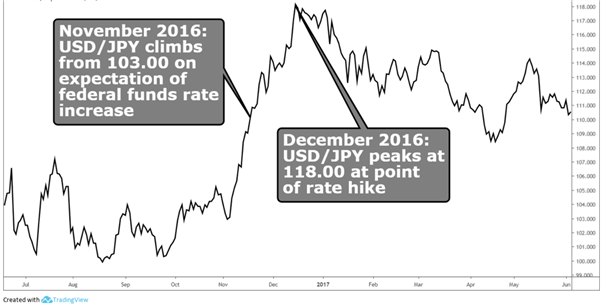
As you can see in the chart below, the Dollar strengthened against the Yen in the leadup to the Fed’s interest rate announcement in December 2016 because it was widely expected that the fed funds rate would increase. The pair peaked at around 118.371 on the day of the announcement, December 14, 2016.

USD/JPY chart before and after Fed hikes in 2016

Chart to show the impact of Fed hikes on USD/JPY

The Bank of England: A Forex Trader’s Guide

The Bank of England: A Forex Trader’s Guide

The Bank of England: A Forex Trader’s Guide

The Bank of England (BOE) is the UK’s central bank. Their mission is to promote and maintain monetary and financial stability. It is important for forex traders to keep up to date with the Bank of England’s latest changes to monetary policy because it can have a large effect on the Sterling Pound (GBP) and relevant currency pairs, like the EUR which is highly correlated to the Pound.

Central Bank of England

What is the Bank of England (BOE)?

Established in 1694, the Bank of England is the banker to, and owned by, the British government but is independent when setting monetary policy. Its roles include the setting of monetary policy – which includes targeting interest rates and using other tools to stimulate or contract the economy – producing the UK’s bank notes, supervising some bank payment systems, and ensuring the stability and safety of the financial system.

For traders, the BOE’s setting of monetary policy is a key factor to consider as it can have a big impact on the financial markets. Other factors, like the independence of the central bank are also important but are more prevalent issues in emerging market economies.

Key Economic Mandates of the Bank of England

According to the Bank of England, their two core purposes or mandates are:

1) Monetary stability – which is price stability or inflation

2) Financial stability – which is the stability and health of the economy

Monetary Stability

Monetary policy is extremely important for the entire economy. It prevents runaway inflation and attempts to ground inflation expectations so that the economy can grow at a regular pace. In order to maintain price stability, the Bank of England and their monetary policy committee (MPC) have set an inflation target of 2%.

If inflation goes above the target of 2% the Bank of England may increase interest rates. The increase in interest rates may cause an appreciation in the Pound as investors increase capital flows into the higher yielding currency. It may also have a negative affect on the stock market, as businesses will have to pay higher rates to lend and equity valuations will be discounted at a higher interest rate. Monetary policy data can be found on our economic calendar.

However, it is not always the case that the Bank of England will increase interest rates if inflation is above target. In some cases, like when GDP growth is still low or negative, the Bank of England may keep interest rates low to stimulate the economy. It is important to know the Bank of England will be looking for a balance between healthy inflation and economic growth.

Join our central bank webinar to watch our senior currency strategist discuss and analyze current central bank trends.

Financial Stability

The resilience of the financial system is paramount to the health of the UK economy and therefore necessary for the Bank of England to accommodate. To support Financial Stability mandates, the bank also has a Financial Policy Committee or FPC which was established in June 2011. From an FX point of view, the Monetary Stability is the key driver of spot rates for the GBP.

How BOE interest rates affect the Pound

Interest rate impact on the Pound

The Bank of England can affect the value of the Pound through changes in interest rate expectations. Traders should understand that currencies appreciate when interest rate expectations increase, not just from increases in the nominal interest rate.

For example, if the Bank of England keeps interest rates unchanged but issues forward guidance (tells the market) that they expect more interest rate hikes in future, the value of the Pound will appreciate. Likewise, decreases in future interest rate hike expectations, or expectations of an interest rate cut can lead to a decrease in the value of the Pound.

This is the general principle for how interest rates affect the Pound and stock market, although they sometimes react differently:

  1. Higher interest rate expectations increase the strength of the Pound (GBP) and negatively affect equity values.
  2. Lower interest rate expectations decrease the strength of the Pound (GBP) and positively affect equity values.

Interest rates aren’t the only monetary policy tool that can affect the currency, tools like quantitative easing can also lead to increases and decreases in the value of a currency. If the Bank of England announces that it plans to start a quantitative easing program (QE), the pound will likely depreciate as a large amount of liquidity enters the market, increasing the supply of money in the market and leading to a decrease in interest rates, or, simply to maintain current rates.

Interest rate impact on the economy

The Bank of England lowers interest rates when it is trying to stimulate the economy (GDP) and increases interest rates when it is trying to contain inflation caused by an economy operating above potential (overheating).

Lower interest rates stimulate an economy in a few ways:

  1. Businesses can borrow money and invest in projects that will receive more than the risk borrowing rate.
  2. When interest rates are lower the stock market is discounted at a lower rate, leading to an appreciation in stock market values which causes a wealth effect.
  3. People invest their money into the economy (stocks and other assets) because they can earn more in these assets than at currently low interest rates.

How to trade BOE interest rate decisions

The table below displays the possible scenarios that come from a change in interest rate expectations. Traders can use this information to forecast if the currency is likely to appreciate or depreciate and how to trade it.

Market expectations Actual Results Resulting FX Impact
Rate Hike Rate Hold Depreciation of currency
Rate Cut Rate Hold Appreciation of currency
Rate Hold Rate Hike Appreciation of currency
Rate Hold Rate Cut Depreciation of currency

Let’s look at the example below on GBP/USD. On August 4, 2016 the Bank of England cut interest rates and announced a stimulus package (quantitative easing program). The market reacted negatively and the Pound depreciated.

Bank of England cuts interest rate to new low

Top Takeaways of the BOE and Forex Trading

Euro Price Forecast: Colossal Data Filled Week for EUR/USD

Euro Price Forecast: Colossal Data Filled Week for EUR/USD

EURO FUNDAMENTAL BACKDROP

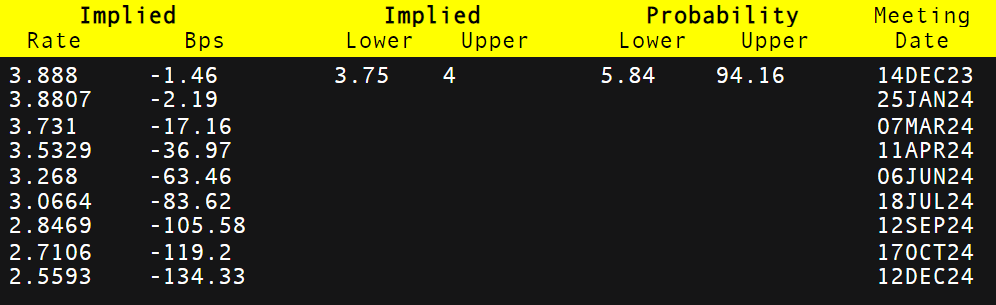
The euro opened the week pretty flat as markets prepare for central bank decisions later this week alongside some supplementary data that could sway the messaging provided by the two central banks. Leading up to these announcements, European Central Bank (ECB) interest rate expectations have been ‘dovishly’ repriced after taking into account eurozone data while the Federal Reserve may be less inclined to rush into heavy rate cuts due to its comparatively more resilient economy. This resilience was reinforced by last week’s Non-Farm Payrolls (NFP) report that highlighted the robust labor market in the US. Money markets currently price in the first ECB cut around March/April next year. From a Fed perspective, Goldman Sachs stated this morning that they expect the Fed to deliver its first rate cut in Q3 2024 vs Q4 2024 in their previous forecast. In summary, the euro area is showing signs of significantly weaker economic data relative to the US and could weigh negatively on the EUR moving forward.

ECB INTEREST RATE PROBABILITIES

image1.png

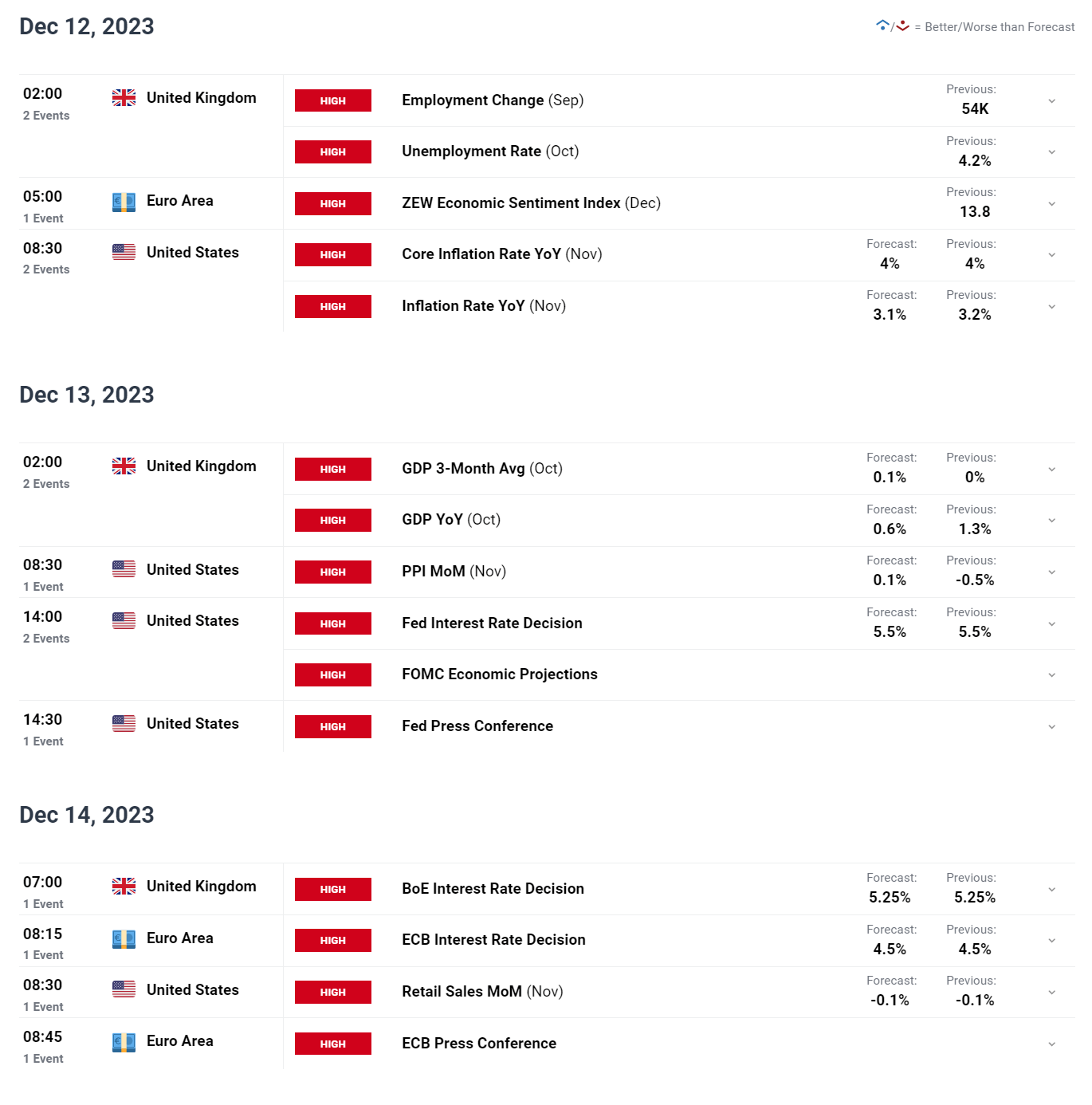
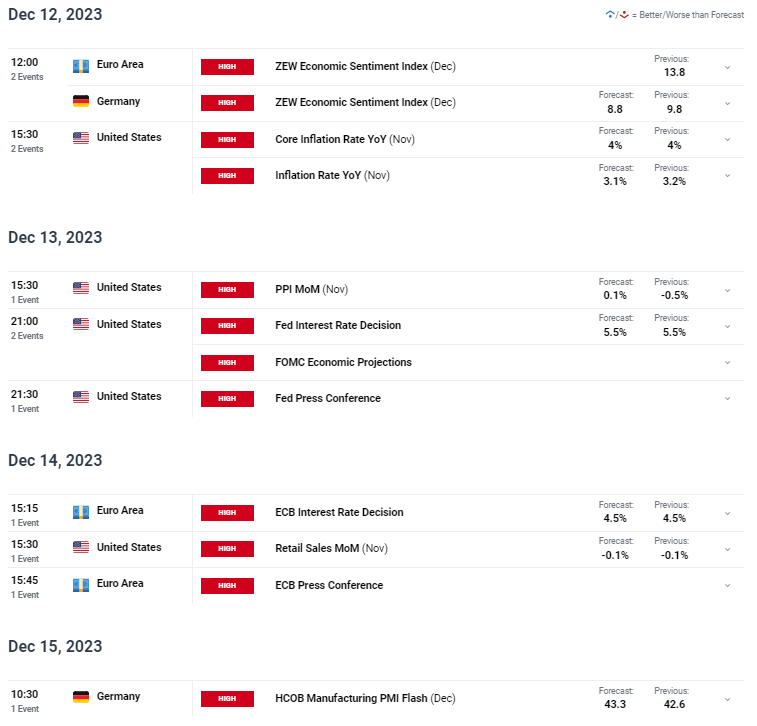
The economic calendar later today does not hold much in terms of market moving information and EUR/USD is likely to remain around current levels. The week ahead will be focused on US CPI and PPI to give an indication as to the narrative Fed Chair Powell may adopt but the US has the benefit of continuing with a ‘wait and see’ approach while the ECB may be more pressed to loosen monetary policy. Other important data points include ZEW economic sentiment for Germany and the euro area as well as US retail sales and German manufacturing PMI’s.

ECONOMIC CALENDAR (GMT+02:00)

image2.png

TECHNICAL ANALYSIS

EUR/USD DAILY CHART

image3.png

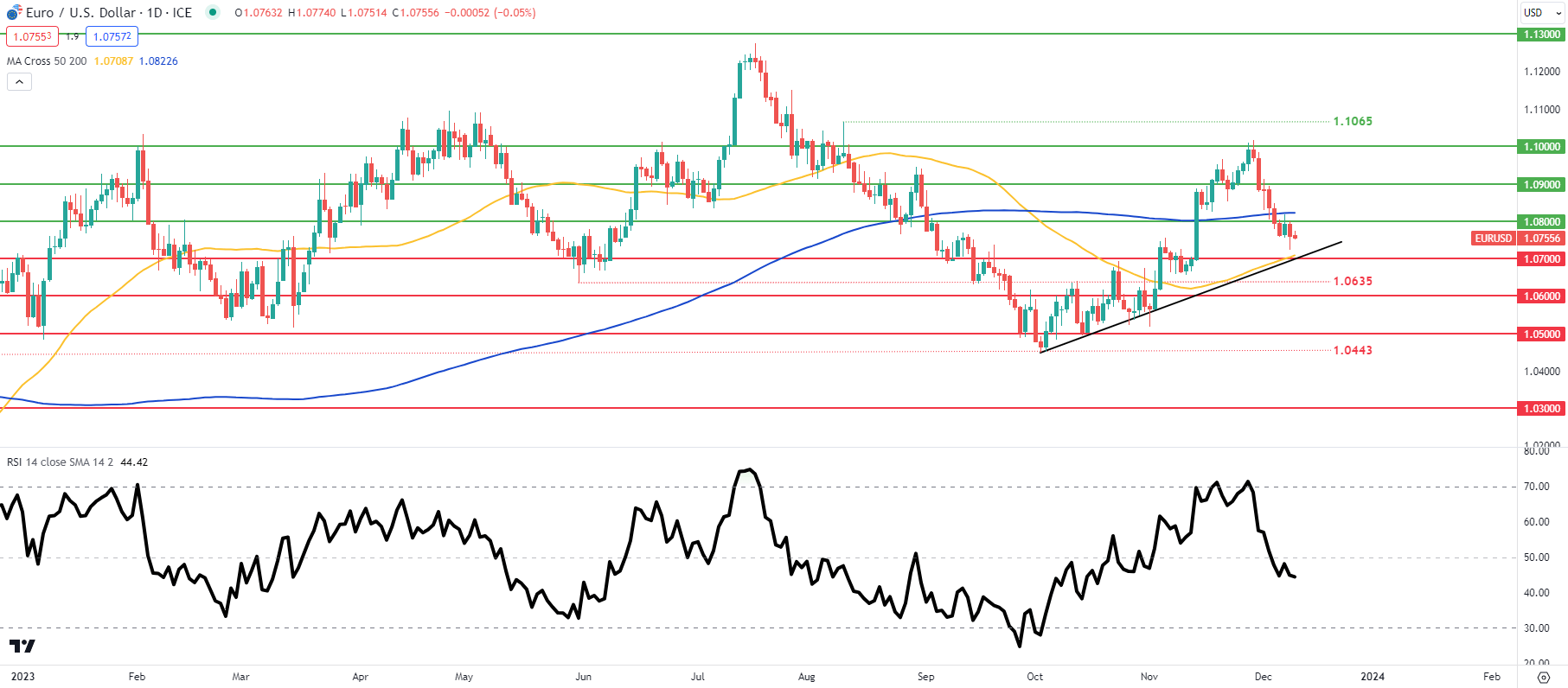
The daily EUR/USD chart above stays below the 1.0800 psychological handle and looks to be heading towards the longer-term trendline support/50-day moving average (yellow). Short-term directional bias could be heavily swayed by US CPI and PPI as mentioned above. EUR/USD traders remain cautious as reflected by the Relative Strength Index (RSI) hovering around its midpoint.

The Bank of Japan: A Forex Trader’s Guide

The Bank of Japan: A Forex Trader’s Guide

The Bank of Japan (BoJ) is a major central bank, setting the monetary policies that aim to maintain price stability and a strong Japanese financial system. As a central bank, the BoJ directly impacts the forex market, so policy meetings and the decisions they bring about are important for FX traders to follow.

What is the Bank of Japan?

The Bank of Japan, or Nichigin, is the Japanese central bank. It implements monetary policy and issues currency to maintain stability of the financial system. The bank’s Policy Board holds regular monetary policy meetings, deciding on their approach to interest rates, and how they intend to influence inflation.

Who Owns the Bank of Japan?

The government of Japan has a 55% ownership of the bank, and 100% voting interest. The remaining 45% is a public float, traded as JASDAQ. As of August 2019, the BoJ governor is Haruhiko Kuroda, who has held the position since March 2013 and is currently serving his second five-year term, which is due to run until April 2023.

Key Economic Mandates of Japan’s Central Bank

The BoJ considers its core mandates to be:

  1. Maintaining stability of the financial system
  2. Maintaining price stability

Maintaining stability of the financial system

The BoJ implements its monetary policy with the aim of maintaining financial system stability, which involves currency control, monetary control and the issuing of banknotes. This also feeds into the BoJ’s other core aim, as currency and monetary control is part of the plan to achieve price stability and develop the economy.

Maintaining price stability

Maintaining price stability is the other central aim of the BoJ. Exports are essential to Japan, so the BoJ tries to keep prices as stable as possible and will manipulate interest rates with the intention of developing the national economy. The bank defines ‘price stability’ as a 2% increase year on year in the Consumer Price Index (CPI).

How does the BoJ carry out its mandates?

The BoJ holds regular monetary policy meetings (MPMs), where it sets the official interest rate and other monetary policies in the hope that they will achieve price stability and financial system stability. MPMs are held eight times a year and last for two days, during which time the Policy Board (the Governor, two Deputy Governors and six other members) will discuss and implement monetary policy. As of July 2018, the base rate remains set at -0.1% in the hope of growing the economy.

How Bank of Japan Monetary Policies Affect the Yen

Japan has suffered from an ailing economy with very low inflation over the course of the last few decades, consistently failing to achieve 2% inflation. The BoJ has adopted what is known as a loose monetary policy, maintaining a low interest rate in the hope of boosting the economy.

When there is little incentive to save due to a low interest rate, the idea is that people will spend more, put money into the economy and encourage inflation. This has seen the yen becoming increasingly weak against major currencies, including the US Dollar and the Euro, ever since Kuroda took office.

USD/JPY went from 94.00 in March 2013 to over 125.00 in June 2015, after Kuroda announced his first raft of policy measures. And while it has fluctuated since then, the yen’s value has remained well below its level when he became governor, with USD/JPY sitting around 108.00 in July 2019.

USD/JPY chart showing the fluctuations in value around major BoJ announcements

Chart showing USD/JPY fluctuations around major BoJ announcements

Following a period from 2012 to 2013 when the yen was relatively strong against the US Dollar, it fell to USD/JPY 125.00 in June 2015 after the announcement of Kuroda’s initial policy measures. The value fell once again in January 2016, when Kuroda made the shock announcement that the bank would implement a negative interest rate for the first time ever, charging -0.1% on deposits held with the bank. This policy aims to get financial institutions to withdraw their cash to invest elsewhere, rather than making a loss by hoarding cash.

This announcement caught the markets by surprise as Kuroda had only recently told the parliamentary budget committee that he was not looking to introduce any policy changes for the time being. The yen fell against currencies including the dollar and pound, while the Japan 225 went up in the hours following his announcement.

How to trade BOJ interest rate decisions

BoJ interest rate decisions are made with the aim of increasing spending and investment, influencing inflation. Changes in demand for stocks and currency as interest rates change can create forex trading opportunities. Even when interest rates remain the same, the anticipation surrounding important events like monetary policy meetings can affect the forex market.

Euro Price Action Setups: EUR/USD, EUR/GBP Post GDP Revision

Euro Price Action Setups: EUR/USD, EUR/GBP Post GDP Revision

EURO GDP REVISION AND FUNDAMENTAL BACKDROP

The Euro outlook continues to look bleak despite a resilient day against the Greenback. EUR/GBP as well seems to be setting up for a bounce following a massive selloff since November 20.

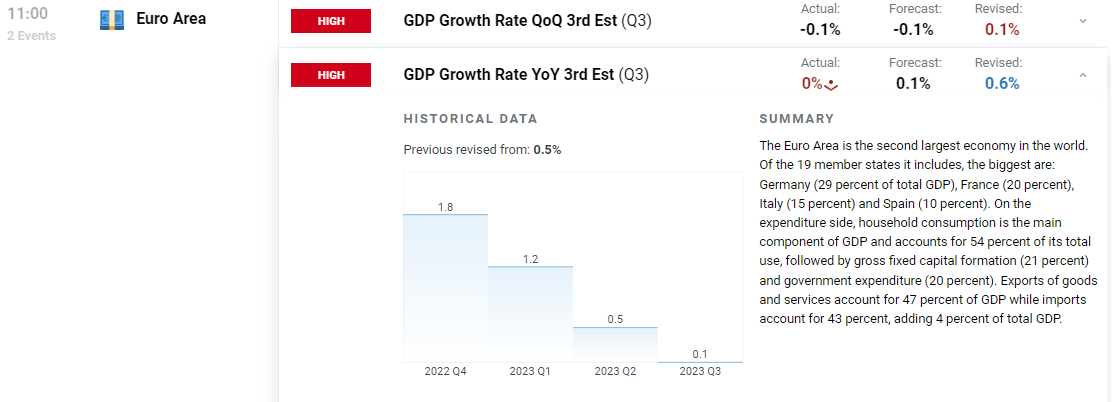
The Euro Area GDP 3rd estimate was out this morning confirming stagnation in Q3 as the Euro area economy feels the pinch. The YoY print managed to avoid a contraction being revised lower to 0% with many sectors struggling in the Euro Area which has prompted market participants to aggressively reprice rate cut expectations. This has weighed on the Euro of late with many believing the ECB may have to cut the most in 2024 to potentially stimulate a sluggish economy.

image1.png

Earlier today Goldman Sachs stated their belief that they see rate cuts as early as April by the ECB. The Bank cited a stronger than expected drop in inflation in the months ahead, which could in part be driven by a serious drop-off in demand. Heading into next week Central Bank meetings it will be interesting to gauge the updated economic projections by the ECB and if there any clues as to potential rate cuts.

PRICE ACTION AND POTENTIAL SETUPS

EUR/USD

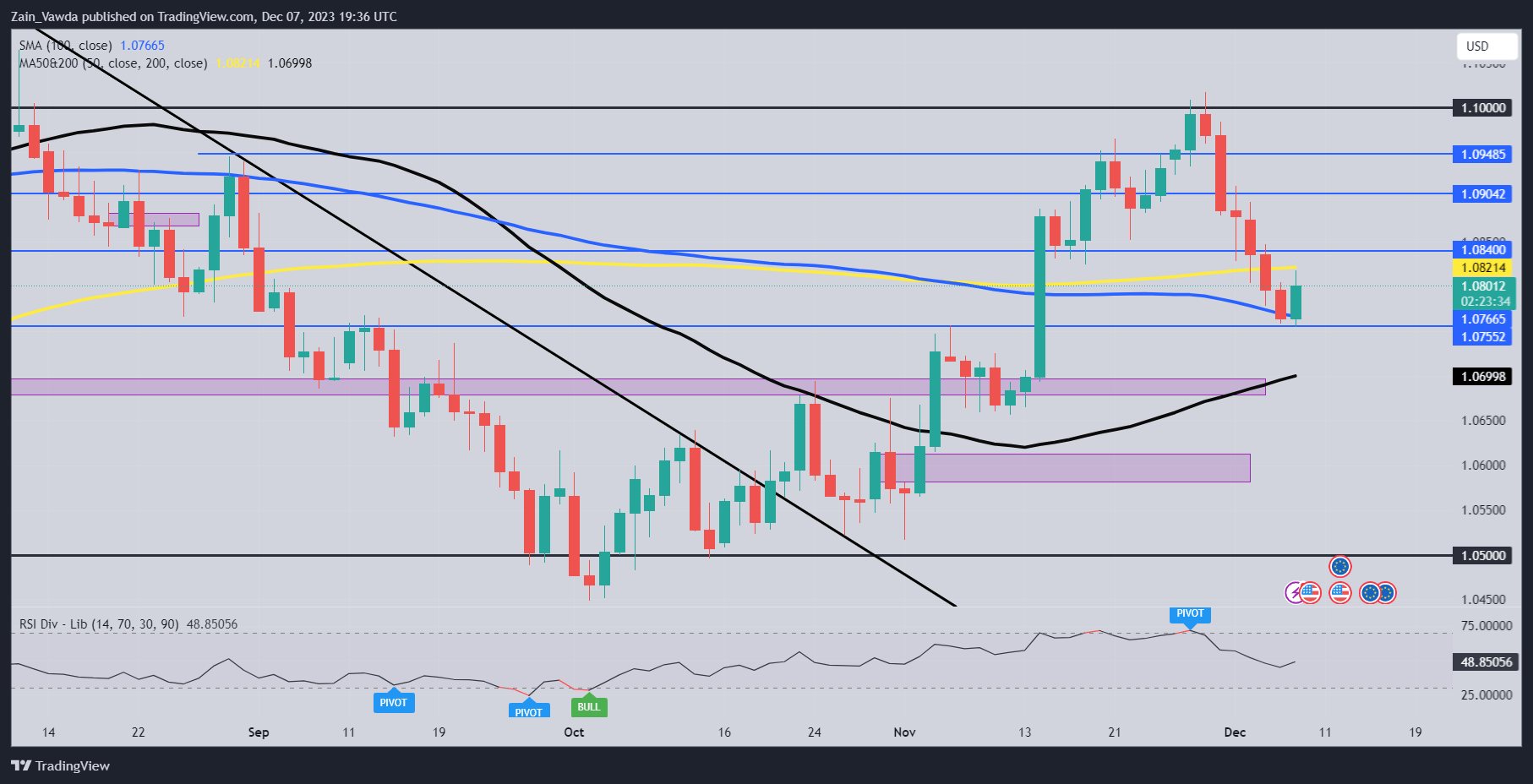
EURUSD finally arrested its slide in the US session in particular bouncing back above the 1.0800 handle. Not surprising given the key area of support around the 1.0760-1.0750 area, the question now being whether the recovery can continue. US Jobs data may play a key role tomorrow but let’s take a look at key areas of support and resistance that may provide some opportunity.

Immediate resistance for EURUSD rests at the 200-day MA which was tapped today and rests around the 1.0821 handle. A break above this may face some opposition at 1.0840 and 1.0900 respectively.

A continued push back toward and potentially below support at the 1.0750 mark may see EURUSD drop toward the 1.0700 handle where the 50-day MA rests.

Key Levels to Keep an Eye On:

Support levels:

  • 1.0760
  • 1.0700
  • 1.0656

Resistance levels:

  • 1.0821
  • 1.0840
  • 1.0900

EUR/USD Daily Chart

EUR/GBP

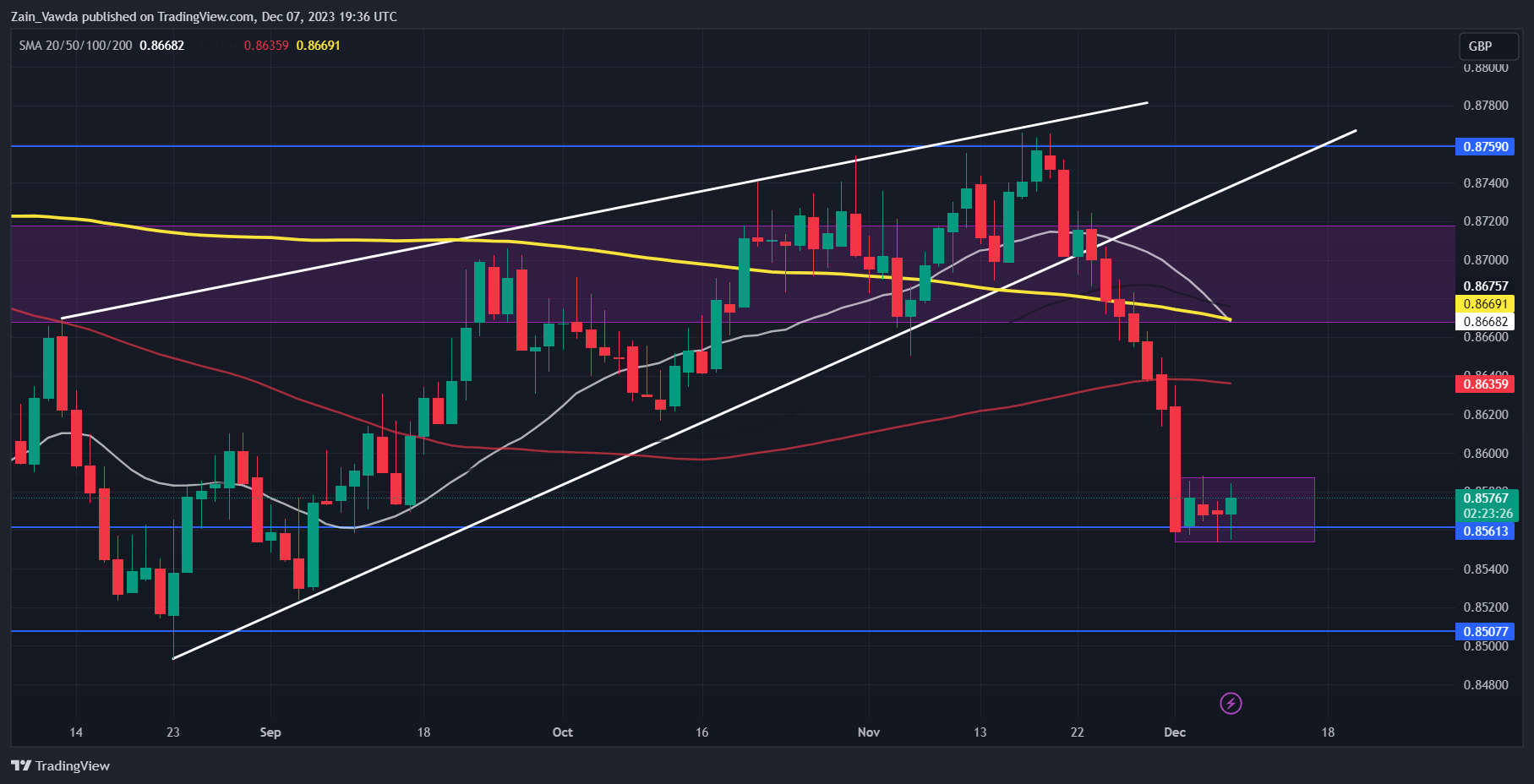
EURGBP has been caught in a 40-pip range for the last 4 days as you can see by the pink/purple box on the chart below. A breakout of the box could be a sign of further upside. There are conflicting signals however as we have just seen a death cross take place with the 20-day MA crossing below the 200-day MA. This of course hints at bearish momentum while the candlesticks themselves tell a different story, hence my confusion.

There is of course every chance that EURGBP may remain rangebound heading into next week. The ECB Central Bank meeting may provide some clarity for the pair.

Key Levels to Keep an Eye On:

Support levels:

  • 0.8550
  • 0.8500
  • 0.8487

Resistance levels:

  • 0.8587
  • 0.8636
  • 0.8668

EUR/GBP Daily Chart

IG CLIENT SENTIMENT

IG Client Sentiment datatells us that 73% of Traders are currently holding LONG positions on EURGBP. Given the contrarian view to client sentiment adopted here at DailyFX, does this mean we are destined to revisit the lows at the 0.8500 mark?