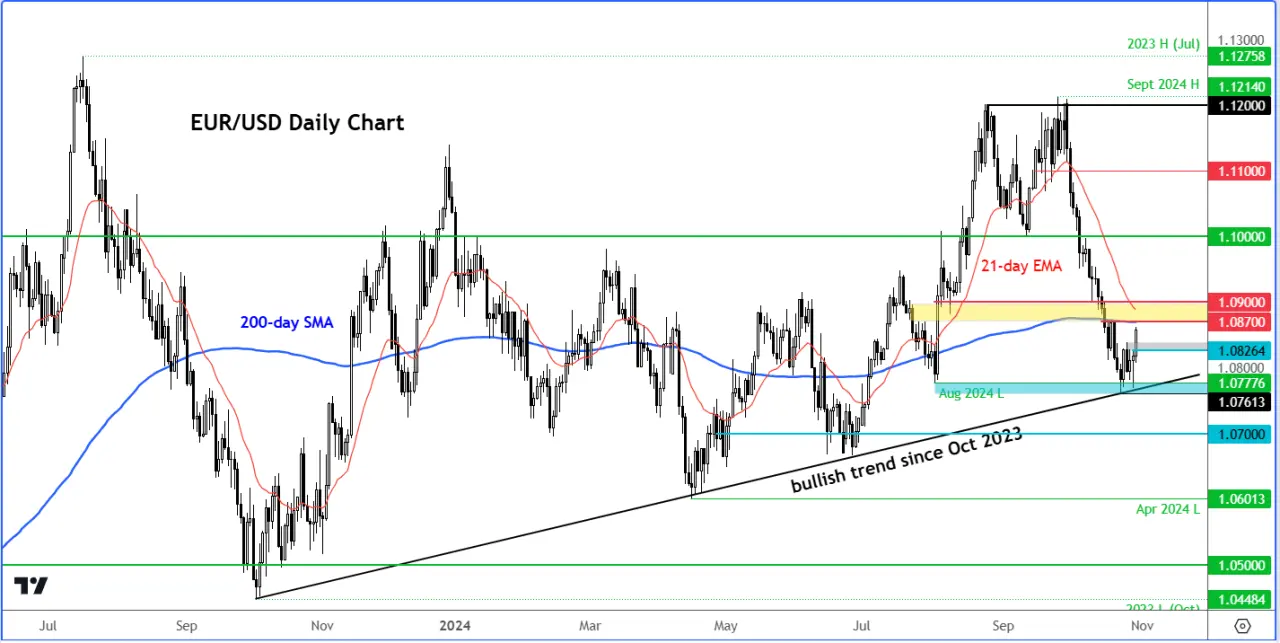
EUR/USD holds onto gains after robust Eurozone GDP growth supports Euro

EUR/USD holds onto gains after robust Eurozone GDP growth supports Euro

EUR/USD holds up near 1.0850 in Thursday’s European session following Wednesday’s sharp recovery. The major currency pair strengthened as traders have pared back bets of a large interest-rate cut from the European Central Bank (ECB) in the December monetary policy meeting after a faster-than-expected Eurozone Gross Domestic Product (GDP) growth and hotter-than-forecasted German inflation.

Eurostat reported on Wednesday that the Eurozone expanded at a faster pace of 0.9% in the third quarter of the year compared with the same period a year earlier. A major contribution to higher growth in the Eurozone came from its largest nation, Germany, which managed to dodge a technical recession. The German economy surprisingly rose by 0.2% compared with the previous quarter, beating expectations of a 0.1% contraction. Meanwhile, the growth rate in Spain was higher than expected, as forecasted in France, and slower than anticipated in Italy.

The German flash Harmonized Index of Consumer Prices (HICP) for October accelerated at a faster pace of 2.4% on year, higher than estimates of 2.1% and the prior release of 1.8%, suggesting that the battle against inflation is yet not over.

“The just-released flash estimate of German inflation in October could make some members of the ECB regret the latest rate cut and the European Central Bank’s new openness to more aggressive cuts,” said analysts at ING.

For more cues on the current status of inflation, investors will focus on the Eurozone flash HICP data for October, which will be published at 10:00 GMT.

Meanwhile, ECB President Christine Lagarde has shown confidence about taming price pressures in an interview with the French newspaper Le Monde published on Thursday. “The objective is in sight, but I am not going to tell you that inflation is under control,” Lagarde said. She reaffirmed her commitment to interest rate reduction, but refrained from committing to a specific rate cut path.

Technical Analysis: EUR/USD strives to sustain above 1.0800
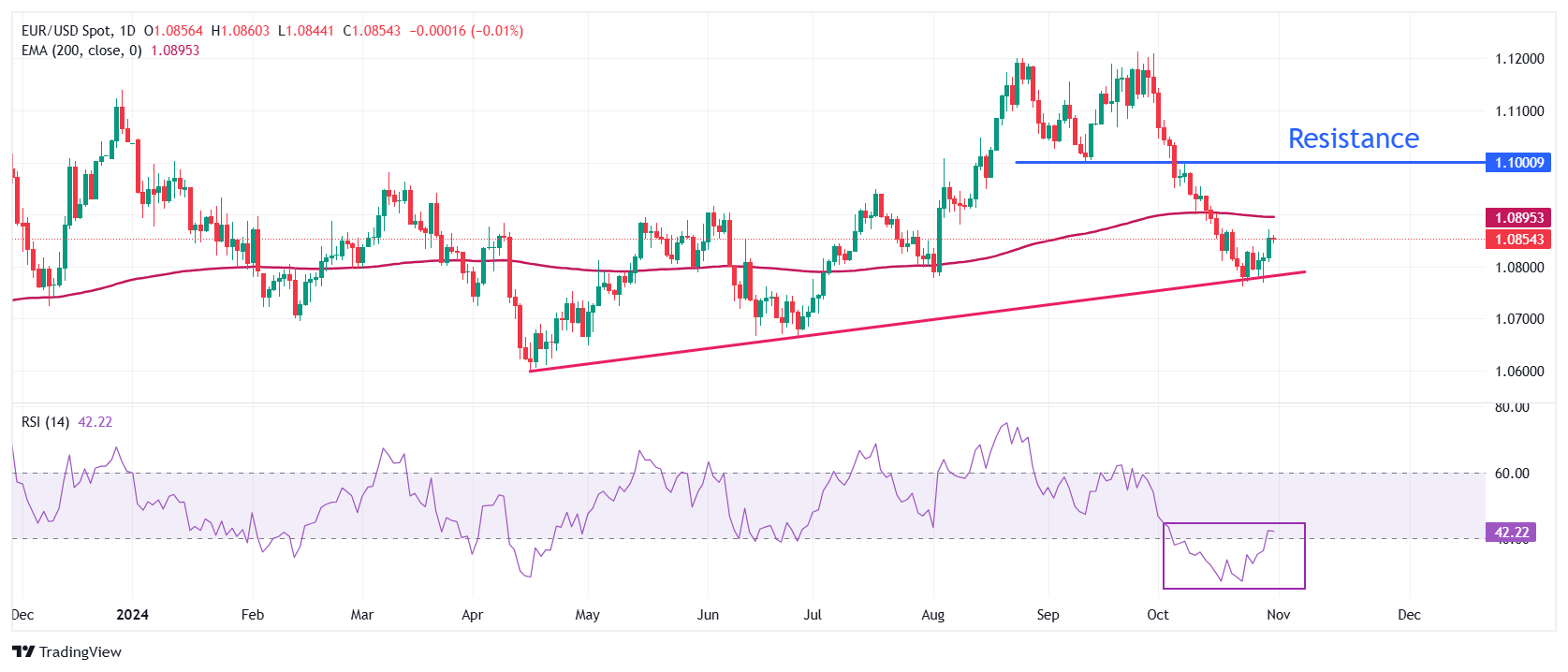
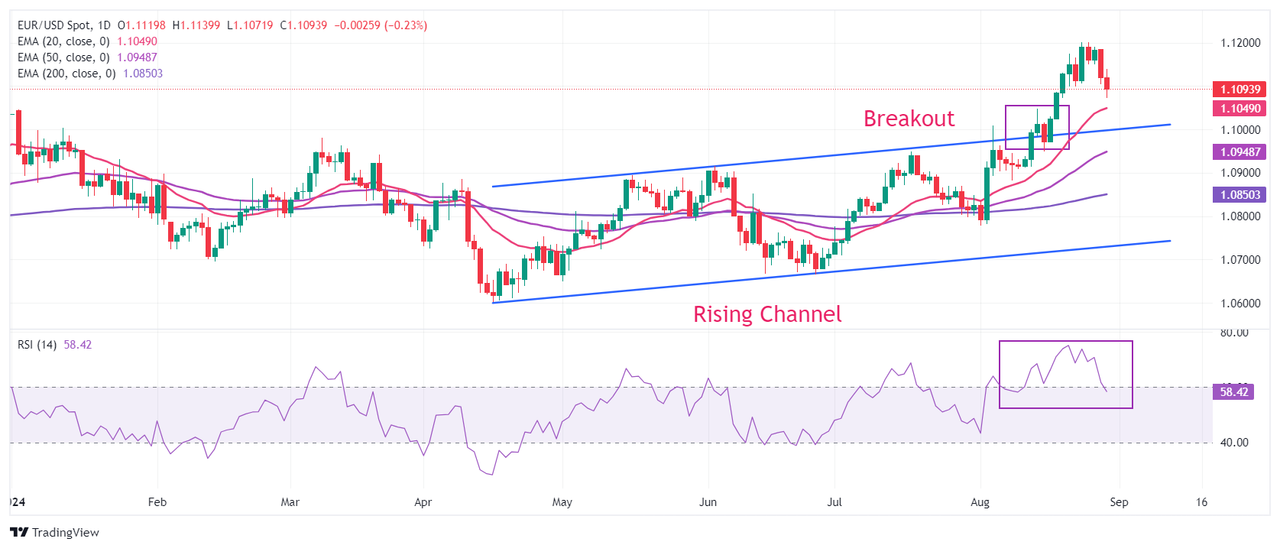
EUR/USD trades close to a fresh more than a week high around 1.0850 in European trading hours. The major currency pair holds onto its recent recovery after breaking above the round-level resistance of 1.0800. However, its broader outlook is still bearish as it trades below the 200-day Exponential Moving Average (EMA) at around 1.0900.

The 14-day Relative Strength Index (RSI) climbs to near 42.00 after staying in the 20.00-40.00 range for almost a month, suggesting that the bearish momentum has terminated.

Looking up, the shared currency pair could rise to near the 200-day EMA around 1.0900 and the September 11 low around 1.1000. On the downside, the upward-sloping trendline near 1.0750, which is plotted from the April 16  low at around 1.0600, will be the key support area for the Euro bulls.
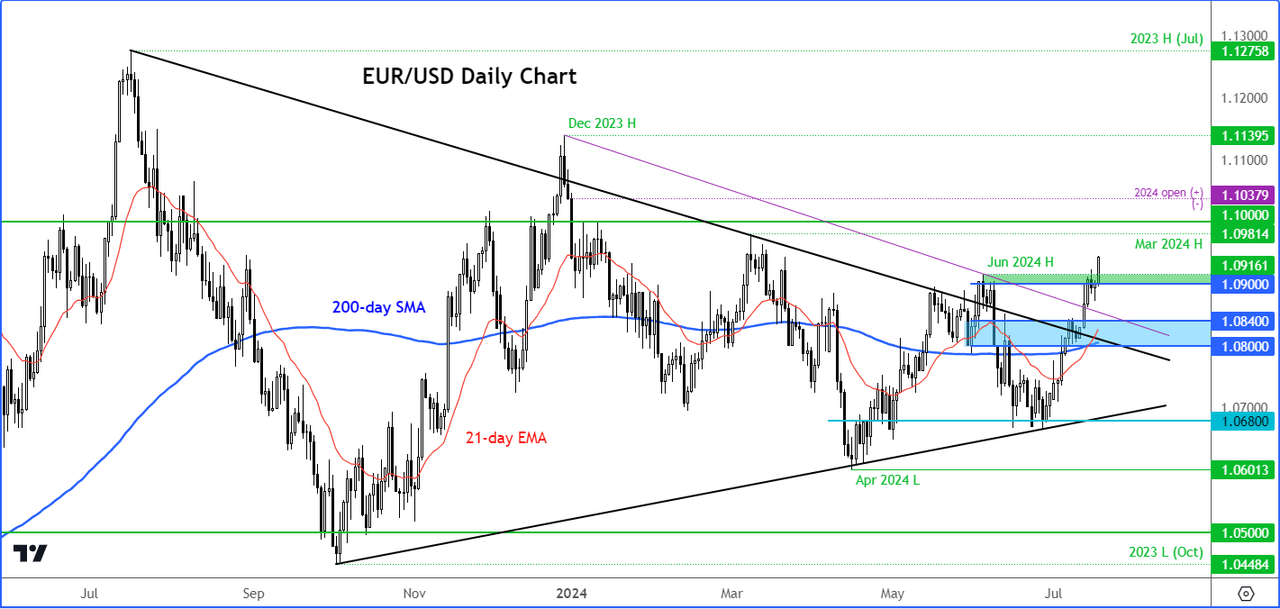
EUR/USD holds near 1.0850 ahead of key inflation data

EUR/USD holds near 1.0850 ahead of key inflation data

EUR/USD struggles to build on Wednesday’s gains and trades in a tight channel at around 1.0850 in the European session on Wednesday. Market participants await key inflation data releases from the Euro area and the US.

The Relative Strength Index (RSI) indicator on the 4-hour chart holds above 60, suggesting that the bullish bias remains intact. On the upside, the 200-day Simple Moving Average (SMA) aligns as a key resistance level at 1.0870. Once the pair flips that level into support, 1.0900 (round level) could act as interim resistance before 1.0940 (100-day SMA).

On the downside, first support could be seen at 1.0800 (round level) before 1.0750 (static level) and 1.0700 (round level, static level).

EUR/USD fluctuates in a tight channel at around 1.0850 after closing the third consecutive day in positive territory on Wednesday. The near-term technical outlook suggests that the bullish bias remains intact but buyers could hesitate to bet on an extended uptrend unless the pair manages to clear the key technical hurdle at 1.0870.

The Euro gathered strength against its rivals on Wednesday after the data from Germany showed that the Gross Domestic Product (GDP) expanded by 0.2% on a quarterly basis in the third quarter, coming in better than the market expectation for a 0.1% contraction. Additionally, annual inflation in Germany, as measured by the Consumer price Index (CPI) rose to 2% in October’s flash estimate from 1.6% in September, further boosting the Euro.

On the other hand, mixed macroeconomic data releases from the US made it difficult for the US Dollar (USD) to stay resilient against its rivals. The ADP Employment Change arrived at 233,000 for October to beat analysts’ estimate by a wide margin, while the first estimate of the annualized GDP growth for the third quarter came in at 2.8% and fell short of the market consensus of 3%.

Later in the day, the Harmonized Index of Consumer Prices (HICP) data from the Eurozone and the Personal Consumption Expenditures (PCE) Price Index figures from the US will be featured in the economic calendar. Investors are likely to ignore these readings. The US GDP report showed on Wednesday that the PCE Price Index rose 1.5% in Q3, down from 2.5% in Q2. Hence, the monthly PCE inflation reading for September is unlikely to trigger a reaction.

Toward the end of the European session, month-end flows could ramp up market volatility and cause major pairs to move irregularly.

Pound Sterling trades with caution ahead of UK Autumn budget statement

Pound Sterling trades with caution ahead of UK Autumn budget statement

The Pound Sterling (GBP) trades cautiously against its major peers on Wednesday ahead of the announcement of the United Kingdom’s (UK) Autumn Forecast Statement at 12:45 GMT. This will be Labour’s first budget presentation in over 15 years, in which Chancellor of the Exchequer Rachel Reeves is expected to announce a tax hike on various income-generating sources and provide higher spending plans to boost investment.

According to the UBS, the Budget will focus on three key aspects: First, changes in fiscal rules to increase headroom for future borrowing; second, a package of tax increases, probably on capital gains, inheritance, pensions, and – most importantly in terms of additional revenues – national insurance contributions for employers; third, additional spending on investment projects, Reuters reported.

Market participants will mainly focus on the quantum of tax raises and spending budgets to forecast their impact on inflationary pressures. Analysts at UBS expect that higher spending will likely lead to an upward revision in the fiscal deficit to 3.1% of Gross Domestic Product (GDP).

A higher deficit target would deepen fears of price pressures remaining persistent and force traders to pare Bank of England (BoE) dovish bets for the remainder of the year. According to the October 22-28 Reuters poll, the BoE is widely anticipated to cut interest rates by 25 basis points (bps) in its upcoming policy meeting on November 7. This would be the BoE’s second interest-rate cut this year, pushing key borrowing rates down to 4.75%.

Technical Analysis: Pound Sterling strives to hold above 1.3000

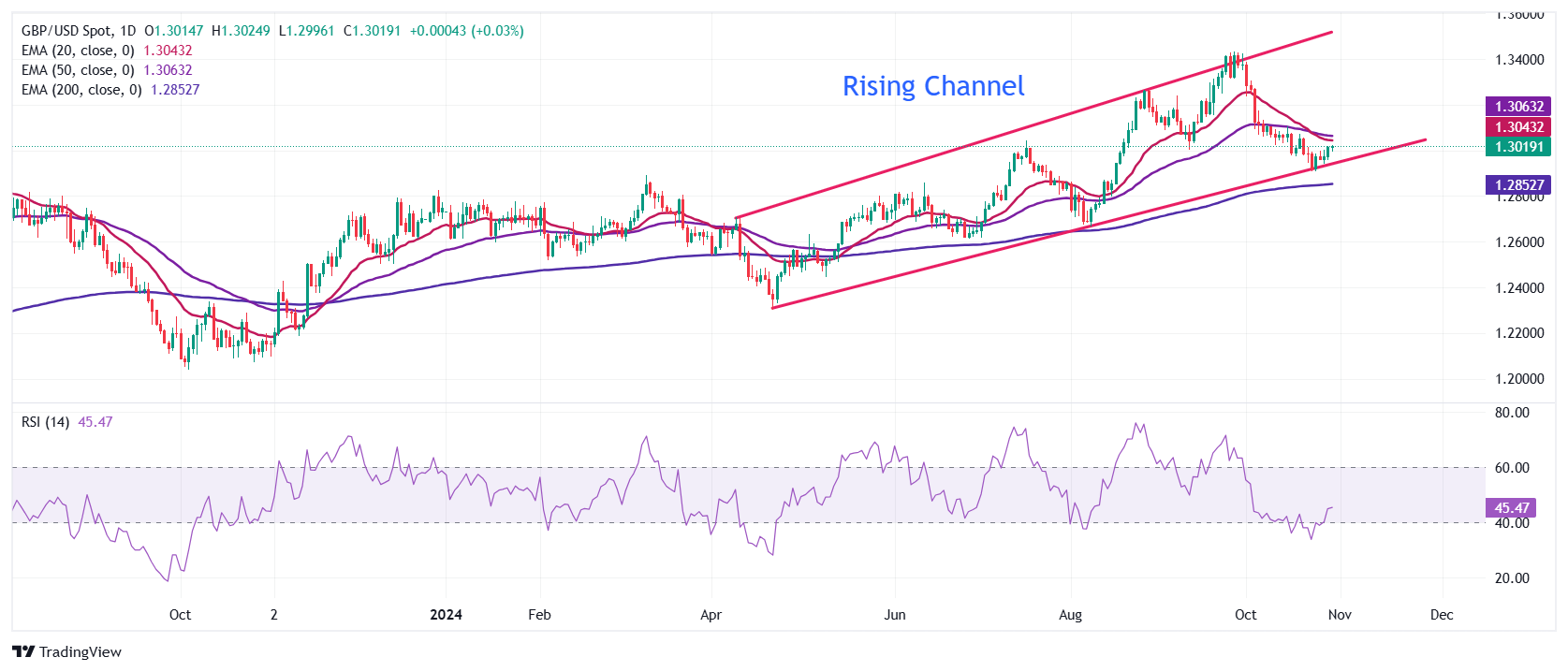
The Pound Sterling edges higher above 1.3000 against the US Dollar (USD) in European trading hours on Wednesday. The GBP/USD pair holds the lower boundary of a Rising Channel chart formation around 1.2900 on the daily time frame.

The near-term trend of the Cable remains uncertain as it stays below the 50-day Exponential Moving Average (EMA), which trades around 1.3070.

The 14-day Relative Strength Index (RSI) stays above 40.00. A fresh bearish momentum would trigger if it fails to climb above it.

Looking down, the 200-day EMA near 1.2845 will be a major support zone for Pound Sterling bulls. On the upside, the Cable will face resistance near the 20-day EMA around 1.3060.

EUR/USD gains on German economic expansion, hot inflation

EUR/USD gains on German economic expansion, hot inflation

EUR/USD gains sharply to near 1.0850 in Wednesday’s European session as the flash Gross Domestic Product (GDP) data has shown that the economy surprisingly grew in the third quarter after contracting in the April-June period. The data showed that the German economy expanded by 0.2%, while economists expected a 0.1% decline as seen in the second quarter of the year.

Year-on-year German GDP contracted at a slower pace of 0.3% after a flat growth in the second quarter. Meanwhile, the October preliminary Harmonized Index of Consumer Prices (HICP) data from Germany and six of its states has come in hotter-than-expected.

Surprisingly positive Q3 German GDP  and hot inflation data have dampened expectations of the European Central Bank’s (ECB) larger-than-usual interest rate cut of 50 basis points (bps) in December. According to market expectations, the probability of the ECB reducing interest rates by 50 bps eases to 22% from 45% after the German data release.

Recent commentaries from policymakers have indicated that they are worried about inflation remaining persistently lower due to weakening economic growth. Market participants are worried about the outlook of the Eurozone economy. In Wednesday’s session, investors await the flash Eurozone Q3 GDP and the HICP data for Germany.

Meanwhile, uncertainty ahead of the US presidential election persists. While national polls have indicated tight competition between former US President Donald Trump and current Vice President Kamala Harris, traders seem to be pricing in a Trump victory, which would have deep repercussions also for the Eurozone.

Trump has promised a universal 10% tariff on all imports, except those from China, which would face even bigger tariffs. The threat of tariffs could impact the Eurozone’s powerful export sector significantly. Investment banking firm Goldman Sachs projects a 1% drop in the Eurozone’s GDP if a universal 10% tariff is imposed.

Silver price today: Silver falls

Silver price today: Silver falls


Silver prices (XAG/USD) fell on Wednesday, according to FXStreet data. Silver trades at $34.20 per troy ounce, down 0.75% from the $34.46 it cost on Tuesday.

Silver prices have increased by 43.72% since the beginning of the year.

Unit measure Silver Price Today in USD
Troy Ounce 34.20
1 Gram 1.10

The Gold/Silver ratio, which shows the number of ounces of Silver needed to equal the value of one ounce of Gold, stood at 81.33 on Wednesday, up from 80.53 on Tuesday.

USD: A blip in the strong US jobs story

USD: A blip in the strong US jobs story

The latest US macro news has dampened the dollar rally. Consumer confidence rose more than expected from 99.5 to 108.7 yesterday, the strongest monthly gain since March 2021. Interestingly, for the first time since July 2023, the survey shows some improved optimism about future job availability, ING’s FX analyst Francesco Pesole notes.

US GDP report to prevent USD narrative turn negative

“The indications from the JOLTS job openings instead pointed to some cool-off in the jobs market. There was a revision in the August figure down to 7.8m, and the September print was 7.4m – well below the consensus of 8.0m. The JOLTS report also includes the quits rate, which has decreased sharply to 1.9% from the 3% early-2022 peak, when a high number of workers were leaving their jobs for higher-paid roles elsewhere.”

“The falling quits rate can indicate that there is indeed a greater scarcity of jobs but also that workers are more worried about the outlook and value job security. This is a net-negative indicator for the jobs market, but payrolls data needs to follow through with a soft read on Friday to convince markets to price back in Fed easing. The Fed funds futures curve is embedding 45bp of cuts over November and December.”

“Today, the US will release the advanced third-quarter GDP report, which includes the quarterly core PCE figures. These are expected at 2.1% QoQ, a decline from 2.8% in the second quarter. The ADP payrolls for October are also released today and are expected to have declined from 143k to 111k. Those have limited predictive power for actual payrolls, but can still move the market. We suspect a strong growth print can prevent the macro story from turning dollar-negative before payrolls on Friday, and allow Trump hedges and rising implied volatility to feed into a stronger dollar.”

AUD/USD: Next level to monitor is 0.6520

AUD/USD: Next level to monitor is 0.6520

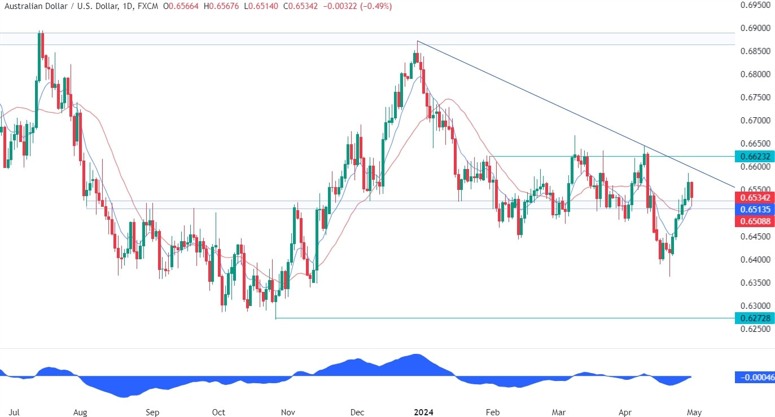
Oversold conditions and slowing momentum suggest Australian Dollar (AUD) is likely to trade in a range of 0.6545/0.6585. In the longer run, the potential for further sustained decline may be limited; the next level to monitor is 0.6520, UOB Group’s FX analysts Quek Ser Leang and Lee Sue Ann note.

AUD can test the 0.6585 resistance

24-HOUR VIEW: “After AUD fell sharply on Monday, we highlighted yesterday (Tuesday) that ‘While oversold, the decline could extend to 0.6560 before stabilisation can be expected.’ Our view of AUD declining was not wrong, even though it fell more than expected to 0.6545. Conditions remain oversold, this, combined with tentative signs of slowing momentum, suggests that instead of continuing to weaken, AUD is more likely to trade in a 0.6545/0.6585 range.”

1-3 WEEKS VIEW: “Yesterday (29 Oct, spot at 0.6585) we indicated that ‘there is potential for AUD to continue to decline to 0.6560, possibly 0.6520.’ We did not quite expect AUD to reach 0.6560 as quickly, as it dropped to a low of 0.6545 during NY trading. Although the weakness has not stabilised, given that the current decline is entering its second month, the potential for further sustained weakness may be limited. The next level to monitor is 0.6520. On the upside, a breach of 0.6620 (‘strong resistance’ was at 0.6640 yesterday) would mean that the weakness has stabilised.”

USD/CAD remains above 1.3900 near three-month highs, eyes on US GDP

USD/CAD remains above 1.3900 near three-month highs, eyes on US GDP

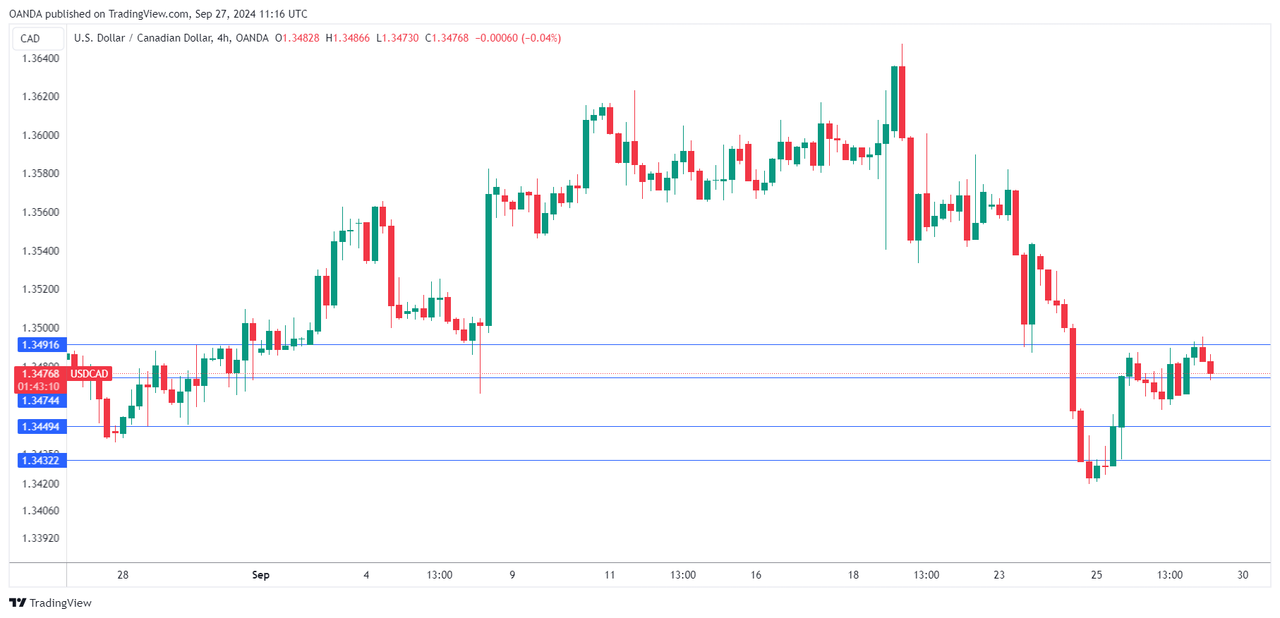
The USD/CAD pair pulls back from its three-month high of 1.3929, recorded in the previous session, trading around 1.3910 during Wednesday’s European session. The Canadian Dollar (CAD), tied to commodities, benefits from stronger Oil prices, as Canada remains the largest crude supplier to the United States (US).

West Texas Intermediate (WTI) Oil price rebounds after two days of losses, trading around $67.70 at the time of writing. Crude Oil prices are bolstered by an unexpected decline in US crude inventories. API US weekly crude Oil stockpiles fell by 0.573 million barrels in the week ending October 25, contrary to expectations of a 2.3 million-barrel increase. Investors now await the EIA crude Oil stockpiles report, due Wednesday.

On Monday, Bank of Canada Governor Tiff Macklem provided more insight into last week’s substantial interest rate cut, describing it as justified following years of sharp rate increases aimed at curbing inflation. Macklem is expected to appear before the House of Commons Finance Committee on Wednesday to discuss the bank’s monetary policy.

The decline of the USD/CAD pair could also be attributed to a weaker US Dollar (USD), driven by lower Treasury yields. The US Dollar Index (DXY), which measures the value of the US Dollar against six other major currencies, trades around 104.10 with 2-year and 10-year yields on US Treasury bonds standing at 4.07% and 4.22%, respectively, at the time of writing.

Traders will likely watch the upcoming release of preliminary US Q3 Gross Domestic Product (GDP) figures and October’s ADP Employment Change, as these could offer important insights into the timing and pace of the Federal Reserve’s (Fed) expected rate cuts. Additionally, US PCE inflation and Nonfarm Payrolls (NFP) will be closely monitored on Thursday and Friday, respectively.

EUR/USD clings to gains near 1.0850 after German data

EUR/USD clings to gains near 1.0850 after German data

EUR/USD clings to daily gains near 1.0850 in the European session on Wednesday. The data from Germany showed that the Gross Domestic Product (GDP) grew by 0.2% on a quarterly basis in Q3, coming in better than the market expectation of -0.1% and supporting the Euro.

EUR/USD broke out of the descending regression channel and the Relative Strength Index (RSI) indicator on the 4-hour chart rose to 60, reflecting a bullish shift in the short-term technical bias.

On the upside, the 200-day Simple Moving Average aligns as strong resistance at 1.0870 ahead of 1.0900 (round level) and 1.0940 (100-day SMA). Looking south, first support could be spotted at 1.0810-1.0800 (20-period SMA, 50-period SMA, round level) before 1.0750 (static level) and 1.0700 (round level, static level).

EUR/USD gains traction and rises toward 1.0850 in the European trading hours on Wednesday. Although the technical outlook highlights a buildup of bullish momentum, the Euro still faces a two-way risk on high-impact macroeconomic data releases.

Regional Consumer Price Index (CPI) figures and third-quarter Gross Domestic Product (GDP) data from Germany will be watched closely by market participants. Investors expect Germany’s GDP to contract at an annualized rate of 0.3% in the third quarter. A worse-than-expected GDP print, combined with soft regional inflation figures from Germany, could weigh on the Euro with the immediate reaction.

Later in the day, the ADP Employment Change for October will be featured in the US economic docket. Analysts see the employment in private sector rising by 115,000 following the 143,000 increase recorded in September.

Additionally, the US Bureau of Economic Analysis will publish its first estimate of the third-quarter GDP data, which is forecast to show an expansion at an annual rate of 3%.

In case the ADP and the GDP data both disappoint, the US Dollar (USD) is likely to come under renewed selling pressure and open the door for a leg higher in EUR/USD. On the flip side, the USD could regather its strength if these data arrive near or above market consensus. If the figures come in mixed, investors could refrain from taking large positions. In this scenario, the risk perception following the Wall Street’s opening bell could be the driving factor for the USD’s performance.

EUR/USD keeps range above 1.0800 ahead of key German/ EU data

EUR/USD keeps range above 1.0800 ahead of key German/ EU data

EUR/USD is keeping its range play intact above 1.0800 in the European session on Wednesday. The Euro remains vulnerable ahead of key growth data from Germany and the Eurozone, which could ramp up ECB interest-rate cut expectations.

EUR/USD broke out of the descending regression channel and the Relative Strength Index (RSI) indicator on the 4-hour chart rose to 60, reflecting a bullish shift in the short-term technical bias.

On the upside, the 200-day Simple Moving Average aligns as strong resistance at 1.0870 ahead of 1.0900 (round level) and 1.0940 (100-day SMA). Looking south, first support could be spotted at 1.0810-1.0800 (20-period SMA, 50-period SMA, round level) before 1.0750 (static level) and 1.0700 (round level, static level).

EUR/USD gains traction and rises toward 1.0850 in the European trading hours on Wednesday. Although the technical outlook highlights a buildup of bullish momentum, the Euro still faces a two-way risk on high-impact macroeconomic data releases.

Regional Consumer Price Index (CPI) figures and third-quarter Gross Domestic Product (GDP) data from Germany will be watched closely by market participants. Investors expect Germany’s GDP to contract at an annualized rate of 0.3% in the third quarter. A worse-than-expected GDP print, combined with soft regional inflation figures from Germany, could weigh on the Euro with the immediate reaction.

Later in the day, the ADP Employment Change for October will be featured in the US economic docket. Analysts see the employment in private sector rising by 115,000 following the 143,000 increase recorded in September.

Additionally, the US Bureau of Economic Analysis will publish its first estimate of the third-quarter GDP data, which is forecast to show an expansion at an annual rate of 3%.

In case the ADP and the GDP data both disappoint, the US Dollar (USD) is likely to come under renewed selling pressure and open the door for a leg higher in EUR/USD. On the flip side, the USD could regather its strength if these data arrive near or above market consensus. If the figures come in mixed, investors could refrain from taking large positions. In this scenario, the risk perception following the Wall Street’s opening bell could be the driving factor for the USD’s performance.