NZD/USD holds losses around 0.5650 as Business NZ PSI reports a decline

NZD/USD holds losses around 0.5650 as Business NZ PSI reports a decline

NZD/USD retraces its recent gains from the previous session, trading near 0.5650 during early European hours on Tuesday. The pair experienced volatility as US President Donald Trump’s inauguration day created ripples in the markets.

The US Dollar (USD) appreciated following reports that Trump plans to direct federal agencies to review tariff policies and reassess the United States’ trade relationships with Canada, Mexico, and China.

However, the NZD/USD gained some footing as the Greenback came under pressure. This was driven by Trump’s apparent efforts to strengthen ties with Chinese President Xi Jinping, the TikTok deal, and hints of a potentially softer stance on tariffs.

US President Donald Trump stated, “If we make a TikTok deal and China doesn’t approve it, we could maybe put tariffs on China.” This comment came after he signed an executive order delaying the enforcement of the TikTok ban by 75 days. Given the close trade relationship between China and New Zealand, any changes in China’s economy could influence New Zealand’s markets.

Meanwhile, the New Zealand Dollar (NZD) faced downward pressure as Business NZ’s data reported a decline in the country’s Performance of Services Index (PSI). The PSI dropped to 47.9 in December from 49.5 in November, marking ten consecutive months of contraction.

Traders will closely monitor Wednesday’s Consumer Price Index (CPI) data, as the annual inflation rate is anticipated to drop to its lowest level since 2021. Markets are currently pricing in an 80% probability that the Reserve Bank of New Zealand (RBNZ) will cut its cash rate from 4.25% to 3.75% next month.

Pound Sterling steady amid increasing UK wage growth acceleration, increasing unemploymnet rate

Pound Sterling steady amid increasing UK wage growth acceleration, increasing unemploymnet rate

The Pound Sterling (GBP) remains steady against its major peers on Tuesday after the United Kingdom (UK) Office for National Statistics (ONS) showed that Average Earnings accelerated in three months ending November. The agency reported that Average Earnings Excluding Bonus, a key measure of wage growth, rose at a robust pace of 5.6%, faster than estimates of 5.5% and the former 5.2%.

Average Earnings Including Bonus also rose by 5.6%, as expected, faster than the 5.2% growth in three months ending October.

Meanwhile, labor growth remained significantly weak, with a fresh addition of 35K workers against the former reading of 173K. The ILO Unemployment Rate rose to 4.4%, higher than estimates and the prior release of 4.3%. Weak labor growth clearly shows employers’ discontent with the government’s decision to increase their contribution to National Insurance (NI).

Bank of England (BoE) officials closely track wage growth data when deciding on interest rates, as wage growth is a major contributor to inflationary pressures in the UK service sector. Technically, stronger-than-expected UK wage growth should have jeopardized recent growing expectations that the BoE will reduce interest rates by 25 basis points (bps) to 4.5% in the policy meeting on February 6. However, soft labor demand would offset this.

EUR/USD remains pressured below 1.0400 on Trump’s tariff threats

EUR/USD remains pressured below 1.0400 on Trump’s tariff threats

EUR/USD remains in the negative territory below 1.0400 in the European session on Tuesday, stalling the recovery. The pair is undermined by risk aversion and the US Dollar demand, fuelled by US President Trump’s tariff threats. The focus shifts to the ZEW surveys.

Despite EUR/USD’s recent pullback, the Relative Strength Index (RSI) indicator on the 4-hour chart holds above 60, suggesting that the bullish bias remains intact. The pair could face stiff resistance at 1.0390-1.0400, where the 200-period Simple Moving Average (SMA) meets the Fibonacci 50% retracement of the latest downtrend. In case EUR/USD stabilizes above this area, 1.0440 (Fibonacci 61.8% retracement) could be seen as next resistance before 1.0500 (round level, Fibonacci 78.6% retracement).

On the downside, supports could be spotted at 1.0350 (Fibonacci 38.2% retracement), 1.0320 (100-period SMA) and 1.0290 (Fibonacci 23.6% retracement).

EUR/USD gathered bullish momentum at the beginning of the week and gained more than 1% on Monday. With the US Dollar (USD) benefiting from the souring risk mood, however, the pair lost its traction early Tuesday and retreated below 1.0400.

The USD came under heavy selling pressure following news of US President Donald Trump stopping short of announcing day-one tariffs at his inauguration ceremony on Monday. In the early Asian session, however, Trump crossed the wires again, saying that they could impose tariffs on China if they make a TikTok deal and China doesn’t approve it. Furthermore, he said that they are planning to impose 25% tariff on imports from Mexico and Canada, triggering a USD rally in the Asian trading hours on Tuesday.

Despite the broad-based USD strength, EUR/USD’s losses remain limited for now. EUR/CAD and EUR/MXN pairs both register strong gains in the early European session, suggesting that the Euro is able to capture capital outflows out of the Canadian Dollar and Mexican Peso.

The US economic calendar will not feature any high-tier macroeconomic data releases on Tuesday. Hence, investors are likely to pay close attention to the risk perception.

In case Wall Street’s main indexes come under bearish pressure following the long weekend, the USD could preserve its strength and cause EUR/USD to continue to stretch lower.

GBP/USD drops to 1.2250 area on broad USD strength

GBP/USD drops to 1.2250 area on broad USD strength

GBP/USD stays under bearish pressure and trades deep in the red near 1.2250 on Tuesday as the USD gathers strength following US President Trump’s tariff threats. The data from the UK showed that the ILO Unemployment Rate edged higher to 4.4% in the three months to November.

The Relative Strength Index (RSI) indicator on the 4-hour chart stays slightly below 50 and GBP/USD struggles to stabilize above the 20-period Simple Moving Average (SMA), highlighting buyers’ hesitancy.

On the upside, 1.2225 (50-period SMA) aligns as immediate resistance before 1.2270 (Fibonacci 23.6% retracement of the latest downtrend) and 1.2300 (static level, round level). Looking south, first support could be spotted at 1.2160 (static level) before 1.2100 (end-point of the downtrend).

After losing more than 0.5% on Friday, GBP/USD gains traction at the beginning of the week and trades in positive territory above 1.2200. In the absence of high-impact data releases, comments from Donald Trump at his inauguration ceremony will be watched closely by market participants.

The US Dollar remains under bearish pressure in the European session, helping GBP/USD stretch higher.

Investors remain optimistic about Trump refraining from introducing an aggressive trade policy later in the day. In a social media post over the weekend, Trump noted he had a call with Chairman Xi Jinping of China. “It is my expectation that we will solve many problems together, and starting immediately,” Trump said.

It’s worth mentioning that stock and bond markets in the US will be closed in observance of the Martin Luther King Jr. Day holiday on Monday. Hence, there could be a delayed market reaction to Trump’s comments.

Early Tuesday, the UK’s Office for National Statistics will publish the jobs report, which will feature ILO Unemployment Rate, Employment Change and wage inflation figures for November.

EURGBP_Bearish-2_Large

EUR/GBP sticks to gains around 0.8635-0.8640 area after UK data/German CPI

The EUR/GBP cross attracts fresh buyers near the 0.8400 mark and stalls the previous day’s sharp retracement slide from its highest level since August 23. Spot prices stick to positive bias around the 0.8435-0.8440 region following the release of the UK macro data and the final German Consumer Price Index (CPI) print.

The UK Office for National Statistics (ONS) reported that the economy returned to expansion and grew 0.1% in November after declining 0.1% in the previous month. Other data from the UK showed that monthly Industrial and Manufacturing Production dropped more than expected, by 0.4% and 0.3%, respectively, in November. This comes on top of Wednesday’s softer consumer inflation figures from the UK and offers the Bank of England (BoE) an opportunity to cut interest rates in February. Adding to this concerns about the UK’s fiscal situation and the risk of stagflation – a combination of high inflation and weak economic growth – undermine the British Pound (GBP).

The shared currency, on the other hand, draws some support from a rise in German core annual inflation, which crept higher to 3.3% in December from 3.0% in the previous month. This turns out to be another factor that remains supportive of the bid tone surrounding the EUR/GBP cross. The data, however, raises stagflation worries for the Eurozone’s largest economy and reaffirms expectations for further interest rate cuts by the European Central Bank (ECB). This might cap gains for the Euro and warrants some caution for bullish traders around the currency pair, making it prudent to wait for acceptance above the very important 200-day SMA before placing fresh bets.

ttt

GBP/JPY remains tepid near 190.50 following key economic figures from United Kingdom

GBP/JPY continues to lose ground for the second successive day, trading around 190.60 during the early European hours. The GBP/JPY cross loses ground as the Pound Sterling (GBP) faces challenges following the disappointing economic data from the United Kingdom (UK) on Thursday.

The UK economy returned to growth in November, with Gross Domestic Product (GDP) rising by 0.1%, following a 0.1% contraction in October. However, this fell short of market expectations for a 0.2% expansion.

Meanwhile, the Index of Services for October remained unchanged at 0% 3M/3M, compared to October’s 0.1%. In November, Monthly Industrial and Manufacturing Production declined by 0.4% and 0.3%, respectively, with both readings coming in below market expectations.

Additionally, the GBP received downward pressure as the yield on the UK 10-year Gilt fell to 4.73%, retreating from multi-decade highs, after official data showed an unexpected drop in headline UK inflation, increasing expectations of rate cuts by the Bank of England (BoE).

The UK Consumer Price Index (CPI) increased by 2.5% year-over-year in December, down from 2.6% in November and below the market forecast of 2.7%. Despite the slowdown, the figure remained above the Bank of England’s (BoE) 2% target.

Moreover, the Japanese Yen (JPY) appreciates amid growing expectations that the Bank of Japan (BoJ) will hike interest rates next week. These speculations have driven yields on Japanese Government Bonds (JGBs) to multi-year highs.

Bloomberg reported on Thursday, citing unnamed sources, that the BoJ is likely to raise interest rates next week unless a significant market disruption occurs following the inauguration of US President-elect Donald Trump.

BoJ Governor Kazuo Ueda reiterated that the central bank will discuss the possibility of a rate hike next week and may increase the policy rate this year if economic and inflation conditions continue to improve. Key factors influencing the BoJ’s decision include the policy direction of the new US administration and domestic wage negotiations.

images

Japanese Yen remains on the front foot; USD/JPY holds above 156.00 ahead of US data

The Japanese Yen (JPY) attracts some intraday sellers after touching a four-week high against its American counterpart earlier this Thursday, though the downside remains cushioned amid bets for a Bank of Japan (BoJ) rate hike next week. Moreover, signs of broadening inflationary pressures in Japan support prospects for further policy tightening by the BoJ, pushing yields on Japanese Government Bonds (JGBs) to multi-year highs. In contrast, the US Treasury bond yields retreated sharply on Wednesday in reaction to benign US inflation data. The resultant narrowing of the US-Japan yield differential continues to underpin the JPY.

Meanwhile, easing fears about US President-elect Donald Trump’s disruptive trade tariffs remain supportive of the risk-on mood and dent demand for traditional safe-haven assets, including the JPY. Adding to this, growing acceptance that the Federal Reserve (Fed) will pause its rate-cutting cycle later this month helps revive the US Dollar (USD) demand and lifts the USD/JPY pair back above the 156.00 mark. That said, benign US inflation data lifts bets that the Fed could cut rates twice this year, which might cap the Greenback. This, along with a bullish JPY fundamental backdrop, keeps a lid on the currency pair ahead of the US macro data.

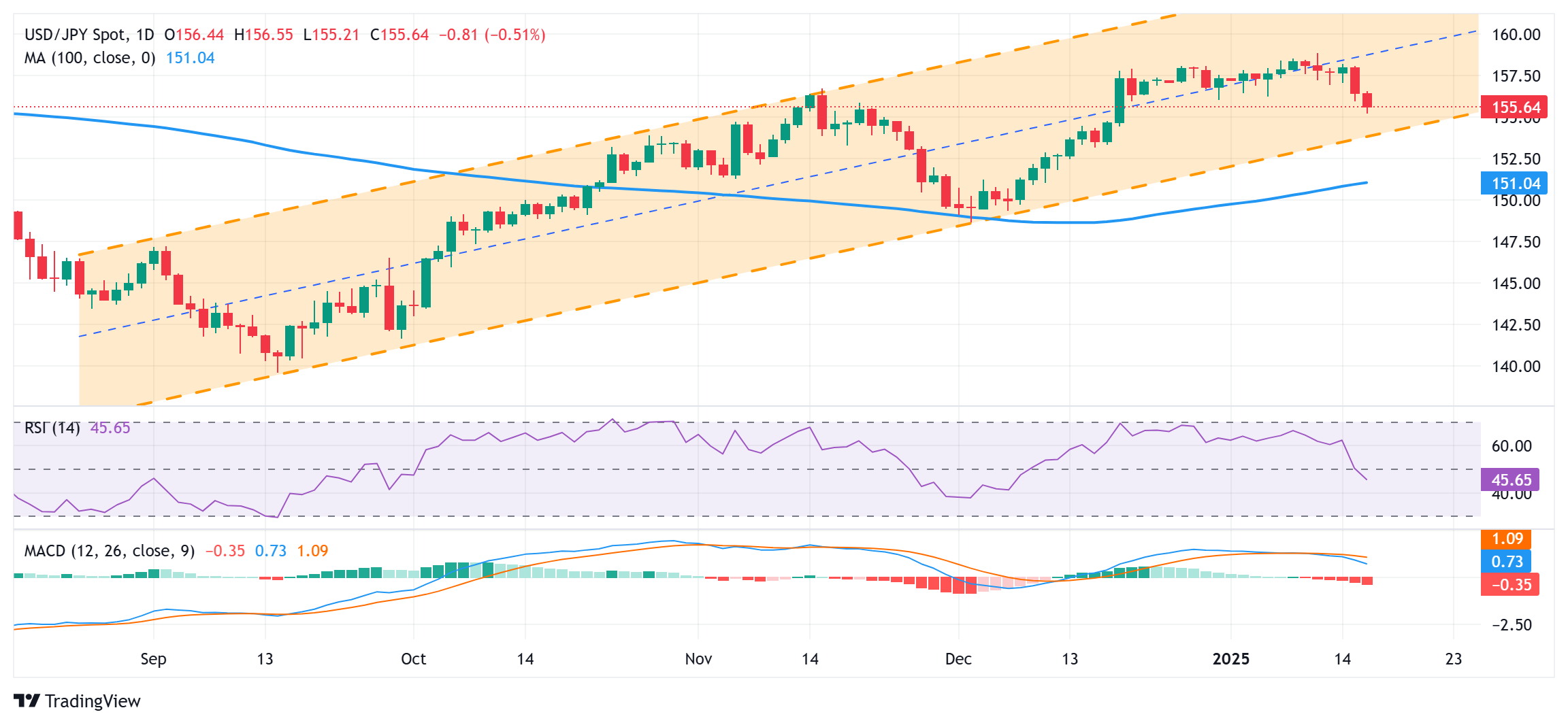
USD/JPY seems vulnerable while below 156.35-156.40 support-turned-resistance

fxsoriginal

Any further slide is likely to find some support near the 155.00 psychological mark, below which the USD/JPY pair could slide to the 154.55-154.50 region. The latter represents the lower boundary of a four-month-old upward-sloping channel and should act as a key pivotal point. A convincing break below will be seen as a fresh trigger for bearish traders and pave the way for an extension of the recent retracement slide from a multi-month peak touched last Friday. Spot prices might then weaken further below the 154.00 mark and test the next relevant support near the 153.40-153.35 horizontal zone.

On the flip side, any attempted recovery might now confront resistance near the 156.00 mark ahead of the 156.35-156.45 region and the 156.75 area. Some follow-through buying, leading to a subsequent strength beyond the 157.00 mark, might shift the bias back in favor of bullish traders and lift the USD/JPY pair to the 155.55-155.60 intermediate hurdle en route to the 158.00 round figure. The momentum could extend further towards challenging the multi-month peak, around the 158.85-158.90 region.

images

Dollar struggles amid upbeat mood, ahead of high-impact US data

Risk flows remain in vogue in the early European session on Thursday, with the US Dollar (USD) struggling alongside the US Treasury bond yields. The market optimism is linked to the revival of expectations that the US Federal Reserve (Fed) would remain on track for two interest rate cuts this year in light of tame inflation figures.

US Consumer Price Index (CPI) rose in line with estimates at an annual rate of 2.9% in December from November’s 2.7%. However, core CPI, which excludes food and energy prices, rose by 3.2%, below forecasts of 3.3%. Earlier in the week, the US annual Producer Price Index (PPI) rose 3.3% in December, missing the expected 3.4% growth.

The dovish Fed bets, hopes for more Chinese stimulus and easing fears over potential disruptive trade tariffs under Donald Trump’s presidency lift investors’ sentiment while diminishing the USD’s safe-haven appeal.

However, FX majors fail to capitalize on the risk-on sentiment and a subdued USD, the Australian Dollar (AUD) and the Japanese Yen (JPY) emerging as the weakest currencies across the FX board. AUD/USD is closing in on the 0.6200 level after spiking to 0.6250 in a knee-jerk reaction to strong Australian employment change data. However, the uptick in the OZ Unemployment Rate added to the bets of early easing by the Reserve Bank of Australia (RBA).

Meanwhile, USD/JPY witnessed another volatile Asian session on Thursday, initially falling hard from 156.00 to 155.20 on mounting expectations that the Bank of Japan (BoJ) will hike interest rates next week. Citing unnamed sources, Bloomberg reported that the Japanese central bank is expected to raise rates next week, barring a major market rout following US President-elect Donald Trump’s inauguration. USD/JPY buyers returned with a bang and recaptured 156.00 following BoJ Governor Kazuo Ueda’s commentary.

The Pound Sterling maintains its offered tone, leaving GBP/USD gyrating near 1.2200 as traders digest the disappointing UK Gross Domestic Product (GDP) and Industrial Production data for November. The UK economy expanded at a monthly pace of 0.1% in November, below the forecast of +0.2%. Other data from the UK showed that monthly Industrial and Manufacturing Production dropped by 0.4% and 0.3%, respectively, in November. Both readings surprised markets to the downside.

EUR/USD defends minor bids near 1.0300 after failing to resist above the latter, courtesy of the improved market mood. But the further upside appears limited amid dovish European Central Bank (ECB) expectations and ahead of the ECB Policy Accounts of the December meeting. The pair also trades with caution before the release of the US Retail Sales and Jobless Claims data.

USD/CAD stays supported above 1.4350 as Oil price consolidates its rally to six-month highs. WTI oil price is down 0.45% on the day, trading below $79 as of writing.

Gold price rebounds to test $2,700 in the European session, reversing a brief dip to $2,690.

gold-bar-and-dollar-bills-42586628_XtraLarge

Gold price bulls seem reluctant amid reviving USD demand, risk-on mood

Gold price (XAU/USD) seesaws between tepid gains/minor losses through the early European session and consolidates its recent gains to over a one-month peak touched this Thursday. Growing acceptance that the Federal Reserve (Fed) will pause its rate-cutting cycle late this month assists the US Dollar (USD) to move away from a one-week low touched on Wednesday. This, along with the prevalent risk-on mood, turns out to be a key factors acting as a headwind for the safe-haven precious metal.

That said, signs of abating inflationary pressures in the US suggest that the Fed may not necessarily exclude the possibility of cutting rates further by the end of this year. This led to the overnight slump in the US Treasury bond yields, which might cap the USD and support the non-yielding Gold price. Moreover, uncertainties around Trump’s tariff plan and its potential impact on global growth should help limit the downside for the commodity as traders look to the US macro data for a fresh impetus.

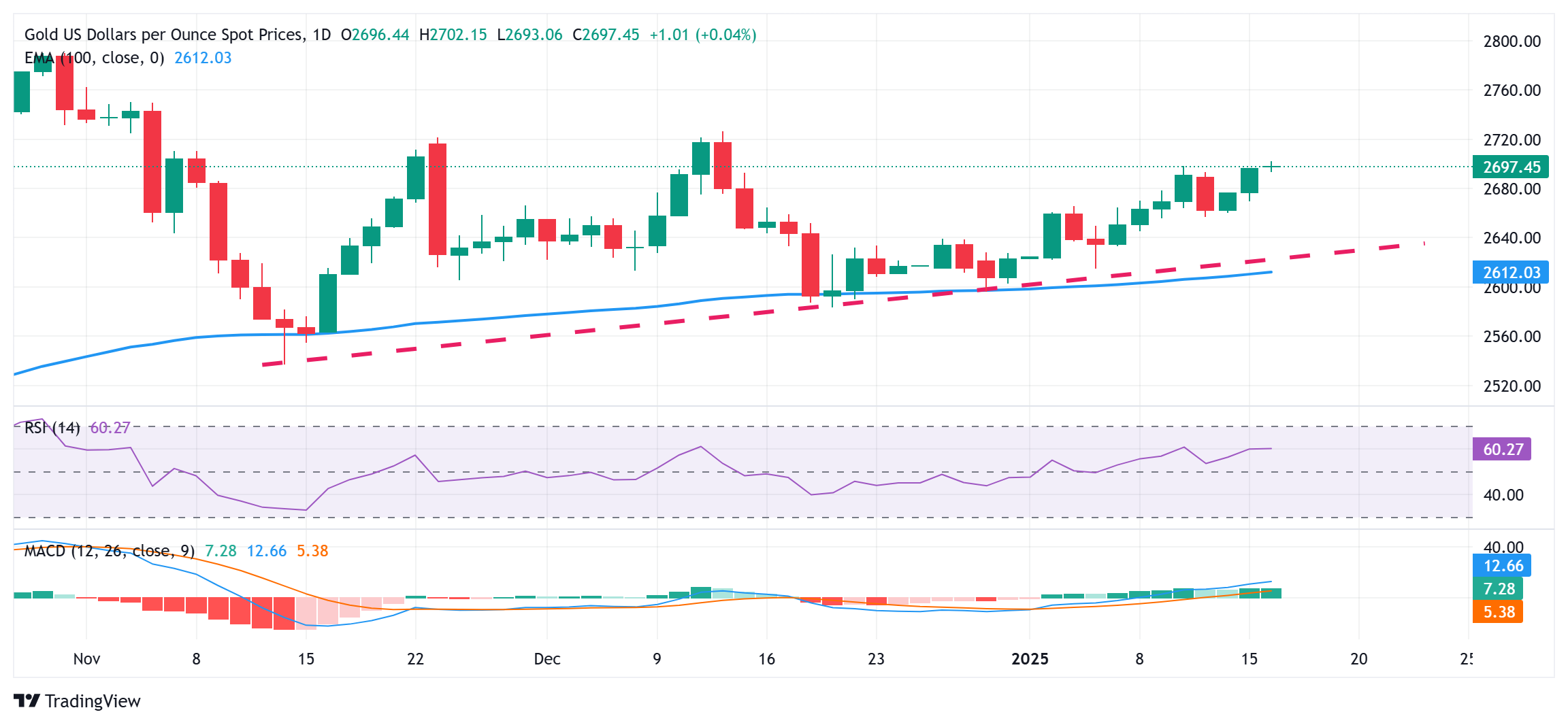
Gold price technical setup supports prospects for a move towards $2,715-2,720 resistane

fxsoriginal

From a technical perspective, positive oscillators on the daily chart support prospects for a further move-up towards the $2,715-2,720 supply zone. Some follow-through buying should pave the way for additional gains towards the next relevant hurdle near the $2,748-2,750 region, above which the Gold price could aim to retest the all-time peak, around the $2,790 area touched in October 2024.

On the flip side, any meaningful pullback now seems to find decent support and attract fresh buyers around the $2,678 region. This should help limit the downside near the $2,664-2,663 horizontal zone. Failure to defend the said support levels could make the Gold price vulnerable to accelerate the fall towards the $2,635 area en route to the $2,615 confluence – comprising a short-term ascending trend line and the 100-day Exponential Moving Average (EMA).

pound

GBP/USD drops to retest 1.2200 after dismal UK data

GBP/USD finds fresh sellers and attacks 1.2200 in the European morning on Thursday. The pair remains undermined by disappointing UK GDP and industrial figures for November, increased bets of BoE rate cuts and a steady US Dollar. US Retail Sales and Jobless Claims data are next on tap.

The GBP/USD pair struggles to capitalize on its modest recovery from the 1.2100 mark, or the lowest level since November 2023 touched earlier this week and attracts some sellers on Wednesday. The intraday descent picks up pace following the release of softer consumer inflation figures from the UK, though subdued US Dollar (USD) price action assists spot prices to rebound a few pips from the vicinity of mid-1.2100s.

The UK Office for National Statistics (ONS) reported that the headline Consumer Price Index (CPI) climbed 2.5% year-over-year (YoY) in December, falling short of expectations for an uptick to 2.7% from 2.6% in November. Moreover, the annual core CPI (excluding volatile food and energy items) rose by 3.2% during the reported month as compared to a 3.5% rise in November and 3.4% anticipated. The softer readings offer the Bank of England (BoE) an opportunity to cut interest rates at its upcoming policy meeting in February. Adding to this concerns about the UK’s fiscal situation and the risk of stagflation – a combination of high inflation and weak economic growth – undermined the British Pound (GBP).

The USD, on the other hand, drops to a fresh weekly low in the wake of softer-than-expected US Producer Price Index (PPI) print released on Tuesday, which made it difficult to project the Federal Reserve’s (Fed) next moves on interest rates. The US Bureau of Labor Statistics reported on Tuesday that the Producer Price Index, which measures wholesale inflation, rose 0.2% in December and the core gauge remained flat during the reported month. Apart from this, the latest optimism led by easing fears about US President-elect Donald Trump’s disruptive trade tariffs, which is evident from a generally positive tone around the equity markets, undermines the safe-haven buck and offers support to the GBP/USD pair.

That said, growing acceptance that the Fed will pause its rate-cutting cycle later this month, which had been a key driver of the recent surge in the US Treasury bond yields, could help limit the USD losses. Traders might also opt to wait on the sidelines ahead of the release of the latest US consumer inflation figures, due later during the early North American session. The crucial US Consumer Price Index (CPI) report would influence the Fed’s interest rates outlook, which, in turn, will play a key role in driving the near-term USD price dynamics and provide a fresh impetus to the GBP/USD pair. Hence, it will be prudent to wait for strong follow-through buying before confirming that spot prices have bottomed out and positioning for further gains.