EURGBP_Bearish-2_Large

XRP price gains alongside increase in volume

Ripple (XRP) price climbs and trades at $2.35 at the time of writing on Monday, up from $2.31 and observing a 1.98% increase in the last 24 hours. The daily trade volume increased by 45.91%, as nearly $2,146,346,621.97 in XRP was traded. Volume remains high, meaning strong interest from a large number of investors likely anticipating a gain in the token in the short term.
XRP gained 1.66% in the last 7 days, and the total market capitalization currently hits $138,023,691,666.78.

In the last 24 hours, Jupiter, Virtuals Protocol and Artificial Superintelligence Alliance emerge as top gainers, while Four, XDC Network and PAX Gold are the top losers.

Untitled

USD/CAD falls to near 1.3700 as traders expect BoC to hold rates in June

USD/CAD continues its losing streak that began on May 19, trading around 1.3710 during the early European hours on Monday. The Canadian Dollar (CAD) appreciates against the US Dollar (USD) as domestic retail sales rose for a second straight month in April, indicating strength in consumer sentiment despite an aggressive trade war between the United States (US) and Canada.

The stronger retail sales data, along with April’s hot inflation data, raised the expectations of the Bank of Canada (BoC) to hold interest rates in the upcoming June meeting instead of another 25 basis points rate cut. This has provided support for the Canadian Dollar and undermined the USD/CAD pair.

Additionally, the US Dollar struggles amid rising uncertainty surrounding the US economy. The US Dollar Index (DXY), which tracks the Greenback against a basket of six major currencies, is extending its losses and trading around 98.90.

During the week, Trump’s “One Big Beautiful Bill” will go through the Senate floor after the Memorial Day holiday on Monday. The Congressional Budget Office (CBO) noted that Trump’s bill is expected to increase the deficit by $3.8 billion, as it would deliver tax breaks on tip income and US-manufactured car loans.

On Sunday, US Senator Ron Johnson said on CNN, “I think we have enough votes to stop the process until the President gets serious about spending reduction and reducing the deficit.” Johnson added, “My primary focus now is spending. This is completely unacceptable. Current projections are a $2.2 trillion per year deficit.”

mmm

EUR/USD sticks to gains above 1.1400 as Trump extends EU tariff deadline

EUR/USD consoldiates latest gains above 1.1400 in the European morning on Monday. The pair draws support from persistent US Dollar weakness and US President Donald Trump’s extension of the 50% tariff deadline on the European Union (EU) until July 9.

The USD held its ground on Thursday and caused EUR/USD to stretch lower after the data published by S&P Global showed that the economic activity in the US’ private sector expanded at an accelerating pace in May, with Composite Purchasing Managers Index (PMI) rising to 52.1 from 50.6 in April. In this period, the Services PMI and the Manufacturing PMI both improved to 52.3.

Nevertheless, the positive impact of the upbeat PMI data on the USD remains short-lived as investors grow increasingly concerned about the US government’s debt outlook. US President Donald Trump’s sweeping tax and spending bill, which is projected to add more than $3 trillion to the national debt over the next decade, passed the Republican-controlled House of Representatives on Thursday by a slim margin. The Senate is expected to start discussions on the bill after the Memorial Day holiday on May 26.

Meanwhile, the European Central Bank (ECB) reported on Friday that Negotiated Wage Rates rose 2.38% in the first quarter, down from the 4.12% increase recorded in the previous quarter. This reading eases concerns over strong wage inflation in the Eurozone and limits the Euro’s gains for the time being.

The US economic calendar will not offer any high-tier data releases on Friday. Hence, the USD could have a difficult time staying resilient against its rivals heading into the weekend.

gold-bar-and-dollar-bills-42586628_XtraLarge

Gold price retreats further from two-week high; $3,300 mark holds the key for bulls

Gold price (XAU/USD) extends its steady intraday retracement slide from a nearly two-week high touched earlier this Thursday and slides to the lower end of its daily range during the first half of the European session. The pullback lacks any fundamental catalyst and is more likely to remain limited amid a combination of supporting factors. Investors now seem convinced that the Federal Reserve (Fed) will lower borrowing costs further in 2025, which might continue to act as a tailwind for the non-yielding yellow metal.

Apart from dovish Fed expectations, growing worries about rising US deficit amid US President Donald Trump’s tax bill and a sluggish US economic growth outlook on the back of renewed US-China trade tensions weigh on the US Dollar (USD). This could further offer support to the Gold price and support prospects for an extension of the weekly uptrend. Hence, any subsequent fall might still be seen as a buying opportunity and is more likely to be limited as traders now look forward to the US macro data for a fresh impetus.

Gold price corrective pullback could be seen as a buying opportunity amid a constructive technical setup

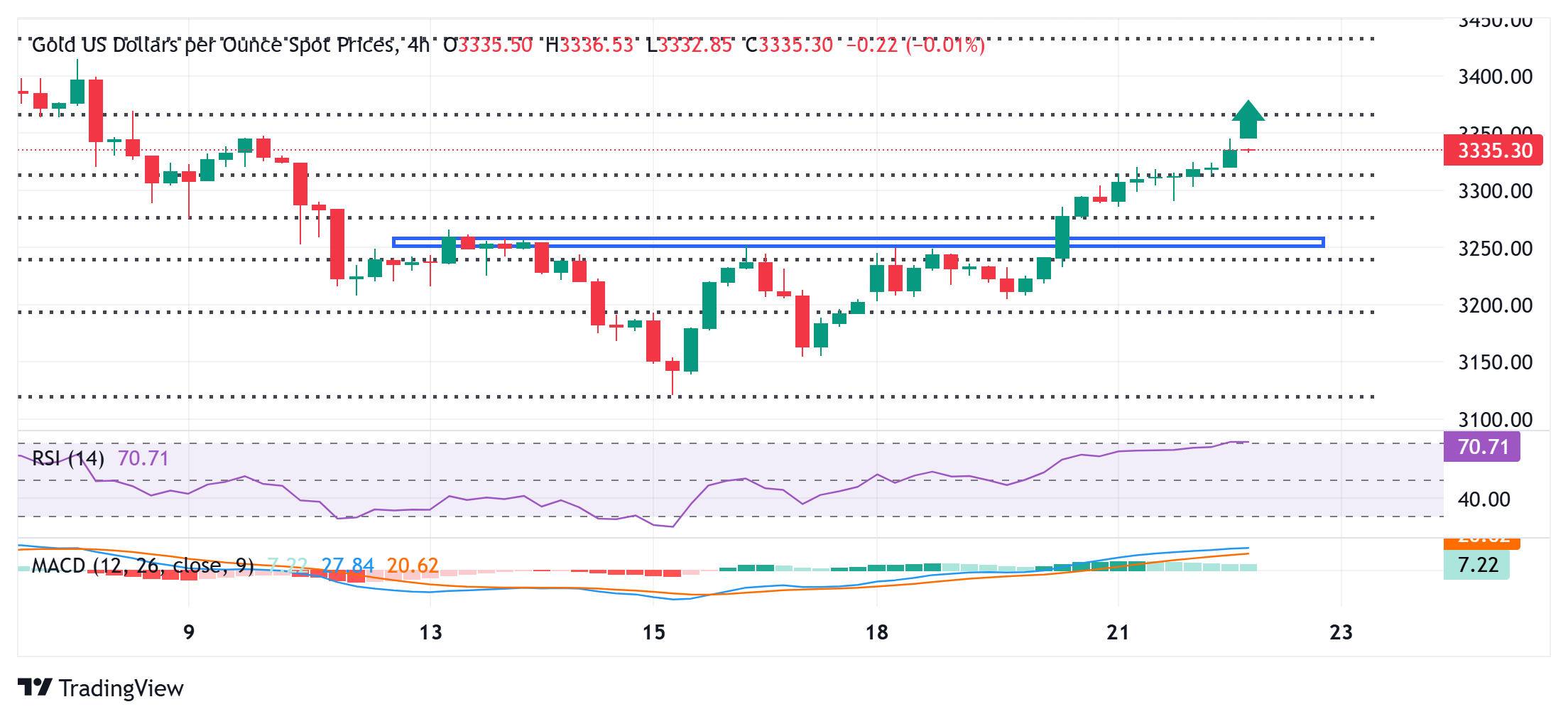
From a technical perspective, the XAU/USD pair now seems to have found acceptance above the 61.8% Fibonacci retracement level of the recent downfall from the monthly peak. This comes on the back of this week’s breakout through the $3,250-3,255 resistance zone and favors bullish traders. Moreover, oscillators on the daily chart have been gaining positive traction and suggest that the path of least resistance for the Gold price remains to the upside. Hence, a subsequent move towards the next relevant hurdle near the $3,363-3,365 region, en route to the $3,400 round figure, looks like a distinct possibility.

On the flip side, the $3,316-3,315 area, or the 61.8% Fibo. retracement level resistance breakpoint now seems to protect the immediate downside ahead of the $3,300 mark. Any further decline below the $3,285 area is more likely to attract fresh buyers and remain limited near the $3,255-3,250 hurdle-turned-support. A convincing break below the latter, however, might prompt some technical selling and drag the Gold price to the $3,200 mark.

images

XRP price gains alongside increase in volume

Ripple (XRP) price climbs and trades at $2.39 at the time of writing on Thursday, up from $2.36 and observing a 1.65% increase in the last 24 hours. The daily trade volume increased by 31.38%, as nearly $3,955,179,778.22 in XRP was traded. Volume remains high, meaning strong interest from a large number of investors likely anticipating a gain in the token in the short term.
XRP gained 2.99% in the last 7 days, and the total market capitalization currently hits $140,511,112,041.02.

In the last 24 hours, SPX6900, dogwifhat and Hyperliquid emerge as top gainers, while Aave, EOS and KuCoin Token are the top losers.

kl

German IFO Business Climate Index climbs to 87.5 in May vs. 87.4 expected

The headline German IFO Business Climate Index rose to 87.5 in May from 86.9 in April. The data came in slightly above the market forecast of 87.4.

Meanwhile, the Current Economic Assessment Index worsened to 86.1 during the same period from 86.4 in April, falling short of the estimated 86.8 reading.

The IFO Expectations Index, which indicates firms’ projections for the next six months, rose to 88.9 in May vs. 87.4 in April and 88 expected.

Market reaction to the German IFO Survey

EUR/USD keeps its range above 1.1300 following the mixed German IFO survey. When writing, the pair is trading 0.12% lower on the day.

mmm

EUR/USD holds above 1.1300 despite weak EU PMI data

EUR/USD stays in a tight daily range above 1.1300 in the European session on Thursday. The PMI data from Germany and the Eurozone showed that the business activity in the private sector contracted in May, limiting the Euro’s gains. Market focus shifts to US PMI data.

Bullish momentum continues to push EUR/USD higher following a technical bounce from the 50-day Exponential Moving Average (EMA) near 1.1100. The pair has closed higher for all but two of the last seven consecutive trading sessions, and price action is tilted firmly to the bullish side as intraday price action looks for a foothold from 1.1300.

Technical oscillators are nearly out of room to run, implying a technical reversal could be on the cards in the near-term. However, Fiber is still trading well north of its 200-day EMA near 1.0840.

US 20-year Treasury yields rose above 5% on Wednesday, sparking a flight out of US capital assets. Even with the rise in yields, investors still turned apprehensive on Treasuries, with bid-to-cover ratios falling below their six-month averages. The US government is on pace to pass President Donald Trump’s “big, beautiful bill” for the federal government’s tax and budget plans, which includes steep declines in critical services spending, and even steeper declines in federal tax receipts. The budget bill is broadly expected to add up to $4T to the US deficit over the next ten years. President Trump campaigned on reducing the deficit and eliminating US government debt.

Purchasing Managers Index (PMI) figures are due on Thursday. Pan-European PMIs are expected to rise slightly across the board, while US PMIs are forecast to come mixed. European Services PMI aggregate survey results are expected to rise to 50.3 from 50.1, while the manufacturing segment is expected to improve to 49.3 from 49.0. On the US side, Manufacturing PMIs are expected to tick down to 50.1 from 50.2, while the Services

eur6

Pound Sterling rises on hot UK inflation, US Dollar extends slide

Pound Sterling (GBP) gathers strength against its rivals early Wednesday following the release of April inflation data from the UK, while the US Dollar (USD) continues to weaken on trade uncertainty and political woes. The economic calendar will not feature high-tier data releases midweek, allowing investors to remain focused on geopolitics and comments from central bankers.

The UK’s Office for National Statistics (ONS) reported in the European morning that annual inflation in the UK, as measured by the change in the Consumer Price Index, climbed to 3.5% in April from 2.6% in March. This reading came in above the market expectation of 3.3%. On a monthly basis, the CPI rose by 1.2% after increasing by 0.3% previously. Finally, the core CPI, which excludes volatile food and energy prices, increased by 3.8% on a yearly basis, surpassing analysts’ estimate of 3.6%. GBP/USD gathered bullish momentum after hot UK inflation data and advanced to its highest level since February 2022 above 1.3450.

China’s Commerce Ministry said early Wednesday that the US’ measures on China’s advanced chips are “typical of unilateral bullying and protectionism,” adding that the US violates international law by abusing export controls to contain and suppress China. Meanwhile, House Republicans are struggling to pass President Donald Trump’s tax bill, which could add roughly $3.8 trillion to the national debt, according to an analysis released Tuesday by the Congressional Budget Office (CBO). The USD Index stays under bearish pressure on Wednesday and trades near 99.50, losing about 0.5% on the day, while US stock index futures fall between 0.4% and 0.6% after Wall Street’s main indexes closed in negative territory on Tuesday.

EUR/USD builds on its weekly gains and rises toward 1.1350 in the early European session. The European Central Bank (ECB) will publish its Financial Stability Review later in the day.

The data from Japan showed in the early Asian session that Exports rose by 2% on a yearly basis in April, as expected. In the same period, Imports declined by 2.2%. USD/JPY stays on the back foot on Wednesday and declines toward 143.50.

Gold benefited from the risk-averse market atmosphere and gained nearly 2% on Tuesday. XAU/USD preserves its bullish momentum and trades comfortably above $3,300, rising about 1% on the day.

USD/CAD continues to stretch lower and trades below 1.3900 after closing the first two days of the week in the red. Statistics Canada reported on Tuesday that the annual CPI inflation softened to 1.7% in April from 2.3% in March.

mmty

GBP/JPY jumps back above 193.00 on hotter UK CPI print, lacks follow-through amid stronger JPY

The GBP/JPY cross trims a part of its modest intraday losses following the release of hotter-than-expected UK consumer inflation figures, though it lacks follow-through buying. Spot prices currently trade around the 193.20 region, down over 0.15% for the day amid a broadly stronger Japanese Yen (JPY).

Data released by the UK Office for National Statistics (ONS) earlier this Wednesday showed that the headline annual Consumer Price Index (CPI) jumped from the 2.6% seen in the prior month to 3.5% in April, the highest level in over a year. Adding to this, the annual core CPI, which excludes volatile energy and food prices, rose 3.8% compared to 3.4% in March. The readings were well above consensus estimates and the Bank of England’s (BoE) 2.0% medium-term target, forcing investors to scale back their expectations for more rate cuts in 2025 and boosting the British Pound (GBP).

Traders, however, are still pricing in the possibility that the UK central bank will lower borrowing costs at least once by the year-end. This marks a sharp divergence in comparison to the growing acceptance that the Bank of Japan (BoJ) will hike interest rates again amid fears of broader and more entrenched price increases in Japan. Furthermore, reviving safe-haven demand, bolstered by renewed US-China trade tensions and persistent geopolitical risks, benefits the JPY. This, in turn, keeps a lid on the GBP/JPY pair’s intraday recovery of around 40 pips from the 192.85-192.80 region.

Nevertheless, the mixed fundamental backdrop makes it prudent to wait for strong follow-through selling below the 200-day Simple Moving Average (SMA) before positioning for an extension of the recent pullback from over a four-month high touched last week.

Untitled

Australian Dollar rises despite rising odds of further RBA rate cuts, focus on Fedspeak

The Australian Dollar (AUD) depreciated against the US Dollar (USD) on Wednesday, recovering after registering more than 0.50% losses in the previous session. The AUD/USD pair appreciates as the US Dollar extends its decline, pressured by cautious remarks from Federal Reserve (Fed) officials regarding the economic outlook and business sentiment.

Cleveland Fed President Beth Hammack and San Francisco Fed President Mary C. Daly both voiced rising concerns about the US economy during a panel event organized by the Federal Reserve Bank of Atlanta. Despite the fact that important economic indicators are still strong, both officials noted a decline in consumer and corporate confidence and partially blamed the change in opinion on US trade policies.

On Wednesday, China’s Commerce Ministry stated that US measures on China’s advanced chips are ‘typical of unilateral bullying and protectionism.’ Chinese authorities are looking further into whether the United States is serious about correcting its erroneous practices.

On Tuesday, the Reserve Bank of Australia (RBA) reduced its Official Cash Rate (OCR) by 25 basis points, from 4.1% to 3.85%. Moreover, RBA Governor Michele Bullock expressed confidence in the central bank’s rate cut decision. She emphasized the significance of curbing inflation and expressed that a rate cut was a proactive, confidence-boosting move that was suitable given the state of the economy. She also mentioned that the Board is prepared to take additional action if necessary, raising the prospect of future changes.

The AUD was also affected by Australia’s political unrest. Following the National Party’s withdrawal from its collaboration with the Liberal Party, the opposition coalition disbanded. The ruling Labor Party, meanwhile, took advantage of the unrest and retook power with a more robust and expansive agenda.

Australian Dollar remains below 0.6450, support appears at nine-day EMA

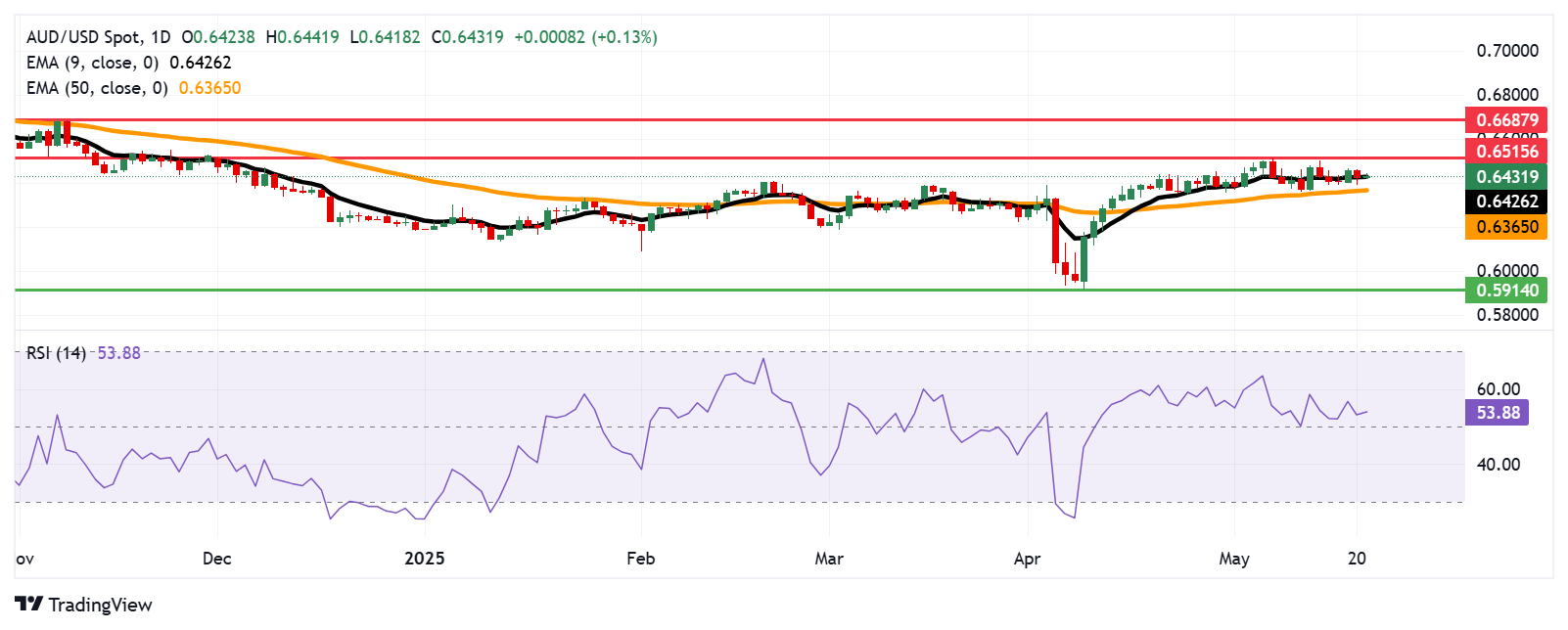
The AUD/USD pair is trading around 0.6450 on Wednesday, with daily technical indicators reflecting a bullish tone. The pair continues to trade above the nine-day Exponential Moving Average (EMA), while the 14-day Relative Strength Index (RSI) remains above the neutral 50 level—both signals supporting sustained upward momentum.

On the upside, immediate resistance is seen at the six-month high of 0.6515, recorded on December 2, 2024. A decisive break above this barrier could pave the way for a test of the seven-month high at 0.6687, which was reached in November 2024.

Initial support lies at the nine-day EMA of 0.6426, followed by the 50-day EMA near 0.6365. A firm move below these levels would undermine the short- to medium-term bullish outlook, possibly opening the path toward the March 2020 low of 0.5914.

AUD/USD: Daily Chart