GBP/USD eases from multi-week high, trades with negative bias below mid-1.2700s

GBP/USD eases from multi-week high, trades with negative bias below mid-1.2700s

The GBP/USD pair oscillates in a range below mid-1.2700s during the Asian session on Friday and consolidates its recent gains registered over the past three days, to over a three-week high touched the previous day. Traders now seem reluctant to place aggressive bets and opt to wait for the release of the crucial US monthly employment details later today.

The popularly known Nonfarm Payrolls (NFP) report will be looked upon for the interest rate outlook in the US and guide the Federal Reserve (Fed) policymakers on their next policy decision at the December meeting. This, in turn, will help determine the near-term trajectory for the US Dollar (USD) and provide some meaningful impetus to the GBP/USD pair. In the meantime, the recent decline in the US Treasury bond yields fails to assist the USD attract any meaningful buyers or recover from a multi-week low.

That said, expectations that the US central bank will adopt a cautious stance on cutting rates, amid hopes that US President-elect Donald Trump’s policies will boost inflation, act as a tailwind for the buck. Apart from this, a softer risk tone and persistent geopolitical tensions benefit the safe-haven USD. This, along with Bank of England (BoE) Governor Andrew Bailey’s signal for four interest rate cuts in 2025, holds back traders from placing bullish bets around the British Pound (GBP) and caps the GBP/USD pair.

Nevertheless, spot prices seem poised to register modest gains for the second straight week, though any further move up is more likely to confront stiff barrier near a technically significant 200-day Simple Moving Average S(AM), around the 1.2820 area. This further makes it prudent to wait for strong follow-through buying before confirming that the GBP/USD pair has formed a near-term bottom and positioning for an extension of the recent goodish recovery from sub-1.2500 levels, or a multi-month low touched in November.

Forex Today: US Dollar consolidates losses as attention turns to Nonfarm Payrolls data

Forex Today: US Dollar consolidates losses as attention turns to Nonfarm Payrolls data

Here is what you need to know on Friday, December 6:

The US Dollar (USD) holds its ground early Friday after weakening against its major rivals on Thursday. Investors await November jobs report, which will include Nonfarm Payrolls (NFP), Unemployment Rate and wage inflation figures. The US economic calendar will also feature the University of Michigan’s Consumer Sentiment Index. Finally, several Federal Reserve (Fed) policymakers will deliver speeches on the last day before the blackout period starts.

US Dollar PRICE This week

The table below shows the percentage change of US Dollar (USD) against listed major currencies this week. US Dollar was the weakest against the Swiss Franc.

USD EUR GBP JPY CAD AUD NZD CHF
USD 0.00% -0.09% 0.03% 0.32% 1.31% 1.07% -0.18%
EUR -0.00% -0.13% 0.03% 0.33% 1.40% 1.07% -0.16%
GBP 0.09% 0.13% 0.13% 0.46% 1.54% 1.20% -0.06%
JPY -0.03% -0.03% -0.13% 0.30% 1.32% 1.07% -0.26%
CAD -0.32% -0.33% -0.46% -0.30% 1.14% 0.75% -0.51%
AUD -1.31% -1.40% -1.54% -1.32% -1.14% -0.33% -1.57%
NZD -1.07% -1.07% -1.20% -1.07% -0.75% 0.33% -1.22%
CHF 0.18% 0.16% 0.06% 0.26% 0.51% 1.57% 1.22%

The heat map shows percentage changes of major currencies against each other. The base currency is picked from the left column, while the quote currency is picked from the top row. For example, if you pick the US Dollar from the left column and move along the horizontal line to the Japanese Yen, the percentage change displayed in the box will represent USD (base)/JPY (quote).

The USD Index came under bearish pressure and lost more than 0.5% on Thursday. In the European morning, the index stays in a consolidation phase below 106.00. Meanwhile, the benchmark 10-year US Treasury bond yield fluctuates below 4.2% and US stock index futures trade mixed. Following the 12,000 increase recorded in October, NFP is forecast to rise by 200,000 in November.

After climbing to a new record high above $100,000 on Thursday, Bitcoin reversed its direction and close the day in negative territory. Early Friday, BTC/USD trades at around $98,000.

EUR/USD benefited from the broad-based USD weakness on Thursday and came within a touching distance of 1.0600. The pair edges slightly lower in the European morning on Friday but holds comfortably above 1.0550. Eurostat will publish revisions to third quarter Gross Domestic Product data.

GBP/USD gathered bullish momentum and climbed to its highest level in three weeks above 1.2770 on Thursday. The pair trades marginally lower on the day slightly below 1.2750 to begin the European session.

After rising for three consecutive days, USD/CAD reversed its direction and fell more than 0.3% on Thursday. The pair holds steady above 1.4000 early Friday. Statistics Canada will publish labor market data for November later in the day.

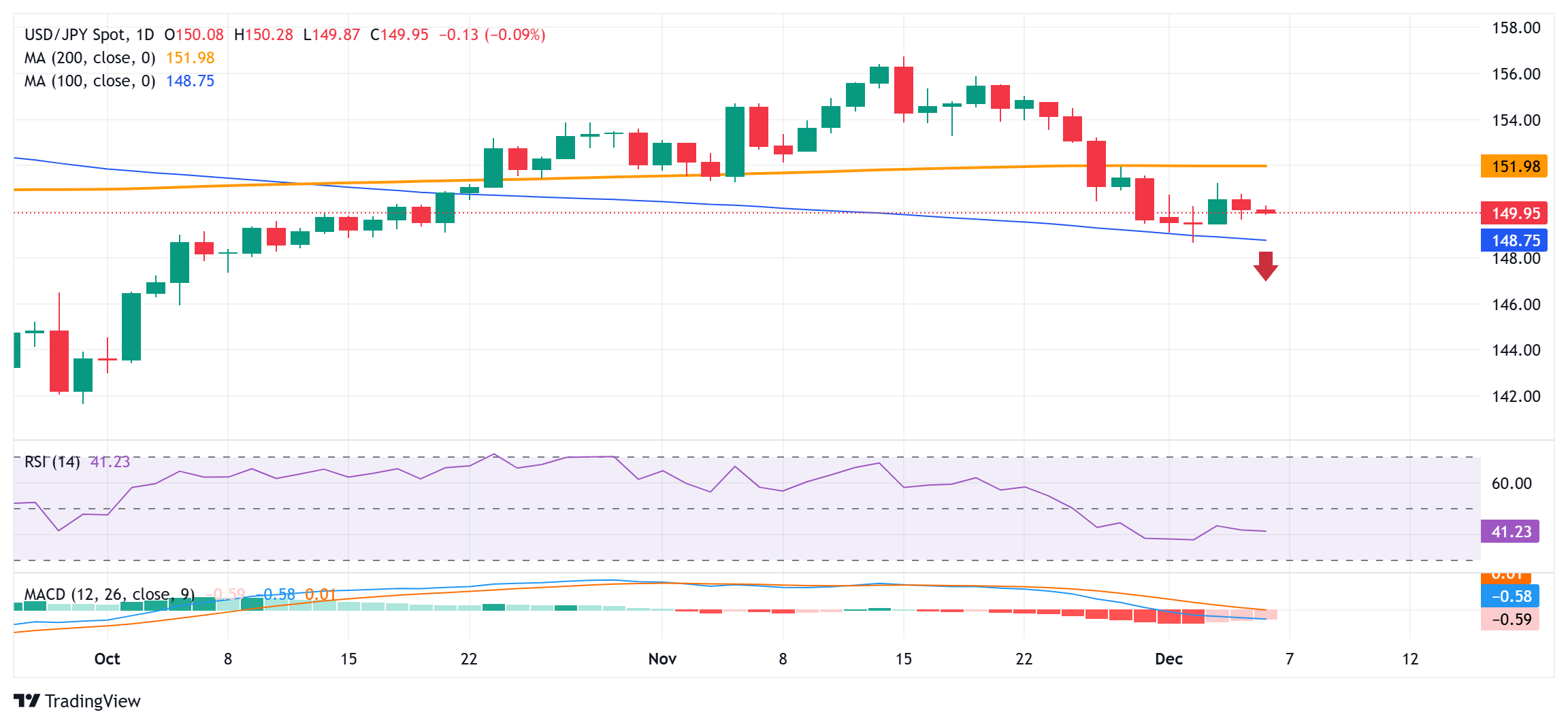
USD/JPY edges lower and trades below 150.00 after posting small losses on Thursday. The data from Japan showed on Friday that Overall Household Spending declined by 1.3% on a yearly basis in October. This reading came in better than the market expectation for a decrease of 2.6%.

Gold failed to capitalize on the selling pressure surrounding the USD and ended the day in the red on Thursday. After falling to its weakest level in over a week below $2,620 in the Asian session, XAU/USD gained traction and was last seen trading near $2,640.

Japanese Yen bulls have the upper hand amid BoJ rate hike bets; US NFP report awaited

Japanese Yen bulls have the upper hand amid BoJ rate hike bets; US NFP report awaited

The Japanese Yen (JPY) struggles to capitalize on the previous day’s modest gains and oscillates in a narrow range against its American counterpart during the early European session on Friday. The near-term bias, meanwhile, seems tilted in favor of the JPY bulls amid the Bank of Japan’s (BoJ) more hawkish stance. In fact, the BoJ remains on track for more interest rate hikes, while other major central banks, including the US Federal Reserve (Fed), are seen lowering borrowing costs further.

Apart from this, the recent decline in the US Treasury bond yields and a slight deterioration in the global risk sentiment seem to underpin the safe-haven JPY. This, along with subdued US Dollar (USD) price action, keeps the USD/JPY pair on the defensive near the 150.00 psychological mark ahead of the US Nonfarm Payrolls (NFP) report. The crucial data could offer fresh cues about the Fed’s rate-cut path, which, in turn, will drive the USD and influence the currency pair in the near term.

USD/JPY needs to break below the 100-day SMA pivotal support for bears to seize control

fxsoriginal

From a technical perspective, the overnight swing low, around the 148.65 region, now seems to protect the immediate downside ahead of the 149.00 mark and the 100-day SMA, currently around the 148.80 region. The latter should act as a key pivotal point, which if broken decisively will be seen as a fresh trigger for bearish traders. Given that oscillators on the daily chart are holding in negative territory, the USD/JPY pair might then slide to the 148.10-148.00 region en route to the 147.35-147.30 zone and the 147.00 round figure.

On the flip side, attempted recovery might now confront some resistance near the 150.55 region. This is followed by the 150.70 hurdle, the 151.00 round figure and the weekly high, around the 151.20-151.25 zone touched on Wednesday. A sustained move beyond the latter could lift the USD/JPY pair to the 152.00 mark, or the very important 200-day SMA. Some follow-through buying will suggest that the recent corrective decline from a multi-month high touched in November has run its course and shift the bias in favor of bullish traders.

US Nonfarm Payrolls set to show hiring bounced back in November after October’s blip

US Nonfarm Payrolls set to show hiring bounced back in November after October’s blip

The United States (US) Bureau of Labor Statistics (BLS) will release the high-impact Nonfarm Payrolls (NFP) data for November on Friday at 13:30 GMT. The Federal Reserve’s (Fed) future interest-rate cuts and the next direction in the US Dollar (USD) depend highly on the November jobs report.

What to expect in the next Nonfarm Payrolls report?

Economists expect the Employment Report to show that the US economy created 200,000 jobs in November, following a meagre gain of 12K in October due to distortions caused by two hurricanes and the strike at Boeing.

The Unemployment Rate (UE) is likely to edge higher to 4.2% in the same period, compared to the 4.1% reported in October.

Meanwhile, Average Hourly Earnings (AHE), a closely-watched measure of wage inflation, are seen rising by 3.9% in the year through November after a 4.0% growth in October.

The November jobs report is critical to gauging the state of the US labor market and the Fed’s easing trajectory in the coming months, especially after Fed Chairman Jerome Powell’s recent cautious stance on rate cuts.

Last month at an event in Dallas, Powell said there was no need to rush rate cuts with the economy still growing, the job market solid and inflation still above the 2% target. Meanwhile, the Fed Chief sounded optimistic about the state of the US economy at the New York Times’ DealBook Summit on Wednesday.

Previewing the November employment situation report, TD Securities analysts said: “We now look for mean reversion in Nov with ~75k jobs added back to the series as the twin impacts from hurricanes/strike fade away.”

“We also expect the UE rate to rise by a tenth to 4.2%, while wage growth likely cooled to 0.2% m/m following October’s outsized 0.4% increase.,” they added.

How will US November Nonfarm Payrolls affect EUR/USD?

The recent series of US economic data releases and speeches by several Fed policymakers did little to alter the market’s pricing of a 75% probability of a 25 basis points (bps) rate reduction later this month, according to CME Group’s FedWatch tool.

Earlier in the week, the BLS reported that the JOLTS Job Openings rose to 7.744 million in October, surpassing the expected 7.48 million increase.

The Automatic Data Processing (ADP) announced on Wednesday that employment in the US private sector employment grew by 146,000 jobs last month, slightly lower than the 150,000 figure that markets expected.

The disappointing ADP jobs report fuels concerns about the health of the US labor market, preparing markets for a downside surprise to Friday’s payrolls data. However, the US ADP data is generally not correlated with the official NFP data.

If the headline NFP reading shows a payroll growth below 200,000, the US Dollar could come under intense selling pressure in an immediate reaction to the data release because the figures could bolster expectations of further easing by the Fed. In such a scenario, EUR/USD could edge up toward the 1.0700 level.

Conversely, a stronger-than-expected NFP print and elevated wage inflation data could raise concerns about the prospects of future rate cuts by the Fed, providing extra legs to the USD uptrend while dragging EUR/USD back to 1.0400.

Dhwani Mehta, Asian Session Lead Analyst at FXStreet, offers a brief technical outlook for EUR/USD:

“EUR/USD needs a decisive break above the 21-day Simple Moving Average (SMA) at 1.0560 to extend the recovery toward the 1.0700 round level. If that level is scaled, buyers will then target the 50-day SMA at 1.0761 en route to the 200-day SMA at 1.0845.”

“However, the 14-day Relative Strength Index (RSI) is still below the 50 level, maintaining risks to the downside for the main currency pair. Technical sellers could emerge if EUR/USD fails to defend the 1.0400 level. Additional declines will challenge the November 22 low of 1.0333.”


EUR/USD holds losses below 1.0600 ahead of US NFP release

EUR/USD holds losses below 1.0600 ahead of US NFP release

EUR/USD is back in the red below 1.0600 in the early European morning on Friday. The US Dollar regains poise due to profit-taking and a softer risk tone. Traders refrain from placing fresh bets on the pair ahead of the critical US Nonfarm Payrolls data release

The Relative Strength Index (RSI) indicator on the 4-hour chart retreated toward 60 early Friday, suggesting that the bullish bias remains intact, while EUR/USD stages a technical correction. On the upside, 1.0600 (Fibonacci 38.2% retracement of the latest downtrend) aligns as immediate resistance before 1.0650-1.0660 (200-period Simple Moving Average (SMA), Fibonacci 50% retracement) and 1.0730 (Fibonacci 61.8% retracement).

Looking south, first support could be spotted at 1.0520-1.0530 (100-period SMA, 50-period SMA, 20-period SMA, Fibonacci 23.6% retracement) ahead of 1.0500 (psychological level, static level) and 1.0440 (static level).

EUR/USD gathered bullish momentum and gained more than 0.7% on Thursday. Before testing 1.0600, however, the pair went into a consolidation phase and was last seen fluctuating at around 1.0570.

The US Dollar (USD) came under bearish pressure and helped EUR/USD push higher on Thursday after the US Department of Labor reported that the number of first-time applications for unemployment benefits rose to 224,000 in the week ending November 30 from 215,000 in the previous week.

Later in the day, November labor market data from the US will be scrutinized by investors. Following the 12,000 increase recorded in October, because of hurricanes and strikes, Nonfarm Payrolls (NFP) are forecast to rise by 200,000 in November.

According to the CME FedWatch Tool, markets are currently pricing in about a 70% probability of a 25 basis points (bps) Federal Reserve (Fed) rate cut in December. A disappointing NFP print of 150,000 or lower could confirm a rate reduction and further weigh on the USD. On the flip side, a reading above 200,000 could cause markets to refrain from pricing in a December cut and trigger a leg lower in EUR/USD.

Later in the American session, several Fed policymakers will be delivering speeches. Since the Fed’s blackout period will start on Saturday, these comments could also drive the USD’s valuation heading into the weekend.


USD/CAD slides back closer to mid-1.4000s amid modest USD weakness

USD/CAD slides back closer to mid-1.4000s amid modest USD weakness

The USD/CAD pair struggles to capitalize on its weekly gains registered over the past three days and attracts some sellers during the first half of the European session on Thursday. Spot prices slide closer to mid-1.4000s in the last hour, though any meaningful downfall still seems elusive ahead of the crucial monthly employment details from the US and Canada on Friday.

Heading into the key data risk, a modest US Dollar (USD) downtick is seen as a key factor exerting some downward pressure on the USD/CAD pair. That said, rebounding US Treasury bond yields, bolstered by expectations for a less dovish Federal Reserve (Fed), acts as a tailwind for the Greenback. Apart from this, subdued Crude Oil prices ahead of the OPEC+ meeting could undermine the commodity-linked Loonie and contribute to limiting losses for the USD/CAD pair.

Meanwhile, hawkish remarks from several FOMC members, including Fed Chair Jerome Powell, suggested that the US central bank will adopt a cautious stance on cutting rates. Adding to this, speculations that US President-elect Donald Trump’s policies will reignite inflation might force the Fed to stop cutting rates or possibly raise them again. This assists the US Treasury bond yields to stage a modest bounce after their lowest closing levels in more than a month on Wednesday.

Crude Oil prices, on the other hand, struggle to gain any meaningful traction on the back of concerns over slowing oil demand, especially China – the world’s top importer. That said, the worsening Russia-Ukraine conflict and increasing tensions in the Middle East, along with expectations that the OPEC+ will further delay plans to increase production until at least the second quarter of 2025, act as a tailwind for the commodity, though fail to influence the Canadian Dollar (CAD).

Traders now look to the release of the US Weekly Initial Jobless Claims data, which, along with the US bond yields, will drive the USD demand and provide some impetus to the USD/CAD pair later during the North American session. Apart from this, Oil price dynamics should contribute to producing short-term opportunities. The mixed fundamental backdrop, meanwhile, warrants some caution for aggressive traders and before positioning for any firm near-term direction.

GBP/USD eases from multi-week high, trades with negative bias below mid-1.2700s

EUR/USD edges higher as investors digest French government fallout

EUR/USD ticks higher and strives to stay above 1.0500 in European trading hours on Thursday. The major currency pair gains slightly as investors attempt to move forward from the already anticipated collapse of a mere three-month-long Michel Barnier’s government after losing a no-confidence vote proposed by the Far Right and Left-wing coalition.

The demolition of the French government has put the economy into a much deeper crisis by limiting its capacity to tame the burgeoning fiscal deficit. Far-right and left-wing lawmakers backed a no-confidence motion against Barnier after claiming the budget from his government was “flawed and harmful” to French people. The budget in question proposed €60 billion in tax increases and spending cuts aimed at addressing France’s ballooning deficit, according to Firstpost.

Before the no-confidence vote, Barnier appealed to lawmakers, “This reality will not disappear by the magic of a motion of censure.” He added the budget deficit would come back to haunt whichever government comes next.

French political turmoil has complicated the road ahead for the already-troubled Eurozone, which is facing severe downside risks to economic growth due to weak demand and potential tariffs once the new US administration of President-elect Donald Trump takes office. Meanwhile, monthly German Factory Orders declined in October but at a slower-than-expected pace. The economic data contracted by 1.5% after rising 7.2% in September. Economists expected the Factory Orders data to have declined by 2%.

European Central Bank (ECB) President Christine Lagarde also warned about growing risks to the trading bloc in her testimony before the Parliamentary Committee on Wednesday. “The medium-term economic outlook is uncertain, however, and dominated by downside risks,” Lagarde said. “Geopolitical risks are elevated, with growing threats to international trade,” she added.

On the interest rate outlook, Lagarde sticked to her data-dependent approach. However, traders expect that the ECB will cut its Deposit Facility Rate by 25 basis points (bps) to 3% at its December 12 meeting.

Euro PRICE Today

The table below shows the percentage change of Euro (EUR) against listed major currencies today. Euro was the strongest against the Swiss Franc.

USD EUR GBP JPY CAD AUD NZD CHF
USD -0.14% -0.14% -0.21% -0.04% -0.02% -0.15% 0.08%
EUR 0.14% -0.01% -0.08% 0.09% 0.11% -0.02% 0.21%
GBP 0.14% 0.01% -0.08% 0.10% 0.12% -0.01% 0.22%
JPY 0.21% 0.08% 0.08% 0.17% 0.19% 0.03% 0.29%
CAD 0.04% -0.09% -0.10% -0.17% 0.03% -0.12% 0.12%
AUD 0.02% -0.11% -0.12% -0.19% -0.03% -0.14% 0.10%
NZD 0.15% 0.02% 0.00% -0.03% 0.12% 0.14% 0.23%
CHF -0.08% -0.21% -0.22% -0.29% -0.12% -0.10% -0.23%

Bitcoin soars past $100K as Trump nominates pro-crypto Atkin as next SEC chair

Bitcoin soars past $100K as Trump nominates pro-crypto Atkin as next SEC chair

Bitcoin’s (BTC) price breaks its all-time high (ATH) of $99,588, surpassing its $100K milestone on Thursday after recovering from its recent pullback since last week. On Wednesday, announcing that Paul Atkins would replace Gary Gensler as Securities & Exchange Commission (SEC) Chair added fuel to BTC’s rally. BTC has entered price discovery mode, with analysts eyeing a target of $113,000.

Donald Trump nominates Paul Atkins as the next SEC Chairman

President-elect Donald Trump confirmed on Wednesday that he has nominated Patomak Global Partners CEO Paul Atkins as the next Chairman of the Securities & Exchange Commission (SEC). This announcement positively impacted the crypto market, as Atkins is considered pro-crypto. Bitcoin’s price increased 2.8% on Wednesday, and the rally continued, surpassing the $100K milestone on Thursday.

Bitcoin breaks above the six-figure mark 

Bitcoin price breaks above its ATH level of $99,588, surpassing its $100K milestone on Thursday after recovering from its recent pullback since last week. At the time of writing, it trades higher above $103,000.

If BTC continues its upward trend, it could extend the rally to test its 141.40% Fibonacci extension level drawn from the November 4 low of $66,835 to the November 22 high of $99,588 at $113,147. A successful close above this level could extend an additional rally toward the psychologically important $125K level.

The Relative Strength Index (RSI) on the daily chart reads 72, trading above its overbought level of 70. Traders should be cautious when adding to their long positions because the chances of a price pullback are increasing. Still, the RSI is still pointing upwards, so there is the possibility that the rally continues and the indicator remains above the overbought level.

BTC/USDT daily chart

EUR/USD trades cautiously ahead of French no-confidence vote

EUR/USD trades cautiously ahead of French no-confidence vote

EUR/USD ticks down but holds the key support of 1.0500 in European trading hours on Wednesday. The major currency pair is broadly sideways as investors await the no-confidence motion by French far-right and left-wing parties against Prime Minister Michel Barnier. The vote has bolstered political uncertainty in the Eurozone’s second-largest nation due to the increasing chances that the French government will collapse, hurting the Euro (EUR).

Looking at the economic calendar, investors will also focus on the United States (US) ADP Employment Change and the ISM Services Purchasing Managers’ Index (PMI) data for November, which will be published in the North American session.

Economists expect the US private sector to have added fresh 150K jobs in November, significantly lower than 233K in October. In the same period, the Services PMI – which gauges activity in the services sector – is estimated to decline to 55.5 from the prior release of 56.0, suggesting a slowdown in growth.

The economic data will influence market expectations for the Federal Reserve’s (Fed) likely interest rate action in its monetary policy meeting on December 18. There is a 74% chance that the Fed will reduce its key borrowing rates by 25 basis points (bps) to 4.25%-4.50% and a 26% probability of rates being unchanged at the current levels, according to the CME FedWatch tool.

In Wednesday’s session, investors will also focus on the Fed’s Beige Book and Chair Jerome Powell’s speech for fresh interest rate guidance.

Meanwhile, a string of Fed officials have recently said that they see more interest rate cuts as appropriate as inflation continues to cool down. “I expect it will be appropriate to continue to move to a more neutral policy setting over time,”  New York Fed President John Williams said on Monday. However, Williams didn’t provide any target for the Federal Funds Rate and said that the path would be data-dependent.

Ahead of the private sector employment and the service sector activity data, the US Dollar (USD) exhibits a muted trend. The US Dollar Index (DXY), which tracks the Greenback’s value against six major currencies, wobbles around 106.30.

The outlook of the US Dollar remains broadly positive as US President-elect Donald Trump threatened to impose 100% tariffs on BRICS. “The idea that the BRICS countries are trying to move away from the dollar while we stand by and watch is OVER,” Trump wrote in a social media post over the weekend.

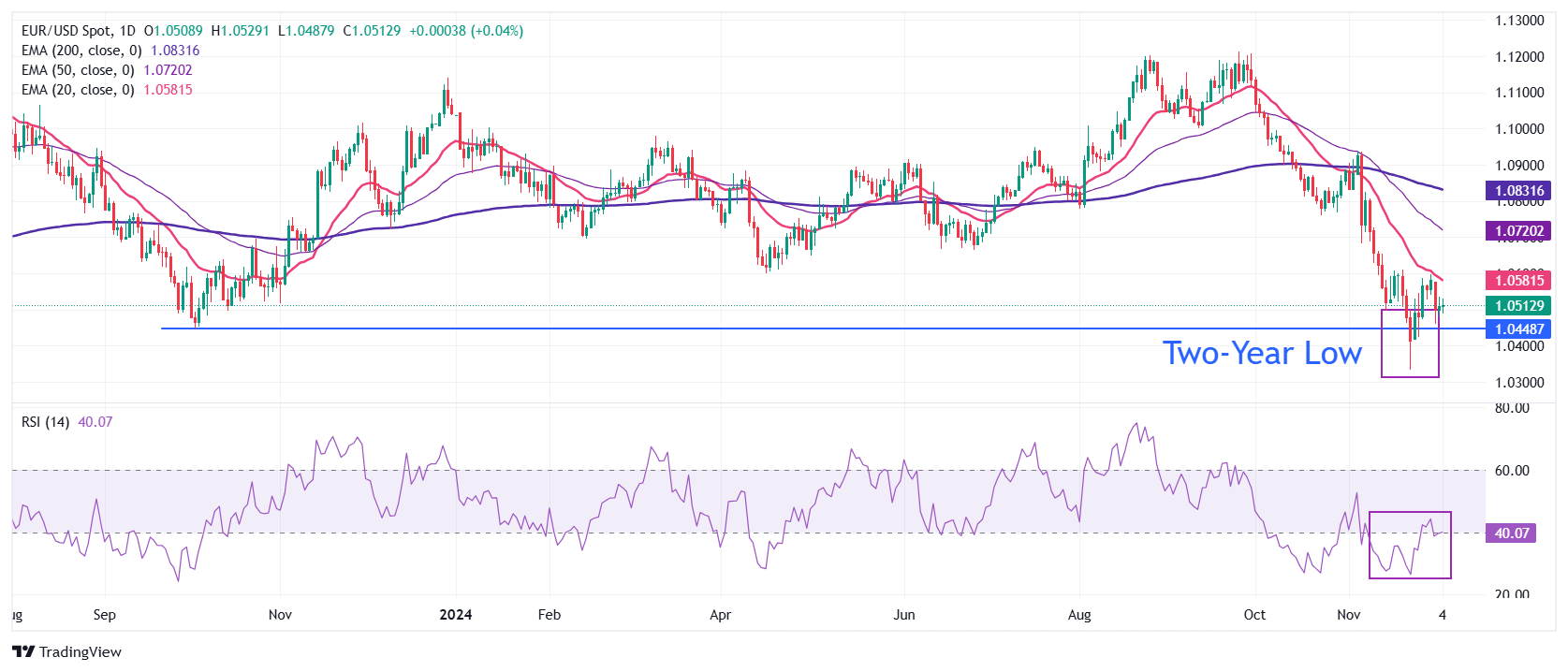
Technical Analysis: EUR/USD consolidates around 1.0500

EUR/USD trades in a tight range near 1.0500 in Wednesday’s European session. The outlook of the major currency pair remains bearish as all short-to-long-term day EMAs are declining, pointing to a downside trend.

The 14-day Relative Strength Index (RSI) remains close to 40.00, suggesting that the bearish momentum has faded. However, the bearish trend has not been extinguished.

Looking down, the November 22 low of 1.0330 will be a key support for Euro bulls. On the flip side, the 50-day EMA near 1.0750 will be the key barrier for the Euro bulls.

USD/JPY: Bearish momentum on daily chart intact

USD/JPY: Bearish momentum on daily chart intact

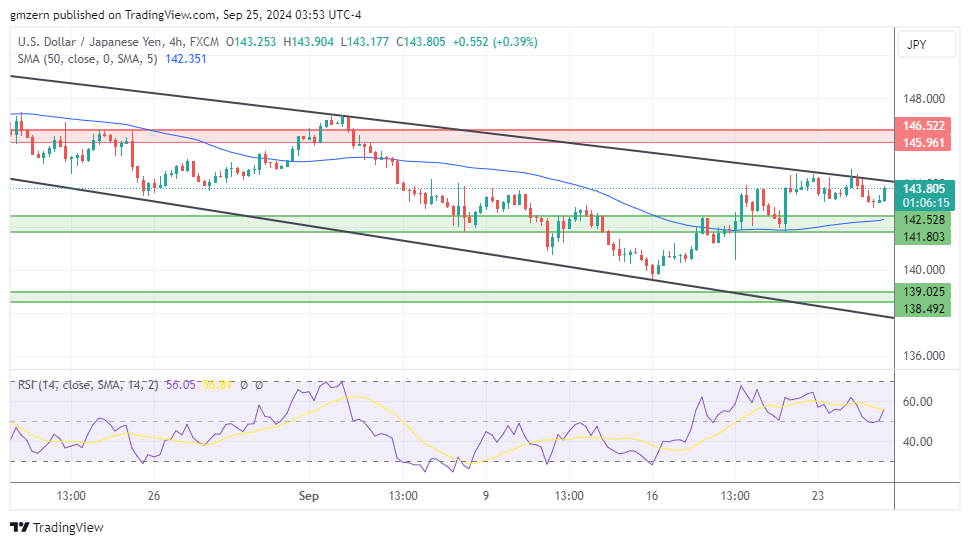
USD/JPY traded a low of 148.65 overnight on safe-haven demand, and was last seen at 150.73 levels, OCBC’s FX analysts Frances Cheung and Christopher Wong note.

Rebound risks not ruled out near term

“Bearish momentum on daily chart intact while RSI shows signs of turning higher from near oversold conditions. Rebound risks not ruled out in the near term. Resistance at 151.20, 152 (200 DMA), 153.30/70 levels (61.8% fibo retracement of 2024 high to low, 21DMA). Support at 149.50, 148.90 levels (100 DMA). Broader bias remains to lean against strength.”

“Price-related data (Tokyo CPI, PPI, etc.), labour market development (jobless rate easing, job-to-applicant ratio increasing, etc.), wage growth expectations (PM Ishiba and trade unions calling for another 5-6% wage increase at shunto wage negotiations for 2025) and Ueda’s recent comments on Nikkei over the weekend continue to reinforce the view that Bo J is likely to proceed with another hike, sooner rather than later.”