Steam to come out of housing market recovery as RBA rate-hiking cycle rolls on

Steam to come out of housing market recovery as RBA rate-hiking cycle rolls on

The RBA has lifted the cash rate a further 25 basis points in June, taking the cash rate 400 basis points higher to 4.1%, announcing 12 hikes since April last year.

A mix of outcomes across economic data through the month created another ‘line-ball’ call for the outlook in the cash rate. May saw measures of consumer sentiment trend lower alongside a rise in the unemployment rate, and retail trade was flat in April.

In the way of upside risks for inflation and the cash rate, the April monthly CPI indicator showed an annual lift of 6.8% (though the exclusion of volatile items saw a slowdown in annual growth). The Fair Work Commission decision to increase award wages by 5.75%, and minimum wages by 8.6% next financial year, also coincided with increased market expectations of a lift in the cash rate.

Adding to uncertainty around interest rate decisions is the housing market dichotomy. CoreLogic’s Home Value Index accelerated in May, rising 1.2% nationally and while established home and residential land values do not directly feed into the CPI housing indicator, there may be upside risk to inflation from rising home prices due to potential wealth effects. The minutes of the May board meeting noted rising asset prices had prompted the RBA to revise forecasts for consumption growth a little higher, and the June statement acknowledges house prices are rising again.

Although the monthly rate of growth in the CoreLogic rental index eased in May, rents continued to rise well above historic averages at 0.8%. The CoreLogic rent value index presents a leading indicator for the trajectory of CPI rents, where CoreLogic imputes an estimate of market rent based on listings evidence, while the CPI measures rents actually paid. It suggests that those rolling off fixed-leases may expect a rental increase, adding further upwards pressure to rental inflation.

However, there is weakness in other facets of housing market activity. New dwelling approvals plunged -8.1% in April, to the lowest level since April 2012. A higher interest rate environment is deterring the supply of new housing, which will continue to ease price pressures in the delivery of new dwellings as the construction pipeline slows. Inflation from residential construction costs, which has the largest weighting in the CPI ‘basket’, has reduced substantially over the past year.

In the short term, the June rate rise may take some steam out of the housing market. For the past two decades, there has been a strong negative correlation between movements in the RBA cash rate and the CoreLogic Home Value Index.

However, like many economic trends since the pandemic, the housing market has defied expectations. With continued strong demand from a surge in overseas migration, a slow return to pre-pandemic household size in the capital cities, and persistently low levels of advertised supply, the June rate hike may only serve to take some steam out of the recovery trend in housing values, rather than reverse recent gains.

NZ Economists: Is the Reserve Bank wrong about the OCR peak?

NZ Economists: Is the Reserve Bank wrong about the OCR peak?

Economists say the Reserve Bank may be incorrect that 5.5% is as high as the official cash rate will need to go.

The Reserve Bank said in its latest monetary policy statement that it did not expect to need to increase the OCR again beyond its current 5.5%.

It forecast the rate to stay at 5.5% into the middle of 2024, before easing slowly. Governor Adrian Orr said, with rates remaining at restrictive levels for some time, inflation would return to its target range of 1% to 3% a year.

But Westpac chief economist Kelly Eckhold said more increases were likely to be required to get inflation to that level.

He earlier said that a 6% peak would be needed, due to the increase in demand caused by a surge of migration.

“We do think the Reserve Bank is wrong to be quite so unequivocal in ruling out further interest rate increases beyond 5.5% given the scale of uncertainties currently at play. Having said that we do expect that they will be watching the data carefully in the period ahead and will adjust their view if it becomes apparent that more interest rate increases are required.”

Miles Workman, a senior economist at ANZ, said he also thought the Reserve Bank would need to increase rates again.

‘Unless something nasty comes out of left field, we think the Reserve Bank will be back in hiking mode by November.

Governor Adrian Orr said restrictive interest rate settings would eventually bring inflation down.

“We’re already seeing some evidence of economic resilience, with green shoots emerging in the housing market, monthly employment growth remaining solid in April, our Business Outlook survey recovering across a range of activity indicators in May, and Budget 2023 adding another $5 billion or so – around 1.4% of GDP – of Government demand to the mix in the year to June 2024. All this before annual non-tradables inflation has started to turn.”

He said headline inflation was likely to slow but was still likely to prove stickier than the Reserve Bank expected.

“That said, there are some significant soft spots out there, and for some households economic conditions are very tough indeed. The Reserve Bank’s current ‘watch, worry, wait’ stance is really about gauging whether or not this softness is enough to get core inflation down and the labour market back into ‘sustainable’ territory in a timely manner. Time will tell.”

He said it was not necessarily dangerous for the Reserve Bank to pause its hikes now, though.

“After such a rapid pace of tightening, it can be a good idea to wait for the economic impacts to catch up. Monetary policy can impact demand and inflation with long and variable lags.

“Conversely, pausing too early could mean that they end up needing to hike more overall, as this would give high inflation more oxygen than otherwise to become entrenched in wage and price setting behaviour. The current pause can be thought of as a middle ground between these two risks. Importantly, a pause certainly doesn’t guarantee that the next move in the OCR will be down – the pre-GFC experience is proof of that.”

CAD, WTI Analysis: CAD/JPY coils at cycle highs ahead of BOC meeting

CAD, WTI Analysis: CAD/JPY coils at cycle highs ahead of BOC meeting

Monetary policy divergences and increased appetite for risk are key drivers for CAD/JPY

Correlations are far from perfect, but they can complement trends amongst markets over the longer-term and help explain the underlying dynamics of a move. Taking CAD/JPY as an example, oil prices can be a key driver of the Canadian dollar as it is a key export for the Canadian economy. Appetite for risk can also support commodity currencies such as CAD and global indices, whilst seeing an outflow from the yen (a safe haven) to support pairs such as CAD/JPY. Of course, monetary policy is also a key factor for respective economies, and the fact that economic data supports higher rates for the BOC (Bank of Canada) whilst the BOJ (Bank of Japan) stick to their ultra-dovish guns helps to explain why CAD/JPY has produced a very strong rally of late.


20230607cadjpyCORRELci

Incidentally, the weaker yen has helped to propel the Nikkei 225 to a three-decade. Global stock markets have also seen increased support in recent weeks as they became more confident that many central banks were at (or very near) the terminal rate of their tightening cycles. Yet an improvement of Canadian data (and a 25bp hike from the RBA) also saw further demand for CAD as it slightly increases the odds that the BOC may be forced to hike further.

Interestingly, the correlation between oil and CAD has broken down lately, with TWI trading closer to its 2023 low relative to its 2023 high. In turn this suggests divergent monetary policy and an improved appetite for risk have been the key drivers for CAD/JPY’s rally, and it would likely be trading even higher if there was a stronger bullish case for oil prices.

Will the BOC hike or pause today?

There was a little excitement generate for CAD bulls when the RBA hiked rates by 25bp yesterday, but if we look over some key data points form the last month I suspect the BOC still have room to hold. For now, at least. Employment remains tight, although job growth was propped up by part-time jobs whilst full-time jobs contracted in April. Unemployment and participation rate remain steady at 5% and 65.6% respectively. PMI’s have slowed, inflation metrics are trending lower whilst producer prices, retail sales and the housing sector are also cooling. GDP exceeded expectations and business confidence has continued to improve.

Whilst I personally favour a hold, it is possible we’ll see a slightly hawkish tone included in an attempt to keep inflation expectations under control, but if April’s statement is anything to go by it will be mostly balanced.

GlobalDairyTrade auction results and forecast update

GlobalDairyTrade auction results and forecast update

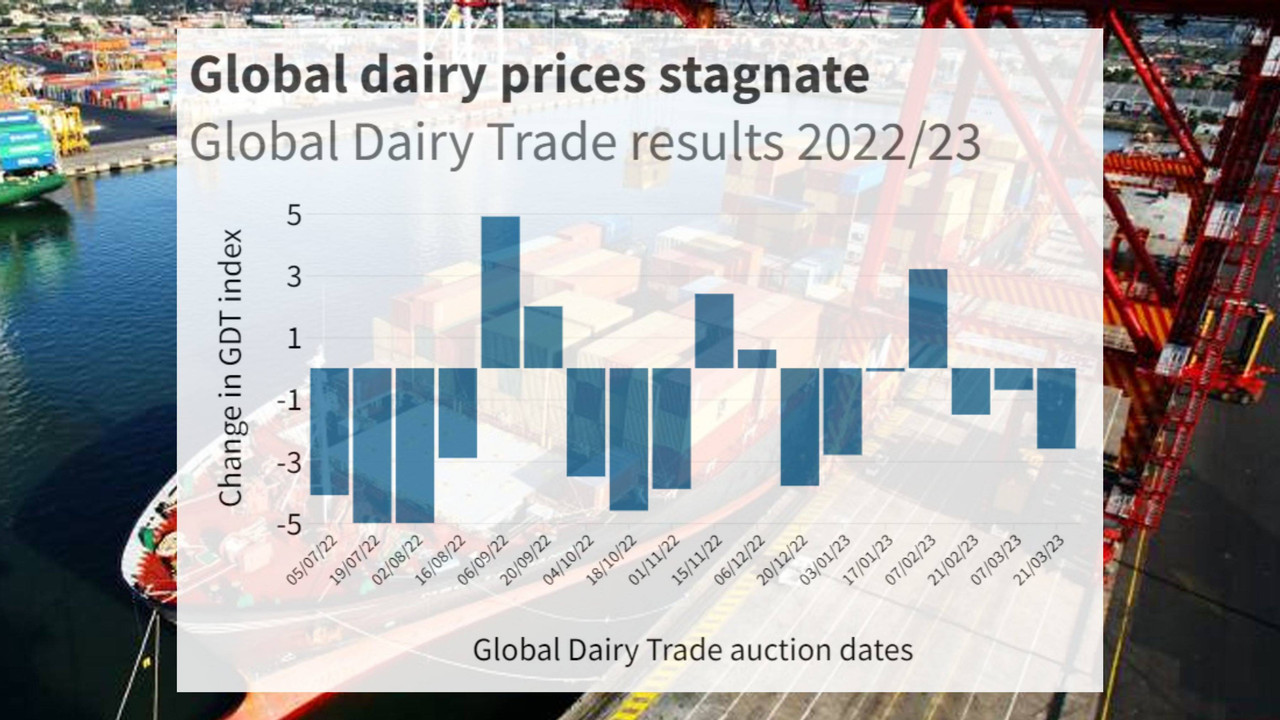
Growing up, my daughter loved cheese. So much so that when it came to pizza night, her Dominos order was always the same – ‘Mr Cheese’. What pizza would you like tonight sweetie? Mr Cheese! And what pizza would you like tonight? Don’t tell me, Mr Cheese! Now, I’m not saying that my daughter started a global trend, but the world now definitely loves cheese. Indeed, reflecting this global love affair, since late 2021, global cheese prices have averaged 32% higher than the five-year average prior i.e., between November 2016 and October 2021. Pinning down the exact genesis for the cheesy trend

Treasury Sanctions Individuals Linked to CJNG’s Arms Trafficking, Fuel Theft, and Money Laundering

Treasury Sanctions Individuals Linked to CJNG’s Arms Trafficking, Fuel Theft, and Money Laundering

WASHINGTON – Today, the Department of the Treasury’s Office of Foreign Assets Control (OFAC) designated two senior members of the Cartel de Jalisco Nueva Generacion (CJNG) engaged in trafficking high-caliber firearms from the United States and fuel theft in Mexico. Additionally, OFAC designated another individual and one Mexican entity that provide support to CJNG by laundering illicit narcotics proceeds. CJNG is a violent Mexico-based drug trafficking organization responsible for a significant proportion of fentanyl and other deadly drugs trafficked into the United States.

“CJNG relies upon a web of criminal activity that ultimately strengthens its ability to traffic fentanyl and other deadly drugs to the United States. Today’s action disrupts key support networks engaged in arms trafficking, fuel theft, and drug-related money laundering,” said Under Secretary of the Treasury for Terrorism and Financial Intelligence Brian E. Nelson. “Treasury, in close coordination with the Government of Mexico and U.S. law enforcement, will continue to target those who support and supply drug trafficking and criminal organizations, especially those engaged in the production and distribution of synthetic opioids that claim the lives of tens of thousands of Americans each year.”

Today’s action was coordinated closely with the Government of Mexico, including La Unidad de Inteligencia Financiera (Mexico’s Financial Intelligence Unit), and is the result of ongoing collaboration with Homeland Security Investigations (HSI), the U.S. Drug Enforcement Administration (DEA), and United States Northern Command (NORTHCOM).

CJNG ARMS TRAFFICKERS

Alonso Guerrero Covarrubias (a.k.a. “El Ocho”) and Javier Guerrero Covarrubias are violent senior CJNG members engaged in various criminal activities on behalf of CJNG, including the trafficking of weapons from the United States into Mexico, fuel theft, and drug trafficking activities.

OFAC designated Alonso Guerrero Covarrubias and Javier Guerrero Covarrubias pursuant to Executive Order (E.O.) 14059 for being directed by, or having acted or purported to act for or on behalf of, directly or indirectly, CJNG.

On July 11, 2022, OFAC designated another member of the Guerrero Covarrubias’ weapons trafficking network—Obed Christian Sepulveda Portillo—pursuant to E.O. 14059, for being directed by, or acting or purporting to act for or on behalf of, directly or indirectly, CJNG.

CJNG MONEY LAUNDERING

Based in Jalisco, Mexico, Mary Cruz Rodriguez Aguirre directs a money laundering network moving illicit funds between the United States and Mexico, including on behalf of CJNG. Mary Cruz Rodriguez Aguirre works as broker for CJNG regional commander Audias Flores Silva, arranging the movement of drug proceeds from the United States to Mexico. On April 13, 2021, OFAC identified Audias Flores Silva  as a significant foreign narcotics trafficker pursuant to the Foreign Narcotics Kingpin Designation Act, and the Department of State announced a reward offer through the Narcotics Rewards Program of up to $5 million for information leading to Audias Flores Silva’s arrest and/or conviction.

Using her currency exchange house Nacer Agencia Panamericana de Divisas y Centro Cambiario, S.A. de C.V. and a network of U.S.-based businesses, Mary Cruz Rodriguez Aguirre uses a trade-based money laundering system to move illicit narcotics proceeds from the United States to Mexico. From 2020 to 2022, Mary Cruz Rodriguez Aguirre facilitated the collection and laundering of over $6,000,000.

OFAC designated Mary Cruz Rodriguez Aguirre pursuant to E.O. 14059 for having provided, or attempted to provide, financial, material, or technological support for, or goods or services in support of CJNG. OFAC designated Nacer Agencia Panamericana de Divisas y Centro Cambiario, S.A. de C.V. pursuant to E.O. 14059 for being owned, controlled, or directed by, or having acted or purported to act for or on behalf of, directly or indirectly, Mary Cruz Rodriguez Aguirre.

SANCTIONS IMPLICATIONS

As a result of today’s action, all property and interests in property of the designated individuals and entities that are in the United States or in the possession or control of U.S. persons must be blocked and reported to OFAC. In addition, any entities that are owned, directly or indirectly, 50 percent or more by one or more blocked persons are also blocked. OFAC’s regulations generally prohibit all dealings by U.S. persons or within the United States (including transactions transiting the United States) that involve any property or interests in property of designated or otherwise blocked persons.

Today’s action is part of a whole-of-government effort to counter the global threat posed by the trafficking of illicit drugs into the United States that is causing the deaths of tens of thousands of Americans annually, as well as countless more non-fatal overdoses. This action demonstrates the Administration’s strengthened approach to saving lives by disrupting the trafficking of illicit fentanyl and its precursors into American communities. OFAC, in coordination with its U.S. Government partners and foreign counterparts, will continue to target and pursue accountability for foreign illicit drug actors.

In addition, persons that engage in certain transactions with the individuals and entities designated today may themselves be exposed to sanctions or subject to an enforcement action.

The power and integrity of OFAC sanctions derive not only from OFAC’s ability to designate and add persons to the Specially Designated Nationals and Blocked Persons List (SDN List), but also from its willingness to remove persons from the SDN List consistent with the law. The ultimate goal of sanctions is not to punish, but to bring about a positive change in behavior. For information concerning the process for seeking removal from an OFAC list, including the SDN List, please refer to OFAC’s Frequently Asked Question 897. For detailed information on the process to submit a request for removal from an OFAC sanctions list


UK house prices flat in May as annual growth turns negative

UK house prices flat in May as annual growth turns negative

House prices were largely unchanged in May, edging down very slightly (-£130) compared to April, with the average UK property now costing £286,532. More notably the annual rate of growth fell to -1.0%, marking the first time since 2012 that house prices have fallen year-on-year. Given the effectively flat month, the annual decline largely reflects a comparison with strong house prices this time last year, as the market continued to be buoyant heading into the summer. -6.0 -4.0 -2.0 0.0 2.0 4.0 6.0 8.0 10.0 12.0 14.0 May-22 Jun-22 Jul-22 % change (seasonally adjusted) Aug-22 Sep-22 Oct-22 Nov-22 Dec-22 Jan-23 Feb-23

China Trade Data Raises Stimulus Hopes as Export Stumble

China Trade Data Raises Stimulus Hopes as Export Stumble

It was a busy Wednesday morning session on the Asian economic calendar. Economic data from Australia drew interest ahead of trade data from China.

The Australian economy expanded by 0.2% in Q1 versus a forecasted 0.8%. In Q4, the economy grew by 0.6%. Year-over-year, the economy grew by 2.3% versus a forecasted 2.7%. In Q4, the economy expanded by 2.6%, year-over-year.

According to the ABS,

  • Household spending rose 0.2% in Q1, contributing just 0.1 percentage points to GDP.
  • Significantly, the household savings ratio declined to 3.7%, the lowest since 2008, suggesting weaker consumer spending ahead.
  • Net trade weighed on growth. While exports increased by 1.8%, imports rose by 3.2%, detracting 0.2 percentage points from GDP.

With the GDP numbers giving the RBA reason to hit the pause button on the monetary policy tightening cycle, economic indicators from China also disappointed.

China’s USD trade surplus narrowed from $90.21 billion to $65.81 billion in May versus a forecasted $71.60 billion. Significantly, exports tumbled by 7.5% year-over-year, with imports down by 4.5%. Economists forecast exports to rise by 8.0% and imports to fall by 8.0%.

The latest trade data from China followed the private sector PMI numbers for May that sent mixed signals. Considering the slump in exports and the latest manufacturing sector PMIs, investors will hope for the Chinese government to kickstart the economy. Stimulus news would be a boon for riskier assets and the AUD/USD and NZD/USD.

AUD/USD Reaction to China Trade Data

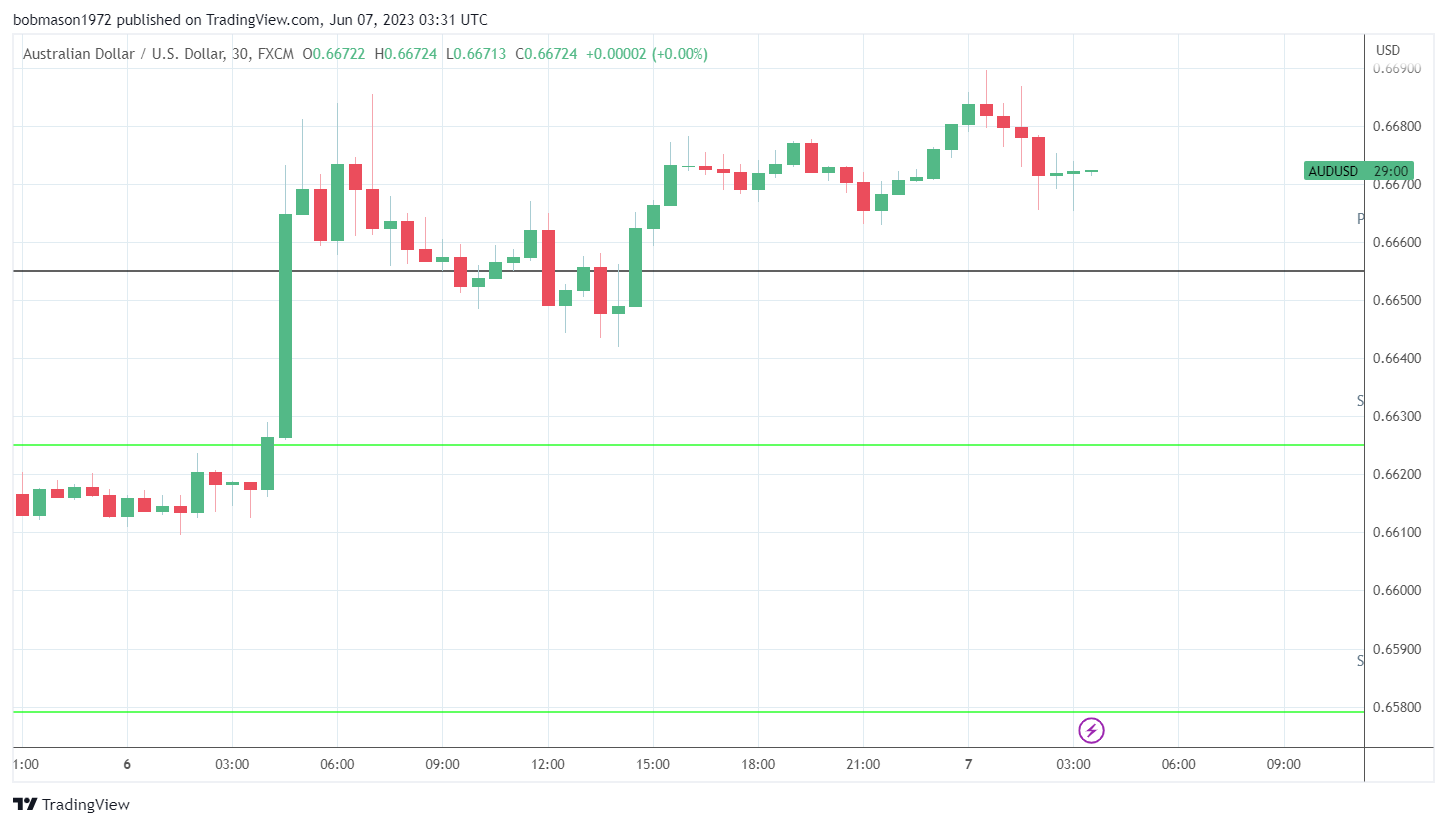
Before the GDP and trade figures, the AUD/USD fell to an early low of $0.66630 before rising to a pre-stat high of $0.66897.

However, in response to the stats, the AUD/USD rose to a post-stat high of $0.66869 before falling to a low of $0.66653.

This morning, the AUD/USD was up 0.02% to $0.66724.

AUD/USD responds to GDP numbers and the trade data.
AUD/USD 30-minute chart – 07.06.23
Global economic outlook improving, albeit to a low growth recovery

Global economic outlook improving, albeit to a low growth recovery

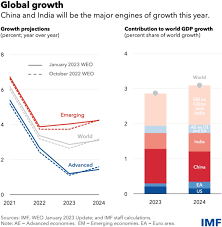
Headline inflation in the OECD is projected to decline from 9.4% in 2022 to 6.6% in 2023 and 4.3% in 2024. The decline in inflation is due to tighter monetary policy taking effect, lower energy and food prices and reduced supply bottlenecks. GDP growth in the United States is projected to be 1.6% in 2023, before slowing to 1.0% in 2024 in response to tight monetary and financial conditions. In the euro area, declining headline inflation will help to boost real incomes and contribute to a pick-up in GDP growth from 0.9% in 2023 to 1.5% in 2024. China is expected to see strong increases in GDP growth in 2023 (with

Interest Rates Drive UK Mortgage Affordability to Weakest Level Since 2008

Interest Rates Drive UK Mortgage Affordability to Weakest Level Since 2008

Fitch Ratings-London-06 June 2023: Increases in interest rates are the single most significant factor in deteriorating mortgage affordability in the UK, Fitch Ratings says. The agency estimates that mortgage affordability, measured as the proportion of household net income spent on monthly mortgage payments, will deteriorate in 2023 to its weakest level since the 2008 global financial crisis. Lengthening loan terms, which have helped borrowers limit monthly payments in recent years, will not be able to compensate for the significant increases in interest rates as lenders will not be willing to extend loan terms beyond the borrower’s retirement age.

In the buy-to-let (BTL) sector, affordability deterioration will be greater than for owner-occupied lending due to the dominance of interest-only products which are more sensitive to rises in interest rates than capital and interest lending. Despite strong rental growth, which remains well correlated with CPI inflation, leading to rising yields on residential property, we expect average interest coverage ratios to deteriorate by around a quarter during 2023.

Fitch expects affordability pressure in both the owner-occupied and BTL sectors to ease through 2024 and 2025. Interest rate reductions will help to lower monthly mortgage payments while nominal earnings continue to increase. House prices, which we expect to contract by up to 7% in 2023, should stabilise and return to growth but at a slower pace than nominal wages.

‘UK Housing & Mortgage Affordability 2023: Rising Interest Rates Put Households Under Pressure’ is available via the link above.

Contacts:
Duncan Paxman
Senior Director, EMEA RMBS
+44 20 3530 1428
Fitch Ratings Limited
30 North Colonnade
London
E14 5GN

Andrew Joseph
Senior Analyst, EMEA RMBS
+44 20 3530 1169

Sara Mariani
Director, EMEA RMBS
+44 20 3530 1540

Media Relations: Athos Larkou, London, Tel: +44 20 3530 1549, Email: [email protected]

Additional information is available on www.fitchratings.com

All Fitch Ratings (Fitch) credit ratings are subject to certain limitations and disclaimers. Please read these limitations and disclaimers by following this link: https://www.fitchratings.com/understandingcreditratings. In addition, the following https://www.fitchratings.com/rating-definitions-document details Fitch’s rating definitions for each rating scale and rating categories, including definitions relating to default. Published ratings, criteria, and methodologies are available from this site at all times. Fitch’s code of conduct, confidentiality, conflicts of interest, affiliate firewall, compliance, and other relevant policies and procedures are also available from the Code of Conduct section of this site. Directors and shareholders’ relevant interests are available at https://www.fitchratings.com/site/regulatory. Fitch may have provided another permissible or ancillary service to the rated entity or its related third parties. Details of permissible or ancillary service(s) for which the lead analyst is based in an ESMA- or FCA-registered Fitch Ratings company (or branch of such a company) can be found on the entity summary page for this issuer on the Fitch Ratings website.
In issuing and maintaining its ratings and in making other reports (including forecast information), Fitch relies on factual information it receives from issuers and underwriters and from other sources Fitch believes to be credible. Fitch conducts a reasonable investigation of the factual information relied upon by it in accordance with its ratings methodology, and obtains reasonable verification of that information from independent sources, to the extent such sources are available for a given security or in a given jurisdiction. The manner of Fitch’s factual investigation and the scope of the third-party verification it obtains will vary depending on the nature of the rated security and its issuer, the requirements and practices in the jurisdiction in which the rated security is offered and sold and/or the issuer is located, the availability and nature of relevant public information, access to the management of the issuer and its advisers, the availability of pre-existing third-party verifications such as audit reports, agreed-upon procedures letters, appraisals, actuarial reports, engineering reports, legal opinions and other reports provided by third parties, the availability of independent and competent third- party verification sources with respect to the particular security or in the particular jurisdiction of the issuer, and a variety of other factors. Users of Fitch’s ratings and reports should understand that neither an enhanced factual investigation nor any third-party verification can ensure that all of the information Fitch relies on in connection with a rating or a report will be accurate and complete. Ultimately, the issuer and its advisers are responsible for the accuracy of the information they provide to Fitch and to the market in offering documents and other reports. In issuing its ratings and its reports, Fitch must rely on the work of experts, including independent auditors with respect to financial statements and attorneys with respect to legal and tax matters. Further, ratings and forecasts of financial and other information are inherently forward-looking and embody assumptions and predictions about future events that by their nature cannot be verified as facts. As a result, despite any verification of current facts, ratings and forecasts can be affected by future events or conditions that were not anticipated at the time a rating or forecast was issued or affirmed.
The information in this report is provided ‘as is’ without any representation or warranty of any kind, and Fitch does not represent or warrant that the report or any of its contents will meet any of the requirements of a recipient of the report. A Fitch rating is an opinion as to the creditworthiness of a security. This opinion and reports made by Fitch are based on established criteria and methodologies that Fitch is continuously evaluating and updating. Therefore, ratings and reports are the collective work product of Fitch and no individual, or group of individuals, is solely responsible for a rating or a report. The rating does not address the risk of loss due to risks other than credit risk, unless such risk is specifically mentioned. Fitch is not engaged in the offer or sale of any security. All Fitch reports have shared authorship. Individuals identified in a Fitch report were involved in, but are not solely responsible for, the opinions stated therein. The individuals are named for contact purposes only. A report providing a Fitch rating is neither a prospectus nor a substitute for the information assembled, verified and presented to investors by the issuer and its agents in connection with the sale of the securities. Ratings may be changed or withdrawn at any time for any reason in the sole discretion of Fitch. Fitch does not provide investment advice of any sort. Ratings are not a recommendation to buy, sell, or hold any security. Ratings do not comment on the adequacy of market price, the suitability of any security for a particular investor, or the tax-exempt nature or taxability of payments made in respect to any security. Fitch receives fees from issuers, insurers, guarantors, other obligors, and underwriters for rating securities. Such fees generally vary from US$1,000 to US$750,000 (or the applicable currency equivalent) per issue. In certain cases, Fitch will rate all or a number of issues issued by a particular issuer, or insured or guaranteed by a particular insurer or guarantor, for a single annual fee. Such fees are expected to vary from US$10,000 to US$1,500,000 (or the applicable currency equivalent). The assignment, publication, or dissemination of a rating by Fitch shall not constitute a consent by Fitch to use its name as an expert in connection with any registration statement filed under the United States securities laws, the Financial Services and Markets Act of 2000 of the United Kingdom, or the securities laws of any particular jurisdiction. Due to the relative efficiency of electronic publishing and distribution, Fitch research may be available to electronic subscribers up to three days earlier than to print subscribers.
For Australia, New Zealand, Taiwan and South Korea only: Fitch Australia Pty Ltd holds an Australian financial services license (AFS license no. 337123) which authorizes it to provide credit ratings to wholesale clients only. Credit ratings information published by Fitch is not intended to be used by persons who are retail clients within the meaning of the Corporations Act 2001.
Fitch Ratings, Inc. is registered with the U.S. Securities and Exchange Commission as a Nationally Recognized Statistical Rating Organization (the ‘NRSRO’). While certain of the NRSRO’s credit rating subsidiaries are listed on Item 3 of Form NRSRO and as such are authorized to issue credit ratings on behalf of the NRSRO (see https://www.fitchratings.com/site/regulatory), other credit rating subsidiaries are not listed on Form NRSRO (the ‘non-NRSROs’) and therefore credit ratings issued by those subsidiaries are not issued on behalf of the NRSRO. However, non-NRSRO personnel may participate in determining credit ratings issued by or on behalf of the NRSRO.