


Canada Beats US, UK and China in Number of Gen Z Investors: FINRA
Canada has the highest percentage of Gen Z investors according to a new study by the Financial Industry Regulatory Authority (FINRA), a US private brokerage industry regulator. The watchdog said nearly three-quarters or 74% of Gen-Zers based in Canada and covered by the study had at least one form of investment.
The new study was conducted by FINRA Education, the regulator’s education arm, in partnership with the CFA Institute, a global association of investment professionals. The research findings are based on a November/December 2022 online survey of 2,872 Gen Zers from the US, Canada, the UK and China.
The Gen Z investors surveyed were aged 18 – 25 at the time of the study. In addition, the research examined millennials aged 26 – 41 and Gen X investors aged 42 – 57 across all regions.
Comparing its results from these jurisdictions, FINRA noted that the United States trails behind Canada with 56% of surveyed Gen Z investors in the former country saying they owned at least one form of investment. The United Kingdom and China come after with 49% and 57%, respectively.
Meanwhile, the study found that ‘a surprisingly large percentage’ or 56% of Zoomers in the United States own at least some investments with cryptocurrency as their top choice. In detail, the research noted that young investors in the country primarily invest in cryptocurrency (55%) and individual stocks (41%).
“[Gen Z investors in the United States] are less likely than their older counterparts to use mutual funds and are more likely, along with millennials, to invest in crypto and non-fungible tokens compared with Gen Xers,” FINRA noted.
Furthermore, the FINRA-CFA Institute project found that social media (48%), internet searches (47%) and parents/family (45%) are just about as equally important as primary sources of learning about investment and finances for US Gen Zers. However, when it comes to online resources YouTube dominates (60%) which is followed by internet searches, Instagram, TikTok, Twitter, Reddit and Facebook.
In addition, FINRA said Gen Z investors in the United States are risk-takers with almost half (46%) “willing to take substantial or above-average financial risks.” Half of US respondents said they have previously made an investment as a result of the fear of missing out (FOMO).
Looking at barriers to investing among young people in the United States, the study found that the lack of savings (65%), lack of sufficient income, or living paycheck-to-paycheck (64%) are the biggest discouraging factors for Zoomers who did not own any form of investment. Additionally, more than half of the young investors (56%) cited a lack of knowledge about investing as a major reason they do not have any investments.
Young Investors across the World
Meanwhile, the British financial regulator released a study on young investors on Wednesday, noting that only 20% of youths are capable of disregarding investment hype despite the fact that the number is significantly higher (33%) when it comes to dating hype. At the start of the year, Cyprus’ financial watchdog published a report on retail investor behaviour, noting that only 31% of retail investors rely on so-called ‘finfluencers’.
In a related development, Finance Magnates recently reported that regulators across the world are increasingly cracking down on ‘finfluencers’. However, questions remain about what regulatory approach should be taken towards them.

Presentation of the ECB Annual Report 2022 to the Committee on Economic and Monetary Affairs of the European Parliament
I am pleased to be back before the ECON Committee to present the ECB’s Annual Report for 2022[1], which we have published today together with our written feedback on the resolution on our activities you adopted earlier this year.[2]
These documents, as well as today’s hearing, are fundamental for the ECB’s accountability relationship with this Parliament. We greatly value this dialogue with you as it allows us to reach out to the public, which is especially important in times of high inflation.
In my remarks today, I will first focus on the outlook for the economy and the appropriate monetary policy response. I will then discuss the importance of a resilient financial system in supporting the real economy.
The outlook for the economy and the appropriate monetary policy response
The euro area economy grew modestly in early 2023. Activity is being supported by lower energy prices, easing supply bottlenecks and fiscal policy support to firms and households. But domestic demand, especially consumption, remains weak.
Headline inflation declined from its October peak and stood at 7.0% in April. Core inflation remains elevated, partly because of input cost pressures. Upside risks to inflation stem from, among other things, higher than expected wage and profit margin growth, and a potential lasting rise of longer-term inflation expectations above our target. Downside risks relate to possible renewed financial market tensions and weaker demand, due for example to a more marked slowing of bank lending or a stronger transmission of monetary policy.
As the inflation outlook continues to be too high for too long, we decided at our May meeting to raise our key policy rates again, by 25 basis points. We also announced that the Governing Council expects to discontinue reinvestments under the asset purchase programme (APP) as of July this year. While our key interest rates are the primary tool for setting our monetary policy stance, the reduction of the APP portfolio also helps to normalise monetary policy.[3]
While the speed and scope of our policy tightening since last July has already been unprecedented, our future decisions will ensure that the policy rates will be brought to levels sufficiently restrictive to achieve a timely return of inflation to our 2% medium-term target and will be kept at those levels for as long as necessary. We will continue to follow a data-dependent approach to determine the appropriate level and duration of restriction, taking into account the highly uncertain environment. To this end, our policy decisions will be based on the assessment of the inflation outlook in the light of incoming economic and financial data, the dynamics of underlying inflation, and the strength of our monetary policy transmission.
One important factor for the future inflation outlook is the behaviour of fiscal policy. As the energy crisis fades, governments should roll back the related support measures promptly and in a concerted manner to avoid driving up medium-term inflationary pressures, which would call for a stronger monetary policy response. Fiscal policies should be oriented towards making our economy more productive and gradually bringing down high public debt. Policies to enhance the euro area’s supply capacity, especially in the energy sector, can also help reduce price pressures in the medium term.
The importance of a resilient financial system
Despite the very strong tightening cycle, financial stability in the euro area has proved robust so far. But we of course continue to monitor the situation, taking into account a wide range of indicators.
Vulnerabilities in euro area financial markets were shown up by recent stress in the banking sector in other regions, which led to market reactions here too, although such spillovers were mitigated by solid euro area bank fundamentals. These tensions were short-lived, however, owing to prompt interventions by the authorities in the United States and Switzerland.
Tighter credit conditions are testing the resilience of euro area firms, households and sovereigns, while the possibility of sudden changes in property prices, especially in commercial real estate, remains a concern. We are also closely monitoring non-banks, which – given their interconnections with banks − can amplify shocks within the financial system. This highlights the need to strengthen the regulation of non-banks, in part by taking a more comprehensive macroprudential approach that would ensure their resilience while avoiding the risk of creating blind spots within the financial system.[4]
Our banking sector is strong today, largely thanks to the reforms and prudential policies implemented over the past years. However, the recent events should remind us to consistently attune our regulatory framework to the times – doing so, among other ways, by monitoring and reacting to new developments such as crypto-assets, digitalisation and the impact of social media.[5]
For our part, we have been working at international level with the Basel Committee on Banking Supervision (BCBS)[6] and the Financial Stability Board[7] to assess what can be learned from the recent events. We have also helped to define the BCBS standard for the prudential treatment of banks’ crypto-asset exposures.[8]
Your role as co-legislators will be crucial in keeping our framework robust.
First, your role is vital in fully implementing the final elements of Basel III faithfully and without delay, as this best guarantees the safety of our banking system. We are very concerned about the numerous deviations from the Basel standards introduced in the EU banking package and think they should be avoided.
Second, we need to swiftly implement in EU law the aforementioned BCBS standard for the prudential treatment of crypto-asset exposures. We need to be ambitious and make rapid progress, in particular on the envisaged exposure limit to reduce contagion between crypto and banks.
Third, it is imperative that we complete the banking union – the European Commission’s proposal on crisis management and deposit insurance is an important step towards this goal.
Conclusion
We are going through a period of high uncertainty marked by a sequence of economic and geopolitical shocks and trade fragmentation. The best way to protect stability in the EU is to ensure closer European integration and a solid regulatory framework.
In the coming twelve months before this parliamentary term ends, we can make tangible progress on some key dossiers.
First, on fiscal policies, we very much welcome the Commission’s legislative proposals for the reform of the EU’s economic governance. A well-functioning governance framework is essential from an economic, monetary and financial stability perspective.
Second, on financial sector policies, we need to make progress on the Basel III reforms, crypto-asset standards, and the crisis management package – along the lines just outlined.
Third, on banking union, the lack of a European deposit insurance scheme is a source of vulnerability; completing the banking union is essential to pave the way for a stronger and more prosperous Europe.

Japan raises view on economy for 1st time since July 2022
Japan’s government raised its overall view of the economy for the first time in ten months in May, after recent data showed the country emerged from recession in the first quarter amid a post-COVID consumption rebound.
The Cabinet Office also upgraded its assessment of consumer spending, exports and factory output, suggesting economic and social activities gathered pace.
“The economy is recovering moderately,” the Cabinet Office said in its monthly report published on Thursday (May 24), upgrading its view for the first time since July 2022.
Previously, it said the economy was picking up moderately though there was some weakness.
Consumer spending is “picking up”, it added in the report.
Earlier this month, the government reclassified COVID-19 as an infectious disease level on par with the seasonal flu, which helped people to go out for leisure.
“The economy has entered a self-sustainable recovery phase,” said an official at the Cabinet Office. “Overall, the positive movements are spreading in the economy.”
With shipments of auto and auto parts growing as supply disruptions in semiconductors ease, the Cabinet Office raised its view on exports for the first time since December 2020.
Exports are showing “solid movement”, it said, better than its previous view of a “weak tone” in shipments.
The Cabinet Office also made an upward revision on factory output for the first time since August 2022, saying it was showing “signs of picking up”.
It removed a reference to “supply constraints” from risks but kept its caution over the downside risks to the economy amid global monetary tightening, price increase and market fluctuations.
The government expects the Bank of Japan to achieve its 2 per cent inflation target in a sustainable and stable manner backed by wage increases.

GBP/USD: Below the 1.2340/50 area the downside could open up to the 1.2200 level – ING
EUR/GBP bias is probably now for a retest of the 0.8650 area
“The EUR/GBP bias is probably now for a retest of the 0.8650 area, and we’ll definitely have to see some softer wage/price data over the coming weeks for the Bank of England to be diverted from what looks like another 25 bps hike on June 22nd.”
“For GBP/USD, the 1.2340/50 area seems decent support below which the downside could open up to the 1.2200 area.”

EUR/USD consolidates losses below 1.0750 amid cautious market mood
EUR/USD is consolidating losses below 1.0750 in the European session amid a German Q1 GDP contraction. The pair also remains weighed down by the US debt-ceiling uncertainty-led cautious mood, which buoys the safe-haven US Dollar. ECB-speak and US data eyed.
The Relative Strength Index (RSI) indicator on the four-hour chart dropped into the oversold territory below 30 on Thursday. Additionally, EUR/USD manages to hold slightly above the descending regression channel coming from early May. The upper-limit of the channel forms first resistance at 1.0750 ahead of 1.0770 (static level, 20-period Simple Moving Average (SMA)) and 1.0800 (Fibonacci 50% retracement of the latest uptrend, 50-period SMA).
On the downside, 1.0700 (psychological level) aligns as next support ahead of 1.0670 (lower-limit of the channel descending channel, static level from February).
EUR/USD has managed to recover modestly after having touched its weakest level in two months below 1.0720. The pair’s near-term technical outlook points to oversold conditions but the Euro could have a difficult time outperforming the US Dollar (USD) unless there is a noticeable improvement in market mood.
The risk-averse market atmosphere amid a lack of progress in the US debt-ceiling negotiations provided a boost to the USD mid-week. Additionally, hawkish comments from Federal Reserve (Fed) Governor Christopher Waller caused investors to reassess the possibility of the Fed leaving its policy rate unchanged in June.
According to the CME Group FedWatch Tool, markets are currently pricing in a nearly 40% probability of one more rate hike in June, compared to less than 20% earlier in the week. Waller reiterated on Wednesday that fighting inflation continues to be his priority and noted that he would not support stopping rate increases unless there was clear evidence that inflation was moving toward the Fed’s objective of 2%.
Early Thursday, the Euro Stoxx 50 Index trades modestly higher on the day. US stock index futures, on the other hand, point to a mixed opening. S&P Futures are up 0.5% but Dow Futures are down 0.3%. In case there is a risk rally after Wall Street’s opening bell, the USD could lose interest and open the door for a rebound in EUR/USD and vice versa.
The US economic docket will feature the first-quarter Gross Domestic Product growth. Since this data will be a revision, it is unlikely to trigger a significant market reaction. Investors will also pay close attention to the weekly Initial Jobless Claims data. In case the number of first time application for unemployment benefits rise significantly, by 20K or more, the USD could come under renewed selling pressure.

Nvidia Earnings Blowout Ripples into the Nasdaq 100, US AAA Rating Cut Risk Brews
Nvidia Earnings Smashed Expectations, Driving Nasdaq 100 Higher Afterhours
Thursday’s Asia-Pacific trading session could be looking at a rosy start after Nvidia Corp. single-handedly buoyed stock market sentiment after releasing its first-quarter earnings report. The now world’s most valuable chipmaker crushed expectations, clocking in a revenue estimate of about USD 11 billion, far above the 7.18b analyst estimate, driven by AI-fueled demand.
During after-hours trade, Nvidia’s stock soared over 25 percent, producing a rippling effect for the tech-heavy Nasdaq 100 (futures) and to a certain extent, the S&P 500 too – see chart below. As a result, Wall Street reversed a good chunk of losses seen during Wednesday’s trading session, which saw the Nasdaq Composite drop 0.61%.
Initial losses on Wall Street were driven by pessimism regarding ongoing debt ceiling negotiations and monetary policy woes. This fueled concerns regarding how a default could increase the risk of a recession. Speaking of which, Fitch Ratings announced that the US AAA rating could be cut, citing the nation’s governance as a weakness relative to its ‘AAA’ peers.
Meanwhile, FOMC meeting minutes showed that policymakers stressed that cuts are “unlikely”, pouring cold water in rising expectations of near-term easing.
Looking ahead, Thursday’s Asia-Pacific trading session is lacking notable economic event risk. That is going to leave sentiment as the key driver for financial markets. As such, the boost to equities from Nvidia’s report could drive optimism in regional indices, such as the Hang Seng Index, ASX 200 and Nikkei 225.
Nasdaq 100 15-Minute Chart

Nasdaq Technical Analysis
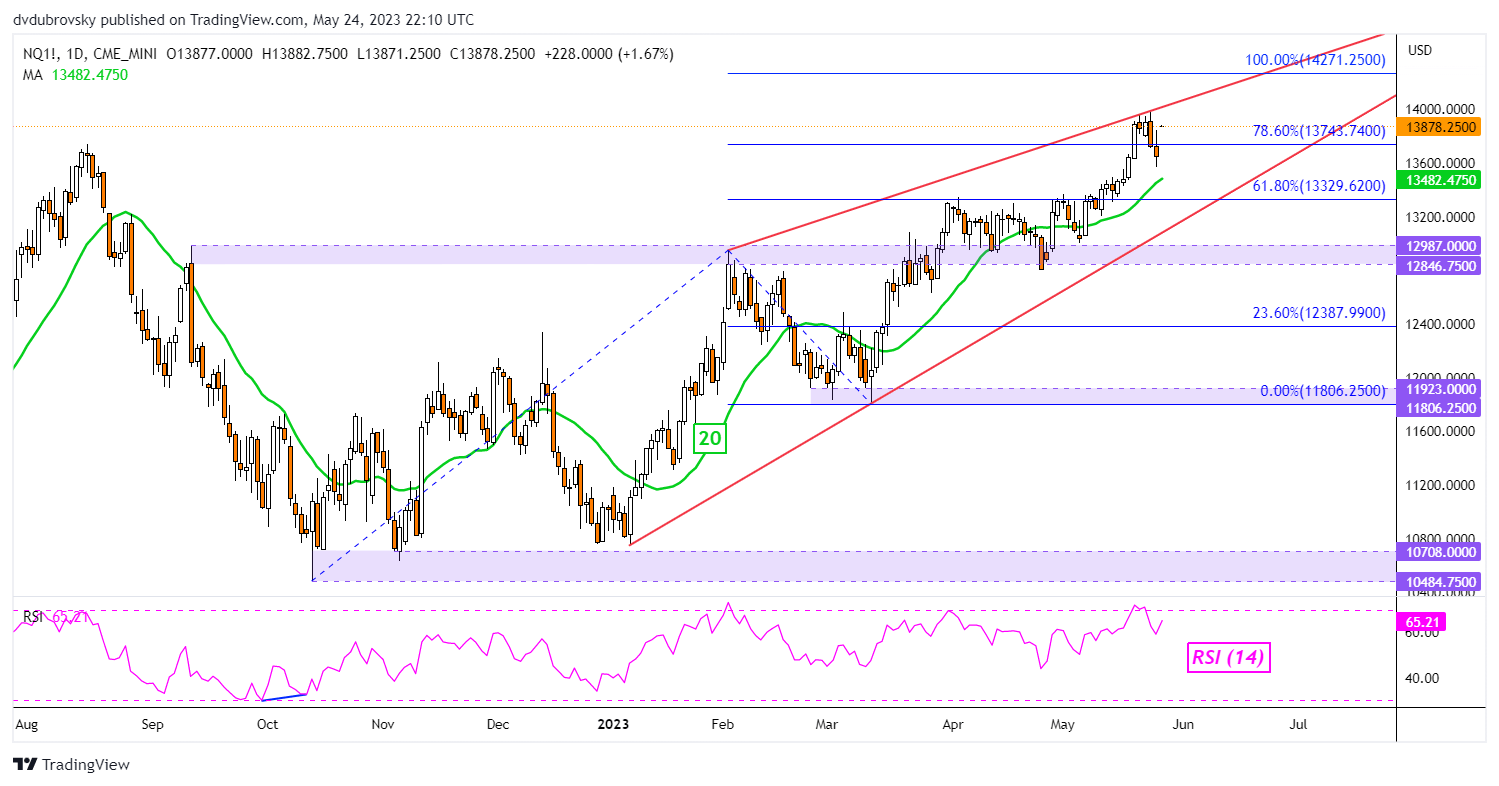
On the daily chart, the Nasdaq 100 appears to be trading within the boundaries of a Rising Wedge chart formation. So long as the index continues to trade within the pattern’s formation, the immediate technical bias could be bullish. On the other hand, a breakout lower could open the door to reversing gains that have been accumulating since the beginning of this year.
Nasdaq 100 Daily Chart

British Pound Shrugs Off Blistering CPI: What’s Next for GBP/USD, EUR/GBP, GBP/JPY?
The British pound’s rally against some of its peers has stalled recently, and chances are that the consolidation could extend a bit further in the short term.
UK macro momentum has been solid as reflected in the two-year high readings of the UK Economic Surprise Index. Data released on Wednesday showed inflation moderated by much less than expected in April, leaving the door open for another BOE rate hike next month. However, the subdued reaction in GBP to the recent upbeat data suggests much of the optimism could well be baked in the price.
Moreover, the deadlock in Washington over raising the debt limit and the scaling back in expectations of a Fed rate cut this year after hawkish remarks from several Fed officials have provided an excuse to unwind some GBP longs given the extent and the pace of the rise since late 2022.
GBP/USD Daily Chart

On technical charts, GBP/USD’s trend has moved to a bearish phase in the short term, as the colour-coded 240-minute candlestick charts based on trending / momentum indicators show. Any break below the immediate cushion at the mid-April low of 1.2350 could open the downside toward 1.2200.
GBP/USD 240-minute Chart

In the past couple of weeks, there have been signs of loss of steam in GBP/USD’s rally (see “A Reversal or a Dead-Cat Bounce in US Dollar? EUR/USD, GBP/USD, USD/JPY”, published May 17. This follows a retreat earlier this month from a slightly upward sloping trendline from 2022 (see the weekly chart).
GBP/USD Weekly Chart

From a medium-term perspective, the rise this month to a one-year high earlier this month confirmed the higher-tops-higher-bottom sequence since late 2022, leaving open the door for some medium-term gains. (see “British Pound Buoyant Ahead of BOE: How Much More Upside?”, published May 8). However, recent signals on charts suggest GBP may need to consolidate / retreat a bit before the next leg higher.
GBP/JPY Daily Chart

GBP/JPY: Rally could pause
GBP/JPY’s rally appears to be running out of steam in the very near term as it tests a key ceiling around the October high of 172.10. No threat to the five-month-long uptrend, but the evolving price action on the daily and weekly charts suggests the cross may need to consolidate/retreat a bit before it embarks on the next leg higher. However, the mid-May low of 167.85 could provide a solid floor.
EUR/GBP Weekly Chart

Chart Created Using TradingView
EUR/GBP: Downtrend fatigue?
EUR/GBP’s losses have stalled following the break below key horizontal trendline support at about 0.8725, raising the prospect of a minor bounce. However, the broader bias remains down, potentially toward the December low of 0.8545.
Note: In the above colour-coded chart, Blue candles represent a Bullish phase. Red candles represent a Bearish phase. Grey candles serve as Consolidation phases (within a Bullish or a Bearish phase), but sometimes they tend to form at the end of a trend. Note: Candle colors are not predictive – they merely state what the current trend is. Indeed, the candle color can change in the next bar. False patterns can occur around the 200-period moving average, or around a support/resistance and/or in sideways/choppy market. The author does not guarantee the accuracy of the information. Past performance is not indicative of future performance. Users of the information do so at their own risk.

Crude Oil Pings Higher as Specs Told to ‘Watch Out’ by OPEC+. Higher WTI?
Crude oil staged a rally going into Thursday despite the US Dollar roaring higher alongside Treasury yields.
Comments from Saudi Arabia Minister of Energy Abdulaziz bin Salman, assisted the bounce when he rattled the sabre, saying, “speculators, like in any market, they are there to stay. I keep advising that they will be ouching. They did ouch in April. I don’t have to show my card, I’m not [a] poker player… but I would just tell them, watch out.”
In early April, OPEC+ announced that they would cut production by 1.1 million barrels per day. This news saw crude gap higher to levels not seen since November 2022.
The reality is that OPEC+ is notorious for not being able to meet their production target and regularly overshoot. For a further deep dive into the OPEC+ cartel and its intentions, check out our colleague Ilya Spivak at tastylive on his MacroMoney show here.

Source; Bloomberg. Created by Ilya Spivak at Macro money
The weekly US Energy Information Agency (EIA) data released overnight saw stockpiles drop dramatically, overcompensating for last week’s run-up in inventory.
12.456 million fewer barrels were stored in the week ending May 19th. The week prior saw 5.04 million barrels added.
Elsewhere, the Canadian wildfires appear to have been contained to a certain extent for now and it’s being reported that production and supply are back to normal levels.
For now, it appears that the shorts have been squeezed but it seems there is a lack of follow-through at this point.
WTI CRUDE OIL TECHNICAL ANALYSIS
WTI overcome resistance making a high of 74.73 overnight. The 34- and 100-day Simple Moving Averages (SMA) are just above the market and may lend resistance near 75.15 and 76.92 respectively.
On the downside, support might be at previous resistance levels down toward 73.60. Further down, support may lie at the breakpoints and prior lows of 69.41, 66.82, 66.12, 64.36, 63.64 and 62.43.


US Dollar Rides High as Debt Debate Continues Amid Fitch Re-Rating. Higher DXY?
The US Dollar regained the ascendency overnight with Treasury yields racing north and stocks taking a tumble as the US debt ceiling debate fumbles forward toward June 1st. That is the date that Treasury Secretary Janet Yellen has identified as the day that Treasury may run out of cash.
Demand for the ‘big dollar’ soared with high beta currencies such as the Aussie and Kiwi Dollars’ hit the hardest, but the rally has been broad-based across currency markets.
The South Pacific currencies snapped to 6-month lows with the growth-linked Dollars susceptible to sways in global risk sentiment, which is being eroded by the uncertainty of the US debt ceiling debacle.
Fitch, the credit rating agency, put the US on negative watch late Wednesday as the debt ceiling deadline approaches.
While many pundits believe a resolution will be found before a default occurs, the prospect of it unfolding is providing conjecture for many scenarios. Should it happen, uncertainty appears to be the only certainty.
It should be noted that House Speaker Kevin McCarthy said ‘we’re not going to default’ late Wednesday.
Treasury yields have lifted across the curve with the 1-year note only a handful of basis points away from a 23-year high.
Federal Reserve meeting minutes released yesterday revealed that while there was no consensus for further rate hikes, the notes pointed toward a pause for some time rather than the prospect of a cut.
Interest rate markets are pencilling in a cut for the December Federal Open Market Committee (FOMC) meeting.
Wall Street finished the cash session lower, but Nasdaq futures have rallied through the Asian session after Nvidia, the chip maker, reported much better than anticipated results. They believe that 2Q revenue will be around USD 11 billion, beating estimates of USD 7.2 billion.
APAC equities are mostly in the red with the exception of Japan, with the Nikkei 225 posting solid gains. Data From Japan’s Ministry of Finance showed foreign buying of Japanese stocks nudged higher again for the week ended May 19th to ¥ 867.5 billion.
Crude oil defied the US Dollar advances, posting a 3-week overnight and it has been steady so far in Asian trade. The WTI futures contract is over US$ 74 bbl while the Brent contract is above US$ 78 bbl.
Spot gold is languishing near US$ 1,960 an ounce while silver dipped below US$ 23 an ounce today.
DXY TECHNICAL ANALYSIS
The DXY index has continued to rally after breaking above a descending trend line 2-weeks ago.
The surge went on to break above resistance near 102 and that area might provide support on a pullback.
On the topside, resistance could be at the 76.4% Fibonacci Retracement level of at the prior peak of 105.10.

 Chat now!