Big Mistake Leads Technical Trader to Top Three Tools

Big Mistake Leads Technical Trader to Top Three Tools

I’ve been trading the markets for nearly 20 years – There’s been ups and down. Along the way you try to find what style trading works best for your personality and goals. Sometimes this process can be orderly and structured- it wasn’t for me.

The 116 Death Trap

Developing your strategy comes at a cost –often a lot of time, money and frustration. I came to this realization in 2003 as USD/JPY was pulling back from multi-year highs. The ‘116 death trap,’ as I’ve dubbed it, was a seemingly rock solid zone of support. It had caught the lows since 2001 with numerous defenses suggesting a perfect opportunity for me to ‘catch the lows’ and cost average in. Even when price broke, my hope was that every rebound was the low. Not quite. In September of 2003, the death trap began with a drop of more than 12% over the next year, taking USD/JPY to lows not seen since the late-90s. Even a glimmer of hope offered by a multi-week rally in early 2004 reversed. With the pain finally too hard to tolerate, I exited at the lows. So much for cost averaging into a loser. That was my hard lesson learned.

USD/JPY Daily Price Chart

Where did I go wrong?

Well, there was a lot, but for starters, emotions are not your friend. Most of all, my error was not having a plan and not recognizing market conditions. Knowing the style of trading that works best for your personality, risk tolerance and goals is critical and without a plan you are on a ship without a rudder.

Everyone comes to this realization differently. I learned through years of managing market flow for one of the first brokers to offer online retail FX trading. It was through close observations of retail market flow and tracking near-term price-action that Ideveloped three basic principles for my technical trading strategy. It boils down to assigning a value for price, time and momentum.

Price Value – Key reversals, Fibonacci, High/Low-day Closes

It’s all about the levels – identifying support / resistance is a critical part of being able to create actionable trade ideas targeting or countering key levels in price. These lateral levels can be identified using various methods. The three I rely on most are key reversals (outside-day reversals), high and low-day closes and Fibonacci.

The word “Fibonacci” often appears in trading and it is likely that you have already seen or heard of it — for good reason. It is a simple measurement based on the golden ratio of 61.8%. This ratio can be observed everywhere in nature from trees to galaxy formations and is also very relevant to buying and selling behavior in markets. It is a tool you can implement in both trending and range-bound markets to help identify areas of possible support / resistance. We have a lot more in the education section: Fibonacci Application in Financial Markets (dailyfx.com)

One discipline I rely heavily on is pitchfork and median-line analysis. The goal of this style of analysis is to identify the slope or gradient of a given market in an attempt to highlight when a price level may be significant. It is this time value that adds another dimension to the lateral levels identified earlier – these “confluence zones” are often points in price and time that can offer major pivots in near-term price-action. Trading into / off these inflection points todayform the basis of my favored technical trade setups.

Momentum value – RSI

The speed of a market can tell The Relative Strength Index (RSI). The RSI is an oscillator that is used as a measure of momentum — the speed of the recent price movement in either direction. While all oscillators are inherently backward looking, they can still be of value when you are trying to asses when the market maybe overextended in either the overbought or oversold conditions. The ability to assess the inertia of a given market is critical for near-term swing and trend trading as it offers a window into the possible longevity and strength of a given move as well as ideas on when it may expire.

Bottom line

Having a multi-faceted approach that takes into account price value, momentum value and time value could help steer you not only to possible opportunities, but also help you avoid failure. Knowing the condition of the market using price, time and momentum has been a major philosophy of my trading.

Federal Reserve pushes pause on interest rate hikes

Federal Reserve pushes pause on interest rate hikes

For the first time since beginning the current tightening cycle in March 2022, the Fed opted against raising the federal funds rate at the June 14, 2023, FOMC meeting. The decision officially ends a run of 10 consecutive interest rate hikes by the central bank.

While the move was expected, the Fed’s release of its summary of economic projections signifies that its hawkish tone on curbing inflation remains intact, as additional rate hikes in 2023 are projected, and the federal funds rate was pushed out to 5.6% by year-end, up from March’s 5.1% year-end projection.

“The Fed’s new dot-plot forecast of potentially higher interest rates in 2023 suggests it is too early for the Fed to claim victory over inflation,” said Raymond James Chief Investment Officer Larry Adam. “However, given the recent disinflationary trends in place, especially with the recent deceleration in CPI and PPI we have seen this week, we still believe the Fed is in the latter stages, if not near the end, of this tightening cycle.”

The updated dot plot also speaks to the Fed’s continued hawkishness. The median federal funds rate for the end of 2024 increased from 4.1% in March to about 4.4% in June.

“As we’ve stated previously, it is clear that the Fed is convinced that in order to prevent markets from bringing longer-term interest rates down, it needs to continue to push the federal funds rate, which is the only interest rate it controls, higher,” said Raymond James Chief Economist Eugenio Alemán.

The Personal Consumptions Expenditures (PCE) inflation forecast moved a touch lower, from 3.3% in March to 3.2% in June, while Core PCE increased from 3.6% in March to 3.9% in June.

The decision to pause keeps the Fed’s cumulative total increase over the last 15 months to 500 basis points (bps), and the federal funds rate remains 5.00%-5.25%, the highest range in the past 15 years.

“In our opinion, there is no question that the economic data – for example, slowing inflation, rising jobless claims and below-trend growth – are moving in the direction the Fed wants. [The movement] is just not happening at the pace that [the Fed] wants,” said Adam. “The big question is how much patience the Fed has to allow the disinflationary trend to continue before tightening further. Lifting the potential fed funds rate ‘dot’ for 2023 allows the Fed more flexibility to remain balanced in the event the disinflationary path stalls.”

Yen Falls to 7-Month Low as Traders Shift Focus From Fed to BOJ

Yen Falls to 7-Month Low as Traders Shift Focus From Fed to BOJ

The yen weakened to its lowest since November against the dollar as traders shifted their focus from a hawkish Federal Reserve to Friday’s Bank of Japan policy decision.

The relatively hardline stance from Fed officials on Wednesday stands in sharp contrast to BOJ policymakers who have stuck with monetary easing even as most global peers tighten, a disparity that favors the US currency. The Fed projected borrowing costs will go higher than previously seen, while almost all of the economists surveyed by Bloomberg see the BOJ leaving its ultra loose policy unchanged Friday.

The Japanese currency fell 1% to around 141.50 per dollar, even after Chief Cabinet Secretary Hirokazu Matsuno said that excessive movements weren’t desirable. Last month when the yen weakened to similar levels, top currency official Masato Kanda said that the government would take action if needed, after an unscheduled meeting between the BOJ, Ministry of Finance and Financial Services Agency.

“The trend for the yen to weaken amid no policy change by the BOJ, in combination with a more hawkish Fed, is likely to continue for a while,” said Tsutomu Soma, a bond and currency trader at Monex Inc. “The authorities may verbally intervene as the yen continues to weaken but actual intervention is unlikely as there’s some benefit from it for the nation, such as higher stock prices.”

The benchmark US Treasury yield climbed 4 basis points to 3.83% in Asia trading Thursday, with its Japanese counterpart little changed at 0.42%. The widening gap between the two played a huge part in pushing the yen to a three-decade low last year.

Demand for the dollar was also likely influenced by Japanese importers, who typically buy the greenback on trading days that are a multiple of five such as the 10th, 15th and 20th of any month.

Looking ahead to Friday, BOJ officials likely see little need to adjust their yield curve control program given some improvement in the functioning of the bond market, according to people familiar with the matter. Governor Kazuo Ueda said earlier this month that the BOJ has consistently stated it will maintain easing until its price goal is achieved in a stable manner, feeding further into speculation the central bank will stay pat in coming months.

BOJ’s Ueda Likely to Hold With Bond Market on His Side for Now

Last year, the yen weakening toward 146 per dollar triggered Japan’s first intervention to prop up the currency since 1998, though in the build up to that there were repeated official warnings about direct action. The Japanese currency has fallen more than 7% this year.

“A sustained break above 141 opens the door for levels above 142 to be tested and potentially quite quickly,” said Rodrigo Catril, strategist at National Australia Bank Ltd. in Sydney. “Intervention is unlikely to do much to arrest yen weakness, it merely offers an opportunity to reset shorts.”

ECB tipped to hike rates again, as Fed hits pause

ECB tipped to hike rates again, as Fed hits pause

FRANKFURT: The European Central Bank is expected to again hike interest rates on Thursday and signal that the fight against inflation is not over yet, analysts said, even as the eurozone falls into recession.

With inflation slowing but still three times above the ECB’s two-percent target, there is little doubt the Frankfurt institution will raise borrowing costs for an eighth consecutive time.

A 0.25-percentage-point hike “looks like a done deal”, Capital Economics economist Jack Allen-Reynolds said.

More interesting to investors will be any clues from president Christine Lagarde at her afternoon press conference in Frankfurt about how much higher rates will go – or if a pause might be on the horizon.

The Federal Reserve, which began lifting rates earlier than the ECB, on Wednesday opted to stand pat after 10 straight increases.

But the US central bank also indicated that further rate rises could be needed this year.

The ECB embarked on an unprecedented campaign of monetary tightening after Russia’s war in Ukraine sent food and energy prices soaring, raising its interest rates by 3.75 percentage points since last July.

Another 25-basis-point hike on Thursday would take the ECB’s closely watched deposit rate to 3.50 percent.

‘No evidence yet’

Eurozone inflation eased to 6.1 percent in May year on year, from a peak of 10.6 percent in October, mainly thanks to rapidly declining energy prices.

But closely watched core, or underlying, inflation – which strips out volatile food and energy prices – decelerated only slightly to 5.3 percent, from 5.6 percent in April.

“There is no clear evidence that underlying inflation has peaked,” Lagarde warned earlier this month, stressing that the ECB still had “ground to cover” on rates.

Like all central banks, the ECB has to walk a fine line in raising interest rates sufficiently to dampen demand and contain inflation, without provoking a sharp economic slowdown in the process.

Higher borrowing costs have already led to a plunge in demand for credit from households and companies, recent data showed, suggesting the ECB’s moves are having an impact.

No pause in sight as ECB eyes next rate hike

But the eurozone economy has proved less resilient than initially thought.

Revised data last week showed that the economy in the 20-nation currency union shrank by 0.1 percent for two straight quarters at the end of 2022 and the start of 2023, meeting the technical definition of a recession.

While still mild, the surprise winter recession has cast doubt on more optimistic predictions for 2023.

‘Heated summer debate’

The ECB will unveil its latest economic forecasts on Thursday, likely to show a downward revision for growth.

The recent disappointing economic data and slowing inflation could strengthen the case of the “doves” among ECB policymakers against tightening much further, analysts said.

But the “hawks” may point to strong wage growth in the eurozone and stubbornly high core inflation to warn against taking the foot off the gas too early.

Senior policymakers including Lagarde have also expressed concern about corporate profits worsening inflation, suggesting some companies were raising prices even as their costs have come down.

Berenberg economist Holger Schmieding predicted “a heated summer debate” between the hawks and the doves, but said “a final rate hike” of another 25 basis points at the next meeting in July seemed likely.

The ECB “will play it safe and follow up with another interest rate hike in July”, agreed Fritzi Koehler-Geib, chief economist at public lender KfW.

EUR/USD: ECB will have to out-hawk the Fed to tempt buyers to reload longs – SocGen

EUR/USD: ECB will have to out-hawk the Fed to tempt buyers to reload longs – SocGen

Economists at Société Générale discuss EUR/USD outlook ahead of the European Central Bank (ECB) Monetary Policy Decision.

ECB could tempt buyers on Euro dip after gains fizzled out following Fed pause

The ECB will have to out-hawk the Fed today to tempt buyers to reload EUR/USD longs.

The pair understandably wavered after the Fed decision but a 25 bps hike today by the ECB and prospect of another increase in July and possibly September means the policy rate and bond yield differentials will narrow, provided the Fed holds fire.

Downside risks to the currency outlook stem essentially from the rally in risk assets fizzling out and European economic growth languishing compared to the US.

The technical recession and stagflationary backdrop do not quite enhance the appeal of the single currency or European risk assets (making abstraction of relative valuations), but in a FX regime where rate differentials are governing the price action, there is a tactical case for EUR/USD to target higher levels.

EUR/USD trades with modest losses above 1.0800 ahead of ECB

EUR/USD trades with modest losses above 1.0800 ahead of ECB

EUR/USD is trading under pressure while defending 1.0800, following an early uptick to the 1.0850 region. The pair consolidates losses, as the US Dollar bulls take a breather after the Fed’s hawkish pause-led upswing. All eyes remain on ECB policy announcements.

The EUR/USD rose again, posting its highest daily close in a month above 1.0800, despite the US Dollar’s recovery triggered by the hawkish hold from the FOMC. Attention now turns to the European Central Bank (ECB) meeting and upcoming US data, which could become more relevant given Fed Chair Powell’s statement that the July meeting will be a ‘live’ meeting.”

The ECB will have its Governing Council meeting on Thursday. It is expected to hike interest rates by 25 basis points. The key for the Euro will be the language used in the statement and ECB President Lagarde’s comments during the press conference. Probably, she will repeat that they are not done raising rates. If the meeting turns out to be ‘dovish’, with signals of a potential pause, the Euro could suffer.

The US dollar recovered ground after the Fed meeting, during which the central bank kept interest rates unchanged but signaled that it is not done hiking rates. The hawkish tone weighed on Treasury bonds and boosted the greenback. Fed Chair Jerome Powell stated that the July meeting will be a “live meeting”, keeping more rate hikes on the table. According to their projections, most FOMC members see another 50 basis points of tightening by year-end

During the Asian session, markets will continue to digest the Fed’s decision and will likely be the key driver until the ECB meeting. Also, key economic data from the US is due on Thursday, particularly Retail Sales, Jobless Claims, and the Philly Fed Index.

New Zealand Dollar Dips on Soft GDP Data. Where to for NZD/USD?

New Zealand Dollar Dips on Soft GDP Data. Where to for NZD/USD?

The New Zealand Dollar fell in response to GDP today after a stellar run higher on the back of a sliding US Dollar. The S&P/NZX 50 equity index is slightly in the green so far today.

The quarterly number was in line with expectations, but the annual read saw some downward revisions.

1Q quarter-on-quarter GDP came in at -0.1% as forecast and against the previous -0.7% that was revised down from -0.6%. Prior quarters also saw downward revisions.

Annual GDP to the end of March was 2.2% rather than the 2.6% anticipated and 2.2% previuosly.

Prior to the GDP data, the real estate institute of New Zealand (REINZ) revealed that house sales slipped -0.4% year-on-year to the end of May. A notable improvement on the April figure of -15. 3%.

Yesterday, Statistics New Zealand data revealed food prices rose by 0.3% month-on-month in May against 0.5% previously. This made for an increase of 12.1% year-on-year to the end of May, slightly below the prior of 12.5% which was the highest read in 36 years.

Earlier in the week, Statistics New Zealand also revealed that there were net 72,300 migrant arrivals in the year ended in April. This was composed of 98,400 migrant arrivals of non-NZ citizens and 26,100 migrant departures of NZ citizens.

The addition might go some way to alleviate the tight labour reflected by the historically low unemployment rate of 3.4%.

All of this stacks up for a delicate dance that the RBNZ will need to trot in order to avoid a deep recession when they next meet on July 12th. The general criteria for a recession is defined as two consecutive quarters of negative growth.

Annual CPI is running at 6.7% and while there has been a deceleration, it is stubbornly high at a time when economic activity is slowing down. The overnight index swaps (OIS) market is pricing no more hikes by the bank this year, leaving the overnight cash rate (OCR) at 5.50%.

For the New Zealand, Dollar, sways in the US Dollar might continue to impact direction, judging by the reaction to last night’s Federal Open Market Committee (FOMC) meeting.

The Fed left rates unchanged, and the ensuing statement appears to have been interpreted as remaining hawkish with a lift in the so-called dot plot. Not long after, Fed Chair Jerome Powell spoke at the press conference and his remarks seem to have been seen with a dovish spin.

The next FOMC is July 26th and there is a mountain of data points between now and then that the market will need to take onboard, as well as Fed commentary along the way.

NZD/USD REACTION TO THE FED DECISION AND NZ GDP


High-for-longer rate outlook as takeaway from FOMC meeting: Gold, Copper, US dollar

High-for-longer rate outlook as takeaway from FOMC meeting: Gold, Copper, US dollar

Market Recap

The conclusion of the June meeting has seen the Federal Reserve (Fed) keeping rates on hold at 5.00%-5.25% in a widely-anticipated move, but there is less conviction for markets that today’s move will mark the end of its tightening campaign.

A hawkish takeaway came from the Federal Open Market Committee (FOMC) dot plot, with peak rate for 2023 revised to 5.6% from previous 5.1%, which suggests another 50 basis-point (bp) of tightening by the end of this year. Rate forecasts for 2024 and 2025 were revised upwards as well, which seems to put a high-for-longer rate outlook on the horizon. The justification may come on the back of some persistence in inflationary pressures, with the Fed’s core PCE forecasts seen higher at 3.9% for 2023 compared to the 3.6% expected in March.

Comments from Fed Chair Jerome Powell seem to add to the hawkish equation, saying that Fed rate cuts are a ‘couple years out’, at a time when broad market expectations were pricing for rate cuts by the end of the year. With July meeting being deemed as a ‘live’ meeting from the Fed Chair, it will leave any rate decision to just a handful of inflation and labour data ahead. Current Fed funds futures continue to lean towards a 25 bp move in July, but its pricing for terminal rate at 5.25%-5.5% are still less hawkish than what the Fed has guided, which leaves any further recalibration on watch.

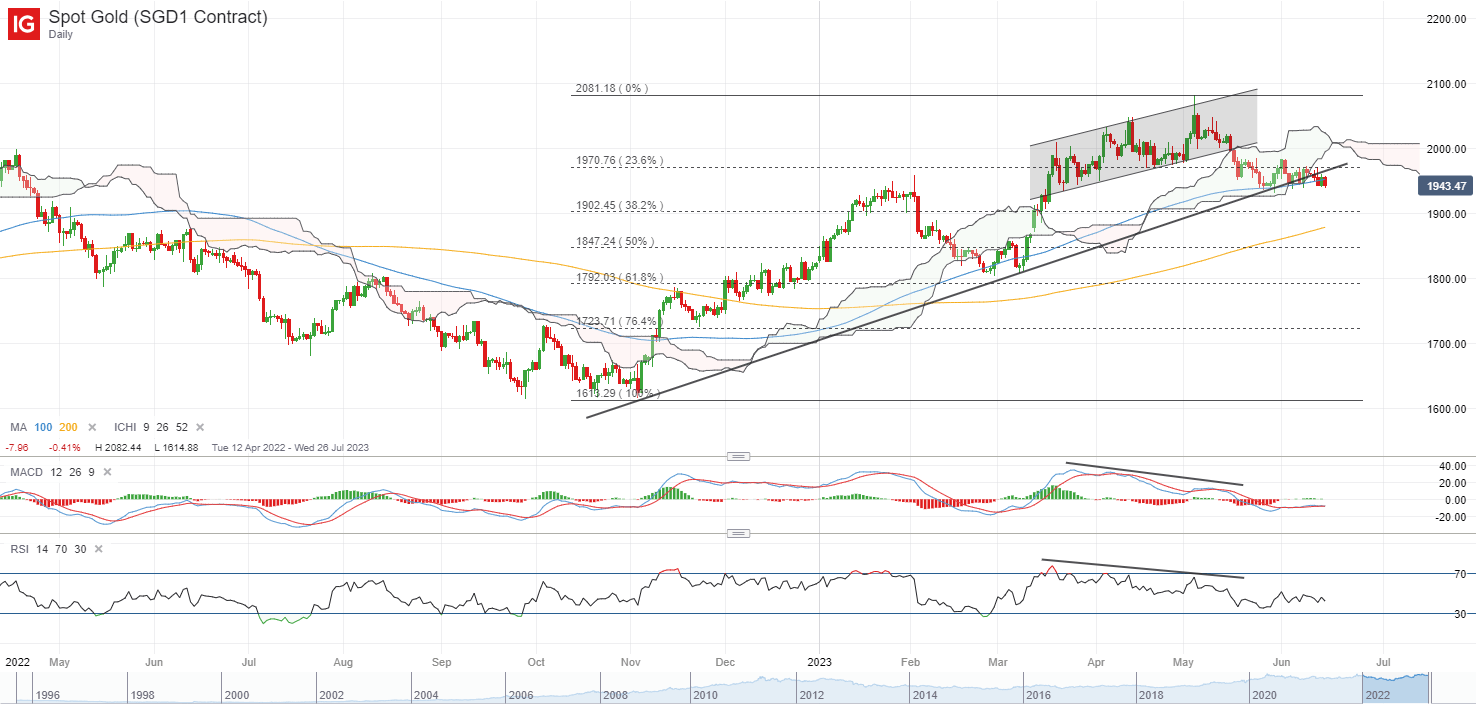
Treasury yields were on a mixed tone, reflecting some indecision in the aftermath of the FOMC meeting. On the other hand, a high-for-longer rate outlook has not been well-received by gold prices, which saw a sharp paring in initial gains overnight. Intermittent bounces over the past one month have failed to find much of a follow-through, with prices hovering back near its two-month low around the US$1,940 level. Any breakdown to a new lower low may be in sight, which could reinforce its near-term downward bias. Its Relative Strength Index (RSI) continues to trend below the key 50 level, while a key trendline support in place since November 2022 has been invalidated, reflecting sellers in control for the present.

image1.png

Asia Open

Asian stocks look set for a slight positive open, with Nikkei +0.17%, ASX +0.31% and KOSPI +0.30% at the time of writing as market participants continue to digest the latest FOMC meeting. The economic calendar this morning has seen first-quarter gross domestic product (GDP) read from New Zealand dragging the country into a technical recession. A 0.1% decline quarter-on-quarter in 1Q, following a 0.7% decline in 4Q, is likely to provide further justification that the Reserve Bank of New Zealand (RBNZ) is done with tightening, which translates to some downward pressure on the NZD.

The day ahead will bring focus to Australia’s employment data, followed by a series of economic data out of China (industrial production, retail sales, fixed asset investment). Recent cuts to China’s short-term borrowing costs may drive hopes of a similar adjustment to the one-year MLF rate later today, with the upcoming economic data likely to add to the recent series of downside surprises and reinforce a low-for-longer growth outlook in China. All three above-mentioned data are expected to display some moderation in year-on-year growth from April.

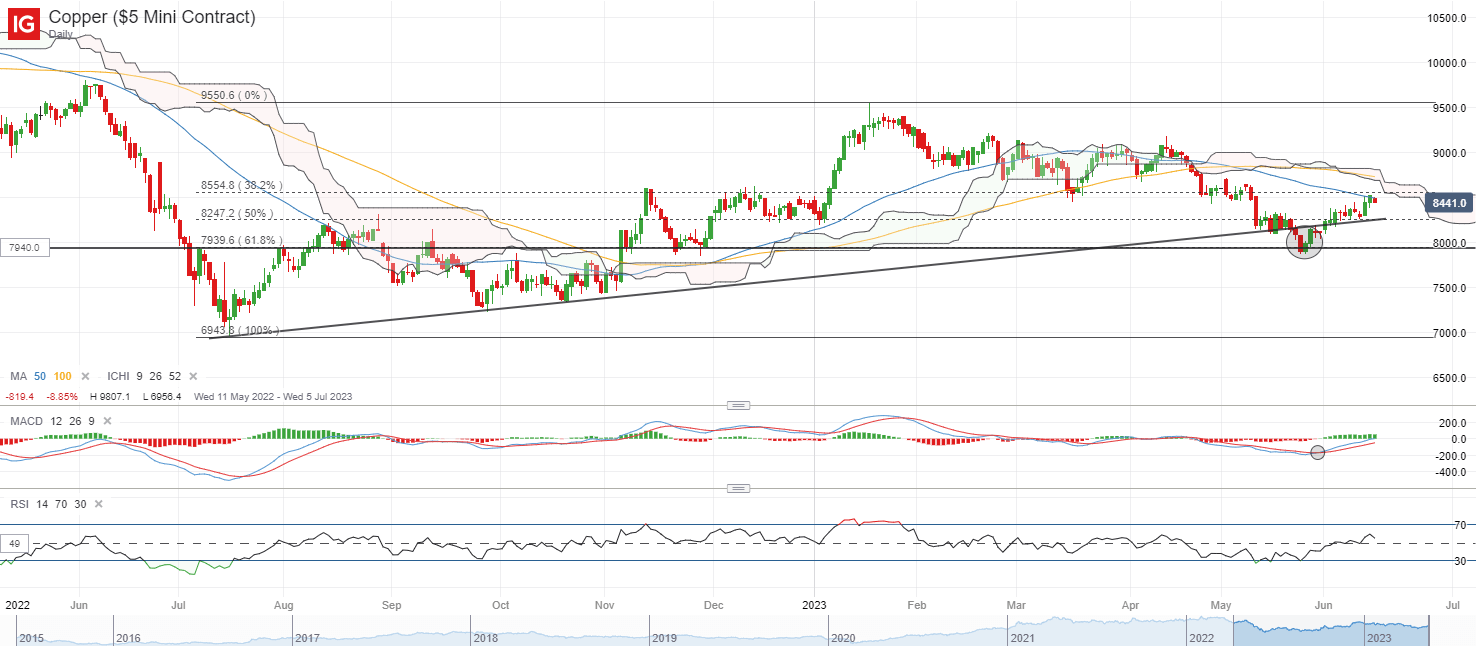
Copper prices have managed to recover more than 8% since finding support at the US$7,940/tonne level. A reclaim of the RSI above the 50 level, along with a bullish crossover on moving average convergence/divergence (MACD) may point towards some upward momentum in the near term. That said, immediate resistance still stands at the US$8,600/tonne level for now. Greater conviction for a more sustained upside may have to come from a move above the Ichimoku cloud to signal an upward trend in place. On any downside, the US$8,250/tonne level may bring some support from an upward trendline in confluence with a Fibonacci retracement level.

image2.png

On the watchlist: Knee-jerk reaction in the US dollar but more signs needed

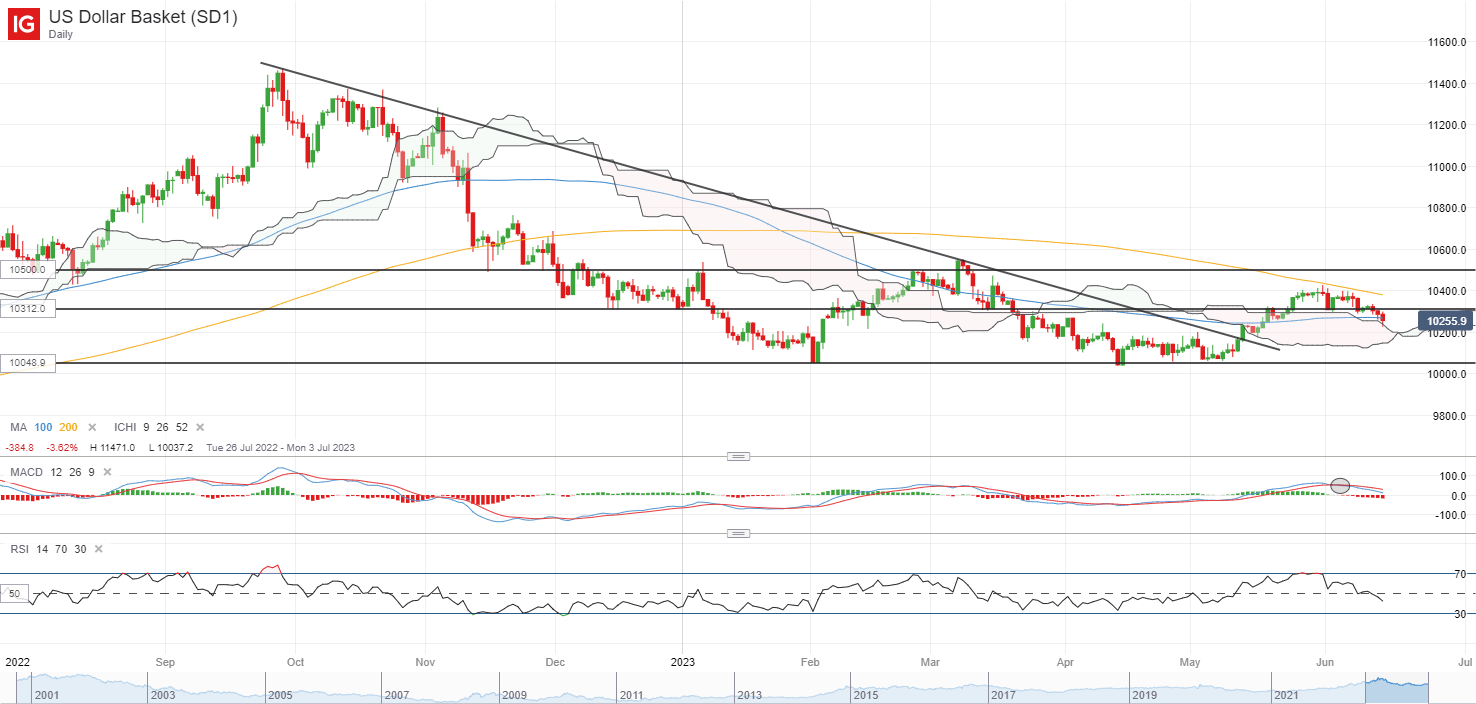
The FOMC meeting has brought about some volatility in the US dollar overnight, with the release of the dot plot triggering a 0.5% knee-jerk reaction mid-day before some gains were pared during the Fed press conference. Greater conviction for the bulls may have to come from an overturn of the lower-highs-lower-lows formation on the four-hour chart since the start of the month, with immediate resistance to overcome at the 103.12 level.

For now, its RSI has headed below the key 50 level, along with a declining MACD, which calls for the need of a significant build-up in upward momentum to provide some conviction for the bulls as well. Any failure to tap on the hawkish tone from the FOMC meeting for any move higher over subsequent days could point towards ongoing exhaustion, which could place its May bottom in sight for a retest next.

image3.png


Australian Dollar Steadies on Jobs Data While China Slows. Where to for AUD/USD?

Australian Dollar Steadies on Jobs Data While China Slows. Where to for AUD/USD?

The Australian Dollar reversed early losses on Thursday after a solid jobs report that saw a dip in the unemployment rate which could reignite price pressures that might see the RBA’s July meeting become a little more interesting.

The unemployment rate was 3.6% in May against the 3.7% anticipated and prior. 75.9k Australian jobs were added in the month, which was notably above the 17.5k expected to be added and -4.3k previously.

Of note was the full-time boost of 61.7k and the nudge higher in the participation rate to 66.9% from 66.7%.

The RBA hiked rates by 25 basis points (bp) earlier this month to 4.10%. Before today’s numbers, the overnight index swaps (OIS) market ascribed about a 20% chance of a hike in the cash rate by the RBA at its July monetary policy meeting. They now see a bit over 40% probability of a 25 bp lift.

For the Aussie Dollar though, the robust domestic data was offset to an extent by weak Chinese numbers. Year-to-date industrial production was 3.6% to the end of May rather than the 3.9% anticipated, although the year-on-year figure was in line at 3.5%.

Retail sales year-on-year were 12.7%, missing estimates of 13.7% and 18.4% prior. Fixed-asset investment growth was 4% year to date, weaker than forecasts of 4.4%. The surveyed unemployment rate in urban areas was unchanged at 5.2% as expected.

On Tuesday, the People’s Bank of China (PBOC) gave markets a slight boost when they cut the 7-day reverse repo rate from 2% to 1.9%. Then today they cut the rate on the 1-year medium-term lending facility to 2.65% from 2.75%.

The sluggish economic performance of the world’s second-largest economy has led to speculation of further stimulus measures from Beijing.

The overnight decision by the Federal Open Market Committee (FOMC) to keep its target rate unchanged followed by the subsequent statement and press conference provided some fireworks for AUD/USD.

Looking ahead, the factors that may play a role in AUD direction could be the pricing of an RBA rate move, Fed speak around more hikes and the economic outlook for China if there is a notable change in policy there.