Crypto Slipping Down

Crypto Slipping Down

Bitcoin’s Support Weakens Below $26K, Key Levels Ahead

The crypto market capitalisation declined by 0.66% to $1.038 trillion, showing several waves of decline with increasingly lower local lows. Alex Kuptsikevich from FxPro said this is a sure sign that the bears are in control, and the pressure seems to be coming from the stock market, as the institutional favourites that are losing the most so far are Bitcoin (-1.1%), Ethereum (-0.9%) and XRP (-0.7%).

Bitcoin weekly chartThe first cryptocurrency is settling increasingly firmly in the territory below $26K. Since March, Bitcoin has been repeatedly bought on dips to this level, but it seems the support doesn’t look as strong now. A failure under $25.4K would signal the end of the corrective rebound to $28K and open the way to $21.5K. However, potentially strong support could come as early as $24K, where the 50-week moving average passes.

Trading Derivatives carries a high level of risk to your capital and you should only trade with money you can afford to lose. Trading Derivatives may not be suitable for all investors, so please ensure that you fully understand the risks involved, and seek independent advice if necessary. A Product Disclosure Statement (PDS) can be obtained either from this website or on request from our offices and should be considered before entering into a transaction with us. Raw Spread accounts offer spreads from 0.0 pips with a commission charge of USD $3.50 per 100k traded. Standard account offer spreads from 1 pips with no additional commission charges. Spreads on CFD indices start at 0.4 points. The information on this site is not directed at residents in any country or jurisdiction where such distribution or use would be contrary to local law or regulation.

Ethereum has already intertwined the 50 and 200-week MAs and has regularly received support on dips under them over the past four weeks. It’s an open question how durable that support will be. It’s worth being prepared that a consolidation under $1600 would trigger a deeper sell-off.

Crypto News

According to CoinShares, investment in crypto funds fell by $11 million last week; outflows have been down for 6 of the previous seven weeks. At the same time, trading volumes were 90% above average since the beginning of the year.

According to IntoTheBlock, crypto whales have invested more than $1.5bn in Bitcoin in the past two weeks, with purchases following BTC’s sharp drop in mid-August.

After the court ruling in the Grayscale case, the SEC has no choice but to approve applications to launch spot bitcoin-ETFs, JP Morgan believes. At the same time, the regulator may approve several applications at once. But that takes time to prepare, so the SEC postponed its decision until October.

The activity of a wallet linked to the bankrupt FTX exchange has raised fears of a potential cryptocurrency sell-off in the making. On 24 August, FTX announced plans to “sell, stack and hedge” $3 billion worth of its cryptocurrencies.

Oil Prices Forecast: OPEC Production Cuts vs. Asia’s Economic Dip Set Flat Tone

Oil Prices Forecast: OPEC Production Cuts vs. Asia’s Economic Dip Set Flat Tone

Global Forces Pulling Oil Prices in Opposite Directions

The tug-of-war between supply and demand continues to baffle oil traders. On one hand, leading OPEC+ members Saudi Arabia and Russia are poised to extend oil supply cuts, with Saudi Arabia likely to roll over its voluntary 1 million barrel per day (bpd) cut into October and Russia set to announce a new OPEC+ deal. Moscow has already slashed exports by 300,000 bpd in September, following a 500,000 bpd cut in August.

These expected cuts typically boost prices, but they’re being counterbalanced by China’s faltering economic recovery, keeping the oil markets in a state of limbo.

Advertisement
Know where WTI Crude Oil is headed? Take advantage now with

Trading Derivatives carries a high level of risk to your capital and you should only trade with money you can afford to lose. Trading Derivatives may not be suitable for all investors, so please ensure that you fully understand the risks involved, and seek independent advice if necessary. A Product Disclosure Statement (PDS) can be obtained either from this website or on request from our offices and should be considered before entering into a transaction with us. Raw Spread accounts offer spreads from 0.0 pips with a commission charge of USD $3.50 per 100k traded. Standard account offer spreads from 1 pips with no additional commission charges. Spreads on CFD indices start at 0.4 points. The information on this site is not directed at residents in any country or jurisdiction where such distribution or use would be contrary to local law or regulation.

Economic Indicators in the West

In the United States, economic signals are mixed but lean towards a stable monetary policy, at least for now. U.S. job growth saw an uptick in August, but the unemployment rate also edged up to 3.8%. Market sentiment strongly suggests the Federal Reserve is done with rate hikes for the moment.

According to the CME FedWatch tool, there’s a 93% chance the Fed will keep rates unchanged in its upcoming meeting and around a 60% likelihood of no more hikes this year. In Europe, ECB President Christine Lagarde emphasized the need for central banks to anchor inflation expectations amidst labor and energy market shifts, as well as geopolitical uncertainties.

Currency Impact

In the currency arena, a minor rise in the dollar index—up 0.086%—could slightly dent foreign demand for dollar-denominated crude oil. A stronger U.S. dollar typically puts downward pressure on oil prices as it makes the commodity more expensive for buyers holding other currencies.

Concerns in Asia

Further complicating the global oil outlook are developments in Asia. China, the world’s second-largest economy, is struggling with weak domestic demand despite various policy stimulus measures. A recent private-sector survey indicated that China’s service activity expanded at its slowest pace in eight months. Meanwhile, in Japan, household spending in July plummeted 5.0% year-over-year, significantly worse than the forecasted 2.5% decline, adding to the uncertainty surrounding demand.

Short-Term Outlook: Bearish to Neutral

The market faces conflicting forces: expected supply cuts from OPEC+ members and economic slowdowns in China and Japan. With the U.S. Federal Reserve likely holding rates steady, it’s a complex backdrop that leaves oil markets with a bearish to neutral short-term outlook. Given the mixed signals, traders would do well to brace for a period of heightened volatility

Dax Index: DAX Stocks on Alert as Eurozone Economic Warnings Multiply

Dax Index: DAX Stocks on Alert as Eurozone Economic Warnings Multiply

DAX Slips as German Economic Woes Deepen

The DAX slipped by 0.1% on Monday. Following a 0.67% loss on Friday, the DAX ended the day at 15,825.

German Exports Fall as Sentiment Worsens

Germany’s trade surplus narrowed sharply in July. Imports jumped, while exports declined. Trade terms with non-EU countries affirmed the weak global demand environment.

Trading Derivatives carries a high level of risk to your capital and you should only trade with money you can afford to lose. Trading Derivatives may not be suitable for all investors, so please ensure that you fully understand the risks involved, and seek independent advice if necessary. A Product Disclosure Statement (PDS) can be obtained either from this website or on request from our offices and should be considered before entering into a transaction with us. Raw Spread accounts offer spreads from 0.0 pips with a commission charge of USD $3.50 per 100k traded. Standard account offer spreads from 1 pips with no additional commission charges. Spreads on CFD indices start at 0.4 points. The information on this site is not directed at residents in any country or jurisdiction where such distribution or use would be contrary to local law or regulation.

The Sentix Index flashed warning signals at -21.5 as the services sector stumbles into contractionary territory.

Beijing Maneuvers Fail to Restore Order

Beijing introduced a department for the private sector, raising hopes for economic recovery. However, concerns over the Chinese real estate market and recent measures remain.

US Labor Day Holiday Left the ECB to Stand Out

The US markets were closed for Labor Day on Monday. A deteriorating macroeconomic environment and an ECB President committed to tackling elevated inflation left the DAX in negative territory.

ECB President Lagarde gave no surprises despite the worsening macroeconomic backdrop. Dissent may creep into the camp.

The Monday Market Movers

RWE AG was the worst performer, falling 2.01%. There was no adverse news to influence. However, sentiment has not improved since the Wednesday sell-off on Orsted impairment news.

Auto stocks were in recovery, with dip buyers returning after the UBS-fueled Friday sell-off.

Mercedes Benz Group (+0.97%), Porsche (+0.39%), BMW (+0.30%), and Continental (+0.09%) made gains, albeit modestly. However, the UBS downgrade continued to resonate for Volkswagen, which slipped by 0.02%.

Today’s Session

Euro area services PMIs will draw interest. With the services sector the main contributor to the Eurozone economy, weaker figures will flash more economic warnings. According to preliminary figures, the German services PMI fell from 52.3 to 47.3. With the manufacturing PMI at sub-40, a downward revision would impact investor sentiment.

However, investors must consider a busy session for the ECB. ECB President Christine Lagarde kickstarts the session. The ECB President shows no intent on shifting focus away from inflation to the deteriorating macroeconomic environment. A beyond-September dovish policy outlook would surprise the markets.

ECB Executive Board Members Edouard Fernandez-Bollo, Luis de Guindos, and Isabel Schnabel will draw interest. Considering the macroeconomic environment, the doves may gain more voice.

The DAX Futures was down 31 points this morning.

US Factory Orders and Early Cracks?

The US markets reopen after the Labor Day holiday, with US factory orders in focus. While the US manufacturing sector accounts for less than 30% of the US economy, the DAX may not handle more bad news. Economists forecast US factory orders to fall by 2.5%.

However, Fed commentary also needs consideration. While no FOMC members are on the calendar to speak, comments to the media will influence. Hawkish chatter would surprise the markets.

Short-Term Forecast

Euro area indicators suggest a recession, with the ECB focused on meeting inflation targets. Changing sentiment among ECB members might prompt a policy shift. Until then, the DAX faces more downside risk.

DAX Technical Indicators

Daily Chart

The DAX failed to break out from the 50-day EMA this morning, leaving the DAX under pressure. Failure to move through the 50-day EMA leaves the 15,663 support level and the trend line in play. However, the 15,663 support level is confluent with the trend line, signaling strong support at 15,660.

Weaker-than-expected service PMI numbers will give the bears a run at the 15,663 support level and trend line. However, hawkish ECB commentary would support a breakout from the 50-day EMA to target the 16,007 resistance level.

The 14-Daily RSI reading of 48.51 leaves the DAX with room to fall through the trend line and support level before entering oversold territory.

DAX Daily Chart sends bearish near-term price signals.
DAX 050923 Daily Chart

4-Hourly Chart

The DAX sits below the 50-day and 200-day EMAs, sending bearish price signals. A more marked decline in the German and Eurozone services PMIs would bring the trend line and support at 15,663 into view.

However, investors must consider ECB commentary throughout the session. Upward revisions to the services PMIs would support a move through the 50-day EMA to target the 200-day EMA.

The 49.16 RSI reading shows the DAX has room to break below the trend line before entering oversold territory.

4-Hourly Chart affirms bearish near-term price signals.
DAX 050923 4-Hourly Chart
EUR/USD Forecast: Inflation, PMIs, and ECB Voices – Unpacking the EUR USD Dynamics

EUR/USD Forecast: Inflation, PMIs, and ECB Voices – Unpacking the EUR USD Dynamics

On Monday, the EUR/USD gained 0.19%. Partially reversing a 0.65% loss from Friday, the EUR/USD ended the day at $1.07938. The EUR/USD fell to a low of $1.07716 before rising to a high of $1.08088.

Euro Area Services PMIs and ECB Commentary in Focus

ECB President Christine Lagarde will influence the European session. She emphasized high inflation on Monday. Any shift in stance would surprise the markets. The German economy is a concern for the euro area.

Trading Derivatives carries a high level of risk to your capital and you should only trade with money you can afford to lose. Trading Derivatives may not be suitable for all investors, so please ensure that you fully understand the risks involved, and seek independent advice if necessary. A Product Disclosure Statement (PDS) can be obtained either from this website or on request from our offices and should be considered before entering into a transaction with us. Raw Spread accounts offer spreads from 0.0 pips with a commission charge of USD $3.50 per 100k traded. Standard account offer spreads from 1 pips with no additional commission charges. Spreads on CFD indices start at 0.4 points. The information on this site is not directed at residents in any country or jurisdiction where such distribution or use would be contrary to local law or regulation.

Euro area service PMIs require attention. Declines in Italy and Spain would suggest a drop in the Eurozone PMI, impacting buyer interest. Preliminary data shows the Eurozone Services PMI decreased from 50.9 to 48.3 in August. Given the service sector’s contribution to the euro area economy, weaker PMIs would raise more economic red flags.

While ECB President Lagarde will garner the most interest, investors should monitor ECB Executive Board Member speeches. Luis de Guindos, Isabel Schnabel, and Edouard Fernandez-Bollo are on the calendar to speak today.

Fed Speeches to Limit the Influence of US Factory Orders

Bets on the Fed ceasing its monetary tightening increase the significance of Fed speeches. Hawkish FOMC comments could sway sentiment on interest rates. No FOMC members are on the calendar to speak, leaving media interactions to influence.

We anticipate Fed remarks to overshadow the effect of US factory orders on the EUR/USD. With the US services sector comprising over 70% of the economy, it has more significance.

Immediate Forecast: Lagarde and ECB Executive Board Members in Focus

Service sector PMIs are notable, but the market attention is on the ECB due to persistent inflation concerns. The ECB is unlikely to address Eurozone recession risks until after the September rate decision, but guidance beyond that will be impactful.

EUR/USD Price Action

Daily Chart

The EUR/USD remained below the 50-day and 200-day EMAs, sending bearish price signals. However, the EUR/USD held above the trend line and the $1.07635 support level this morning. A EUR/USD move through the 200-day EMA would give the bulls a run at the $1.08322 resistance level.

However, services PMIs and ECB commentary must align to support a breakout from the 200-day EMA. A larger-than-expected fall in the services PMI and less hawkish ECB commentary would see the EUR/USD break below the trend line. A break below the trend line would bring the $1.07635 support level and $1.0750 into play.

Considering the 14-Daily RSI at 39.16 and the EMA signals, the EUR/USD could retreat to $1.0750 before entering oversold territory.

EUR/USD Daily Chart sends bearish price signals.
EURUSD 050923 Daily Chart

4-Hourly Chart

The 4-Hourly Chart continues to reaffirm the near-term bearish trend. The EUR/USD sits below the 200-day and 50-day EMAs and the $1.08322 resistance level. However, the EUR/USD remains above the trend line and the $1.07635 support level.

Avoiding a break below the trend line would give the bulls a run at the $1.08322 resistance level and 50-day EMA. However, Services PMIs and ECB commentary must support a breakout.

A larger-than-expected fall in service PMIs and mixed ECB policy signals could see the EUR/USD break below the trend line. A break below the trend line would bring the $1.07635 support level and $1.0750 into play.

With the downward bias intact, the 14-4H RSI at 41.66 shows the EUR/USD has more room to fall before entering oversold territory.

4-Hourly Chart affirms bearish price signals.
EURUSD 050923 4 Hourly Chart
Eurozone Services Sector Contraction Spells Economic Concerns

Eurozone Services Sector Contraction Spells Economic Concerns

Eurozone’s Services Sector Under Pressure

The services sector of the Eurozone is facing a series of challenges, as depicted by the HCOB Eurozone Services PMI Business Activity Index, which slid from 50.9 in July to 47.9 in August, marking its first contraction since December 2022. The largest economies of the Eurozone, namely France, Germany, Italy, and Spain, all observed setbacks, with France and Germany registering the most substantial downturns.

New Business & Demand

The Eurozone’s services sector observed a reduction in the volume of new business for the second consecutive month, at the steepest rate since February 2021. The demand for services has seen a decline eight times since the second half of 2022. Specifically, France and Germany were primarily responsible for this contraction.

Outlook

While the services sector retains a positive perspective regarding future activities, the level of optimism remains consistent with the low of July 2023.

The drying up of new contracts in August led to a reduction in incomplete tasks, resulting in a cautious approach to hiring. The growth in employment in the sector slowed down, mirroring the rates from February 2021. In particular, Italian service companies reduced their workforce for the second month in succession.

Pricing Dynamics

August saw service providers witnessing the fastest input price increase in three months. Though these prices haven’t touched the highs of 2022, service charge inflation reduced to a 23-month low. Germany, however, still grappled with significant inflation.

Expert Commentary

Dr. Cyrus de la Rubia, the Chief Economist at Hamburg Commercial Bank, reflected upon the data and highlighted potential challenges for the Eurozone in the upcoming months. The once stabilizing services sector now appears to be a burden on the Eurozone’s economy. With the manufacturing sector yet to recover, the region’s economic growth could be at risk. This has resulted in a downward revision of the GDP, now standing at an anticipated decrease of -0.1% for Q3 2023.

The resurgence of input price increases raises concerns about the potential prolonged existence of high inflation, possibly exacerbated by wage hikes. As businesses have become wary of expansion, Dr. de la Rubia suggests that if the current conditions persist, these firms might transition towards reducing their workforce.

Germany and France, in particular, have registered substantial downturns in the service sector, while Italy and Spain have witnessed only mild declines. However, these countries might face steeper downturns in the future, considering the trends in the larger economies.

Silver Prices Forecast: XAG/USD Grapples with Dollar Might and Rate Uncertainties

Silver Prices Forecast: XAG/USD Grapples with Dollar Might and Rate Uncertainties

Ambiguous Economic Signals

Silver, symbolized as XAG/USD in the market, faces a tumultuous path. Traders are juggling the formidable dollar’s strength against the enigmatic U.S. Federal Reserve’s rate intentions. With a 93% market consensus leaning towards an unchanged rate stance in the upcoming month, the lukewarm labor market paints a puzzling picture for future rate modifications. Despite August showcasing robust job growth, there’s an unsettling increase in the unemployment rate to 3.8%, coupled with subdued wage increments.

Federal Reserve’s Rate Conundrum

The U.S. labor landscape is not without its paradoxes. While the economy added a promising number of jobs, prior months witnessed revisions. June and July’s combined job figures were slashed by 110,000. This, juxtaposed with the surge in unemployment, raises questions about the Federal Reserve’s next moves. Chairman Jerome Powell’s recent remarks about the need to quell inflation suggest a bias towards further rate hikes. Yet, a slackening labor domain might push the Fed towards a more cautious approach.

Trading Derivatives carries a high level of risk to your capital and you should only trade with money you can afford to lose. Trading Derivatives may not be suitable for all investors, so please ensure that you fully understand the risks involved, and seek independent advice if necessary. A Product Disclosure Statement (PDS) can be obtained either from this website or on request from our offices and should be considered before entering into a transaction with us. Raw Spread accounts offer spreads from 0.0 pips with a commission charge of USD $3.50 per 100k traded. Standard account offer spreads from 1 pips with no additional commission charges. Spreads on CFD indices start at 0.4 points. The information on this site is not directed at residents in any country or jurisdiction where such distribution or use would be contrary to local law or regulation.

Silver’s Price Pivots

The global arena noticed a marginal dip in spot silver, settling at $23.64 per ounce. Echoing this sentiment, U.S. silver futures too charted a minor descent. Amplifying these nuances is the resilient dollar, soaring near its peak since early June, making silver pricier for international stakeholders.

Interest Rate Dynamics and Inflationary Pressures

Despite a gentle drift towards a potential “soft landing” in the economic realm, hopes of drastic rate reductions are dissipating. If the Federal Reserve veers away from rate slashes, silver, seen as a non-yielding asset, might lose some sheen. In such a scenario, other yield-bearing assets might take center stage.

Market Projections: Treading Cautiously

The upcoming Federal Reserve September meet casts a significant shadow. Current market sentiments suggest a plateaued interest rate climate in the near horizon. Silver’s trajectory seems ensnared, flanked by the formidable dollar on one side and rate hike unpredictability on the other. This delicate balance hints at a neutral-to-bearish stance, urging traders to gear up for potential market tremors and to stay attuned to Federal Reserve announcements.

Technical Analysis

4-Hour Silver XAGUSDBased on the provided 4-hour chart data for Silver (XAG/USD), the current price stands at 23.61, slightly below the 200-4H moving average of 23.79, indicating a bearish tilt. This sentiment is further confirmed by the 50-4H moving average at 24.31, which is well above the current price. The 14-4H RSI reading of 28.24 shows an oversold condition, possibly heralding a near-term corrective rally but fundamentally underlining the bearish sentiment.

The price is hovering just above the main support area, ranging from 22.70 to 22.28, while substantially lower than the main resistance area between 25.00 and 25.27. Overall, the market sentiment appears decidedly bearish.

Gold Prices Forecast: Dollar Strength and Rate Uncertainty Challenge XAU/USD

Gold Prices Forecast: Dollar Strength and Rate Uncertainty Challenge XAU/USD

Gold’s Murky Path Amid Dollar Strength and Rate Hike Uncertainty

Gold (XAG/USD) prices have been pulled in different directions as traders weigh a robust dollar against uncertainties around the U.S. Federal Reserve’s interest rate policy. While the market priced in a 93% likelihood that the Fed will keep rates unchanged in the coming month, a more subdued labor market puts future rate hikes in question.

Shifting Fed Outlook

Recent data revealed mixed messages about the U.S. labor market. Job growth accelerated in August, yet the unemployment rate edged up to 3.8%, and wage gains showed restraint. These nuances have traders nearly convinced that the Federal Reserve will hit pause on rate hikes, leaving them to debate the timing and extent of future adjustments.

Trading Derivatives carries a high level of risk to your capital and you should only trade with money you can afford to lose. Trading Derivatives may not be suitable for all investors, so please ensure that you fully understand the risks involved, and seek independent advice if necessary. A Product Disclosure Statement (PDS) can be obtained either from this website or on request from our offices and should be considered before entering into a transaction with us. Raw Spread accounts offer spreads from 0.0 pips with a commission charge of USD $3.50 per 100k traded. Standard account offer spreads from 1 pips with no additional commission charges. Spreads on CFD indices start at 0.4 points. The information on this site is not directed at residents in any country or jurisdiction where such distribution or use would be contrary to local law or regulation.

Gold Price Movement

Spot gold saw a minor drop to $1,936.30 per ounce. Concurrently, U.S. gold futures also experienced a marginal decline. The strong dollar—hovering near its highest levels since early June—makes gold more expensive for international investors, capping its rally potential.

Inflation and Rate Cuts

Though labor conditions have eased and economic data points to a “soft landing,” expectations of aggressive rate cuts have dimmed. Gold’s attractiveness as a zero-interest-bearing asset could wane if the Fed holds off on rate cuts, making yields on other assets more appealing in comparison.

Short-Term Forecast: Neutral to Bearish

While the Fed’s September meeting looms large, market sentiment leans towards a steady interest rate environment, at least in the short term. Gold’s future gains are trapped between a rock—a strong U.S. dollar—and a hard place—an uncertain rate hike scenario. Traders should prepare for more volatility ahead as they look for cues in speeches from Federal Reserve officials throughout the week.

RBA Leaves the Cash Rate at 4.1% and the Door Open for More Hikes

RBA Leaves the Cash Rate at 4.1% and the Door Open for More Hikes

The RBA Interest Rate Decision

In line with expectations, the RBA left the cash rate at 4.1% this month. The decision to leave the cash rate unchanged shifted the investor focus to the RBA Rate Statement.

Salient points from the RBA Rate Statement included:

Inflation:

  • Inflation has passed its peak but will likely remain too high for some time.
  • Prices for service are driving inflationary pressures, with rent prices contributing.
  • The RBA expects inflation to return to the 2-3% target range by late 2025.

The Economy and the Labor Market:

  • The economy is in a below-trend phase and will likely remain so for some time.
  • High inflation is impacting consumer spending power, weighing on consumption.
  • Labor market conditions remain tight. However, the Board expects the weaker economic environment to push the unemployment rate to 4.5% in 2024.
  • Wage growth has accelerated but remains aligned with the inflation target.

Uncertainties:

  • Service price inflation has been resilient globally, and Australia may experience a similar trend.
  • The outlook for household spending despite some finding relief from higher house prices, savings, and higher interest income.
  • The Chinese economy.

The Board concluded further monetary policy tightening will remain dependent on data. However, the Board will also assess ongoing risks. The focal points will include the global economy, household spending, and inflation and labor market expectations.

Notably, the RBA did not signal an end to the policy-tightening cycle, leaving the option for more rate hikes on the table.

AUD/USD Reaction to the RBA Decision and Rate Statement

Before the RBA interest rate decision, the AUD/USD rose to a pre-stat high of $0.64646 before sliding to a low of $0.64211.

However, in response to the RBA interest rate decision and rate statement, the AUD/USD fell to a post-decision low of $0.64161 before rising to a high of $0.64303.

This morning, the AUD/USD was down 0.54% to $0.64254.

AUD/USD shows a mixed reaction to the RBA Rate Statement.
050923 AUDUSD 30 Minute Chart

Up Next

Eurozone services PMIs and US factory orders will influence market risk sentiment. A larger-than-expected decline in euro area services PMIs would signal a deteriorating macroeconomic environment. US factory orders may also play a hand in market risk sentiment.

However, ECB and Fed commentary will need consideration throughout the day.

ECB President Lagarde kickstarts the European session. The ECB President will likely stick to the ‘inflation too high’ script. However, ECB Executive Board members could send mixed signals. ECB Executive Board Members Luis de Guindos, Isabel Schnabel, and Edouard Fernandez-Bollo are on the calendar to speak today.

No FOMC members are on the calendar to deliver speeches. However, comments with the media will draw interest. With the markets betting on the Fed hitting the brakes, hawkish chatter would test the dovish Fed bets.

GBP/USD Price Forecast: A Tale of Two Patterns

GBP/USD Price Forecast: A Tale of Two Patterns

GBPUSD FUNDAMENTAL BACKDROP

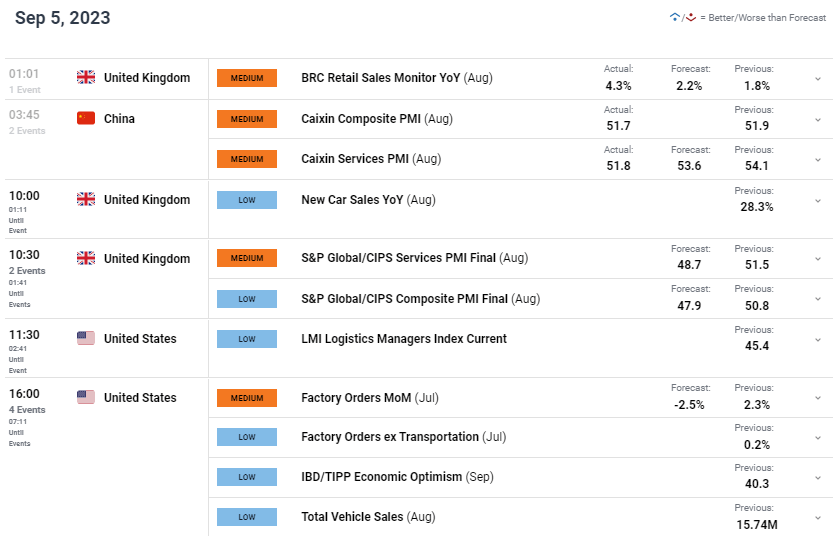
The British pound is now back below the 1.2600 handle once more despite some positive BRC retail sales data (see economic calendar below). The release printed the highest percentage increase since April and reflected a brief bout of optimism by consumers, spending large on food, health and beauty. The summer months may have contributed to this uptick in spending as well as moderating UK inflation.

While retail sales numbers were strong, the pound has yet to find support from markets due to Chinese services PMI’s slumping to its lowest level this year. The 51.8 read is swiftly approaching the midpoint 50 level that separates expansion from a contracting services sector. Recent Chinese economic data has been supportive of this slowdown and growth concerns continue to gain traction. The Chinese government has since issued statements to stimulate the economy but without any significant changes just yet, markets remain cautious.

Later today, UK PMI’s will come into focus but with estimates expected to hit 2023 lows, cable may be in for further downside to come. The upcoming US sessions should also provide some added volatility to markets after US Labor Day yesterday.

GBP/USD ECONOMIC CALENDAR (GMT +02:00)

image1.png

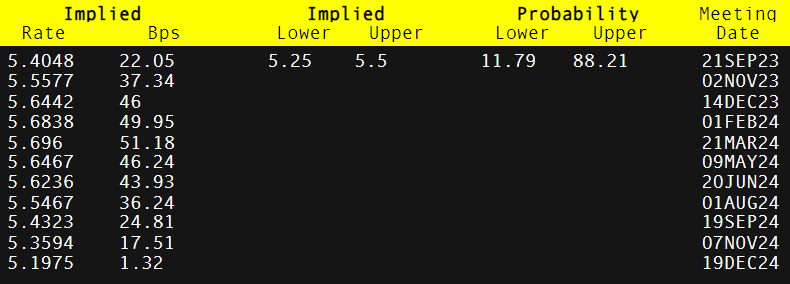
The Bank of England’s (BoE) market pricing (refer to table below) remains steadfast on a 25bps interest rate hike for September although the probability has softened from close to 100% to around 88% at present. With one more labor and CPI report prior to the rate announcement, I do not anticipate any change for September but a further drop in inflation and a weakening labor market may see some significant repricing thereafter.

BANK OF ENGLAND INTEREST RATE PROBABILITIES

image2.png

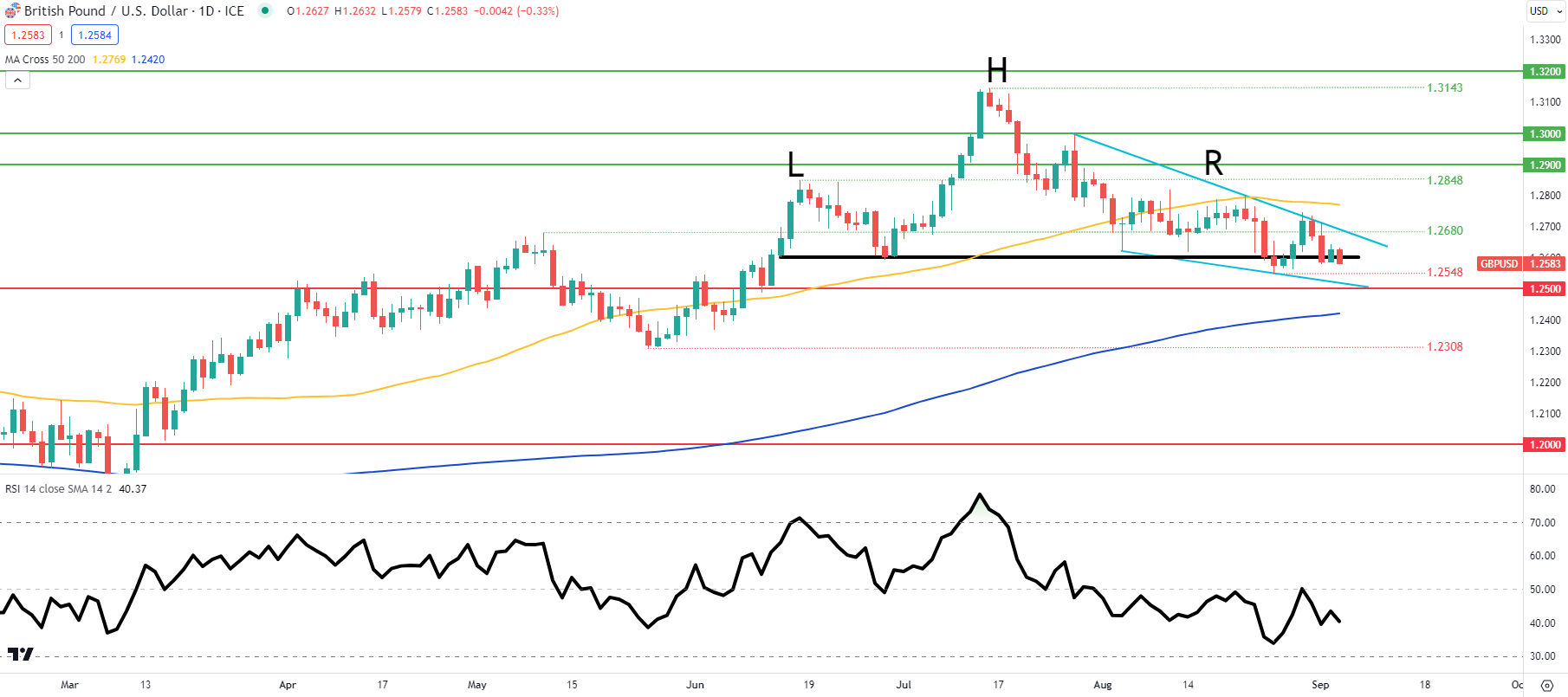
GBP/USD DAILY CHART

image3.png

Price action on the daily cable chart above sees the pair sandwiched between a longer-term head and shoulders (black) and a short-term falling wedge (light blue). The latter tends to favor and upside breakout that could invalidate the H&S but the present state may favor a H&S breakout below the neckline. Bears have been tentative in their pursuit of a bearish breakout and I will be looking for a confirmation close below the 1.2548 swing low as a precursor to another leg lower.

Gold Price Steadies as US Real Yields Offset by Potential BRIC Demand. Lower XAU/USD?

Gold Price Steadies as US Real Yields Offset by Potential BRIC Demand. Lower XAU/USD?

The gold price continues to oscillate around US$ 1,940 going into Tuesday’s trading session as market headwinds might be offset by geopolitical factors that have seen volatility in the precious metal slide lower.

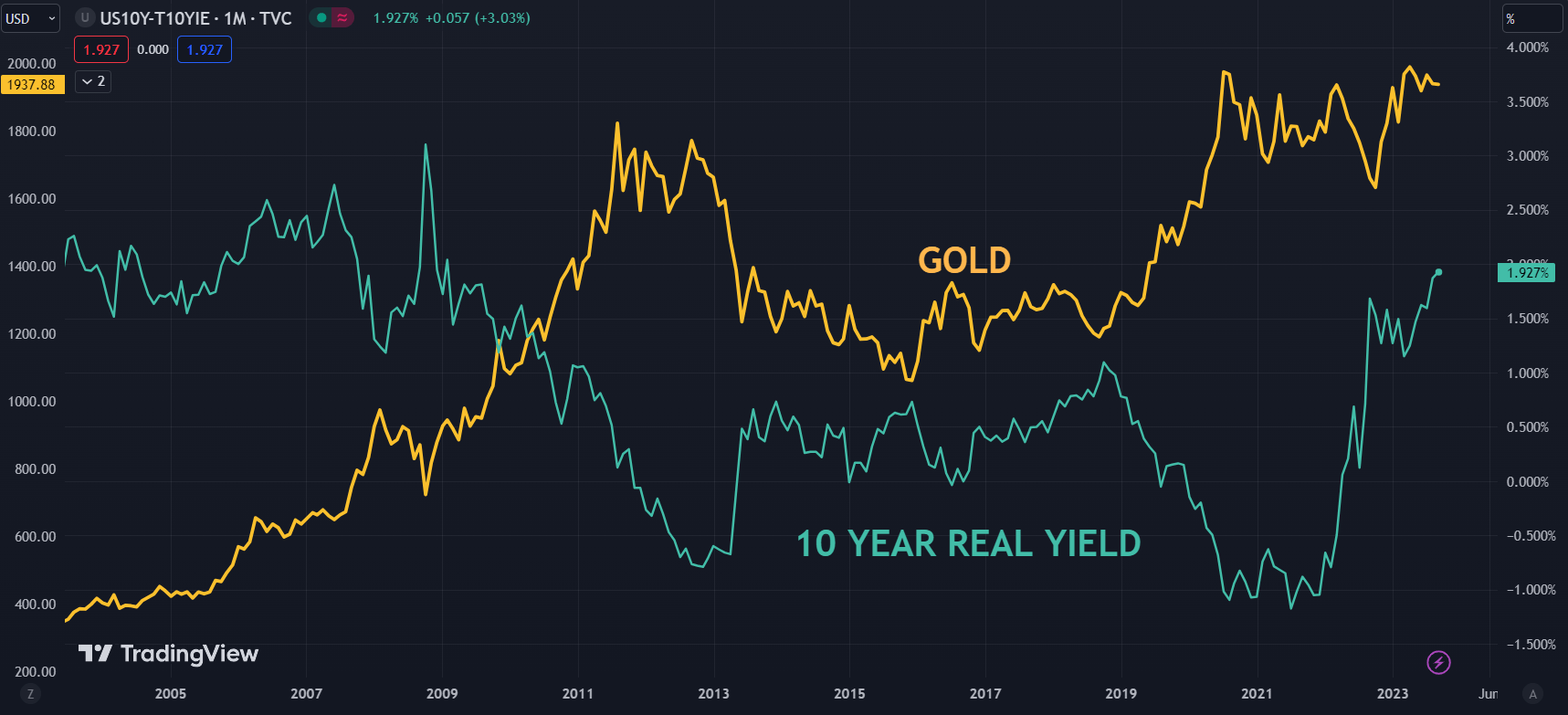
US real yields have been on the march higher for the better part of 2023 and recently stretched to a 14-year peak at the 10-year part of the curve, trading above 1.90%.

The real yield is the nominal yield less the market-priced inflation rate derived from Treasury inflation-protected securities (TIPS) for the same tenor.

The last time that real yields were this high was 2009, when spot gold was below US$ 1,000. More recently in 2018, when the real yield was near 1.0%, spot gold was under US$ 1,300 an ounce.

SPOT GOLD AGAINST US 10-YEAR REAL YIELD – THE BIGGER PICTURE

image1.png

Chart created in TradingView

Of course, there has been a lot of water under the bridge since then and the currents of demand have been tilted as the BRIC (Brazil, Russia, India and China) nations seek an alternative to the US Dollar as a reserve currency.

Much has recently been made of the potential for a gold-backed currency to allow these countries to bypass the US Dollar in international trade.

Such a system has proven to be a failure in the past for a multitude of reasons that are beyond the scope of this article. Refer to the Bretton Woods gold exchange for reference.

On a recent trip to Western Australia, one the largest physical gold-producing regions globally, a number of contacts highlighted that almost every ounce of the yellow metal currently being dug out of the ground was being put on a ship to China.

Such anecdotes of other BRIC members taking similar actions have been reported elsewhere. Keeping in mind that Australia, China and Russia are also the top producers of gold, it might be the case that gold hoarding has been a feature of the price action of late.

Looking ahead, a break of the recent range of US$ 1,885 – 1,900 could be the catalyst for the next notable move for XAU/USD. Click on the banner below to learn more about range trading.