Australia, NZ dollars sidelined as bonds build on rally

Australia, NZ dollars sidelined as bonds build on rally

SYDNEY, Oct 12 (Reuters) – The Australian and New Zealand dollars were subdued on Thursday as bonds extended their rally to a sixth session as markets wagered interest rates had peaked both at home and in the United States.

The Aussie was flat at $0.6419 AUD=D3, having run into resistance around $0.6445 the previous session, but was still well above its recent 11-month trough of $0.6286.

The kiwi dollar also steadied at $0.6016 NZD=D3, after topping out at $0.6056 on Wednesday. It has support around $0.6000 ahead of the recent low of $0.5871.

Bonds were having another upbeat day with 10-year futures YTCc1 rising 8 ticks to 95.64, and yields down at 4.355% AU10YT=RR compared to a peak of 4.682% a week ago.

The only domestic data showed New Zealand food prices fell a surprisingly sharp 0.4% in September led by fruit and vegetables.

The result led Westpac to lower its forecast for third- quarter consumer prices by a tick to 1.9%, short of the 2.1% expectation of the Reserve Bank of New Zealand. The data are due on Oct. 17.

Domestic non-tradable inflation is seen easing a little to a still-high 6.3% for the year, which would keep alive the risk of a further hike from the RBNZ at its Nov. 29 meeting, which will be the last until February. 0#RBNZWATCH

Markets imply only a 26% of a rise given the central bank this month indicated a preference for keeping rates at 5.5% for longer, rather than hiking again.

The Reserve Bank of Australia (RBA) is also in wait-and-see mode having held rates at 4.1% for four months straight and markets implying only a one-in-ten chance of a hike at its next meeting on Nov. 7. 0#RBAWATCH

Australia’s CPI report is due on Oct. 25 and there is some risk it could surprise on the high side and rekindle speculation of another rate rise.

Analysts at NAB warn the trimmed mean measure of core inflation could rise 1.1% in the third quarter and top the RBA’s prediction of 0.9%

“We expect market services inflation to remain very strong and is the reason in our view why there is likely to be slower than expected progress in returning inflation to target,” argued NAB economist Taylor Nugent.

“NAB’s view is that the RBA is likely to lift rates at the November meeting, to get more comfort that inflation is on the required path back to 2-3% in a reasonable time frame.”

US dollar hovers near two-week lows ahead of inflation data

US dollar hovers near two-week lows ahead of inflation data

SINGAPORE, Oct 12 (Reuters) – The dollar was rooted near a two-week low on Thursday following minutes from the last U.S. Federal Reserve meeting that showed policymakers taking a cautious stance and as investors awaited key inflation data.

The dollar index =USD, which measures the U.S. currency against six rivals, was at 105.67, not far from 105.55, its lowest since Sept. 25 it touched on Wednesday. The index is down 0.4% for the week.

Fed officials pointed to uncertainties around the economy, oil prices and financial markets as supporting “the case for proceeding carefully in determining the extent of additional policy firming that may be appropriate,” according to the minutes released on Wednesday from the Sept. 19-20 meeting.

In recent comments, Fed officials have cited rising bond yields as a factor that may allow them to call it a day on their rate hike cycle.

Also keeping the mood cautious was a mixed report on U.S. producer prices, which increased more than expected in September amid higher costs for energy products and food. But underlying inflation pressures at the factory gate continued to abate.

“This (PPI data) is a reminder that the last mile of the fight against inflation is going to be a tough one,” said Ryan Brandham, head of global capital markets, North America at Validus Risk Management.

The report comes ahead of the release on Thursday of September’s consumer price index data, which is expected to show inflation moderated last month.

A downside surprise to inflation will likely support the case for the Fed to have finished its tightening cycle, thereby pulling down U.S. yields and the dollar, according to Carol Kong, a currency strategist at Commonwealth Bank of Australia.

“On the flip side, an upside surprise will likely encourage markets to reprice higher the chance the Federal Open Market Committee will follow through on its projected 25 basis point hike.”

Futures markets are pricing in a 26% chance of a 25 basis point hike in the December meeting and a 9% chance of a 25 basis point hike in November meeting, according to the CME FedWatch tool.

The dollar’s recent weakness has been driven by declining Treasury yields as bond prices rallied on the Fed’s softer stance on future rate hikes. Bond yields move opposite to their price.

The yield on 10-year Treasury notes US10YT=RR was down 3.5 basis points to 4.562%.

The euro EUR=EBS was up 0.03% at $1.062, after touching an over two week high on Wednesday.

Two influential European Central Bank policymakers said on Wednesday the central bank has made progress in getting inflation back down to target, but new shocks could still require the bank to continue a now-paused tightening cycle.

The Japanese yen JPY=EBS strengthened 0.03% to 149.11 per dollar, while sterling GBP=D3 was last trading at $1.2311, flat on the day.

The Australian dollar AUD=D3 rose 0.05% to $0.642, while the kiwi NZD=D3 fell 0.03% to $0.602.

USD/JPY, Nikkei 225: Implications should the BOJ never reach escape velocity on rates

USD/JPY, Nikkei 225: Implications should the BOJ never reach escape velocity on rates

The BOJ’s normalisation dilemma

The Bank of Japan (BOJ) appears a long way off normalising monetary policy. Upstream price pressures a diminishing while the Fed and other major central banks are moving towards calling time on rate hikes, making it difficult for the BOJ to start tightening policy, especially when the recovery in the Japanese economy is already showing signs of flagging. Should the BOJ fail to reach escape velocity from its ultra-easy settings, this will have implications for the Nikkei 225 and USD/JPY as we move towards 2024.

It’s not looking good for Japanese inflationary pressures

Data released Thursday underscores the risk posed to the BOJ normalising policy before inflationary pressures have become persistent. Wholesale prices, equivalent to measures of producer prices in other nations, fell unexpectedly in September, easing 0.3% against expectations for an increase of 0.1%. The monthly undershoot saw the annual increase slow to 2%, the lowest level since March 2021.

Along with slowing upstream price pressures, so too are core machine orders with a decline of 0.5% reported in August compared to an expected increase of 0.4%. Core orders – deemed a lead indicator on capital expenditure plans at Japanese firms, have now fallen 7.7% from a year ago. The government described the momentum in the series as “stalling”, adding to similar trends in household spending which is the largest part of the Japanese economy at over 50%.

Prematurely tightening reeks of policy error

Given the state of the Japanese and global economy, it would be a risky on the BOJ’s behalf to abandon yield curve control yet alone lift policy rates before there’s clear evidence that higher wages are feeding through to higher inflation and inflation expectations. If done prematurely, it would come across as a major policy error in the making.

Should the Bank of Japan be unable to begin normalising policy, it would likely see USD/JPY be weaker than what would otherwise be the case given the important role interest rate differentials have been playing determining fluctuations in the pair in recent years.

USD/JPY downside risks evident even with no BOJ normalisation

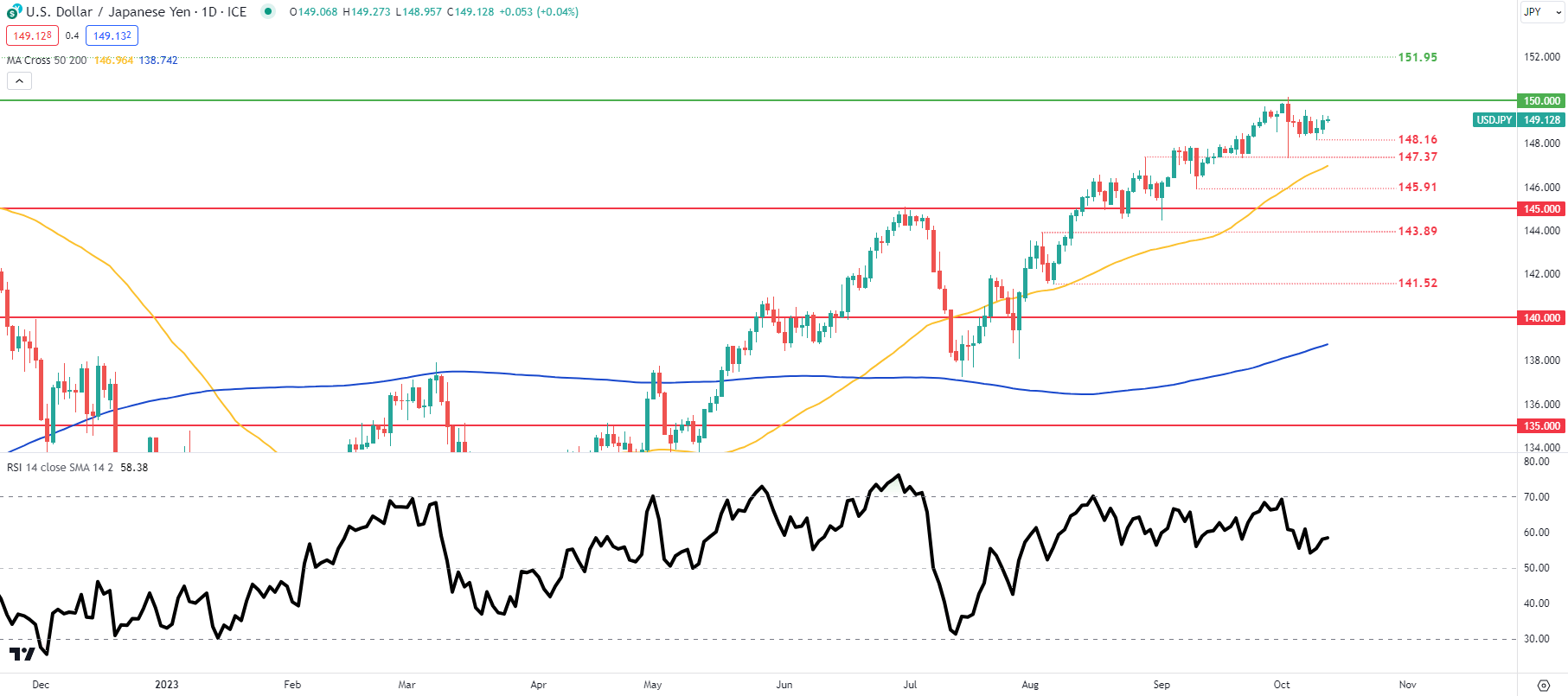
Looking at the daily chart, the strong uptrend since July looks to be evolving now into a period of sideways range trade between 147.35 and 150 as yield differentials between Japan and United States are countered by the threat of FX intervention from the Bank of Japan, a fact reinforced by the significant decline seen last week when USD/JPY briefly ventured above 150.

In the absence of another leg higher for US yields which may be diminishing given rising risk aversion and a softer tone from several key Fed officials when it comes to the interest rate outlook, unchanged policy settings from the BOJ points to near-term yield differentials between the US and Japan remaining around these levels with risks over the medium-term likely skewed towards the downside.

That suggests risks for USD/JPY may also be shifting lower heading into next year, especially should the Fed begin easing policy a little earlier than anticipated. Over a longer time horizon, 145 and 138 are the first major downside levels to watch.

usdjpy oct 12

Nikkei bounces hard, easy policy will help longer-term

For the Nikkei 225, attempts last week to force it out of its downtrend channel were met with solid buying at a former resistance level, delivering a bullish pin bar which has seemingly acted as a slingshot higher ever since. It’s now tangoing with minor resistance at 32400 and seems destined for a test of retest of channel resistance above 32600. A break there may open the door to highs seen earlier this year, including the multi-decade peak of 34000 hit in June. An improvement in the Chinese economy would be a positive macro factor for the Nikkei, were it to occur. For longer-term traders, levels to consider on the downside include below 30725, 30000 and 29300.

n225 oct 12

China’s yuan slips despite state boosting bank stakes, weak US dollar

China’s yuan slips despite state boosting bank stakes, weak US dollar

SHANGHAI: China’s yuan weakened against the dollar on Thursday, even as state investor Huijin increased stakes in “Big Four” banks to lift market sentiment, and the greenback remained subdued amid more dovish signals from the Federal Reserve.

But some traders expect the yuan to get support from more stimulus from Beijing that will ease worries over the economy.

The spot yuan opened stronger at 7.2957 per dollar, but was changing hands at around 7.30 at midday, slightly weaker than the previous late session close.

Yuan flat despite dollar weakness

Prior to the market open, the People’s Bank of China set the midpoint at 7.1776 per dollar, 1,156 pips stronger than Reuters’ estimate, reflecting authorities’ desire to prop up the currency.

The yuan market had muted reaction to news that state investor Central Huijin Investment Ltd increased holdings in China’s “Big Four” banks in an apparent move to lift market confidence.

“We look for further hints on China’s stimulus plans, which could broadly boost the yuan and other Asian currencies,” Maybank said in a note. “Thus far, China’s recovery which we expected earlier in the year has flattered to deceive.”

The yuan was not helped by a weak greenback, as the dollar index fell to two-week lows.

Minutes of the Fed’s Sept. 19-20 meeting showed policymakers wrestling with risks they agreed were no longer just about inflation, but slowing global growth, labor strikes and tightening financial markets.

The recent sharp increase in US Treasury yields, and the war in Israel, “could further increase the two-sided risks referred to in the minutes,” Maybank said.

“The implication is that the USD could now be more vulnerable to bearish forces, especially as USD bulls have looked increasingly fatigued in recent times.”

A trader at a foreign bank in China said though, that “the yuan could rebound as Beijing will likely step up policy support to the economy”.

“Market consensus may have underestimated China’s Q3 GDP after overestimating Q2 GDP,” wrote Shuang Ding, Standard Chartered Bank’s chief economist for Greater China and North Asia.

The consensus forecast is currently 4.5% year-on-year for China’s Q3 growth, but “we think an outcome of around 5% is more likely,” Ding said.

BOJ wasn’t tightening policy when it raised bond yield cap, Noguchi says

BOJ wasn’t tightening policy when it raised bond yield cap, Noguchi says

The Bank of Japan raising its cap for the yield on 10-year Japanese government bonds to 1% from 0.5% in July wasn’t monetary tightening, board member Asahi Noguchi said Thursday.

The central bank will contain excessive rises in bond yields that aren’t backed by higher inflation expectations, Noguchi said.

He added that consumers would likely stay reluctant to spend until they become confident that real wages, adjusted for inflation, keep rising.

“It is the Bank of Japan’s mission for the time being to realize such a situation as soon as possible by patiently continuing monetary easing,” he said.

Recent government data showed that inflation-adjusted wages declined for a 17th straight month in August.

This content was created by MarketWatch, which is operated by Dow Jones & Co. MarketWatch is published independently from Dow Jones Newswires and The Wall Street Journal.

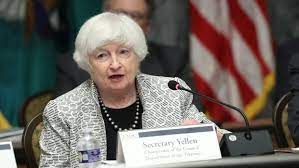
Statement from Secretary of the Treasury Janet L. Yellen on the World Bank Development Committee

Statement from Secretary of the Treasury Janet L. Yellen on the World Bank Development Committee

The United States extends its deepest condolences to the people of Morocco and Libya, who have lost loved ones and now face the devastating impacts of once-in-a-century earthquake and floods.  We stand by the governments of Morocco and Libya as they take steps to recover from the destruction these disasters have wrought.

As we gather for these Annual Meetings – for the first time in 50 years on the African continent – we are aware of two realities.  On the one hand, the global economy remains in a better place than many predicted, with growth outperforming expectations, and annual headline inflation falling in many of the major economies, including the United States.  At the same time, the global economy faces significant uncertainty.  Major shocks emanating from global challenges—the economic disruption from COVID-19; catastrophic, climate change-driven extreme weather events; and fragility and conflict in all parts of the world—have eroded development gains and disproportionately impacted the poorest and most vulnerable people and countries.  Russia’s illegal and unjustifiable war of aggression against Ukraine has caused a tragic loss of life, destruction of property, and has exacerbated global economic challenges by destabilizing energy and food prices.  We call on Russia to swiftly end this unjust war, which would help to rapidly reverse some of these trends and set the global economy on a more positive trajectory.  The compounding effects of these shocks have taken a terrible toll in terms of lives lost and livelihoods disrupted, and contributed to rising extreme poverty, hunger, and slower economic growth.  Further, their impacts have been more severe across emerging markets and developing countries, often in those countries that are already burdened by heightened debt vulnerabilities and have the least fiscal space to respond.

We have undertaken important efforts over the last year to evolve the multilateral development banks (MDBs), starting with the World Bank, to better address global challenges, particularly climate change, pandemics, and fragility and conflict.  Addressing such challenges is in the national interest of all countries; mitigates risks to our collective economic outlook; and is integral to achieving poverty reduction and sustainable, inclusive, and resilient development.

The United States is not alone in this undertaking.  Beginning with the Development Committee last year at the Annual Meetings, there has been a broad coalition calling for bold and urgent evolution reforms.  In the G20, the Paris Summit for a New Global Financing Pact, the Africa Climate Summit, and the Sustainable Development Goals (SDGs) Summit, the international community has also loudly and collectively voiced the importance of MDB evolution.  Through these fora we have all recognized that addressing global challenges and achieving poverty reduction and inclusive economic growth are mutually reinforcing, and we must all work together to build an MDB system better equipped to respond.

In the past year, shareholders and World Bank Management have worked together to advance the reforms that will enable the Bank to evolve to bring 21st century solutions to 21st century challenges.  We have updated the Bank’s vision and mission to reflect that addressing global challenges is a core part of reducing poverty and boosting shared prosperity.  The Bank’s updated operational model will integrate global challenges through refocused diagnostics, enhanced country engagement, and greater support to sub-national entities.  It will also deliver a concessionality framework that will enable greater support to address global challenges.  Reforms to the IBRD financial model endorsed in the spring will yield around $50 billion in additional lending capacity over the next 10 years, with more possible in the near term given the establishment of the Portfolio Guarantee Platform and work to issue hybrid capital to interested shareholders.  This is just one part of the initial $200 billion in additional financial capacity we expect to achieve over the next decade across the MDB system through the G20 MDB Capital Adequacy Framework (CAF) Review recommendations that have been adopted or are under consideration.  The energy behind the evolution work has sparked similar efforts at the regional development banks, which together with the World Bank, will make the entire system deliver better.

These accomplishments are significant.  But our work is far from done.  It is crucial that the World Bank robustly implement the evolution reforms that have been adopted, complete work on those currently underway—like the concessionality framework and measures to increase speed and agility—and begin work on reforms that have not yet been taken up.  Specifically, we urge the World Bank to establish incentives for staff to incorporate addressing global challenges into country engagement, and fully implement the recommendations of the G20 MDB CAF Report, including the recommendation to incorporate a prudent share of callable capital in the Bank’s capital adequacy framework.  We also call on the World Bank to implement private capital mobilization (PCM) reforms that include incentives for staff to mobilize private capital rather than use own-account financing, ambitious portfolio-wide mobilization targets, clear reporting on results, and improved quality and accessibility of data in the Global Emerging Markets Risk Database.  The World Bank – and other MDBs – should develop scalable platforms to increase private investment, including securitization platforms, and they should scale and better utilize guarantees, insurance, local currency lending, and other de-risking tools to crowd-in investors.  We look forward to ideas from President Banga’s new Private Sector Innovation Lab on how all parts of the World Bank can step up efforts in these areas.

Taken together, these reforms across vision and mission; the operating model; and financial capacity will build a better bank that delivers both more finance and greater impact.  And a strong and effective World Bank that is open and eager to partner with others is vital to having a strong and effective IFI system.

In support of the evolution agenda, President Biden requested funding from Congress to contribute to the new Portfolio Guarantee Platform and the Global Public Goods (GPG) Fund.  This funding would unlock roughly $25 billion in new IBRD lending capacity, the terms of which could be bought down with the GPG Fund contribution to incentivize investments that address priority global challenges.  Evolution will not succeed, however, without sufficient attention to the immediate needs of the poorest and most vulnerable countries, that endure the harshest impact of global challenges and are least equipped to cope with them.  This is why President Biden also requested $1 billion for IDA’s Enhanced Crisis Response Window (CRW+).  We appreciate those who have joined us in boosting the concessional finance capacity of the World Bank and invite others to do the same.

As the largest contributor to IDA-20, protecting the resources that go to these countries is a top priority of the United States.  This is why we strongly support efforts by IDA management to responsibly boost IDA’s capacity using existing resources, in addition to our own potential contribution to the CRW+, and we look forward to a successful IDA-21 replenishment next year.

We welcome the efforts of the World Bank and other MDBs to drive food system transformation and strengthen food security through medium and long-term investment, policy reforms, and technical assistance, including through the IFI Action Plan to Address Food Insecurity launched last year.  Coordination plays a key role, and we are actively working with the MDBs to institutionalize the coherent approach fostered by the Action Plan, and applying lessons learned to future work.

Building resilience to shocks arising from global challenges is critical, which is why we must press forward with policies to mitigate and adapt to climate change.  The World Bank and other MDBs are key providers of public climate finance, mobilizers of private finance towards emissions mitigation and climate change adaptation, and supporters of innovative financing tools that accelerate the transition to net zero emissions and reduce reliance on fossil fuels.  The World Bank should screen all projects for cost-effective climate benefits, particularly to build resilience and adapt to the effects of climate change.  It is also critical that climate finance be targeted efficiently, and we urge alignment of global financial flows with the goals of the Paris Agreement and investment standards that incorporate transparency and accountability.  World Bank Country Climate and Development reports should serve a standard-setting function, helping countries advance their climate agendas by informing the design of the International Financial Institutions’ projects and programs, including specific and ambitious reforms for the country to implement.  Mobilizing the private sector is also instrumental to achieve progress towards our collective climate ambition.  The Just Energy Transition Partnerships (JETPs) are a promising model for mobilizing and aligning public, private, and philanthropic capital for the energy infrastructure and social investments needed to accelerate the transition towards a cleaner energy future in ways that benefit all communities.

We recognize that the climate finance architecture is complex and developing countries can struggle to access available financing.  While an important source of financing, including much needed concessional financing, the climate finance architecture is not optimized to help countries access finance easily or to deliver finance at scale where the need is greatest or where the impact will be highest.  This is why the United States, working closely with partners, including the incoming G20 and G7 presidencies, is initiating an effort to review the climate finance architecture, with the goal of improving the efficiency and effectiveness of the system.  As an implementing entity and host to some of the largest climate investment funds, the World Bank has an important role to play.  We call on the World Bank to assess how it can do a better job in helping countries access climate finance and help them to blend concessional resources from the specialized climate and environment funds with the Bank’s own resources.  By partnering with others, the World Bank strengthens the overall architecture.

The enormous infrastructure gap in developing countries and emerging markets continues to hold back economic growth, the delivery of basic services, and trade.  We must do more to maximize the capabilities of the World Bank to support infrastructure development, including in the energy, transportation, health, digital, and critical minerals arenas.  Doing so will require stepped up efforts on project preparation and structuring—including scaling up the Global Infrastructure Facility—increasing access to knowledge and data, and assisting the implementation of policy reforms to create a more inviting environment for private investment.  The United States and its partners are proud to be focusing on significantly scaling up private capital mobilization to help close the infrastructure gap, including as a core component of the G7 Partnership for Global Infrastructure and Investment (PGI).  Under PGI, the G7 is prioritizing strengthening supply chains, especially for critical minerals, with the creation of the Resilient and Inclusive Supply-chain Enhancement (RISE) Partnership.


Three years since the start of the COVID-19 pandemic it is evident that threats to global health can disrupt entire societies and the global economy.  That is why the United States remains committed to improving regional and global health security, and our contribution to the Pandemic Fund will catalyze investments to fill critical gaps in pandemic preparedness and bolster overall health security.  Recognizing the continuing risk of pandemic spillover, the World Bank should incorporate health-related risks and vulnerabilities, including an assessment for country pandemic prevention, preparedness, and response capacities, into its current work.  The World Bank will also need to coordinate with partners and with other efforts underway to strengthen the global health architecture.

Over the last decade, violent conflict has spiked, causing immense human suffering, contributing to extreme poverty and to the significant displacement of people, while also stunting economic growth and absorbing a large share of national budgets.  We need strong collective action to mitigate the widespread impact of greater fragility and forced displacement.  The United States is committed to strengthening global resiliency and democratic renewal, and promoting peaceful, self-reliant nations that become strong economic and security partners capable of addressing shared challenges.  As part of the evolution initiative, and learning from the mid-term review of the Strategy for Fragility, Conflict, and Violence, we welcome the World Bank integrating new diagnostics, incentives, and approaches into its operations that address the root causes and impacts of fragility, conflict, and violence to help build countries’ resilience to potential fragility drivers within the country and spillovers from neighboring countries.  We urge the World Bank to redouble efforts to anchor and leverage strategic partnerships with peer institutions, civil society, and the private sector to strengthen its ability to respond with agility and impact in fragile contexts.

The United States strongly supports the 2030 Agenda for Sustainable Development and the bold action needed to address global challenges that threaten to set back progress on achieving the SDGs.  The World Bank has made good progress with the Gender Strategy Update, and the Equality of Opportunity for Sexual Gender Minorities report, but it can do more to combat discriminatory laws and policies, along with their economic impacts, social and cultural norms around economic roles and responsibilities, and gender-based violence in its programming.  These considerations should be front and center as the World Bank assesses business and investment climates worldwide through the B-Ready report.

Accountability and transparency in the multilateral institutions is essential for MDB projects to be successful, and for greater development impact and effectiveness.  This is why the United States will continue to press for greater access to, and disclosure of, information; stronger environmental and social safeguards, and robust governance; a culture of learning and accountability; and transparent and competitive procurement practices that are consistent with sustainable development.  We look forward to upcoming reviews that will bolster the World Bank’s sustainability, environmental and social framework, and accountability mechanisms.  The World Bank must continue to strengthen its approach to avoiding, reducing and mitigating harm in its projects.  Finally, corruption disproportionately hurts the poorest, undermining the World Bank’s ability to eliminate extreme poverty, boost shared prosperity, and build resilience.  There must be a culture of compliance across all levels of the Bank.

As we work towards a better World Bank that is fit for 21st century challenges, we recognize the efforts undertaken by World Bank President Ajay Banga, senior management, and the thousands of staff who have tirelessly worked towards this goal.  We are grateful for their energy, creativity, dedication, and collaborative spirit.  They represent multilateralism at is best – collective work to meet the world’s most critical needs and to meet the moment with great impact.

USD/JPY Price Forecast: Yen Wary on US CPI Forecasts

USD/JPY Price Forecast: Yen Wary on US CPI Forecasts

JAPANESE YEN FUNDAMENTAL BACKDROP

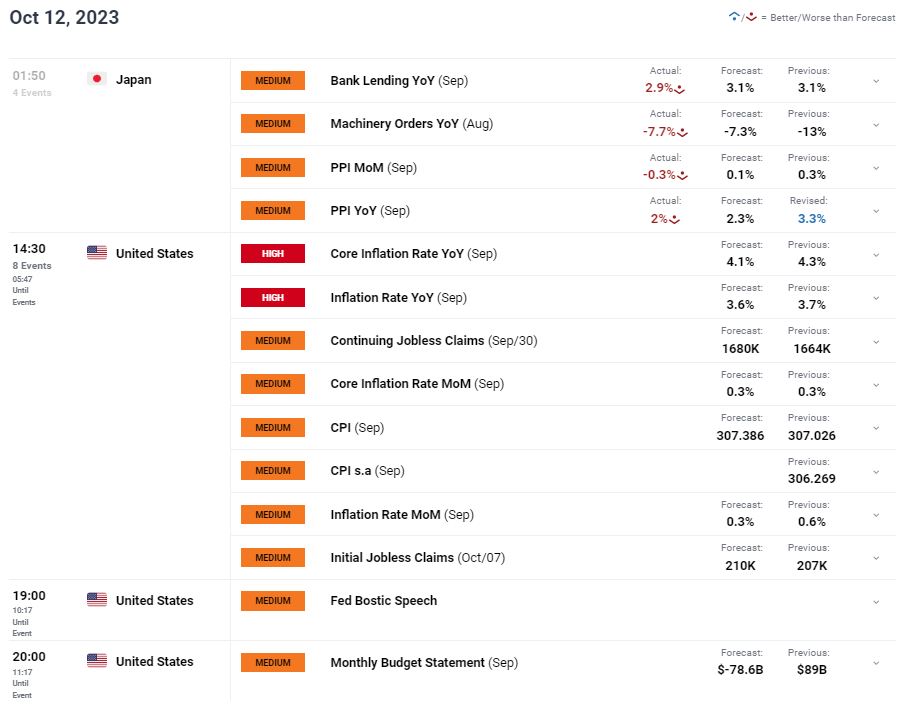
The Japanese Yen is relatively flat today after weak Japanese economic data (see economic calendar below) saw USD/JPY marginally higher post-release. The miss on PPI could see softer inflationary pressures to come going forward as a leading indicator for CPI. That being said, the Bank of Japan (BOJ)‘s Noguchi stated that “we have no choice but to raise inflation forecast for FY 2023” that could prompt a shit away from the ultra-loose monetary policy markets have become so accustomed to with Japan.

Today will be centered around US CPI with forecasts showing a moderation in inflation for both core and headline metrics respectively. Considering recent dovish remarks by Fed officials as well as overtightening risks cited in yesterday’s FOMC minutes, only a significant upside surprise today could sway market pricing from roughly 90% probability for a rate pause in November. Fed speak will continue today and give more insight as to the thought process of these individuals.

LISTEN TO MY RISK EVENT FOR THE WEEK COVERING US CPI

USD/JPY ECONOMIC CALENDAR (GMT +02:00)

image1.png

Want to stay updated with the most relevant trading information? Sign up for our bi-weekly newsletter and keep abreast of the latest market moving events!

USD/JPY TECHNICAL ANALYSIS

USD/JPY DAILY CHART

image2.png

Daily USD/JPY price action remains elevated just below the 150.00 psychological handle that has been well respected of recent. Although there is no concrete guidance from Japan about intervention at this point, officials responses and cues could be important moving forward. A weak US CPI later today could find the pair breaking down towards the 148.16 swing support low.

Gold Advances to New Trend Highs, Potential for Further Upside

Gold Advances to New Trend Highs, Potential for Further Upside

Gold Forecast Video for 12.10.23 by Bruce Powers

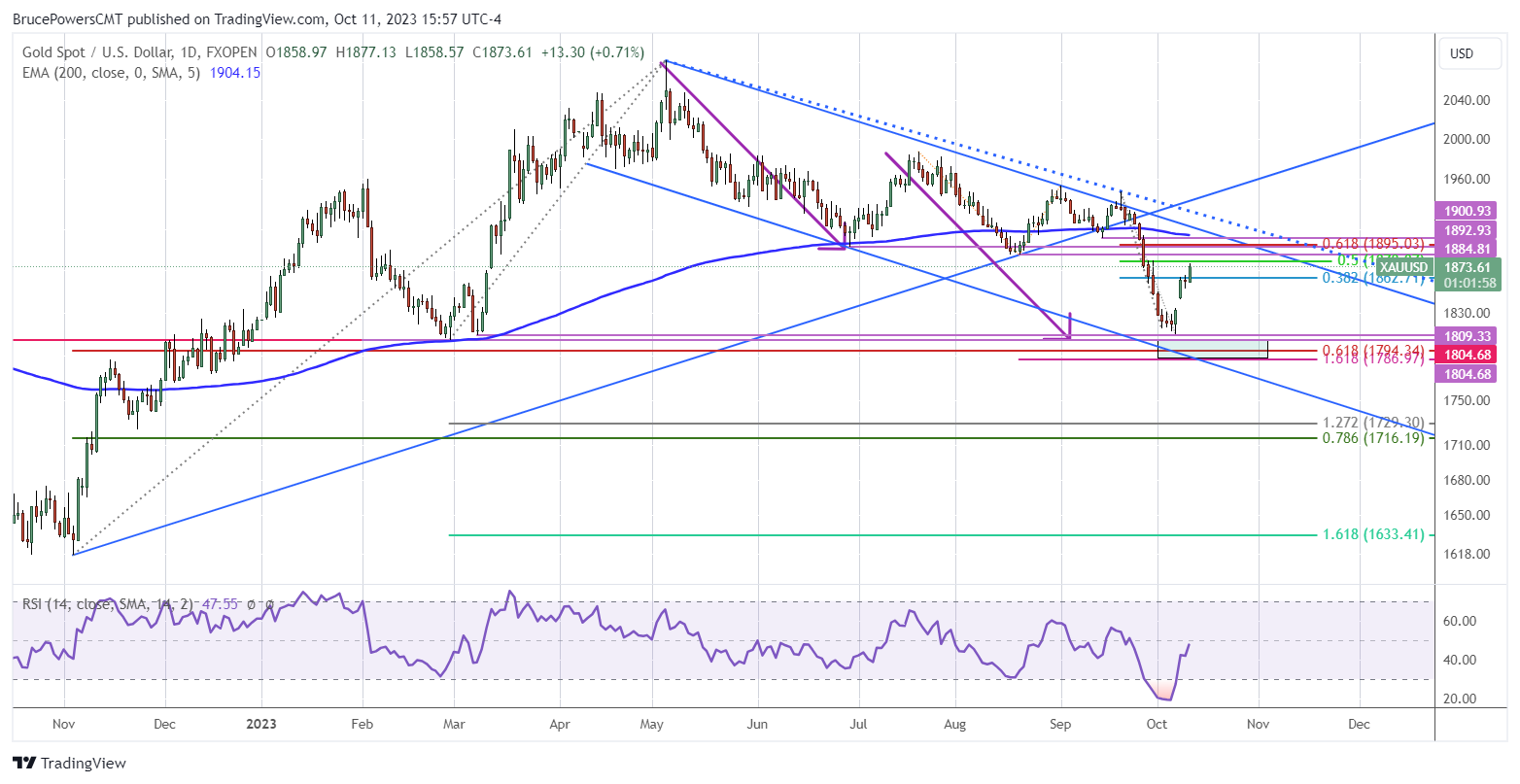
Gold continued its rally off the 1,810-swing low today as it advanced to a new trend high of 1,877, and it is on track to close at a new daily high for the rally. Today’s advance almost completed a 50% retracement, which is at 1,879. Further, gold is set to close strong, in the top third of the day’s range.

Trading Derivatives carries a high level of risk to your capital and you should only trade with money you can afford to lose. Trading Derivatives may not be suitable for all investors, so please ensure that you fully understand the risks involved, and seek independent advice if necessary. A Product Disclosure Statement (PDS) can be obtained either from this website or on request from our offices and should be considered before entering into a transaction with us. Raw Spread accounts offer spreads from 0.0 pips with a commission charge of USD $3.50 per 100k traded. Standard account offer spreads from 1 pips with no additional commission charges. Spreads on CFD indices start at 0.4 points. The information on this site is not directed at residents in any country or jurisdiction where such distribution or use would be contrary to local law or regulation.

A graph with lines and numbers Description automatically generated with medium confidence

Gold Points to Test of 1,885 or Higher

The current advance looks to be heading higher to test resistance around prior lows, along with the 200-Day EMA and downtrend line. Next on the agenda is a test of resistance around the 1,885-swing low from August. This is followed by a price range from 1,893 to 1,895. The lower level is the June swing low and the higher is the 61.8% Fibonacci retracement. Subsequently, the September swing low at 1,901 matches the 200-Day EMA at 1,904.

Relative Strength of the Rally Points to Higher Prices

There have only been two advances of notes since the retracement began from the record 2,082 high in gold. So far, gold is up as much as 3.7% from the October swing low of 18.10. That slightly exceeds the prior rally of 3.6% that started from the August 21 swing low and is less than the 5.0% advance that began from the June 29 swing low.

Certainly, given the potential significance of this month’s swing low, as it may be the low for some time, an advance to at least match the 5.0% rally seems possible before a significant correction. That would occur at a high of 1,901. An exact match for potential resistance around the September swing low. Therefore, there are three methods identifying a similar price zone.

Bull Hammer Breakout on Weekly

The strength seen so far during the rally is supported by a bullish breakout in the weekly chart at the beginning of this week. Last week completed a bullish hammer candlestick pattern. It triggered Monday on a rally above last week’s high of 1,850. And strength was confirmed by two daily closes on Monday and Tuesday above that high.

Downside Support

On the downside, a drop below today’s low signals likely further weakness. There is a possibility that the earlier gap may be filled. If so, gold will have to drop to 1,835 to fill the gap.

DAX Index: How the DAX Reacts to ECB Comments and US Inflation Reports

DAX Index: How the DAX Reacts to ECB Comments and US Inflation Reports

DAX Wednesday Overview

On Wednesday, the DAX gained 0.24%. Consolidating the 1.95% rally from Tuesday, the DAX ended the day at 15,460.

German Inflation and a Dovish Fed

German inflation figures for September kickstarted a positive start to the Wednesday session. The annual inflation rate softened from 6.1% to 4.5%, the softest since the start of the war in Ukraine.

Trading Derivatives carries a high level of risk to your capital and you should only trade with money you can afford to lose. Trading Derivatives may not be suitable for all investors, so please ensure that you fully understand the risks involved, and seek independent advice if necessary. A Product Disclosure Statement (PDS) can be obtained either from this website or on request from our offices and should be considered before entering into a transaction with us. Raw Spread accounts offer spreads from 0.0 pips with a commission charge of USD $3.50 per 100k traded. Standard account offer spreads from 1 pips with no additional commission charges. Spreads on CFD indices start at 0.4 points. The information on this site is not directed at residents in any country or jurisdiction where such distribution or use would be contrary to local law or regulation.

Another sharp pullback in 10-year US Treasury yields offered support as dovish FOMC member speeches resonated mid-week.

Investors brushed aside the ECB Consumer Expectations Survey results for August. Consumers anticipate a modest increase in income but expect a decline in spending.

However, US producer prices limited the gains. Hotter-than-expected numbers tested bets on the Fed pausing interest rate hikes. Producer prices increased by 2.2% year-over-year in September vs. 2.0% in August. Nonetheless, the numbers failed to spook investors ahead of the US CPI Report out on Thursday.

The US equity markets made modest gains. On Wednesday, the Nasdaq Composite Index rose by 0.71%. The S&P 500 and the Dow ended the day up 0.43% and 0.19%, respectively.

The Wednesday Market Movers

Defense stock Rheinmetall led the way, rallying 2.71%. The ongoing Middle East conflict fueled demand for the stock. Auto stocks were also on the rise.

Porsche and Volkswagen saw gains of 1.25% and 1.07%, with BMW ending the day up 1.00%. Mercedes Benz Group and Daimler Truck Holding rose by 0.37% and 0.35%, respectively. Easing bets on further ECB and Fed rate hikes and stimulus plans from Beijing supported a positive demand outlook.

However, Fresenius tumbled by 7.84% in response to favorable Novo Nordisk drug trial results for treating kidney failure.

The ECB, the Fed, and US Inflation in the Spotlight

On Thursday, the ECB will be in the spotlight. Comments from ECB President Christine Lagarde, attending the IMF/World Bank Annual Meetings, need monitoring. The ECB President will attend the G20 Finance Ministers and Central Bank Governors meeting.

Comments relating to inflation, the economic outlook, and monetary policy would influence buyer appetite for DAX-listed stocks. Investors will also need to digest the ECB monetary policy meeting minutes. Investors may consider the minutes dated after recent ECB speeches.

However, the US CPI Report will influence the DAX and broader equity market trends. Economists forecast the US annual inflation rate to soften from 3.7% to 3.6% in September.

With inflation the hot topic, FOMC member commentary also warrants consideration. Recent Fed speeches will likely limit the influence of the Fed minutes from Wednesday.

The DAX and NASDAQ mini were up 59 and 43 points this morning.

Short-Term Forecast

The US CPI Report could test the buyer appetite for riskier assets, including DAX-listed stocks. The markets are betting on the Fed ending its interest rate hike cycle. However, a hotter-than-expected CPI Report may force the Fed to raise interest rates. Higher US interest rates would adversely impact the DAX and broader equity markets.

DAX Technical Indicators

Daily Chart

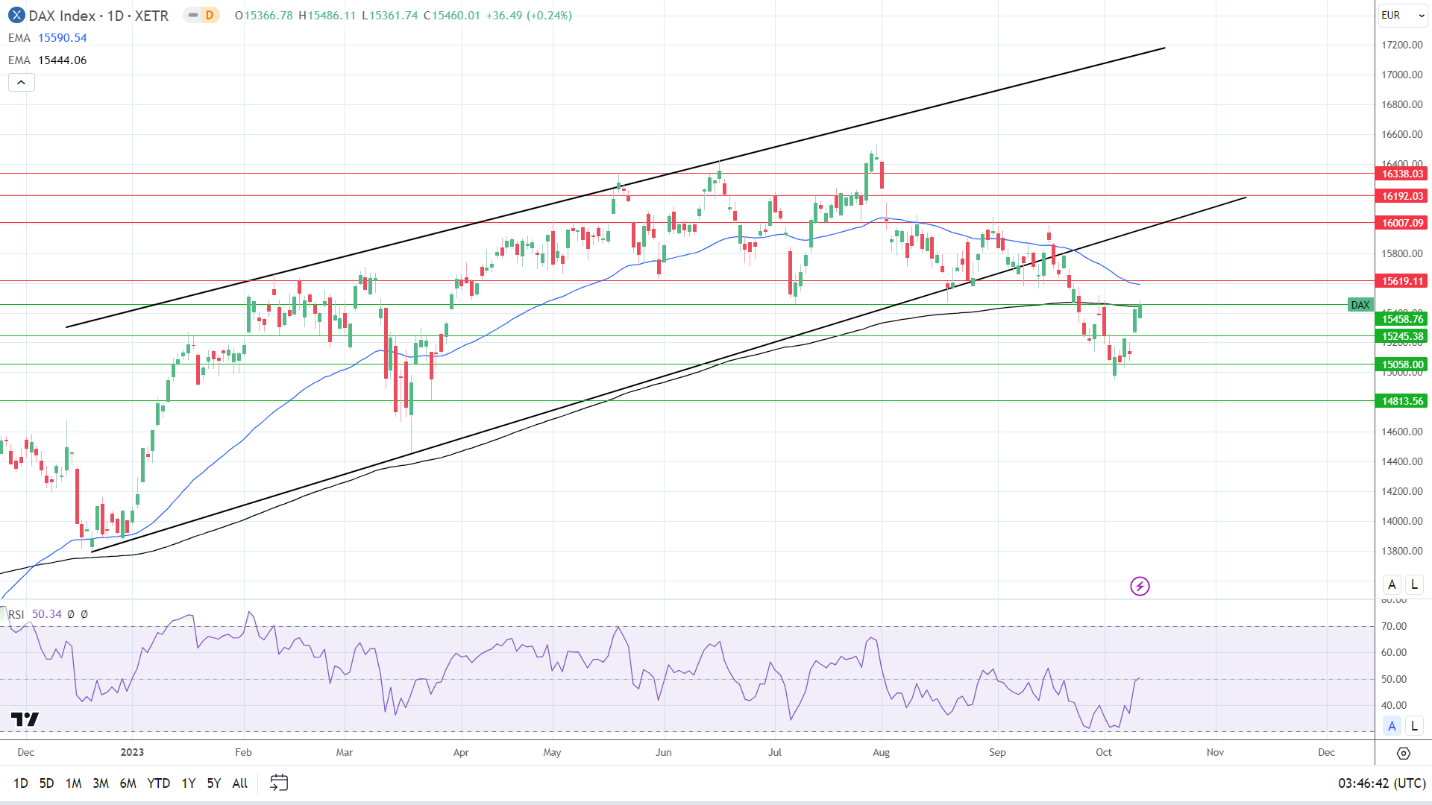
The DAX sat above the 200-day EMA while remaining below the 50-day EMA, sending bearish near-term but bullish longer-term price signals.

A return to 15,500 would support a DAX move to the 50-day EMA and the 15,619 resistance level. Selling pressure will likely intensify at the resistance level. The 50-day EMA is confluent with the 15,619 resistance level.

However, a break below the 15,459 support level and 200-day EMA would bring the 15,245 support level into play.

US inflation figures and news updates from the Middle East will be focal points. An unexpected pickup in US inflationary pressures and an escalation in the Middle East conflict would test buyer appetite.

The 14-day RSI reading of 50.34 supports a DAX move to the 50-day EMA before entering overbought territory.

DAX Daily Chart sends mixed price signals.
DAX 121023 Daily Chart

4-Hourly Chart

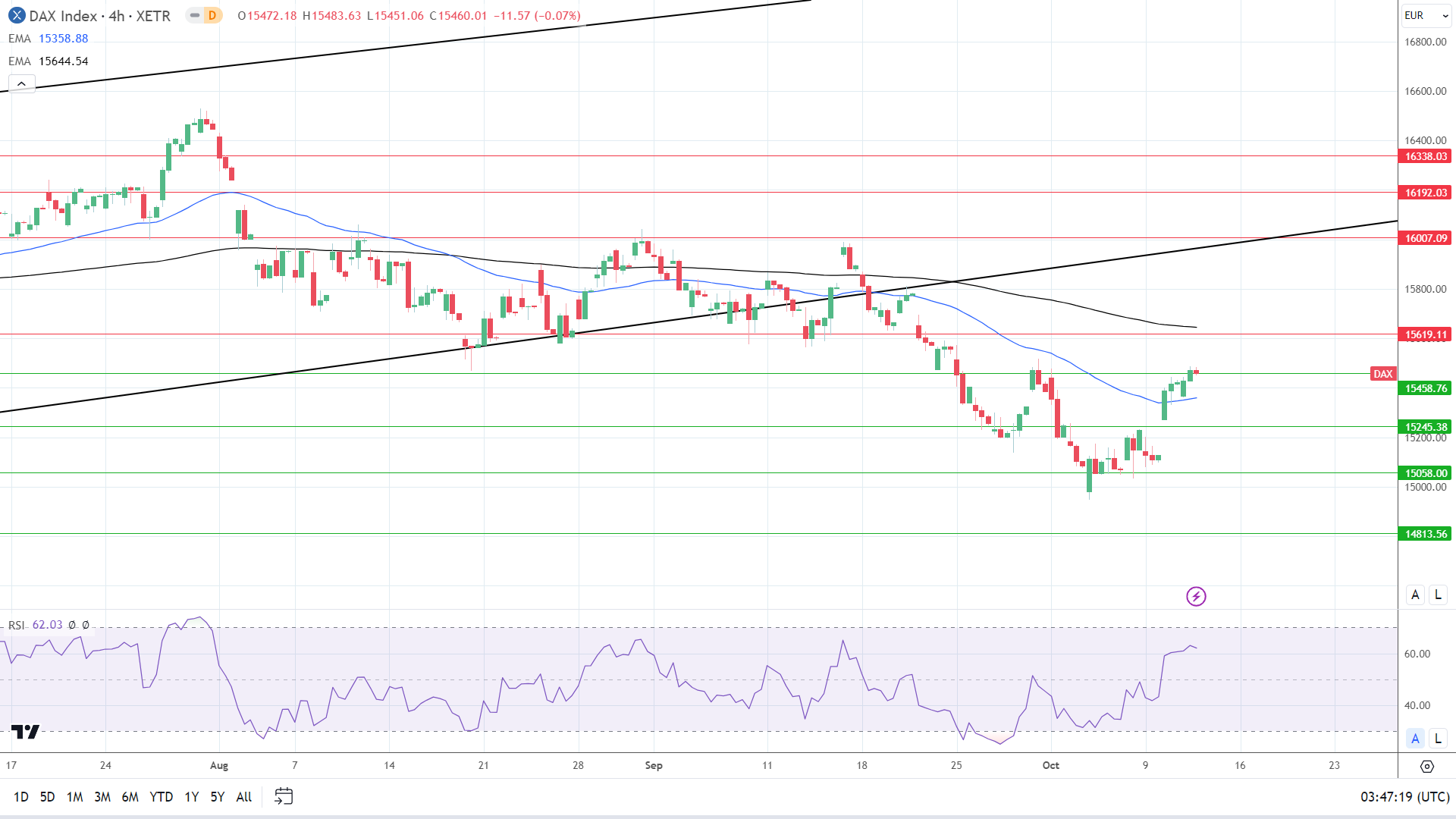
The DAX remains above the 50-day EMA while hovering below the 200-day EMA, sending bullish near-term but bearish longer-term price signals. A DAX return to 15,500 would give the bulls a run at the 15,619 resistance level and 200-day EMA.

However, a break below the 15,459 support level would bring the 50-day EMA into play.

The 62.03 14-4 hour RSI reading supports a DAX move to the 15,619 resistance level before entering the overbought territory.

4-Hourly Chart sends bullish near-term price signals.
DAX 121023 4-Hourly Chart